Father of Yeti

“Always steals women.”  So Subra mutters high in the Himalayas.  Perhaps one of the most unintentionally funny bad movies, The Snow Creature does hold a place in history.  It was the first abominable snowman, or yeti, movie made.  It’s also incredibly cheaply made with a costume that most twelve-year-olds could’ve fabricated better.  As the antepenultimate movie in the “Beast Collection,” I felt obligated to watch it one snowy weekend.  Spouting colonialist and sexist values like a Republican, the story is tedious even at eighty minutes.  But funny at times also.  So a botanist travels to the Himalayas to study plants at 10,000 feet.  His fun is interrupted when a yeti kidnaps the head sherpa’s wife, causing the sherpa to take charge and start to hunt the beast.

The American scientist decides to capture the yeti instead so that he’ll have something to give the foundation sponsoring the expedition.  Leaving behind a female and baby yeti, both killed, he drugs the snowman until a special refrigerated container can be built—gee whiz, Americans can do anything!—to bring the beast back.  And they fly west from Bombay to California, where, when they land the beast is held up in customs (I kid you not).  There’s a debate about whether he’s human or animal and while the debate goes on, the creature escapes.  The hapless police can’t find a seven-foot tall yeti wandering around Los Angeles at night, harassing the women.  Finally they figure he’s using the storm sewers.  They trap him but, alas, have to shoot him.  At this point they completely lose interest in the corpse and exchange meaningless banter as they drive off.

This movie seems to be what the Trump administration wants America to revert to.  Bossing around BIPOC people in their own countries, women being helpless without men to rescue them, and corporations buying what is arguably a human being.  Sounds like a playbook to me.  Also, it was extremely cheap.  What amazed me is that United Artists distributed it.  People must’ve been pretty hungry for entertainment back in 1954.  Having said that, it is worth watching for a laugh.  Now that streaming exists, you can find this free on various services.  If you like very wooden acting, and superior Americans having their way in Asia just because they’re, well, Americans, you might find this a passable way to spend a snowy weekend (wait til winter to watch it; it’ll keep).  Only a word of advice: be sure to lock up your women before you do, because the beast always steals women.


Mired

For someone who grew up with an Oscar Mayer jingle forever lodged his his brain, it took decades before I became curious about the surname.  I had always supposed it was a Germanic word for “mayor” but then, if so, mayors had to be very busy in the boudoir to make so many.  The reason I grew curious was that there are so many ways to spell it.  I’ve had people complain to me about having to spell their name every time, but I’ve run across “Meyer” spelled “Maier,” “Meyers,” “Mayer,” “Myers,” and many more.  Yes, I’m afraid you have to spell it.  (My wife’s surname is Stephenson and she has to spell it every single time.  For that matter, so do I.)  Why so many Mayers?  A little (very little) research turned up that it comes from old German for “manager”—thus possibly related to “mayor” and maybe even “major”—but that over time it came to mean “tenant,” basically a freeman farmer.  That’s why so many.

Photo by Erik 🖐 on Unsplash

Growing up in a small town, the very common surnames I encountered were “Smith,” “Jones,” and “Miller.”  My mother even married one of the Miller clan eventually.  “Smith” and its variants, derive from craftsmen of various sorts, such as “blacksmith.”  “Miller” is someone who works a mill.  The odd one out here is “Jones,” which derives from a prolific “John” somewhere way back when.  I’ve written before about how common (and widely variable) the name John is.  All these names share a “non-noble” background, it seems.  People of occupations that keep us going.  It made sense that “Meyer” was a name for farmers.

I grew up with a different, but not that uncommon (as the internet has taught me), surname.  Interestingly, all of my grandparental surnames were unusual, although one is compounded with “Schmidt,” or “Smith.”  I find names fascinating.  With so many of our species running around, unique forenames weren’t in large enough supply for us to stop there.  Which John are you?  John Johnson?  Okay, now I can place you.  I tend to struggle with transposed letters from time to time, making the variants of “Meyer” particularly difficult for me.  And that “y” acts like a vowel and sometimes becomes an “i.”  Or a “j” in German.  Cheeky.  We identify closely with our names.  They say something about us.  Thankfully we have other ways of distinguishing ourselves, otherwise we’d all just be lost in the crowd.  


Making More Monsters

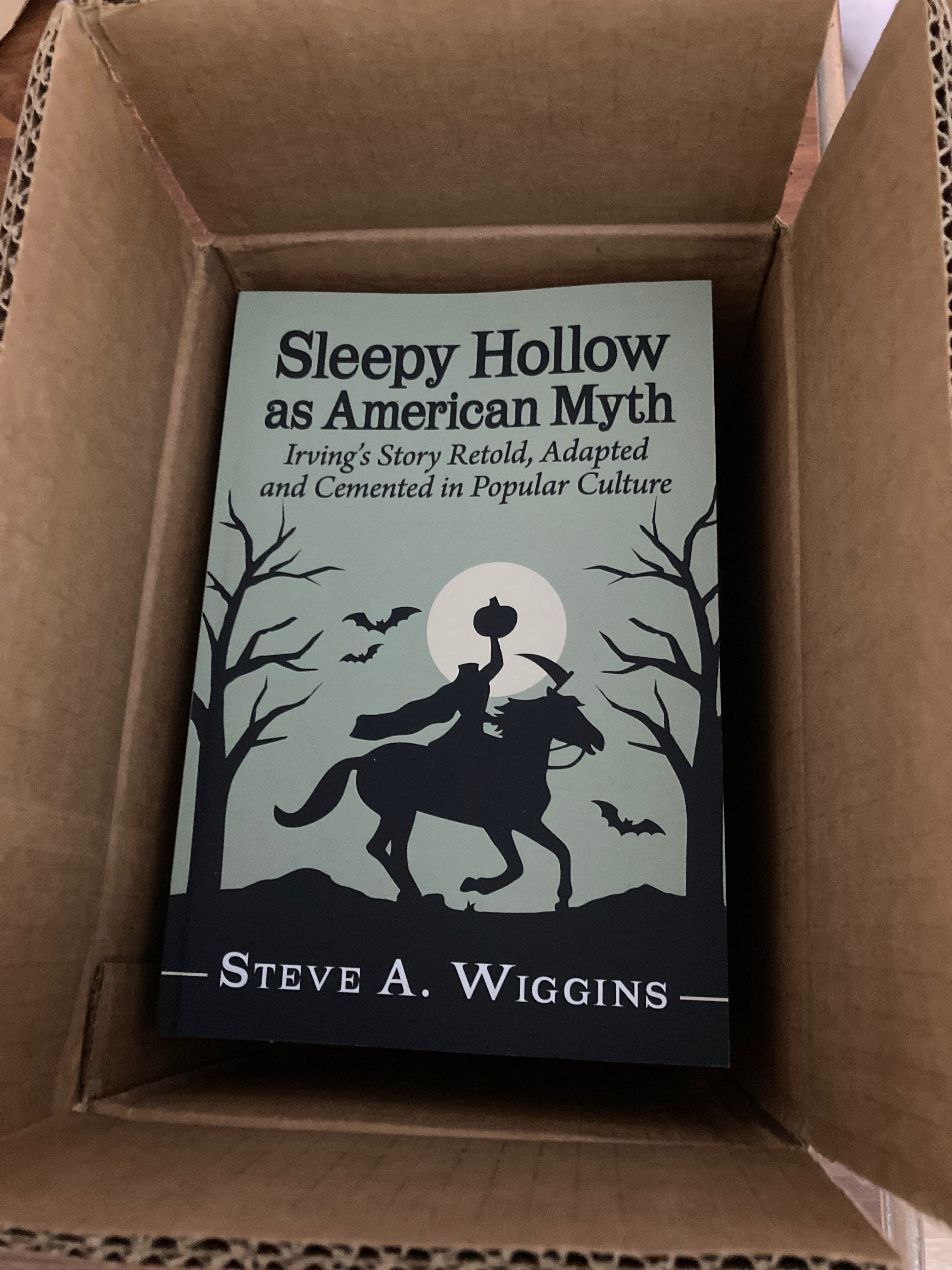
It’s endlessly frustrating, being a big picture thinker.  This runs in families, so there may be something genetic about it.  Those who say, “Let’s step back a minute and think about this” are considered drags on progress (from both left and right), but would, perhaps, help avoid disaster.  In my working life of nearly half-a-century I’ve never had an employer who appreciated this.  That’s because small-picture thinkers often control the wealth and therefore have greater influence.  They can do what they want, consequences be damned.  These thoughts came to me reading Martin Tropp’s Mary Shelley’s Monster: The Story of Frankenstein.  I picked this up at a book sale once upon a time and reading it, have discovered that he was doing what I’m trying with “The Legend of Sleepy Hollow” in my most recent book.  Tropp traces some of the history and characters, but then the afterlives of Frankenstein’s monster.  (He had a publisher with more influence, so his book will be more widely known.)

This book, although dated, has a great deal of insight into the story of Frankenstein and his creature.  But also, insight into Mary Shelley.  Her tale has an organic connection to its creator as well.  Tropp quite frequently points out the warning of those who have more confidence than real intelligence, and how they forge ahead even when they know failure can have catastrophic consequences for all.  I couldn’t help but to think how the current development of AI is the telling of a story we’ve all heard before.  And how those who insist on running for office to stoke their egos also play into this same sad tale.  Perhaps a bit too Freudian for some, Tropp nevertheless anticipates much of what I’ve read in other books about Frankenstein, written in more recent days.

Some scientists are now at last admitting that there are limits to human knowledge.  (That should’ve been obvious.)  Meanwhile those with the smaller picture in mind forge ahead with AI, not really caring about the very real dangers it poses to a world happily wedded to its screens.  Cozying up to politicians who think only of themselves, well, we need a big picture thinker like Mary Shelley to guide us.  I can’t help but think big picture thinking has something to do with neurodivergence.  Those who think this way recognize, often from childhood, that other people don’t think like they do.  And that, lest they end up like Frankenstein’s monster, hounded to death by angry mobs, it’s better simply to address the smaller picture.  Or at least pretend to.


Capture and Release

Waste not, want not.  I place some stock in old sayings.  With the way things are going, prices are sure to rise and so saving a penny or two may be wise.  So I turned back to my boxed set of “The Beast” for my horror fix.  As I’ve explained before, I bought this DVD set before streaming was a thing, and I was feeling nostalgic for Zontar: the Thing from Venus.  Being a fan of bad movies, it was worth every cent.  The set is actually (mostly) themed around Bigfoot.  I’ve talked about a few of these movies before, and trying to be frugal, I’ve determined to watch the whole set, no matter the cost.  Besides, there’s an aesthetic to bad movies.  The Capture of Bigfoot, no doubt, is a bad movie.  Knowing this before I slipped the disc in, I have no business acting outraged at the poor acting, directing, writing, or any cinematic sins.  Except one: a horror movie can’t be boring.  And Capture is b-o-r-i-n-g.  If you like movies about people slogging through knee-deep snow, this may be for  you.  

What really amazes me is the talent the compilers of such collections have at locating truly obscure bad films.  Now, I have a soft spot for 1970s horror.  Nostalgia carried me through, floating on those seventies’ vibes.  The clothing, especially.  And more particularly, the winter coats.  Although set and filmed in Wisconsin, the winter coats the kids wear in this movie are just like those everybody was wearing in Pennsylvania at the time.  And yes, I trudged through knee-deep snow my fair share of times.  That part just opened the flood gates of memory.  So, the story goes like this…

An evil businessman (I lost track of how many people he killed, or tried to), wants to capture Bigfoot (shown early, in winter white) to put the town on the map.  Paying stooges to go get the beast, he finally builds an elaborate trap that succeeds.  The local game warden, with his girlfriend/wife and her little brother, decide the creature isn’t evil.  Using Batman-style tying skills, bad guy’s henchmen assure that most of his enemies escape to trudge through the snow some more.  A mysterious Indian character tells the game warden that the creature must be set free, which it is.  The evil businessman dies in a fire inside his wicked mine where he’s keeping the beast.  In the end, two families—the warden and the Bigfoot—pay mutual respect.  I do wonder about the mentality of someone making a movie like this.  But then, some forty years later, here I am writing about it.  Win-win. 


Not Schrödinger’s

It’s quite a dilemma.  It’s Schrödinger’s cat without the box.  Well, it’s a dead cat in my yard.  It’s not my cat and I only know about it because the next-door neighbor saw it while out mowing.  (It’s on the thin strip between our houses and we seldom make our way over there.)  Death is always a problem.  I don’t want to bury it since it looks like it was a pet.  Said neighbor is the only one I know around here but I know some pets have tracers/implants to help owners know if something happens.  So I tried calling the local animal control companies.  They don’t deal with cats.  There is a county service, in the next town over, but we’re across the border in a county that doesn’t deal with cats or dogs.  The DOT won’t get involved unless they’re on the street.  The local municipality also handles them only on the street or sidewalk.

Now, I own a shovel and I’m not afraid of hard work.  I am a bit squeamish, though.  I’ve handled half-squirrels from some hawk with eyes bigger than its stomach.  I also have to take care of dead birds and squirrels that get into the garage.  This is a bit bigger than I’m used to.  I’m not even entirely sure if it’s a cat, really.  Once an opossum got into our compost bin and the fur looks like it could be an opossum.  It doesn’t smell bad, though, and possums don’t have the most pleasant bouquet even when they’re alive.  The flies seem to like it okay, however.  The space between our houses would be challenging for the turkey vultures I see around daily.  They must be mad with frustration circling up there.  If it’s somebody’s pet I’m sure they’d like to know, but it’s looking like I’ll be digging—but you’re supposed to call Angie first, right?  In case of buried cables?

Death is entirely natural.  Ironically, I live two blocks from a pet crematorium.  I wonder if they make house calls?  Then again, it wouldn’t be cheap.  We expose ourselves to loss when we bring pets into our families.  My own beloved childhood beagle was hit by a car.  Meanwhile, I know that we shall all meet on that beautiful shore, by and by, and when we do I hope someone recognizes their cat from this side of the vale of tears.  Or at least outside of Schrödinger’s box.

Image credit: Greudin, public domain, via Wikimedia Commons

Saint Francis

With the death of the most saint-like Pope in living memory, it feels a little like fate that I’d seen Conclave just three days before.  Francis was the only Pope I’ve seen, and am likely to see.  He cared for people more than dusty doctrines that still repress.  He laid hands on the sick and genuinely loved human beings.  Given the reactionary world of politics, I suspect his successor will be conservative, but I would be glad to be wrong.  All this seesawing on the way to progress makes me a bit seasick.  And Francis was a man who, from a humble background, understood the necessity of moving forward rather than pretending things always stay the same.  I already miss him.

It was on the rare occasion of being invited to a New York City church to offer a program that I saw him.  Since I’d be staying a couple nights in Manhattan, my wife joined me.  On the way to meet her after work on that Friday, I saw large crowds along 34th Street in Herald Square.  The buzz indicated that the Pope would be going this way on his way out of town.  The police refused to confirm that, but it seemed like a good bet.  I asked Kay, “Do you want to see the Pope?”  We found a place in the crowd (this was pre-pandemic, of course) where we had a good view of the street and eventually the motorcade rolled through, Pope Francis in his trademark Fiat, the window down, waving at the crowd.  And then he was gone.  

In New York City you see motorcades.  I’d seen President Obama’s go by once, on the way to the United Nations, I think it was.  But still, seeing the Pope was incredible.  Not shielded behind bulletproof glass, his care for the nameless crowds felt genuine.  I empathize with those raised in humble circumstances who manage just to survive, let alone become the head of the largest branch of Christianity.  I like to think he was a reluctant Cardinal, and a reluctant Pope.  Conclave is fiction, of course, but the idea of choosing someone who really doesn’t want the job is immensely appealing.  How different from world leaders we’re now burdened with!  Men (almost always) who see themselves as God’s gift to us, clawing at power.  At the same time, Francis, who was a divine gift, actually remembered what Jesus said and did.  The world is poorer for his death but richer for the lessons he taught by example.


Thinking of Home

The earth, and even life on it, will, I’m confident, outlive our petty desires for money and being the king of the hill.  Scientists are getting tantalizingly close to demonstrating something that many of us already know—life exists elsewhere.  Chemical signatures of life appear as close as Venus and as far as K2-18b.  I suspect our universe is full of life.  And life is more than just rationality.  We’re creatures driven to survive and that level of will appears to be universal.  As Ian Malcolm says, “Life will find a way,” or something similar.  Earth Day should be a celebration but under too many Republican presidents it has become a plea to please stop intentionally harming our planet.  I grew up in that distorted religion known as Fundamentalism.  I learned that the destruction of the world was necessary to force God’s hand with the second coming.  The planet was here to exploit and waste since he’ll be back any day now.

Unlike many of my cohort, I decided to learn more about that perspective.  The more I learned the more shocked I became.  A warped and twisted message had been passed along as Gospel truth, and that the care the creator bestowed upon creation was merely a smokescreen to hide Jesus’ return.  I still believe we are not capable of completely destroying the planet.  Life will continue with or without us.  Life is persistent and hopeful.  That doesn’t mean we shouldn’t take care of it.  Earth Day has become a rallying point for those who see the world sensibly.  We have so much wonderful life on this planet.  In our arrogance and in our tendency to take mythology literally, we have assumed the worst.  Why not take care of what we were given?  Jesus may not come back, but perhaps the Lorax will.

There are ways to live sustainably on this planet.  It does mean that some of the richest will need to surrender some of their wealth and power.  We need to learn the habits of requiring less and appreciating more what we have.  Like most people born into the world in this era, I struggle against the desire for new things.  Novelty is natural to such curious creatures as ourselves.  But there are other such curious creatures too.  They have a place here, even as those which seem to have no curiosity do.  It’s a planet big enough for all of us.  We just need to be sensible about it.  And remember the earth today and be thankful for our home every day.

Image credit: NASA/ISS Expedition 28, public domain from Wikimedia Commons

Space Rocks

The thing from another world.  No, not the movie, but an artifact.  My recent post about the asteroid sent me looking for something.  When we lived in Wisconsin, we purchased a small piece of a meteorite while on a visit to the Yerkes Observatory.  It is, quite literally, a thing from another world.  The problem is, I can’t find it.  Our house isn’t that big but the fragment is quite small.  I’ve been told our house is like a museum—there are curios pretty much everywhere, and they each have some significance.  But the meteorite: where could it be?  I find that moving is one of the most disruptive activities known to those of us in the “developed” world.  As much as I wanted an organized move, the fact is that you can’t have such a move without taking at least a month off work in advance.

There are things (from this world) that I haven’t found in the six-plus years in this house.  Most often they’re like the meteorite in that I don’t think of them often, and when I do I wonder where I might’ve packed them.  Knowing where they might’ve been packed gives a clue to where they might’ve been unpacked.  And no matter what, some things get lost on every move.  There’s a book I had in New Jersey that is simply not here in Pennsylvania.  I’m sure I packed all our books.  One, at least, did not make it over the Delaware.   The fragment of meteorite, which is unique, is only about the size of a small ladybug.  Where might I have put it?  

That small fragment of rock traveled through the solar system.  It likely came from distances no human has ever gone.  Unimaginable distances.  Only to get lost in a house in Pennsylvania.  If it’s here at all.  Back when it was legal to pick up petrified wood, a family friend gave us two chunks from the petrified forest (for now, a National Park in Arizona).  One of them came to me and I treasured it for years.  I haven’t seen it since we moved to Pennsylvania.  There are boxes that haven’t been fully unpacked.  The squirrels make a mess of the garage every winter and I can’t go in there without feeling I should clean things up first, before emptying out the remaining boxes.  To a squirrel the thing from another world is just one more thing to ignore.  It has no value except for to an aging guy who remembers buying it at the very spot where Edwin Hubble worked and Albert Einstein visited.  Only to mislay it when moving fifty miles from state to state.

Not my meteorite. Image credit: Meteoritekid under the GNU Free Documentation License, via Wikimedia Commons


O Levels

Out jogging last week, I was thinking about a harsh interview I once had.  It was in Manhattan.  The woman interviewing me made no attempt to hide her disdain.  I’m not sure if it was for me personally or what I represent.  She did not smile at all, not even for the usual niceties.  She asked me whether I was better at speaking or writing.  I said they were about equal.  “No,” she briskly corrected.  “Which is it, one or the other?”  This came to me while jogging because I was reflecting that public speaking and writing are really the only two things I’m any good at, and I have worked on both for my entire life.  These years later I still can’t say which is stronger.  That was appreciated by my students and fellow scholars in my teaching career, if reviews are anything to go by.  I like to communicate.  (My wife might say too much so.)

Owls are difficult to spot in the wild.  Just last week I’d seen only my second in some sixty years.  This was a screech owl.  It’s not unusual to hear them when jogging at dawn.  This time my right ear picked up on it more than my left as I jogged past a grove of trees.  I looked but saw nothing.  The trees were budding and some had small leaves already.  I reckon I’ve seen my fair share of bald eagles.  They’re large and they’re pretty obvious when they’re in the area.  Owls are more secretive.  Good at hiding.  I reached the end of the path and turned around.  As I reached the stand of trees, now on my left, it screeched again and I saw a blurred flapping of wings as it disappeared in flight.  I couldn’t identify this owl in a line-up, but then again, that’s not something I’m good at. The voice is distinctive, however.

The person hiring is a bald eagle.  Bold, aggressive, and sometimes literally bald.  I’m more like that screech owl.  Their public speaking is distinct and isn’t really a screech at all.  I can’t speak for their writing ability.  Life is our chance to come to know ourselves.  We may think we have it figured out in our twenties, but each score of years makes you question past assumptions.  Two things I always thought would be part of my career—public speaking and compelling writing—have both fallen by the wayside.  At least professionally.  What we say to others has an impact.  Especially if we’re eagles.  All things considered, however, I would rather be an owl.

Photo by James Toose on Unsplash

Mass Market

The mass market paperback.  This may very well be one of the best symbols of my younger years.  One of the largest distributors of mass market paperbacks (Readerlink) has announced that it will no longer distribute them.  It seems that the writing, instead of in readers’ hands, is on the wall.  Mass market paperbacks are the least expensive formats of books to buy.  Publishers have increasingly been tending to push trade size (about 6-by-9 inches)—they can charge more for them.  They don’t fit easily in your pocket, however, and well, they cost more.  Often, as someone who reads in public, I find myself wishing more literary fiction was still produced in mass market form.  Only the best selling authors ever make it down to that size.  I miss being able to stick a book in my pocket.  

The mass market paperback’s story began with railroad books, once innovated by my erstwhile employer, Routledge.  The form we recognize today only really took off in 1935.  When I was growing up, I considered all other formats somehow too big.  My book collection and reading habits began with mass market size.  When we moved to our house a few years back, I repurposed an old dresser as a bookshelf.  The top drawer slots were just tall enough for mass market books.  I discovered that I really didn’t have enough of them to fill that shelf.  Books have grown bigger.  Now, working in publishing I realize profit margins are thin in this industry.  Many publishers need the big sellers to help make up for disappointing sales of other titles.  (You have to have thick skin to be an author, I know from experience.)  They need to stay solvent.

But still, this feels like the end of an era.  Books in this format have been around really only less than a century.  Literacy—reading for pleasure—among the masses hasn’t been around much longer.  Books were expensive and were afforded by the elite, then cheaper forms and formats became available.  The electronic revolution has made much of life more convenient but some of us miss the challenge of having to fold a road map and never really knowing, for sure, where we are.  We’re also the ones who likely have a book in the car.  On the occasions when I don’t, I often regret it.  And one of the ways to encourage people to take books with them is to make them of a size that would sell thousands.  So many, in fact, that they would be given the title “mass market.”


Protected?

I like Macs.  Really, I do.  Ever since I realized that “Windows” was a cut-rate way to imitate Macintosh’s integral operating system, I’ve never been able to look back.  (I don’t have a tech background so I may be wrong in the details.)  Every time I use a work laptop—inevitably PCs—I realize just how unintuitive they are.  Something about Apple engineers is that they understand the way ordinary people think.  I sometimes use software, not designed for a Mac, where I swear the engineers have no basic comprehension of English words at all.  And nobody ever bothers to correct them.  In any case, I find Macs intuitive and I’ve been using them for going on 40 years now.  But the intuitive element isn’t as strong as it used to be.  As we’re all expected to become more tech savvy, some of the ease of use has eroded.

For example, when I have to create a password for a website—not quite daily, but a frequent activity—Mac helpfully offers to create a strong password that I will never have to remember.  Now before you point out to me that software exists that will keep all your passwords together, please be advised that I know about such things.  The initial data entry to get set up requires more time off than I typically get in a year, so that’ll need to wait for retirement.  But I was talking about intuitive programming.  Often, when I think I won’t be visiting a website often, I’ll opt for the strong password.  Maybe I’ve got something pressing that I’m trying to accomplish and I can’t think of my three-thousandth unique password.  I let Mac drive.  That’s fine and good until there’s an OS update.  This too happens not quite daily, but it does sometimes occur more than once a week.

After restarting I go back to a website and the autofill blinks at me innocently as if it doesn’t recognize my username.  It doesn’t remember the strong password, and I certainly don’t.  So I need to come up with yet another new one.  At work I’m told you should change all your passwords every few months.  To me that seems like a full-time job.  For grey matter as time-honored as mine, it’s not an easy task.  I’m not about to ditch Macs because of this, but why offer me a strong password that only lasts until the next system update?  Truth be told, I’m a little afraid to post this because if by some miraculous chance a software engineer reads it and decides to act, a new systems update will be required again tonight.


Four-leaf Clover

It was recently my late mother’s birthday.  I didn’t post about it on that that day since it might become a security question some day.  In any case, it was a somber day for me.  It’d been raining on and off for several days straight and I was wanting a picture of her for my bulletin board.  I remembered that I had inherited one of her photo albums.  This was the old kind with black paper onto which you had to lick and stick corners to hold the pictures.  Many of the photos had fallen out even back when she asked me to hold onto it, but there were some still there of her as a young woman.  As I was looking through them, something inside the front cover caught my attention—the crumbly brown remains of three four-leaf clovers that she’d glued there.

Since this isn’t likely to be a security question, I can say that her home life wasn’t ideal.  The page with the young photos of her were obviously from a day that she and my father were taking pictures of each other as young lovers.  They were outside a house on a summery-looking day.  Smiling and looking for a better future.  Four-leaf clovers.  My father was an alcoholic, and my mother knew that, but hoped that she might change him.  I don’t know the dates of the photos so I’m not sure if they yet knew they’d be parents.  One of the oddities of life is that about the time the questions occur to you, your parents might already be gone.  I wanted to ask about that happy day.  Those clover leaves.  The sunshine.

Rain and gray clouds persisted.  That particular day I had little human interaction, and I felt her presence with me.  I’m not a minister, as she always hoped I would be.  I could never find a job closer to home, as she wished time and again.  I didn’t even get to see her before she died.  Instead I had a photo album on my lap and rain falling.  And work for the day looming.  Her birthday is an engrained date in my mind.  Those last years we tried to find appropriate gifts for a woman who always said, “I don’t need anything.”  A few of those gifts are scattered around our house now.  One that gives me hope is a vase with flowers made from colorful paper that we purchased at a craft show for her.  I look at it and think of crumbled four-leaf clovers.


Remembering Consciousness

I recently inadvertently read—it happens!—about anesthesia.  I’ve been relatively healthy for most of my adult life and have experienced anesthesia only for dental surgery and colonoscopies.  I’ve actually written about the experience here before: the experience of anesthesia is not like sleep.  You awake like you’ve just been born.  You weren’t, and then suddenly you are.  This always puzzled me because consciousness is something nobody fully understands and there is a wide opinion-spread on what happens to it when your body dies.  (I have opinions, backed by evidence, about this, but that’s for another time.)  What I read about anesthesia made a lot of sense of this conundrum, but it doesn’t answer the question of what consciousness is.  What I learned is this: anesthesiologists often include amnestics (chemicals that make you forget) in their cocktail.  That is, you may be awake, or partially so, during the procedure, but when you become conscious again you can’t remember it.

Now, that may bother some people, but for me it raises very interesting issues.  One is that I had no idea amnestics existed.  (It certainly sheds new light on those who claim alien abduction but who only remember under hypnosis.)  Who knew that even we have the ability to make people forget, chemically?  That, dear reader, is a very scary thought.  Tip your anesthesiologist well!  For me, I don’t mind so much if I can’t remember it, but it does help answer that question of why emerging from anesthesia is not the same as waking up.  Quite unrelated to this reading, I once watched a YouTube video of some prominent YouTubers (yes, that is a full-time job now) undergoing colonoscopies together.  They filmed each other talking during the procedure, often to hilarious results.  The point being, they were not fully asleep.  The blankness I experience after my own colonoscopies is born of being made to forget.

I think I have a pretty good memory.  Like most guys my age, I do forget things more easily—especially when work throws a thousand things at you simultaneously and you’re expected to catch and remember all of them.  Forgetting things really bothers me.  If you haven’t watched Christopher Nolan’s early film Memento, you should.  I think I remember including it in Holy Horror.  In any case, I don’t mind if anesthesiologists determine that it’s better to forget what might’ve happened when the last thing I remember is having been in an extremely compromised position in front of total strangers of both genders.  My accidental reading has solved one mystery for me, but it leaves open that persistent question of what consciousness really is.


Fabric of Time

I’m not a sewer.  I mean, a person who sews.  I know people who are, though, who are quite distressed that JoAnn Fabrics is going out of business.  In an effort to console such folk, I indulged in an online search for fabric shops that led to a couple of conclusions.  One is that the internet is lousy at clean-up, and the second is that big box stores have ruined the ability to find things, funneling all purchasing to Amazon.  Let’s take these one at a time. 

If you’ve ever searched for a physical store (fabric or otherwise) online, you know that sites like Yelp are full of artifacts.  Stores that closed a long time ago and have never been removed.  In fact, when I commuted to New York City I sometimes walked several blocks on my lunchtime, looking for a store only to learn that it had closed five or ten years ago.  It still beamed happily on the web, though.  I have driven to bookstores that no longer exist, based on their location being proclaimed loudly online.  Regarding fabric, I located directories for Enright’s Fabric Warehouse, in nearby Bethlehem.  Nothing online indicated that they were long out of business.  I street-leveled the address on Google Maps and found a building I’d driven past many times; I’d actually driven by it the day before.  It obviously was a large factory-like building, but it hadn’t been a fabric store in the seven years I’ve lived in the Lehigh Valley.  This isn’t the only time I’ve searched specifically for a company/store with the query word “bankrupt” or “out of business” to find Hal-9000 saying, “I can’t let you do that, Steve.”

The second point.  Big box stories come to town, drive smaller stores out of business, then fold themselves, leaving us all poorer for it.  As big boxes go, I liked JoAnn’s.  Probably because they were failing, they had lots of things besides fabrics that I could look at on family outings.  But the fact is smaller fabric stores (which still appear online as existing) went out of business when JoAnn came to town.  There were two JoAnn stores in the Lehigh Valley.  Smaller places closed, and now we’ll be running around naked before we can find a fabric store willing to sell.  I’ve seen this happen with other industries as well.  There was a fine office supply store in Oconomowoc, Wisconsin when I was at Nashotah House.  Staples came to town and closed them down.  If you’ve been in a Staples lately, you know the writing’s on the wall.  I know we’re stuck with big boxes.  More often we turn to Amazon where a few keystrokes will get you what you need.  Check and mate.


Think

Those of us who write books have been victims of theft.  One of the culprits is Meta, owner of Facebook.  The Atlantic recently released a tool that allows authors to check if LibGen, a pirated book site used by Meta and others, has their work in its system.  Considering that I have yet to earn enough on my writing to pay even one month’s rent/mortgage, you get a little touchy about being stolen from by corporate giants.  Three of my books (A Reassessment of Asherah, Weathering the Psalms, and Nightmares with the Bible) are in LibGen’s collection.  To put it plainly, they have been stolen.  Now the first thing I noticed was that my McFarland books weren’t listed (Holy Horror and Sleepy Hollow as American Myth, of course, the latter is not yet published).  I also know that McFarland, unlike many other publishers, proactively lets authors know when they are discussing AI use of their content, and informing us that if deals are made we will be compensated.

I dislike nearly everything about AI, but especially its hubris.  Machines can’t think like biological organisms can and biological organisms that they can teach machines to “think” have another think coming.  Is it mere coincidence that this kind of thing happens at the same time reading the classics, with their pointed lessons about hubris, has declined?  I think not.  The humanities education teaches you something you can’t get at your local tech training school—how to think.  And I mean actually think.  Not parrot what you see on the news or social media, but to use your brain to do the hard work of thinking.  Programmers program, they don’t teach thinking.

Meanwhile, programmers have made theft easy but difficult to prosecute.  Companies like Meta feel entitled to use stolen goods so their programmers can make you think your machine can think.  Think about it!  Have we really become this stupid as a society that we can’t see how all of this is simply the rich using their influence to steal from the poor?  LibGen, and similar sites, flaunt copyright laws because they can.  In general, I think knowledge should be freely shared—there’s never been a paywall for this blog, for instance.  But I also know that when I sit down to write a book, and spend years doing so, I hope to be paid something for doing so.  And I don’t appreciate social media companies that have enough money to buy the moon stealing from me.  There’s a reason my social media use is minimal.  I’d rather think.