Galilean Blues

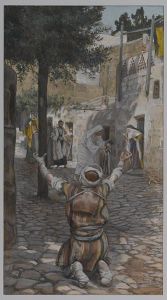
Call me nostalgic, but growing up Fundie, “Capernaum” tripped easily off my lips.  In fact, it was a word I heard very frequently at church, always pronounced “kap-er-NEE-um” (please pardon my amateur phonetics).  Even though no one I knew had ever been to Israel, we all knew it was in Galilee and that it figured large in the early life of Jesus of Nazareth (although we assumed he was surnamed “Christ”).  When I attended seminary I was surprised to hear the geonym pronounced “ka-per-NUM.”  It sounded so sophisticated—aristocratic, even.  Still, everyone at Boston University School of Theology knew what, and roughly where, it was.  It was a household name, no matter how you pronounced it.

Spellcheck disagrees.  It doesn’t recognize one of the most famous places in the New Testament.  Now, I’m aware that my view of things is idiosyncratic.  This blog should be proof of that.  Those who grow up from Fundamentalism often know this experience—something that everyone knew when you were young and informed is arcane knowledge to the rest of the world where Kardashians and Sedarises are household names.  The Bible, irrelevant at best, is a foreign country.  Then the religious right comes to power and everyone’s confused.  They don’t speak the same language as the rest of the world.  They say kap-er-NEE-um.  Others scratch their heads and glance at their knee caps.

When I visited ancient Capernaum it required some imagination to reconstruct what it had been, back in the day.  Since the ruins were relatively recent—only a millennium or two—some of the buildings were still above ground, including the famous synagogue.  Even among the unchurched archaeologists, everyone knew the connection of the city to Jesus of Nazareth.  That doesn’t mean, however, that the programmers responsible for spellcheck recognize the name.  Kardashian doesn’t get a red underline on my word processor.  Even in the first century, however, Galilee was a backwater (with real water!).  Important people came from big cities and had family connections.

Some things don’t change much over the millennia.  The famous often find their spotlight because of connections.  If the deity decided to incarnate today, s/he’d know to get a website put together first.  And it would help to have some product endorsements.  Even salvation at a click isn’t enough to draw most people in.  Of course, the matter of name—excuse me, “brand”—is important.  More than anything, you want something people can pronounce.  And just to be safe, anchor it to either New York or the city named The Angels.


Stand-in Line

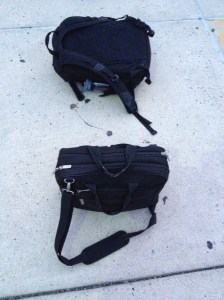
Pop culture borrows from religion without knowing it.  Or maybe it’s just that religion has become so irrelevant that people no longer care.  Whichever may be the case, those who contribute to pop culture have a rich treasury from which to take withdrawals.  This occurred to me while waiting for a bus into New York.  Many people don’t want to stand in line (who does, really?).  In the Park-n-Ride subculture, you may leave an avatar in your place.  It’s probably not called an avatar, but since there’s nobody here to ask, I’m going to use the pop culture name.  You put your bag on the pavement, marking your place and then go sit in your car.  Since I’m going to be sitting in a big car for the next two hours, I prefer to stand outside.

The idea of an avatar is mediated to most people through either computer language or the movie.  I first encountered the term in the former sense in Neal Stephenson’s Snow Crash.  I was an internet neophyte and had trouble conceiving a virtual world in those days.  Some time later came the latter.  James Cameron’s film embodied the idea—linked through software, the tired hardware of physical bodies could be given new life.  In some senses it was an even better life.  Now everyone knows what an avatar is.  Perhaps except that the idea is native to Hinduism.

Hinduism was never an organized, intentional religion such as Christianity.  It is rather a wide array of traditional beliefs that, in the light of missionary activity, had to be given a name.  There are many gods in Hinduism, and when a deity descends to earth s/he appears in a form recognizable to humans—an avatar.  Not being an Indologist, my understanding of the concept is very basic, but it’s enough to know that this religious idea found a role in pop culture first through computer representations of human beings.  We had flattered ourselves with being gods, since we had created a virtual world.  A world we couldn’t physically enter.  Avatars were, therefore, how we wanted others to experience us.  Snow Crash is peopled with all kinds of representations.  The internet today, nearly 30 years on, has many more.  After all, there are many gods.

I glance at my watch.  The bus should be here any minute now.  When it enters the lot I’ll see the deities behind these canvas and leather avatars.  They’ll be less impressive than I’ve imagined them, I’m sure.  And although we’ve created virtual reality, I still have to get on a physical bus to go to virtual work.


Book Naked

Alogotransiphobia doesn’t just strike me when I’m on the bus.  Whenever I travel anywhere I try to take a book along.  To the DMV.  To movie theaters.  To take the paper to the shredding truck.  Anywhere there might be a line.  There comes a time when you realize every second is a gift, and time runs swiftly through the glass.  Life’s too short not to read.  So it is that I find myself in a hotel for a night.  Feeling somewhat like taking a risk, I’ve only brought three books.  Will I read them all tonight?  Most likely not.  But just in case…

Alogotransiphobia is real.  In my long-distance commuting days—in a past still very recent—I tried to calculate carefully.  Would I finish this book in the three hours I knew I’d have on New Jersey Transit?  If even a chance seemed to exist that I would, I would add another book to my bag.  But then that occasional Monday morning would arrive when somehow Sunday night seemed to slip away unbidden, leaving me bleary eyed and foggy brained to face pre-dawn alone on a deserted street corner.  And I neglected to calculate the chances.  Once in a great while, on such a day I would finish a book only to face a very long ride home without another.  Alogotransiphobia would kick in.  I would squirm in my seat as well as in my mind, anxious to get off that bus, as if I needed to shower to wash the feeling of wasted time off me.  A commute without a book was remaindered, unrecoverable time.  Lost time.  Squandered.

For two months now I’ve been delivered from the daily commuting life.  Now I find the opposite phobia.  That which entails staying at home and having so much to do that time to read is stolen back by that cosmic trickster we call fate.  I try to carve out time for reading, but the funny thing about work is that when you do it from home you feel you have to prove yourself.  I suspect employers know that.  A certain type of worker—perhaps one who’s lost a job or two in recent years—will always reach for supererogation.  And such a one will even sacrifice literacy on the altar of an assured paycheck.  Until recent days I was like a hermit on the bus.  Those around me may have been going in the same direction but we were in completely separate places.  I was, during the commute, lost in a book.  Alogotransiphobia was in the seat right beside me.


A Star in the East

The times they are a, well, you know—nobody wants to violate copyright.  In any case, nothing stays the same for long.  New York, for example, is a city in a constant state of transformation.  Fully grown buildings now stand where there were literally holes in the ground when I began working there.  One building near Times Square recently had a facelift that revealed the steel girders beneath.  On the I-beam were the words “Bethlehem Steel.”  And it’s not just New York.  Our cultural transformation has been taking place over the last few centuries as populations have moved to urban areas, abandoning farming to the few who remember how.  Being from western Pennsylvania, I pretty much thought the eastern part of the state was Philadelphia.  I’d heard of other urban regions, of course, such as Scranton and Allentown, but they were well outside my experience.  We didn’t get out much.

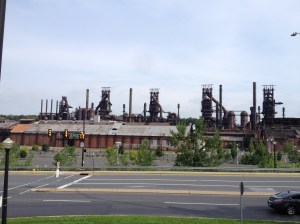
Now that I’m here in the eastern part of the state, I’m begun to explore the ever-changing micropolitan area of Allentown-Bethlehem-Easton.  The three cities blend at the edges, and this region is the third largest population zone in the state, after Philly and Pittsburgh.  It’s also the fastest growing region in the commonwealth.  I suppose we might’ve helped with that statistic.  The other day I had to run an errand in Bethlehem.  I pulled over to marvel at the hulk of what had once been Bethlehem Steel.  Now, I grew up in a town with an active steel mill, and Pittsburgh grew to fame for the same metal, but this was a behemoth of a plant.  Subdivided and open to development, it now houses a casino, in part, and an arts center.  And still there’s more space.

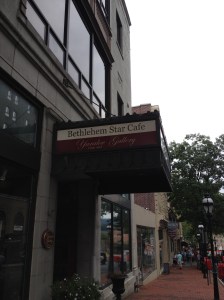
Bethlehem was founded on Christmas Eve by the Moravians.  Perhaps appropriate for a town trying to resurrect itself, Bethlehem calls itself the Christmas City.  Star imagery abounds, and many businesses name themselves with this Christian symbol.  The image is quite different from that of a steel city with hard-working men on the shift.  The grime and din of industry.  Bethlehem, like many places in the state, was named for its biblical forebear.  On my visit to the original Bethlehem many years ago I was, like many tourists, disappointed that it isn’t “O little town of” anymore.  There were people everywhere and it was difficult to imagine a quiet stable inside a noisy stone church thronging with the faithful.  Clearly things don’t remain unchanged for long, even in towns famous for their remoteness.  Although far from New York, they share a common heritage of people everywhere, and that heritage could bring us peace if only we would allow it.  The answer, it seems, is blowin’ in the, well, you know.


Away and a Stranger

“And Joseph also went up from Galilee, out of the city of Nazareth, into Judaea, unto the city of David, which is called Bethlehem.”  Strangely enough, the great physician (although we know nothing of his medical practice) Luke was writing about a place an ocean and a sea away from here.  The place names of eastern Pennsylvania demonstrate the religious awareness of the early colonial Europeans who brought their Bibles and diseases to this nation.  Bethlehem, Pennsylvania was known more for being a house of steel than being a house of bread.  It’s just down the road from the little town of Nazareth, made famous by The Band’s classic hit, “The Weight.”  The road to Emmaus is nearby.  And the major medical facility is, you guessed it, St. Luke’s.

The Band had an influence somewhat surprising for those who may have trouble recalling their nondescript name.  “The Weight” is a story of a traveler coming to, of all places, Nazareth, Pennsylvania.  So taken by the song was a Scottish band that they adopted the name Nazareth before informing us that “Love Hurts.”  This is something the evangelist and purported doctor Luke presumably knew.  If you go down from Nazareth even unto Bethlehem, you’ll find the steel city recast as the Christmas city.  For those of us who grew up in the western part of the state, Pittsburgh was the real steel city anyway.  When I was growing up, Pittsburgh was the 16th largest city in the country.  It now sits at 65th, because, like Bethlehem it had trouble drawing people without the natural hardness that is Pennsylvania.  There’s a parable in a city transforming from a heavy metal to a holiday.  There’s no Pittsburgh in the Bible.

When Luke begins his Christmas narrative (think of this as one of those “Christmas in July,” or August things), quoted above, he ironically leaves Mary until the next verse.  Joseph, whom later tradition will say had nothing to do with the conception anyway, still gets first billing.  One wonders what might’ve been different had Mary led the way.  It was much later, after the gruesome crucifixion account, that Emmaus came into the picture.  Two unnamed disciples were walking along that road and didn’t recognize who Jesus was.  Had they kept walking, I wonder if they might’ve ended up in Pittsburgh, for the biblical names soon give way to places like Kutztown and Fleetwood, the latter of which, I have to admit, I never got into.  Had Mary taken a load off in Nazareth, this story would’ve been completely different.  Thus saith The Band.


The Distortion of Absence

I’m sure it’s happened to you, too.  After some time away, you return to somewhere familiar.  For some reason this doesn’t seem to apply to places you spend only a little time—for example, the cabin where I tend to go on vacation every year.  Rather, it impacts quotidian spaces, the places you see nearly every day.  Returning after an absence, the place looks strange, as if you’d forgotten what it was really like.  A fairly common example is a college dorm room.  When you return to it after, say, the winter holiday, it looks not quite how you remembered it.  It’s a little smaller or larger than you recalled, or you didn’t remember that the floor tiles were that color.  Within a day or so the feeling disappears and you accept the “new normal.”

The strange, or unfamiliar, is the source of many monsters.  Freud famously phrased the uncanny as “unheimlich,” un-home-like.  It is close to what you expected, but not exactly.  The uncanny valley is that place where things are about right, but slightly off.  It generates a creepy feeling, as if reality is being distorted.  On a business trip to Boston a few years back I visited Boston University School of Theology, a place where I spent over two years in my twenties.  745 Commonwealth Avenue hadn’t been renovated, but I stepped inside and was stunned by how wide the hall was.  In my mind it had become far narrower.  It was downright disturbing, as if I’d walked into somebody else’s past.  It made me wonder—is any of this really real?  Or more frighteningly—is my memory that fragile?

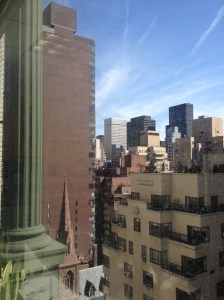
I recently spent a day working in the New York office.  While the office itself seemed the same, the city did not.  Emerging from the Port Authority Bus Terminal I knew exactly where I was.  Or did I?  I’d walked roughly the same route daily for almost five years, and two years before that a similar track.  It was as if the bus had exited the Lincoln Tunnel into an alternate Manhattan.  Unheimlich.  I’ve returned to many places after being away for awhile and this distortion of absence always creeps me out.  Can my memory be that faulty or is all of this an illusion?  The gap between present reality and remembered reality provides crevices into which monsters crawl, waiting.  By the time I reached the block of my office the feeling had gone away.  But somehow, the monsters remained. 


Childhood’s End?

Writers are agents against chaos.  Those of you who read this blog frequently know that chaos has been one of my themes lately.  Moving, which is a process that takes months and months of time, is pure chaos.  Whenever I settle down to write, yet another moving-related task comes to me—this box needs to be unpacked, that gap in the fence must be mended, where did I put the toolbox?  Mundane things.  Writers like to think the world conforms, somehow, to their inner lives.  In reality, things are far more complex than that and don’t seem to be getting any easier.  Starting to learn about house ownership is something best left for the young, I suspect.  Every question (where should we put the television?) leads to a daisy-chain of other issues (but first we need to move that hutch, but it’s too heavy for either of us to lift, etc.).

In ancient times water symbolized chaos.  Before we left on vacation, the main issue was to get all boxes off the floor in the garage.  We haven’t had time to move them safely inside yet, what with planning for vacation and all, so plastic became the order of the day.  We do need, however, to get things inside eventually.  A slow process for two middle-aged people with full-time jobs, even without jet lag.  Writing feels like a luxury item, for what is most required is time—time to move things to their proper places.  Time to figure out what those proper places are.  Time to go to work again.

Had we thought this through, we might’ve used vacation this year to unpack.  We bought our plane tickets, however, before we bought the house.  This latter transaction is one of chaos embodied.  Who knew, for example, that the grass had to be cut so often?  That all roofs leak?  That chaos is constant, and not intermittent?  In biblical times, one of the signs of God’s greatness was the ability of the Almighty to hold chaos in constant check.  The waters were always lurking, looking for any opening—except when you need rain and it just won’t come.  Sitting here writing feels like the giddy irresponsibility of childhood where there’s so much to get done and so little time in which to do it.  And neighbors don’t appreciate the lawn being mowed before the sun is properly out of bed.  The renter pays a price for living with, for at least some stretches of time, chaos-free maintenance.  The home-owner quickly learns that any time left over for writing feels like being irresponsible, and a little bit divine.


Final Leg

Travel is a form of education.  You won’t get college credit for it (unless some administrative footwork is involved), but it is a means of learning.  One of the things you pick up flying coast-to-coast is how exhausting a day on a jet can be.  Quite apart from jet lag itself, the weariness of occupying your minuscule allotted space in a pressurized cabin can be intense.  And like ocean travel by ship, you have to dock at a distance to use smaller and smaller forms of transportation to reach your destination until at last you walk inside.  This was the first year that such a trip ended by returning to a house rather than somebody else’s rental unit.  It’s an odd feeling.

Work starts again tomorrow, and since I’ve been pretty much unplugged for an entire week, I know chaos awaits.  I also have the task of learning what has happened in this off-kilter world for the last week.  And then I have to make an inventory of the books that were ruined in our own personal Noah event just days before our flight.  The changing of scenes feels rather like a jump-cut in a movie.  Suddenly you find yourself somewhere different, with circumstances that have their own set of parameters.  Vacation time, in a sense, is like a dream sequence.  None of the episodes from back home can reach your sleep-addled mind.  And then you wake up.  Bills are due.  The lawn wants cutting.  The unpacking must continue.

For all that, it feels as if something transcendent happened.  Like Elijah being whisked away in his own personal whirlwind, I was on a plane that took me to a different plane of existence.  A place where no matter what decisions were made the outcome would be pleasant.  Coming home involves what theologians like to call “metanoia,” a sense of transformation—memories that give you strength to carry on the quotidian tasks that make up the vast bulk of our lives.  Lakes in the mountains are all fine and good, but society demands its pound of flesh, and the way they get it is through productive employment.  Tomorrow it’s back to work, a chance to test just how successful the metanoia might’ve been.  This is the reason we traveled on a Saturday, for the sabbath should be a day of rest.  No one knows where that whirlwind set Elijah down, but it’s virtually certain that he had plenty to do once he got there.


Hidden Origins

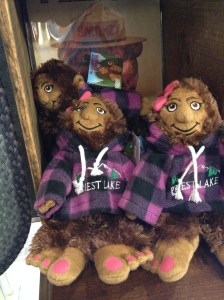
This blog was born at the very lake I’m about to leave.  Although it’s relaxing, there’s an element of chaos to a family vacation that stirs up creativity.  Tomorrow’s long day of travel back east, however, will mean another day without a post.  Flights leave so early that you barely have time to slither out of bed to the shuttle, and the airport hotspots want your money to connect.  I’d rather maintain radio silence for a day.  That doesn’t mean I won’t keep my eyes open for religion hidden in the interstices of American life.  Since religion and mythology share sleeping quarters, I’m reminded of something I saw up here in the northwest the other day.  While in a local grocery and souvenir shop (for all groceries in this area carry souvenirs) I saw sasquatch dolls.

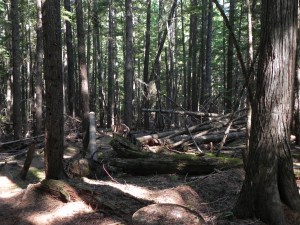
Such cryptids are unknown to science, of course.  Even if they really exist, their liminal status now places them firmly in the realms of mythology.  Being in the wilderness can be an uncanny experience.  Long accustomed to dwelling in cities and towns, we feel vulnerable out in the open.  Taking walks in the woods might just put you in the path of black bears, grizzlies, or mountain lions.  Who knows what else might be hiding in these woods?  It’s easy to believe in our myths here.  Vacation, in addition to being the ultimate reality, counts as time borrowed against work and its punishing rationality.  Religion thrives in the quiet moments when you’re not sure what might be hiding just out of view.

Did ancient people devise belief in such circumstances as this?  (Well, without the wifi and indoor plumbing, of course.)  It’s not hard to feel the spirit of the lake.  Standing chest-deep in the water, being rolled by the waves, there’s a kind of secular baptism taking place.  In the quiet unearthly voices can be heard.  No television or newspaper tells you that it can’t be happening.  Listening is much easier with no distractions.  These woods are vast.  Human access to them is limited to marked and maintained trails.  Beyond these borders, who knows?  Science comforts us with the assurance that there are no monsters out there.  Standing isolated from any other human beings, surrounded by ancient trees, you might begin to wonder if such assurance is as certain as it sounds.  The sasquatches are children’s toys, and the sense of the numinous you feel can, like all extraordinary things, be explained away.


Lions, Bears, and Caribou

The place I’ve been spending this week is the habitat of grizzly bears, caribou, and mountain lions, none of which I’ve ever seen here.  Two of these species view us as potential, if troublesome, prey.  In actuality, even here in the wilderness we’ve made the human presence felt and wildlife sightings are somewhat rare.  I saw more deer in New Jersey than I’ve ever seen here.  Kind of makes you wonder about the human reputation among other creatures.  We like to look at them in zoos, but we don’t see them in their natural surroundings.  I like to think that it’s because they have so much space out here to wander—we see plenty of evidence of moose, for example, without an antler or dewlap making an appearance.

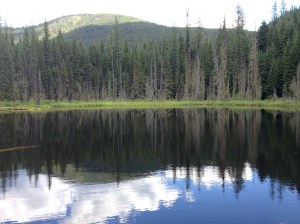
The environment, as created in our won image, has become somewhat sterile.  Kind of the angry, old white man’s view of government.  One color is all you need.  Variety is too challenging, and threatening.  We’ve driven the wolves to extinction around here, so you won’t see any of those.  Won’t hear their plaintive howls on a moonlit night.  You’ll see motorboats aplenty, and cars with fancy technology, and airplanes buzzing overhead.  This will have to do for wilderness, since other places are fast developing into surveillance states to protect the rich men’s money.  Wilderness means nothing to such people, unless it can be exploited for personal gain.  The thing is, once it’s gone for them, it’s gone for us all.  I found a sardine tin shining like silver in the silt on the bottom of our lake.  Our fingerprints are everywhere.

The problem isn’t new.  Even some monks in late antiquity found that when they headed into the desert for heroic feats of spirituality, they were followed by the curious.  Crowds would sometimes gather to watch them being holy.  Would that break a saint’s concentration?  Do I even need to ask?  The forest service asks us to stay on the trails.  The trails are well trod.  Out of sight, but never far from mind are the bears and cougars.  We’ve driven them out of our path and then congratulate ourselves on becoming the top predators.  Once the beasts are gone we turn our instincts on our fellow humans.  To flush them out into the open we must tame their wildness. And when it’s all gone the only rule will be, in this distorted vision, that of rich white men.  An angry grizzly bear would be far more congenial.


Hearing Nature’s Voice

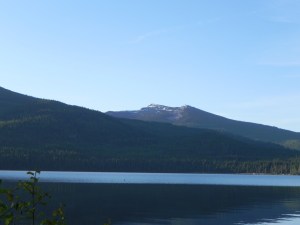
Silence is a rare treat.  I enjoy music and witty repartee just as much as the next guy, but silence is revelatory.  At home and in hotels I sleep to the sound of a white noise generator.  You can’t predict the sounds of neighbors, and my hours are askew from those of the rest of the world.  Here at the lake, things are different.  I awake early, hoping to catch the sun as it trips over the mountain tops across the way, lighting successive peaks before it reaches the near horizon.  It is utterly still.  Perhaps it’s the interference of humans in the habitat, but crepuscular animals seldom wander past.  The stillness is divine.  For some the lake means loud jet skis and buzzing motorboats.  I come here seeking silence.

Our daily lives lack peace.  Even when things are good there are always more things to be done.  We cram as much as possible into days impossibly short, giving at least eight out of every twenty-four to those who deign to pay us for our efforts.  Sleep is troubled and interrupted.  There are noises in the night.  You can’t hear your soul.  As the first rays seep into the valleys across the lake the birds begin to greet it.  Their conversation may interrupt the silence, but it doesn’t break it.  Silence is finding one’s place in nature.  Taking time to be still.  To listen.

Thirty years ago I first came to the lake.  My wife had been coming here for years already before that.  There have been many changes even in my short time here.  I can, however, hear eternity in the silence, for forever is a whisper, not a shout.  As I watch the morning mist arise, skate, and dance over the surface of the water as still as the very mountains that cradle it, I strain my ears to catch any sound.  The twirling wraiths are as silent as they are ephemeral.  They spin away the last minutes before the whine of an early morning fisherman’s boat begins its sleepy journey to the deep water in the middle of the lake, herald of other daylight noises to come.  I will await tomorrow’s unction of silence, and although the baptism may be secular it’s redemptive after all.  Nature knows far more about the human soul than any measurements might reveal.  You only have to listen to hear it.


Traveling Unplugged

Those who pay close attention, or who have nothing better to do in July, may have noticed that I missed a day posting on this blog on Saturday.  That hasn’t happened for a few years now.  I think maybe I ‘m growing up.  Or learning to resist.  Saturday was a travel day—the first I had to make from Pennsylvania, back to Newark in order to fly to Washington state and drive a few hours to the lake.  All in all, it turned out to be a long day in which I didn’t even notice that I was unplugged.  I had a book that I read along the way.  Although it’s against my religion—(call it Moby)—(but I jest)—I even fell into a cat nap or two on the plane.  I didn’t have a window seat and strangers don’t like you staring in their direction for five hours at a time.

Upon awaking, eyes refusing at first to work in tandem, in the chill mountain air, I realized I’d spent the entire day off the internet.  We had to pull out at 2:30 a.m. to meet TSA requirements, and you have to pay for the privilege of connecting to the web in airports and on board jets.  I’ve become so accustomed to being wired that I feel I have to explain why I wasn’t able to post a few thoughts when circumstances were so adverse to getting tangled in the world-wide web.  Yes, it still has a few gaps where one might buzz through without being caught.

It was remarkably freeing to be unplugged.  I believe Morpheus may be correct that they want us to believe reality is otherwise.  I feel guilty for not checking email manically.  What if someone requires something right away?  Some sage response to a communique that just can’t wait until I’m back from vacation?  Some reason that I must ask to be inserted back into the matrix if just for a few moments, to hit the reply button?  We’ve perhaps been exposed to what The Incredibles 2 calls the Screenslaver, the force that draws our gaze from even the beauty of a mountain lake to the device in our hand, whining for attention.  We have wifi here, of course, for the fantasy of living raw is sustainable for only a few hours at a time.  Reality, as you know if you’re reading this, is electronic.  But until I have to reinsert myself at the cost of my soul, I think I’m going to take a dip in the lake.


High Places

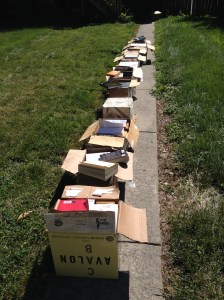
I have gotten me away unto an high place.  No, that’s no biblical, but it sure sounds psalm-like.  Part of the anxiety I felt about the literary loss over the past few days is that it happened just before a long anticipated, and paid for, vacation.  As Thursday dawned, I knew I had only two days to try to rearrange the undamaged books and try to salvage what I could of those that were soaked.  And I had to do it quickly and then leave, only to see the results when I returned.  Not yet having met any neighbors, and not really being in a position to prevail upon their presumed good will, it was a test of personal endurance.  Our garage has an upper floor that remained dry.  I made well over an hundred trips up those stairs, book boxes in hand.  One cares for ones friends.

For now, however, I am at my favorite high place, in the mountains.  On a lake.  I’m having to reconcile myself with my old foe H2O, for here it is placid welcoming.  It stays outside the cabin and we remain friends.  And truth be told, there is a kind of idolatrous element involved in my visits to the lake.  You see, I covet peace.  Since childhood violence and bullies have led me to a quasi-monastic life—Paul Simon reflected that perfectly in his early song “I am a Rock.”  Even Superman had to have his fortress of solitude.  Some fear being alone with their thoughts.  Although I struggle with them, they are, like my books, who I am.

Dawn’s early light; and it only got worse as the day went on.

Prophets and deuteronomists railed against high places.  Such were locations where the God of Israel grew jealous of the attention lavished on other deities.  Perhaps religious promiscuity comes naturally to people, but we need our high places to regain perspective.  To breathe pine-scented air and feel the chill of a July morning at altitude.  Yes, even to reconcile with the splash of water that is here to make life possible rather than to destroy that which you have worked to acquire.  Ironically some of the destroyed books had been with me since college—theological classics such as Niebuhr, Gutiérrez, and Tillich, lying on the unmown grass beneath a healing sun.  Perhaps they were trying to warn me of the idolatry of such retreat.  But here I am, reflecting on loss and hope, and praying that somehow we might just all get along.


Religion in the City

It’s 5 a.m., so what are all these people doing here?  On the highway.  It’s still dark and I’m on my way to the choice of public transit that will take me to New York City.  You see, telecommuting is never 100% city-free.  Somehow I’d been thinking that once we’d gotten away from New York things would be quieter.  Then I remembered that in two decades, if current trends and models continue, nearly half of the US population will live in just eight states.  New York and Pennsylvania are two of them.  Those of us who’ve moved here to get out of the rat race have made our own little mouse race, I guess.

Being in the city after an absence of almost three weeks was a shock to the system.  The first things I noticed were how loud and crowded it was.  In the summer Manhattan has, I was forcefully reminded, lots more tourists than the winter months when it feels like, as one comrade says, Leningrad.  As always when I’m in the masses on the streets, I think about how religious New York City is.  And how secular.  It is, I suspect, a cross-section of American (and international) beliefs.  People come here looking for something transcendent.  Otherwise, why leave home?  Tourism can be a sacred industry.  It brings people from different places together and, in the best of circumstances, forces them to get along with one another.

There are plenty who seek to convert those who are different.  On my way to Penn Station last night, as the light was beginning to fade in Herald Square, I woman had set up a portable mic and speakers.  She was preaching, ignored, to the evening crowds.  Among the strangers are those who believe differently.  Those who are ripe for conversion.  It’s all part of New York’s background hymn.  Then on the sidewalk I spied, scrawled in chalk, “Repent and obey Jesus — Heb 5:9;” the writing on the walk.  “And being made perfect, he became the author of eternal salvation unto all them that obey him” the selected verse reads.  We can overlook that it says nothing about repenting.  This is, after all, the melting pot where religions encounter, mingle, and blend.  Even the Fundamentalists must feel it from time to time.  The traffic home at 10:30 p.m. is quieter.  The day, I will learn, is not over yet.  Such is religion in the city.


Not Quite Eschatology

Realized eschatology, if you’ll pardon my French, is a term that describes the “already/not yet” aspect of the “end of the world.”  In other words, some theologians suggest that the eschaton—the end—has elements of both the present and the future in it.  The term came back to me yesterday as we returned to our old apartment to take care of things the movers left behind.  (And “left behind,” I realize, isn’t really a biblical eschatological concept at all.)  Joined by our daughter, I felt a bit resentful of her time being taken from our new home to spend in the old.  I felt an almost adulterous desire to leave the old and cleave to the new—hadn’t we already paid, and overpaid, for that apartment many times over?  The house, on the other hand, is new (to us) and still requires much attention.

As we organized the remaining items, broke down boxes we didn’t use this time around, and waited for the Got Junk guys to arrive and haul it away, I noticed our daughter gazing wistfully at the empty space that had once had our imprint all over it.  It dawned on me that she’d spent her teenage years here—after the Nashotah House debacle, this was the place she’d lived the longest.  This empty apartment was, for her, home.  I began to feel insensitive about my earlier anxiety to leave.  We all live between at least two worlds—our pasts make us who we are in the present.  The world of our teenage years is fraught with emotion and memory.  The world looked so different at that time, as I sometimes forget.

Moving is one of the most stressful situations human beings encounter.  We have a love/hate relationship with our past.  To me the apartment represented a place we occupied out of a kind of desperation.  Five states to the west, we had to move to New Jersey with little money and tons of boxes—one of them Pandora’s, with hope nestled inside.  We told ourselves the apartment was temporary—maybe a year—only until we could buy a house.  Twelve months turned into a decade, then more, with each year accreting memories in every crack and corner.  Part of us will always be in that apartment, for every place people have lived before is haunted.  On our way back to our new home at the end of the day, we were each lost in our thoughts.  Perhaps not so much realized eschatology as experienced reality, we’d spent a day in a present that will never fully arrive.