Madness of Kings

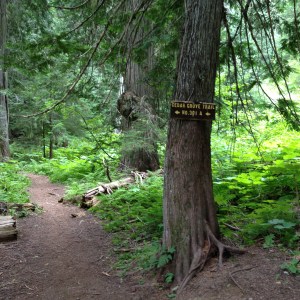
The Roman Empire ruled the known world. Christianity owes much of its form and structure to the fact that the Romans expressed their rule in a military way and prized what they thought was order and fairness. While all of this was happening across the ocean, what are now ancient cedars had begun to grow in Roosevelt Grove, Washington. Having survived the many forest fires that sweep through this area of the northwest, these trees may be up to 2000–3000 years old with an average of about 800 years per tree. Impressed by such longevity, this year on the East Coast I’ve visited the two oldest trees in New Jersey (posts about them may be found in January and July of this year’s offerings). The Great Swamp Oak may be 700 years old, and the Basking Ridge Oak is over 600. The longest lived trees in the country, however, are out here in the west.
IMG_2890

The cedars of Roosevelt Grove aren’t the oldest. There are Bristlecone Pines further to the south that are twice again the age of these millennial trees. One survives from the days when writing itself was first being invented and has lived through most of human civilization. Wisely, its exact location has not been disclosed. We all know how, in a moment of foolishness, a single human being can easily destroy that which can’t be replaced. The story of the Bristlecone Pines is illustrative. A naturalist studying the trees took a core sample of the tree that, at that time, was the oldest living tree known. When his bit broke off in the tree the solution was to cut it down to retrieve the bit. Fortunately an even older tree was later discovered in the same forest and those who know where it is don’t say. It’s a form of collective madness that makes humans want to conquer. Romans and trees both stand witness.

A few miles south of Roosevelt Grove stands the Shoe Tree. For reasons unknown, decades ago campers began leaving shoes on this great conifer. Shoe trees actually exist in several locations around the country. This particular exemplar was a well-known local attraction. Shoes had been nailed to the trunk, or tied together and tossed high into the branches. Whimsical and illogical, it would have drove a Roman crazy. Then a few years back someone decided to set the tree on fire. Thinking the act had ended the joie de vivre, one unthinking person sought to change history. After the act of destruction, however, shoes were once again nailed to the now dead tree, and once again tossed into its lifeless branches. The tree next to it, I noticed, has started to acquire its own sets of footwear. If it outlasts the empires of today, there will be those of generations yet unimagined wondering about the madness that those who insist on conquering leave in their wake.
Things Unseen

The reductionistic mind doesn’t care for mystery. Unlike a lover, the unknown is a problem to be solved so that the march of nice, neat solutions may continue to march on, unabated. Fear of fuzzy thinking leads to a coldness that those of us experiencing life find not a little unsettling. Take the cougar, for example. Right now I’m in one of the few habitats of the grizzly bear in the lower 48. It is also home to mountain lions (pumas, panthers, ghosts of the Rockies). Just a week before I came here a local website posted a rare photo of a cougar caught unawares. These creatures are seldom seen, and are officially extinct for most of the country east of the Mississippi. That doesn’t stop them from existing, however. Reports from my native Pennsylvania continue to be filed. I saw tracks when I was a child, but never saw an actual cat. A friend in West Virginia had seen one shortly before we visited that state some years back. Even New Jersey still gets the occasional sighting. Officially these are misidentifications.

I recently read a couple of books that addressed the beast of Dartmoor, in the United Kingdom. Dartmoor is a wild and remote area and for many years an uncomfortable story has circulated about an unknown creature that haunts the moors. The story is older than Sherlock Holmes as Sir Arthur Conan Doyle had the detective face the hound of the Baskervilles in that region. Those unhappy with the unknown have sought a rational explanation and now some are claiming that escaped cougars are the basis for the tale. A zoo owner even declares that some of his escaped in the 1980s, causing the stories to arise. The fact that the beast had been part of folklore for over a century already at that point suggests that this may be a little too little a little too late. It’s better than mystery anyway.

DSCN0740

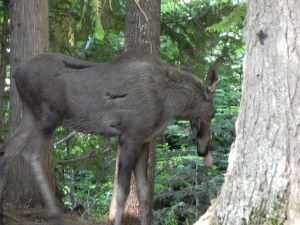
My minimal experience on Dartmoor didn’t lend itself to seeing folkloristic beasts. Even my somewhat extended time in this wilderness hasn’t led to a cougar or grizzly sighting. The mysterious gains its reputation by rarity. The thrill of seeing a relatively common moose is akin to theophanic. I know it’s just a big deer. It’s more than just a big deer. Wonder is an essential part of the human condition. Without it we become as soulless as the mechanistic universe some so desperately want to explain neatly, according to the rules. Cougars escape. Cougars escape detection. What else might we be missing in a universe we’ve only just begun to explore.


Sky Gods

One of the unspoken prompts for writing Weathering the Psalms was the unscientific idea that God is somehow associated with the sky. To my mind this has more to say about what religion is beyond the recognition that Anu, El, Nut, and kin were primordial deities of the celestial sphere. We’re all drawn to the sky. One of the earliest fictional pieces that I polished had to do with our desire for the sky—it’s something we deeply crave but cannot control. We dream of flying. Although flight seems almost casual these days, it is anything but. We still refer to satellite photos as being “God’s eye view” of the earth, knowing full well that the ancient cosmology of the three-tiered universe was simply a misconstrued view of how nature really works. Still, we want to embrace the sky.

Perhaps the cruelest aspect of work in the commercial sphere is the prevalence of “workstations” with no outside views. I’ve held two jobs since leaving academia where my “cubicle” was/is in a windowless room. Cut off from the sky, I’m supposed to focus on the glowing screen in front of me as if that could ever inspire me like a mountain sunrise or the silent crescent of the moon gracefully arcing across the sky. It could be night or day, snowing, raining, or brilliant sunshine, and for eight hours of each day I would never know. We call it efficiency. I think back to that story I wrote as a child about wanting the sky. If there are gods anywhere, it’s up there.

DSCN6374

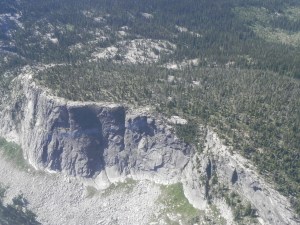
The perspective from above can change everything. On a small plane tour at 7000 feet, you can get a sense of what you’d never expect from the ground. Sharing the view of gods and angels, the land is laid out before you. “Distances,” our pilot says, “are very deceptive from up here.” Indeed, a few minutes aloft and it’s easy to forget what things looked like on the land. Pedestrian. Street-level. Quotidian life. Up here, isolated in a different way, I am seeing what the ancients could only imagine what the gods might see. For the moment I’m one with the sky. For the moment the world of everyday life is far away. That dark and gloomy cubicle no longer exists. In fact, from the sky I cannot see it in its windowless dungeon. We can’t own the sky. Being up here I start to suspect that neither can the gods.


Nature Worship

IMG_2383

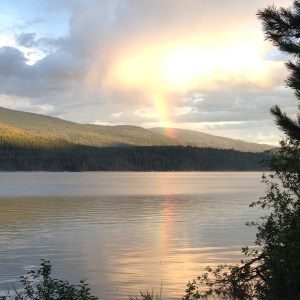
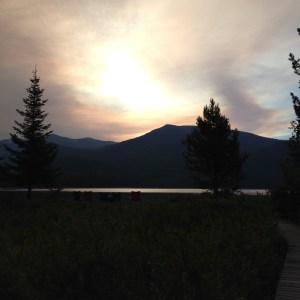
Here I am in a natural setting, with nature close at hand. From these windows I can see mountains, a mercury-smooth lake with fish breaking its silvery sheet, and trees aspiring for the sky. I hear a red squirrel chattering from one of those trees, and the call of a lonely osprey looking for its morning meal. It took a day of arduous travel to get here, and I am staring at a computer screen as nature puts on her show for me. I think, “it’ll still be there when I get done.” Then I think about what I think. Will it be there? This world we’re creating in our own image demands more and more of the planet we inhabit. To which we feel entitled. As I stood at the airport staring at the monitor, I couldn’t believe that my flight had been cancelled. What? I arrived at the airport at 5 a.m., flew countless miles, only to have you tell me my flight has been cancelled? Am I not owed better than this?

This attitude, I reflect, may be what brought us to such a place to begin with. This incredibly beautiful world was never ours to own. We’re guests. Invited perhaps, but guests nevertheless. And we all know that guests are supposed to be gracious and to act as if they wish to be invited back. So why am I rudely sitting here, ignoring my host? We are part of nature, but we tend to think of those closely attuned to nature as “uncivilized.” They don’t dress like city dwellers. Their hair is worn differently. They value things money can’t buy. They don’t play the entrepreneur’s game.

I travel to “get away from it all.” That which I’m getting away from is my life every other day of the year. How did we come to call this “civilized”? There’s no denying the creature comforts of a place to call home and a routine that seldom varies. But sitting here, amid nature, I realize the tremendous cost. Even as soon as it began to warm up in New Jersey we tried to carve out the time to explore local parks. To be outdoors among nature before heading back to the office on Monday. The whole point of worship is to break the flow of everyday time. To stop and think of the good that we have been invited to enjoy. I find myself amid this splendor, and I sit at my computer while nature awakens around me.


Leaving Town

After grousing about having too little time, today begins a trip out of town. Changing time zones, forsaking civilization, resting at a mountain lake. And I’m thinking of all that I’ll accomplish without having to go into the office for an entire week. I made similar plans last year. I’d lined up all the projects that had been piling up and figured that being away for a while would be perfect for getting them done. On the flight across the country, however, my laptop died. Gave up the electronic ghost and died. I grieved, and I was in shock. Thoughts of buying a replacement came to mind, but then, I told myself, I justified buying all my past laptops because of teaching. I carried my PowerPoints with me to class. We’d become a two, then three, computer family. I remembered the sign-up sheets they used to use when you needed an hour on the computer in the library. I’ve practically become a single entity with my hardware, how would I survive without?

Last year, survive I did. Concerned family members kindly offered to let me borrow their laptops so that I could post my daily ravings here. I was surrounded by nature’s majesty—mountains, a pristine (or nearly so) lake, huckleberries, fresh air—and my thoughts turned to the Borg. I’d read about transhumans, and now, I could see, I was becoming one. I don’t want the internet plugged into my brain. In fact, sometimes I don’t even want it sitting on my lap.

All of this is my long-winded way of saying to the ether that my usual posting pattern may be disrupted. It was at the lake, however, that this blog was born. I’m sure that those who first suggested it are a touch disappointed at the way it has grown up. Initially it was supposed to be mostly podcasts. My servers for those casts, however, charged for the service of holding my voice bytes. I used to get paid for sending that same voice out over a classroom full of students only to fall on the wrong side of politics and economy. So it is that I await my flight to remote reaches—remote reaches with Wifi, if the elements allow. If you don’t see my usual musings at my usual time, this will likely be the reason. Although, this time around, with a new top for my lap, I hope I’ll remember to get outdoors every now and again.

IMG_2362


Holy Girdles

Religions, it seems, come in belts. Or at least elements of religions do. Although we may not all agree on what constitutes the “Bible Belt” we all have a pretty good idea that it includes several southern states, and parts of the Midwest. It doesn’t really resemble a belt that I can tell, but its convenience and assonance keep the phrase alive. Over this past weekend I was in the “Borscht Belt.” I’d heard the term before, but had no idea where this supposed belt was, or, indeed, why it was called this. Historically, three counties in the southern Catskills, so I learned, were attractive locations for summer homes for Jewish families from New York City. All within a easy day’s drive of Gotham, they provided the low mountain, resort feel of much of New York State and Pennsylvania. According to Wikipedia (surprisingly, I had no books on the Borscht Belt in my library) this designation is less descriptive now than it had been, back in the day.

BorschtBelt2

One of the immediately obvious features of the region, at least as recently as last weekend, were the number of orthodox Jews walking beside the roadways throughout these counties. I’m using “orthodox” here not as a technical term since I have difficulty identifying the different brands of conservative Jewish belief (there I go again!). Another obvious indicator was the number of billboards written in Hebrew. Just a hundred miles down the road west and these markers tend to disappear. By the time you reach the central part of “the southern tier” you come back to what was once called “the Burnt Over District” from the “Second Great Awakening.” Distinctively Christian in orientation. Religion is endemic in these hills.

The internet tells me that the Borscht Belt began to unbuckle with the relative ease of air travel. I have many Jewish colleagues who pop over to Israel on a fairly frequent basis. I suppose the Catskills just don’t compare with the Holy Land. Further south, along this same rocky spine, you come to the Poconos. I grew up hearing about this vacation paradise in my own state, but, like the Catskills, the region has been largely abandoned for higher mountains, bigger thrills. Having grown up in the foothills to the Appalachians, I learned in school that these are ancient mountains. Old ways are naturally preserved here. The religion I grew up in was old-time, for sure. There’s an agelessness to these weathered hills that seems to invite those with old religions to form enclaves and imagine that little has changed, despite what Wikipedia might say. And maybe it’s time to get a bigger belt, since conservative religion seems to be growing rather than shrinking.


Simon Says

Music preserves your youth. When my wife was studying music therapy, one of the pieces of information she received is that those whose brains have begun to shut down the speaking faculties can still sing. People respond best, in such states, to the music of their youth. Anyone who lives long enough will decry the noise that the younger generation calls music. I’m thinking about this not just because of my recent visit to Bethel Woods, but also because of a New York Times story that Paul Simon is planning to leave the musical stage. Simon and Garfunkel was among the music of my youth. Accessible music with profound lyrics and, for the most part, a muted sadness. I grew up a long way from New York City, but listing to this music I felt like I was wandering the streets of the Village, soaking in a reality I would otherwise never experience.

It strikes me as no surprise that among the earliest manufactured artifacts discovered are musical instruments. While I seem to have missed nature’s boon in offering musical gifts, I nevertheless inherited the appreciator’s side. I don’t often listen to background music. I listen to music to listen. It carries its own meaning, akin to what we tend to think of as a religious experience. No doubt, for many, Woodstock felt like such an encounter. Music that could take you away from the troubles of a war-torn, prejudicial, jaded society. Even if only for a few moments. “I am a Rock,” was, for much of my youth, a kind of personal anthem.

IMG_2836

During a commencement address in not too distant months past, Simon told the graduates that ours was becoming a society at war with art. Music is money. College isn’t about becoming who you are; it’s career training. We don’t allow our young any time to explore any more. Few are willing to admit that capitalism, unrestrained, is just as bad as communism. Music used to be about the soul. The artists I know tell me it’s now about the cash. The man calls the shots. So as I stood on the hill overlooking the former Max Yasgur’s farm a few days ago, the lack of sound was poignant. There used to be, it seemed, different ways of existing in the world. Today the tempo is set and the music composed by those who prefer marching tunes that lead straight to the bank. Standing on that windswept hill I’m sure I can hear the sound of silence.


Things Remembered

IMG_2839 copy

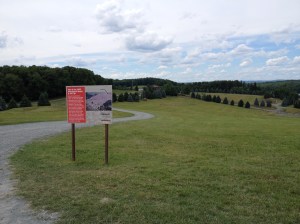
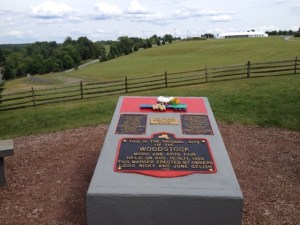
Freedom. Independence Day is our celebration of liberty. Yesterday I happened to find myself at Bethel Woods, the out-of-the-way location in New York where Woodstock was held. Probably no one in 1969 realized just how formative Woodstock and its message of peace, love, and music would become for American culture. Those of us who came of age in the ‘70s learned about it as recent history (I was only seven at the time and, I’m sure, would’ve found the whole thing somewhat unChristian had I been here then). Much has changed in the intervening years. Not many peaceful events get so much airtime any more. Upwards of 400,000, basically unpoliced, youth, gathered in Bethel, New York, for three days of music, chaos, and peace. The Vietnam War was still draining our nation of its youth and murdering its idealism. Fear of the other, racial inequality, and male superiority were part of the context that led to the need for Woodstock. Freedom was free.

Often on this blog I reflect on the sacredness of place. Events that take place in a location leave their impression on the land. Bethel Woods Center for the Arts, the current administrators of the property, have left the field largely intact. As my wife and I stood at the top of the hill and tried to imagine almost half-a-million people here, it was strangely quiet. The nearby museum had plenty of music playing, but standing where it actually happened, there were only ghosts of an event studied in school and which, even today, kids can generally identify. I couldn’t have named every act that played the concert and, although the music was clearly important, it was the gathering that is most remembered. Self-governing youth getting along in an area so remote that still today you have to drive a couple miles to find even basic necessities, sent a powerful message. It was an event that, I fear, can never be replicated. The snake has spoken.

Nearing fifty years later, we’ve become so paranoid that anyone who looks Middle Eastern is under suspicion. Guns, which children of the sixties shunned, have proliferated and may now be carried, wild-west style, in many states. A fear-mongering candidate bellows fascism before the Grand Old Party. Remember, Nixon was president during Woodstock. I may have lived hundreds of miles from here, occupying myself with the matters that seven-year-olds find so pressing. But Woodstock happened. By the time I got to Woodstock, everybody else had gone. I see others milling about the museum, slightly older than me. Perhaps some of them were here for the event itself. We all seem to be searching for something here. The festival had its problems, for sure, but with a sincere belief in freedom, it makes the pre-seventies United States feel like a strangely foreign county. How do we get back to the garden?


Philosophies of Reading

I like my Starter. For those of you unaccustomed to New Jersey Transit buses and their ways, a Starter is a person who makes sure the buses scheduled to arrive at her or his gate do so on time. It’s not a job for the faint-hearted. If a bus is late, or AWOL, the Starter takes the heat from angry would-be passengers. Since they’re present “on the ground,” angry people lash out with their frustration. My regular Starter recognizes me. I’m usually early in my line, so I appear about the same place most days. My routine is, well, routine. I get to the Port Authority Bus Terminal, pull out my book, and read. Starters can’t really get involved in anything like a book because their job requires constant interruptions. Even when no buses are coming in because of an accident in the Lincoln Tunnel, they still have to answer questions and hold up the occasional crucifix. My Starter came to me the other day, as I was reading, and asked me what I thought of an incident four days earlier. To put this in context, the incident happened on Friday. I was there for it, in my usual spot, and this was Tuesday. Clearly it still bothered the Starter that someone had come out and yelled at him for not getting us a bus on time.

I sympathized. Starters can’t materialize objects. If they could, they wouldn’t be Starters. Yet, I realized as I turned back to my book, that I had lost some reading time. I don’t mind helping out my Starter, but it occurred to me that there are a couple of different philosophies behind reading while waiting for, and on, the bus. Many people, I suspect, read to pass the time. I don’t know what they’re reading, since much of it is on a flat device, but knowing that research reading is nearly impossible on the bus, I suspect they are just reading to make the weary time go quicker. Others, I know, read for content. For me, reading is very seldom passing time. I read because reading is what I want to do.

Commuting behavior isn’t conducive to my life choices. No longer do people sit quietly on the bus, respecting that inherent violence of awaking before 4 a.m. to try to get to the city before traffic inevitably makes you late. Devices make their unmuted bodily noises and glare in your face. The guy next to you pulls out his wide-screen laptop, while tapping away on his phone. Or pulls our her iPad to watch a movie with fast-paced images splashing in your face. The book is demanding company. Your time, your attention, your concentration are required to get the most out of it. I don’t mind supporting my Starter. I feel for the ennui of my fellow commuters. I also crave time alone with my books.

IMG_0899


Virgil’s Vigil

IMG_2798I can never keep Virgil and Beatrice straight. I blame Dante. Allegories can be so tiring. So, sitting under a tree in Princeton, enjoying a root beer float prepared at The Bent Spoon, I ponder the empty bottle before me. Virgil’s root beer. So good, it states, that I’ll swear it was made in Heaven. It is good, I must say, but didn’t Virgil lead Dante through the other place? You see, I’ve just spent a pleasant morning at Grounds for Sculpture, the outdoor museum set up by Seward Johnson, a sculptor that some accuse of kitsch. Others come by the busload to see what it’s all about. Johnson’s cast sculptures of people are so lifelike that it isn’t unusual to find yourself staring at an actual person sitting on a bench, wondering if they’re real or not. I spend a lot of time pondering reality, and this place makes that question explicit.

Descartes said “I think therefore I am,” but what if I am really the thought of another? How would I ever know? As I wonder around among the sculptures, a different face of reality shows itself. Many of Johnson’s pieces are sculptures based on paintings. To get behind the surface you have to imagine what the unshown side must’ve looked like. That which the original artist left out. Any art is a matter of perspective. Unseen realities—isn’t there something Dantesque about all this? Is Virgil the guide through Heaven, or is that Beatrice?

These statues, in quotidian poses, are so real. If they’re cast from actual persons, maybe they are. After all, this camera I carry is capable of capturing souls. And if you don’t make it through the first time around, there’s always Purgatory as a safety net. This bottle in my hand causes me confusion. Is my tipple divine or diabolical? How much difference is there between them, really? Princeton is a place that needs no one, after all, except those who have already made a success out of life. A place with expensive root beer on offer. A vice for which I’m willing to pay. Maybe life is a divine comedy after all.


Monstrous Intentions

Atlas Obscura is one of those websites where you could spend all day and feel like you’ve just traveled the world. Featuring less know locations, and strange spots that you might like to visit, sometimes it also has stories about monsters. Well, at least one story about monsters. A friend of mine recently shared Cara Giaimo’s story about thirteen lesser-known monsters from history. While none of these are likely to keep you up at night, they do demonstrate the endless imagination people devote to the unknown. Monsters, like religion, defy easy categorization. Is something that’s “too big” or “too small” for its type a monster? Is it a monster if it is a mix of things that don’t normally come together? Or is it merely a matter of baleful intention? What doth a monster make?

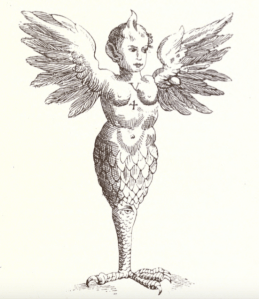
Taking a page (almost literally) from John Ashton’s Curious Creatures in Zoology, the Atlas Obscura page runs down some monsters once believed to have existed. Some of them, despite our flattened world seen only through the eyes of rationality, were actually reported to have existed. The “monster” of Ravenna, for example, was apparently a sad case of a medieval/early modern birth defect that, in the popular imagination took on monstrosity. We now know that birth defects may contain throwbacks to earlier stages of evolution, or that genetic coding may contain mutations. None of this suggests any evil intention on the part of anybody. Accidents of nature may be the saddest kind of monster of all.

Screen Shot 2016-01-27 at 5.42.32 AM

A surprising number of the monsters from Ashton’s sampler here are mixes between human and animal. Indeed, that mix is still a potent force, theologically. One of the loudest voices speaking out against evolution is the one that says people are “not animals.” Having grown up with that belief, it took a couple years of college to convince me that we fit into the greater biological scheme of things. We fear that which resembles us, but is not quite us. Perhaps part of the mystique is that we haven’t quite yet learned to be humane to one another. Being a monster may just have more to do with what one does with prejudices than it does with physical features of their bodies.


Swamped

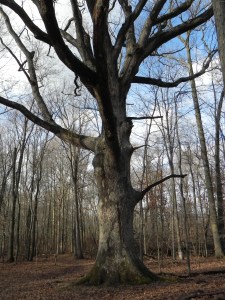
The word “venerable” is often applied with the connotation of age. Although the word in its own right really means to “adore,” or “worship,” objects of extreme age evoke that response. Perhaps the fact that “time-honored” is used as a synonym helps create that impression. As human beings, many of us experience an awe at being in the presence of something much older than ourselves. When I read about the Great Swamp Oak, then, I knew I would eventually need to see it. Reliable indications of a living tree’s age are difficult to assess for a non-botanist. Websites don’t give much thought to checking out the oldest tree in the state (although I did discover The NJ Big Tree Registry), but there are those who give that honor to the white oak of Basking Ridge, not far from the Great Swamp Oak. Others seem to indicate that the swamp denizen is older—somewhere in the range of 700 years. In the state of New Jersey, where things are constantly being reinvented and reconstructed, it is a source of comfort to find something so old leaving peacefully in a swamp.

DSCN6148

Now that I’ve used the words “tree” and “worship” together, I am inevitably brought back to the conceit of Asherah. As my academic writings have adequately demonstrated, I have doubts about the goddess’s association with trees. Nevertheless, there is something venerable about an ancient tree. If the Great Swamp Oak is 700 years old, it was already alive well before the “Age of Exploration” began. The only people to know of it, when there was as yet nothing to know, were First Nations inhabitants of the region. It was a time when, to American Indians, Europe did not even exist. Meanwhile across the ocean the plague could have been raging. A century or two later, Europeans would bring their plagues to these shores, forever changing the landscape. And not in a good way.

Trees, without human interference, can have tremendous life spans. In our short-sighted way, however, we have often understood them as nuisances in the way of some great shopping mall or industrial site. The “lungs of the planet,” trees have been wantonly destroyed in the name of progress. It is amazing that, especially on the East Coast, a few of them managed to avoid the axe and saw. Looking up into the branches of this great oak, I marvel at the changes that have taken place that, in its own way, this tree has “seen.” The world outside this swamp would be completely unrecognizable. Whether an asherah or not, I find myself reacting to the venerable nature of this sentinel of the ages. If only we could learn to keep our hands off young trees that nature plants, who knows what wonders future generations might experience in places even more unlikely than a swamp.


Thoughts in a Cemetery

DSCN6136

Being distinguished, indeed, getting noticed, is increasingly difficult to accomplish. When you read a lot of history, you realize that anyone who managed to write coherently in the past few centuries seldom had difficulty getting a publisher, for instance. The key to getting noticed was publishing books, or being lucky enough to have landed a highly visible job. I was reminded of this, and was given a slight inferiority complex, by a recent visit to the Nassau Presbyterian Church’s cemetery in Princeton. I’ve gone by this cemetery dozens of times, but only recently took the time to get out and explore.

DSCN6129

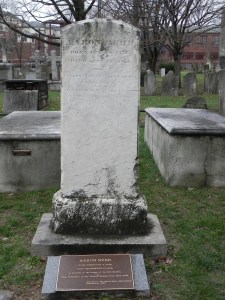
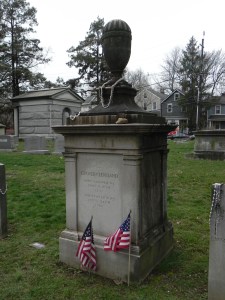
History buffs will know that Aaron Burr is buried there. Burr was from a family of privilege; his father Aaron Burr, Senior, was one of the founders of the College of New Jersey, better known by its current name of Princeton University. The vice-presidential Burr was also the grandson of Jonathan Edwards, who also rests in this very graveyard where one hopes God is somewhat more forgiving of sinners than rhetoric might suggest. Although he was the third Vice-President of the United States, Aaron Burr is now remembered for killing Alexander Hamilton in a duel not far from where my bus rumbles every workday. One kind of conflict exchanged for another. This odd and tragic duel ended Hamilton’s life and Burr’s career. As the bad boy “founding father” Burr has found a number of supporters posthumously. His grave is perhaps the most celebrated in Princeton. This despite the fact that President Grover Cleveland is only a few yards away.

DSCN6122

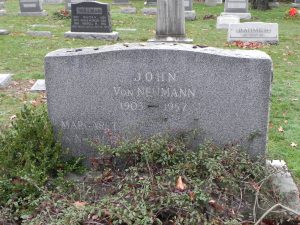
There are, however, more enlightened minds buried here as well. Being in the presence of Kurt Gödel and John von Neumann is a humbling experience. The presence of Albert Einstein, perhaps Princeton’s most famous resident, is, however, missed. Einstein was cremated and his ashes scattered at an undisclosed location. Standing in the cemetery in which so many of his compatriots rest on an overcast, damp December day, it felt like some slight compensation. Political power and ambition often lead to obscurity. I look to those who would be president and shudder. Here in this quiet cemetery, thinking of the common fate of us all, self-aggrandizement seems to be in such bad taste. Einstein, as so often, had it right. Those who are truly noteworthy seldom leave any traces in this world.

DSCN6123


Only Hummus

I remember the moment well. I was in Jerusalem on my own. Although in my early twenties, I really didn’t know much. The man at the vending cart didn’t speak English, but I was hungry. My first experience of falafel would certainly not be my last. After I married a few years later, I introduced my wife to the various Middle Eastern foods I’d tried. Hummus became a personal favorite, especially after I became a vegetarian. There are plenty of things for vegetarians to enjoy, and many cuisines of the world have less meat-heavy options than many restaurants I’ve experienced in the States. Hummus, to get to my point, can be rather bland. It is generally inoffensive, and people of many dietary and religious restrictions can eat it. The Christian Century ran a blurb recently about a hummus restaurant in Netanya, Israel. This eatery offers a fifty percent discount to Jewish and Arabic customers who sit together. Here is a workable idea for peace.

We all have to eat. Half the trick to world peace is getting people who dislike each other to sit down and do it together. Those of imperialist bent may not realize, or even be able to see, that we have more in common than most agitators think. Human needs are the same, and often, very easily provided. You like hummus? I like hummus! We must not be so different, after all. If instead of weaponizing themselves, radical believers armed themselves with food to share, not nearly so many warplanes would have to take to the air. I admit I’m an idealist. I don’t think peace is impossible. We can choose to focus on what divides us, or on what we have in common.

IMG_2641

Perhaps if I’d never traveled to Jerusalem I would never have tried hummus. I didn’t travel for the food, but travel led me to a kind of serenity. Both falafel and hummus are made primarily of chickpeas, a versatile vegetable that has a verisimilitude of peace. If we could learn to eat together we would find it harder to hate each other after that. Sharing our mutual needs sometimes, as the restaurant owner in Netanya understands, requires a financial incentive. Although it may be lucre that lures those who are different to the same table, it is the peace itself that, I believe, will keep them coming back.


Deserted Village

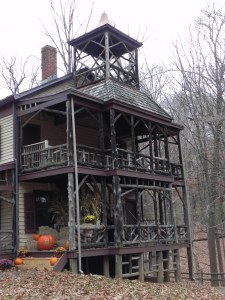
Hands up, anyone who’s heard of David Felt. Until just recently my hand would’ve remained down too. In his day, however, Felt was famous enough to have a town named after him (Feltville, New Jersey) and wealthy enough to leave it when it failed. Today the Deserted Village is a small tourist attraction, a wooded site on the National Register of Historic Places, and the residence of a few locals who prefer the quiet life. David Felt settled in Union County back in the days when it was rural, and established an industry around a mill. The available literature is frustratingly silent on what kind of a mill it was, but it was important enough for him to build housing to accommodate his workers out in the middle of nowhere. While many of the houses no longer stand, including that of Felt himself, the property has a few remaining buildings and a sense of history.

2015-11-06 22.16.35Upon walking into the park, part of the Watchung Reservation, the first building you meet, after a private residence, is the Union Church. Felt was a Unitarian. He nevertheless insisted that residents—his employees, remember—attend services weekly. The church, which is one of the few buildings open to the public, was a center of communal life. The timeframe here is the mid 1800s. Today employers are more likely to try hard to distance themselves from any religious activities, renaming any holiday gatherings with more neutral titles and hoping, rather than praying, that they won’t offend anybody. Of course, Felt’s business venture failed. Others that followed, sans church, didn’t fare much better.

The man that employees knew as “King David” went on to other ventures and has largely faded from history. Incredibly in this age of internet fame he doesn’t even have his own Wikipedia page. Symbolically, the only building that remains accessible to the public in the church—now a museum with a few artifacts from a century-and-a-half ago. Having lived not far from Feltville for nearly a decade now, I had no idea of its presence until a chance meeting held there brought it to my wife’s attention. We can build our own little kingdoms, it seems, and call them after our own names. They are no guarantee, however, that what we leave behind will not become a ghost-town as the interests of civilization move in directions we had never anticipated.