No God for Women

A friend recently asked me to write a post on the feminine image of God. Specifically, she noted that images of God tend to be overwhelmingly male, even today. Having written a book on the goddess Asherah, and being very interested in gender equality issues, I was intrigued by this request. Growing up male it seems natural in our culture to find representations of God as a man. It stands to reason that in a culture more open to feminine experience we should find female images of God. They are, however, still lacking. This combination of improbable facts kick-started some ideas about both religion and culture. To begin at the beginning, although the Bible makes passing references to God as either non-gendered or even female in rare places, clearly the predominant metaphor is masculine. The third-person masculine singular pronoun (i.e., “he”) is almost always used for God, beginning in Genesis 1 and running straight through. The Judeo-Christiani-Muslim deity is decidedly male in his demeanor. All three religions developed in circumstances of male social dominance.

Enter the 60’s (1960’s, that is. C.E.). Women were able to begin expressing their needs without the whole weight of a social McCarthyism bringing down the girth of the government upon them. Instead of finding feminine traits to the god of the Bible, interest in goddess worship revived. Now, serious scholars disagree on just how much a role the goddess played in the development of monotheistic religions. The end result, no matter how you parse it, is pretty masculine. Therefore some women found the goddess to be more conducive to fulfilling their needs. Problem is, there never was, historically, a goddess monotheism. There were always goddesses, plural. Without the unifying force of a single, female deity societies just never fully coalesced around a single, strong image of feminine deity. Some have tried to put Asherah in that role, but she was defined by her husband El and shared the stage with Anat, Shapshu, Ashtart, and a host of other potent females. In a world of two basic genders, monotheism favored the male.

Are there female images of god? Undoubtedly there are. There will be a great deal of difficulty finding them because Christianity very quickly invented the idea of heresy (something Judaism fortunately lacked). This assured that the “orthodox” voice would always be the loudest in the shouting match that we call religion. This situation has had two millennia to ferment and brew. Theologians (mostly male) early on stated that God really has no gender. After all, a male god does imply a lady somewhere in the wings—otherwise human maleness is really superfluous, theologically speaking. Rather than embrace castration, let’s just keep god male, the thinking seems to go. Religions are conservative by nature. They may breed radical free thinkers, but natural selection comes to their rescue by reinforcing the bearded, chastely clothed, divine father. Until society is ready to embrace true equality, however, religion will continue to privilege the big man upstairs.
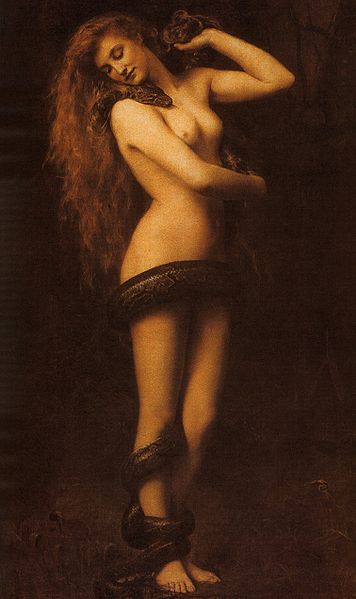
Monotheism’s bete noir?
Ultimate God

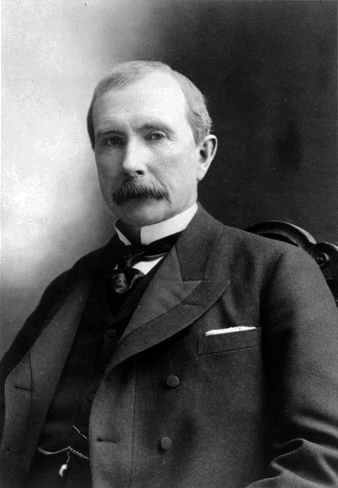
In a recent op-ed piece in the New Jersey Star-Ledger, Ben Krull published a satirical piece entitled “Strategizing God’s election campaign.” While some, no doubt, took offense at the piece, it is less an indictment of God (Krull is a lawyer) than it is a broadside against those who use God to get elected. As portrayed in the Bible, God is not always a likeable character. As Krull points out in so many words, God is a guy with “issues.” Would he ever be elected on a family values platform? What is happening here is that God is being recast as those who most vociferously claim him an ally want him (always him) to be. Using Yahweh as a springboard, they vault over the compassionate Jesus and land firmly at the disapproving God of Jonathan Edwards, who, along with the God of John Rockefeller, wants them to be rich. It’s not as much an election as it is a catalogue where you can order just the deity you want. The God they claim America follows is a god of their own making.

Paul Tillich, a theologian, once famously declared that God is a person’s ultimate concern. While other theologians instantly and continuously disputed this, the idea still has some currency. The distorted versions of Christianity that we constantly see in the political and sports scenes today is a god that adores the free market and loves football, especially when the Broncos are playing. Somehow, incredibly, he couldn’t get tickets for the Super Bowl. If you listen closely you’ll see this god resembles nobody so much as Mitt Romney, Rick Santorum, Newt Gingrich, Herman Cain, Sarah Palin, Michele Bachmann—wait a minute… has god packed up and gone home? Since undisputed God sightings are as rare as undisputed UFO sightings (maybe even rarer) we are free to fill in the enormous lacunae with our ultimate concerns. Ourselves.

At least in the world of polytheism you had a choice of gods and a ready source on which to blame unpleasantness. If Baal’s not answering your prayer, maybe Anat is standing in the way. Ancient folk were not conscious of the fact that they were making gods in their own image, after their own ultimate concerns. But modern Christians, trapped with the God of the Bible, feel that they can at least give the big guy a makeover. This is God on-demand. The beauty of this deity is that he is a poseable action figure who is a picture-perfect image of one’s personal ultimate concerns. A God so malleable, so fluid, and so idiosyncratic should have no trouble getting elected. To find the God of popular politics, just look in the mirror.

Who does your God look like?


Don’t Need No Righting

“If you can read this, thank a teacher.” So the old saying goes. Besides the virtue of venerable age, this proverb has the added advantage of being true. When I first peered at a page full of complex combinations of minute, triangular wedge-marks and was told I’d learn how to read them, I needed to head outside for a few gulps of cold air. My first attempt at Akkadian was doomed to failure, but eventually I learned to read cuneiform through the gateway language of Ugaritic. After that the bewildering sprawl of Mesopotamian languages didn’t seem so threatening. I don’t exactly remember when I was first exposed to English cursive in the classroom, but I do recall that same breathless fear of the unknown. The language I’d learned to print out neatly all seemed to be melting into curly figures that looked remarkably alike. How would anyone ever be able to read this?

According to a story in Sunday’s New Jersey Star-Ledger, schools are moving away from teaching cursive. Beginning next year 46 states will no longer require it. Beyond that, some politicians are questioning why teachers should be wasting their time instructing students in printing, or even keyboarding. The gold standard they are worried about is identity. Can you sign your name (to endorse this campaign check)? If we have another way of identifying you—eyeball scans seem to be very popular suggestion—why should you bother to scrawl your name? Keyboarding, well, kids already know that by the time they start school these days. If the texting craze really takes off we may evolve future generations with just thumbs. School is for teaching students science, math, business—practical stuff. Oh yes, and intelligent design. (Got to keep the gods, or anthropic principles, happy.)

In a world where languages are dying out at a disturbing rate (each language is a thought process as well as a way of stringing sounds together), we have become very cavalier about the very innovation that has allowed us to develop as we have. I used to tell my students that less than seventy years separated the Wright brothers from the moon landing. A human lifespan where technology outstripped our ability to think. And the pace has only accelerated since then. Are we premature in leaving out cursive from the curriculum? There is coming a day when future archaeologists will discover a strange substance that seems to have been manufactured from wood pulp. On it they will find scrawls with loops and curls that form a pleasing pattern in the repetition, but from which no intent can be discerned. And if they are like modern technocrats, they will quickly realize the utility of the wood pulp for starting a fire.

What's it say?


Dead Sea Souls

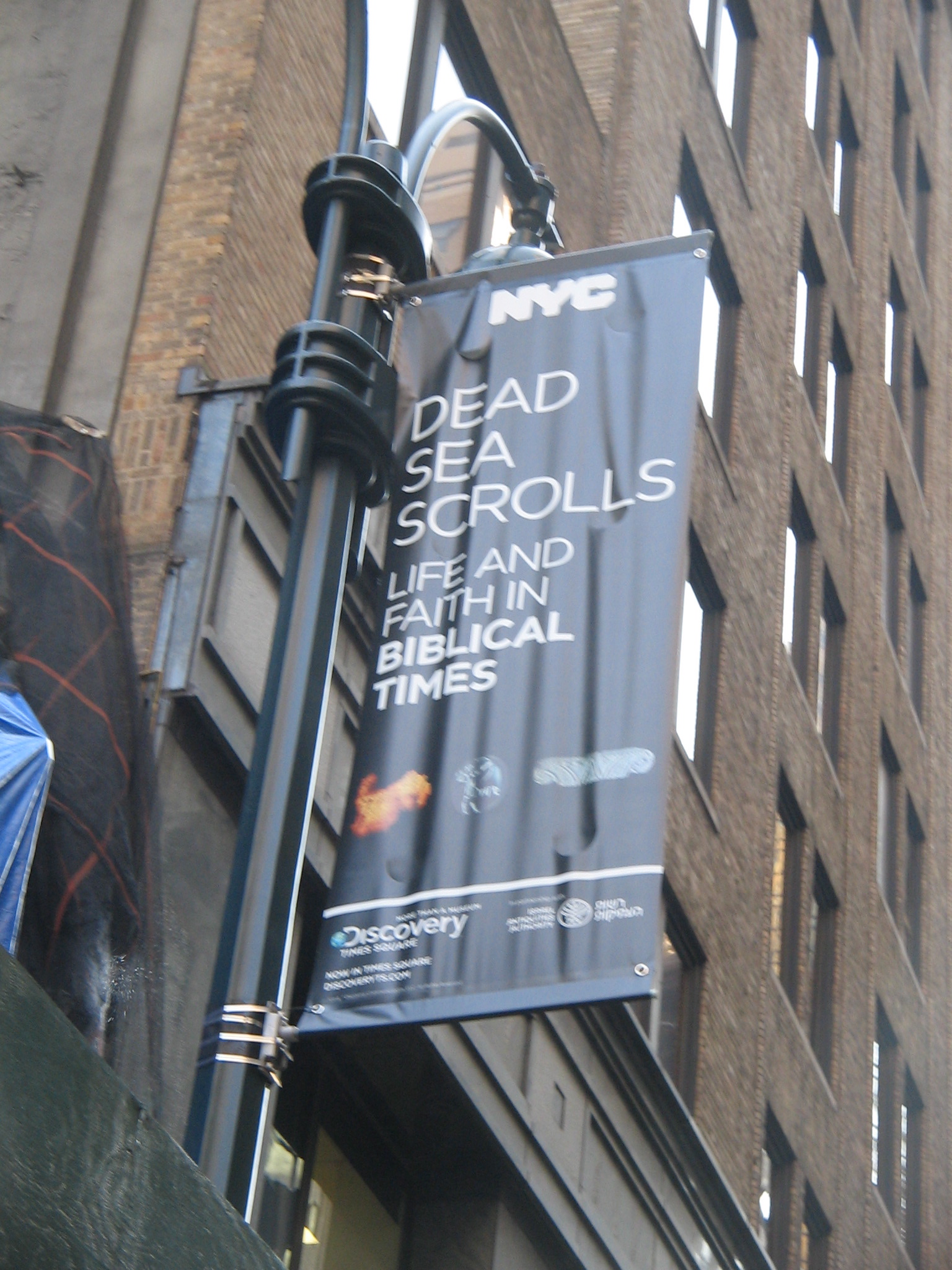
The Dead Sea Scrolls are coming to Times Square. Times Square is the kind of place where you know your being sworn at, but you’re never really sure in what language. It is a place of the people. So the sacred meets the profane. Mircea Eliade would be scratching his great head with his pipe firmly in hand. The Dead Sea Scrolls are the sexiest of ancient documents. Their story has it all: mystery, intrigue, conspiracy, romance—well, maybe not romance. A chance discovery by dirt-poor Bedouin in a desert, ads being taken out in the Wall Street Journal, clandestine meetings with ancient texts being viewed through a hurricane fence in a forbidden zone. And do those scrolls ever get around! I first saw them (those that are accessible to the public) in Jerusalem. The next time was in the Field Museum in Chicago. Now I’m feeling a bit blasé about the whole thing.

Those of use who’ve spent much time (too much time) with ancient documents relating to the Bible know that the Dead Sea Scrolls require no introduction. The far more interesting (and sexy–yes, literally sexy) Ugaritic tablets still receive slack-jawed stares of unrecognition, despite their importance. Those who read the stories of Baal, Anat, El and Asherah wonder why the “Classics” only begin with Homer. People have been creative with the gods since writing began. The theme of the human race might be summed up as, “if the gods are so powerful, what am I doing in a dump like this?” Fill in the blanks—that’s religion. From the beginning, once we’d come up with gods, we began to wonder why they treat us so. People are on the receiving end and so many things can put gods into a bad mood. It’s your basic dysfunctional family.

No doubt the Dead Sea Scrolls are important. We have learned much about the context of early Christianities from them. They provide the earliest manuscript evidence for the Hebrew Bible. And they’ve got that Dead Sea mystique. When I read the story of their discovery, I understand why crowds will flock into a tight room to stare through the glass at a bit of shriveled parchment that most of them cannot read. It’s like standing next to someone famous and powerful; maybe Moses or King David. Or more famous and powerful, like George W. Bush. I know, that was the last administration. But the Scrolls come from an even earlier one. I just hope somebody will give me a call when they find one that tells what happens when Baal meets Astarte. That will be worth the price of admission! And, who knows? It might even fit in with the spirit of Times Square (pre-Disney, of course.)


Secret Life of Language

I recently met with a friend to catch up on several years of silence. Increasingly I’m discovering the wisdom of those I’m privileged to know—perhaps it is the shedding of a purely academic way of learning. We all share in this very human voyage of discovery. This particular friend presented me with an idea that I just can’t dismiss: what if language is a living entity, existing in its own world but intersecting with ours? In a symbiotic relationship, we use words and they help us to survive and advance. This friend is a writer, and like all of us who attempt the art, knows the joys and frustrations of dealing with words that can elude but also fall subtly into place forming a poem or story of sublime beauty. We haven’t fully tamed language, but it defines us. Even my feeble attempt to replicate his fascinating idea is fraught with difficulty, for language won’t be relegated to the page, whether of paper or of electrons.

Language evolves along with us, helping us to express concepts that defy explanation. I recently read of the disappearance of three of our alphabetic letters in English. Alphabets, beginning with the earliest complete exemplar in Ugaritic, contain roughly thirty members that may be combined to replicate, in facsimile, the sounds we make. Different cultures use differing sounds; letters that represent those sounds require symbolic representation. Not all alphabets are created equally. One of English’s missing letters is “ampersand.” I always wondered why when I learned the alphabet the song ended with “W, X, Y and Z”—why the “and”? “Ampersand” was part of the alphabet in the early 1800s. Students sang “X, Y, Z, and per se and.” “And per se (‘by itself’) and” eventually ran together into “ampersand.” Over time it fell out of our rank of letters. As the runic Anglo-Saxon that gave us English was absorbed into Latin characters, the Teutonic “thorn,” or th sound, went extinct in our alphabet as well. As any student of German knows, “th” has distinct pronunciations in Germanic languages. It has its own letter of the alphabet in both Arabic and Greek. Since the Latin “y” resembled “thorn” the letter was replaced by ye olde “y.” The archaic letter “wynn” looks like a flattened “p” but was pronounced as “w.” As Latin superseded runic forms “wynn” was written as a doubled “u,” literally “double-u,” which, in Latin was scripted with a “v” shape. This gives us the anomalous W written with what looks like two “v”s.

The alphabet, second to writing itself, is perhaps the most important invention that humans have devised. The alphabet made writing much easier to learn and with writing ideas could be preserved for centuries and could be sent vast distances without changing. Writing allows us to stand on the shoulders of giants. As the school year is beginning again and kids everywhere feel the strain of losing the freedom of summer, I think back to the purpose of education—teaching our young to read, write, and calculate. Language has been guiding us all along. It may evolve, shed a letter or two, frequently grow by taking on entire new words, but it still cradles us as we struggle to find the perfect expression. We should take a little time to get to know our own language better, for without it we are merely biological entities.

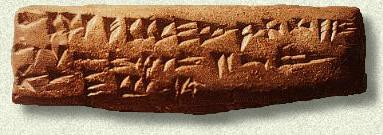
An Ugaritic abecedary


Internet Asherah

Things represented on the Internet are not always what they seem. Removed to the back-bench of academia, I don’t have the opportunity for research that I once had. Every now and again, however, I still like to see what people are saying about Asherah. When I check the popular goddess books available off the shelf, my book on the subject is not often mentioned. At least on the Internet some researchers seem to have noticed it. A recent search for Asherah on Google, however, brought some surprising results. The first item of interest was a quinoa-based, organic veggie burger from Asherah’s Gourmet. The Asherah in question here, however, is simply a woman’s name. As a vegetarian I thought I would put a word in for the product, in any case. I found this brand at a health food store last week, but miles from home and with an air temperature of over 100 degrees, I was afraid the frozen products wouldn’t make it home without half baking in the car.

My next stop on the web was Sacred Suds. This New Age-themed site offers hand-made soaps, many of them associated with goddesses. The product entitled Asherah is named for “the Canaanite mother goddess” and is made with milk and honey. The website doesn’t actually state anything about washing away sins, but it seems difficult to go wrong by washing with a goddess. Another selling point—also not on the website—might be to point out that Asherah is known as the one who “walks upon the sea.” There is even a scene in the Baal Cycle from Ugarit where she is presented as doing her laundry in the sea. Asherah and soap, it seems, are a natural match.

One final product seems to be biding its time, although I suspect there is a market for it. The Asherah action-figure, privately made, does not appear to be commercially available yet. Garbed in an Egyptianizing cobra headdress, armed with a cobra staff, this heroine looks to be a suitable partner for Captain America, bringing the United States and Middle East together in an attempt to bring peace to a troubled region. Maybe heroes can accomplish what gods apparently can’t.

Not exactly big business yet, nevertheless Asherah appears to be on the move. Maybe once she breaks into the big time, those of us who’ve tried to make a living on her cape-tails might be dragged out of obscurity as well. In the meantime, it is about time for a veggie burger and a luxuriant bath.


Thor’s Day

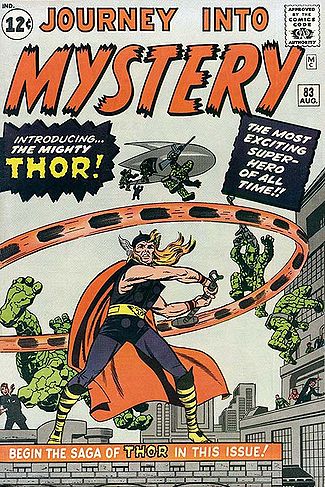
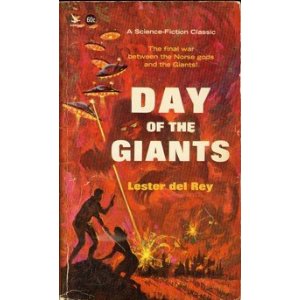
Mythology has visited the big screen in many guises, but among the current spate of superhero films a god may rival mere mortals and mutants. Thor opens in theaters today, bringing a Norse god back into the public eye. Like many young boys I owe my early reading predilection to comic books. One of my favorite heroes was Thor (our birthdays were very close) but I couldn’t quite make out how he was a superhero with the unfair advantage of being a god. Why weren’t other gods down here with us? At some level I sensed Thor’s rage, and perhaps even his estrangement from his father. Was there a sadness to this mighty wielder of thunder? When I was a little older Lester del Rey’s Day of the Giants became one of my favorite books. Norse mythology is plaintive compared to the world of the jovial Greek gods. Even the beloved Balder dies.

Thor is the embodiment of one of the most ancient principles of divinity: control of the storm. A generation after Odin, Thor also experiences that generational divide that all ancient people felt marked the lives of the gods. Zeus likely developed as a more civilized form of Hadad (Baal). In Ugaritic mythology Baal is the lord of the storm; he bears a mace where Thor will grasp a hammer. Baal, however, is often described as the son of Dagan, likely an early Mesopotamian storm god. Back to the earliest levels of civilization miniscule humans have quaked in wonder at the power of storm gods. Making Thor into a superhero humanized him a bit, and with classic comic-book biceps he was sure to be a hit among scrawny boys with dreams of grandeur. We would never have been allowed to read comic books featuring Baal.

The salient point, I suppose, is what makes a god a god? In the mythological mindset, deities are quite human except for their immortality and their strength. The might of gods clashes with the might of other gods. Omnipotence takes the fun out of the equation, for a truly all-powerful deity has orchestrated this whole cosmos and we are just pathetic players on the stage. Thor rages against the machine. If a god cannot be defeated, there is no story to tell. It may be difficult to predict how well Thor will perform on the big screen, but if I am not alone in my fascination of watching gods struggle against even greater gods, this may be like the Day of the Giants for grownups and kids alike.


One to Tree

Asherah’s in the news again. My book on the old girl safely moldering on obscure library shelves, I figure it is my academic duty to be a staid voice of reason on the subject. The jury’s still out on her status as Yahweh’s wife – no wedding pictures have yet surfaced – and her associations with lions and snakes have always been suspect. It is clear, from the Bible’s perspective anyway, that the physical object called by the goddess’s name was made of wood. Although such a slight association does not a tree-goddess make, it nevertheless runs counter to scholarly orthodoxy to suggest otherwise.

In the Rabbinic period it had become clear that just about any tree in the right location could serve as an asherah. So it was with a double-take that I looked at the cover of my Green Bible. I began using the Green Bible a couple of years ago because of the environmental impact of the millions of Bibles printed annually. Best estimates are that about six billion Bibles have been printed (about half of which have been sent to me by various vendors as textbook options) and I was hoping to at least use a recycled book to ease the burden. Then yesterday it clicked for the first time: the Green Bible has a tree on its recycled cover.

Asherah seems to have had the last laugh. If she was a tree-goddess. The fact remains that Asherah is a difficult goddess to qualify. She may have been associated with trees, or lions, or snakes, or wisdom, but none of these things has been proven beyond reasonable doubt. She was, however, the spouse of the high god El among the people of ancient Ugarit. And the Israelites accepted without qualm that El was essentially the same as Yahweh. Did he bring his former spouse along? We don’t know. Asherah, as her own person nevertheless, is a wonderful example of the feminine divine. Too bad she doesn’t have her own book.

God's wife on the cover of his book?


Son of Stone Flies

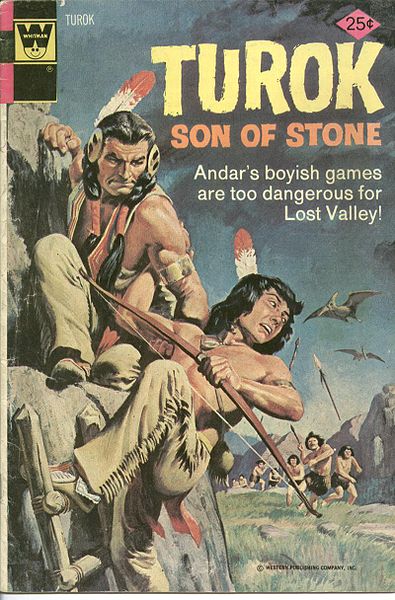
One of my favorite comic books growing up was Turok, Son of Stone. We couldn’t afford as many comics as our friends, but among brothers we’d share our resources and get a fair variety of reading material. Turok belonged to my older brother. It felt so ancient and sophisticated, tinged with primal urgency as Turok and Andar attempted to make their way from the Lost Valley where dinosaurs daily threatened their existence. The comics had a gravitas that even The Valley of Gwangi lacked. In one installment, a scroll-keeper joined Turok and Andar and claimed his sacred scrolls would show them the way free of this accursed valley. Turok doubted this and was rebuffed with “Fools scoff at what they don’t understand!” as their erstwhile companion decisively re-rolled his scrolls for storage in a handy leather pouch.

One pilgrim's progress

That image comes back to me when I think of how ancient writers sometimes used ridicule to castigate competing religions. It even happens in the Bible. A friend recently inquired into the figure of Baalzebub, the famous “Lord of the flies.” The Bible attributes worship of such a deity to the Philistines, the popular pagan foil of the children of Israel. The Philistines, as we know today, were a sophisticated group of Indo-European settlers on the coast of the eastern Mediterranean who showed up about the same time as the early Israelites were emerging from their “Canaanite” milieu. Since they didn’t practice circumcision and didn’t worship Yahweh, the Philistines were shackled with the worship of ineffectual fish-and-insect deities. (Dagon would never regain his proper significance until he was rediscovered by H. P. Lovecraft many centuries later.)

A different pilgrim's progress

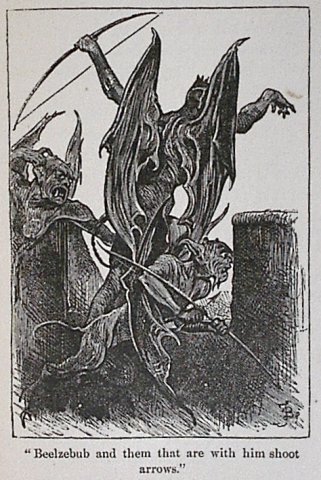
With the discovery of the Ugaritic tablets, the common usage of the term zbl (let’s say zebul, so it can be pronounced) was clarified. Zebul commonly designed “prince.” One of the recipients of this honored title was the deity formerly known as Baal. Baal-Zebul, “Prince-Lord,” the great thunderer Hadad. From the sketchy evidence of Philistine religious practice, it seems the new-comers did adopt some of the gods of their new land, and perhaps among them the lordly Baal. In order to disparage the cafeteria choice of their neighbors’ gods, a biblical writer renamed Baal-Zebul, Baal-Zebub, Lord of the Flies. There have been other explanations for the title, but the lessons learned from our youngest days often furnish our adult interpretative lenses. This explanation makes sense to me, and it reminds me of a bit of wisdom from Turok, Son of Stone.


Baal Necessities

Baal has been on my mind lately, despite the limited time I’m able to dedicate to research. You see, Baal and I share a common interest in weather. One of those people whose moods synchronize with the atmosphere, I have always felt what the sky projects. So when a colleague asked me to lecture his class on the Baal Cycle, I felt it was a kind of catharsis after all the gray skies and snow we’ve had this year. Baal, or properly Hadad, was doyen of the skies. In modern perspective it is often difficult to realize that the seasons and climate of ancient Aram were quite distinct from our own. Whatever came from the sky came from Baal.

In the documentation we have on this god, we find him particularly associated with thunder, lightning, and rain. These were more common in the Mediterranean basin than the snows of the higher elevations. It stands to reason, however, that Baal meted out the weather to the denizens of Ugarit, no matter how wet or cold. Even his daughters’ names reflect their meteorological roles. Thunder and lightning may be the most dramatic expressions of divine power, but nothing makes you shiver like a good snow.

It is difficult not to take the weather personally when my long commute days are permeated with ice and snow. Continuing a pattern initiated last spring semester, my lengthy drive to Montclair has been accompanied by snow each class session I’ve been assigned so far this semester. Even the students have begun to notice. One co-ed asked why it always snows when I’m teaching. Meteorologists may have their naturalistic explanations, but somewhere deep down, I’m afraid that Baal has it in for me. It’s time to go and shovel the front steps again.

A Baal's eye-view


The Triumph of Baal

“Snow weariness” is no strange phenomenon even to those of us who were reared in the legendary snow belt of Lake Erie. Although Buffalo consistently topped our records, months of deep snow burying all the familiar features of our landscape in northwestern Pennsylvania were regular expectations of winter. Snow weariness generally settled in around March when we longed for green pastures and unstill waters. As an adult in generally snow-deprived New Jersey, the weariness sets in much quicker. Attempting to drive on highways with sneophytes is a challenge; before I had my license I had driven in plenty of snow, otherwise I’d have had to hibernate from December through April of each year. Digging out from New Jersey’s third major snow-plop of January, however, the magic seems to have vanished.

Baal was a god who controlled the weather. Some years back I finished a book (still unpublished) on weather terminology in the Psalms. Many psalms are notable for containing archaic imagery and phrasing, leading some scholars to suggest they might have been new, revised “Canaanite” versions of songs originally dedicated to Baal. Perhaps so. The Psalms frequently note the wonder of weather, even occasionally of the snow. Psalm 147 contains the lines:

16 The one giving snow like the wool,
he scatters hoarfrost like the ashes,
17 throwing his rime like crumbs,
before his cold who will stand?

Originally a paean to Baal? Who knows? It’s just that we’re all shivering down here. And Israelites didn’t have to shovel a path to their cars to turn over reluctant engines to get a modicum of warm air circulating before they actually arrived at work.

Once Israel’s monotheism set in, Yahweh took control of the weather, thank you. Even a glance at the Psalms demonstrates the superiority of Israel’s divine weather-maker. From the view down here, however, it looks like maybe Baal has a few tricks still to play. Would Yahweh ever cause a Bible class to be cancelled because of inclement weather?

Dawn in the new snow Baal


Dog Gone!

Religion is a strange attractor. Maybe not in the exact same sense as in chaos theory, but in reality it brings together mental states so bizarre that science fiction and fantasy writers have a buyer’s choice. Yesterday the New York Daily News reported on a South Carolina woman who hanged and burned a one-year old pit-bull puppy. Why? The bitch had bitten the woman’s Bible. Citing the animal as a “Devil dog,” the southern woman became a vigilante for the Lord. Now she’s being tried on charges of animal cruelty. This story touched me in a number of ways.

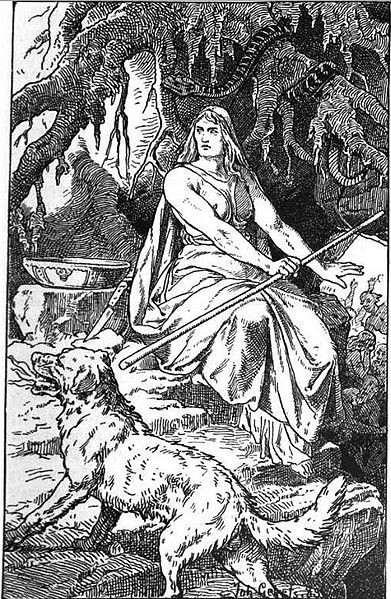
With family roots in South Carolina, I can conjure up images of this happening. Having known many, many Fundamentalists, it seems even more plausible. Given the constant barrage of contrary messages descrying the presence of evil in the world, all the sudden any mutt can become Mephistopheles. Begging off the Baskervilles, the demonic hound has a long pedigree in mythical imagination. It is well known that the Bible cites dogs as unclean animals, but it is their charnel character that leads to the development of the full-blooded hellhound. Prior to the Hebrew Bible, in ancient Ugarit dogs had an infernal connection. It isn’t seen clearly, but the association is there. Snatches of the underworldly dog appear long before Cerberus, and last well nigh into the twenty-first century.

Hel and his hound

Unfortunately for the deceased canine, it is a myth. Hellhounds still abound in popular media, everywhere from The Omen to O Brother, Where Art Thou? Dogs, however, were among humanity’s earliest partners in the survival game. From about as early as I can remember, we always had dogs in the house, and nary a demonic encounter. We never put them on trial, even when house-training was in progress and an accident occurred.

The news story reminded me of an episode of Dragnet I saw as a child. A woman was arrested for murder, and Sergeant Friday, in his unflappable voice, told his partner it was because the victim had shot one of her books. In the final fade out, after Bill Gannon asked what book it had been, Friday holds up a Bible with a bullet-hole through it. I was a little confused. Was the woman guilty or was someone shooting a Bible just cause? The episode did not answer the moral dilemma. I can’t even remember the outcome. But in 2011 things haven’t much changed. If he goes to South Carolina McGruff better watch what he takes a bite out of, or it could be lynching time again.


Black Monks and Grim Reapers

Last night I assisted my daughter with a stint of volunteering at the local community “haunted house” for charity. This is one of the high points of October, so I was glad to be asked. I reprised my role that I developed for Nashotah House: in that context the character was called “the Black Monk,” based on a local ghost story. While I was on the faculty of Nashotah there were plenty of students who swore the Black Monk story was true, the actual event involved an early student who drowned while trying to walk across water (something many students think they are capable of) – this was actually during the winter, however, and Upper Nashotah Lake is not always as thickly frozen as people assume. The poor student broke through and is buried in the cemetery on campus. Halloween was a major event at that Gothic location until a new, evangelical administration came along. During a haunted hayride, the kids of the community lumbered along on a hay-wagon while costumed students jumped out to scare them. I played along in a costume my wife made where my face was invisible and the flowing black robes eerily blended into the night.

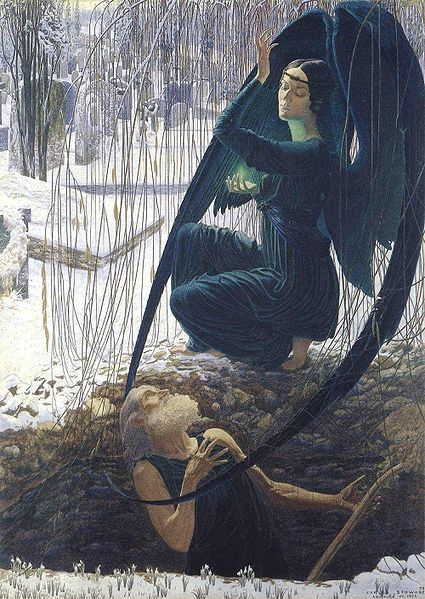
In my current secular context, of course, I was simply The Grim Reaper. This character has a very ancient pedigree. Religions from the earliest times have personified Death as a character that all people inevitably meet. The Mesopotamians had Ereshkigal, the Queen of the Underworld, the Ugaritians had Mot, the god whose name is “Death,” and the Hebrew Bible has “the Angel of Death.” We are often not given a physical description of this baleful but sometimes beneficent supernatural entity. When Revelation was finally penned, Death is one of the four horsemen, and he rides a pale horse, but we do not find many physical details. In the fifteenth century Death was pictured as a skeleton, often with a scythe. His role is that of the classical psychopomp, or guide to the next world. He is not evil, but when the doorbell rings you’d rather hope it had been Avon calling rather than the G.R.

Carlos Schwabe, Death of the Undertaker

Appealing to the fear of the unknown, I lurked last night in the shadows, face completely obscured, not speaking, stepping out to reminded holiday revelers that what is really scary is that which we can not define. When playing the silent ghoul, sudden movements are not necessary to frighten, shouts and screams are unimportant. The simple reminder of mortality and the unspoken question “is he here for me?” are sufficiently frightening on their own. Whether the Black Monk or the Grim Reaper, this character has a natural place on the chilly nights of October. And sometimes it seems there is just not enough October to keep all of us in line.


Athtar in Wonderland

Last night I finally got around to seeing Alice in Wonderland, the Tim Burton version. As a child I don’t recall having seen the overly optimistic Disney original, and I only read Lewis Carroll’s two-part, disturbing original after I had finished my undergraduate degree. When I first discovered Wonderland I was in one of my periodic phases of questioning reality and Carroll’s provocative prose and ingenious lyric ability only made the inquiry more complex. Strangely, it felt as if I had rediscovered a missing piece of my own childhood.

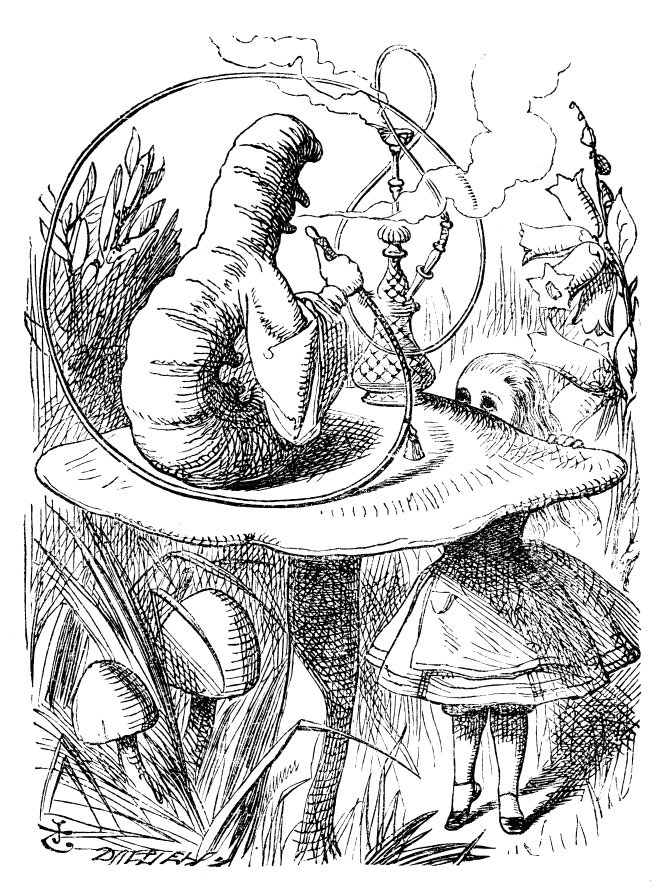
Burton’s versions of childhood stories would likely have been my preferred fare had they been available when I was young. Eerie without the overt horror of an R rating, the vision is one of a world where uncertainty reigns supreme. Then came the hookah-smoking caterpillar. It has been a few years since I’ve read the book, but I don’t recall the larval character as having a name. Linda Woolverton, the screenwriter, presumably gave him the name Absalom. Supposing this to be nothing more than the reassignment of a fated biblical name associated with failed attempts at kingship, I simply let the reference pass. Until the chrysalis scene. There he was, Absalom hanging from a plant, just like David’s son swayed from a tree according to 2 Samuel. This mysterious scene in the battle of Ephraim Forest had captured my attention before when I wrote an article on Absalom, eventually published in the Journal of Northwest Semitic Languages.

Noticing the strange phrase that Absalom was suspended between heaven and earth, I suspected that this might be a reflex of the ancient morning star (Venus) myth. The story of Athtar, the god who would be king but who must decline the throne, is a brief tale preserved in the Ugaritic Baal Cycle. As I watched the sage caterpillar giving wise advice to a confused Alice, the name Absalom took on new significance for me. I have no way of knowing if the reference was intentional or not, but in a culture deeply suffused by the Bible it would appear to be a logical guess. And if I was correct in my article, I was seeing a cinematographic reference to Athtar as a blue caterpillar last night. Wonderland indeed.

Curiouser and curiouser


Natufia to Say

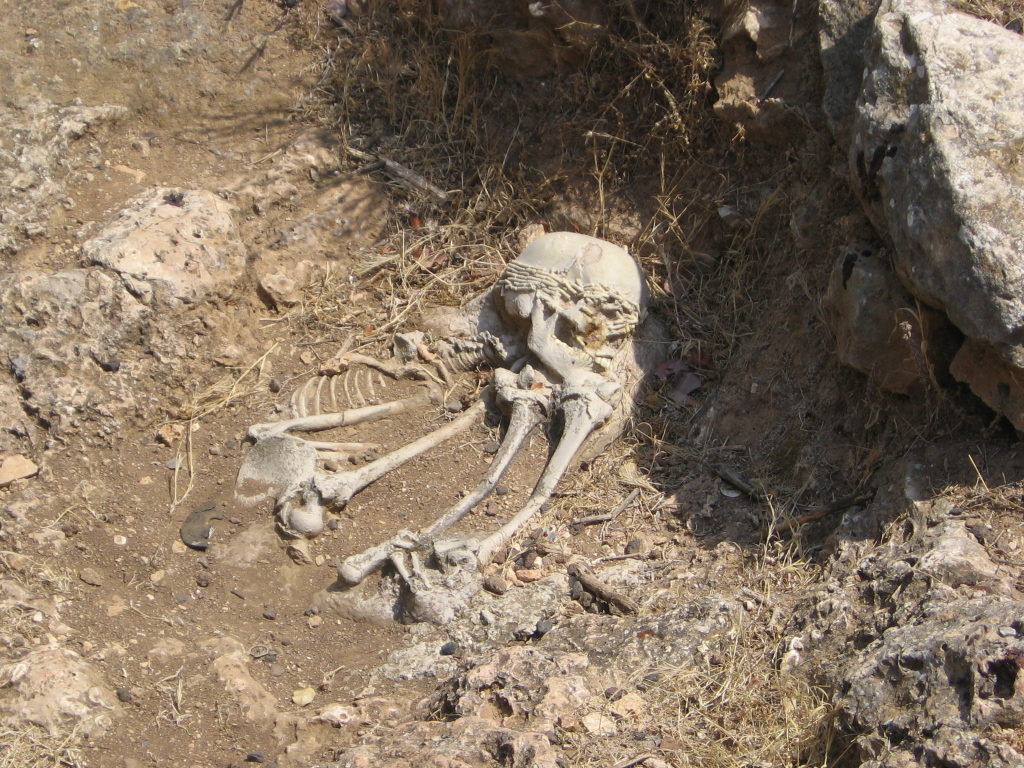
The Natufian culture predated the Israelites by millennia. They were gone by at least 7000 years by the time Israel appeared. The Natufians seem to have been the first permanent residents of a hotly disputed piece of real estate: Israel/Palestine. On Monday MSNBC reported on the archaeological find of a feasting hall among the Natufians. The story reminded my wife of similar stone-age sites that we visited in the Orkney Islands several years ago. What the story reminded me of, however, was the marzeah. The Natufian site features two activities: feasting and burial. The article notes the coincidence of 28 human burials, including one shaman, and the unmistakable signs of feasting. Bring them together and its sounds like marzeah time to me!

Natufian burial, from Wikipedia Commons

The marzeah is an imperfectly understood social institution from the ancient Levant. It is mentioned in the Bible as well as in the Ugaritic texts. Although plausibly reconstructed by modern theorists, we simply do not have a complete record of what the marzeah entailed. Two of the key elements seem to have been feasting and a funerary nature. Monotheistic religions tend to downplay the role of the dead as influential entities since they interfere with a monistic view of the divine. The two Hebrew Bible references (Amos 6.7 and Jeremiah 16.5) do not speak highly of the practice. The Ugaritic material suggests drinking may have been involved as well, further problematizing the ritual.

Now here is where the ambiguity of archaeology is thrown into sharp relief. The fact is we do not know what the Natufians were doing when they buried or feasted at this site. The Hilazon Tachtit Cave does not seem to have been a regular occupation site, and we do not have any reason to connect the burials with the feasting. Beyond a hunch. The hunch is the incredible urge to bring like things together. People excel at pattern-recognition. When I read of funerals and feasting my mind leapt to the marzeah. There seems to be no organic connection between the Natufians and Israelites (or Ugaritians), but the continuity of cultural concepts seems to strong to dismiss. Were ancient people toasting their dead with feasts that were remembered down into the Late Bronze and Iron Ages?