Chilling Thoughts

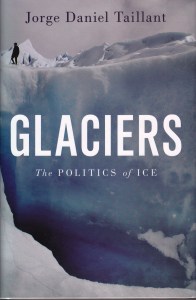
GlaciersI don’t think much about glaciers. At least I didn’t. Now they keep me awake at night. Literally. I just finished Jorge Daniel Taillant’s Glaciers: The Politics of Ice. Never have these ice sheets ever seemed to have so much personality before. I don’t live near glaciers, but I have seen a couple. A number of years ago I visited Glacier National Park in Montana. It was summer and the one glacier that was right by the road (Highway to the Sun) was melting. It was the first glacier that I knowingly saw, and I went my usual way, not thinking any more about them. Taillant’s book, however, indicates why everyone should be concerned about ice sheets. Not only is global warming a reality, our ice caps are melting on what appears to be a runaway timetable and we are not likely able to reverse the process until the damage is done. Not only our ice caps endangered, but our glaciers as well.

Why should anyone care about glaciers? For purely selfish reasons, I might point out that they are crucial to supplying drinking water for much of the world. Looking at the globe, it seems there is plenty of water to go around. Only about 3 percent of all water on the planet is fresh water, however. And of that 3 percent about three quarters of it is locked up in glaciers. Glaciers are the only source of fresh water in dry climates during years of drought or excessive heat. Whatever water isn’t used as these ice giants melt flows into the ocean, becoming part of the salt water majority. When the glaciers are gone, they’re gone. They are part of the fine balance that makes life on earth possible. The politics enter the picture when Taillant reveals that large mining interests, particularly in South America, have been destroying glaciers to get at the gold underneath. They block legislation and provide disinformation, all in the name of wealth. When they destroy glaciers, they destroy future prospects for life in the regions they mine. It’s an issue of social justice.

On our little planet that seems so big, we don’t often stop to consider that we didn’t really show up here by accident. We evolved with the features that our planet gave us—notably water—and we have continued to thrive only in the presence of water. It has often been said that future wars will not be fought over petroleum, but water. We can live without oil. We can’t survive without water. And our industrial action is blithely wasting away the largest reserves of drinkable water on the planet. I don’t live near any glaciers. I’ve only seen one or two in my lifetime, but I now worry for their health. Their future is, in many respects, our future. And that makes me want to pour a glass of water and reflect.


Footprints in the Snow

A friend keenly aware of my interest in the unusual sent me a story about the “Devil’s Footprints” that sometimes occur in snow. The article focuses on an instance in England in 1855 but which was reprised in 2009. The prints, made by a bipedal, cloven-hoofed animal, surmount tall barriers and occur on rooftops as well as on the ground. Such a phenomena is not limited to England. Associated with the Jersey Devil, similar unusual trails were reported during the flap of sightings in the early part of the last century here in New Jersey. As the piece on Mental Floss states, this is most assuredly not diabolical work, but it does make me wonder why people associate the unknown with the Devil.

IMG_2654

As a character in world religions, the Devil can trace his (and, like God, he is almost always a male) origins to the Zoroastrians. Zoroastrian theology is a dualistic outlook: ultimate good versus ultimate evil, Good God versus Bad God. The idea synced particularly well with the burgeoning of apocalyptic thought that hovered in the air during the time that the people of ancient Judah came into contact with Persian thinking. The idea was toned down, of course, to a being with lesser powers than God, but still a real foe with which to contend. By the time of the New Testament, the Devil was ensconced and associated with the Persian accuser known by the title of “the Satan,” or the divine prosecuting attorney. How this character came to be associated with strange footprints in the snow traces an odd trail indeed. The key is the cloven hooves.

No description of the Devil exists in the Bible. The best evidence suggests that the horns, goatish bottom, and cloven hooves come from an association with the Greek demigod Pan. Why Pan was singled out as a particularly bad god is not known. He was popular in ancient Greece. It is certain that the Jews of Jesus’ time would not have recognized a cloven hoofed beast as devilish. The livelihood of too many relied on sheep and goats. Once the transformation took place in the imagination, unexplained cloven footprints appearing in the night suddenly became those of the Devil. As Stacy Conradt points out in her Mental Floss post, several suggestions have been made for creatures of the natural world and their snowy markers. We don’t know what makes the footprints, however, and winter is all the richer for it.


Illusions

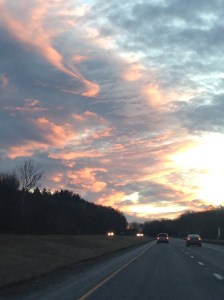
While out driving one winter evening, the sun was setting below a distant horizon that I couldn’t see. Trees lined the sides of the road and, while creating not exactly a tunnel, they blocked the actual view of the orb itself. The day had been partly sunny with cloud forms shifting between layers of the atmosphere. Even though I had studied weather pretty intensely for a number of years, I couldn’t readily identify the cloud types. Thin, smooth lengths of cloud seemed to be suddenly rising up into cumulus banks, heavy with snow. Not far away, the sky was clear. As the sun was going down, these dramatic clouds were lit with the colors of fire: yellows, oranges, and reds. Further to the west, a high, broken bank of clouds glowed a rosy red against a twilight sky. Since the highway we were on was straight, I had a fairly consistent view of the warm tones of the sun highlighting the impressive clouds. My camera couldn’t hope to catch the intensity of the palette revealed to my eyes. When the sun finally fell beyond the range of the clouds, they appeared gray and prosaic against a darkening sky. They had been alight only moments ago, and now they were dull, and not even white.

IMG_2657

What I’d learned of physics reminded me that even these colors were not inherent to the clouds—colors are simply reflections of light rays and the range that we see depends on our eyes. An object’s color, in other words, is a kind of illusion. It’s an illusion we share, and although some people are color-blind, we make the conventions of color part of everyday life. Red means stop, and green mean go, for example. Objective reality is simply the fact that objects reflect different wavelengths of color. Depending on the light source, they appear a specific color to us. While we take colors for granted, they are actually a way of conveying meaning that isn’t entirely real.

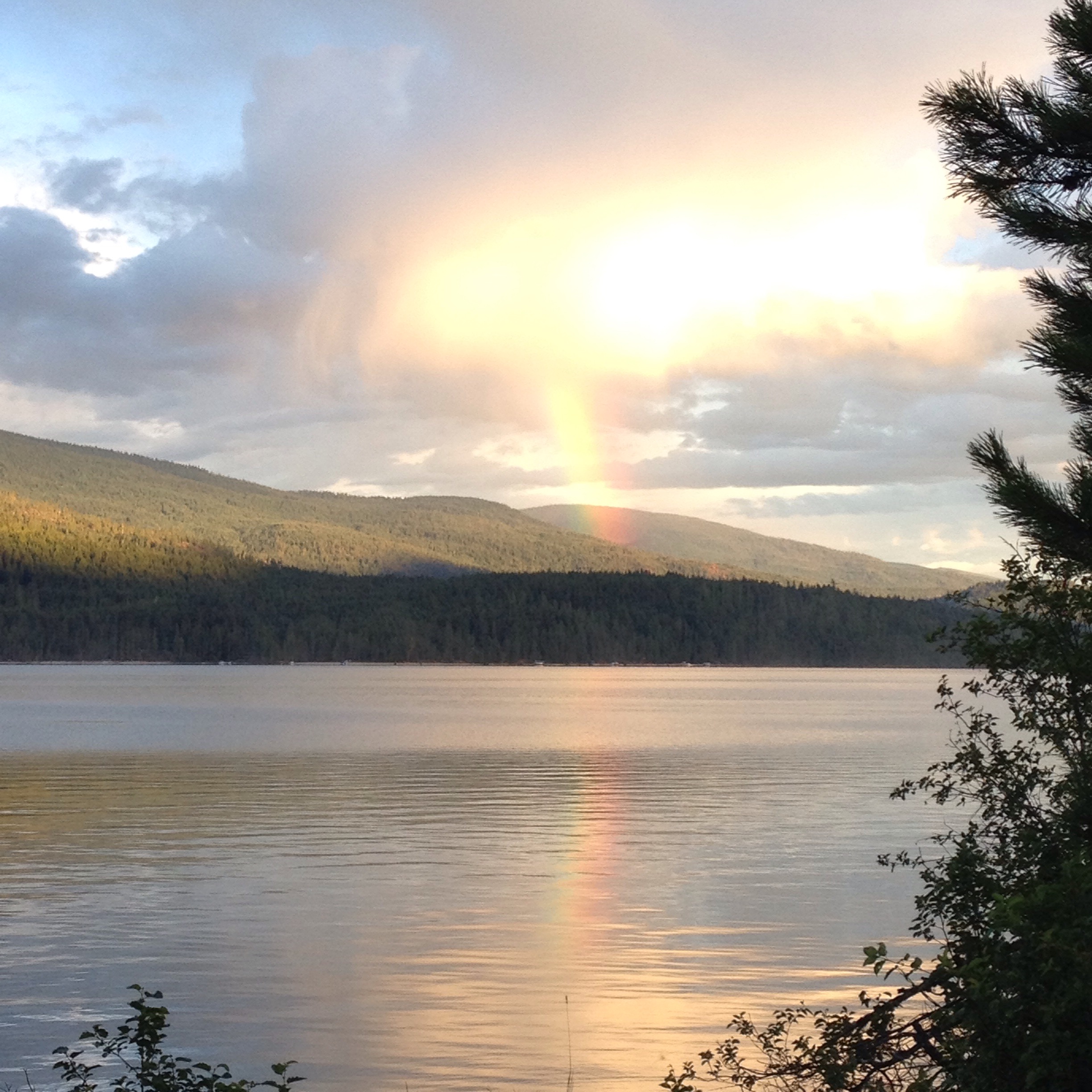
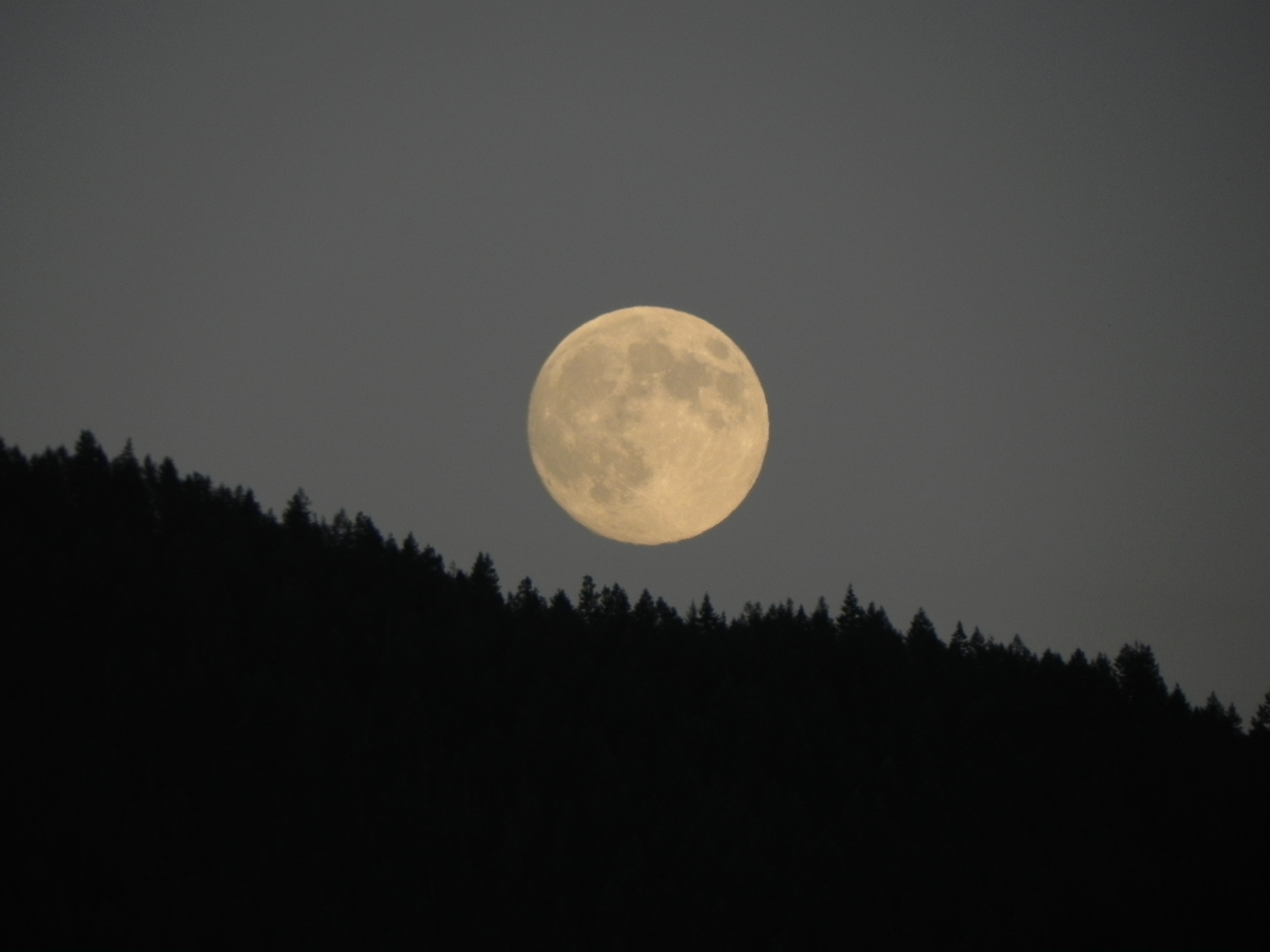
Ancient people looking at the colors in the sky could only understand them as caused by the activity of the gods. Bright hues in the clouds suddenly diminished to gray could be the basis for a myth of heavenly conflict. A rainbow, according to Genesis, is a sign that such a conflict is finally over. I don’t know what the gods might have been doing overhead that night, but as the sun disappeared and a full moon rose, throwing soft, but pervasive light from the broken clouds that have only moments before had appeared red, another reality seemed to be taking over. I suspect that we have lost much by no longer watching the sky. My daily work generally involves sitting in a windowless room, and in Midtown the sky is occluded with human attempts to climb to heaven. When I can see the sky for an extended period of time, it seems that the gods are putting on a show, if only we’d watch.


Silent Light

One of the first things I notice during and after a snowstorm is the silence. Part of it, I suspect, is the dampening effect the blanket of snow has on ambient sounds, but another part of it is the lack of usual frenetic human activity. Here in New Jersey it often feels like being in a perpetual motion machine. People are always going some place. Movement is constant and even if I have to head to the airport at 3 a.m. there is other traffic on the road. We are all too busy. Snow has the power to make one stop and reflect.

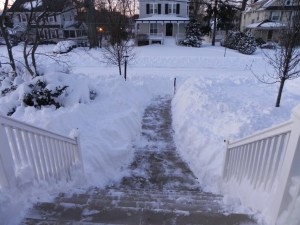
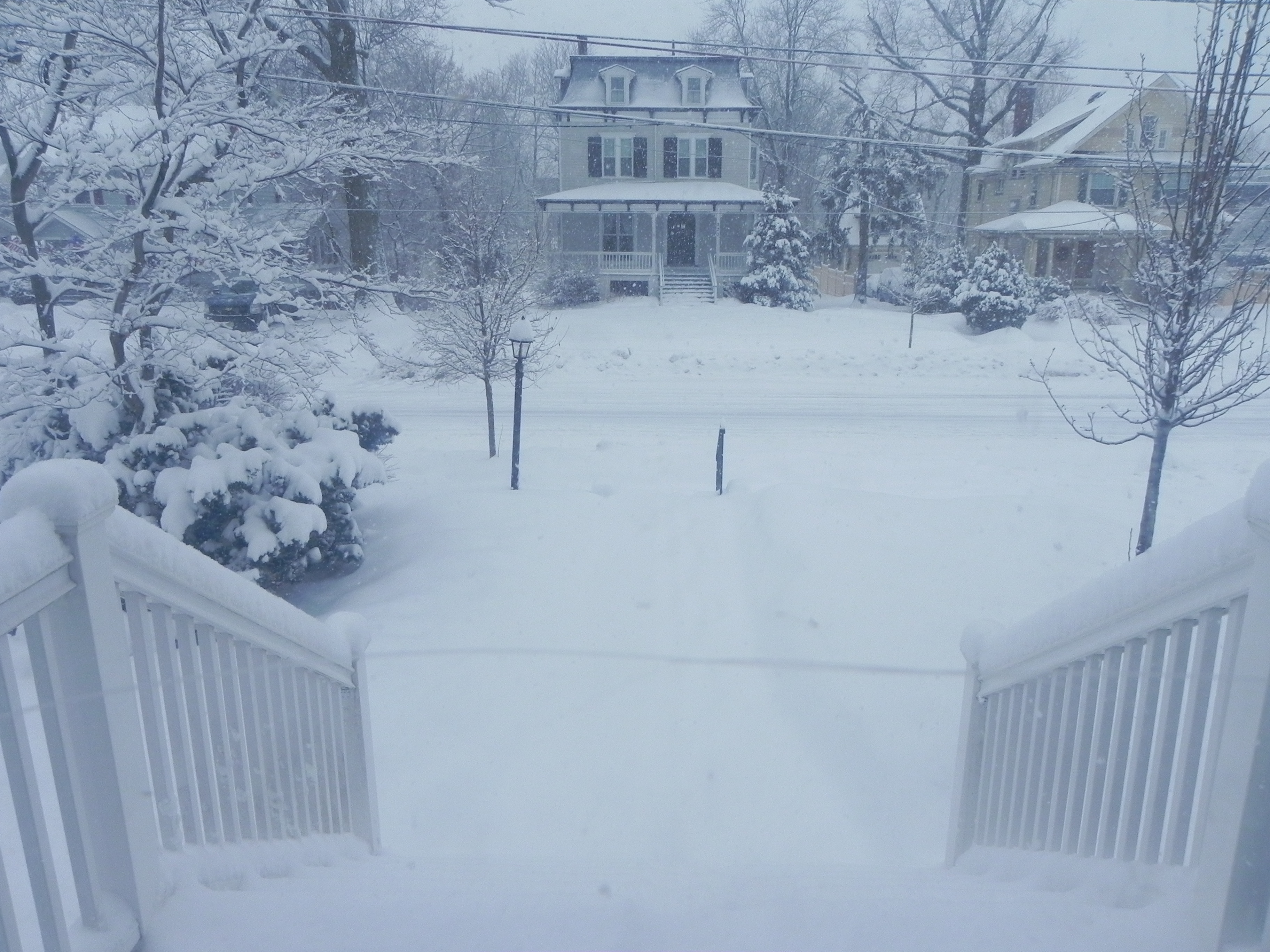
We live on a fairly busy street since we’re just a couple blocks from the county hospital. Further along our street in the other direction are the county jail and social services offices. People are going by constantly. When yesterday’s snow began, the traffic died down. For once people seemed to take forecasters seriously—driving would be dangerous, and the snow would keep coming well into the night. By mid-afternoon we had more snow in my town that I’d ever seen at a single time during my decade in New Jersey. It was as if winter came in a single day. But it was quiet. Very occasionally a snow plow would rumble by, but most of the day our busy street was deserted. A few kids ventured out, but not many since this was a blizzard (the definition of which is that wind is strong enough to lift snow off the ground and make it airborne again). The silence was almost disorienting. It was like living at Nashotah House once again.

DSCN6193

Silence has long been understood to be a spiritual virtue. Both eastern and western religious traditions recognize the value of listening. The noise may be internal or external, but it is nearly constant. Taking time to try to shut it out, if only for a few minutes a day, can be a spiritual exercise. A snowstorm can help to quiet the constant reminders that we have to do this or that, or that we have to be here or there. During a snowstorm we only have to be where we are, and we only have to do what we’re doing. Soon enough the roads will be cleared and the traffic will begin again. Until it does, however, it is worth exploring what the silence has to offer.


Storm Watch

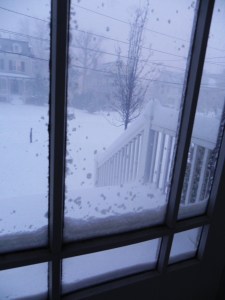
Nothing encourages sleeping in like a blizzard. Although it’s a talent I’ve largely lost over the years, hearing the bellows of the wind and seeing the white reflecting through the blinds, and being a Saturday morning form the perfect recipe for letting my brain relax enough to fall back asleep after I’ve awoken. It’s a guilty pleasure that I had, quite honestly, nearly forgotten. Unlike several winter storms predicted last year, this one has actually come to pass. Prediction of the future may be one of those “God-of-the-gap” things, but meteorologists are modern-day prophets. In a society driven by work uniformity, days off are unwelcome, so a weekend blizzard might just seem to come from God. The highly anticipated list of school closings simply doesn’t apply. Many businesses still recognize the sanctity of the weekend, and we can just roll over and go back to sleep.

In ancient times the weather was anything but natural. The sky—so large and so far away—was purely the realm of the divine. The only way to impact it from down here was to pray and sacrifice and hope that it would behave. Getting back to that view of the world is nearly impossible here in the twenty-first century. We are so accustomed to natural causation that it is just one of those “butterfly effect” things. In truth, though, we know that human activity also has to share some blame with the butterfly.

Winter storms in January are not uncommon in the northern hemisphere, of course. January hurricanes, however, are. And as political rhetoric heats up and we once again ponder what it would be like to have another clown in the White House, global warming is dismissed as just another bad joke. As a nation we’ve been enamored of those who can provide the most entertaining gaffs and still claim they know enough to lead the nation. I have a hard time believing those who voted for Reagan had any success at separating fiction from fact. I still can’t convince myself that W was legitimately elected. The second term of both of these actors freezes me as much as the chill draft making its way through my apartment. The meteorologists nailed this one with their predictions. I’ll stay inside and huddle under my blankets until the all clear. And that may not be until well after November.

DSCN6166


Think Bigger

PlanetRagesI’ve spent a lot of time with academics. Having been one myself, I know something of their habits. Getting through a doctoral program involves, at least in some fields, becoming the specialist on a very tiny piece of information. Since people have been thinking about things for millennia, finding something new to say can be a challenge. Often, by the time they’re done, newly minted doctors know an incredible amount about a very specialized topic. This is, in many ways, simply an intensification of the human experience. We think small. Part of the problem is that our brains haven’t evolved to think big. Having learned an awful lot about the weather in the book on Psalms, I have instinctively taken an interest in natural disasters. Charles Officer and Jake Page share this interest, as is evident in When the Planet Rages: Natural Disasters, Global Warming, and the Future of the Earth. This, however, is a big idea book. Globally big.

Throughout the first two sections of the book, which deal with humans in the face of nature, God often comes up. As scientist and science writer (respectively) Officer and Page simply reflect common beliefs. Nowhere do they advocate invoking God, but they note that throughout history, in the face of just about any species of natural disaster, people have. Many people still do. Disasters and God. What a team! We worship what we fear. Once Officer and Page reach the third section of human impacts on nature, however, God drops out of the picture and the fingers are pointing solely at us.

When I read about what we’ve already done to this planet, I, as a colleague once said, start seeking another species to join. We have destablized the atmosphere so throughly that it will take at least ten-thousand years to return to it’s pre-Industrial Revolution state. Ten-thousand years. At the same time, the largest industrial pollutor (the United States) has jury-rigged politics so that only the wealthy can attain high office. Votes can be bought and we simply won’t sign the Kyoto Protocol. Those who knowingly doom their children are the smallest thinkers of all. We have changed the course of the biosphere well beyond our share of time, and even those scientist who deny global warming know that it is true. You don’t bite the hand that signs the pay check. After all, specialists have a tendency to be very small thinkers.


Inventing Concepts

A neologism is an invented word. Of course, it is impossible to be certain about the origins of many words, and even the many neologisms attributed to William Shakespeare may have been overheard by the bard at the local pub. Still, one of the things I sometimes dream of is inventing a word that will come into wide circulation. I think it must be easier to do in fiction than in non-fiction writing. When I first wrote my book, Weathering the Psalms, I chose what was, at the time, a neologism for the subtitle. “Meteorotheology” was a word I’d never read or heard before and, quite frankly, I’m not sure how to pronounce. Although the world-wide web existed when the book was written, scholarly resources were still few, and tentative. Amazingly, that has changed very rapidly. Now I’d be at a loss to find most basic information if I were isolated from a wifi hotspot. In any case, the web has revealed that others beat me to it when it comes to meteorotheology.

I suppose that some day, when I have free time, I might go back and see if I can trace the web history of the word. It is used commonly now to refer to God taking out wrath on people through the weather. For example, when the Supreme Court decision on the legality of gay marriage was handed down this summer, there were various websites—more popular than mine!—asking a “meteorotheological” question: when was God going to send a hurricane to punish the United States for its sin? These were, as far as I can tell, all tongue-in-cheek, but there can be no question that some people treat meteorotheology that way. It is a sign of divine wrath. My own use of the word had a wider connotation. When I was invited to present at talk at Rutgers Presbyterian Church in Manhattan a few weekends ago, I was reminded of my line in the book: “To understand the weather is somehow to glimpse the divine.”

That’s an idea I still stand by, but it is difficult to move beyond. What exactly does the weather say about beliefs in the divine? There’s plenty of room for exploring that. I know that when I walk outside to fetch the paper on a clear fall morning when the moon and stars are still out, I know that I’m experiencing a kind of minor theophany. The brilliant blue of a cloudless October sky can transport me to places unlike any other. What exactly it is, I can’t lay a finger on. That’s why I came up with the word meteorotheology. I many not have been the first person to use it. I may even be using it incorrectly. But the weather, in my experience, has many more moods than just anger. Any autumn day is enough to convince me of that.

DSCN6011


Hurricane Joaquin

The name Herostratus is deservedly obscure. In fact, I shouldn’t even be mentioning him here. His use as an object lesson, however, seems apt in a country fascinated by firearms and fame. Herostratus was an arsonist of the fourth century B.C.E. who destroyed the Temple of Artemis in Ephesus, one of the Seven Wonders of the Ancient World. He perpetrated this crime so that he would become famous, and he is representative of those who want fame at any cost. So it was that on Thursday a gunman, who shall remain nameless here, shot and killed nine people at Umpqua Community College in Oregon before being killed by police. This individual, upon investigation, had been fascinated by how obscure people gain immediate fame by killing innocents. After a summer of what seemed like endless, pointless shootings, we now have nine more graves of students to mourn, and as a nation we still lovingly stroke our guns.

Society is a dangerous combination of a cult of celebrity and violence. Most of us live our lives in utter obscurity, not being noticed. For many that is the way they want it, but for some it is a pathology. Guns are so easy to find. Police discovered seven firearms in this man’s apartment, in addition to the six he took to campus. Doing the math confirms the madness of a nation that makes guns so very accessible. Even the insane may buy. All it takes is money. The Temple of Artemis was one of the most magnificent structures of all time. It even gets mentioned, in an indirect way, in the Bible. Although it had been rebuilt, the idea had already fermented, without firearms, that fame could be had for infamy. In antiquity the perpetrator’s name was outlawed. Now anyone can find out who he is.

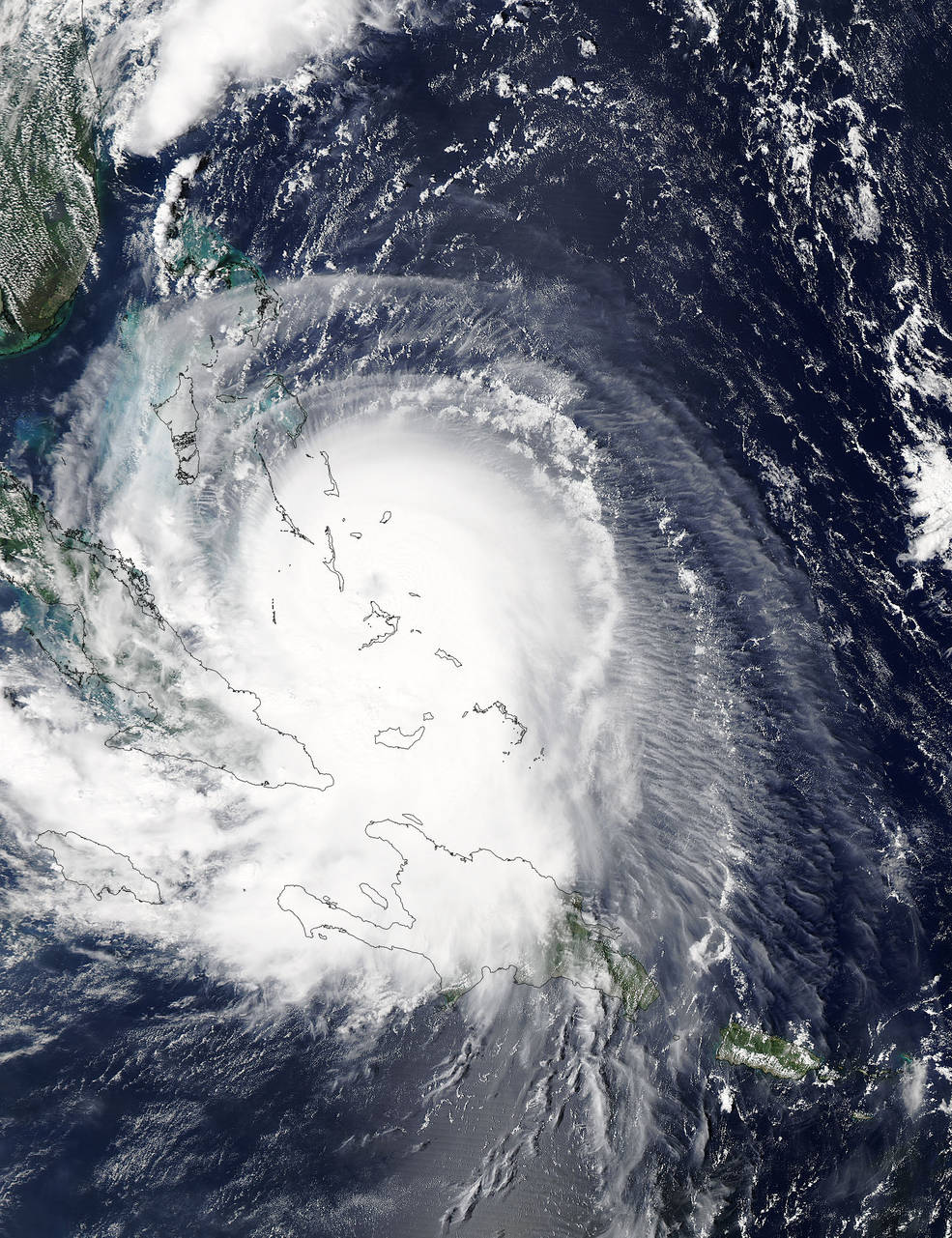
No shooting is without tragedy. Those that take place on college campuses and high schools are especially tragic because education is the only way to move forward from barbarism. Those who went to class on Thursday were improving their minds. Education makes the world a better place. They were, however, eliminated by a nameless man with easy access to weapons and a wish for fame. Perhaps American Idol and American Gladiator should offer a venue for those who wish to slaughter each other in public. It could be sponsored by the NRA. It was the ancient world, after all, that also gave us bread and circuses. Although the hurricane may be veering away, we have already been hit by tragedy, only this one was of our own making.

joaquin.a2015274.1755.1km


Rutgers Presbyterian

It is indeed an honor to be invited to address a church group on topics that matter. While I didn’t directly address global warming in my book, it was in my mind as I wrote it. Early in my teaching career, I wasn’t sure how to cinch up the gap between the lexicography I was attempting and the real world issue that it should address. The seminar portion of yesterday’s program focused on topics associated with the weather, and I was gratified to hear that many of those present felt that a profound weather event had made an emotional impact upon them. Weather has a way of reminding us that we’re small and that forces beyond our control still exist. I’d forgotten how nice it is to while away a few hours with intelligent people who think about the world we all inhabit. I only wish I could have recorded all the wisdom I heard. We tend to think if someone’s not speaking to us from a major media outlet they’re not worth listening to. I am glad to be reminded that this is not so.

IMG_2515

During our discussion of global warming, the question arose as to what we could call “climate change” to make it appropriately terrifying. Various suggestions were made such as poisoning the sky, suffocating the earth, and old-fashioned, and to-the-point air pollution. We are a species that seems bent on its own destruction. The atmosphere is so incredibly large, but, as our host reminded us, so very thin. Life is supported only in what might be considered, in his words, a thousand-story tower. Beyond that, life runs out. We need to take the limited nature of this small envelope of gas surrounding us seriously.

I’ve come to realize that my fascination with the weather largely derives from looking at the sky. Such an activity is so basically human and so profound, that we simply overlook it most of the time. The sky is superior to us. It was, for most of human history, far out of reach. We have stretched our hands up to the realm of the gods and smeared it with our industrial filth. Many of those present, although not Catholic, applauded the Pope’s insistence that the world must be view holistically and that we must stop polluting our home. Pollution used to be an ugly word, but we have been taught to change our language to add ambiguity. “Climate change” is so neutral, with no one to blame. But it’s not at all accurate when it comes to the real costs. We’ve already impacted the weather for a millennium into the future at least. And I, for one, left our session optimistic that intelligent people cared enough to spend a beautiful Saturday afternoon discussing it.


Weathering Academia

Come the end of September, I’m scheduled to give a talk at Rutgers Presbyterian Church in New York City. I’m personally very flattered by this because, as it has become clear to me, an academic without a post is mute. I’ve seen colleagues who teach at schools I’ve never heard of consulted by the media—and there is obviously more to it than this—because they have teaching positions. Those of us who used to be professors apparently forgot everything when we take jobs out of necessity. That’s why I’m so flattered. My talk will be on the larger issues behind my book, Weathering the Psalms. I never expected this book to be a bestseller. I knew that it was, in some sense, incomplete. Academic books are the kinds of things you write when you have an academic post. When your day is not programmed with “enter this data, follow up on that book, and when you have time, get other people to write books.” People, of course, with university posts. The rest of us know not whereof we speak.

It’s funny. Back when I was teaching, even if it was only at Nashotah House, I used to be asked to give little talks all the time. It was rare for a year to pass without someone asking me to lead a seminar or share what I’d learned with some august body. That tapered off once I became an adjunct, although a Presbyterian Church in Princeton once invited me to speak because I was teaching at Rutgers (the university). And as I prepare my talk in my free time, I wonder about a society so tied up with name prestige that someone who has something interesting to say is just a crackpot unless a college or university or seminary or think-tank hires them. There are many of us—hundreds, if not thousands—who know as much as our university colleagues about a topic. An individual doesn’t have a name big enough to flash around, so we don’t get asked to share. Keep your hand down and your head down on the desk, please.

IMG_2416

In any case, it has been good for me to come back to the weather and think through some of the larger implications. I’d just had the book declined by a big name academic press when Nashotah House terminated my position. For many years I couldn’t look at the manuscript since it seemed a symbol of my failure. No, the book isn’t everything that it could be, but there is some good information there. The larger implications are actually of some importance here. The weather is studied both by science and by religion. Both understand aspects of it that the other misses. I’m looking forward to exploring this with the good folks of Rutgers Presbyterian who were kind enough to invite a guy with nothing more than a book and an obscure name to come and talk about something that most academic colleagues just don’t notice.


The Reign of Rain

I’m on vacation for a week. My job is such that taking vacation is becoming a rare commodity, what with precious few allotted days and move-in, move-out schedules of a collegiate child, and so on. And also company policy about keeping employees in the office between Christmas and New Year. Anyway, now that I’m here I should be kicking back and enjoying the beautiful lake and getting out to do the things inmates of the city seldom do. It has, however, rained every day that I’ve been here. Not all-day rains, of course, but just enough that plans have to be interrupted or changed at the last minute. I end up sitting in the cabin playing Solitaire when I should be out getting some fresh air. So it goes.
Ironically, I am staying in the drought-stricken west. The western United States, I learned when researching for Weathering the Psalms, has been ensconced in a decades’ long drought. In fact, prior to my family trip here it hadn’t rained in quite a while. Our arrival with the clouds was, after all, mere coincidence. Still, it’s hard not to take the weather personally. I know that the weather is larger than any one person’s needs or desires. I also know that water is a commodity even rarer than vacation days, largely because of our misuse of the limited supply that we have. California’s plight has been in the news. We have large cities in water-challenged environments and people treat water like there’s no end to its abundance while the opposite is the case. Just thinking about it makes me thirsty.
There are many things a person can go without, some of which feel absolutely essential at the time. Many vacations, I know, are extravagant. Fancy hotels, high-priced entertainment, exotic locations. Work can feel so crushing that vacation my become the one island of sanity in the midst of a hostile ocean of obligation. For me, vacation is time with family in a stripped-down, natural setting. Of course, we do indulge in some of the comforts of home, but having nothing in view outside the window beyond that which nature dictates is a transcendent experience. From where I sit, I can see nothing of human artifice. I do see clouds, however. I know that more rain is on the way. And I know that it is a gift, complain as we might, of the highest magnitude.


A Kind of Lunacy

I can never keep track of the vernal equinox. Actually, I have the same problem with the autumnal equinox and both solstices. I think it’s because when I was growing up I thought they always came on the 21st of the month. That’s a nice, regular interval. Our months, however, are not natural. Were they to follow the moon (whence we get the word “month”) they would be about February length. The moon’s phases, however, do not keep to human time. In actuality, a month is approximately 29.53 days. Various emperors throughout history added days to their months, making our jumble of 365.25 days a mix of mostly 31-day periods, with some being 30, and February alone holding out at 28. Or 29, depending. All of which is to say, I didn’t realize spring was here until the day was mostly over. Here in the northeast it was snowing, and the celestial dome was occluded. That was a shame since it was also the day of a solar eclipse. I consoled myself by realizing that even if it had been sunny I was in the wrong location to see the eclipse, so I wasn’t missing much.

DSCN3762

So spring subtly appeared this year. Not only was the day an eclipse day, for some, it was also a “supermoon” day. That is to say, the moon was at its closest point to earth at the time, making the eclipse a truly spectacular one, if you could see it. All of these astronomical machinations on the event that sets the date for Easter has developed a new kind of mythology. According to The Guardian, some minority of clergy have seen this event as initiating the apocalypse. Of course, eclipses are by their nature local events. The vernal equinox occurs every year, and the first Sunday following the first full moon of the equinox will be Easter. We get a supermoon (or perigee-syzygy of the Earth-Moon-Sun system) about every 14 months, so this is hardly rare. But then, the moon has always been the locus of mythology.

Ancient peoples knew the phases of the moon intimately. As the main source of non-artificial light at night, it was a boon to those without electricity, or even gaslight. Without physics to provide a mechanism, stories developed to explain the ever-changing status of our nearest neighbor. Some of those tales took on religious elements, and many religious calendars remain lunar. The vernal equinox, however, is a solar event. From now on the days will get longer until the summer solstice, a day of celebration and mourning, as we move back into the days of declining light. Each of these celestial events comes with its own religious freight, and it seems, dissenting clergy notwithstanding, that so it shall carry on for many moons to come.


Holi Daze

It’s pretty white out there. For many parts of the eastern United States it has been a season of snow on snow on snow (why does that sound familiar?). The wisdom back in old white Wisconsin was there’d be three snows on the crocuses. This year the crocuses have remained buried, even in New Jersey. Judging from the number of people not driving, it looks like most people had a snow day yesterday. The color white has often been treated as a symbol of purity in various religions, but today is also the celebration of Holi, a Hindu festival of color. I’m no expert on Hinduism, but I do find the concept of a day of color to be immensely appealing. Anthropologists trace its roots to some fertility festival, but the fact is, we could all use some color right about now.

DSCN5027

Winter technically lasts, in this hemisphere, until the vernal equinox. Religions around the world have festivals to celebrate this slow turning of the seasons, and the lengthening of days. A long while back I wrote a little book on the holidays. In it I tried to find the basis for various holiday colors. We all know red and green clash, but when we see them together we think of Christmas. Black and orange make a standard Halloween combination, and red by it self suggests St. Valentine, while green alone gives St. Patrick his identity. A more recent addition is black and silver for New Year. Easter, coming in the spring, however, is a celebration of color. We don’t dye the eggs just one hue—it has been a long winter and we celebrate its close with a burst of color. Even the staid old Episcopal Church reverences the liturgical seasons with distinct colors. In other words, colors mean something.

Years ago a friend recommended Jasper Fforde’s Shades of Grey (this was before Fifty Shades of Grey took over the world). It quickly became one of my favorite novels. It’s all about color. Apart from a few years under the influence of a friend with a strong personality, I’ve always been a subdued haberdasher. I tend to wear understated colors because I don’t like people commenting on the way I look, or, even for that matter, looking at me. I enjoy public speaking, but having someone single me out on the street or the bus has always felt distinctly uncomfortable. Still, I think we may have lost something that Holi has retained. Color exists to be celebrated. And shared. It is so important that commerce and trade apparently stopped last week to figure out the color of a certain dress. I may not be a Hindu, but I think I might wear my brightest shirt today to welcome color back to the world.


Lazarus, Come Forth

The red-cast face staring down from the giant LCD billboard this side of the Lincoln Tunnel has my attention. Having become an unwitting fan of horror movies, the genre was clear from the creepy, black-eyed gaze that found me even in mass transit. The Lazarus Effect, it said. I stored the information away knowing that it would be a movie I’d have to rent and watch alone—I don’t know many other true fans, and I don’t like going to a theater by myself. Then I started thinking about Lazarus. The man raised from the dead, according to the Gospels. When I was a child I always confused this Lazarus with the one from the parable of the rich man and Lazarus. I’d never known anybody with that name, and to find it twice in the same book must imply, at some level, that they were the same guy, right? I mean, they’re both dead. So my juvenile thinking went. In the parable Lazarus, whose wounds are licked by dogs, is taken into the comfort of heaven when he dies. The rich man, it turns out, isn’t so lucky.

769px-Bonnat01

This was a bitter cold day. Dressed like I was headed to McMurdo Station rather than central Midtown, I tried to keep my head down as the wind howled through the channels constructed by excess wealth. I am always distressed to see the homeless out and about on such days. I’ve got on more layers than an onion on steroids, and I’m still chilled through. What must it be like to face such weather threadbare? There, on Madison Avenue I saw a dog being taken for a walk. He had on a warm sweater and fancy purple slippers to keep his canine feet from touching the cold ground. That dog was better dressed against the cold than some of the people I’d passed. I thought of the dog licking the sores of Lazarus. “Father Abraham, have mercy on me,” the rich man cried.

“Son, remember that thou in thy lifetime receivedst thy good things, and likewise Lazarus evil things: but now he is comforted, and thou art tormented.” The words are almost as harsh as this wind. We’ve become a society that will spend more readily on our pets than on our compatriots. Dogs, at least the breed I saw on the street, have evolved to grow thick coats. I’ve seen pictures of huskies running across the snow like their wolfen ancestors. Indeed, the wolves, where we’ve not hunted them to extinction, still manage in the winter. But then, there’s the Lazarus Effect. I’m feeling guilty thinking about putting out the money to rent it, several months down the road. There’s a real life Lazarus who could use any spare change right now. And the well-heeled dogs, I’m sure, would be made to turn up their noses from even getting near enough to lick his wounds.


Ultimate Superlative

“Push men too far and they fall off the cliff.  Push great men too far and they soar.”  The words are those of my novelist friend K. Marvin Bruce.  Unless you read this blog you’ve probably never heard of him; his novel publishing record is about as successful as my academic career.  Still, I think quite a bit about Marvin’s plight.  He seems to be a gifted writer—he sends me copies of his stuff—but publishers take no notice.  He’s had a few short stories appear in online journals; two of them even won prizes, but the internet is a very crowded place.  It’s not easy to get noticed. Those who try to make a living smithing words often face a dilemma; it feels like all the momentous words have already been taken.

Marvin on a superlative walk

Marvin on a superlative walk

I mentioned in a recent post that we are suffering from a crisis of superlatives.  The other day I was in a mall (this is a foreign activity for me—the people all look far trendier than I do, and they seem to think this is the place to be, not just where you have to go to have your laptop serviced).  I saw a mother walking by holding the hand of her maybe three-year-old son.  His little tee-shirt read “Über Awesome.”  I recall when awesome really meant full of awe.  And that was rare, reserved for things like towering, severe Midwestern thunderstorms alive with constant lightning, or gray north Atlantic waves crashing mercilessly into the cliffs of Maine. I stood, small and insignificant on the prairie or the coast, utterly at a loss for words. Yes, it was that impressive. My superlatives, however, have all been absconded. We live in a world where “greatest” sounds somewhat ordinary. Even the apocalypse has grown thin from overuse, and that used to be the ultimate end of everything. How weak it all sounds.

Over the past few weeks I’ve been watching the second Star Wars trilogy. While the special effects are impressive, it suffers compared to the original trilogy. One of the reasons, in my idiosyncratic hermeneutic, is that the Jedi knights were reconceived, or reconceptualized. They are action figures, hands on hips, ready to dart into a fight. “May the force be with you,” has become a mere “God bless you.” Was not the real strength of Obi Wan his silence and lack of haste? Was Luke ever more impressive than when he slowly walked into the cave of Jabba the Hut, light saber tucked away, only to be used when such an awesome weapon was called for? It takes a certain placidity of soul to stare long into the abyss. Perhaps this is a metaphor for our superlatives. Calm lives of measured, considered action. This seems to be what the world lacks. To find it would truly be experience simple greatness.