Seasonal Horror

It was a rare combination: Friday the 13th, Saturday Valentine’s Day, and Monday some federal holiday.  One of our first friends as a couple called unexpectedly on Friday to say she was in the area and that led to an impromptu meeting for a late supper at a diner.  Still, being Friday the 13th a horror movie was prescribed.  So I picked My Bloody Valentine.  I’ve seen it before, of course.  (I had a whole life before this blog, as witness this friend.)  But the confluence of Friday the 13th and Valentine’s Day forced me to realize that I’d never posted about it.  And the fact that Monday is Presidents Day made a horror movie mandatory, given the current denizen of the White House.  Back to My Bloody Valentine.  First of all, there was the question of which to watch.  The original from 1981?  Kids in high school were talking about this, but I didn’t watch it until several years later.  Then there was a reboot, My Bloody Valentine 3D, which wasn’t as highly rated, in 2009.  It nevertheless was well made and, it was streaming for free.  Spoilers follow.

I’d forgotten whodunit, so the movie kept me guessing.  Here’s how the story goes: a coal mine cave-in led Harry Warden to kill his fellow miners to preserve the air to survive.  He went into a coma, but after a year he awoke and massacred the hospital staff and kids partying at the mine on Valentines Day.  He was shot dead.  Ten years later, Tom, the son of the former mine owner, one of the kids at the fateful party, returns to town to sell the mine.  Instead, he becomes Harry Warden in his mind and begins killing again.  Viewers don’t know that it’s him since he wears a miner’s mask.  Suspicion is thrown on the sheriff, Axel, who was also one of the kids at the party.   And Tom and Axel are feuding over Sarah, now Axel’s wife, but formerly Tom’s girlfriend.  The movie effectively keeps you guessing whether Axel (who’s a philanderer) or Tom (who has mental problems) is the killer.

The movie has a Pennsylvania feel to it, having been filmed in my home state.  This is more in the industrial part where I grew up, rather than the Bucks County that features in M. Night Shyamalan movies.  The only thing they got wrong is that it doesn’t seem very cold for February.  (February can be a trickster in this state, with temperatures anywhere from the seventies to zero or below.)  It isn’t a bad horror offering.  The 3D effects are campy, but that only adds to the fun.  It was the right choice, given the confluence of red letter days.


Virtues of Fiction

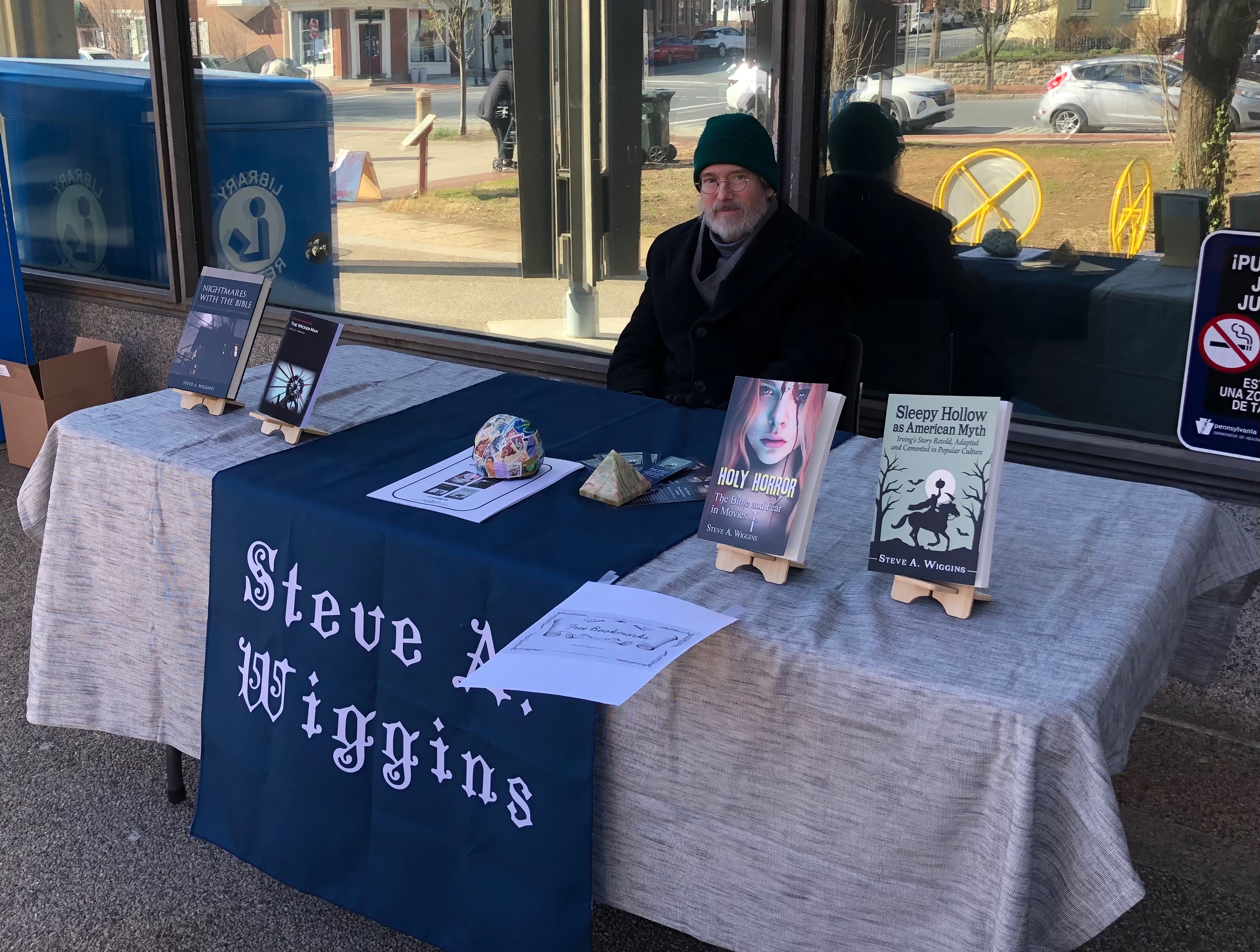
So, my first royalty statement for Sleepy Hollow as American Myth arrived.  It is my poorest selling book ever, not even notching up to Nightmares with the Bible, and that one was twice as expensive.  A couple things: I know that nonfiction books had a hard year last year.  Also, “academic” books tend to do better in the subsequent years after their initial release, for those of us with no name recognition.  In any case I’ve decided to try focusing on fiction.  The compulsion to write is deep-seated in me.  My nonfiction books are creative explorations of ideas neglected or never before brought together.  They’re also priced too high for the trade market.  I was pleased to see, recently, that The Wicker Man is now in over 400 libraries, according to WorldCat.  That makes it my second best-selling book, after Weathering the PsalmsA Reassessment of Asherah has been viewed over 9000 times on Academia.edu.

So, fiction.  I write my fiction under a pseudonym.  I currently have one novel out for consideration and another very close to being ready.  I have several in the wings.  What strikes me as crazy about all of this is that I’m told (as I have been since high school) that my writing is quite good.  I’m not the one to assess this claim, since I’m far too close to it.  It does make me wonder, however, what it takes to earn a little cash at it.  My last royalty check for a new book was half of what they usually are.  Good thing inflation is under control and the economy booming.  So I hear.  I do believe that the most impactful books tend to be fiction.  People like a good story.  And they can last for many decades.  The nonfiction that stands the test of time is a very narrow shelf indeed.  At least compared to our fictional siblings.

For fiction you need to keep at it to improve.  I think of all the years I’ve poured into my last four nonfiction books.  The only real critique I’ve seen of Holy Horror was that it was “too well written.”  When’s the last time someone said such things about fiction?  Oh, I’ve got three nonfiction books underway as well.  One of them I’m quite excited about.  But then I take a look at this royalty slip sitting in front of me and wonder if I’ll ever learn.  I have to write.  I’ve done that since fifth grade as a means of coping.  Here I am at over half a century at it.  There’s no danger of giving it up now. But the form it may take, well, that’s up for grabs.


Spells

I suspect the reason Incantation was recommended to me is that it is an intimate blend of religion and horror.  A Taiwanese horror film, the highest grossing ever for that country, Incantation is in found-footage format.  Fortunately the camera motion isn’t excessive, so I was able to watch it all.  The story involves a woman ghost hunter who accompanies her boyfriend and his cousin to a site with a reputedly haunted tunnel that they plan to film.  The tunnel is on the property of the boyfriend’s great uncle.  The movie, by the way, isn’t presented in chronological order, so piecing it together may take some afterthought.  In any case, the woman is pregnant when she visits the shrine and the family, who perform strange rituals, do not welcome her.  Nevertheless, the young men persist in exploring the tunnel and discover a curse at the end of it that leads those who see it to die by suicide.  There will be spoilers to come.

The movie begins with the woman reclaiming her six-year-old daughter from foster care.  After the event at the shrine, she had herself committed to a psychiatric hospital, but now that she’s recovered, she wants to raise her daughter.  Unfortunately, the curse remains.  The girl sees bad entities and can’t make friends.  The mother grows increasingly distressed and kidnaps her daughter when she is hospitalized.  She then takes her to a different shrine but the religious master is killed by unseen forces.  She then returns her daughter to the hospital and takes the camera back with her to the original shrine.  The idea, like Ringu, is that if you see the video you will be cursed.  The important difference, however, is that if the curse is widely dispersed it will be weakened.  The viewer is, in the diegesis of the movie, cursed.

This film is of interest for a number of reasons.  One is that the deity is malevolent and only by worshipping it and obeying strict rules can anyone who encounters it be safe.  In the western world there are no malevolent deities beyond Satan, and he’s not really a deity.  The family that worships this god want to be freed of it, but the god is in a tunnel on their land.  They inherited it.  There’s an element of possession at play as well.  Those who watch the video kill themselves because the deity possesses them.  There is also no way to completely destroy the curse—it can only be passed on and diluted.  The movie is quite well done although some aspects of it are familiar from other horror offerings.  Its relationship with religions of east Asia make it a particularly intriguing example of T-horror.


AI Death

I was scrolling, which is rare for me, through a social media platform where someone had posted a heartfelt comment after the death of actor Catherine O’Hara.  Beneath were two prompts, following an AI symbol, intended to keep you on the site.  The first read “What’s Catherine O’Hara’s current status?”  The second, “Why did Catherine O’Hara choose that answer?”  The second was clearly based on the post, where the question was what was O’Hara’s favorite role.  The first, however, demonstrates why AI doesn’t get the picture.  She is dead.  I found, early when I wasn’t aware of all of generative AI’s environmental and societal evils, and we were encouraged to play with it, that it could never answer metaphysical questions.  “Does not compute” should’ve been programmed into it.  And what is more metaphysical than death?

Carlos Schwabe, Death of the Undertaker; Wikimedia Commons

We are aware that we will die.  All people do it and always have done it.  Just like other living creatures.  We’re also meaning-seeking animals, which AI is not.  It’s a parrot that’s not really a parrot.  And we’re now being told we can trust it.  What does Catherine O’Hara have to say about that?  She has had an experience that a machine never will since it requires a soul.  I know that sounds old fashioned, but there’s no comparison between having been born (in my case over six decades ago) and living every day of life, taking in new information that comes through evolved senses (not sensors) and interpreting them to make my life either better or longer.  These are metaphysical realms.  What makes something “good?”  Philosophers will argue over that, but quality is something you learn to recognize by living in a biological world.  There’s a reason many people prefer actual wood to particle board furniture, for example.

Also, I’m waiting for a lawsuit representing those of us who put out content protected by copyright, such as blog posts, to sue AI companies for infringement.  While Al is off hallucinating somewhere, we’re all aware of the fact of death.  And coping with it in very human ways.  Ignoring it.  Pretending it won’t happen.  Or maybe thinking about it and coming to peace regarding it.  After it happens, whatever intelligence may be on this blog will reach the end of its production cycle.  And I suspect that Al will have taken over by that point.  And when there are none of us left to interact with, it will still post nonsensical questions, trying to get us to return the sites of our addiction.


With Thorns

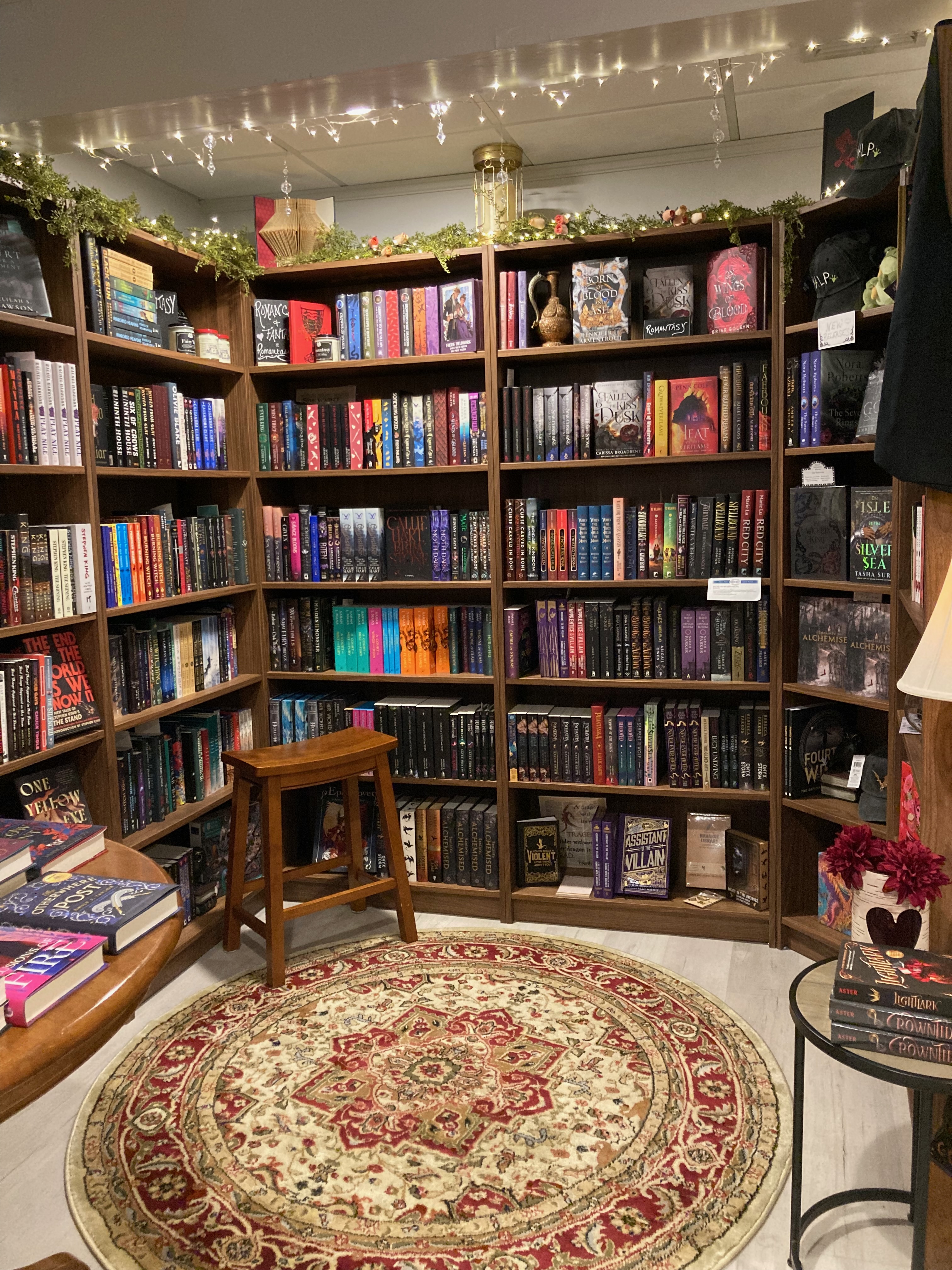
I’ve seen T. Kingfisher’s books on the tables of various bookstores and I’ve noted them.  I wasn’t sure if they were horror since the tables have always had ambiguous labels, such as Books to Read at Night, or some such.  I was in a new independent bookstore a couple weeks back and A House with Good Bones was decisively shelved with horror and so I decided to give this new (to me) author a try.  I’m glad I did.  Kingfisher writes in the vein of humor and horror, like Grady Hendrix.  This is a fetching kind of horror writing, if it’s done well.  A House with Good Bones keeps the pages turning with winsome writing as things start to get more disturbing and dark.  Samantha Montgomery, an archaeoentymologist (an archaeologist who studies insects, or an insect scientist who’s into archaeology) waiting for a dig to resume, visits her mother in North Carolina.  She learns that her mother has been acting strange.  There could be some spoilers below.

Overall, the plot is a bit complex, so some aspects will be left out.  Even if there are spoilers, you’ll need to read the book to reconstruct it all.  Fair warning.  The house seems to be haunted, but Sam doesn’t believe in ghosts.  And the haunting is unconventional—it focuses on roses.  The roses were planted by Sam’s grandmother, a woman she and her mother lived with, but who was anything but nice.  She was, however, dedicated to her roses.  While staying with there as an adult, Sam tries to do some research.  She learns that her great-grandfather was a kind of local wizard, or warlock.  Her grandmother wasn’t well liked in the small community where she lived.  As things begin to get creepier, Sam is forced to realize that despite her scientific training, houses can be haunted.  Her dead grandmother shows up, made of roses.  With the aid of a local witch, they banish the grandmother.  Then more trouble comes.

The grandmother had warned Sam of “the children underground”—her version of the bogeyman—and when the house suddenly becomes half buried, Sam and her mother learn that the children underground are real.  The novel also has a vulture theme.  I’m not doing a good job summarizing, since the story is, as I said, complex.  But it’s very enjoyable to read.  Kingfisher is funny and then scary, and passes easily between the two.  I enjoyed this book quite a lot, and I’ll be coming back for more.  And I think I know, after reading her, why Kingfisher is sometimes placed on ambiguously labeled tables at bookstores.  I always appreciate writers who make up their own genres while telling a compelling story.


Retro Fear

Maybe I shouldn’t have started.  This was, however, a recommendation from a friend, so I watched Fear Street 1994.  I say maybe I shouldn’t have watched it because I then learned that it’s a trilogy and I’m not sure that I want to watch the other two parts.  Not because the movie was poor, but because of time.  That, and I’m not a slasher fan.  At the same time, this movie does address the issue of class disparity.  The story begins in 1666 (the satanic number is intentional, of course) when a minister became a mass murderer.  This was because he was possessed by a witch and that witch comes back every few years in a new possessed person who kills several people.  In 1994 she possesses a mall worker who kills his friend and several others before being shot dead by the local police.  Class enters into it because the bad stuff takes place in Shadyside, a town right next to Sunnyvale, which is affluent and crime free.  Shadyside is where the poor live, work, and go to school.

A set of five friends band together to try to figure out what’s happening after the dead murderer starts pursuing them.  It turns out that two of the past murders, also undead, have converged on Shadyside to kill a girl who disturbed the witch’s grave, accidentally.  It’s also a love story but it leaves the situation unresolved because, well, part 2.  The problem with this kind of movie is that you don’t know if the unanswered questions you have will be addressed in the other two parts or not without watching them.  Since I’m not really fond of slashers and I’ve got other things to see and do, I’m not sure that I’ll get the answers.  And I don’t want to cheat by reading up on it.

Was Fear Street worth watching?  I’d say yes.  Despite the gaps, perhaps holes, it was nevertheless not a bad film.  It is very full of action and twists.  Some of the tropes are well-trod territory—adults never listen to teens, the killer can’t be stopped, an ancient crime keeps recurring—but there is enough new here to keep a viewer interested, at least through the first installment.  It is a little distressing to see the nineties being referred to as “retro,” but then again, 1994 was over thirty years ago.  And something about watching young people so alive (until they end up dead) does have a way of providing a bit of a thrill to even a guy my age.  But I’m not sure I should’ve started something I may not finish.


The Dismal Science

I kind of resent it.  I was was having a conversation with a friend about retirement.  He knows our circumstances (my middling and muddling career) and suggested that we might retire, noting we’d need to ask ourselves “do we really need this?” before buying everything.  I don’t resent what my friend said, but rather the fact that economists get the final word on when we rest our weary bones.  Why do we insist on measuring an individual’s worth based on the amount of money they have?  There’s no denying that’s what we do.  And there’s no denying that we age the longer we maintain this mortal coil.  We are all slaves to capitalism.  We are owned by our jobs, and since corporations are legally people in this country, that means we are owned by a person.  Oh, we can quit, but there goes your food, shelter, and medical care.  Is it really a choice?

The problem is that many people, far smarter than yours truly, have proposed much better, more humane systems.  Universal living income, universal health care, fair use of tax money we pay.  Since governments have been suborned by the wealthy—both capitalist and communist—such fairness measures are unlikely to ever take place.  Why do we allow this to happen?  Sometimes such situations lead to revolutions, a new system that will be equitable takes hold.  Only to be taken over by those who have access to more resources and who hope to aggrandize themselves.  The other day when I was checking out from a department store, the person at the register had to be in her late seventies or early eighties.  Instead of enjoying retirement, she was scanning overpriced items for people who also wouldn’t likely retire.  Our system is broken.

Photo by Blogging Guide on Unsplash

More than a mere economic readjustment, we need a philosophical one.  Years ago the United States went off the gold standard.  Our system of values changed.  On the surface it stayed the same, but the slow eroding of services the government used to offer has led to the phenomenon of people who should be enjoying a rest from many decades of working continuing to work so that they can survive.  Should such a person’s ship come in, they’ll soon forget their concern, I’m guessing.  They may feel sorry for others, but they aren’t likely to be activists for change.  The friend I was talking with was retired.  He was younger than me.  And should he want to buy anything he doesn’t have to ask if he really needs it.  Some of us tire and others retire.


Loss and Beauty

Losing someone close to you is never easy.  We of our species are closely interconnected, but family is where we feel the safest and, hopefully, most accepted.  There are many ways to deal with grief, but one of the more unusual is to take a job at the Met.  The Metropolitan Museum of Art is world famous, of course.  And Patrick Bringley, giving up a rat race job at the New Yorker (where he got to meet Stephen King, I might add), to become a guard at the Met, is the kind of thing to write a book about.  He frames it as a way of dealing with the loss of his older brother prematurely to cancer.  All the Beauty in the World gives you insight into a job open to just about anybody, but that has long hours and pay hardly comparable to the costs of living in New York City.  Giving up the rat race to spend your days looking at, and keeping people from physically interacting with, art doesn’t sound like a bad thing.

This memoir delves a little bit into spirituality, but not in any kind of religious way.  Then Bringley starts a family and after ten years decides to take his career in another direction.  I’m familiar with career pivots.  In my case, the choice was made for me and anybody who reads much of my writing (either fiction or non) knows that I’m trying to cope with it still.  In any case, museum work—I’ve applied for many such jobs, on the curator side, over the years—isn’t easy to find unless you’re willing to be a guard.  I know security guards.  It’s not a job that will make you rich, but it does give you access to riches.  Art is something we seldom take time to admire since, for most of us, museums are a weekend activity, and even then, only once in a while.

Museums begin with collectors.  Generally rich ones.  Those who can afford what the rest of us can only dream about.  They’re also altruistic places, for, as well as showing off, they give the rank and file access to what we tend to value even more than money.  The creative work of those we deem geniuses.  Bringley doesn’t just focus on the “Old Masters”—they are in here, but not alone—demonstrating that art can, and should, include the creative work of African-American quilters and woodworkers ivory carvers from Benin.  Museums are places that bring us together instead of separating us (that’s the job of politics, I guess).  And this book is a thoughtful way of dealing with loss.


Murder in Oxford

The Oxford Murders isn’t a bad effort as a thriller, but where it works is as dark academia.  This 2008 movie didn’t have significant box office take, so it may be one rather unknown.  Nevertheless, it is erudite, involving considerable debate about logic (including Wittgenstein) and higher math.  So much so that some might get lost.  Set in Oxford (and filmed there), it has the dark academia atmosphere down.  Since it’s so complex there will be spoilers here, so if you intend to watch it, best do that now.

Here’s a spoiler: the elderly widow of a famed mathematician is murdered by her daughter.  The reason for this is that the young woman has fallen in love with an American boarder at their house, but her mother, who has outlived her expectation with cancer—for years—is interfering.  Meanwhile, the border (Martin) is obsessed with Arthur Seldom, a brilliant Oxford mathematician.  Seldom was in love with the girl’s mother and decides to protect her by making the murder look like the work of a serial killer leaving Pythagorean symbols on the murder notes.  Since Seldom isn’t a murderer, he chooses as his “victims” people who’ve already died, making their natural deaths look like murders.  This throws suspicion off of the daughter, but when the code and the motivation is published in the newspaper, a man struggling with sanity because his daughter requires an operation, finishes the Pythagorean sequence by killing ten special needs students in a bus crash.  Seldom didn’t technically kill anyone, but when Martin confronts him Seldom points out that if he hadn’t boarded with the old woman, her daughter wouldn’t have fallen in love with him and killed her.

The movie is a little clunky, but I think it’s been underrated.  There are lots of ideas here that beg to be discussed.  Like many murder-mysteries, it has subplots meant to throw you off, one involving a disgruntled mathematician, and another involving a nurse who hooks up with Martin, but who has previously had an affair with Seldom.  None of this detracts from the movie as dark academia—something has definitely gone wrong in Oxford.  The widow’s murder was a crime of passion, leading to the deaths of innocents, rather like the butterfly effect that the movie discusses.  The problem seems to be with the writing.  It was based on a novel by Guillermo Martínez, which, I suspect will be added to my reading list.  As a movie it’s not great, but it is good for a dark academia fix.


Whose Smile?

Amazon’s smile logo is a mask.  I use Amazon when I need something specific and I don’t have time to run around to six or seven stores to see if I can find it (I usually can’t).  This means that many of the items come from other vendors and Amazon takes a cut.  Taking a cut, by the way, may be the best way to make a living.  In any case, I seldom write reviews of such orders.  Most of them are books and generally they arrive in the condition in which they’re described.  I did, however, receive a non-book item which did not work.  I tried contacting the seller and their email didn’t work.  I decided to alert the world.  So I took some of my precious time and wrote a review on Amazon.  The prompt promised me that if I wrote seven reviews they’d tell me a joke.  What can I say?  I’m easy.

So I reviewed books, etc. until I reached seven reviews.  The next screen simply said “Awesome! Thank you for helping other shoppers!”  Is this meant to be a joke?  What about that Amazon smile?  I just gave them ten minutes of my time for a promised joke that never materialized.  Now I’m grumpy.  By the way, I started the review process with the most altruistic of motives; I don’t want anyone else to waste money on a product that doesn’t work, and you can’t contact the seller.  To make matters worse, it was a Christmas gift, so that by the time it was open and tried out, it was too late to return it.  Is this supposed to make me happy?  I was looking forward to at least a dad joke.  None at all.  This happened a few months after I fell for a scam, so I’m not feeling especially generous to the internet today.

It’s a little thing, a joke.  I’m not good at making them up myself (although I’ve been told now and again that I can be witty).  Ten minutes easy labor, feeding the beast and the best they can come up with is “Awesome!”?  An overused word at that!  Don’t promise me a joke if you don’t intend to deliver one.  Probably some AI trick, if you ask me.  They lure you in with promises and when it’s all over you’re left with nothing.  (Kind of like the product I bought as a gift).  In the end, the joke’s on me.


Don’t Tank It

The Tank is a reasonably well done monster movie.  It isn’t great, but monsters are monsters and they can be appreciated in their own right.  The main problem of the movie is that it’s not terribly well written.  The premise is scary enough.  A family of three goea to inspect a property they inherited but which nobody in the previous generation had ever mentioned.  The house is in a remote cove on the Pacific, in rural Oregon.  They arrive to find it boarded up and in poor repair.  Ben, the father, begins making basic repairs while his wife Jules and daughter Reia try not to become too creeped out.  The water supply comes from an underground, eponymous tank that brings spring water into a reservoir.  There’s no electricity.  That night something tries to get into the house.  Ben assures his family it’s only a raccoon or some other woodland animal.

The tank, where the monster comes from, is certainly creepy in its own regard.  When they become convinced something may indeed be wrong with the property a realtor shows up with a generous offer from a buyer.  She is, unfortunately and predictably killed as she tries to leave and we see the monster for the first time.  This is a dilemma for all monster movie makers—when and how much of the monster to show.  We’ve seen monsters of every description and seeing a new one invites comparison with others.  This monster, a toothed amphibian, troglomorphic from having evolved in a deep cave, has some resemblance to the Demogorgon from Stranger Things.  It attacks by sound (A Quiet Place) and perhaps simply by sensing movement.  There are a lot of “why?” moments in the film; why didn’t they do this or that obvious choice of action.  But still, there’s a new monster.

Eventually Ben is able to contact police but the police officer (why did he not pull his gun when he first saw the monster?) is killed.  All three members of the family are attacked with Jules ultimately getting them to safety.  Part of what makes this a mediocre offering is that there is nothing profound about it.  The monster was released—actually it’s a family of monsters—when the tank cut into its sealed cave.  It attacks people, it’s implied, the way an axolotl defends its territory.  This isn’t explored in any detail.  There’s also the backstory of Ben’s family; his father and older sister were killed by the monsters, but his mother was deemed insane and responsible for the deaths.  So there’s a lot going on in the movie but no real resolution to the many ideas that are started by the story.  It’s a meh horror movie, but it does have a monster.


Laughing Matter?

I sincerely hope AI is a bubble that will burst.  Some of its ridiculousness has been peeking out from under its skirts from the beginning, but an email I had from Academia.edu the other day underscored it.  The automated email read, “Our AI turned your paper ‘A Reassessment of’ into a shareable comic.”  Let me translate that.  Academia.edu is a website where you can post published (and even unpublished) papers that others can consult for free.  Their main competitor is Research Gate.  Many years ago, I uploaded PDFs of many of my papers, and even of A Reassessment of Asherah, my first book, onto Academia.  This is what the email was referencing.  My dissertation had been AIed into a shareable comic.  I felt a little amused but also a little offended.  I quickly went to Academia’s site and changed my AI settings.

I didn’t click on the link to my comic book for two reasons.  One is that I no longer click links in emails.  Doing so once cost me dearly (and I didn’t even actually click).  I no longer do that.  The second reason, however, is that I know Academia’s game.  They want free users to become subscribers.  They frequently email intriguing tidbits like some major scholar has cited your work and when you go to their website, the only way to find out who is to upgrade to a paid account.  They do the same thing with emails asking if you wrote a certain paper.  If you own that you did, they’ll tell you the wonders of a paid account.  Since I’m no longer an academic, I don’t need to know who is citing my work.  I’d like to believe it’s still relevant, but I don’t feel the need to pay to find out to whom.

I am curious about what a comic version of my dissertation might look like, of course.  I am, however, morally opposed to generative AI.  In a very short time it has ruined much of what I value.  I do not believe it is good for people and I’m disappointed by academics who are using it for research.  AI still hallucinates, making things up.  It is not conscious and can’t really come up with its own answers.  It has no brain and no emotion, both of which are necessary for true advances to take place.  My first book has the highest download rate of any of my pieces on the Academia website.  Last time I checked it had just edged over 9,000 views.  AI thinks it’s  a joke, making a comic of years of academic work.


That House

In this season of deportations, thinking about what it means to be a refugee couldn’t be more important.  The horror film His House makes you do just that.  Bol and Rial are fleeing war-torn South Sudan with their daughter.  After a mishap on the overcrowded boat from France to England, their daughter drowns.  Kept in a refugee camp for months, they are finally allotted a council house in poor repair and a meager income.  If they violate any of the rules, which include living anywhere else or trying to earn their own money, they will be deported.  Bol tries to assimilate quickly while Rial is more tied to her traditional ways.  Then the ghost of their daughter, and other dead from the war and the crossing, begin to haunt them.  All the while they face the threat of deportation.  Some spoilers follow.

Rial recognizes the ghosts come from an apeth, a kind of witch that demands repayment for the crossing.  Bol sees the ghosts too, but denies it.  They will not go back, he insists.  When the social workers come to inspect the house, after Bol asks for a different place, Rial tells them a witch is causing the problems, causing the Englishmen to roll their eyes.  When Rial tries to escape, an alternative reality back in Africa shows that when Bol was denied a place on the overcrowded refugee bus, he grabs a random girl—their “daughter”—to get a place on board as the soldiers begin shooting.  The girl’s mother is left behind, screaming for her child.  The apeth is demanding Bol’s life for that of the girl he used to gain his freedom.  Rial, realizing that Bol will die for trying to make their life better, attacks the apeth and lets go of the image of their daughter.

This is a sad and thoughtful kind of film.  We seldom stop to think that refugees, in culture shock already, are stripped of everything familiar and made to feel as if continuing to live is itself a special favor.  They have their own ghosts too.  The real horror here comes through seeing the world through the eyes of someone who has experienced a high level of trauma.  To do so while Trump’s storm troopers are once again separating families, killing people at will, and deporting refugees, is not an easy thing to do.  Horror can be an instructive genre, and although the threat here is supernatural, as it often is in folk-horror, the real fear is all too human.


Hinge Years

I recently read about “hinge years.”  Some historians use this as a kind of shorthand for a particularly tumultuous year in the history of the world, or of a country.  Curious, a brief search brought up the year 1968 as one of these hinge years for the United States.  No doubt, a lot was taking place at the time.  Since I spent most of that year enjoying my last year before Kindergarten, my political awareness was pretty dim.  I found a website of an historian arguing that this was indeed a foundational period in US culture.  The hallmarks cited were political events (assassinations and their aftermaths, Vietnam, Democratic Convention in Chicago), science (circling the moon in preparation for landing on it), and music (Hair, the Beatle’s White Album).  Now, years are convenient hooks on which to hang events, but many of these events had earlier roots or later consequences.  The Vietnam War began in the fifties, we would actually land on the moon the following year, etc.  But 1968 was a pivotal year for horror movies.

Two game-changing films were released that year.  The unexpectedly influential Night of the Living Dead, by George Romero, changed the horror genre forever.  Low budget, shot in black-and-white, with no famous actors, that movie not only introduced the modern concept of the zombie, its political and social commentary rang through loud and clear, intentional or not.  Today it is considered essential viewing for anyone who wants to claim street cred as a horror fan.  An early “splatter” film, the use of gore was new (even if they used chocolate syrup for blood), and the action took place in rural America—not terribly far from Pittsburgh, but certainly not suburbia.  These departures showed what could be done.  Its success was record-breaking.

That same year Roman Polanski’s adaptation of Ira Levin’s novel Rosemary’s Baby was also released.  This movie brought religion directly in front of the camera to share space with horror.  To some extent this had been done before, but the seriousness with which satanism was played off against Christianity was unprecedented.   Okay, so The Devil Rides Out also appeared in 1968, but it wasn’t exactly a blockbuster.   Rosemary’s Baby was itself decried as satanic in some circles and it opened the door for The Exorcist some five years later.  Horror cinema would never be the same.  1968 was an eventful year, no doubt.  I’m skeptical that it was any more of a hinge than 1967 or 1969, but it sure did change the horror scene forever.


Uncomfortable Truths

Horror makes us confront uncomfortable truths.  I suspect Birth/Rebirth might be the kind of movie to contain triggers for some folks.  I’ve watched enough body horror to be somewhat desensitized, but I was uncomfortable at a point or two.  The movie follows two female medical professionals—Morales, a maternity nurse, and Dr. Casper, a pathologist.  Overworked, Morales feels she’s not spending adequate time with her five-year-old daughter, Lila.  Then the unthinkable happens; her daughter suddenly dies from meningitis while she’s at work.  Casper, who works in the same hospital, handles the corpse of the young girl, but Morales learns the doctor has taken her home and, more than that, brought her back from the dead.  Horror fans know that reanimation is always problematic.  In order to discuss this, however, I may need to resort to spoilers.

Casper, ever since her own youth, has been working on regeneration.  She’s somewhat emotionally disconnected from others, doing this work for the sake of science.  Morales, however, refuses to leave Casper’s house once she learns her daughter is there and alive.  The two work together to supply the serum needed to maintain Lila.  She begins to speak and walk again, but the serum, derived from stem cells, requires a very specific profile that Casper has.  When an infection prevents Casper from conceiving (and providing the necessary tissue) Morales has to start taking amniotic fluid from another woman with the rare profile that matches Lila.  Until the other woman decides to change hospitals.  The story, which drew inspiration from Frankenstein, is sad, just as that book is.  A woman has to lose the same daughter twice, but that’s not the end of the story.

I think I’ll leave it there.  The tale raises ethical issues and probes the lengths we will reach not to let go of those we love.  The maternal bond may go as far as, if not murder, manslaughter.  The bond is emotional and Casper works it for the science of regeneration.  If life can be introduced to apparently dead tissue, why shouldn’t it be?  But the result is never satisfying.  There is a permanent line between life and death that can’t be crossed, no matter the emotional need or scientific curiosity.  And yet.  And yet.  Birth/Rebirth takes us to this juncture and forces us to look.  And it makes the viewer wonder just how far they might go.  The answer might make a person squeamish.  But then, uncomfortable truths are like that.