Pagan Virtue

We are products of our place of birth. One of the truly amazing things about human culture is how quickly it can evolve. As biologists have noted, populations separated by natural barriers such as mountains, big rivers, or oceans, tend to evolve in different directions. They adapt to their environment. So far the world-wide web hasn’t flattened our differences out completely with a cultural creole, and it may be best to celebrate it while we still can. In an article in The Atlantic, “Why the British Tell Better Children’s Stories,” by Colleen Gillard, answers her titular query with religion. The British, she suggests, are better attuned to their pagan past. In the United States children’s stories tend toward the moralistic, reflecting the Puritan values that some decry as absent from culture. British stories lean toward magic and earthiness in a way that American stories don’t.

Any generalization opens itself for criticism. (Including the generalization I’ve just made, I suppose.) Still, I think Gillard is onto something. Children are magical thinkers and have to be taught not to see what they think they see. We acculturate them into the dull, adult world of making money instead of magic. American kids get started on the entrepreneurial pathway with early moralizing about hard work and attaining goals—just glance at the titles mentioned in the article and see if you can disagree. Christianity arrived in Britain much, much earlier, of course. There it encountered a pagan sensibility that tempered its increasingly harsh edges. Puritanism took the remaining joy from the good news and made it into a very serious belief system, indeed, with eternal consequences that persistently threaten any enjoyment of life. You constantly have to examine and prove yourself. The British allowed their former earthiness to survive, as early epistles to Augustine (not of Hippo) demonstrate.

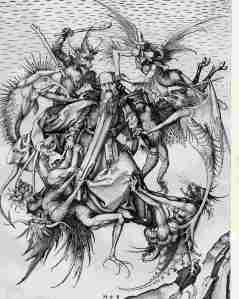
389px-The_Snake_in_the_Grass_or_Satan_Transform'd_to_an_Angel_of_Light

The article ends by reflecting on recent American dystopian novels for young adults. These, Gillard suggests, reach toward fantasy in a way earlier efforts didn’t. I wonder if a bleak future is the natural consequence of founding a nation under the eye of an ever watchful, and vengeful, deity. Even a Trump may appear righteous with a Pence in his pocket. We’ve got to return to those old Puritan ways of subjecting women to men to make America great again. As this mass insanity continues to grow and infects the internet, dystopian futures appear to be strangely prescient. The C. S. Lewis of real life was not the grinning evangelical that modern-day candy Christians suppose. He knew a faun wasn’t what it seemed.


Consciousness Times Eight

SoulOctopusPerhaps the characteristic that marks our species most distinctly is its arrogance. Conscious of who we are (we think) we stake the claim for minds for ourselves alone while all the evidence points away from that very conclusion. Naturalists are castigated for “anthropomorphizing” animals by stating that they have consciousness too, or—oh the heresy!—personality. Any of us who’ve spent time with two or more of the same non-human species, however, know that personality is a given. Animals think and feel and, yes, act on their own view of the world. I have to admit I fell in love with Sy Montgomery’s The Soul of an Octopus. I’ve read animal books from my youngest days, but finding an author so forthright about the feeling of getting to know another species is rare. And I learned tentacles full of information about octopuses. I had already known that octopuses are intelligent—I hadn’t realized just how smart—but since my interactions have only been with sleeping cephalopods on the opposite sides of aquaria glass, I had little to go by.

Throughout her charming book, even if the evidence is anecdotal, Montgomery reveals the personalities of the octopuses she got to know at the New England Aquarium. The reader can be left with no doubt that these are animals with personality, different from one another and strikingly conscious. We can’t define what consciousness is, but I tend to agree with Montgomery that it is what many people call “soul.” She admits that her religious tradition would likely frown upon her willingness to share such a valued commodity with an animal—an invertebrate, no less—but surely she is right. Many, if not all, animals have a form of consciousness. Heaven will be a much more interesting place for it.

Please don’t confuse my enthusiasm with sentimentalism. Those of you who regularly read this blog will know that books on animal intelligence by a variety of scientists make up a steady part of my literary diet. Biology, however, often has a difficult time in a world where physics and chemistry are treated with reductionistic glee. I was strangely satisfied when Montgomery mentioned that Stephen Hawking signed the Cambridge Declaration on Consciousness which proclaims humans alone are not the guardians of this phenomenon we don’t even understand. The Soul of an Octopus was one of those books that I couldn’t wait to keep reading, even if it meant being on my long commute each day. And I can’t help but think of how much intelligence we squander by claiming that only our own kind possesses it.


Look Both Ways

Like many kids of the sixties I grew up watching Batman. I mean Batman—the campy, goofy, live-action version of the caped crusader that was must-see TV for young boys and other hero wannabes. This was all hung upside-down, as it were, by Tim Burton’s reboot of the troubled crime-fighter. Then came Christopher Nolan’s canon. The Dark Knight remains one of my favorite movies as it seems unstintingly honest. We are all part Joker and part Batman. Neither is ideal. More than that, this movie was my first introduction to Harvey Two-Face Dent. You see, I didn’t grow up reading Batman comics, and the television adventures never featured him. At least not as far as I can remember. Two-Face is a fearful foe because you can never tell when he’s telling the truth. That can be very scary.

The other day I asked my mother about someone I remembered from church growing up. This was a woman I hadn’t seen since the Nixon Administration and I was curious how she was doing, and even if she was still alive. My mother told me she was still around, but she doesn’t talk to her any more because the friend is “two-faced.” Among evangelical Christians this is one of the most feared of epithets. Telling different “truths” to different parties is a certain way to demonstrate want of moral fiber. Hypocrisy. It’s also a non-refundable ticket on the bus heading south, if you get my meaning. Christians want to be thought of as honest, if nothing else. Harvey Dent would’ve had real trouble being an evangelical (with some noteworthy exceptions).

JanusVatican

Businesses, however, are disciples of Janus. I often ponder the sheet number of items that companies classify as “public facing.” What, I wonder, is the antonym? I’ve even heard of corporations that will take legal action against former employees who honestly admit how business is done. No one is permitted to speak of what happens in the entrepreneurial boudoir. Corporations, under the law, are persons. They are afforded the secret inner life of real individuals. There was a “naked business” craze in early in the millennium, but that petered out. We have a public facing face and a reality that no one is allowed to know. Trade secrets. Information that only one corporation may have. Over in Gotham, Two-Face slips into a dark alley and escapes. In little white churches across the country, those who speak different truths are shunned. In the corporate high-rise, businesses are now people. They are, however, two-faced. I miss the Batman of my youth.


Up, Up and Away

OurSuperheroesIntellectuals often have difficulty, it seems, taking popular culture seriously.  I remember feeling slightly guilty taking a class on Science Fiction in college and actually getting credit for it.  At the time—I remember the Dark Ages—a course on comic books, or even superheroes, would’ve been laughed out of the academy.  And not in a good way.  Monsters, likewise, were considered the opiate of the small-minded.  I’m not sure what happened to turn all of this around, but I think my generation growing up may have had something to do with it.  Scholars began to pay attention to more than the cheap paper and eye-catching, if impractical, costumes.  There were, unnoticed by standard readers, messages embedded in comics.  Superheroes may have been telling us something about ourselves.  Now tenured professors can write about various caped crusaders without fear of ridicule.  Some of the books are quite good.

Robin S. Rosenberg’s Our Superheroes, Ourselves, is a rare example of a uniformly fascinating edited volume.  Contributions from a variety of psychologists and psychologists explore several of the deeper aspects of  the superhero phenomenon.  Insightful and thought-provoking, this little book gives the lie to the frequent admonition of my youth that reading such things was a waste of time.  Anything but.  Now, I didn’t have the level of commitment to comics that Big Bang Theorists do, but I recall being entranced by much of what I read.  Some comic panels are still vivid in my head, although I haven’t seen the original in more decades than I’d like to admit.  They are, as one of the essays suggests, a form of modern mythology.  Another form of modern mythology is the movie.  Superhero movies are discussed as well as the print versions.  These cheap, easily read books were more, it seems, than meets the eye.  I’ve fallen a little behind in my superhero movies, but perhaps it is time to start trying to catch up with Superman.

What is really striking, to me, is the discussion of super-villains.  As more than one contributor points out, you can’t have a superhero without the nemesis of an arch-criminal.  This quite naturally leads to the discussion of abstracts: good and evil.  Early comics tended to be Manichaean in this regard.  In our world evil may be much more subtle than it appears on the outside. The book appropriately ends with a reflection on morality. More than one ethical system may be found in superhero tales. Super-villains, apart from becoming role models for some political candidates, allow us to explore our own dark sides. In the end, however, we know that Batman must overcome the Joker, no matter how appealing he may be.


Auld Reekie

DSCN3452

Those of us who once tried to storm the walls of academe from humble beginnings soon learn our lesson. This is a guild meant only for those whose parents knew enough to suggest an Ivy League education. Those whose parents have never heard of Harvard (they exist!) and who don’t know what an Oxford is aren’t really well-placed to give advice on these matters. At a small-town high school you couldn’t count on a guidance counselor noticing your academic prowess as anything more than a statistical blip in a non-challenging career. I learned about the Ivy League too late. It was, therefore, a very pleasant surprise to have an Edinburgh colleague ask me to write a piece for a Cambridge Companion. I don’t have the contract yet, but even the invitation made my day. Maybe my month. Or career.

I spend my days commissioning just such works for a different press. I know hundreds of colleagues. Only one ever said, “would you consider writing…” I’m not being entirely fair here. I’ve been asked to contribute to Festschriften. Such volumes are the highest praise an academic can be given. John C. L. Gibson, of blessed memory, was the first honoree. Nick Wyatt was the second. Simon Parker, also departed, whose Festschrift is currently in the works, was the third. I’ve been asked for others, but regular research is beyond my reach with my current schedule. I can churn out an original article once a decade, it seems. The ideas are still there, alive and popping. The time, alas, is not.

So I’m happily sitting here thinking of how to write a Companion article. The colleague who asked me is someone I recently met. He found out that I had attended his alma mater and wondered why I hadn’t landed a regular teaching post. Edinburgh University, in the larger world, is a recognized name. I can’t see through the ivy to discern it on this side of the Atlantic, but I’m assured it’s still there. Recognizing that those who fall between the cracks can still sink a taproot and make a contribution, he asked me if I might consider it. He had me at Edinburgh. School loyalty still counts for something, I’m glad to learn. For once I feel that I don’t have to apologize for having ventured to Scotland with only my transcripts and high hopes in my pocket (and with an indulgent wife by my side). Now I’ve been asked to write. I’ve gone all red, and I hide my face behind my hand. Of course I’ll do it.


Minding Souls

The mind, despite nay-sayers, is real. It isn’t an illusion. Emergent phenomena are often larger than the sum of their parts. One of the problems with the non-physical is that we can’t parse it precisely. “Mind” may be called “soul” may be called “personality” may be called “spirit.” You get the picture. Many scientists would answer “none of the above” to the question of which of these exist. Other scientists, not on the fringe, are beginning to see that the answers aren’t quite so simple. A recent piece in the mainstream Washington Post, dares to say what we all feel. Or at least many of us feel. There are realities that religions have recognized for millennia, that demonstrate the existence of the non-corporeal. “As a psychiatrist, I diagnose mental illness. Also, I help spot demonic possession,” an article by Richard Gallagher, is worth reading. Gallagher, with a hat-trick of Ivy League-awarded degrees, believes in demons. They’re rare, of course, he says, but real.

The standard story—in large part correct—is that ancients misdiagnosed epilepsy and some forms of mental illness as demons. Undoubtedly their standard threshold was too low. Occasionally, however, they may have been right. Unlike what we’re sometimes told, the ancients recognized at least some mental illness when they saw it. There were non-functional people then, and while some may have blamed demons, others saw them as people who don’t think like the rest of society. Then there were the possessed. As Gallagher notes, humans with superhuman strength, speaking languages they never learned, and yes, even levitating, have been witnessed by credible viewers. Very rare, yes. But also very real.

Despite the need that many feel for freedom, we are, as a species, fond of laws. We want to know the rules and we’re quick to call out those we catch cheating. We’re so fond of laws that we apply them to nature and claim that natural laws can never be broken. Well, at least not above the quantum level. A friend shared that this concept of applying legal language to nature is a fairly recent development in human thought. The idea of a law, however, requires someone to oversee and enforce it. One of the subtleties here is that any enforcement that takes place requires a measure of value, and value, as much as we all treasure it, simply can’t be quantified. Is gold more valuable than silver? It depends. The value comes in assessing its usefulness. Laws separate good behavior from bad behavior. And, if many credible people are to be believed, the behavior of mind sometimes defies the laws of nature.

Buer


Holy Oak

IMG_2876 copy

It was already ancient when first discovered by the early European colonists of New Jersey. The Basking Ridge oak is a well-known and time-honored New Jersey denizen. Over six centuries old, the white oak, it seems, is dying. Like it’s cousin, the Swamp Oak that I mentioned back in January, this tree is dear to many in the state. It is also historical. An article in the New Jersey Star-Ledger begins with some religious associations: George Whitefield, one of the evangelists responsible for “the Great Awakening” from which we’re still trying to awaken, preached under this very tree. George Washington also knew it. It has been tended and cared for by the town for so long that there is a reluctance to let it go. In the words of another New Jerseyan, “well everything dies, baby, that’s a fact.” Job, in a more optimistic moment, declared, “there is hope for a tree.” Like the Good Book, the good folk of Jersey wax religious about this sexcentarian, and for good reason. The human outlook is far too short.

Think, for example, of what was happening when the Basking Ridge oak was a mere acorn. In the early 1400s there were no Protestants yet. That didn’t stop Jan Hus and Joan of Arc from being burned at the stake, however. Although the Vikings, and perhaps others, had ventured here from across the ocean, North America was blissfully unaware of those waiting to claim for their own any land they could set foot on. Good thing too. The Inquisition was still underway and witch trials lingered on, flying in the face of enlightenment. Cambridge and Oxford University Presses were, in some sense, neophyte businesses. This Eurocentric view overlooks the great achievement of Machu Picchu down south. As the Dark Ages were beginning to lighten, this oak began its life’s journey. We who are a mere blink of its slow eye are still spouting hate for those who are different and are determined that nobody should outlive us.

The Holy Oak, as it is known, stands beside a Presbyterian Church. One of the trustees of the church is in charge of the tree. In the article he stated that this is about eternal life. From our perspective, trees seem to live forever. That’s because we are so dreadfully short-sighted. It’s surprisingly easy to become nostalgic for a tree so old. In terms of accomplishment, we think humans are exceptional for surviving a century of all the misfortune we dish out for one another. The tree, however, seems innocent by comparison. We’re changing the climate even now, making it more difficult for trees to thrive. We continue to shoot people for the color of their skin and although we don’t call it witch-hunting any more we still find ways of oppressing anyone who is different. At this rate we may need six more centuries to come to our senses. If only we had the perspective of a tree.


Sense of Place

Visiting the Holocaust Museum was one of the most wrenching activities of my life. I was in Washington DC for a meeting of the Society of Biblical Literature when my friend Jeff came across the Atlantic to attend. He wanted to see the Museum and I reluctantly agreed to accompany him. About half-way through I found a secluded bench, sat, and wept. I simply couldn’t take the weight of the sadness and cruelty this represented. I have trouble telling another person “no,” let alone striking, or harming them. How could millions of people simply be discounted? Murdered for being born who they were? Could there be anything more inhumane? A quote from the recently departed Elie Wiesel hung on the wall behind my bench. “Never shall I forget those moments that murdered my God and my soul and turned my dreams to ashes.” My wife asked if I would be okay. “I don’t know,” I said.

I have to admit to being a Pokémon illiterate. I don’t know who or what Pokémon is. I do know it/he represents a game universe that originated in Japan. The last “game” I ever played was Myst. Before that it was Pong. I suspect that growing up without computers made real games seem, well, real. I don’t have time for computer games and I wouldn’t know an X-Box if if fell on my head. I don’t even know if they still exist. You’d have to be dead, however, not to know that Pokémon Go is all that anyone cares about any more. An app that lets you “find” Pokémon in various places, adults and kids alike are blindly walking out in front of cars to get her/it. One of the undying lessons of my childhood was, “if the ball rolls out into the street, don’t run after it!” Natural selection at work.

So what do Pokémon and the Holocaust Museum have to do with each other? Nothing at all. Or thus it should be. A story in the Washington Post shares the plea of the museum for people to stop seeking Pokémon there. One of the sites programmed for the whimsical creatures is more sacred than a church, synagogue, or mosque. Genocide is not a game. Headlines boldly proclaim that Pokémon Go is great for businesses. The Holocaust Museum is not about business. It is a mass grave on a scale that the human mind simply can’t conceive. A place to remind us where hatred and fascism lead. As difficult as it may be, we need to visit that terrifying place and we need to remember that it began as distrust of those who are different.

Photo credit: AgnosticPreachersKid, Wikimedia Commons

Photo credit: AgnosticPreachersKid, Wikimedia Commons


Biblical Literature

HB as LitIt must be difficult to write a Very Short Introduction. Although the series is published by Oxford University Press, I’m not being a shill. As someone who writes the equivalent of several of these little books a year, I imagine it must be nearly impossible to confine what you need to say to such a small space. I recently read The Hebrew Bible as Literature: A Very Short Introduction, by Tod Linafelt, and I imagined the anguish of my colleague as he had to decide what to leave out. Professors these days appreciate short books because there is an actual chance that students might read them. The Bible itself is intimidating as a textbook—massive and brooding as it is. Then, in addition to the Ding an Sich, the instructor also has to provide interpretive tools. One of the most common these days is that of the Bible as literature.

This obvious assignment is not without dispute, however. Literature is defined by some as a secular category. The Bible, as a set of one, is a holy book. That is to say, it can’t be considered literature at all. As a collection of written texts, however, the Bible can be understood as a literary venture as well as a sacerdotal one, and for many schools this is the only way the Bible can be legally taught. Not only that, but almost all scholars now realize that, protestations aside, the Bible is literature. It is one of the great books of the western canon. Civilization for huge swaths of the planet was based, in some way, on this book (the Bible, that is). Understanding it as literature is the venture of a lifetime, and condensing that down to an easily digestible Very Short Introduction is no mean task. Linafelt performs his duty admirably. The basics of prose and poetry are covered, as well as their interaction. The examples he chooses are compelling and I learned quite a bit myself, even having taught the Bible many years.

As I read, it struck me that the main objection to the Bible as literature revolves around the concept of truth. Linafelt raises this question early, and it stayed with me throughout the book. In a kind of sacred exceptionalism, “Bible believers” treat literature literally. Ironically, this can lead to grave misunderstandings. Truth, however, is a difficult concept to pin down. Many people equate literature with fiction and truth with fact. Truth is actually a bit more fluid than that. As any poet knows, some truths can’t be expressed in prose. Or history. Or philosophy. And some truths are best expressed in fiction. That brings us back to literature as a form of truth. I suppose that’s a good thing too, because were I to write much more I might be in danger of accidentally composing a Very Short Introduction. As long as I’m being a shill, just consider this a very short introduction to a Very Short Introduction.


For the Dogs

DogsThatKnowYou know that feeling of being dropped into a very strange place?  Sure, it’s disorienting for a while, but once you get used to it, you start to enjoy your surroundings.  Now ask yourself: what if my entire way of looking at life is based on a faulty paradigm?  Many, I suspect, will drop out at that point.  There’s strange, and then there’s going too far.  For those wedded to the idea of finding the truth, however, weirdness is part of the journey.  I just finished reading Rupert Sheldrake’s Dogs That Know When Their Owners Are Coming Home.  Yes, it felt like the room was spinning (actually, I read it on the bus, so that might’ve been true a time or two), but it confirmed something I’ve suspected for many years.  The reigning, mechanistic universe paradigm is wrong.  Please don’t take this as an anti-science statement.  Sheldrake is a bona fide scientist, and I’m an avid reader of science books.  It’s not so much that science is wrong as it is that science doesn’t go far enough.  Ever since the Industrial Revolution—not coincidentally—we’ve been informed that the universe is really a giant machine.  We can figure out how it works using this squishy stuff in our heads that insists we can find Pokemon everywhere we look when it’s not busy solving the riddles of the mulitverse.

Sheldrake, who is given a wide berth by many scientists, states what any of us who grew up with pets knows: they know more than they’re saying.  Admitting up front that much of the evidence is anecdotal, Sheldrake provides empirical studies to demonstrate what folk say.  Dogs do know when their owners are coming home, before they are within sight, hearing, or smelling range.  His study, however, isn’t limited to dogs or to knowing when someone’s coming.  Animals, by virtue of their own minds, have abilities that we do not.  Since they don’t speak our language, we assume they are dumb.  In fact, as this book shows, a great many animals know a great deal more than we do.  The question is, if this is the truth why don’t we hear more about it?

We prefer, it seems, our truth to be qualified.  There’s a lot at stake here.  The reigning paradigm keeps us plugged into this corporate machine we’ve devised.  Our lifestyle cannot subsist without the subordination of animals.  We can’t give them abilities we lack, apart from tastiness.  If the universe isn’t a machine, it might open the door for a broader view of reality.  Maybe it is better to be post-Christian, but religion has proven benefits to humans (and perhaps animals).  Why does religion remain in a mechanistic universe?  Perhaps what we call “souls” are the same as “minds” and perhaps they aren’t the same as brains.  If we really do have minds, it is in our best interest to care for them, develop them, and improve them.  It may seem like a strange world indeed where your dog informs your view of reality.  Read Dogs That Know When Their Owners Are Coming Home, however, and see if you don’t find yourself wagging your tale, just a bit.


Ham’s Ark

Noah and his ark have been in the news quite a bit over the past several months. A friend recently shared a story on American News X about Ken Ham’s Ark Encounter, soon to open in Kentucky. It may be open already, but I haven’t been down yonder lately. I’m not going to attempt to match the well-deserved snark of Thomas Clay’s article, but I did find the design of Ham’s ark worthy of comment. I’m afraid I’ll have to wait while you check the article since photographs are covered by copyright and, well, I haven’t been down yonder. What first strikes me about Ham’s ark is that it has a rudder (as well as a keel). The Bible does imply that this was the first boat built, but then it also states the plans, like the Bible itself, came directly from God. The Almighty surely understands fluid dynamics, but I was wondering what the rudder was for. Did Noah plan on going someplace? Presumably in his flat world he’d have wanted to just stay afloat over the same place since, to quote another scripture, “there’s no place like home.”

Genesis doesn’t say anything about a rudder. In fact, apart from the inexact measurements in cubits, all we know about the ark are the following features:

•its dimensions (300 cubits by 50 cubits by 50 cubits; RMS Titanic, by comparison, was approximately 548.5 cubits long)
•it had three decks
•it had a door
•it had a window.

The Ham-style ark design is based on that advocated by Sun Pictures some years back as being especially seaworthy. Nobody knows what gopher wood is, but there was plenty of it around since all the plants were considered expendable in the face of a flood that would kill everything. But a rudder?

The biblical ark took its cue, somehow, from the much older tale of Utnapishtim. There are even earlier versions than that in the Gilgamesh Epic, but the parallels between Gilgamesh and Genesis have been known for well over a century now and are pretty remarkable. The original ark, however, was a cube. It had six decks. Now a cube of wood—even gopher wood—would sink like, well, a cube of gopher wood. Such a ship wouldn’t require a rudder to help it find the bottom of the New World Ocean.

Before my academic career took a tumble I was slated to write a book on Noah. Too bad that never happened, what with all the interest these days. A cottage industry in making arks has been launched. As modern-day arks sail, or at least get towed, through the present-day oceans, or are built high on dry ground, we can be glad for a rudder in the prescient mind of the sender of all floods.

Photo credit: Centre for Research Collections University of Edinburgh, via Wikimedia Commons

Photo credit: Centre for Research Collections University of Edinburgh, via Wikimedia Commons


Camping Season

Summer is the time for camp. I’m not into extreme sports, like sleeping outdoors in the snow, so in my mind, summer is the time for camp. While in college I spent two summers as a counselor for the Western Pennsylvania United Methodist Conference camps: Wesley Woods, Camp Allegheny, and Jumonville. These were formative experiences for me since I’d never camped as a kid (beyond sleeping on the front porch and an ill-fated attempt at Boy Scout camp one winter), and certainly not in a Christian context. My wife recently sent me a story in The Guardian about Jesus Camp. The documentary is a decade old now, and people are wondering if the religious indoctrination of children is child abuse or what. As always in such situations I tell myself the real issue is that you can’t understand Fundamentalism unless you’ve believed it. Really believed it.

IMG_2856 copy

Some psychologists claim children can’t conceptualize God. Many adults can’t either, but for those who try, what they believe is true. The Fundamentalist parent doesn’t attempt to deceive his or her child. The thought of having your own children suffer eternally in Hell is a wrenching, and very real one. A convinced adult is morally, viscerally, and utterly compelled to teach her or his child the truth. Anything less would be monstrous, hideous, and inhumane. Critics from the outside say that such nonsense damages children psychologically. I have to admit that watching Jesus Camp made left me feeling enraged and, in some measure, victimized. The untold reality, however, is that apart from some cases of deep insincerity, most Fundamentalists truly believe what they teach their children. They’re not trying to abuse any more than a parent who teaches their progeny that the stove is hot. They want the best for their kids and life is full of uncomfortable truths.

Richard Dawkins, notably, has argued that teaching children religion is a form of child abuse. The fact is nobody knows the truth about religion. All we can do, scientists included, is believe. Believe for or against or somewhere in the middle. God, by definition, stands outside the reach of empirical evidence. Perhaps it’s just a trick of consciousness, but we have to leave the possibility open. We don’t even understand consciousness yet. Rare aberrations apart, people love and care for their children. They try to give them the best that they can, and that includes their religion or lack thereof. I saw some strange stuff at church camp. It wasn’t in any sense “Jesus Camp,” but it’s safe to say it changed my life. On the brink of fully legal adulthood I was coming to learn that certainty was impossible, and the only honest way to be in the world was to admit that we all, in some form, believe.


Nazi Religion

CatholicismRootsAs a lifelong pacifist, I’ve never been a fan of war books. Indeed, war seems to be to an utterly useless waste of life and a source of herculean suffering. The fact that wars happen, and books about them depress me, causes me to avoid them. Still, Derek Hastings’ Catholicism and the Roots of Nazism is less about war and more about, as the subtitle phrases it, Religious Identity and National Socialism. As I read through this history of the early Nazi movement, it occurred to me that this was probably the first actual book I’ve ever read about it. My knowledge of the Nazis had previously come from articles, movies, and documentaries. And Hogan’s Heroes. Being largely of germanic pedigree, I suppose I bear some residual guilt. I have to remind myself that my ancestors had left Europe before Germany had even existed as a unified state. I like to think they would’ve left during the rise of the Nazis, if they hadn’t already left generations before.

In any case, I had no idea of how the Third Reich dealt with organized religion. I have heard anecdotal opinions from time to time that the Catholic Church should have been stronger in its condemnation of the atrocities that wartime Germany perpetrated, but I had no sense of their official outlook toward each other. Hastings makes clear that although Catholicism and Nazism came to distrust each other implicitly, at the beginning of the Nazi movement they were considerably more chummy. In fact, anti-Semitism was something they had in common. Many of the early member of the party were Catholics—some of them priests—who felt an accord with the developing ideology. As Hitler’s rise to power increased, his personal antipathy to Christianity widened the growing gap between his own outlook and that of the early Catholic Nazis.

The book has no schadenfreude for the church, however. This is academic history. As Hastings notes, few studies have focused on the early developments of Nazism. In today’s political climate, that struck a chord with me. It seems vitally important to be aware of how such movements start so that we can recognize them as they attempt to rise again. I have little confidence, reading the news, that we are any better in the 2010s than people were in the 1920s when political instability, economic distress, and hatred of those who were different led to a reactionary, fascist regime. Could it happen again? I look around at a culture in love with guns and endless, selfish gain, and distrust of those of different ethnic origins and I wonder. The early stages are, I think, the most crucial to recognize. Surely no German Catholics could’ve anticipated just what Nazism would become.


Words for Play

IMG_2849

Maybe you’ve seen it too.  Corporate-style psychobabble.  Memos land on your desk, whether real or virtual, jostling with neologisms, indicating the trendy new directions the business is going.  Apparently a legal requirement is that old vocabulary is vorboten in such information-bytes.  You can’t call a spade a spade—it might confuse somebody.  Do you mean a playing card spade, or something to dig with?  And do people even use spades anymore?  Why not call them loam-moving facilitators?  Isn’t that really what they are?  If you can get through a memorandum without a dictionary (slang or otherwise) you’re much more fluent in my native language than me. Or I.  I often wonder how much this has to do with an inherent inferiority complex.  A cog in this corporate machine has to prove it’s usefulness.  If nobody can understand what you’re doing, it seems, your job is secure.  I imagine think tanks as being like big aquaria, but with fewer viable ideas than captive fish.  I once read a memo that had to give each and every stage of a process a chic new name.  I felt like I needed to update my wardrobe and get a fashionable haircut just to read the thing.

Perhaps it’s just that a simply guy like yours truly prefers things explained clearly.  I can imagine a meeting taking place where nobody really understands what’s going on but they all have to nod their heads in approval for fear of feeling stupid.  New phrases, of course, have their place.  We needed a portmanteau for “telephone” back in the day, since there had been nothing like it before.  Most of my memos, by contrast, have been about plain old things that have been around for centuries.  Or millennia.  And if an old word is used, such as “idea,” it has to be in quotes.  Business must find a way of ensuring stakeholders that it’s on top of the latest developments.  Who uses a fax any more?  Most people consider email outmoded.  The period itself, I’ve read, is about to go extinct.  Still we have time to make up corporate-speak.

I work in the publishing industry, which is notoriously slow.  Unhurried attention to detail is a sign of quality.  If you want a book to be good, you need to take your time at every stage of the process.  Sure, a book can be churned out mere days after an important event, but if you read it you’ll see the corners that have been cut.  We even received an issue of Time once that had the “e” accidentally chopped off by a hasty cutting machine.  You want quality, you need to take your tim.  Adopting the newest coinage in the busyness business hardly seems a way for minting success.  Utilizing quality ideas isn’t the same as the fabrication of nonce words.  Of course, attention to detail takes away from time that could be spent making more money.  Churning out new verbiage creates the illusion of being ahead of the game.  If you need a dictionary to understand what your company is doing, perhaps it’s a good thing to work in publishing, even if you have to look words up online.


Joban Vampires

Interview VampireThe first vampire novel I ever read, I remember correctly, was one of the Dark Shadows series written by Marilyn Ross. I don’t recall which one, since I had to buy my books from Goodwill or some such vender utilized by the poor. Now, I’m really a squeamish guy and the sight of blood bothers me. Barnabas Collins, however, was a compelling character—deeply conflicted and a reluctant vampire. The combination of his sadness and the setting in coastal Maine kept me looking for Dark Shadows books every time we went shopping. It surprised me, given all that, that I had such difficulty getting into Anne Rice’s Interview with the Vampire. I started reading it years ago (it was also a second-hand copy, and, interestingly, the color scheme of the cover nearly matched Dark Shadows novels) and some eighty pages in put it down only to forget about it. Starting from the beginning a few weeks ago, I gave it another try. Although Louis is a conflicted vampire, the pace is languid and it was almost as if the self-pity was overdone. I was determined this time, however, to see it through.

One of the recurring themes of the book, and I presume the Vampire Chronicles series, is that vampires are not evil because of the Devil. In fact, there is nothing Satanic about them. Blame tends to fall on God for their state. The more I thought about it, the more the theodicy of the vampire began to resemble that of Job. Like Job, death for a vampire takes a long time. There is much suffering along the way. Louis can love, in a measure, and can loath himself. He never really understands what it is to be a vampire. The other undead he meets help to define him, but he can’t get too close. His life is a kind of Hell without Satan.

Rice’s vampires don’t fear crucifixes or shun churches. In fact, Louis takes a priest as one of his victims, sacramentally near an altar in a church. Religious imagery and discussion abound in the book. It truly is a vampire theodicy. Perhaps, for its day, it was the next step in vampire evolution. Bram Stoker, while the most famous contributor to the modern vampire myth, didn’t corner the market on defining the undead. When Louis meets vampires of the old world, they are mindless, plodding killing machines that even other vampires avoid. Rice’s vampires feel, think, and yes, theologize. I feel strangely satisfied now that I’ve finally finished the Interview. It was a vampire at my bedside for so long that it feels like an accomplishment to have finally laid it to rest.