Academic Freedom

Azusa Pacific University, 2013. Emmanuel Christian Seminary, 2012. Interdenominational Theological Center, 2012. University of Illinois, 2010. Carroll College, 2005. Nashotah House Episcopal Seminary, 2005. Unfortunately the list could go on and on. Academic institutions in the land of the free and the home of the brave dismissing faculty for saying or writing something that offended their doctrines. This is the land of my birth, and yet I’m still rocked by its permissiveness. That’s not permissiveness in that sense. I was latterly working on a paper called “the myth of academic freedom.” I know too many people for whom that myth has become a reality and all the while the governments, state and national, try to decide on more important issues such as whether or not to give children equal opportunity, our institutions crumble for petty points of pretentious pugilistic piety. Not only books may be banned, but those who potentially write them as well.

“You say you’re afraid for America,” Ellen Hopkins’s “Manifesto” suggests. Academics, of all people, should be afraid. Our society asks us to borrow thousands and thousands of dollars to become experts in some obscure topic only to release us from any possibility of finding employment that allows us to pay off said debt. “I don’t need no arms around me,” but I sure could use a podium in front of me. I am afraid for America. I am afraid for a nation that doesn’t defend its thinkers, instead following the wealthy to the peak of an unscalable Everest.

Academic freedom was once the guarantee that no question was disallowed, no thought anathema. We live in a time of pronounced conservative pushback, where those who feel threatened by knowledge persecute those who dare to think. Ironically in this situation many academics have become complacent. Having a place of your own, and the compunction not to make waves in this bathtub will allow your toy boat to float for many a year. Long enough to reach safe harbor. Beneath the surface shipwrecks lurk and books will never be written. Banned books are easiest to engineer at the aborted career stage. Even a pro-lifer knows that.

They don't write 'em like that anymore...

They don’t write ’em like that anymore…


Lola Lolita

LolitaAs a father, Vladimir Nabokov’s Lolita is difficult to read. With Banned Book Week upon us, however, and with my wife suggesting I read Reading Lolita in Tehran, I figured I’d better read Lolita in New Jersey first. It’s not the kind of book you want to be seen reading on the bus. As is well known, the novel is written from the sympathetic point of view of a pedophile. It is distinctly creepy and yet also strangely sincere. Effacing the distinctions between love and lust and healthy and ill psyches, the story draws you into the life of a single-minded Humbert Humbert and his twelve-year-old obsession. I had been prepared for the end of the story, having seen Stanley Kubrick’s cinematic version some years ago, still, this tale distresses. Banned books take us to places we’d rather not be, and cause us to linger there. This is part of their secret appeal. These authors are honest enough to make us question assumptions. You have floated out of sight of land.

Lolita, through euphony, if not something more, reminds me of “Lola.” The Kink’s hit. I first heard “Lola” while I was in seminary, although it had been released a decade and a half earlier (I tend to run a little behind the times). When I listen to songs I pay attention to the lyrics, and I was disturbed to find that “Lola” was a catchy tune with a (to me, at the time) disturbing message. I confessed to a friend that I liked the song, but wasn’t sure that I should. We ban songs just as we ban books, because they bring us to a place where we question what we thought we knew. In my case, it often doesn’t take much. My friend Dave gave sage advice not to overthink the whole thing. If you like a song, you like a song. Let the music play on.

“You say you’re afraid for children,” Ellen Hopkins’s second stanza of “Manifesto” begins. (I confess to following a different scansion of the poem, call it poetic license.) I believe, however, our fear is for ourselves. We know that we could have a monster lurking inside. Lolita does not encourage pedophilia. Like many social crimes, pedophilia is the manifestation of an illness that some people, like sociopaths, unfortunately suffer. The lack of empathy for others is a frightening thing indeed. It makes for some of the scariest movies, and headlines, that I have ever seen. We do ourselves no favors, however, by pretending it doesn’t exist. I know little of the life of Nabokov, but I know that he died in Montreux. I know that he could afford to live there at least in part because of the royalties from Lolita, a novel whose manuscript he had once attempted to burn. And I know that in Montreux “some stupid with a flare gun,” well, you know the rest.


Acts of Apostles

“Manifesto,” the poem that launched Banned Book Week 2010, was written by banned author Ellen Hopkins. As a perspicacious undergraduate I know pointed out, each stanza of this poem addresses an aspect of that strange cultural fear known as Banned Book Week. Her line, “false
patriots who live in fear of discourse,” in stanza one makes me tremble each time. You see, it is easy to believe that censorship applies only to Nazis goose-stepping around bonfires with books flying through the air like a Steven Spielberg movie, or even, more recently, The Book Thief (the book is better than the movie), or godless Communists. That fear, however, travels both forward and backward in time. The Patriot Act has been at work effacing liberty for several years now, and people too fond of fear are unwilling to withdraw it. The world of frightening ideas in which we live, however, is nothing new. Literary artists bring us to uncomfortable places. That’s why we read them.

If we turn history’s pages back to the Nazis, we find ourselves sitting in judgment over their cowardly act of book burning. Those who never read of the phoenix are swift to recreate the myth. But we do history a disservice if we stop there. I was recently reminded that burning books has a biblical precedent. According to Acts 19.19, while Paul was performing miracles in Ephesus, those who were converted brought out their books of magic and burned them, to the approval of the nascent Christian movement. A Bible that advocates the burning of books is ironic, for the Bible itself has been banned in parts of the world. What greater crime against humanity can there be than the deliberate destruction of its own cultural heritage? We don’t believe in magic any more, but we still burn books.

NewYorkSocietyForTheSuppressionOfVice

Owen Davies, in his book Grimoires, shows that the practice goes back even further, with Romans burning books of magic as early as 186 B.C.E. There is a perverse symbolism at work here. As someone who admires, but can’t afford, antique books, the thought of ancient documents intentionally destroyed appears as one of the most easily preventable of cultural crimes. Sometimes as I hurry through the Port Authority Bus Terminal to reach my gate, I see the military guards with machine guns and full combat fatigues and I hope that they don’t stop me to search my bag. The only thing I’m carrying is books. Books, however, convey ideas. Banned Book Week reminds us each year that ideas are essential to the life of the mind. They may be burned or banned, but they will live on. The cost, however, may never be fully recovered by the society that permits its ideas to be incinerated.


All Things Being Equal

Today the light and darkness are equal. The equinox is the great equalizer of the year, the day that reminds us summer’s ebullience is always, and ever will only be, temporary. From this day forth, for six months, night will dominate day. Religions the world over have offered responses to the increasing darkness. Autumnal festivals are among the most poignant as we can see the light diminishing, but we know nothing we can do will prevent it. Time alone cures this growing tenebrous atmosphere, until, as the solstice arrives, we dance, and sing, and drink, and burn candles to encourage the light to return. Return it does, on our universe’s ever rotating axis, bringing us around once again to when days lengthen and we turn our thoughts toward shallower things.

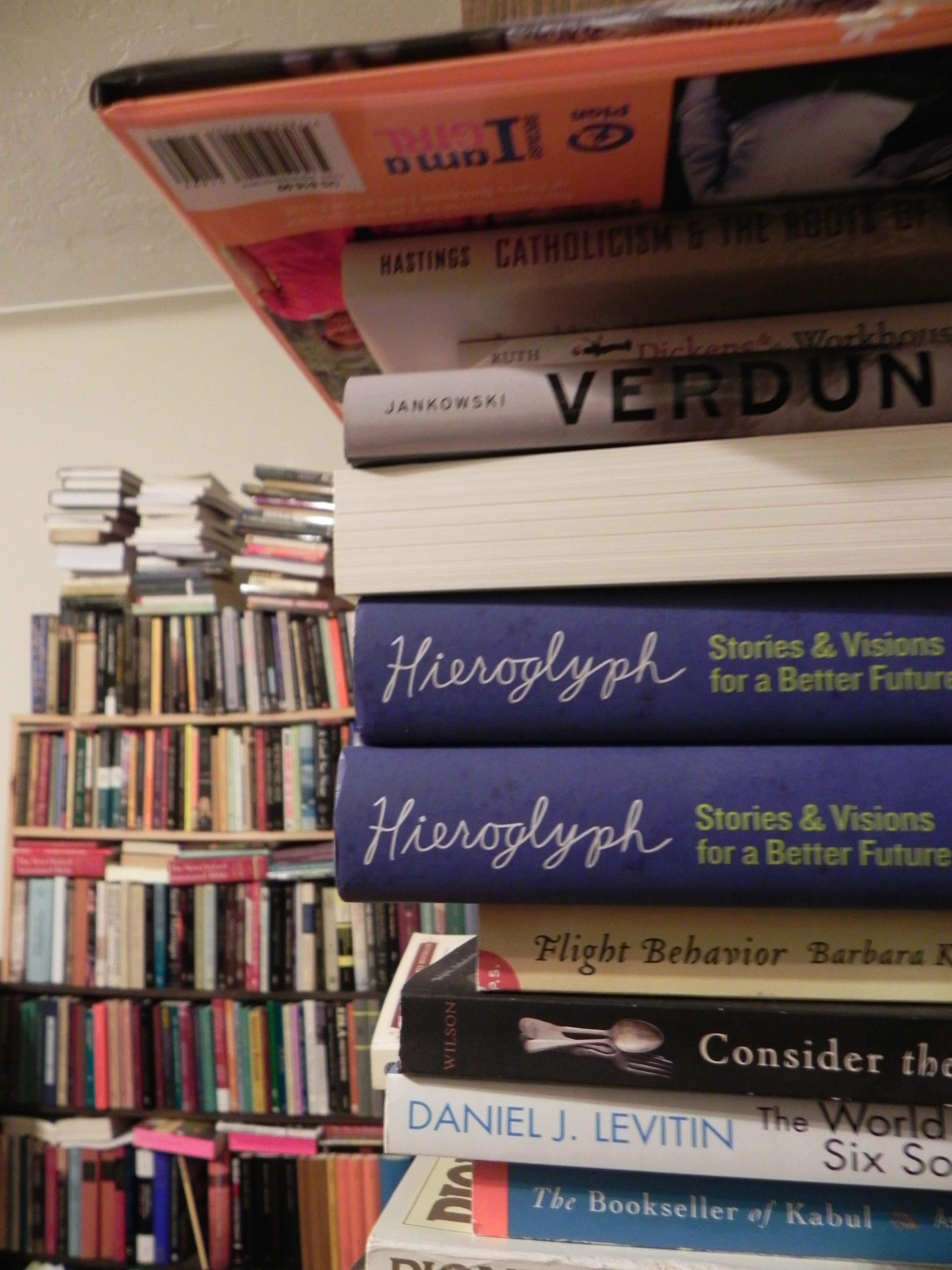
IMG_1177

The ember months, September, October (by association), November, December, each with an increasing sense of solemnity, invite us to read. Today begins Banned Book Week. I’ll be posting about banned books since, although my books deemed fit to print are so mundane as to offend no one, I stand in solidarity with any writer who has ever been told that her or his book is too violent, sexy, or depraved to be read. What thoughts are too dangerous to think? Religions will tell you, and so will pseudo-religions. Thoughts, however, are not so easily stopped. As an editor, I am a gatekeeper of sorts. Still, I know as an author that those I turn aside will persist. They will find their publishers. Their words will not be banned.

As an erstwhile writer I know that some of myself resides in each work clacked out on this keyboard. Those lucky enough to court editors with their efforts find the larger readerships. Some authors don’t even write their own books any more. Anyone can be imitated. The truly original, however, will always end up on someone’s banned book list. Our minds resist being challenged. We don’t want assumptions to be wrong. It’s too much work to have to think through all of this. It is easier to ban books than to have to try to comprehend them. As the darkness increases over the coming months, I will stockpile candles and light bulbs and huddle down next to a stack of books, secure in knowing that most of them have offended somebody along the way. And reading those books will only cause the light to grow.


Bargain Basement

Signs, in my experience at least, lend themselves to being over-read. How often a heedless moment suggests something more than was intended—signs try to say too much in too few words. Indeed, poets rather than marketers ought to be sought. I found myself in Barnes and Noble recently, since Borders is gone. In all fairness, I attended two independent bookstores as penance afterward. Nevertheless, in the corporate atmosphere of the last major brick-and-mortar chain, I saw a sign. Several, actually. One of the most obvious is how many tchotchkes the store had, as opposed to wall-to-wall books. Barnes and Nobel has never been particularly imaginative in its selection of floor stock, but now it is a great place to buy toys, electronics, and coffee. Maybe pick up a book as an afterthought on your way out.

IMG_1550

The front space just inside the door of a bookstore is prime real estate. Publishers have to pay extra to have their books displayed immediately inside the doors—something they reserve for sure-fire rapid sellers. The average customer will walk in, down the center aisle and there they will find promoted (and demoted) items, laid out on their own tables. So it was that I saw a sign reading “Religion & Spirituality Bargain Priced.” In fact, they’re free. Not the books, but religion and spirituality. Even in this secular world, people are not shy about buying books in these categories. Step into the religion aisle sometime. You may be surprised how much you find there. In fact, those who track the industry often include Christian books as a third major category besides fiction and non. We trust those who know enough to write books about such matters. The Bible, despite its detractors, is a bestseller by any measure.

Do we, however, value religion and spirituality? So often religion is portrayed as the root of all extremism while spirituality is relegated to the weak-minded. The science section generally takes up only half the shelf space of religion. People want to know what it’s all about. The rates are anything but bargain priced. Some religion may indeed be simple, but most religions are unexpectedly complex. Those who engage them seriously know there is more to life than just fact and fiction. There are middle grounds and outer limits. There are places that have yet to be discovered, let alone explored. We are in the infancy of intellectual awakening. Of course that shows in how quickly we’ve abandoned our bookstores and gone off after less weighty things. If you have a moment, though, on your way to the coffee bar, you might pick up some religion cheap, and who knows where it might lead?


Banned Magic

Grimoires“If you believe in the power of magic,” Eric Woolfson plaintively sang, “then I can change your mind.” A song that bewitched my younger years, when the atmosphere is just right, it can still bring a silent tear to my eye. Magic is a powerful elixir.

On my own personal almanac of holidays, Banned Book Week is one that takes the most preparation. In anticipation, for it is next week already, I read Owen Davies’ Grimoires: A History of Magic Books. Since this blog doesn’t get nearly the readership of a banned book, I might explain that witches are among my favorite topics. Despite that, and despite growing up with constant curiosity about religion, I only learned about grimoires recently. Davies makes it clear in his book that apart from some standard texts that have been around for a few centuries, the idea of a magic book is really relatively recent. Yes, the Egyptians and Mesopotamians had books of magic, but the concept of a grimoire only really fits the Zeitgeist of medieval Europe particularly well. Such books may draw on or cite oriental wisdom, frequently stepping into the forbidden territory of Arabic learning and alchemy, but they reflect the worldview of the Middle Ages when magic still seemed possible. In earlier centuries conjuring seems to have been subsumed under the miracles associated with Jesus, and we don’t hear much about magi beyond people like Simon Magus.

Davies packs a lot of information into his book, but my reason for focusing on it here, now, is the banned nature of grimoires. Many of them are considered rare and valuable books today, but in their day they were dangerous and forbidden. The concept that an idea can be suppressed is an odd one. In fact, many ideas have a very difficult time finding receptive minds. Once it is written down, however, an idea can circulate. The surest way to guarantee that it will is to ban it. People want to know what is so dangerous about this idea that it must be kept hidden. It makes an idea powerful, esoteric. Forbidden fruit, we all know if we’ll only be honest, is the sweetest.

Grimoires were considered most efficacious when written by hand. Although it took the printing press to proliferate such books, magic was believed to be most potent in the hand-written form. By writing text, one engages intimately with it. This is a reality we are in danger of losing in the computerized age. I grew up with only a second-hand typewriter acquired by my family when I was in high school. Most of what I wrote—for inspiration seldom comes when you’re sitting at your desk—was done by hand. My own little grimoires. Now we’ve added the interface of a keyboard. It is faster, and more efficient. Clinical even. But often the magic seems to be gone. And that is testified in many banned books. They especially, I would aver, believe in the power of magic.


Centuries and Millennia

This past week I had a look at Christian Century. It has been about a century since I’ve read it, so I noticed quite a few changes in that time. Magazines in general, I’ve noticed, have been on a weight-reduction program. They are thinner and more direct than they used to be. Also, the last time I looked at Christian Century, perhaps in my college days, it was still assumed that Christianity was the dominant paradigm for American society. Church attendance wasn’t stellar, but it seemed pretty solid. In my town, in any case, pretty much everything was closed on Sundays. There was a sense of status quo ante, perhaps it was just that social changes of the sixties and seventies were taking a while to settle into the cracks. My college town was pretty far from the forefront of theological, or even social developments, and enough other places must have still been as well. There was no denying that you had great odds of finding Christians, self-professing, in places outside the halls of government.

Christian_Century_Dec_2010

It was almost sad that Christian Century felt so diminished. Inside I was surprised to see so many ads and reviews concerning themselves with secularism and/or atheism. Attempts to understand, or convert, were the foci of seminars and books. Get things back to the way they used to be. A century ago. One gets the sense that subscriptions might have slipped a bit. The consensus is breaking up. Too much information—too many choices. People aren’t sure what they will choose after all. The Christian Century seems to have been the nineteenth or twentieth. We are sadder but wiser.

It could be that I’m misreading this whole thing. After all, a couple of the articles were written by big name scholars teaching at big name institutions. One of them, however, is admittedly not a Christian. Those who are are, it seems, trying to learn about this sea change that happened around them while they perhaps supposed everything was progressing as normal. Growing up where I did, I know that I was unaware that people could not, in great masses, not go to church. That other religions were not but minor blips in an otherwise uniformly Christian country. Considering the posturing of many televangelists, I’m not the only one who thought so. It may be that another Christian century is to come. Or even a millennium. Until that happens, however, the institutions that look backward instead of toward a future approaching very fast will feel, I suspect, that a century quickly slipped by and left them wondering in its wake.


ET vs UAC

When I first heard of “unaccompanied alien children,” I hope I might be forgiven for thinking about ET. Or EBEs as they’re sometimes called, “Extraterrestrial Biological Entities.” Instead UACs are serious enough to be assigned their own acronym, and serious politicians are making themselves frantic over the proper response. Should we allow children refugees from Latin America into the “land of opportunity?” This is a matter that calls for immediate debate! But should it? I am an American, but I am also a human being. And a parent. To me few things are more depressing than politics getting in the way of care for children. We fear their Spanish-speaking ways and incipient indigence. At the same time we as taxpayers fund Fundamentalist Mormons in their polygamy, reproducing beyond their ability to pay for themselves. The IRS turns a blind eye to those who claim food stamps and eschew birth control. There are children with nothing in this world standing at the door, and we debate whether to let them in.

I saw a recent opinion survey of major Christian bodies in the United States and their opinions on whether the children should be allowed to enter. White evangelicals came in dead last for the compassionate response of sanctuary. Meanwhile, reading the humanist literature, there is a strong sense that the ethics of this situation demand a, well, humanistic response. These are children, not political chattels. We will not purposefully endanger our own children. In fact, it is a criminal offense to do so. When it comes to somebody else’s children, we fuss and fume and I don’t hear many Fundamentalists saying “What would Jesus do?” in this case. Probably because the answer is clear: let the children come unto me.

Some decisions should be easy to make. Children are not political liabilities. They are often victims of adult complications of a world where a hug would solve many more problem than a gun or a bomb. I’m not sure when compassion became so calculating. I’m old enough to know that there are no easy answers, but I do believe some difficult decisions can be made much easier. Excepting Native Americans, all of our ancestors once entered this continent, largely without permission, as outsiders. Granted, they felt compelled to come—some voluntarily, some not. When their hosts suggested the party was over, they refused to leave. Now their descendants can’t decide whether children are a threat or not. We insist on their right to be born, but we don’t necessarily want to give them a home. When ET went home we all cried. Our tears for our own kind, apparently, are a scarce resource on this planet.

Are we all really just another brick in the wall? (Photo credit: Noir, WikiCommons)

Are we all really just another brick in the wall? (Photo credit: Noir, WikiCommons)


Disarmament

Maybe it’s just where I cast my attention, but debates over belief or unbelief seem to be everywhere these days. The word “militant” is used to describe belief (or lack of belief) systems with a worrying stridency. We want to prove what we believe, with violence, if necessary. So in anticipation of 9/11 Nick Cohen wrote a piece in the Guardian entitled “The phantom menace of militant atheism“. He points out, rightly enough, that you seldom hear of militant atheists being suspected of acts of terrorism. When a bomb goes off, we look for the religion behind it. For each pyromanic a religion can boast, it has a larger number of pacifists, in most cases. As Cohen points out, atheists aren’t blameless—Stalin and Mao remind us of that—but in today’s world of free agent religious ordinance missionaries we seldom, if ever, hear that the atheists have been plotting and planting explosives. In that Cohen is surely right. Humanists (to generalize) tend to hold humanity up, not blow it up.

By Creator:Tadeusz Cyprian (cyfrowe.mnw.art.pl) [Public domain], via Wikimedia Commons

By Creator:Tadeusz Cyprian (cyfrowe.mnw.art.pl) [Public domain], via Wikimedia Commons

There is, however, a strange disconnect that Cohen, and countless others, point(s) out—atheists (and I would broaden this to humanists) are considered immoral. As if the concept of deity were somehow a mark of moral maturity. Of as if a specific belief system were the default for humanity and the rejection of it somehow a willful attempt at evil. Humanists, however, have been around for a long time. We tend to overlook that fact because they weren’t busy plotting to destroy others. Being raised in a religious environment, I didn’t even realize that long before I was born quiet, ethical, good people had come to think that religion was a delusion. Sure, some humanists have weird peccadilloes, but as the headlines remind us, so do the religious. The problem comes in when militants are the measuring rod. “With what measure ye mete, it shall be measured to you again,” a pacifist once said.

At the root of all this blustering is the unrelenting urge to convert. Those who are truly convinced they’ve found the right way—believing or un—want others to see it their way. Problem is, others want the same thing, the other way around. Apart from Cohen’s observations, I would note that we never hear of tolerant believers or unbelievers attacking anyone. Physically or verbally. The mantra of live and let live applies up to the point that a belief system mandates harm and then the old contradictions begin to resurrect themselves. Some belief systems are, by dint of their very premises, immoral. The majority, however, are just fine. If the zeal for conversion can be kept under control. I can envision a world where evangelical atheists could exist side-by-side with those who believe and don’t believe at the same time. And they might even meet together peacefully if only we would leave the militancy at home.


Fighting with Monsters

GothicThe Lady and Her Monsters reminded me of Gothic. A friend of mine in seminary showed me this “shocking” movie by Ken Russell just after it was released on VHS (I always was fond of ancient history). To my young eyes this was a challenging film, but it rated higher in moodiness than scariness. Roseanne Montillo’s book brought the movie to mind because, it turns out, several of the incidents in the movie were based on fact. Perhaps I need to take a step back because Gothic never made it big, and many may not realize that the movie is about the legendary night Mary Godwin (soon to be Shelley) came up with the idea for Frankenstein. In an early nineteenth-century walk of fame, Percy Shelley, Mary Godwin, Lord Byron, and John Polidori decided to write scary stories, as a kind of contest. Only two ever made it to print, Polidori’s The Vampyre, which inspired Bram Stoker’s Dracula many decades later, and Mary Shelley’s Frankenstein. The movie, with Ken Russell’s famous flamboyance, traced an unlikely story of the friends conjuring a ghost and then banishing it once again before the stormy night is over.

Ken Russell had the reputation for being obsessed with the church and sexuality. These interests are certainly well represented in Gothic, where Percy Shelley, famously an atheist and believer in the supernatural, struggles to make sense of it all. Polidori, Byron’s personal physician, is presented as a Catholic who admits, when each has to confess his or her deepest fears, that God terrifies him. The friends (perhaps in an unwitting prelude to a television series by that name) explore sexuality and the supernatural through the long night. Waking nightmares meet them at every turn. They even have a skull of “the black monk,” a character attested in all sincerity, at one time, at the most gothic seminary in the Wisconsin woods.

“He who fights with monsters,” Friedrich Nietzsche opined, “might take care lest he thereby become a monster. And if you gaze long enough into an abyss, the abyss gazes also into you.” That which we worship is that which we fear. Certainly the Christianity of the Middle Ages had as much of Hell as of Heaven in it. Bursting out into the light of rationalism, it seems, did not banish the darkness after all. We still have many questions left unanswered, and many intelligent people have begun to question whether any one paradigm fits all of the evidence. I suspect not. Human experience goes in multiple directions at once. We have ladies, we have monsters, we have scientists, we have God. And on rainy nights we have movies that make us see that we have combined them all into a tale often repeated but never fully understood.


Horsemanship

Hi ho Silver, away! I’ve been pondering academic freedom. (It was suggested to me that I might discourse on such.) My academic career, three years cold in the grave, seems a long way away. In religious studies it is kosher to fire someone for academic freedom issues. Doctrine permits no challenges, for it has already been decided. This doesn’t only apply to conservative religions, but to academic institutions of all stripes. Nobody likes to be challenged. Somehow, since 9/11 any academic dispute in religion is a potential threat. I have known many academics to have lost their jobs. I also know how it feels to see colleagues go from grace to grace because they have an institution that will vouch for them. I don my black mask and saddle up Silver. Those of us raised in working class families watched that show, you know, religiously. And Gunsmoke, among other campy westerns. Caricatures of good guys versus bad guys. You know the story.

In a moment of self-delusion, I thought I might be asked to deliver a paper at this year’s Society of Biblical Literature annual meeting. I plodded along in my cumbersome way, reading a few books on academic freedom and interviewing a couple of its sacrificial victims. Turns out I was, well, self-deluded. It is probably for the best since I don’t wish to put myself forward as an expert on anything. Still, it felt like arriving at the front desk on that great and terrible day to find out your name’s not in the book after all, and so, where do you go now? Academics are running along as healthily as they always have. I was not raised knowing the difference between a salad fork and a meat fork. Some colleagues insist that universities crave the voice of hoi polloi; the authentic blue collar academic who worked his or her way up from a disadvantaged start through a doctoral program. I know it’s all just fancy talk. Academics are just as xenophobic as the rest of us.

Losing an academic position is easy. It’s like falling off a horse. I speak from experience here, having fallen off a big horse during a canter while helping underprivileged kids at horse camp one summer. It didn’t seem much like the wild west at the time. Seeing the world in a side view of the horse as you’re sliding off has a way of changing your perspective. You know the ground is coming fast. You just hope that your feet have slipped the stirrups. When it was all over the horse whisperer (or whatever they were called back then) publicly berated me for letting the reins fall from my hand. I should’ve slipped them over the saddle horn on my way down. Didn’t I know that the horse might’ve stepped on them? Rubbing my sore backside, I didn’t feel like such a masked lawman anymore. Silver had gotten away. At the dining hall I could feel the uncomfortable stares. Which one is the salad fork again? I never could keep my silver straight.

By Pleasure Island Uploaded by We hope at en.wikipedia [Public domain], via Wikimedia Commons

By Pleasure Island Uploaded by We hope at en.wikipedia [Public domain], via Wikimedia Commons


Fashions to Slaves

Howard Thurman was a theologian who held saintly status in my days at Boston University. As an African-American he’d experienced episodes while growing up that nobody should have to face. I remember him writing about being stuck with a pin in the hand by a caucasian girl who declared, “you don’t feel pain.” That image has stayed with me for decades. Unfortunately, that image hasn’t remained alone. I’ve been reading about slavery in the ancient world. No matter your race, slavery was considered a kind of ontological state. The color of your skin didn’t matter; your social status did. Slaves, you see, were less than human. When the slave trade began its hideous trans-Atlantic business ventures, essentially an entire race was classed as subhuman, because it is easier to feel good about mistreating a subhuman than it is a fellow being with a soul just like yours, if only purer.

This is not to deny the very real and troubling, criminal mistreatment that African-Americans experienced during the colonial period. The deeper problem with slaves was that of social status. If you look closely enough, you can always make someone “the other.” Heck, we’ve done it for millennia with those of the female gender. Something that has always bothered me has been how sociologists, political scientists, and historians constantly overlook the concomitant issue of class. In the new world we like to image we’re a classless society, but we’re not. The plight of many African-Americans today is economic. If you prevent people from having access to education and good jobs, they become much more easy to repress. It doesn’t take a genius to figure that out, just someone with the will to look. Those who write the history are those comfortably ensconced in offices and with research assistants, and people who empty the departmental garbage for them after hours.

Photo credit: Jun, Wikimedia Commons

Photo credit: Jun, Wikimedia Commons

How easy it is to suppose that the other is not the same as me! Most people do not like to challenge their preconceived notions. This is one of the real values of an education in religious studies. Take that intimate belief and put it under a microscope. Many would leave the lab screaming. Those who remain, patiently probing, learn uncomfortable truths. If the biologists are right—and there seems to be no reason to doubt it—all people evolved from common ancestors and we have more in common than we have that separates us. Skin color is only skin deep. Gender differentiation is merely in the service of species reproduction. What really makes us different is culture. And culture always requires classes. As even the ancients knew, some tasks are odious, and it is far more pleasant if we can compel someone else to do them. First, however, we must use our religion to explain why they can be made our slaves. If anyone doubts this, read Howard Thurman and see if he can’t change your mind.


Dark and Stormy Night

LadyAndHerMonstersI miss my monsters, especially when I stay away too long. I had eyeballed Roseanne Montillo’s The Lady and Her Monsters: A Tale of Dissections, Real-Life Dr. Frankensteins, and the Creation of Mary Shelley’s Masterpiece nearly a year ago in a busy Port Authority bookshop, and wanted to curl up with it right away. Well, work and the world intervened, but finally I found time for the beast. Although a member of the monster kid generation, as a child I never felt much kinship with Frankenstein’s creation. I think it is because there was so much human intention involved in his origins. Almost ungodly. Too godly. Vampires and werewolves, and even mummies, seemed to have come up on the wrong side of a curse and couldn’t be blamed for being what they were. Frankenstein’s monster had a willful, if neglectful, creator. A human being, and fully so. There was, it seemed, some kind of blasphemy at work here.

Montillo’s book, however, gives me pause to rethink this. I had never realized, foe example, that Shelley’s book unfolds over nine months, and that Mary Godwin Shelley had suffered as her own fate unfolded—or unraveled—after Percy Shelley’s death. Nor had I stopped to consider that in the lifetime of these young lovers scientists and poets were overlapping careers with philosophy holding them together. I also hadn’t realized that Percy Shelley also shared his beau’s enchantment with the fantastic. But Montillo gives us so much more, wandering through the seedy world of body-snatchers and scientists who experimented on the dead, often with an eye toward a secular resurrection.

Frankenstein’s monster has, of course, become an instantly recognizable fixture in our society. Indeed, it is almost the definition of monstrosity: the ultimate mischwesen while being technically only one species. A creature that crosses boundaries and is both dead and alive, a miracle and a curse, innocent and evil. Morillo places this creature in the context of a world where galvanism was thought to bring life and medical schools scrambled to find corpses to dissect and on which to experiment. A world where the Shelleys would visit Lord Byron and Polidori, literally on a stormy night, and give the world both Frankenstein and the prototype of Dracula. Where the three men of that night all died prematurely and tragically, survived by a struggling Mary who lived only to fifty-three and who gave the world one of its most memorable nightmares. Horror fiction was, and is, considered lowbrow entertainment, but there is something profound here. And we are richer, if more unsettled, for having it.


What I Mean

It might seem, in this world of constant misunderstanding, that we might get along better were it not for the Tower of Babel. I mean, we call it a language barrier, right? So why are some people upset about the extinction of languages? Rebecca Morelle writes of how economic success may be behind language extinction in an article on the BBC science and environment page. There are some—many entrepreneurs—who see no cause for mourning. I have to wonder, though. I cut my academic teeth studying dead languages. Koine Greek and “Classical” Hebrew are no longer regularly spoken, and really haven’t been for centuries. Then I moved on to rediscovered languages: Ugaritic, Akkadian, Epigraphic South Arabian, each sounding more exotic than the last. Would world commerce exist if we were all hampered with Sumerian? We got on fine without the wisdom of the past—why should we even care?

I see politicians, mostly male, arguing in the “most advanced” government in the world, that women shouldn’t be given the full benefits of health care because they misunderstand the Bible. It is easily done. As I told my many students of biblical Hebrew over the years, language is not just words. Languages are ways of thinking. No translation is truly perfect. If you want to understand the Bible, you must do it on its own terms: learn to conceptualize in Hebrew and Greek, then come back and tell me what you think. It is, however, much easier to let King James do the talking. A man’s man. Just don’t ask what he did after hours, right Robert Carr? Something seems to have gotten lost in translation.

Languages are more than just ways of expressing ideas. They are the basis of cultures. When languages die off, cultures soon follow. Do you suppose that everyone on Papua New Guinea goes to work wearing a tie? Just give it some time. We call it progress, and it is inevitable. It has happened even closer to home, for those bound to the States like me. It used to be that academics had a language that didn’t necessarily included economics. The rarified domiciles of words like trenchant and salient and boustrophedon soon became superannuated. What are you trying to sell here? Dictionaries? As business marches unstoppably ahead, consuming all in its path, our lesser languages quietly die. With those languages ideas also pass away. With each demise, the world becomes a poorer place. Maybe it’s time to start building a tower.

Confusion_of_Tongues


Sustain This

Sustainability“Grant me chastity and continence,” Augustine famously prayed, “but not yet.” That tragicomic scene kept coming to me as I read Jeremy L. Caradonna’s Sustainability: A History. Few ideas can bear the sheer weight of irony than that of a human population destroying their own and only planet. We know we’re doing it, and yet for a few more greenbacks to flash before our fabulously wealthy peers, we don’t mind warming the place up by a few degrees. There’ll be time to throw on the brakes right before the crash. I once took a ride, perhaps unwisely, with a friend who believed nothing could go wrong. Although the car didn’t actually roll, it came awfully close, and I am haunted by what might have happened. The difference between that incident and destruction of the environment is that the latter has already happened.

I’m cynical enough not to believe in simple solutions to complex problems, and reading Caradonna was a sobering finish to a day that had started out optimistically. Such books are not easy to read. Science does not come charging over the hill like the cavalry to save us at the end of the picture. You can’t take your marbles and go home when the marble is home. Sustainability does not set out to be a bleak book. There is a guarded optimism to it, and I was particularly pleased to see that sustainists readily recognize that without some kind of just distribution of goods, no system will ever be sustainable. I had no idea, until I read this book, that some economists advocate for a steady state economic existence instead of the ridiculously illogical constant growth. Constant growth in a world of limited resources is the worst kind of delusion.

We’ve gone pretty far down the road to destroying our planet. Already it will take many decades to repair the damage done. If we can muster the will to address corporate greed with a good old dose of primate ethics. Society, in all honesty, may have to collapse before that happens. If it does, of course, the strong will survive. I have a prediction to make, and it’s one that rationalists won’t like. If we can’t avoid the wall that is right before us, and if society as we know it buckles under its own greed, the survivors will, as sure as gray matter, devise a religion to explain it. As a species we are all about myths. Like fabled saints we believe we can have our fossil fuels and consume them too. Before rising sea levels wash us all away, do yourself a favor and read Sustainability. And when you’re awake for nights afterward, tell everyone else you know to read it too.