The Idea of a University

I have to admit that my sense of justice has been a bit offended by the loss of reputation of my chosen field. Seeing how universities are fast becoming job-training institutes, I fume about what once had been and no longer shall be. History is the lens through which I view the world (a subject many industrialists consider “useless,” but to their cause actually “dangerous”). Historians dispute which university was the earliest, although something similar to the idea of a university was developed in Bologna, Italy, around 1088.  The University of Paris was also very early, as were Oxford and Salerno.  While “business” as it was then known could be studied to some degree, a primary function of early universities was the training of clergy. No doubt, paranoia concerning heterodoxy and heresy helped spur on the idea that future clergy required extensive training. As universities caught on, many centers for the studying of theology (indeed, a branch of religious studies) sprang to life.  It could be argued that this was a “trade mentality,” but very quickly this became an academic point.  Who else but a theologian would every worry about how many angels could dance on the head of a pin?

Science was incorporated into theological studies from the beginning.  We all know about the antagonistic relationship between the Church and Galileo, but less often do we hear about the religious thinkers who were trying to put it all together into a workable system.  Often the university was among the few places where such abstract and critical thought could occur. Some of the great universities in the United States began as seminaries: Harvard, Yale, Boston University—they started as places to train clergy. How often do graduates of the Harvard Business School toot that particular horn? Permit me the privilege of a mournful sigh as I watch the torch pass from abstract thought to the abstract symbol of the gold standard. Money only possesses the value we assign to it.  Currency can be measured in less material avenues as well—the ability to think clearly and precisely and compassionately; these abstractions, I would lament, have inherent value.  Alas, the heart of the university has gone another direction. I have undergone the heartache of breakups before, and always one needs a little time to adjust to the loss.

The University of Virginia’s recent object lesson to higher education should perhaps serve as a warning tap on the brakes to those who would see higher education kneeling abjectly before the towering statue of commerce with its head of gold.  Maybe there is more to life than money?  Maybe education for its own sake is what sets civilization apart from life in the savage jungle.  Those who castigate our great institutions of learning seldom turn down the offer of an honorary degree.  While these academic niceties require neither coursework nor dissertation, they do offer a kind of credibility that the rich seldom find on their own.  So what is the idea of a university? Is it a place to learn a trade?  Sometimes.  The humble request those of us deemed useless make is that the university not forget its humble origins as a place of speculative thought in the service of religious thinking.  Critical thinking. Otherwise it will be more than irony that the city that gave us higher education is also the one that also gives its name to baloney.

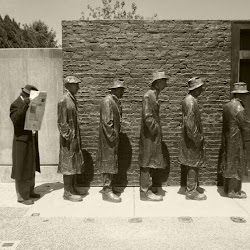
from Wiki Commons


Friday the Sixth

I tend to run behind on the movie front.  In some cases, decades behind.  I have never been a fan of slashers, although I did take a date to A Nightmare on Elm Street in the staid, dry town of Grove City while in college.  We broke up shortly after.  Still, I have a soft spot for “the classics,” and Friday the 13th has spun enough sequels to qualify.  “Jason” is a household name for the heartless serial killer, and the movie is set in New Jersey.  And it was hot outside and lazing on the couch trying not to stick to myself seemed about as much of a challenge as I could handle. Besides, a week from today is Friday the thirteenth. Now that I’ve finished with the excuses, here is a declarative sentence: I finally got around to watching Friday the 13th.  After many other films I’ve seen, I have to say that it didn’t really qualify as scary.  You know in advance that the counselors, by rote, must by killed in what are supposed to be shocking ways.  Shadowy corners and rainy woods and aluminum canoes are to be avoided, if the movie and its successors have taught us anything.  Nevertheless, the religion and scary film equation still applies.  And a strange kind of throwback to an unexpected classic (the literal kind).

The religious element comes in the form of the stock crazy local named Ralph.  Ralph warns the kids that they will die and says he’s been sent by God to warn them.  Of course they don’t listen.  If they had, there would have been no movie. As a child I was always offended by the caricature of the religious crazy, but I have come to see that this stock character is itself a symbol of fear.  Although ubiquitously laughed off, the person passionately driven by religion is indeed a potential danger to society.  In the days of my innocence we had little hard data upon which to hang such fears.  In the post-9/11 world it seems there are far too many sky-hooks for that purpose. Some of those sky-hooks are a little closer to the ground, but they inspire fear nonetheless. I’ve known all along that one of the reasons I watch scary movies is to give myself some advance warning of what might go wrong.  Not that it would help in any real way, but sometimes avoiding the shock by anticipating the worst seems like the only human thing to do.

What about the literal classic that I mentioned? Beowulf falls outside the Greco-Roman period, but is clearly a classic of English literature.  (Spoiler alert for anyone even more behind the times than me—) The only thing scarier than Grendel was, of course, Grendel’s mom.  So in Friday the 13th, the killing is done by Jason’s mom.  Like Grendel, Jason dwells underwater and surfaces to pull down his victim(s).  Like Grendel’s mother, Jason’s mother is decapitated by a sword (actually, a machete in the modern version), on the shore of the Crystal Lake.  After the mother’s death the child (Jason/Grendel) is resurrected.  Whether it was intentional or not, there is a lot going on here. The sacrificial mother is an inherently religious theme although many formal religions make it a male prerogative. The death of the mother brings the son back to life.  I wonder how Christianity might have differed if instead of three male deities, there had been a divine mother.  In such cases resurrection of the son comes only at a very steep price. Just like watching Friday the 13th on a hot summer night.


My Cultic Breakfast

The word “cult” is no longer used by religious specialists to refer to New Religious Movements, but when I was growing up in a fundamentalist home it was liberally applied to suspect groups. While having breakfast this morning I realized just how deeply rooted in American culture such groups are. I reached for my cereal. The reason that many Americans eat cereal for breakfast stems directly from the healthy lifestyle advocacy of John Harvey Kellogg of the Seventh Day Adventists. Adventists are vegetarians and are very concerned about healthy eating. Kellogg was a devout Adventist and produced Corn Flakes as a means of providing a—pardon the term—kosher choice for breakfast foods. Of course, growing up I’d been warned against the “cult” of Adventism, even as I happily munched their Corn Flakes.

So today I decided to have some Apple Jacks instead. Apples made me think of John Chapman, better known as Johnny Appleseed. Americans learn about the eccentric apple-planter from childhood, but most never learn that he was also a missionary for the Swedenborgian Church. Named after the Swedish scientist and theologian Emanuel Swedenborg, this New Church taught doctrines that set traditional Christians’ teeth on edge. Believing that Christ had already returned in the words revealed to himself, Dr. Swedenborg didn’t ingratiate the fundies by rejecting the standard interpretation of the Trinity and by promoting mystical beliefs. John Chapman spread Swedenborgian ideas along with his apple seeds. I’m sure that as we sang the Swedenborgian hymn at Methodist Church camp, we didn’t realize its heterodox origins: “The Lord’s been good to me, and so I thank the Lord, for giving me the things I need: the sun, the rain, and the apple seed—the Lord’s been good to me.”

What good is cereal without a spoon? As I grab my Oneida spoon, selected by my wife and me when we registered for our wedding, I’m sure I didn’t know at the time that the Oneida company is what is left of the Oneida Community. Founded by John Humphrey Noyes in the Burned-Over District back in 1848, the Oneida Community was one of the Perfectionist groups common at the time. Their town of Oneida held everything in common—everything. That included “complex marriage” which meant that all members had sexual access to all members of the opposite gender. They worked to support themselves, and one of their products was silverware. With the death of Noyes and concern of secular authorities about the interesting sex that was going on, the Oneida Community quietly closed, leaving us a company to produce fine stainless steel implements with which to eat our cultic breakfast.


Just You Wait, Professor Higgs

They finally found him. Peering deep into the invisible world of the sub-atomic universe, his hiding place has practically been discovered. I knew that when it happened my alma mater, Edinburgh University, would be part of the equation. That’s just the kind of thing you know deep down in your sub-atomic parts. Scientists are now coming very close to announcing definitive proof of the “God particle,” or Higgs boson. Named for theoretical physicist Peter Higgs, who predicted the particle, this elusive piece of physics has been nicknamed the “God particle” by journalists who want to express just how great its explanatory value is. The average citizen knows very little about the inner workings of science—thus we have Creationists and Tea Partiers—so we require striking neologisms to help us comprehend that this is not only important, but really, really important. For explaining the way the universe works, the Higgs boson has been likened to Newton’s discovery of gravity, although apples had always fallen from trees even before he learned why.

I have always found it curious that when we need a superlative we dash back to the biblical worldview. As John Heilprin and Seth Borenstein of the Associated Press make clear, “God particle” is not utilized by physicists (although coined by one), but is used “more as an explanation for how the subatomic universe works than how it all started.” To get us to read about science they have to use mythology. The more we understand about science and the way our minds work, the more perplexing it becomes. Humans are meaning-seeking creatures and we often find story more meaningful than fact. Facts, however, determine what actually happens or what actually is. The Higgs boson is getting close to facticity. We whimsically call it the “God particle.”

Could the great gulf between science and religion, I sometimes wonder, be bridged by good, liberal arts education? The liberal arts, particularly the humanities, are all about understanding what it is that makes us, well, human. They aren’t precise like science, or profitable, like business. At the end of the day, however, in those few quiet moments, don’t we dwell among the realm of humanity? When we stop posturing for our co-workers, the media, or our neighbors, when we are who we truly are—then we are engaging in the humanities. Education can be in the service of becoming human as well as becoming rich. In one of its latest triumphs, it has produced physicists who have discovered the footprints of the Higgs boson, potentially revolutionizing the universe as we know it. And many of us would have never even heard if they hadn’t called it the “God particle.”

Like atoms over our heads


Flea the Obvious

In one of my personal ironies of history, the period of ancient times that I find least interesting is the one I’ve been reading most about. Part of that is based on my lack of coherence when it comes to selecting reading material. I take recommendations seriously, so when a friend suggested Justinian’s Flea by William Rosen, I figured I’d better read it. I had fairly recently read Philip Jenkins’ Jesus Wars, about the nearly unbelievable shenanigans of post-apostolic Christendom, and so I felt up to taking on the Plague. Justinian’s Flea is about the fall of the Roman Empire. At Gorgias Press, where Justinian’s former prostitute wife Theodora was subjected to revisionist history that made her a lifelong saint, I learned to discount most of what went on during this time period. I was, it seems, a bit too hasty. Justinian and Theodora’s reign is quite interesting, and it is, as intimated, largely because of ecclesiastical politics.

Rosen begins his study by laying out the background to Justinian’s imperial days in Constantinople. In describing the disputes between what specialists now call various Christianities (formerly true believers versus heretics), Rosen notes that Christians had particular disdain for Gnostics, largely based on interpretations of what Jesus’ death might mean. At one point he writes, “Monotheistic religions are famously intolerant of apostasy, even when they disagree about what constitutes it.” Here he hit the flea on the head. “I doesn’t know what it be, but I’m ag’in it.” This attitude of religions has long been the motivation behind massive campaigns of bloodshed and intolerance. Often in the name of religions that claim peace and tolerance as the highest goods. So it was in the early church; heretics were routinely martyred for their “wrong” belief.

Not to throw in a spoiler, but the first great wave of the Plague does nearly draw an end to the ailing Roman Empire. Justinian’s expansions were mere band-aids trying to hold together a Frankenstein’s monster of many nationalities. So riding home on the bus I was surprised first of all that the driver engaged a passenger in conversation (generally frowned upon) and second of all, that he ranted for many miles about politics. It isn’t very comforting in the stressful traffic around New York City to hear your bus driver cry out, “the Roman Empire collapsed—maybe it’s time America did as well!” The prospects of getting home seldom looked dimmer. And I had just been reading about that very empire’s last days. I try to stay away from predictions because I dislike being proven wrong—the end of the story hasn’t been written yet. Rosen, however, has given us a great cautionary tale; if the humble flea can help bring down the world’s mightiest empire—one ruled by a leader overwhelmingly concerned with religion—maybe it’s time to canvass what the infidels like to take in their coffee.


Heat Wave

Stewing in the heat of the wave washing over much of the east, my thoughts sometimes turn to the cool, refreshing flood of Genesis. I’ve been Tweeting the Bible for some months now, and I am in the midst of the stories of the flood. Noting the many contradictions and discrepancies, it is a wonder to me how many of the religious are able to overlook or harmonize infelicities for the sake of a consistent faith. Most famously the story states that Noah took one pair of the clean animals, but also seven pairs of clean animals. The rain came down forty days. Or was it 150? One of the reasons that people continue to believe this story may be its specificity. No approximations or guesses, the numbers are precise, as if written down by an eyewitness at the scene. In actual fact, the story is among the oldest of recorded civilization and has its origins at least as far back as ancient Sumer. For as long as people told stories about the gods, they told stories about world-wide floods.

As a species that is able to think ahead, we have long been concerned with the fate that might befall us. Consider the amount of hype about the end of the world that has accompanied the random calendrical dates we’ve assigned to the cosmos: the world has been expected to end nearly every year since 2000, and that is only the most recent incarnation of this foreboding. If there are gods out there, they must have it in for us. The very fact of our being human seems to anger the deities. Even after God promises the world will never again be destroyed, he adds a caveat—not by flood, anyway. By the time we reach the letters near the end of the Christian Scriptures the future torment has turned to fire. There’s always something out there looming on the horizon.

“Prometheus teacher in every art brought the fire that hath proved to mortals a means to mighty ends,” so reads the quote from Aeschylus behind Paul Manship’s statue of Prometheus. Prometheus was the Greek god (Titan, actually) favorably disposed toward humanity. His name means “forethought.” When humanity cowered and shivered in the dark, Prometheus brought the light and warmth of fire. It is easy to suppose the Greeks to have been more enlightened than earlier or contemporary civilizations, but Prometheus had offended Zeus and was subject to eternal torment for his thoughtful gift. Perhaps it is just the divine way—gods are jealous of us although they hold all the power. As I continue to tweet the good news of an angry god, I am starting to understand the power deities will always have over their vulnerable creatures.


Think Again

Within a few blocks of my office is Midtown are at least three temples related to the New Thought movement. New Thought has been variously interpreted, but generally it is considered a religious movement, challenging, as it does, the very perceptions of reality itself. New Thought is usually traced back to Phineas Parkhurst Quimby, a nineteenth century American philosopher and inventor. A watchmaker by trade, Quimby came to believe that mind had ultimate reality and New Thought opined that the divine is true human selfhood, and what we call God is ubiquitous. One of the corollaries of this outlook is that the mind is capable of healing the body. A woman who was a patient of Quimby took his ideas and developed them further. Mary Baker Eddy would eventually found the Christian Science movement. Although the Mother Church of Christian Science is in Boston (and is a somewhat imposing building), over on East 43rd Street in New York stands the First Church of Christ, Scientist.

New Thought was noteworthy in that many of the leaders of the movement were women. Unburdened from traditional Judeo-Christi-Islamic ideas of paternal divinity, New Thought had no use for male-centeredness. One of the early leaders of the movement was Emma Curtis Hopkins. Originally a disciple of Mary Baker Eddy, Hopkins split off from Christian Science and began to organize the New Thought movement. One of her followers was Ernest Holmes, the founder of Religious Science. While based in Los Angeles, Religious Science had roots in New York where Holmes spent some of his younger years. Holmes would eventually write The Science of Mind and his followers would become recognized as another New Thought “church.” While on a lunchtime errand I came across the Religious Science center on East 58th Street, just a few blocks from its kin down by Grand Central.

Theosophy is probably better classified as an esoteric religion rather than New Thought. What ties them together is their beginnings in the late nineteenth century in the Northeast. Helena Blavatsky and Henry Steel Olcott began meeting in New York City and the movement grew out of their mutual interest in the religions of antiquity and the far east. The Theosophical Society moved its headquarters to India with a main US office in Wheaton, Illinois. Nestled between the Church of Christ, Scientist and Religious Science, an office of The Theosophical Society sits quietly on East 53rd Street.

One brief lunch hour will take you past all three. These New Religious Movements attest to the vitality of religious thought. Some of them continue to try to combine science with the world of the mysterious, spiritual universe in which we find ourselves. The obituary for religion was written long ago, but a stroll through Midtown on lunch hour will show it was certainly premature.


Burned Over

Western and central New York State, in any religious history of America, have acquired the nickname, “The Burned-Over District.”  This graphic metaphor arises from the constant evangelizing and, more importantly, the fertile soil for new religious movements left in its wake.  This region could claim to be the home of Seventh-Day Adventism, Spiritualism, the Oneida Society, and the Latter-Day Saints.  It was also an early home of the Shakers and the land chosen by the Publick Universal Friend for her new Jerusalem.  The sense of place is important to religions.  The Latter-Day Saints, however, grew restless in this region where Joseph Smith translated the Book of Mormon and began a torturous trek that would land the Mormons in Utah.  Joseph Smith never made it that far.  Religious leaders being persecuted are nothing new; Smith had been tarred and feathered, was wanted on charges of fraud, and was eventually murdered for his beliefs.  He was also one of the most intensely creative individuals America has produced. His extraordinary creative venture is often overshadowed by the religion that grew out of it.

With Mitt Romeny’s campaign stoking up steam, many people find themselves wondering about Mormonism.  I first learned about the Latter-Day Saints from a rather biased World Religions course at Grove City College.  One aspect which was true in that course, however, was the great secrecy surrounding Mormon teachings. Of course, the Book of Mormon is in the public domain and is easily available to those who wish to read it.  Official Latter-Day Saint beliefs, on the other hand, are frequently inscrutable.  For all its problems (and they are sometimes significant), mainstream Christianity is very open (and often vocal) about its belief system.  The same holds true for Judaism (mostly) and Islam.  If you want to know what they believe, just ask.  Americans tend to be a little perplexed by the Latter-Day Saints because there is always a feeling that there is something they’re not telling you.  It goes all the way down to the underwear.  All religions are concerned with sex.  Some may not disclose the details in public, but they all deal with it somehow.  Latter-Day Saints have rules about underwear–I’m sure other religions do too.

If Americans are really, seriously curious about the religious heritage of a potential president, a great way to find out is to read a bit of our own history.  I learned about the Burned-Over District back in college and have periodically read about it several times since then.  It is no secret.  Our society is not likely to expend the energy needed to learn about its own heritage.  As several of my recent posts have intimated, even higher education has no time for the study of religion (or history, or anything that doesn’t make money–Romney surely does!). Instead we will charge fearlessly ahead into the dark.  And when we are in the dark we may start to wonder why we’re wearing this unusual underwear. Wondering about religion is far easier than supporting those who study it.

Have you seen this man?


Divine Fury

“It was like Armageddon,” a woman in Colorado Springs told a reporter, according to CNN, after seeing the wildfires raging down the mountains onto the city. The article opens with a reference to Godzilla. The story is a wrenching reminder of how helpless humans are in the face of disaster. When facing danger far bigger than ourselves, language of God is never far behind. The things we control—the future we engineer—is bright in prospect. We’ve impacted our own chances for the better in a steady surge since the Middle Ages. Of course, there have been notable blips along the way where we’ve fallen victim to our own paranoias, but generally, things are better. Controlling fire was among the first of human innovations that eventually led to civilization. Humans took a natural force and put it to work for us. It is easy to forget that fire serves no master. Until nature reminds us.

Earth, wind, fire, and water. The ancient Greek philosophers had narrowed the basic environment down to four features. Each of them holds profound dangers for a small species like our own. No wonder the ancients ascribed each of these elements a guardian deity or two. On driving trips to the west, I have gone past fires whose intense heat could be felt hundreds of yards away in the air-conditioned comfort of our car. Still, I shuddered. In this day of advanced transportation, most people can drive themselves away from the danger of wildfires. The problem is that material goods take up space, and in a world that values material goods above all things, well, you still can’t take it with you. My heart goes out to those who tell their stories of impossible decisions of what to take. What in our lives can’t be replaced? What do we truly value?

Funny thing is, we’ve known since I was in high school at least, that our own actions were changing the climate. The wildfires may not be directly related—I don’t know—but I do know that we’ve been in deep denial. We’ve been caught in a sin so black that the only way out is to lie until we’re even deeper in it. We’ve been destroying our own environment for money. Money with which to buy material possessions. Earthquake, hurricane, wildfire, and flood. None of the four elements are safe. We can put our material goods in a secure house in a mountain stronghold and still lose everything. It is the fate of a culture that puts too much faith in material goods. Colorado is beautiful and peaceful, much of the time. But nature respects no human. Yet we put our faith in material things. Maybe she was right after all, it is like Armageddon.

Friend and foe.


Lost Professors

In front of my desk at home sits a chair.  That chair came to me when Gorgias Press was subleasing some of its office space and was necessarily divesting itself of unnecessary furnishings. Gorgias Press came to inherit the chair with the closing of the for-profit Katherine Gibbs School of Business, a branch of which leased half of the building.  I sit in that chair, contemplating the future of education.  I have just finished reading Frank Donoghue’s The Last Professors: The Corporate University and the Fate of the Humanities (as recommended by my friend Marvin).  Despite the fact that it is the first academic book I can recall leaving me in tears, it is a book every Ph.D. and potential Ph.D. in the Humanities should read and/or be forced to read.  Buck the trend!  Buy a book!  Donoghue is a rare individual who actually takes time to research what is going on in higher education and who has the courage to report it directly.  My regular readers will know that for nearly two decades I worked in higher education, spending every one of those years hoping that the next year things would get better.  Thank you, Dr. Donoghue, for speaking the truth.

I didn’t enter higher education as a child of privilege.  My career ambitions in high school were to be a janitor.  Encouraged along the way by well-meaning teachers and professors, I eventually found a job (lackluster as it was) in higher education.  What I didn’t realize is that the game had been rigged.  I recall being told with crystalline clarity that college and university positions were headed for a vast turn-over in the 1990s and jobs would be abundant.  Donoghue heard that story too.  His research shows that the writing had been inscribed on the wall as early as the 1970’s (before I reached high school) that this would not happen.  This is not hindsight either; studies were already indicating that higher education was going after the vaunted business model of the glitzy for-profit world.  Shiny baubles.  Worse yet, the roots of this inevitable transformation reached back to the Civil War and the nation that emerged from it—replace the dead on the battlefield with the dead in the factory.  Only only method of judging value existed: money.

The most disturbing aspect of all of this is the irreversibility of this trend: in today’s world only one value system is admitted, and it is purely material. No other way in higher education is capable of assessing worth. Rather, the alternate ways are being ruthlessly silenced by the transformation of university to corporation. That transformation was well underway long before the 1970’s, of course.  I had recognized at a young age that capitalism is a cancer that eats away the soul of people, convincing them that financial success is the only goal worth pursuing. I protested.  I spent years earning a doctorate in the Humanities to show that other values still throbbed away in the hearts of those who weren’t taken in by shiny baubles.  If you have any interest in resuscitating the human spirit, read Donoghue and weep with me.  The only consolation that I have is that I am sitting on a chair of a for-profit school that fell victim to the value system it once supported.  Capital and cannibal are too close for comfort.


Cabin Fervor

It’s a sure sign that work is growing overwhelming when I’m too tired to watch my weekend horror movies. Well, I decided to fight back the yawns and pull out Cabin Fever this past Saturday night. I’d seen the movie before, and I’m not really a fan of excessive gore. The acting isn’t great and the characters aren’t sympathetic, yet something about the story keeps me coming back. In short, a group of five teenagers (it always seems to be five) are renting a cabin for a week when they get exposed to a flesh-eating virus. They end up infecting just about everyone in the unnamed southern town before they all end up dead. It doesn’t leave much room for a sequel, but that hasn’t stopped one from being made. One of the unfortunate victims of the virus is torn apart by a mad dog. The locals, fearing their safety, decide to hunt down the surviving youths.

On the way to the now gore-smattered cabin, one of the locals mutters that they’ve been sacrificing someone—a natural enough conclusion when body-parts are scattered around, I suppose. He says, “it ain’t Christian.” Well, yes and no. Sacrifice is at the putative heart of Christianity, although human sacrifice (beyond infidels and women) was never part of the picture. As is often the case with horror film tropes, the victim who has been dismembered is a woman. The guys whose deaths are shown are all shot. Now, I have no wish to attribute profundity where it clearly is not intended, but there does seem to be a metaphor here. Our society and its staid religion tolerate the victimization of some over others.

One of the hidden treasures of the best of horror movies is the social commentary. George Romero made an art form of it in Night of the Living Dead and its follow up Dawn of the Dead. Many other writer/directors have managed to do it quite effectively. We can critique our world when hidden behind the mask of the improbable. While the commentary for Cabin Fever may be entirely accidental, I still find a little redemptive value in it. That, I suppose, is the ultimate benefit of social commentary—it is true whether intentional or not. Is there a larger message here? I wonder if the fact that when women are victimized no one survives is pushing the metaphor a little too far. It’s hard to say; I’ve been working a little too much lately.


Ancient Wisdom

The Huffington Post recently ran a story on Stonehenge. Part of the endless fascination with the ancient monument is that no one really knows why it was constructed. Given the tremendous amount of effort the building represents, it is clear that this was important to the cultures constructing it. The article in Huffington cites archaeologist Mike Parker Pearson as suggesting that Stonehenge was a monument to the unification of Britain. While not as sexy as explanations that draw on human sacrifice, precision astronomy, or alien visitation, something rings true about it. In the long course of human development, we’ve had to overcome many, many hardships. At one time humans were relatively easy prey animals for large predators. Our evolution didn’t endow us much in the way of body armor or built-in weaponry. Our eyesight and other senses pale next to various other animals. Even with all these deficiencies, our biggest challenge hasn’t been nature, but other people.

Archaeologists have also been discovering that a peaceful prehistory to humanity does not match the facts. Warfare and strife have been as much a staple of human behavior as the perennial hunt for food and safe shelter. Civilization involved cooperation at unprecedented levels. People had to trust one another and work to maintain the infrastructure that allowed diversification of talents and abilities. Fighting and wars still occurred, of course, but less frequently and with less brutality. With economies of surplus, however, capitalism also eventually evolved. It is an aggressive organism. It is visible in the greed embodied in the thought process that the only good in life is financial and the only worth of humans can be calculated in dollars and cents. It is this thinking that has erected the monuments more familiar to us today in our cities and centers of civilization.

Stonehenge could never have been a money-making venture (not until the development of capitalism at least). It is in the middle of nowhere, in a sense. The Salisbury Plain is fairly empty—no large cities nearby, no grand scenery as one might find in Cornwall or the Grampians. According to the theory, its location has to do with it being in a very rough middle between various regional cultures. Building impressive monuments is very difficult to do if one has to watch constantly over one’s shoulder. I suppose in my Romantic notions Stonehenge will always represent a mysterious past suffused with unanswered questions. For the present, however, Pearson’s explanation seems more than likely—it sounds absolutely vital in a world so dangerously divided as ours. Perhaps it is time to start a truly monumental building enterprise involving every nation. It will give future generations something to wonder about.

Time to build another henge.


Gothic Religion

Every great once in a while, you run across a book that seems to have been written just for you. I’m cheap enough to wait for most books to be issued in paperback (and storage is getting to be an issue in our cozy apartment), but sometimes the urgency is too great and I can’t resist. In Providence a few weeks ago, I visited the university bookstore—one of my favorite places in town. On the new arrival table was Victoria Nelson’s Gothicka. For what seemed inexplicable reasons, I always found Gothic tales among my favorite growing up. Poe was a standard, but he was accompanied by other stories that elicited the same cocktail of sensations, accompanying a dark and mysterious atmosphere with a suggestion of menace. Transfixed by even the mere presence of this book, I knew I was in the power of a force to which I would eventually succumb. And, unexpectedly, the book helped to explain part of my childhood.

Not every book I read has to do with religion. Far from it. I expected Nelson to discuss literature and movies and culture—all of which she does—but not necessarily religion. The first three chapters proved a revelation in that regard. Nelson deftly explains how Gothic largely overlaps with the characteristics of religion, bringing the supernatural into human lives and insisting that we tremble before it. Perhaps best explained by pastor Rudolf Otto in The Idea of the Holy; the transcendent is something that terrifies as well as compels. In a culture where organized religion appears to be losing ground, Gothic offer the opportunity to tremble before the supernatural, and many people find it almost a religious experience. As becomes clear, the “almost” may appropriately be dropped.

Tracing the trajectory of my own reading interests, Nelson next provides an insightful chapter on H. P. Lovecraft. In many ways the initiator of worship of the dark divine, Lovecraft’s Cthulhu and kith and kin represent an undisguised secularization of deity. At the same time, the trembling is still very much present—indeed, it is a native part of the experience. Lovecraft, who was an atheist, understood the literary utility of gods. They frightened and haunted him with their very non-existence. That is power. Gothic acknowledges and embraces that power while never relinquishing its darkness. Nelson’s Gothicka holds the potential of a journey of self-discovery. As she ranges deeper and deeper into that world, the reader discovers just how much it is part of being human in a world tormented by fallen gods.


Help from the Friend

Being unconventional does carry certain risks. I first learned of the Publick Universal Friend, born Jemima Wilkinson, from Mitch Horowitz’s Occult America. There are many things, I imagine, worse in life than being labeled “occult,” but the Publick Universal Friend seems to have been more eccentric than occult. The “Friend” of her chosen moniker was a mark of her Quaker roots. The Quakers, while never among the most numerous of Christian sects, are infrequently considered occult. Two U.S. Presidents were Quakers, as is that friendly face smiling at you from your breakfast cereal box. What Jemima Wilkinson did that pushed her over the edge into the unconventional was actually the fault of her father: she was born female. In the 1770s religious leadership was nearly unanimously male. 

Wilkinson underwent a near-death experience that, like John Wesley some 70 years earlier, led her to believe that she was born to some higher purpose. Quakers, or Friends, generally eschewed excess showiness and the Publick Univeral Friend liked to make her presence known. She rode a white horse into Philadelphia and rode around in a carriage with her own logo, a kind of evangelical branding, if you will. Eventually tiring of the criticism of city folk (Publick Universal Friend was strictly platonic, advocating absolute celibacy), she moved to a region of New York that would eventually become the birthplace of several distinctive American religions. She settled near Keuka Lake and formed a community called Jerusalem.  New York and Pennsylvania would eventually harbor many utopian groups.  Both states were (and are, to a large extent) rural and it was a fairly easy matter to locate unclaimed real estate and establish a little bit of heaven here on earth. 

The message of Publick Universal Friend was peace and friendship, nothing too radical.  If preached by a male it would have been considered gospel. In fact, in a less darwinian world it might actually work.  The pull of nature on some people is too strong.  On others it is too weak. Maybe it is the legacy of having been born in a state that began as a “holy experiment” by William Penn, but I find it sad that the Publick Universal Friend has been nearly forgotten. Perhaps the Friend will have the final laugh. It seems that a young man named Joseph Smith might have been influenced by her in the days before writing up the Book of Mormon. As I’m sure Joseph Smith learned in the town of Carthage, we can all use a Friend who encourages us all to get along.


Ms. Found in an Email

The other day I received a distressed message from a friend that I met in college. Marvin’s career somewhat parallels mine; he went on to get a PhD, taught for a few years in New Hampshire until the economy claimed his job, tried to make it as a fiction writer and adjunct instructor for awhile before moving to Boston to work with a publishing company. He’s never made any money for his writing, but that may be for his own good because the money that authors make goes to support the CEO of whatever corporation owns the publishing house. Still, I wish him luck. Yesterday he emailed me about a book he’s reading, The Last Professors, by Frank Donoghue. He’s convinced me that I should read it, but I thought his message would be appropriate for this blog. In Marvin’s words:

“If a more bleak preface has ever been written, I’m an illiterate ape who never reads. The writing has been on the wall for years, but those of use who are able to see it have been hopelessly myopic. In the preface he tells how industrialists since the end of the Civil War have been dead-set against liberal arts education as useless. People like the two of us who studied ‘useless’ fields, they would have as the cogs in their efficient machines, suppressing our thoughts. The only useful education they can deign to approve is one that earns them more money. There’s only one value system in the world, it seems.

“Don’t you feel like a sell-out, working in New York City, that cathedral of capitalism? Is NYU on anybody’s list of tourist stops for people down there in New York? Who goes to visit a university when there’s so much of commercial interest to see?

“And yet, corporate types are the ones who can afford tickets to shows written and put on by people educated in their ‘useless’ craft, but who are in reality their unwitting chattels. And who wants to be seen with authors and intellectuals to enhance his personal prestige, so that he will appear smart? Who are the dogs in the manger who keep everything they can’t possible use for themselves, for fear that others might enjoy it?

“We all play along with their game—we wear jeans on casual Friday and declare how good we have it. We speak their demeaning language, using humiliating phrases like ‘best practice,’ ‘core competency’ and ‘corporate values.’ In this dehumanized state we all live in cages that we’ve helped build. Corporate moguls hold their power over us because we let them. We, the workers, have the power to change it. They make the rules and we obey because we all want to be in their place.

“Education is the way out—that’s why they hate it. There’s an entire support industry built around it; those of us in the book business rely on educated readers. What happened to Borders looks prophetic to me. Time to close—I’ve just arrived at work.

“Sent from my iPhone”

Just another useless lay-about