Castle Dreams

It’s a real problem.  If you’re a passionate collector you eventually run up against the space issue.  A New York Times piece tells how a couple that collects puzzles had to buy an Italian castle to house their collection.  I appreciate their passion, but I operate on a more modest budget.  We bought our house going on six years ago.  Like many people raised in poverty, I’m a bit of a packrat.  When you’ve experienced a life of not being able to afford things, you tend to keep everything.  That’s an economic reality.  You spent money on this and you don’t want to waste it.  Add to that the passion of a collector and you could have a real problem.  Castle-sized.

When we were searching for houses the market was poor.  It still is.  Although a recent trip to Somerville, where we used to live, revealed massive amounts of new apartments—we were literally stunned—buying a house remains difficult.  (But all those apartments!  When we moved to Somerville in 2006 there were only a few units available, so I guess that was before it became popular.)  And we specifically needed a house where you could keep books.  (I do periodic purges and end up feeling full of regret afterwards.)  Our house has a large garage with storage space.  Not an Italian castle, but the principle is the same.  Only our garage has been taken over by aggressive squirrels.  We can’t yet afford to have the roof rebuilt (with solar panels because we have beautifully unimpeded southern exposure); we can’t lay up books where squirrel and mildew doth corrupt, so I guess we might have to consider a castle down the road.

My escape fantasy would probably be Ireland, however.  They speak English there and they have castles.  And Scotland’s just across the way.  Although I spent my doctoral years in Edinburgh, my ancestry leans more toward Ireland.  And Germany, but although they have castles I’m not sure I can revive my German well enough to get along there.  No, Ireland might be the best choice for my castle-buying dreams.  Of course, those of us who grow up poor do dream of castles.  I read about them in books.  And books beget books—this seems to be an inescapable law of nature.  I do wonder if Irish castles have problems with squirrels, though.  If I’m going to make this work it’s going to require quite a bit more money.  And thought.  It’s a real puzzle.

Photo by Reid Naaykens on Unsplash

Clergy Problems

I believe Revival is the most recently written Stephen King novel I’ve read.  It was pretty good—it certainly scores high on the religion and horror scale, although it takes quite a while to get to the horror part.  Part of the problem for me is that I liked Charles Daniel Jacobs.  I tended to relate more to him than to Jamie Morton (the narrator/protagonist).  Perhaps this was because, like Jacobs, I studied to be a Methodist minister.  And like him, came to have a rather different view of what is really going on in the world.  He’s clearly King’s villain, however.  Or “fifth business” as he’s termed in the novel.  The secret lightning he seeks turns out to be a kind of MacGuffin.  I was curious to know more about it.  The novel, as is typical, has several subplots but the main one is how Jamie and Charlie face what’s after death in a tragic climax.

Charlie starts out as a Methodist preacher.  When his wife and son are tragically killed, he becomes a huckster who actually has tapped into an electrical power that can heal people.  It often, however, leaves bad aftereffects.  Jamie, who knew him as a kid, is cured by him from a heroin addiction.  Their paths continue to cross over the next fifty years or so—this is a longitudinal story—as Jamie comes more and more to distrust his childhood hero.  Charlie can use electricity to perform wonders and it make him rich.  He wants more, however.  He wants to see beyond death to assure himself that his wife and son are in a better place.  It seems to me that that motivation isn’t a bad one.  The only way he seems a villain is that he doesn’t really care for other people.

The story is well told but it doesn’t have the same “classic” feel as some of King’s earlier novels.  He well understands, however, that horror and religion belong together.  I haven’t read all of his novels—not by a long shot—but clergy aren’t rare and when they’re present they’re implicated in the horrors, or in this case, responsible for them.  These are important insights, as others have also noticed.  Revival is one of those books that requires some reflection.  It certainly feels like something written by a man facing the limitations of the aging process.  And not necessarily at peace with it.  Ministers sometimes do go bad—they’re only human—but they can also lead to real change.  I, for one, am interested to hear what King has to say about it.


Sticky Thoughts

It’s a common problem.  You need to stick two things together.  Perhaps you don’t have welding or soldering equipment lying around the house so you buy some glue.  Now, I don’t know if you’ve been in an adhesives aisle recently, but the choices are overwhelming.  Not only that, but ephemeral.  I mean the bonding action has improved since I was a kid, but the problem is I can’t use glue fast enough.  Like the old-fashioned White Out, you open a container and use it as quickly as possible because it’s going to dry out.  I was reminded of this when I needed to stick some fabric to plastic (don’t ask).  I tried some Elmer’s left over from when my daughter was in middle school sometime in the second Bush administration.  That didn’t work.

Then I found a bottle of Gorilla glue.  The problem is that it sticks to itself.  So much so that I couldn’t get the bottle open.  I could see there was some liquid life in there, but the top half of the contents seemed to have congealed and clung to itself.  That wouldn’t work.  I eventually found a tube of plastic glue and since one of the pieces for my project was plastic, I figured that’d work.  Still, it made me wonder about the conscience of those who make adhesives.  Surely they must know the mindset of, “oh, I’ve got lots of stuff to fix, so I better buy a reasonable size bottle.”  Only, the fixing comes at widely spaced intervals and the glue can’t last that long.  Various Crazy Glues are the worst.  They’re one-time openers, just like White Out.

My most recent trip to the adhesive aisle brought a moment of clarification.  Although I try to reduce waste, one company (not a sponsor), was selling little, tiny tubes of Crazy Glue.  Single-use units.  And you get six/eight per shot.  That works for quite a few applications.  Still, I’ve got a number of half-full (I’m an optimist) bottles of various glues that can’t seem to get over themselves.  I guess the lesson we’re to take home is buy in small quantities, even though the unit cost is higher.  You can always buy two, no?  Things don’t break at convenient times, unfortunately.  You run to the closet to see what glue you’ve got.  Then you drive to the store to get some that’s not all gummed up in the bottle.  It’s a dilemma.  Just like that nagging question of why someone’s trying to stick cloth on plastic.


Not The Sting

Why do we make the decisions we do?  Watch the movies we do?  I have to confess that for me a number of strange factors combine to make for some weird choices.  For example, Invasion of the Bee Girls is difficult to explain apart from compounding oddities.  One is that Amazon Prime auto-suggested it too me (for free).  Yes, I have a history of watching bad movies and this definitely fits that bill.  Fuzzy-headedness during my weekend afternoon slump time probably played into it.  Along with the fact that I’d been researching bees and that brought the movie The Wasp Woman back to mind.  Wasp woman, bee girls?  It’s free and I’m not going to be able to stay awake otherwise.  The movie is about what you’d expect from a low-budget 1970s sci-fi horror film.  It did make me think I should read about movies before I watch them rather than after.

Nevertheless, I’m trying to develop an aesthetic for bad movies.  If you’re a regular reader you’ll know that I have a fascination with Ed Wood and his films.  I even read a book about him and also read a book on why it’s okay to like movies that we tend to label as bad.  No matter how you parse Invasion of the Bee Girls, it’s bad.  The acting, the writing, the plot.  Still, some of us have a taste for films from the seventies—it’s kind of a nostalgia trip since I was really only becoming aware of the odd world of science fiction about then.  Nicholas Meyer, who wrote the initial screenplay wanted his name removed after he saw the changes that’d been made.  That should be telling you something.

Meyer, while not a household name writer, did pen some good detective stories about Sherlock Holmes, and wrote, uncredited, both Star Trek II: The Wrath of Khan and Fatal AttractionInvasion of the Bee Girls has a somewhat salacious plot that fits the Zeitgeist of the seventies of which I was unaware, growing up.  The seventies were my sci-fi high point, it was good escapist material for someone living in a situation less than ideal for day-to-day living.  I watched, for example, Killdozer about that time and thought it was great.  Now that streaming is how we watch, the amorphous internet has a record of what we’ve seen and then recommends products for us based on our record.  I really thought we outgrew being tracked all the time.  Little did any of us know that it was only getting started in high school.  And as long as you have a penny to spend, those who track us will try to figure out how to take it.  You could get stung.


A Footnote

I was recently compelled to use footnotes.  I don’t mean the clever asides that capable writers sometimes utilize to spice up subjects by making points off topic.  No, I mean the kind with author, date, title, city, publisher, page number.  I deal with footnotes daily—it’s an occupational hazard.  As a recovering academic I’m trying to get away from using footnotes on everything from grocery lists to daily meeting reminders.  Cite your sources!  That’s the kind of rhetoric that’s pounded into the heads of bright young people, often preventing them from learning to think for themselves.  At this stage of my life a footnote is more often trying to find someone who agrees with what I’ve observed for myself.  Hmm, did anyone ever say that before?  If so, where?

My concern goes down to the level of cities.  Yes, cities.  Standard format requires you cite the city in which a book was published.  This ridiculous pre-internet artifact had a purpose originally, but I have worked for two international publishers and I can tell you two related, and perhaps contradictory points: employees can tell which office a book is from: New York or London.  And unless you work for said publisher there is almost no way for you to know.  So if a publisher has offices in a dozen cities, you need to write a dozen of them in your footnote.  Does this sound like a rational thing to do?  Don’t get me wrong—it’s important, very important to cite the publisher.  But it’s not like there are a ton of presses around with the exact same name.

There’s a move among some reference experts (refperts, if you like) to do away with the city in footnotes.  It’s a reasonable guess that Cambridge University Press is pretty widely recognized.  And that Cambridge is located in Cambridge.  Or course, there’s a Cambridge in Massachusetts, and I hear there’s a university there as well.  In any case, if you don’t know where a publisher’s located, there’s a remarkable invention called the internet where you can look it up!  Pedanticism comes naturally to academics, I suppose.  Had I not been one I would probably have had no reason to write such an anal post as this.  Still, there’s a larger point: when is one able simply to assert what one knows?  I frankly don’t remember the page on which I read most facts I point out in my writing.  Often I notice them myself and recognize them as facts when there’s good, solid evidence.  Of course, I really should footnote that.  If I can remember in which city the appropriately named Random House is located.

How do you footnote this?

One Demonic Night

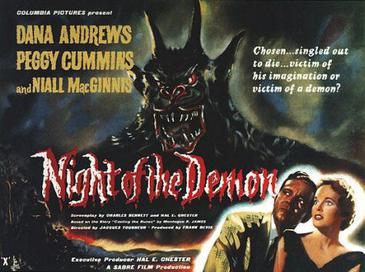
I only discovered after watching Night of the Demons (2009) that it was a remake.  Eventually curiosity got the best of me and I had a spare moment to watch the 1988 original.  It’s still kind of a bad movie, but it is scarier than the remake.  It’s also a horror comedy, but the emphasis is a bit more on the horror here.  A group of ten high schoolers go to Hull House, which used to be a funeral home, for a Halloween party.  When the power goes out they decide to have a séance.  Unbeknownst to them, however, there is a real resident demon.  This demon gets passed on through kissing, and it animates the kids who’ve been killed along the way.  Although the final girl is pretty clear from the beginning, in a usual twist the only surviving guy is African-American, the son of a preacher.

The concept of demons here is explained as entities that were never human.  This is the explanation Ed and Lorraine Warren used, often without making reference to fallen angels.  Since the demons are using the physical bodies of the kids, they can be stopped by locked doors, but killing them doesn’t really help, since they keep coming back.  It seems that there’s really just one actual demon, a dragon-headed entity that lives in the crematorium.  Rodger, the Black man, brings the element of religion to the story.  He objects to the séance in the first place, and suggests that they pray as he and Judy, the final girl, are attempting to escape.

In-between all this is sandwiched the gore and violence that make it pretty typical horror.  The humor involved, however, makes it less intense than a typical slasher.  Although I didn’t walk away thinking this would be a favorite movie, I could see why it’s garnered a cult following.  As is often the case, the original is better than the remake.  For one thing, it understands that religion seasons horror quite well.  Demons are, by definition, religious monsters, at least traditionally.  And the two “good kids” who survive are uncomfortable with messing with spiritual forces to begin with.  Judy just wants to go to the dance, after all.  The movie went on into sequels as its cult fandom grew.  If I ever do a sequel to Nightmares with the Bible I’ll need to include this franchise, I guess.  For a sleepy weekend afternoon, there are worse bad movies to watch.


Love Life

I suppose that it’s good to keep Valentine’s Day mostly private, but there was some wisdom to how it was practiced in school when I was growing up.  In primary school the rule was that everyone had to give everyone else a valentine card.  You couldn’t just give them to the people you liked.  Valentines Day was a day of equity, and, as children understand it, love.  Love for everyone, not just those of your nation or ethnicity.  Kids of any gender received cards from kids of any other gender.  The point was, love one another.  Looking at the way that hatred has become the new normal with right-wing politicians leading the way, Valentines Day has become a much-needed symbol.  We should be loving those who are different.  Instead we go to the polls and elect extremists who start wars and who brag, even before votes are cast, of the damage they intend to do in their next term.  Where’s the love?

I confess to being an idealist, but I do wonder why love is so difficult to achieve.  Are we so much the victims of tribalism that we can’t see there’s enough to go around?  We live in a world where, were it properly administered, we could see to it that most people, if not all, would have their basic needs met.  Where love could be our highest motivating factor.  Instead, we want the love of only those we love and everyone else can fend for themselves.  And whatever facsimile of love we can muster ends at an artificial line we call a national border.  Those on the other side are our enemies and we want to take what they have.  Is this a sane way to spend Valentines Day?

The irony of all this is that those who perpetuate this divide and conquer mentality were raised in religions founded by leaders who insisted on love.  Love your neighbors.  And, more radically, love your enemies.  What if Valentine’s Day were more than just a time for romantic dinners and little treats, and those things which are best kept private?  What if it were a day when we all tried to love that kid who’s always picking on you?  Or who looks different?  That kid that doesn’t seem to have any friends?  Childhood taught us that everyone’s shoebox got a card today.  We may have been too young to understand some aspects of love, but one thing we got right.  Everyone deserves ours.  Why not try love?


Scholarly Publishing

So here’s the thing about innocuous names—they don’t work well with the internet.  Search engines throw a rod trying to find something so insipid that it might mean anything.  I’m driven to this topic by the fact that “Scholars Press” or something like it, is used by a number of organizations, some apparently predatory.  If you’re a scholar of religion you know to what I’m referring when I say “Scholars Press.”  You know the neat, trim little monographs that you consumed like popcorn while writing your dissertation.  Try to find a history of the press online.  I’ll wait.

So finally I heaved myself out of my chair and got an actual book (imagine that!) off the shelf.  It is a volume I purchased when the American Academy of Religion and Society of Biblical Literature met in Orlando.  A conference to remember.  So, along with Woody and Buzz Lightyear, we were gathered to learn about religion and I finally shelled out for Ernest W. Saunders’ Searching the Scriptures: A History of the Society of Biblical Literature 1880–1980.  There I found what Google couldn’t: Scholars Press dates from 1974, a joint venture of the two societies.  Originally it published books from the University of Montana at Missoula, and later moved to Chico, California.  Finally it settled in Atlanta and eventually split into two as AAR and SBL took on the publishing of their own books.  I saved myself several minutes of probably fruitless scrolling.  It seems nobody else is really interested in this.  I am an historian of religion, but an historian none the less.  I wanted to know the sequence of events.

I am curious when the two decided to break up this venture.  There was a divorce, or temporary separation, between the societies some years back—I can’t recall when it was—that seems a logical time for them to think about taking on their individual publishing programs, but then again, they may have started before then.  In other words, I don’t have the date when Scholars Press dissolved.  Religious studies, I realize, is a small discipline.  For many colleagues it’s their entire world.  Some of them write histories about various aspects of it—I saw a book that I want to read about the murder of a religion professor Ioan Culianu back in 1991—but compared to history or English, we’re minuscule.  And we don’t seem very curious about ourselves.  We’re an odd lot, that’s for sure.  And we don’t always pick the best names.


Out of Season

Culture fascinates me.  And one of my favorite aspects of culture is holidays.  I realize that’s a privileged thing to say but were we living among the hunter-gatherers I’d probably have ended up a shaman.  In any case, I had my eye on Stanley Brandes’ Skulls to the Living, Bread to the Dead: The Day of the Dead in Mexico and Beyond for some time now.  Like most observers of lugubrious culture, I’ve noticed the symbols of el Día de los Muertos creeping into Halloween displays in the United States for many years.  I knew that the Day (properly Days) of the Dead was connected in some way to All Saints and All Souls days.  I wanted to find out more, however.  Now, I know that one source doesn’t give you all the information, but time is limited and Brandes was recommended.

This book contains a lot of information.  I am, however, a worker in the publishing industry and that made me wonder a number of things.  The trim size (dimensions) and cover design suggest this is a textbook.  I suspect Blackwell (the publisher) wanted it so.  It is, however, written for ethnographers.  I’ve read enough anthropology over the years to have an idea of how this works, but inside the book it seemed that this was a toned-down academic monograph.  It doesn’t use a lot of technical terms, but the writing is geared toward other ethnographers, it seemed to me.  There is a bit of a dilemma here.  If you’re wanting an authoritative book you generally go to academic publishers, such as Blackwell.  On the other hand, sometimes you just want an overview that doesn’t get lost in the weeds.

The fault is entirely my own, I realize.  And I don’t mean to criticize since I learned an awful lot from this book.  Nothing is ever simple, not even holidays.  Especially holidays.  These are times we take from the ordinariness of daily living to find meaning, and often joy, in our lives.  A safe space where work can’t reach us and we can concentrate on celebrating the occasional, the unusual.  The Day of the Dead is, in the eyes of many, an unusual take on the late autumn holidays.  (Halloween is also unusual, but the two holidays are distinct.)  This book provides a lot of information on the culture of Mexico—information that derives from its most famous holiday.  You can tell a lot indeed from looking at what people celebrate.  There’s more going on than meets the eye.


Not Bram

I guess I wasn’t sure if Stoker was horror or not.  It’s similar to Hitchcock in many ways, and some suggest it’s a “thriller” rather than horror proper.  One of the refrains of this blog is that horror is a poor genre designation.  Too many other genres bleed into it and it grows into several others also.  Still, Stoker was conceived of as a horror movie and it fits that, generally.  The title made me think of Bram, the most famous bearer of that surname, at least in my mind.  I’m pretty sure that others had the same impression, since some websites take pains to mention that this is not a vampire story.  It’s not.  It is, however, a story about a psychopath or two.  But it generally gets compared to Shadow of a Doubt rather than Psycho.  I’ll spoil things below.

On India Stoker’s birthday, the family receives the news that her father has died.  She was very close to her father and distant from her mother. During his funeral she notices someone watching from afar.  It’s an uncle she didn’t know existed and who’s decided to live with them.  This uncle, we learn, was released from an asylum.  As a child he’d killed his younger brother.  After arriving at the Stoker mansion, people who recognize him disappear.  India was trained as a hunter by her father and senses something is wrong.  The uncle meanwhile seduces her mother so she doesn’t see his obvious faults.  (He’s a charming psychopath.)  He’s goal is to have his niece, India.

There’s a creepy atmosphere throughout, and it’s difficult to determine what India’s end game is.  She’s able to take care of herself, mostly.  She does rely on her uncle to save her, though.  India discovers that he’d been institutionalized at the fictitious Crawford Institute, interestingly in Crawford, Pennsylvania, not far from where I grew up.  Instead of accepting his plans for her, however, she charts her own violent course.  This is an odd film as far as determining character motivations go.  It’s not really clear what India or her mother really wants.  The uncle’s straightforward about it, but he’s a serial killer.  It’s difficult to know upon whom to cast your sympathies.  A movie about family dynamics as much as about horror (a character kills both his brothers, his aunt, and a housekeeper that he feels is in the way), it has no clear message.  And there are no vampires anywhere to be seen.


Drac Ops

Just don’t ask, okay?  Like most things in my life, I discovered Dr. McNinja way past when it was popular.  Who knows?  Maybe it’s still popular.  I’m not the best judge of that kind of thing.  I’ve read a few graphic novels in recent years, generally when someone lends them to me, or when a movie I like is based on them.  Now, the thing about Dr. McNinja is that it started out as a webcomic.  People younger and more with it than me have shown me other people younger and more with it than me making a good living web cartooning.  They don’t have 9-2-5s and they live, going by their videos, in nicer houses than I do.  So when someone suggested I look up Dr. McNinja I found an old-looking website saying it was no longer online.  The author had published it in book form.

Even though I work in publishing, I find it difficult to tell if a book is out of print.  We live in that strange purgatory where IP (intellectual property) can be kept on life support until copyright expires without ever really having to print more books when they run out of stock.  They’re never truly out of print.  I’m guessing that’s what happened when on Amazon you see that only used copies are available.  So which McNinja to select?  The one with a cover that riffs off Plan 9 from Outer Space, of course.  That movie keeps coming back into my life.  It’s one of Fox Mulder’s favorites on the X-Files.  In any case, I was hardly prepared for the amazingly creative imagination that Christopher Hastings has.  If you start with Operation Dracula! From Outer Space you’re entering the story in media res, as the academics say.

I confess to liking Teenage Mutant Ninja Turtles when it first came out.  These days the exoticism of eastern Asia is frowned upon by academics, but it’s still there in Christopher Nolan’s Batman Begins, so why not?  In case you’re wondering, there is a reason behind all this.  I can’t tell you at the moment, however.  I can say that if you’re looking for a wild, wild story with lots of unexpected twists and turns, Dr. McNinja will not fail to win approbation.  I’m dithering on whether to go back and start from the beginning—these print volumes are becoming collectors’ items, it seems.  And no matter how much fun it is, reading graphic novels always feels like cheating to me.


Using Brains

I’m old enough to know better.  Here’s a thought.  I recently saw a headline that suggested human brains filter out things like ESP because brains evolved to help us survive.  No matter what you believe about ESP, the idea got me to thinking.  We often act as if our brains are able to determine the Truth (that capital is intentional).  At the same time we don’t understand what consciousness is.  We know that other animals have brains and that the evolution of said organ is to help individuals survive to reproduce.  Some animal species end their existence at that point, but others linger on to wonder.  And I’m wondering if our brains are filters.  Stick with me here: we know that there are stimuli that we can’t perceive that other brains can.  For example, it seems that migrating birds can perceive magnetic fields.  Even if they can’t there are magnetic fields that we perceive only through their effects on objects.  Our brains have no direct access.

Image credit: Andreas Vesalius‘ Fabrica, showing the Base Of The Brain, by user Ancheta Wis

Here’s where it gets spooky.  If our brains filter out things that may hamper us in survival, what if they overzealously teach us not to perceive things that actually exist?  We’re somewhat limited by our “five” senses, no doubt.  We get along okay.  But what of those people who see things that others don’t?  We tend to medicate them or lock them away, but what if their brains have learned how to shut off part of the filter?  Having written a book about demons, naturally they come to mind as a test case.  Or, if you prefer, ghosts.  We tell our children these things aren’t real.  Trust the filter.  Get on with life in “the real world,” right, Cypher?

I didn’t have time to read the article, but I’d experienced a perspective shift.  If our brains are all about gathering information (and in part they clearly are), that’s one thing.  If they are actively filtering things out, well, that’s quite another.  We laud the imagination of children until they become “old enough to know better.”  Do we teach them to shut out what they can actually see, or sense, in order to accept the inevitable, material, adult world?  This idea has startling implications.  As we plunge ahead inventing AI to do our thinking for us, perhaps we’ve left something even more fundamental behind.  Have we lost interest in the Truth?  We may not be able to access it directly, but I wonder if we’re taught to give up without even trying.


Seeing in Darko

Having seen it I have to wonder why I waited so long.  Part of it was timing, of course.  I was still teaching at Nashotah House when Donnie Darko came out, and I didn’t watch as many movies then.  My loss of that job started me on my horror-watching spree, but Donnie Darko is more than horror.  In fact, it’s usually labeled a thriller instead.  Another reason I avoided it is, alas, the title.  It’s actually the name of the protagonist, and one of the other characters in the movie remarks that it sounds like a superhero name rather than a regular person.  What’s it about?  Well, that’s where it gets interesting.  Donnie has mental health issues, but those issues are tied in with time travel and philosophical discussions about the existence of God.  The high school Donnie attends, although not explicitly stated, seems to be Catholic but there aren’t priests and nuns about, and one of the teachers is seemingly evangelical.

Donnie has trouble distinguishing reality.  Instead of allowing the audience to get away with labeling him easily, the question of reality itself is left unanswered.  The movie is deep like Brazil or The Matrix, and is often considered one of the greatest independent films of all time.  It’s the story of Donnie’s October 1988.  He sleepwalks and sees a guy in a bunny costume who tells him the world will end in 28 days.  Of course he’s medicated and sent to see a psychologist, but what the guy in the bunny costume tells him ends up coming true.  The story is intricate and doesn’t bear a brief synopsis.  It is a movie that will make you think.  It’s become a cult film and I think I’ll be joining that crowd on this one.

Films that manage to put philosophical reflection in the spotlight are rare.  Even more uncommon are those that do so with high production values and convincing acting.  Movies that do this aren’t often cheerful—philosophers in general don’t tend to be a jovial lot (some are fun, of course, but they’re not the majority).  Thinking is serious work, even if those who do it aren’t really paid for their efforts.  Donnie Darko is a movie that will make you think.  Is it horror?  Some classify it so.  Others say sci-fi, but it didn’t really seem like that to me.  In fact, it’s very difficult to classify at all.  Many of the best movies are that way, in my experience.


One Another

Like much of the other information that I’ve managed to pick up in these six decades of wandering the planet, my knowledge of horror is self-taught.  In truth, I’m an eclectic reader—my various, periodic obsessions generally stem from books I’m writing.  For my unwinding time, however, horror stories seem to do the trick.  Nobody I know in person reads horror, so my recommendations are generally the results of other books I read.  That’s how I found Thomas Tryon’s The Other.  Although I’d only learned of it recently, it has been a classic in the field for many decades.  After having read it, I can see why.  And unlike many fiction works with an afterword, this edition has one worth reading.  Maybe you’re unfamiliar with the novel?  If so, in brief, it’s about twins.  It’s about twins.

Identical twins.  Holland and Niles Perry were born over the cusp of midnight, giving them different birthdays while still being the same age.  Unlike stereotypical identical twins, however, Holland is evil and Niles is good.  As the novel unfolds it contains some twists that, if like me you haven’t heard the story, really do work.  They live in a small town in Connecticut with their widowed mother, older sister and brother-in-law, maternal grandmother, and a couple of domestics.  An aunt and uncle, along with a cousin, settle in.  (It’s a large house.)  Family dynamics are strange and the locals grow increasingly impatient with Holland’s antics.  The Perry family is, however, long established and well respected.

Doesn’t sound very scary, does it?  That’s the genius of the work.  It’s a slow burn but when the fuse reaches the powder it leaves you trembling.  Nobody taught me how to find and read horror.  I’m still pretty much a novice and it seems that novels these days tend to have weight problems.  I was glad to find The Other wasn’t excessively long.  It shows that literary horror is possible as well.  Like Shirley Jackson, Tryon received acclaim for his work.  (And like Jackson, his novel doesn’t balloon out to over four hundred pages—something of a rarity these days.)  I guess I’m just a bit surprised it took so long for me to find out about this one.  I don’t want to give any spoilers because this is a beautifully constructed novel and knowing what happens might deter other readers.  I wouldn’t want to do such a disservice to a book I wish I’d known about when I was younger.


Strangers

Okay, so I like to think that I’m a reasonably intelligent person.  I can drive a car.  I’ve read over two thousand books.  I have been blogging for nearly a decade and a half.  Why can’t I figure out this password thing?  My brother has a blog on WordPress too.  His posts are quite different than mine, but I always like to read them since we think a lot alike.  Anyway, I wanted to leave a comment on a recent post he wrote.  You’d think that’d be easy since this blog is also hosted on WordPress.  (I’m the one who suggested WordPress to him.)  When I went to post the comment I received a dialogue box basically asking “and who might you be?”  When I gave my web credentials it wanted a password, but it wasn’t clear which password it wanted.

An actual word press; image credit: DANIEL CHODOWIECKI 62 bisher unveröffentlichte Handzeichnungen zu dem Elementarwerk von Johann Bernhard Basedow. Mit einem Vorworte von Max von Boehn. Voigtländer-Tetzner, Frankfurt am Main 1922, public domain via Wikimedia Commons

Like most human beings alive today I have more passwords than atoms in a typical tardigrade.  With a brain over sixty, trying to recollect them all in an instant, well, let’s just say that ain’t happenin’.  As I laboriously lumber through all relevant passwords (I’m pretty sure they don’t want all the unique ones I use at work, in addition to my private accounts), it rejects each and every one.  You see, WordPress is funny.  My own account, now 14 years old—maybe that’s the problem—those teenage years!—doesn’t recognize me at times.  Indeed, on my own blog (and I have a paying account) it sometimes blinks its virtual eyes and says, “and who might you be?”  I try not to take this personally.  I mean, we’ve only known each other for years.  And all I want to do is put a supportive comment on my brother’s blog—we share the same surname, and even the same web host.  What could be so difficult about that?

I’m pretty much logged into my WordPress account constantly.  I post every day.  There’s over 5,300 mini-essays of about 400 words.  That’s over 2 million words.  Is this relationship really so one-sided?  I’m trying hard not to let my aporripsophobia get the best of me here.  Just tell me which password you want!  And, if I can use it to log into my own WordPress account, why won’t it work for the WordPress accounts of family and friends when I want to make a comment?  We’ve been together for so long, do you really not know me any better than this?  Hey, I think I need a private moment with WordPress—you can check out my brother’s blog while you wait…