Eclipsed

Shooting the moon.  It’s such a simple thing.  Or it should be.  I don’t go out of my way to see lunar eclipses, but I had a front row seat to yesterday’s [I forgot to post this yesterday and nobody apparently noticed…].  I could see the full moon out my office window, and I’m already well awake and into my personal work before 5:00 a.m.  When it was time I went into the chilly morning air and tried to shoot the moon with my phone.  It’s pitiful to watch technology struggle.  The poor camera is programmed to average the incoming light and although the moon was the only source of light in the frame, it kept blurring it up, thinking, in its Artificial Intelligence way, “this guy is freezing his fingers off to take a blurred image of the semi-darkness.  Yes, that’s what he’s trying to do.”  
Frustrated, I went back inside for our digital camera.  It wasn’t charged up and it would take quite some time to do so.  Back outside I tried snapping photos as the phone tried to decide what I wanted.  Yes, it focused the moon beautifully, for a half second, then decided for the fuzzy look.  I had to try to shoot before it had its say.  Now this wouldn’t have been a problem if my old Pentax K-1000 had some 400 ASI film in it.  But it doesn’t, alas.  And so I had to settle for what passes for AI appreciation of the beauty of the moon.

Artificial Intelligence can’t understand the concept of beauty, partially because it differs between individuals.  Many of us think the moon lovely, that beacon of hope in an ichor sky.  But why?  How do we explain this in zeros and ones?  Do we trust programmers’ sense of beauty?  Will it define everyone else’s?  No, I don’t want the ambient light averaged out.  The fact that my phone camera zoomed in to sharp focus before ultimately deciding against it shows that it wasn’t a mechanical incapability.  Sure, there may be instructions for photographing in the dark, but they’re not obvious standing out here and my freezing fingers can’t quite manipulate the screen with the nimbleness of the well warmed.  There were definite benefits to having manual control over the photographic process.  Of course, now that closet full of prints and slides awaits that mythic some day when I’ll have time to digitize them all.  Why do I get the feeling that the moon isn’t the only thing being eclipsed?

Who Bites?

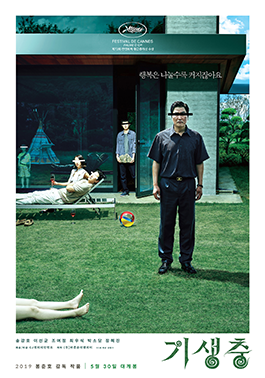
Although I use them, I find genres too constraining.  When Parasite first came out in 2019 many people said it was a horror film.  Others called it a thriller.  A comedy.  A drama.  It has elements of all these things.  As the first non-American film to win an Academy Award for best picture, it was an irresistible draw.  When it would come to a streaming service I already pay for, that is.  And having watched it, I still don’t know how I’d classify it.  And if you haven’t seen it, how would I describe it?  The word that keeps coming back to me begins with the same first couple of syllables: a parable.  In case you’re even more out of touch than I am, here’s the skinny on it.

A South Korean film, it’s the story of a poor family (Kim) that, desperate to get out of their circumstances, finds a way to infiltrate a rich family’s (Park) home.  The Kims live in a semi-basement flat prone to bugs and flooding.  The family’s son gets hired as the Park’s substitute English tutor for their daughter.  He recommends his sister (putatively as someone his cousin knows) as an art tutor for the Park’s son.  The poor siblings then arrange to have their father (presented as a stranger) hired as the chauffeur, and finally the mother as the housemaid.  They live in poverty while working for the wealthy.  Then they discover the former housekeeper kept her own family in a secret basement.  The homeowners discover none of this, then a garden party goes all wrong.

Laugh out-loud funny in parts, it’s a poignant film that, for me, explores the plight of the clever poor.  The wealthy have so much that they can easily support a second family without even noticing any financial loss.  The only reason the Parks employ all the Kims, however, is that they don’t realize the Kims are actually a family.  By pretending to be unrelated they’re able to survive.  There’s a lot to say about this movie.  I can see why some people suggest it might be horror—that’s not the usual genre assigned, though.  It has a Jordan Peelesque nature to it.  The social criticism is fairly intense throughout from trying to syphon off a neighbor’s wifi to cheap solutions to kill the bugs in the apartment.  The Parks live in a walled, gated paradise while those down lower simply have to make do.  If you haven’t seen this one, please do.  You’ll be glad you did.  And please, remember to vote.


Life in the Woods

Early influences are often the strongest.  “If you can’t say something nice, don’t say nothing at all.”  Thumper was the dispenser of this particular wisdom, as prompted by his mother, upon noticing how shaky newborn Bambi is on his long legs.  Now I recall having seen Bambi only once, at an age so early that it’s buried in my personal ancient history, but I’ve tried to live by those words ever since.  I don’t like to hurt anyone’s feelings if I can help it.  When I do, I feel awful myself, often for a prolonged period.  Add that to the fact that I read a lot and review the books, in some fashion, here, and I sometimes face a dilemma.  Particularly when it comes to self-published books.  Most of them just aren’t that good.

My wife once asked me whether I was concerned about my own critical reputation by not pointing out the problems in self-published books.  I had to ponder that a bit.  Just when the keystrokes start to point out the issues, Thumper hops into my mind and I think how I wish my own reviewers would be nicer at times.  You see, we’re all the victims of circumstance.  I’ve read self-published books where the author was clearly trying to make a living and honestly believed that s/he could write.  Ham-fisted keyboarding clearly stood behind some of these books and I realized that an editor serves a vital role in the literary ecosystem.  It’s also why I’ve resisted self publishing.  Before Holy Horror, I’d been compiling a book on monsters that I was ready to take to CreateSpace.  I’m glad I didn’t.  Books need editors just as surely as sparks fly upward.

The problem is the review.  I don’t mind saying critical things about books published in the standard way.  I’m still petting Thumper, though, and keeping it nice.  When it comes to self-published material I realize just about every time why the authors really should pursue a different line of work.  Many of us who write books do so while holding down full-time jobs.  Writing productivity suffers, yes.  I could write a lot more books if I didn’t spend nine hours at work most days.  As much as the criticism of editors (or peer reviewers) always stings, the resulting book is better for it.  You have to convince an editor, first off, that a book is worth doing.  If you can’t, perhaps there’s a hint to be taken.  I’ve never read the story behind Bambi to know if Thumper’s line came from Felix Salten or not, but I know the book was published by the prestigious German publisher Ullstein Verlag.  And self-publishing is, in many ways, a life in the woods.

Bambi: Eine Lebensgeschichte aus dem Walde by Salten, Felix

Cone of Silence

I still get asked occasionally.  Actually, I was never asked when I was employed as a professor.  Peer review is essential to the academic process.  Although I hung my shingle at Nashotah House for a decade and a half, nobody was passing by.  Now I get asked from time to time, to do some academic reviewing.  As an editor I have to ask people to do this on a daily basis.  It always bothers me when some privileged professor says, “I don’t do peer reviews; I’ve got my own writing to do.”  Well, professor, if everyone felt that way you would never be published.  We’ve got to pay our dues, no?  Getting a Ph.D. doesn’t necessarily make you humble (although it should) or considerate.  Although I’m hoping to move away from academic publishing to the more popular trade venue (believe me, I’m trying!), I know that holding a Ph.D. means I should review when I’m asked to.

Right now I’m reviewing a book manuscript that I really wish I could talk about here.  Problem is, peer review is either a singly or doubly-blind process.  The author doesn’t know who the reviewers are—that’s crucial.  And sometimes the reviewer doesn’t know who the author is.  Although this blog doesn’t get a big readership, it’d be just my luck that I’d be spouting off about some ideas I read and the author of said manuscript (I don’t know who it is, in this case) would happen upon my remarks.  That means I have to make this post about the process rather than the content.  Too bad too, because I’ve had a number of conversations about this very topic recently.  Ah, but I must keep my fingers shut.

Peer review isn’t a foolproof process.  I try to remind people frequently that nobody—and I mean nobody—has all the answers.  As the Buddha reportedly said, “Don’t take my word for it, check it against your experience.”  I used to tell my Rutgers students that same thing.  Don’t take my word for it just because I’m standing in front of an auditorium full of students.  Ask others.  Ask yourself, does it make sense?  And don’t believe anyone who claims to have all the answers.  That doesn’t solve my dilemma, though, of wanting to tell the world about the hidden book I’m reading.  It ties in so well with what I try to do on this blog.  And, really, it’s an honor to be asked.  Someone thinks I have knowledge worth sharing.  Only I can’t talk about it.

Photo by saeed karimi on Unsplash


Jason’s Javelin

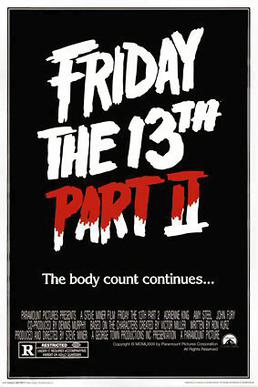
This past weekend was my third this year spent recovering from vaccinations.  The shingles jabs were worse, but this time it was a double-duty flu shot and bivalent Covid vaccine.  That’s as good an excuse as any for admitting to watching Friday the 13th, Part II.  In general I’m not a fan of sequels, but I’d read quite a bit about this one and I was curious because I hadn’t realized before watching the first installment years ago that Jason wasn’t the original killer.  I’m also not a fan of slashers, and I know that many people who dislike horror think all horror consists of such movies.  (It doesn’t.)  But still, Jason is a household name as a movie monster and I was having trouble concentrating with all those vaccines swirling around inside.

Utterly predictable, there are still a few jump startles that’ll catch a first viewing off-guard.  All I really knew about the film was Jason and Camp Crystal Lake and that generally teens get killed for having sex.  As many critics report, this kind of horror tends to have a “conservative” outlook—“sin” is brutally punished and the girl who refrains tends to be the last survivor.  That much you know just from doing your homework.  So as Jason hunts down the teens and dispatches them, along with a police officer and a crazy guy, you almost get bored.  There was one scene, however, that had unrecognized biblical roots.  Interestingly, I haven’t found anyone pointing that out.  When Jeff and Sandra go upstairs for sex, Jason takes a spear and thrusts them through, right in the act.

Analysts trace this scene to the movie Bay of Blood (which I’ve not seen), but in fact the inspiration comes from the Good Book.  In a genocidal mood in Numbers 25, Yahweh tells the Israelites to kill the Midianites among them.  Zimri is seen taking Cozbi into his tent, and Phinehas the priest grabs a javelin, rushes into Zimri’s tent and skewers the two of them in the act.  That scene stuck with my young mind as I read through the Bible, which is probably why it immediately came to mind while watching Part II.  Others may well have noticed this connection, but with the vaccine-induced lethargy I didn’t have the energy to go thumbing through my library to find it.  Besides, when I read things about movies I haven’t seen, they don’t often stay with me (which is one reason I give thorough descriptions of movies when I analyze them in my books).  This particular horror over, I know I don’t have to worry about the flu this year.


What Lurks

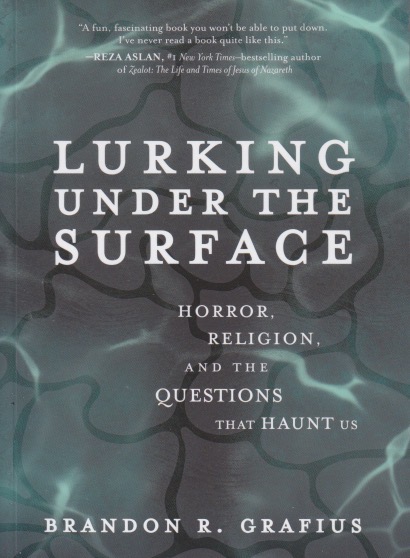
One question that I get asked by those who don’t understand is “Why horror?”  The asker is generally someone that knows I’ve been “religious” all my life, or affiliated with religion—which people think means sweet and light—and who associates horror with bitter and dark.  I know Brandon R. Grafius has been asked such things too, because I’ve just read his Lurking under the Surface: Horror, Religion, and the Questions that Haunt Us.  Like me, Grafius has been writing books on the Bible and horror—I’ve reviewed a few on this blog.  As in my former life, he teaches in a seminary.  People find this juxtaposition jarring.  This little book is Grafius’ struggle with various aspects of this question.  He’s not anti-religion, but he’s drawn to horror.

For those of us familiar with Grafius’ other work, this offers a more detailed explanation of what one religion scholar finds compelling about horror.  Specifically, he shows how various films deal with similar issues to his Christian faith.  The book deals with that for about half its running time, and the other half discusses similar themes in horror.  You get the sense that Grafius has been at this for a long time.  Scooby-Doo seems to have been his childhood gateway to horror and it raised some deeper questions as he explored further along the line.  If you read this blog, or search it, you’ll find such things as Dark Shadows and The Twilight Zone in my background, but then, I’m a bit older.  The point is, being a religious kid doesn’t discount finding monsters fascinating.

As usual with books like this, I’ve come away with several films to watch.  And more angles of approach to that tricky question of “Why horror?”.  A recent post on a panel discussion titled “Religion and Horror” led to an online exchange about religion and fear.  Grafius deals with that here as well, but from a more distinctly Christian point of view.  Although he’s an academic, this book is written (and priced) for wider consumption.  I found it quite informative to hear the story of someone else who grew up with monsters and the Bible.  He had the sense, however, to start addressing this early in his academic career.  We each have different paths to walk and for some of us it will take a jarring experience to chase us back to our childhood monsters.  And being religious is no barrier to that, as this brief book demonstrates.


Holy Nightmares

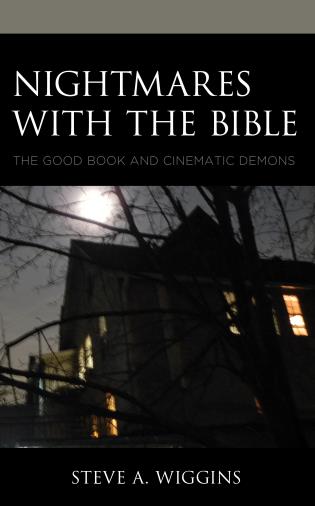
The thing about ratings, as John Green astutely notes in The Anthropocene Reviewed, is that they are in many ways arbitrary.  From the very few reviews of my own Nightmares with the Bible, I get the sense that people misunderstand the book.  Or it could be that they just don’t like it.  To each their own.  To me it is quite a personal book.  It is also a bookend to Holy Horror.  They represent first steps into a new kind of endeavor for me—saying something (hopefully) intelligent about horror films.  And writing books with no institutional support at all.  There are several intentional interlacings between these two books and to understand one it helps to read the other.  For those who want to get a sense of the way this addled brain works, in any case.

Holy Horror was literally one of those “if you see something say something” books.  I had noticed something that apparently nobody else had—the way the Bible is presented in horror films tells us something about the Good Book.  I have not seen every horror movie made.  I know of nobody who has, or even can.  I’d noticed a commonality, however, among those films.  The Bible isn’t rare in horror.  In fact, it’s quite common.  I’ve done quite a lot of reading about religion in horror since then, and this is something that has to be taken into account when considering the effects of Christianization.  It brings fear in its trail.  Nightmares with the Bible is a bit more ambitious and a bit of a hybrid.  That may be why its been reviewed so poorly.  It is a continuation of the thesis—if you want to understand how people really believe, look at what popular culture teaches us.

What do we believe about demons?  What The Exorcist taught us to believe.  Anyone who looks at the history of the idea sees that this concept really only took off, after the Middle Ages, when movies reminded us of the threat.  From the early modern period on, belief in demons and their impact on the world had been in decline.  Anyone looking at the headlines today will have to wonder about the wisdom of that loss of interest.  When The Exorcist hit, it struck a nerve.  Since then demons have been back on the big screen time and time again, each showing providing more information on what to believe.  I suspect those who’ve been rating the book really don’t get what I’m trying to do.  At least, I tell myself, somebody’s reading my work.


Grave Robbers

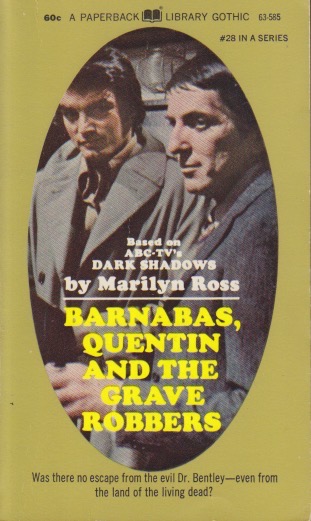
My personal reconstruction of the Dark Shadows universe was made by connecting the books by Marilyn Ross that I could find with the episodes of the television show that I saw.  I’ve always been one to try to make a logical storyline out of such things so that I could connect them when they came at irregular intervals.  (I’m still a fan of linear storytelling.)  So it’s a bit of an eye-opener to read the series of pulps in order.  There are continuities and discontinuities.  Barnabas, Quentin and the Grave Robbers again has Quentin, in 1830, portrayed as a good guy.  When he was first introduced in the series some books back, he was a satanist and very nearly evil.  And this was in a more recent era.  You get the sense that Ross was responding to fan requests.

As I noted regarding the last book in the series, the stories do seem to have grown more complex, and sophisticated over time.  The writing remains labored, but the story aspect improves.  Barnabas, Quentin and the Grave Robbers comes the closest to standard horror so far.  This is a dark story with problematic race issues thrown in.  The first two-thirds or so are set in England and are tied into the story by Barnabas Collins being there.  It is distanced from the usual moody setting of Collinwood where, despite all the haunting and troubles, you tend to think things turn out alright in the end.  Here the antagonist grave robbers kill people close to the heroine and the corpses sent to gruesome ends.  And there are zombies.

To flee the evil ringleader, Barnabas takes Paula Sullivan to Collinwood where Quentin is introduced to the story.  In 1830 he’s an unpredictable trickster, but good at heart.  He and Barnabas team up, as last time, to take on the grave robber when he moves, you guessed it, next door to Collinwood.  Then something unusual happens—Paula discovers zombies are afraid of crosses.  This leads to a strange episode of Barnabas—a vampire, remember—chasing a zombie with a cross.  In general religious imagery is scarce in these novels.  A vicar or two may be mentioned, but vampires aren’t menaced with crosses.  That does happen in one of the movies, but here it seems that because Barnabas is a good vampire he’s not bothered by a cross.  Or it could be a consistency issue.  Either way, this is a moody addition to the series, appropriate, as always, for autumnal reading.


Not Over

It’s not over, you know.  Halloween, I mean.  We may have made it through the actual night of trick-or-treating with all of its build-up, but like many holidays from olden times, Halloween was, and still should be, part of a complex of holy days.  People have long believed that something was transitioning at this time of year.  Halloween spun off of its more sacred sibling, All Saints Day.  Before Christianization, Samhain perhaps spanned more than one day.  As a result of relentless capitalism with its parsimonious counting of days off, like pre-conversion Scrooge, has made all holidays one-day events.  Sometimes you need some time to sort out what’s happening and this three-day complex is one of those times.  Día de los Muertos begins today—this holiday’s just getting started.

I’ve frequently suggested to the few who’ll listen that we need to take holidays seriously.  Culturally we tolerate them as days of less productivity.  Who actually gets Halloween off work?  And how many of us work in places where “Happy Halloween” is a regular greeting on the 31st?  I don’t know about you, but in all my Zoom meetings yesterday nobody was wearing a costume.  And yet, at Nashotah House I learned that today is a “day of obligation.”  Attending services isn’t optional (of course, it never was optional at Nashotah).  But this one was really serious.  The Catholic Church moved All Saints Day to November 1 to counter Samhain celebrations encountered in Celtic lands.  People are reluctant to give up their religion, however, and the day before All Hallows allowed for Samhain to retain its identity.  And even today’s not the end of the season.  Tomorrow has traditionally been All Souls Day.  But what company’s going to give you three days off at this time of year? We’re gearing up for Black Friday.

Holidays serve to give structure to the passing of time.  Winter with its privations is on its way.  This autumnal complex of holidays, whether celebrated as Samhain, Día de los Muertos, or Halloween-All Saints-All Souls, reminds us to take a pause and ponder what all of this really means.  And not only ponder, but also celebrate.  Halloween is fun with its costumes and candy and spooky decorations, but it’s more than just that.  It’s a season of existential questions and of preparing for the inevitable cold days ahead.  We ignore such things at our own peril.  There are reasons for holidays, but those who find meaning only in mammon see no reason to offer even one day off, amid a season we most deeply, intensely need.


This Halloween

This year I’ve been making a conscious effort to appreciate autumn.  It’s admittedly difficult when you’re forced to sit in an office, even a home office, for most of the daylight hours five days a week.  (At least I have a window here, which I never had on Madison Avenue.)  Seeing the blue skies and colorful leaves, each individual one of which is a singular work of art, or watching the moody, cloudy skies, I wish for freedom.  Every night before falling asleep, if I can remember to do so, the last word I whisper to myself has been “September,” then “October,” to remind myself of the wonder of this time of year in which I’ve been privileged to live.  Since America is driven by money alone, often in the guise of religion, Halloween is practically over before it begins.  Stores have sold their candy and spooky decorations, now it’s on to the more lucrative Christmas season.

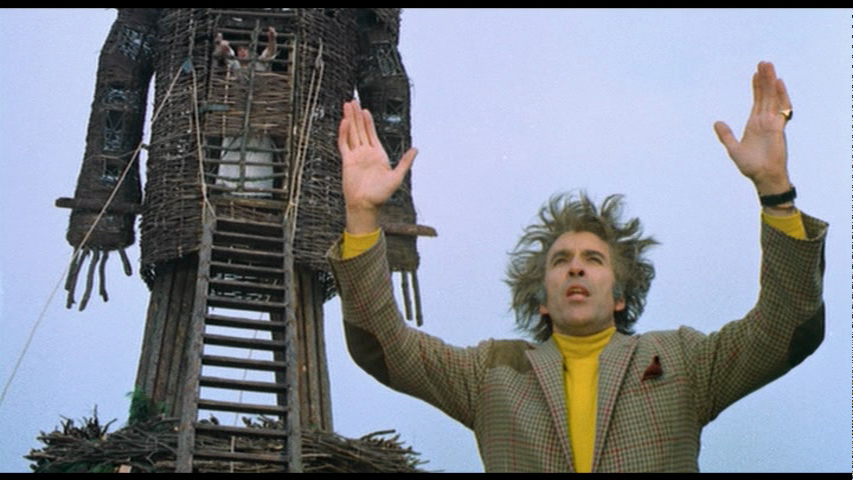
Do we really believe that holidays have any power anymore?  Is Halloween really, perhaps, a time when the veil between worlds is actually thin?  Or have we ceased believing in the other world, the one behind all the money and sham?   Holidays are liminal times.  In an ironic way, it’s my heartfelt appreciation of Halloween that led me to write about The Wicker Man, although it’s set half a year away.  Nashotah House was hardly an ideal place to work, but prior to an administration change, it was the best place I’ve ever lived to celebrate Halloween.  A campus with an in-house cemetery, and surrounded (at the time) by cornfields and woods, was adjunct to really believing.  It was a haunted place.

Out on late nights or early mornings, I often felt it.  Trying to photograph a comet down by the lake by myself, woods on either side, in the total dark.  Or dragging a lawn chair through the trees to the edge of a cornfield at 4 a.m. to try to catch a meteor shower.   Hiding in the graveyard on Halloween night, dressed as a grim reaper to follow the hay wagon of kids that the maintenance director would drive through on that night.  Those memories remain as highlights of my foreshortened teaching career.  Since Harry Potter was in the ascendant, students had taken to calling the seminary “Hogwarts,” and, I was told, I was the master of Ravenclaw.  The leaves, miniature Van Gogh’s each one, are fast falling from the trees.  There’s a decided chill in the air.  Something might, just might, really happen this Halloween.


Seasonal Viewing

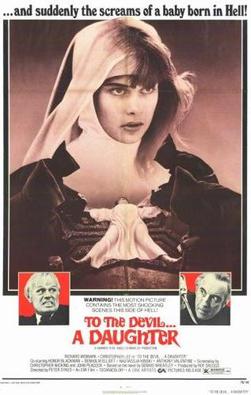
Any movie that begins with an excommunication ought to be good.  Especially with its list of stars you’d think To the Devil a Daughter might’ve turned out better.  Still, it is a good example of religion and horror mingling together.  I’ve never read any Dennis Wheatley novels, but reputedly he didn’t like this film adaptation of his book.  It certainly has a convoluted plot.  So an excommunicated priest has started a new religion that worships Ashtaroth.  He has to baptize a child, now 18 (three-times-six, don’t you see), with the blood of the demon so that she can become his (Ashtaroth’s) avatar.  This is apparently the eponymous daughter to the Devil.  She was baptized initially by her mother’s blood at her birth.

The girl’s father, who survived her birth—unlike his wife—has decided at the last moment to save his daughter.  He appears to be independently wealthy yet he talks an author of occult books into doing the saving for him.  The girl, it turns out, is a nun in this satanic religious order and is only too willing to do what she can to serve “our Lord.”  The way that all of this plays out is confusing and Byzantine, but it does raise a serious question: what if a child is reared in a bad religion?  (And there are some.)  Who has the right to decide if a religion is good or bad?  Children are easily indoctrinated and not too many question the faith in which they were raised.  Yes, we all think the religion we believe is the right one.  The problem is everyone else thinks the same thing.

One of the things this movie got right is that the “heretics” are portrayed as sincerely believing that their religion is for the improvement of the world.  Calling themselves Children of the Lord, they believe Ashtaroth is good.  And a good lord wants what is best for the world, right?  This is the dilemma of exclusive religions that teach only their own outlook can possibly be the correct one.  Otherwise you have to give adherents a choice and another religion may be more appealing.  Or worse, they may reason out that if you’re given a choice that means your own religion is also merely one of many.  Historically religions have gotten around this by valorizing true believers who never question anything.  To the Devil a Daughter isn’t a great movie.  It’s not even a very good one.  Nevertheless, it raises some questions that lie, of course, in the details.


Hallowed Tradition

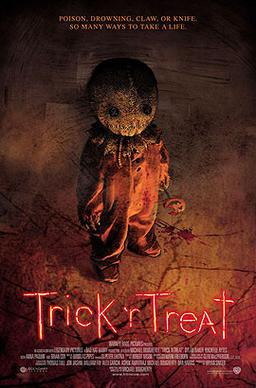
The more I learn about the movie industry the more complex I realize it is.  Take Trick ‘r Treat, for example.  It was released to some film festivals—and backed by a major studio—in 2007.  I wondered why I’d never really heard of it, and the reason seems to be that it never had a theatrical release.  Until this month.  It is now playing in theaters.  The thing is, it’s already available on streaming services because it gained a cult following when it was initially released fifteen years ago.  I came to know about it by wandering into one of those Halloween pop-up stores recently.  There were plenty of Sam costumes so I did a little research and discovered a Halloween movie I’d never seen.

I have to say, the first time watching it was confusing.  I didn’t realize it was four or five separate, but interlaced stories.  I kept waiting for a central plot to emerge, but it didn’t.  At the same time, I wasn’t aware that it was a comedy horror either.  I have no problem with comedy horror, of course.  I just like to know that before I get into it.  Once I’d figured these things out, I could see the draw.  It is fun and seasonal.  Clearly it’s holiday horror.  In fact several websites list it as being essential October viewing.  It’s certainly different from many Halloween movies in refusing to be taken seriously.  It’s like adults having fun instead of kids enjoying the holiday.

Perhaps the most self-aware Halloween film, it constantly reinforces that you need to obey Samhain etiquette.  Those who are killed (and there are many) die for having violated the rules of the holiday.  I appreciate the fact that it insists that we do these things for a reason.  Wearing costumes, handing out candy, carving and lighting jack-o-lanterns, these all serve a purpose.  The movie suggests we need to do these things to stay safe from Sam.  Sam, of course, can’t be killed which means that a sequel may be in the works.  Trick ‘r Treat gets full marks for staying focused on the holiday.  Holiday horror has been a fascination of mine for some time and this movie has it in spades.  Even if it’s a little confusing at times, it’s a fun way to celebrate the season.  And this year you have your choice of seeing it in the theater or streaming it on your most convenient device.


Data Protection

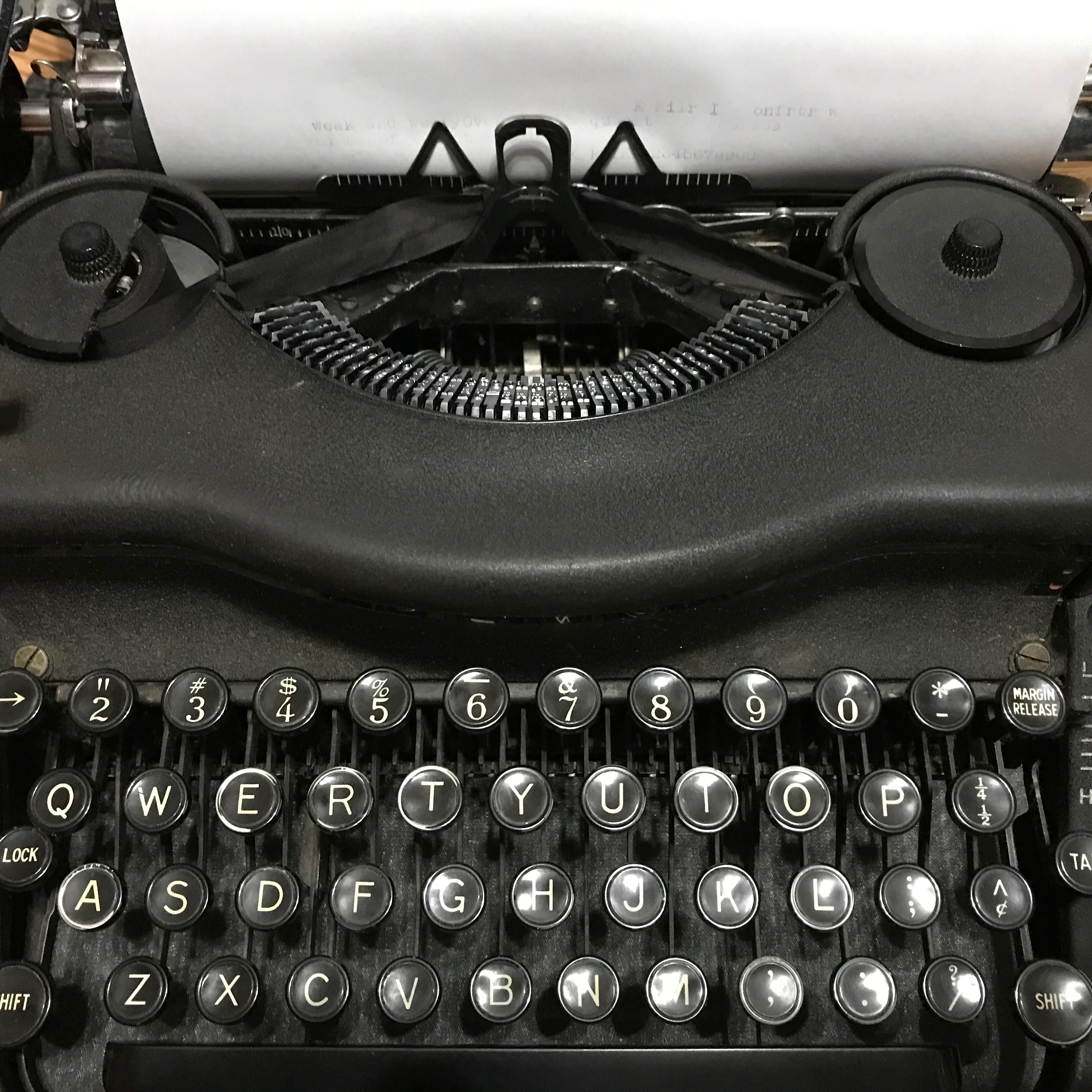
I learned to type on an actual typewriter.  For many—likely the majority—of those my age or older, that was the case.  Schools in the seventies, perhaps anticipating the computer revolution, emphasized that both boys and girls should learn typing. At least my school did.  Those were the heady days of electric typewriters that smacked the paper with a satisfying thwack at the slightest touch on the keys.  In circumstances whose details I simply can’t remember, my mother bought me an old, manual typewriter at a garage sale or something.  One thing is certain—it didn’t cost much.  It worked, however, and I typed away writing stories and plays and even attempted letters to editors.  I’d been writing long before that, of course.  Some of my early fiction was in pencil on school tablet paper and I think I still might have a few survivors from that era in the attic.

The image of the noisy newsroom full of clacking typewriters still conveys a kind of power.  Writers in those days, if they were prominent enough, could bang away at the keyboard, jerk the results out, put them in an envelope and be assured of publication.  Everything seems more difficult these days.  Computers have made writers of so many people that it’s difficult to get noticed.  More important, however, is the fact that print preserved data.  Newspaper was cheap, so perhaps the newsroom isn’t the best example.  Kept dry and in climate-controlled environments such as libraries, books keep a very long time.  Longer than the life of the author, or so it is hoped.

Data backup is now a constant concern.  A couple years back, an unfortunate bump on my own terabyte drive led to a quite expensive data recovery bill with some information lost forever.  Throughout the process I kept thinking, if all of this were printed out at least I’d be able to access it.  So true.  The vinyl market demonstrates that not everyone is willing to put up with the artificiality of electronic media.  Those who promote it tend to shy away from discussing its fragility.  Even now when I have a story published I print it out so that if the data becomes corrupted it can at least be retyped.  My most recent double-backup took an entire Saturday to accomplish.  Who knows what memory-intensive software lies behind each keystroke?  I look at the humble typewriter and tell myself that certain plateaus were perhaps more stable than the majestic mountains with their landslides and crevasses.  And I always found that clacking noise soothing, as ideas were preserved in solid form.


The Panel

More than one person pointed it out to me, so I guess I must be getting a (small) reputation.  During one of my campus editorial visits I stopped into the center for Religion and American Culture at that venerable institution known as IUPUI—Indiana University Purdue University Indianapolis.  I was immediately impressed and, of course, since I’m no longer in academia I’ve realized that the impact of religion on culture is my real interest in it.  What was pointed out to me, however, was an episode of their “Religion and” series.  This one was held via Zoom and has been posted here, so if you, like me, work, or are just finding out about it, can still see it.  I encourage that behavior.  This particular panel was “Religion and Horror.”

As the word “panel” indicates, it was a moderated group discussion.  The panelists were Douglas E. Cowan of the University of Waterloo, Erika Engstrom of the University of Kentucky School of Journalism and Media, and W. Scott Poole of the College of Charleston.  The moderator was Melissa Borja of the University of Michigan.  What a great way to spend an October afternoon!  It is also good to know that I’m not the only one who’s noticed that religion and horror are similar and even address similar needs.  I’ve read books by Cowan and Poole and have even met the former a couple of times.  No longer a university employee, I largely work in insolation, so it’s great to hear conversation about the kinds of things in my head once in a while.  A number of refrains became obvious during this all-too-brief discussion.

We’ve been conditioned to think of religion as inherently good.  In general, we’ve also been conditioned to think of horror as inherently bad.  As with most black-and-white categories, both of these things get some key points wrong.  Religions, like everything else, have histories.  Those who study those histories learn that much of what’s passed along to believers is intended to make them into repeat, paying customers.  Try teaching in a seminary for a few years and then attempt to dispute that.  And, the panelists pointed out, horror is also a product, intended to sell.  This explains the endless parade of, for example, Halloween movies.  Just when you think you’ve purchased the last one you’ll ever need to buy there’s another.  There was so much squeezed into that one hour that I was glad I was taking notes.  But then, it was a recording—you can see it too, and I urge you to do so.


Small Big World

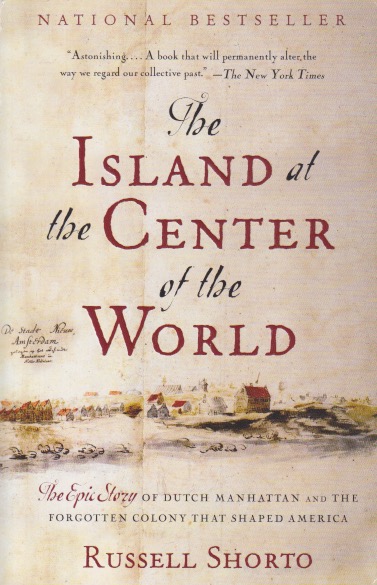
Serendipity may have been over-used in the eighties, but the idea of finding something by chance that turns out to be really good is real enough.  My wife found The Island at the Center of the World, by Russell Shorto, by chance.  You see, used bookstores are places of serendipity.  This one happened to be in Trumansburg, New York.  Subtitled The Epic Story of Dutch Manhattan and the Forgotten Colony that Shaped America, this is the story of an early European incursion into North America.  These days it’s difficult to feel good about any of that, but overlooking the misery we’ve caused for a moment, the early Dutch settlement was, comparatively, not as detrimental to the American Indians as later colonies were.  The Dutch were mainly interested in trading, and unlike the Puritans who settled to the north, they were tolerant of difference, even religious difference.

Shorto chronicles how the settlement of Manhattan from the beginning was one of diverse peoples having to get along and accept one another.  The Dutch, like the Puritans, had been infected by Calvinism, but they took a more practical view.  People get along better if you don’t force them all to think the same way.  The book suggests that this was impressed on New Amsterdam from the beginning, and it remained when it became New York.  It’s a fascinating story partially because it begins the narrative before the point where we’re generally instructed in school.  Europe was warring, at the time, of course.  But it was a Dutch idea—that peace could be the default state, instead of war—that allowed for real civic progress.  Those scrambling for empires, however, continued to squabble, even as they still do today.

There are plenty of unexpected insights from this book.  The Dutch in many ways molded the die that would become European America.  Having built a successful trading colony in Manhattan, they had to surrender it when the English, after the Cromwell debacle, decided to take it by force.  The people of Manhattan did not want to fight a clearly superior army and lose all that they’d gained by their tolerant way of life.  And so New Amsterdam became New York.  The story is filled with colorful characters and incidents that, if you’re like me, you’ve never heard of.  I’m not one of those people who has to read everything published on New York City.  Working there for many years was sufficient for me.  But still, this is one of those books that I’m glad my wife serendipitously found while looking for nothing in particular in a used bookstore.