Q’s and P’s

I finally had to break down and buy it.  Quatermass and the Pit has been on my “to see” list probably longer than any other single movie.  I managed to stream the first two of this telinema series for free, so I guess it was like getting three movies for the price of one.  Aired in the United States as Five Million Years to Earth, this isn’t the greatest sci-fi-horror movie ever, but it isn’t bad.  The pacing is a bit slow but the story is intriguing.  Rocket scientist Quatermass gets involved in the excavation of what turns out to be a buried rocket ship from Mars.  Surrounding the ship in the five-million-year-old matrix are the remains of apparently intelligent apes.  The scientists discover that the apes were artificially enhanced by insectoid martians that resemble the devil.  It’s pointed out that any time digging has taken place near Hobb’s End, strange phenomena occur.  It’s noted that Hob used to be a nickname for the devil.
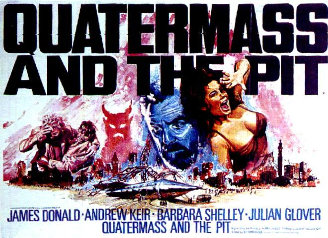
This detail leads to a perhaps unexpected connection to religion and horror.  Quatermass and Barbara, a scientist who has the ability to “see” the creatures via collective memory, realize that the hauntings that have taken place around Hobb’s End for centuries may have been the image of demons, or the devil, emanating from the evil of these would-be invaders.  At one point a priest argues that their influence is essentially demonic, but the scientists realize that these modified apes are actually the creatures from which humans evolved.  All the human tampering with the ship eventually frees the spirit of the martian insects, resembling a devil.  The way to destroy it is with iron, relying on folklore which, in this instance, works.

The four Quatermass movies (I don’t plan on seeking out the last) were theatrical reshoots of television serials.  The last movie is essentially the TV series stitched together as a movie.  From at least the seventies on (Quatermass and the Pit was released in 1967) the first and third installments were considered fairly good horror films.  They aren’t always available in the United States, probably due to digital rights management.  It seems ridiculous that in this day and age that companies still restrict access, even to those willing to pay a modest fee, for movies that are essential parts of the canon.  Hammer (all three Quatermass movies are Hammer productions) films are still difficult to access in the United States.  At least, with the willingness to wait half a century, I’ve finally be able to see Quatermass and the Pit.
Quatermass Again

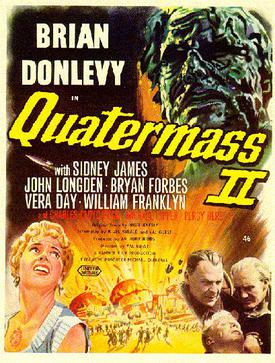
Quatermass, as I’ve noted before, is a name I knew from boyhood, but with no frame of reference.  Having watched The Quatermass Xperiment, and still seeking Quatermass and the Pit, I found a freebee of Quatermass 2 on a commercial streaming service.  Hammer films are notoriously difficult to find in the United States, unless you’re willing to pay serious money for them.  In any case, Quatermass 2 is a passible bad movie in the sci-fi-horror genre.  Quatermass is supposed to be a likable character, but for the film versions American “tough guy” Brian Donlevy played Quatermass in the first two movies.  But I need to take a step back.  Quatermass was a BBC television serial.  There were four series, each eventually made into movies.  The first three were reshot and the final one (The Quatermass Conclusion) was cobbled together from the serial rather than being refilmed.

Of this set of movies, The Quatermass Xperiment and Quatermass and the Pit are considered proper horror.  Brian Donlevy doesn’t garner a ton of sympathy in Quatermass 2.  This is mainly because of poor acting and a small budget.  Reputedly suffering from alcoholism, Donlevy has trouble with his lines and often appears curt and short-tempered (he was replaced in Quatermass and the Pit).  Even so, Quatermass 2 has monsters and some reasonably scary moments.  Here’s the story: alien invaders are taking over a secret government plant preparing for moon colonization.  Quatermass discovers the base and finds that everyone acts odd.  Interestingly, they’ve stolen his plans for the base.  The aliens take over people, body-snatcher style.  Quatermass and an angry mob manage to get into the base where the alien-infected fight them.  Eventually the huge monsters break loose and Quatermass has his own rocket converted to a bomb to destroy the mothership in geosynchronous orbit.  The infected people return to normal.

It’s fairly easy to see why few people comment on Quatermass 2.  I wouldn’t have watched it had I not stumbled across a clip showing some of its horror chops.  I’m glad, in a strange way, that I saw it.  I knew Quatermass was a telinema [link to Fire Walking]  product, but I wasn’t quite sure how the television serial fit together with the movies.  Quatermass 2 was bad enough to make me look it up.  From all my reading about horror movies, Quatermass and the Pit is the scariest of the four.  At least at this historical moment it’s not available on streaming services.  And that, I submit, is why we still need DVDs.  Digital rights management is rather like an alien invader…


Experimenting with Quatermass

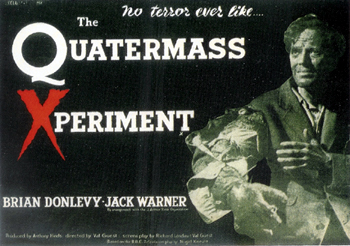
Hammer films are coy.  In these days of digital rights management, they’re often difficult to locate in the United States.  Even on streaming services.  I’d known about Quatermass since I was a kid.  I’d heard about Quatermass and the Pit as a pretty scary early science fiction-horror offering.  I’ve still never seen it.  Quatermass was a BBC television character, a kind of mad scientist figure.  The Quatermass Xperiment was the first of a set of four Hammer films based on him.  Also known as The Creeping Unknown, it was cast with an American Quatermass (ironically, it turns out) to appeal to American viewers (who can now seldom access the film).  In any case, one of the streaming services finally acquired rights to the 1955 movie.  The special effects were naturally primitive, but that doesn’t stop this from becoming a scary film.

Watching these early movies is like studying history.  Other films were influenced by The Quatermass Xperiment, most notably Lifeforce.  I couldn’t help but think of Night of the Living Dead as well.  Quatermass, a rogue scientist, sends a rocket into space with three astronauts.  Since this was before we had any kind of conception of how this might actually be done, the idea seems implausible, of course.  The rocket returns with only one of the three crew members, and he’s morphing into something else.  Despite his arrogance, Quatermass realizes he has to cooperate with the police to contain the menace.  Inspector Lomax describes himself as a “Bible man,” unacquainted with science, and Quatermass considers his work superior to that or mere police.  When the hybrid is finally located and destroyed, however, it is in Westminster Abbey.

Although the runtime is just over an hour and some of the acting is quite wooden, this is an affecting story.  The scene where the transforming man encounters the little girl’s tea party bears elements of the pathos of Frankenstein.  Without the budget, science, and even acting resources of modern productions, The Quatermass Xperiment manages to fall squarely into horror with a monster I’d been waiting since childhood to see.  In those days you were at the mercy of your local television offerings.  Now that we have worldwide content on the worldwide web, we still restrict viewing so that the most money can be made from a movie that’s seven decades old, and its cohort.  In any case, this experiment has left me determined to find what Quatermass discovers in the pit.  Once that becomes available on a service I use.


Eye Eye

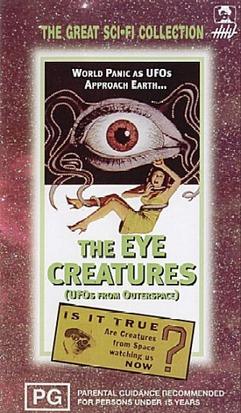
When trying to be conscientious about not spending too much money on movies there’s always the risk of seeing something cheap.  In the case of The Eye Creatures, not only was it cheap, but it was also a throw-back to childhood.  I remember seeing this one in my younger years, and, not yet old enough to be critical, loving the costumes.  Rewatching it as an adult, where some critical faculties remain, reveals it to be a bad movie.  Poorly written, poorly acted, and poorly financed, it ticks all the boxes.  It’s actually a remake of an earlier American International Pictures film, and AIP wasn’t known for its lush budgets.  To be fair, the film is supposed to be a sci-fi horror comedy, but the comedy isn’t that good.  The unintentional gaffs are.

So, the Air Force is concerned about keeping flying saucers secret.  When an “unfriendly” one lands where the teens all go parking, the Air Force investigates while the eponymous eye creatures terrorize the local kids.  Specifically, they seem bent on revenge against Stan Keyton and his girl, because they ran over one of the creatures.  Keyton gets arrested for manslaughter because the creatures substitute the body of a drifter they killed for the corpse of their own comrade.  The police don’t believe in aliens, of course, and the Air Force denies everything.  Keyton and gal decide, after discovering the the eye creatures explode when exposed to light, to round up the necking kids and wipe out the aliens with their headlights.  They figure nobody will believe them anyway.

Some movie monsters stick with you for decades.  The eye creatures are one example of this.  Simply seeing the movie title reminded me of them, although the only plot point I could remember was that they exploded in the light.  I didn’t recall all the voyeuristic watching of teens making out that the Air Force officers did.  Or the tedious revisiting of the Old Man Bailey character.  One of schlockmeister Larry Buchanan’s films, it was released the same year as his other cheap childhood favorite, Zontar, Thing from Venus.  As much as people like to make fun of makers of such cheap movies, Buchanan gained recognition in the New York Times (as have other makers of schlock such as Roger Corman and William Castle), so there is something to these movies.  For one thing, those of us who grew up in the sixties remember them.  And, if we also remain cheap, we can see them again as adults, and relive a bit of cinematic history.


Another Level

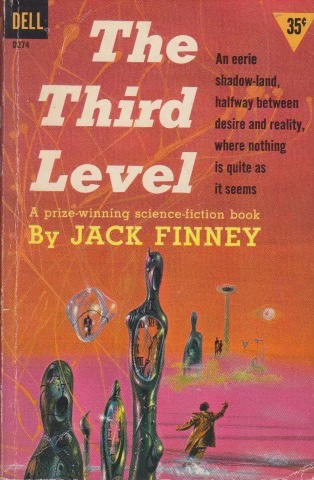
Jack Finney is probably best remembered as the person who came up with the idea for The Invasion of the Body Snatchers.  His book, The Body Snatchers, was the inspiration behind the two movies based on it, as well as various knockoffs.  The Third Level is a collection of short stories he wrote.  I’ve been trying to introduce more short stories into my literary diet, and this one was recommended by Stephen King in Danse Macabre.  Specifically, he mentioned it as being more like what The Twilight Zone should’ve been than much of what Rod Serling wrote.  Now, I’m an unapologetic Rod Serling fan.  This is based on memories from childhood when I watched the show and, let’s be honest here, wished he could be my father.  I already had a taste for the unusual and sometimes macabre, and so I was curious what King thought might do Serling better.

The Third Level was labeled as science fiction, but sci-fi and horror share more than a boundary or two and at least four of the stories have nothing sciency about them.  As a collection it’s good in the same sense as a mature reading of Ray Bradbury is good.  I would’ve liked this—probably loved it—as a kid.  I was reading, however, for The Twilight Zone.  There are some good twist endings here, but not all the stories have them.  A couple of them are pretty straightforward whimsical romances.  Many of them feel very much like they were written in the forties and fifties.  A couple of the stories, late in the collection, I really liked.  They were a bit more Zonish than some of the others.

One of the problems in writing a brief post on a collection—and no collection is uniformly great—is that it’s difficult to give a sense of the whole.  So instead I’ll just focus for a minute on the last story, “Contents of the Dead Man’s Pockets.”  This one shows the power of Finney’s descriptive writing and it caused physical reactions I seldom get when reading.  It involves a man climbing out on an eleventh-story ledge to reclaim an important bit of paper that blew out the window.  More than once I almost had to put the book down.  Fear of falling is deeply embedded in the human psyche and Finney is able to probe it for more pages than I was comfortable reading.  Well done, sir.  Overall, the collection is good to have read.  It won’t change my mind about the Zone, however.  It reached me a little too late to do that.


Alien Invaders

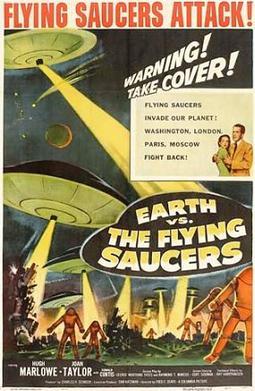
I’ve been pondering genre for some time now.  And since Stephen King assures me (not personally) that Earth Vs. the Flying Saucers is horror, I figured I’d give it a try.  In fact, given the various themes of the movie, I’m surprised I hadn’t seen it before.  The title pretty much gives it away—aliens try to take over Earth with a swarm of flying saucers.  Two scientists figure out how to make their saucers stall, and even though the aliens have a disintegration ray that pretty much destroys anything, the earthlings prevail.  Having summarized it all in less than a hundred words, is there really anything worth comment here?  I think so.

Like many older movies this one makes use of stock footage to fill in action sequences and to keep the budget reasonable.  So there are big guns going off and rockets being launched.  (This was a pre-Sputnik movie and it depicts America having eleven satellites in orbit.)  But the additional footage that stayed with me was a scene of two planes colliding and crashing.  It was clear these weren’t models and the footage was authentic, apart from the flying saucer shooting the planes.  It turns out that this scene was indeed real, and that the pilots of both planes died in the crash.  During an air show outside Spokane, Washington in July 1944 this collision was caught on film by a Paramount news crew and it was reused in this film.  This got me to thinking about war footage—something that really only became possible in the Second World War.  And what we now see today in real time on the internet because the world is wired.

It’s as if those who wage war are fine with it as long as people with a conscience don’t know what happens.  There’s even a phrase used to excuse unspeakable barbarism during combat: the haze of war.  This we know about our species—there’s a tipping point beyond which rationality shuts off and we’re no longer responsible for our behavior.  We also know that war puts people in that zone.  It was fine as long as only surviving warriors were left to tell the stories of their bravery.  Photographing, particularly in motion pictures, combat revealed a much darker truth.  Well, at least in Earth Vs. the Flying Saucers the enemies under attack were fictional.  Except.  Except, some of the casualties were real people whose final moments were caught on camera.  Be sure to get out and vote today, if you’re in the United States.  There’s a party even less understanding than aliens out there, desiring to take over.


A Land Forgotten

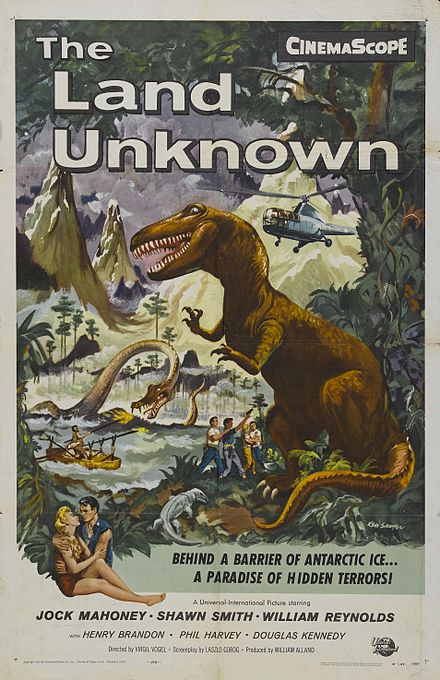
In case anyone’s noticed (which I doubt) that I’ve been discussing a spate of 1950s sci-fi/horror movies, I have a confession to make.  Several years ago I needed to see Tarantula.  (Anyone with similar headspace will know this need.)  The only place it was available at the time was in The Classic Sci-Fi Ultimate Collection.  Volumes 1 and 2 were sold together.  I did what I had to do.  Then I forgot I had the set before finishing volume 1.  Who knows what might’ve been going on in my life then?  Rediscovering it has been a budget-saving way to address my fix.  I had never heard of The Land Unknown before, and although it has one of the goofiest T-rexes ever, it is actually a good story.  Of course there are holes in the plot, but it is about the necessity of being humane, even when emotion dictates otherwise.

A helicopter crew on a South Pole expedition makes an emergency landing in a volcano that harbors prehistoric life in a hot spot in Antarctica.  The crew has a female reporter with them—these movies certainly have fifties attitudes about women!  Not having the parts to repair their copter, they try to survive among dinosaurs and an aggressive, giant monitor lizard.  There is another person there, the sole survivor of an earlier expedition, who’s become mostly feral.  The commander of the modern crew demands that they give him the dignity and fair treatment that all people deserve.  There’s a bit of drama around who will get the girl (again, the fifties), with the commander ultimately winning out.  How do our heroes escape this peril?  They’re able to repair the helicopter with parts from the earlier expedition’s crashed vehicle.

With its budget the special effects had to be cheap, but the story has redeeming value.  The message that we mustn’t let isolation drive us to bestiality is still as important as ever.  There are those who watch such movies solely to laugh at the special effects.  Hey, I laughed a bit too, but I’m only human!  There is, however, more to this movie than the dinosaurs, which drew audiences then just as the Jurassic Park franchisedoes now.  There’s even some serious talk about evolution, which was often present in these Universal creature features.  There are some slip-ups on the evolution part, but apparently the monitor lizards were meant to represent stegosauruses—did I mention the budget was tight?  I actually found the movie to be worth seeing for its intrinsic value.  Not bad for a forgotten set purchased mainly for one movie in a time unknown.


Animate Magnetism

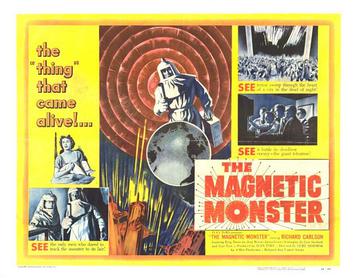
The Magnetic Monster is listed as sci-fi and horror on industry websites.  It falls into that period when horror had shifted to Hammer Studios in the UK and the US had entered that white-shirt, button-down period known as the fifties.  There were still monsters out there but they generally had to do with radiation.  In this case, it’s magnetism and its relationship to electricity.  The movie came out in 1953 and introduces what may have been the forerunner of the X-Files, namely the Office of Scientific Investigation, the OSI.  This team of A-men (yes, this was the fifties) study anomalies in order to keep America safe.  There were a total of three OSI films, of which this is the first.  The eponymous magnetic monster is alive only in a philosophical sense—it’s actually an irradiated element gone wild.

An unrestrained scientist had subjected a radioactive isotope to alpha particles for several days and this started a chain reaction.  He takes the substance onto a commercial airline—in his carry-on, no less (it was the fifties)—but the plane is diverted so the A-men can intercept it.  Every eleven hours this isotope divides and doubles, eating all the energy around itself to do so.  This creates an immense magnetic field.  So immense, in fact, that in a mere matter of days it will throw off the earth’s core and our planet will spin helplessly off into space!  Don’t panic, dear reader, the A-men are on the job.  They find a scientific means of overfeeding this monster and destroying it, which is why we’re all still here.

Interestingly, this is one of the more highly rated movies of the era, perhaps because of its scientific optimism.  Scientists can solve all our problems.  And yet you’ll find them without fail in church on Sunday morning.  The fifties were developing a kind of split personality for this country that was trying to hold two conflicting impulses together in an attempted fusion.  The problem is, overthinking either (or both) of them would demonstrate that they really have separate paths to take.  They may well be compatible, but in ways that relegating religion to Sunday morning simply doesn’t work.  Even today many scientists—generally not the outspoken kind—still hold religion and science in tension.  There is something to this impulse we call religion, but it always seems to have to wait while we use science to destroy the monsters we create ourselves. 


Bug Eyes

Science fiction and horror are close kin.  Once relegated to the cheap rack of “genre fiction,” both have now developed considerable literary sophistication, perhaps in the wake of their ability to bring in money.  I used to attend used book sales.  Two of the big ones in central Jersey were the Bryn Mawr sale, held just outside Princeton, and the even larger Hunterdon County Friends of the Library sale.  Both were springtime events and highlights on my calendar.  I always had a list with me when I went, but there were also so many books I’d never heard of and that looked fascinating.  One such book was the science fiction anthology, Bug-Eyed Monsters, edited by Bill Pronzini and Barry N. Malzberg.  The garish cover was half the appeal, and, well, monsters go without saying.

Although I’ve mostly moved to the horror end of the spectrum, there were some good stories here.  Bug-eyed monsters were a staple of 1950’s sci-fi, gracing the covers of pulps, often menacing women with their tentacles.  Some of the tales here share that kind of wide-eyed wonder at the sheer power of imagination, while others are much more subtle.  Monsters, of course, lurk between genres, bursting into consciousness when something unexpected is discovered.  They also have strains of religious awe associated with them.  That’s obvious in a couple of the stories as well.  Since I’m trying to read through my own books while stores are closed, I decided to spend some time with my monsters.  The problem with story collections, however, is you can’t discuss them all in the short format to which I limit myself here.  Besides, some of them I didn’t like.

Monsters deserve to be treated with respect.  In the “golden age” of sci-fi they were often played for titillation.  Most of the monsters in this collection are from outer space.  Some are homegrown, generally in the scarier tales.  We are afraid of those who are different.  Monsters, as more than one of these stories indicate, can be more humane than humans often are.  It’s no surprise that they tend to represent the foreigner, the person whose culture and appearance are different than our own.  Titillation apart, these narratives often ask us to stop and consider what might happen if we really did listen.  Would we not improve ourselves if we could learn from those we fear?  In these days of government-approved xenophobia, perhaps we should dust off our copies of the old genre fiction.  Even in those days we were encouraged to be open minded like our monsters.


For Illustration Purposes

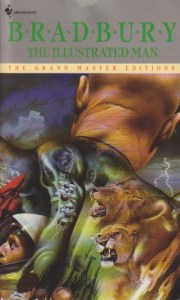
With the non-essential stores closed, my daughter asked me the other day “does that mean bookstores?”  Sadly, yes.  More weekends than not I spend some time in a bookstore.  Fortunately we are well stocked for an apocalypse, book wise.  Lately I’ve been on a kick of reading short stories.  I’ve certainly written enough of them to fill a book or two, and it’s nice to start something you can finish in one sitting.  I just finished reading, or perhaps re-reading Ray Bradbury’s The Illustrated Man.  I say “perhaps re-reading” because I know I read many of the stories in the edition of the book I bought as a tween.  Some of the tales I didn’t recall at all, making me think I was reading selectively in those days.  That’s the nice thing about story collections: you don’t have to worry about continuity.

That having been said, the conceit of the illustrated man himself is that of a framing device.  His tattooed body is the canvas on which all of these tales are painted.  A surprising number of them are religious in theme.  Many of them take place on Mars.  Rockets are ubiquitous.  As a child I hadn’t realized that many of Bradbury’s stories were published in the late forties and in the fifties.  They still felt futuristic to me, having grown up in a small town with very little exposure to technological developments.  Reading many of the tales as an adult, I was surprised at how much they influenced my own fiction writing style.  I must’ve read a lot more of them when I was younger than I recall.

My tweenage years were long enough ago now that memories slip into one another.  I can’t remember when this or that happened, especially as regards reading.  When did I first read about the incessant rain on Venus?  Or about the writers living on Mars dying out as their books are destroyed?  Looking back over my own fictional work I see Bradbury’s fingerprints everywhere.  Bradbury couldn’t afford to attend college, so he did what he knew—he wrote.  Of course, back in those days publishers and agents weren’t dealing with the volume they face these days.  The internet has made writers of us all.  And I have to admit that some of the stories in The Illustrated Man disappointed me.  They didn’t reach the level of either depth or insight that I had recalled.  Overall, however, the impression was good, if nostalgic.  As the days become a long series of interconnected hours of sitting in the house, it’s a real gift to have short stories to punctuate the days.


Sci-Fi Culture

I’ve recently taken up rereading Ray Bradbury stories from my childhood.  Bradbury’s difficult to classify, but he’s often genrefied as science fiction, but many of his stories are horror and fantasy related, or just plain stories.  One aspect upon which future readers, I believe, may pick up—and this isn’t just a Bradbury thing—is how people were projected into the future with the culture of the past remaining intact.  Things like characters smoking in the most unlikely of places.  I picked up on that the first time I watched Alien.  In space, where no-one can hear you scream, air has got to be a precious commodity.  And yet there they are, smoking in space.  Same thing with Bradbury.  The culture of the 1940s and ‘50s when he was writing such stories simply couldn’t see beyond the time when culture was what everyone did.  It seems weird in 2019.  How much weirder it will look in 2050 (presuming we make it that far).

There’s almost a “gee-whiz” quality to such stories of the past.  People in the future, and in space, drink coffee and wear blue jeans.  They may have more technological homes, but their home lives reflect the forties and fifties as well.  The women are housewives and the husbands go to the office, or outer space, to work.  I suppose cultural verisimilitude was a different thing back then.  Did nobody really consider that patriarchy might be a problem?  Did everyone think clothing would never really change?  And not a hint that vegetarianism might catch on.  What makes the future the future in these stories is tech.

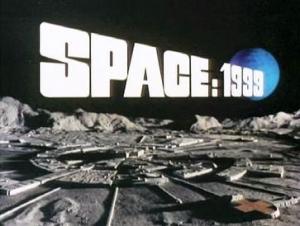
These days we’re loaded with tech.  In some ways we have more of it on our person at any given moment than all of Bradbury’s space-workers ever had.  In one of his stories a character was born in the impossibly far year of 1993.  I used to watch a show called Space 1999.  We haven’t colonized the moon yet (we may be working on it, but considering how long things like an obvious impeachment take, I wouldn’t hold my breath).  Speaking of holding breath, I’m pretty sure some of the characters were smoking on Moonbase Alpha.  Or my memory is cloudy.  (The earlier, and more lasting series Star Trek pretty much avoided several earth-bound habits, although Captain Kirk was pretty fearless when it came to the possibilities of space-spread STDs.)  I read Bradbury as a throwback to my childhood.  His stories have both an prescience and naivity that make them compelling period pieces.  From our current standpoint, one wonders if there will be any culture left at all in the future.  Perhaps we should enjoy what we have, while we still can.


Vox Humana

You know how it is when you get a song stuck in your head? This is one of the few scenarios that will actually lead me to buy music. I have very specific (some would say “odd”) tastes in music. I love the originals. Long ago I ceased listening to “Christian Rock.” It was a thing when I was attending a Christian college, of course. Many who feared the terrors of the drugs and sex part felt they could be slightly rebellious with the rock-n-roll side of things by listening to various groups that pounded out evangelistic messages with electric guitars and overheated amps. There were, however, amid those groups pretending they were a saved Metallica, some real artists. Somehow some of the songs of Daniel Amos came to my mind. I had all four albums of the ¡Alarma! Chronicles—still do up in the attic somewhere—but we left most of our sound system in Wisconsin. I hadn’t bothered to buy a new needle for my turntable, and I’m not sure I still have the patch cables to connect it if I did. It’s been at least a decade since I heard Vox Humana. The internet made it too easy.

VoxHumana

To understand my quest, you have to imagine the context. It was 1984. I was a rising senior in college and I hadn’t seen much of the world. Having grown up in humble circumstances, I didn’t have money for travel or many material things. When my roommate took me to visit his house and he introduced me to a friend who had a room dedicated to sound equipment and albums, I felt as though I was on another planet. Daniel Amos’s Vox Humana had just been released. Our host slipped it from its yellow cover and played it with all the blinking green and red equalizer lights flashing and I was completely blown away. It was Christian music unlike I’d ever heard. In fact, it was ahead of much of the pop music of the time. As soon as I got back to campus I ordered it from the Christian bookstore. The songs still come back to me when I least expect them to.

Call it a guilty pleasure. My theological outlook is lightyears away from what it was when I was an undergraduate. I still haven’t seen much of the world, but what I have seen of it has changed me in ways that there’s no means of reversing. Although I really can’t afford to be buying music—we’re only paying for electrons any more—I just couldn’t help myself this one time. It’s no longer the ‘80s, and the 1950s sci fi movies DA references in the lyrics are closer in time to the album’s initial release than that release is to me now, but still large swaths of the lyrics are imprinted in my mind, taking me back over the decades. It’s the music of my youth. And it was edgy then. It sounds more conventional, perhaps even old fashioned now. Still, when you get a song stuck in your head, pagan or Christian, there’s really only one thing you can do about it.


Dystopian Paradise

Dystopias resonate with me. As I ponder why, two factors seem to rise to the surface: dystopias are inevitably populist in orientation, and I was raised religious. Each of these factors requires some explanation, but so does the choice of addressing dystopian topics on a cheerful September day. In an article by Debbie Siegelbaum in the BBC News Magazine, Project Hieroglyph is featured. Project Hieroglyph, which involves some people I know, is an attempt to write a more optimistic future back into science fiction. To understand my reservations, I have to confess to having grown up as a nerdy science fiction reader. The stories from the 1950s and ’60s to which I had access (growing up poor, and buying books at Goodwill and second-hand shops) tended to be optimistic—people colonizing other planets, creating great labor-saving inventions, traveling time itself. In the meanwhile I slept in torn sheets in a ratty room and had to work to buy my own school clothes, inevitably cheap. For a few years our house didn’t even have a bathtub or shower. It wasn’t an easy existence, and I found solace in religion and science fiction, both of which promised a better future.

Today, forward-looking literature tends to be pretty bleak. With reason. Optimistic futures are the luxury of the elite. The average working person labors under a constant threat of unemployment and no jobs to replace the one you have. Hey, some of the people I see begging in Midtown are not dressed in the rags of the classic ne’er-do-well. Their signs asking for help are articulate and neatly written. The elite may look to a brighter future, but from street-level things appear a bit more challenging. There’s no question that politicians long ago lost touch with the commoner. They have no idea what life is like for most of us. Same is true of most university folk (cited in the article); unless they’ve been cast out, I suspect, they can conjure a pretty rosy future. With tenure.

That’s the populist angle. Now for the religious. The basic idea of Project Hieroglyph is as old as Buddhism, or perhaps even older than that. Salvation. Religions promulgate the idea that people require salvation. Otherwise it’s pretty difficult to get people up on a Sunday morning and convince them to drop their money in the plate. Look, however, at what has been happening to mainstream churches. So technocrats and other elites think technology, rather than the gods, will save us. Those devices of optimistic 1950’s and ’60’s sci fi have turned on us, and we have become slaves to our own technology. Gee, it’s awfully gloomy in here! Perhaps we need a brighter vision of the future where technology makes things better. It sounds like a return to the stories I read as a child. Still, I can’t help noticing all the closed churches I see, and how much the penmanship of the indigent has improved with the passing of time. If only I could decipher hieroglyphs my future might look shinier too.

Is this paradise or what?

Is this paradise or what?


Shipwrecked

Childhood dies in pieces. There is nothing a young boy desires more than a father to show him how to negotiate life. As Mick Jagger eloquently declared, however, many of us know “you can’t always get what you want.” I did not get to know my father growing up, and so I did what any American did in the 1960s—I looked to television for solutions. Children can be terribly naive, but I had a shortlist of ideal candidates in my head. The one who unwittingly set the direction for my life was shipwrecked on a not-so-grim deserted island. Everyone loved Gilligan because he made them laugh, but the Professor, he seemed the ideal father: rational, mostly kind, and generally unflappable. My earliest career ambition, before I decided that janitor was my true calling, was to be a scientist. This was largely because of the Professor. Religion eventually interfered in my plans, but even as I attended seminary, and then graduate school, the Professor never left me. He had been a kind of father figure to me. I’m sure going to miss Russell Johnson.

TheIsland

I still feel a stab of delight when, watching old Twilight Zone episodes, “the Professor” appears. When I see Johnson in It Came From Outer Space and This Island Earth, it’s a particular island I’m thinking about. An island where, if religion came up, it was treated lightheartedly but even science, for all its clear thinking, never managed to help get the castaways rescued. This island represented my childhood. Innocent, sincere, and strangely funny. Little did I realize at the time that the science Roy Hinkley advocated would become such a fierce enemy to the religious milieu from whose baptismal waters I’d never fully emerge. It sure would’ve helped to have had a father to sort all this out.

Back before Borders (a kind of ersatz father) closed,Tina Louise came to our local to promote her new children’s book. I couldn’t believe I was standing twenty feet from a childhood icon—a movie star, nonetheless. How shocked I was to see her in The Stepford Wives where she talked about sex—that was always in the deep, deep background on the island. Pagan gods exerted real power on Gilligan’s island. As I grew up, religion held me in its powerful grip. With the Professor and the Bible in my head, I went off to become logical, intellectual, cynical. I taught Bible, students called me professor. Then my career was shipwrecked. Is it any wonder that I had that nightmare about being lost at Nashotah House again last night? Sometimes a boy just needs a father to show him the way. Thank you, Professor, for stepping in. You influenced one life in a way that I’m sure you never expected.


Running to Stand Still

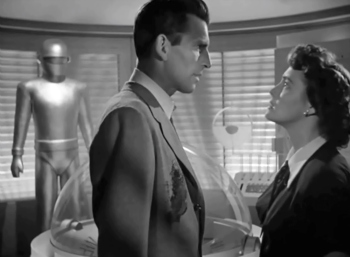
“You have faith, Professor Barnhardt?” Klaatu asks the scientist in the classic The Day the Earth Stood Still. Barnhardt demurs, stating that curiosity is what makes good science, not faith. But sometimes I wonder if the professor or if the alien is correct. Science fiction was young in 1951, and Robert Wise would go on to give us such diverse fare as West Side Story, The Haunting, The Sound of Music, and the first Star Trek movie. Still, The Day the Earth Stood Still has always been my favorite movie that he directed. In 1951 quite a bit could be assumed about America’s religious sensibilities. Yes, diversity had been part of the mix from the very beginning, but the view of America as a “Christian nation,” although not in any way official, was not seriously challenged in those days. This shows through clearly in the movie. Although the opening sequence is intended to be a Klaatu eye-view of descending to earth in his space ship, it is reminiscent of the stock “creation” imagery that would become so familiar to those of us who watched Bible movies. It is a God’s eye-view as well.

Christ-like, Klaatu descends to earth to bring a message of peace, but also an apocalyptic threat, from the powers beyond. He is capable of miracles, such as the eponymous day the earth stood still—the ultimate in non-violent protest because hospitals and airplanes still have power and nobody is harmed. In his human incarnation Klaatu not so subtly takes the name Carpenter, making the corollary clear. In case you missed that, however, he is killed, resurrected and in the end ascends to heaven. Klaatu becomes the prototype of the messianic alien, a figure we would see in guises from ET to Starman. Believers in ancient astronauts or not, the makers of our space movies know that God is an alien.

daytheearthstoodstill

The Day the Earth Stood Still came early on in the Cold War. The obviousness of distrust in the Soviet Union is placed in the mouths and knowing glances of various characters. Some even suspect that Klaatu is a Russian rather than a spaceman. Sputnik was still six years in the future, but the atomic bomb was already in the past. We had learned to destroy ourselves before we had learned how to escape the only planet we have. Klaatu delivers his final homily not to politicians, but to scientists of all races (and, unspoken, creeds). Seated on folding chairs in the outdoors, as if at a revival meeting, they listen as Klaatu tells them the decision of how to live is up to us, but Gort, a kind of avenging angel, is always overhead. The invocation that can save humanity, however, is given to the female lead Helen Benson. She alone knows the sacred words “Klaatu barada nikto.” Amen.