In the Cult

The word “cult” has fallen out of favor with religionists.  The reason for this is the problematic claim that any one religion makes to being the “only true” religion.  If that religion then sets about to study other religions there is a built-in bias that the study is being done from the perspective of those who know the truth looking somewhat bemusedly toward other religions.  A cult was defined as a relatively new religion with a fairly small number of adherents.  The more correct term is a “New Religious Movement.”  The idea of brainwashing is controversial, but it is clear that people can be made to follow the leader against their better judgment.  We’ve seen this time and time again and not just in places like Jonestown or Waco.  The word “cult” seems to fit.

Branch Davidian compound in Waco; photo credit: FBI, courtesy Wikimedia Commons

A friend recently pointed me to the work of the psychologist Jeremy E. Sherman.  Sherman has been studying the behavior of Trump followers and has illustrated quite well how it is a cult.  This is one place where the use of the term becomes essential.  I’ll lay aside my objections to the word to point out that a cult denotes a group that follows a leader without critical assessment of that leader.  You’ll have noticed that Democrats are quite critical of one another.  They think about and assess what each other say and do.  When someone like Trump, who is well known as a Pez-dispenser of lies, becomes a saintly paragon of his party, capable of no wrong, we’re in the land of cults.  What Sherman does that I can’t, is suggest how to deal with such thinking.

Most of us try to reason with our interlocutors.  If reason is turned off, as in blind following, it simply falls on deaf ears.  The public record of Trump’s doings speaks for itself.  Those who refuse to see it or engage it will never be reasoned out of it.  The parallels with Hitler’s Germany are extremely frightening.  Not even a decade after his death Hitler was understood to have been clearly unstable and driven by evil impulses.  Many of those alive today overlapped with the lifetime of this dictator.  There’s no doubt that Nazism behaved like a classic cult.  Presented with credible evidence of breaking the law while within office, Trump’s followers blithely acquitted him.  Those who study cults would expect no less.  We need to arm ourselves with knowledge of how religious thinking works.  To do otherwise is dangerous, despite what our economically driven bastions of higher education may say.  (See?  I’m critical of those on my side!)  Or we can lay down reason and simply follow.

Clear Thinking

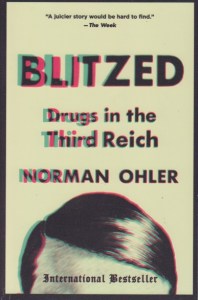
I first heard of Norman Ohler’s Blitzed: Drugs in the Third Reich before it found a publisher.  Even at that point I found the idea fascinating.  My knowledge of the Second World War isn’t deep.  I was born less than two decades after it happened, so it was still heavy in American consciousness, but as a child I wasn’t much interested in history.  (I was a fan of monsters even then.)  Like many people, since November of 2016 I’ve had a renewed interest in how the Nazis rose to power, and how a highly intelligent nation could follow someone as unstable as Hitler.  When I spotted Blitzed on a discount table at the Moravian Book Shop I figured it was a good opportunity to learn more.

Never a drug user myself, I grew up in a culture where such use was prevalent.  I had never realized, however, just how ubiquitous drugs were in Nazi Germany.  Ohler begins by noting the use of crystal meth in keeping German soldiers awake and alert for days at a time, thereby allowing Blitzkrieg to take place.  The offensive on the western front would likely not have worked without it.  The story gets seedier from there.  Hitler, a vegetarian who eschewed drugs and alcohol, had a personal physician who began giving him daily injections of vitamins and what we’d likely recognize as placebos for a number of physical ailments.  Even as decisions were made for genocide, der Führer was being injected with hard drugs of the opiate family, eventually becoming an addict.  Decisions about the fate of an entire nation were being made by a leader so high that straight thinking wasn’t a possibility.

Ohler is careful not to claim that Hitler’s excesses of hatred and megalomania were the results of his drug use.  They were there well in advance of his decline.  Outside the bunkers in which Hitler spent much of the war, drugs were widely used, and abused, in the German military.  In order to try to entice young men into what would become suicide missions, high doses of drugs were provided, often enough to prevent the effective outcome hoped for.  This is a fascinating, sordid story.  It’s a side of the tragedy of the war that we don’t often hear, and it’s a further indication of just how easily madness spreads.  Reading the descriptions of Hitler’s personality, in this particular era, was frightening.  Especially since history has a nasty tendency to repeat itself.


Let the Sunshine in

The earliest sunrise does not occur on the longest day. At least not at this latitude—I can’t speak for the entire world, but sunrise lags behind the latest sunset by a few days. In Germany the longest day was January 30, 1933. It seems that the Nazi Party did not win the majority, but Hitler was made chancellor anyway. All he wanted to do was to make Germany great again, right? No matter who it hurt. When Americans, who sacrificed thousands of souls, found the concentration camps they swore it would never happen again. That was, however, before Donald Trump was born. Indeed, those seeking the transmigration of souls might wonder where he’d been wondering for the previous thirteen months. There’s some cryptic stuff happening here.

How can it be that sunrise isn’t earliest on the longest day? Back in the days when science mattered, it was simply explained: the number of minutes the sun is in the sky maxes out on the summer solstice. Sunrise can keep getting earlier for a few more days, but so will sunset. The longest day, in the biblical world, was when Joshua was fighting at Makkedah. The slaughter was going so well that the big white guy upstairs (oh no, he’s not Jewish, you see) reached out and held the sun in place for another 24 hours so it could continue. That, you see, is the longest day. Not exactly sand chairs and sunscreen, although the latter might’ve been awfully useful.

Although in modern times the solstice is known as the first day of summer, in olden times it was considered midsummer. The solstices and equinoxes were the midpoints, not the start of something. Such a perspective can make a world of difference. June, it is said, is named for Juno, the pagan wife of Jupiter. The constantly cuckolded goddess of marriage. Only we call her long-suffering, since stormy weather should be over by June, shouldn’t it? With enough lawyers even sin can be made to sound righteous, for longest day brings everything out into the light otherwise. The longest day, you see, can be fake news. Around here the sun will rise still earlier tomorrow. Experts—those we no longer believe—tell us that the solstice was yesterday. And yet, what is that orange thing arising in the east so early in the morning? Don’t be fooled; the longest day is over.