Remembering to Forget

I think I’ve discussed memory before.  I forget.  Anyway, I recently ran across Ebbinghaus’ Forgetting Curve.  Now, I’ve long known that when you reach my age (let’s just say closer to a century than to 1), your short-term memory tends to suffer.  I value my memories, so I try to refresh what’s important frequently.  In any case, Ebbinghaus’ curve isn’t, as far as I can tell, age specific.  It’s primarily an adult problem, but it also resonates with any of us who had to study hard to recall things in school.   The forgetting curve suggests that within one hour of learning new information, 42% is forgotten.  Within 24 hours, 67% is gone.  This is why teachers “drill” students.  Hopefully you’ll remember things like the multiplication table until well into retirement age because you had to repeat it until it stuck.  Where you put the car keys, however, is in that 42%.

I’m a creature of habit.  One of the reasons is that I fear forgetting where something important might be.  The other day it was my wallet.  In these remote working days you don’t need to put on fully equipped pants every day.  Pajama bottoms work fine for Zoom meetings and if you don’t have to go anywhere, why fuss with the wallet, cell phone, pocket tissues-laden pants?  You can put your phone on the desk next to a box of tissues.  The wallet gets left in its usual pocket.  One day I pulled on the pants I last wore and as I was headed to the car noticed my wallet was gone.  Fighting Ebbinghaus, I tried to remember where I’d last used my wallet.  We’d gone to a restaurant the previous weekend that seemed the most likely culprit.  It could’ve fallen out in the car, or maybe down a crack in an overstuffed chair.  I couldn’t find it anywhere, swearing to myself I was going to buy one of those wallet chains if I ever found it again.
(I did eventually find it, in the bathroom.  Apparently this has happened to others as well.)  In this instance, my memory was not to blame.  It had been right in the pocket where I last remembered putting it.  But other things do slip.  Think about the most recent book you read.  How much of it do you remember?  That’s the part that scares me.  I spend lots of time reading, and more than half is gone a day after it’s read.  Unless it’s reinforced.  The solution, I guess, is to read even more.  Maybe about Ebbinghaus’ Forgetting Curve.

Monster of Aging

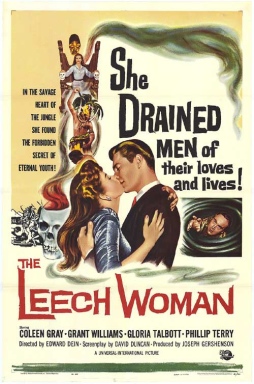
Movies with no likable characters, or none with any redeeming personality traits, are difficult to remain awake through.  At least on sleepy weekend afternoons.  The Leech Woman is one such movie.  It was difficult to get past the premise that an aging woman is cause for alarm among the overly entitled male characters.  Dr. Paul Talbot is disgusted by his older wife until he finds credible evidence of a concoction that will cause a person to grow young again.  Wanting her to be his experiment, he takes her to Africa where he witnesses the rejuvenating formula in person.  It requires, however, a murder to be effective.  For her victim, June chooses her husband.  The effects, however, are only temporary so June will need to keep on killing to remain young.  Each time the formula wears off she’s prematurely aged.

When she’s young again, the men around her feel it is their right to claim her, which, in a sense, provides her with a ready pool of victims.  On the other hand, it reflects attitudes beginning to die out as the sixties began.  Many of these movies from the fifties throw in a woman to provide little more than love interest.  Sometimes these women have a profession—reporter is one that shows up occasionally, or perhaps in a military role or as nurse—but mostly they are there to find a husband and become, ideally, a housewife.  Many unrealistic men today still think that should be the case, but few jobs earn enough for the possibility of being a one-income family.  Besides, did anyone ever think to ask the women what they wanted?

Aging isn’t the easiest thing to do.  This movie plays up the stereotype that men become “distinguished” with age while women don’t.  Such unreflective outlooks on aging completely overlook things like aching backs and forgetting things that are typical for just about anyone who makes it past a certain landmark.  In fact, aging is something we all face in common, and our attitudes toward it can make all the difference.  Fortunately since this movie came out, we’ve had many role models showing us that women do retain their worth and dignity as they age, even as men do.  We are an aging population.  One benefit, hopefully, to the passing years is the accumulation of wisdom.  And that applies, no matter gender or sex.  We reach a certain age and we look back and wish we’d known then what we know now.  That takes place with generations, too.  That way we can say Leech Woman is a period piece, but that still doesn’t make it a good horror movie.


Passing Words

I’ve never counted, but it must be dozens.  Maybe a hundred.  And they have very high memory requirements.  Especially for a guy who can’t recall why he walked into a room half the time.  I’m talking passwords.  The commandments go like this:

You can’t use the same password for more than one system/platform/device/account

You can’t tell anyone your password (duh!)

You can’t write it down

You can’t send your password to someone electronically (duh!)

You must logoff your device when it’s unattended

You will be held responsible for anything done under your login

The word of the Lord.

Now, how much more ageist can you get?  I’ve never counted the number of passwords I’ve had to generate for work alone but I can’t remember much without writing things down.  Even the chores after work.  I hear that there are “keychains” you can get that remember your passwords for you.  I suspect you need a password to access your passwords.  Replicate the commandments above.

I know internet security is serious business.  My objection is that you’re not supposed to write any of this down.  I carry a notebook around with me (it has no passwords, so please don’t try to steal it) to keep track of everything from doctors’ orders to how to call the plumber if there’s a leak.  I can’t remember all that stuff.  Some of it is personal information, but with everything you’re expected to keep in memory these days—at the same time we’re unleashing AI on the world—is madness.

A friend pointed out that AI books are written without authors.  If I remember correctly, my response was “AI has great potential, but let’s leave the humanities to humans.”  I hope I’m remembering that correctly, because I thought it clever at the time. I wish I’d written it down.  Those who make the rules about passwords aren’t as close to their expiration date as I am.  My grandmother was born before heavier-than-air flight took place and died after we’d landed on the moon.  Guys my age regale their kids (and some, their grandkids) by telling them telephones used to be attached to walls and you could walk away from technology at will.  Now it follows you.  Listens to you even when you’re not talking to it—our car frequently interjects itself into our conversations.  At least she isn’t asking for a password while I’m driving.  I couldn’t write it down.  Our love affair with technology is also driving.  More often than we suppose.  It’s driving me too… driving me crazy.


Personal Psalms

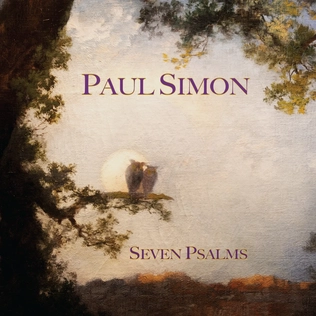
I haven’t heard it yet, but a New York Times article encourages me to.  Paul Simon has joined the ranks of those aging music stars to record albums presaging their deaths.  The article was about Simon’s latest album, Seven Psalms.  And, yes, the religious reference is pretty hard to miss.  Like most kids from the sixties, I grew up hearing Simon and Garfunkel on the radio.  We didn’t have money for albums, but I always liked their songs when I heard them.  After their breakup I really didn’t pay much attention to Simon until Graceland, and since then I’ve listened with half an ear.  You see, I’m wired in such a way that I can’t listen to music while I write.  Or read.  My mind grips one thing at a time.  That means I don’t listen to background music much.

That doesn’t mean I don’t appreciate music.  I do.  Almost religiously so.  On occasion I come back to Simon, with or without Garfunkel.  I posted about his song “Werewolf” some years back.  I eventually listened to that album, and I’m not sure I got it.  Artists are that way.  Some pieces you like, others are just okay.  I am curious about Seven Psalms, though.  I’ve posted about David Bowie’s Blackstar, Leonard Cohen’s You Want It Darker (both discussed in the Times article), and Bruce Springsteen’s Letter to You.  No longer young myself—these guys were young when I was a kid—hearing them reflect on death is powerful, and, if the mood is right, peaceful.  We fear death because it’s unknown.  And also, we all know, deep down, that we’re flawed.

Psalms aren’t necessarily biblical, of course.  Sinead O’Connor’s “Take Me to Church” is a psalm.  So is “Sounds of Silence.”  Artists have been writing psalms for as long as they’ve been writing songs.  The biblical psalms are among the most quoted bits of literature in the western world.  They were likely originally sung as well, but we can only guess what they may have sounded like.  We know that across the world people turn to song to express strong emotion.  I’m not sure what Paul Simon’s Seven Psalms might be, but it seems that thoughts of mortality go naturally enough with emotion.  I don’t write much about music because it’s so deeply personal.  I try to be intellectually honest on this blog, but if you want to talk music you really have to get to know me first.  Then I’ll reveal my psalms.


Final (not) Thoughts

One thing I’ve noticed as I’ve aged is that I pay attention to necrologies a lot more.  Few people from my college and seminary days stay in touch, and the same is true of my teaching days.  People are busy, I know, but I always look at alumni magazines memorial pages.  Whenever I get on the Society of Biblical Literature website a morbid curiosity draws me to the list of departed members.  I’ve known several of them in past years.  Still, it was a shock to see Michael S. Heiser on the list recently.  For one thing, Michael was younger than me, and for another, I knew him for a long time.  Theologically we were pretty far apart, but that never stopped us from being friends.  We both lived in Wisconsin and we both ended up in academic-adjacent jobs.  We shared an interest in unusual things and we were even blog buddies for awhile.  Michael died back in February.

I hadn’t heard because SBL moved its recently deceased list off the home page (I suspect that’s not the best marketing), so you have to click through.  But when I did I was saddened to see Michael there.  Then I notice two colleagues even younger who’d died in the last few months.  It gives you pause.  There are no guarantees in life, I know.  Those who manage to make it to my age are fortunate, but can generally expect to have a few more years.  That’s not a promise, however.  Having watched a lot (possibly too much) television in my life, it brought to mind a Frasier episode where a colleague the famous psychologist’s age died, sending Frasier into a search for reasons why.  That’s something those older than me tell me that I’d better get used to.

We tend not to want to think about it, but I’ve had both a parent and parent-in-law say how strange it is to find yourself old while still thinking like a young person.  It is bewildering.  And it’s one of the reasons I write so frenetically.  It was after I finished my third book, I think, that I realized I didn’t have all the time in the world left.  I have lots of books I want to write, many of them already started and slumbering on my hard drive.  Michael was also a prolific writer, and a more successful one than I have become.  His blog had more followers.  And it seems like only yesterday that I ran into him at an SBL meeting and he did an impromptu interview with me.  Life’s too short not to stay in better touch.


Aging Children

So I was reading this academic article from the late fifties.  In it the author was discussing how, in literary studies, imagination was considered childish.  It is something we’re expected to outgrow to participate in the adult world of cold, hard facts.  (Making money and such nonsense.)  And I came to think about the elderly I know.  You see, I’m part of that sandwich generation where children take longer to grow up and need more care longer, and parents live longer, requiring care as they age.  I know several elderly folk.  One thing I can say is that as they age, they live more and more in their imagination.  The cold, hard facts, in other words, are mere preoccupations of our “productive years.”  I, for one, stand with childhood and advanced age.  Imagination makes us human.

We’re all aging children.  I’ve rebelled against the work world since I’ve been in it.  My first job, at 14, was being a janitors’ assistant.  That meant taking all the jobs the school janitors didn’t want.  It often involved being left alone at a remote bus shelter with a Lord of the Flies-inspired group of tweens and being told, “Get that shelter painted by the time I get back” as the boss left.  (Ironically, my boss was also my seventh-grade science teacher.  The more I learn about everybody else’s school experience the more I realize just how extraordinary the Oil City School District was—Flu, may you rest in peace!)  From that point to now being told “Bring in more money for the company,” my mind feels truly at home only in imagination.  Perhaps I’ve grown up too soon, but we should still be listening to our elders.

There should be nothing but praise for those who manage to keep their imagination alive in the workaday world.  It’s not easy.  Faced with numbers, “metrics,” and “evidence-based” analytics, we’re expected to act like CEOs.  Every time I open Quicken I’m reminded I should’ve been an accountant, a real “adult” job.  My own evidence, however, comes in dreaminess.  I’m a daydreamer—always have been.  As a professor it was easy enough to get away with it.  Less so in the business world.  I still spend a couple hours every day in creative pursuits.  It keeps me young, I think.  Well, maybe it makes me old before my time.  In either case, I can imagine no better use of any adult’s time.


Subconscious Humor

It’s good to know your subconscious has a sense of humor.  What with all that’s going on in the world these days, God knows we could use a laugh or two.  At least a smirk now and then.  One of the less-anticipated aspects of becoming old and wise is disrupted sleep.  Our bodies did not evolve for the 925 schedule, and the “eight hours a night” trope is more naturally along a pattern of sleep for maybe four hours, get up for a while and get things done, then sleep for a few more hours, until dawn.  That doesn’t fit well at the office, so we try to cram all of our sleep into one unbroken stint.  When you’re young that’s often not a problem, at least in my experience.

Then you reach a certain age when, with no discernible change in habits, you have to visit the restroom in the middle of the night.  Modern people, of course, have a lot on their minds, so after that mid-night pee it’s difficult to get back to sleep.  For those of us who can’t break the long-term commuting habit, any waking after midnight is likely to be the end of a night’s sleep.  Once you get tired enough, however, you tend to overpower the full bladder and snooze on to the usual rising time.  (For some of us that’s earlier than it is for others, but that’s immaterial.)  This is where the subconscious starts to play its role as the comedian.

Mildly thalassophobic, I tend not to go out on very deep water, especially in small craft.  To be fair, I don’t live too close to the ocean and I don’t own a boat of any kind, so this often isn’t an issue.  One of my biggest traumas in college was meeting the “swim a length of the pool” requirement for graduation—I understand that’s now been abolished.  I nearly didn’t make it, but the last semester as a senior I had a private show—which must’ve been funny—for the swim coach.  So when I need to pee and I sleep through the middle of the night, I have deep water dreams.  I’m on a small boat in an ocean.  Sometimes I see paranormal geysers bursting from the surface and wonder what they are.  Then I wake up and dash for the bathroom.  Hey, it could be worse—my subconscious could find a humorless way of waking me.  Meanwhile, it probably wouldn’t hurt to take some adult swimming lessons.

All that water…

Reading Memory

I recently wrote about writing too much (as if such a thing were possible).  After posting that I thought of how much the same can be said of reading.  I like to believe that whatever I’ve read is stored in my brain somewhere, rather like my writing on all those external drives.  I get some hopeful hints of this when a fragment of something read long ago suddenly reappears.  It’s good to know it’s there somewhere.  What brought this to mind is that a book I’m currently reading used a significant term.  Overly confident as I only am when reading, I figured I’d remember where it occurred.  A few days later I’d forgotten.  “No problem,” I thought, “the index.”  Indexes are never perfect and I’m always amazed by what strikes me as being so important failed to make the author’s cut.  So it happened.

This particular book was compactly written, but even so, it was more than sixty pages ago.  It took a few days of skimming, and finally going through line-by-line to find the word again.  It was a capitalized word and I thought mere skimming would be able to pick it out.  No such luck.  Part of the problem, I suppose, is that since I’ve left academia I’ve pretty much stopped writing in books.  I always did it in pencil, but still—there’s something about that pristine page so carefully typeset and laid out.  Well, if I had all the time in the world I could re-read those first sixty pages again, but I don’t have time to read all the books I need to, so I grabbed my old Pentel and began marking the spots I wanted to remember.

When we age it’s recall that suffers.  I tend to think the memories themselves are still there, sometimes distorted, sometimes altered, but present.  Books, after all, can be reread.  If I read something while commuting to Manhattan, there is a good likelihood that some of it was occluded by the worries of work lying ahead, coupled with the anxiety of catching the bus back home at the end of the day.  Not to mention anything that might’ve been happening in real life—that place outside of work that you really care about.  I’m glad for the commute reading; I regularly read over 100 books a year.  You couldn’t take notes while on a New Jersey Transit bus, though.  It’s not possible to read too much, but reading memory, it seems, is a sometimes a scarce resource.


Zoom Game

Perhaps you’ve notice it too.  The technology blame-game, I mean.  Although it’s grown more acute since the pandemic, it has been around for as long as the tech disparity has existed.  A typical scenario goes like this: someone (often of a more senior generation) encounters a techical problem communicating with someone else (often of a more recent generation) and asks them what the problem is with their (the younger person’s technology).  I sent you the message, the narrative goes, there must be something wrong with your tech if you didn’t receive it.  Believe me, I understand how bewildering this can be.  We’ve sold seniors (one of which I am rapidly becoming) on the idea that this little device in your hand can do anything.  When it doesn’t work, it must be somebody else’s fault.  The young, however, often have the latest tech and fastest speeds and broadest bandwidth, so the problem is probably on the sending end.

I run into this quite a bit since I run a small program for some local folks that involves weekly Zoom meetings.  I’m no Zoom maven.  My wife trained me in it and I can do passably well at running a meeting.  Many of those older than me, however, often have problems.  They wonder what is wrong with my broadcasting rather than their receiving.  I’m not sure how to say ever so gently that we pay (through the nose) for high-speed connectivity.  We have to since I work from home as a matter of course.  Now my wife also works from home and the two of us use our bandwidth all day long with multiple simultaneous meetings without any issues.  The tech here seems good.  We have no way of checking the tech on the end of those who are having connectivity issues.

I’m not setting myself up as any kind of tech prophet.  If you read my blog you know that I am deeply ambivalent about this whole thing.  I’ve been thinking a lot about overpromising recently and I wonder if that’s not a major part of the problem.  Technology will not solve all of our problems.  The fact that you need a regular source of electricity for it to run shows its inherent weakness.  It is a tool like any other, and if the tool is bladed to be useful it must have a dull part onto which one might hold.  Our Zoom society is bound to have issues.  Once we can see each other face-to-face again, all we’ll have to worry about is whether the laptop will communicate with the projector, or if the microphone is on the fritz this morning.  So it always has been.


Aging Tech

When I get an idea my first impulse is to grab an envelope and pencil and start scribbling.  I run around with an older crowd.  Many of my generation don’t appreciate how much a single “share” can do for a blog post, or what a simple link to a page can do.  I have college friends who have no email addresses and who are invisible on the web.  I guess this is a young person’s playing field.  I suppose one of my reasons for writing about horror is that it keeps me in the younger demographic.  I don’t know too many people my age who are fans of “the genre.”  Sci fi is a little more acceptable, I suppose.  Still, I’ve been thinking quite a bit about why I find horror so fascinating.  There’s actually something redemptive about it, at least in my reading of the material.  It’s also a coping mechanism.

One reason that people tell stories (and read stories), according to psychologists, is to learn how to handle situations they might encounter.  This is on a subconscious level most of the time, otherwise speculative fiction simply wouldn’t apply.  I can’t recall having been in a crisis situation and stopping to think what a Stephen King character would have done in such circumstances, but I suppose that might be in the back of my mind somewhere, along with information about all the things I’ve mislaid over the years.  The older you get, in a technologically rapacious society, the more things there seem to be worthy of horror stories.  I haven’t even figured out the last round of devices before the new generation’s introduced.  No wonder so much of horror has to do with being attacked by monsters that look innocent.  Clinically engineered in a clean room.

Image credit: Pattymooney, via Wikimedia Commons

Some of the horror comes from the inherent instability of a constantly upgrading tech.  My laptop’s a few years old.  While a little younger than that, the device that sits on my laptop is also not fresh from the factory.  The last time I tried to back up the contents, the external hard drive (new from the factory) refused to do what I commanded.  While I did eventually figure it out, I wasted a good deal of my scarce free time working out how a device I couldn’t control was in fact controlling me.  Younger folks grew up with this kind of problem solving drilled into them from kindergarten on.  Now I find myself in a world of devices I can’t comprehend and which don’t even react the same way they did last time I bought the exact same one.  I ask my fellow quinquagenarians what to do and I watch as they grab an envelope and pencil.


Autumn Music

It is an experience as old as humanity itself. At least humanity that started to realize that age, as remote as it may seem, will always eventually catch up with you. This past weekend was Family Weekend at my daughter’s college. Since her school does things up right, there were a variety of events on offer, one of which was an a cappella group concert. A cappella has come a long way since my college days, with students able to use their voices to sound like a band, professionally mixed, and full of energy. Somehow, I don’t recall that much energy from when I was a student. In any case, the inevitable group doing “oldies” took the stage an opened with a song from 1987. Wait. What? Since when was a song of which I remember the first release an oldie? The kids did a great cover, and I suspect in their minds it was really an old song. I was only 25 when it was given to the world. Can I really be an oldie? Outside the leaves on the trees were brilliant, as if on cue for the tuition payers to have their heartstrings wrung. Trees become their most alluring as they are about to die.

Songs, however, have a way of becoming part of you. Back when we were young(er) and idealistic, my wife had thought to study music therapy. Nashotah House, however, decided to change the career trajectories of an entire family in the name of orthodoxy. One of the things she learned in her classwork, prior to being sent back to the work-a-day world, was that patients suffering from dementia can often sing a song from their youth, even if they can’t speak a word. Music gets into our brains in a way that language learning doesn’t, and when we hear that song we are, to borrow a phrase from Bob Dylan (which another of the groups sang), forever young. It is a beautiful wish, endlessly covered and recovered. Watching those kids on stage, I recalled being on the cusp of adulthood myself. Everything seemed possible then. Then a world that others constructed imposed its constraints on me. My hair began to grow gray even as the leaves lit up yellow and scarlet and fire orange.

DSCN4928

Religion is the business of those who are old. Even as a religion major in college I was classed among those old before my time. We think of the hereafter on our deathbeds, not when we’re twenty. For those who teach their children to ponder eternity at a young age, however, that portal is never far from view. My fellow students were looking ahead to careers in all kinds of fields that would make their fortunes and reputations. My modest attempt to bring a younger generation to a more mature outlook faltered at the hands of Fundamentalists, and it was music that helped me through that terrible shock. Little do we think that that song we like so much is marking us indelibly as a child of our age. Time will not relent. We will be the ones, like the trees, showing our signs of age as our children show us where the future lies. And the attitude of that song from 1987 will be, for any who truly listen, forever young.


Retire Me This…

We’re all getting older.  My daily, grudging glimpse in the mirror reminds me that my beard wasn’t always gray, and there was a time *gasp* when no beard grew at all.  One of the realities of the brave new world we inhabit is that career stability has become a myth.  My father, in the brief time I knew him, worked as a house painter.  My stepfather worked in a sewage plant for a small town and drove a snowplow in winter to make ends meet.  These utilitarian jobs seemed never to end.  I made the mistake of going into higher education, not realizing that the risks were much higher and that I would make more money working in a sewage plant than I have ever made in my professional career, PhD in hand.  So it rankles me when I hear professors complaining about being too busy in retirement.  Retirement: what a concept.  When the guy who has custodianship of my minuscule retirement account from Nashotah House, after his gentle awaking from the defibrillator, looks at my records he always informs me, “you’re not well placed for retirement.”  Talking to my big brother we agree—our retirement plan is to die on the job.  So, when someone asks you to write another book, remember maybe it is some guy your own age who is trying not to starve.

As a society we’re aging.  Those who managed not to be fired by Fundamentalists have had a secure, tenure-ridden ride through the occupation that some of the rest of us were denied.  Busy in retirement?  Some of us will never have that privilege.  Funny thing is, it’s not funny.  I sometimes lean back in my editorial chair and realize, if this hadn’t happened to me, I would probably look at it the same way.  I would have published that second, third, and fourth book, and people would actually think my opinion mattered.  I would’ve become a resource to be tapped rather than a dancing monkey who hopes for anything shiny.  Is that another gray hair?

I don’t belittle the hard work of higher education—it’s not an easy profession. But writing books? That’s the fun part! Privilege induces blindness. How rare an opportunity it is to teach! While we as a nation devalue it, in many parts of the world those who shape future minds are revered. Yet elsewhere in the world there are those who are far worse off even than an editor—those for whom life is constant suffering and surviving another day is not reasonably assured. How easily I forget this as I neglect to balance my checkbook for fear of what I might find. We shouldn’t complain when someone asks us to give back, even in retirement. Those of us capable of writing books sometimes lack only the bona fide of a college or university position to do so. Otherwise I might hope to retire as well some day.

"Photo by Chalmers Butterfield"

“Photo by Chalmers Butterfield”