
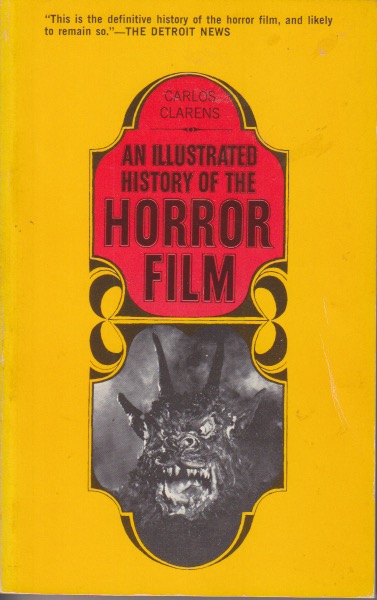
The problem with writing about the history of anything is that time keeps unspooling. Published in 1967, Carlos Clarens’ An Illustrated History of the Horror Film has a certain innocence about it. As a genre, horror had not been discussed much in book form yet at the time, thus part of the innocence. Another part, however, derives from the fact that the very next year, 1968, is often considered the year horror “grew up.” The reason for that is that both Night of the Living Dead and Rosemary’s Baby were released that year, forever changing the direction horror might go. This book is a rare glimpse into what film critics thought of horror before it really came into its own. There are many gems of horror history here and quite a lot of insight comes through. On the very first page Clarens notes that horror meets some of the same needs as religion does. At one point he states that horror avoids religious themes. Then Rosemary’s Baby happened.
Another early insight in this book is that “horror” is a faulty title for the genre. I’ve been suggesting this, quite independently, for years. One of the alternatives Clarens mentions is “chiller,” which was common before “horror” took over in the 1930s. Even today “thriller” and “horror” aren’t easily parsed. Clarens tends to consider horror as involving the supernatural in some way. He does discuss Peeping Tom, however, but not Psycho. Hitchcock makes an entrance in the very last chapter where The Birds is discussed. Turning back to the supernatural, this has largely been the draw to horror for me. Something beyond the expected, whether it be vampires in the night or unnaturally enlarged animals that rise from the use of nuclear weapons. I’ve never really been a fan of slashers; I’ve stopped watching one or two because they don’t really appeal. Slashers, unless you count Psycho and Peeping Tom, were in the future when Clarens wrote.
This book does a good job with early precursors to horror, going back to George Méliès, and spending long, lingering moments over silent movies. The chapter on Universal and its role in the development of horror is quite good. The slipperiness of the label, however, comes with science fiction. As is well known, America’s interest in the fantastic in cinema tended to slip toward sci-fi in the fifties. Some of this was also horror, and crossovers are still common. But at the end of this book, Clarens ends up discussing mostly sci-fi. There was a big horror revival coming the next year, however, but books of history are caught up in history themselves.

