Mired

For someone who grew up with an Oscar Mayer jingle forever lodged his his brain, it took decades before I became curious about the surname.  I had always supposed it was a Germanic word for “mayor” but then, if so, mayors had to be very busy in the boudoir to make so many.  The reason I grew curious was that there are so many ways to spell it.  I’ve had people complain to me about having to spell their name every time, but I’ve run across “Meyer” spelled “Maier,” “Meyers,” “Mayer,” “Myers,” and many more.  Yes, I’m afraid you have to spell it.  (My wife’s surname is Stephenson and she has to spell it every single time.  For that matter, so do I.)  Why so many Mayers?  A little (very little) research turned up that it comes from old German for “manager”—thus possibly related to “mayor” and maybe even “major”—but that over time it came to mean “tenant,” basically a freeman farmer.  That’s why so many.

Photo by Erik 🖐 on Unsplash

Growing up in a small town, the very common surnames I encountered were “Smith,” “Jones,” and “Miller.”  My mother even married one of the Miller clan eventually.  “Smith” and its variants, derive from craftsmen of various sorts, such as “blacksmith.”  “Miller” is someone who works a mill.  The odd one out here is “Jones,” which derives from a prolific “John” somewhere way back when.  I’ve written before about how common (and widely variable) the name John is.  All these names share a “non-noble” background, it seems.  People of occupations that keep us going.  It made sense that “Meyer” was a name for farmers.

I grew up with a different, but not that uncommon (as the internet has taught me), surname.  Interestingly, all of my grandparental surnames were unusual, although one is compounded with “Schmidt,” or “Smith.”  I find names fascinating.  With so many of our species running around, unique forenames weren’t in large enough supply for us to stop there.  Which John are you?  John Johnson?  Okay, now I can place you.  I tend to struggle with transposed letters from time to time, making the variants of “Meyer” particularly difficult for me.  And that “y” acts like a vowel and sometimes becomes an “i.”  Or a “j” in German.  Cheeky.  We identify closely with our names.  They say something about us.  Thankfully we have other ways of distinguishing ourselves, otherwise we’d all just be lost in the crowd.  

The Other Mississippi

Salmon aren’t the only animals that head back to their ancestral homes late in life.  There’s a draw to where we’re from.  Many humans can’t physically return for socio-economic or emotional reasons, but there’s an urge that may transcend generations.  For me it’s always been traced through my maternal line to upstate New York.  My mother’s [redacted for security question purposes] family had been in the upstate region around Schenectady for generations, as traced back as far as the 1770s.  It was my maternal grandfather, branching off from his father (who made it as far as central New York) who eventually left the state, after teaching in a one-room schoolhouse, for which, in those days, you didn’t need to be a college graduate.  In any case, I have a fondness for the Hudson Valley and an interest in its history.  

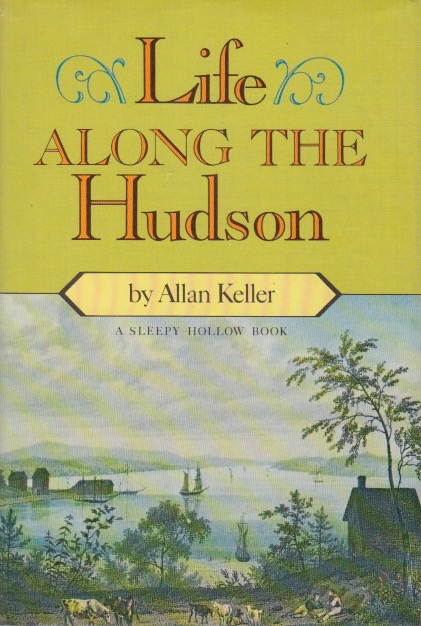
Allan Keller was a journalism professor who never became famous.  His Life along the Hudson is one of those charming, dreamy books about yesteryear.  Richly illustrated, it really isn’t a history (Keller wasn’t an historian) so much as a set of vignettes illustrating the role and importance that the river has had not only for New York state, but for the United States as a whole.  There are chapters about famous residents, battles of the Revolutionary War, historic houses, quirky facts, boating, and railroads.  It’s an interesting cross-section of a forgotten part of America.  Today when we hear Hudson River we tend to think New York City.  And while that’s not wrong, it certainly isn’t the whole story.  The Hudson early on connected Albany with Manhattan as they grew to be the two major points around which the Empire State expanded.

The book was never a bestseller.  It’s not particularly rare.  It is, however, a series of snapshots.  One of those was 1976, when the book was published.  The Hudson had become so polluted that major remediation efforts had to be put in place to redefine it from a cesspool to a beautiful waterway that took the breath away from many early travelers.  This valley was once considered one of the truly scenic spaces in the United States.  Now it’s pretty much a suburb of New York City, but it retains much of its earlier appeal, if you know where to look.  I’ve tried to find jobs that would allow me to move back to this region of upstate New York, but I’ve ended up in my own immediate home state of Pennsylvania.  I’d go back a couple more generations, if I could, but even salmon sometimes never make it back home.


Self Finding

I had occasion to peruse the Dictionary of American Family Names recently.  I realize that other people’s genealogy is generally boring, so I won’t provide the details, other than to say that “Wiggins” seems to be Breton in origin, way back when.  In any case, I checked my other ancestral names to find that they were either Germanic or unknown.  That made me feel a little special (an unusual feeling, to be sure).  I may be a mutt, but I’m a mutt with mysterious background.  Can you feel the mystique?  The thing about our origins is that they’re irresistible.  When I was still employed as an academic, one summer I was completely enthralled by the state archives in Madison and spent hours and hours researching—trying to figure out who I am retroactively.

This was before the need for horror films reasserted itself.  I was living the dream, employed in the profession for which I’d trained.  Or at least close enough.  At Nashotah House there was no real measure of academic productivity.  I was publishing at least an article a year and I had the draft of my second book written.  But who was it that had written that book?  What did I know about that person and where he’d come from?  My family names, at least until I get back to the inevitable Smith, are all pretty distinctive.  As a child “Wiggins” was a rare name, but it is the most common one from among my grandparents.  Perhaps all this Teutonic weight helps to explain my endless pondering.  Perhaps not.

Origins have always fascinated me.  The other day I was glancing over all the books on Darwin and Genesis that I had collected and read in those Nashotah House days.  Those were for the book that had never gotten written.  And names (and their origins) are all about identity.  Other people we meet want to know what we’re called.  Surnames, especially, convey quite a bit of information about us.  They might locate us geographically or ethnically.  It’s really a wonder that they’re not protected information.  Indeed, if you reveal too much genealogy online someone might be able to answer one of your security questions!  I suppose that’s another reason to keep your ancestry to yourself.  We do, however, take some of our cues for our identity from our names.  Family names aren’t generally chosen, except in cases of name changes.  And those can be tricky for those seeking to learn who they are.  Who am I? It depends on when you ask me.


Families in Trees

Genealogy is one of those things that’s fascinating as long as it’s yours.  It’s not hard to lose a few (or many) hours, trying to find ancestral connections.  When someone you don’t know begins to tell you, however, about other people you’ve never heard of, your eyes begin to glaze over.  My wife kindly gave me a gift of a local genealogy class that we attended the other day.  Along with some dozen others we gathered to learn some tricks of the trade.  The presenter began by having us introduce ourselves, “briefly.”  It’s a dangerous move in a genealogical crowd.  A few of our fellow students went into great detail about their ancestors, forgetting, for the moment, that we were there to learn how to do the research, not to find out about their families.  It’s a natural enough mistake.

None of us ask to be born, and we spend our lives wondering why we are here.  How did our parents meet?  Where were they from?  What did they do?  And the generation before that?  Some time ago I figured out that, due to the exponential nature of ancestors, that by the time you get back to just eight “greats” before for your grandparents, it took over a thousand people to make you.  It boggles the mind.  Suddenly it seems as if there would never be enough chance encounters or arranged marriages or tumbles in the hay for you to ever get here.  So many ancestors!  By the time I was in college I’d managed to trace it back to almost sixteen family names.  I was able to break through a barrier on this just over a year ago when talking to some family members about a lost ancestor at the turn of the twentieth century.  Genealogy is a search for meaning.

Both my wife and I share this interest.  Of the dozen or so others at the session, four others were married couples.  Almost all of us had done the voluntary DNA test to find our nations of origins—to confirm or deny family stories.  And that’s what it’s really about: stories.  Although we may be squeamish about some aspects, we want to know where we came from, the story of how we arrived here.  As if there’s some cosmic clue in it that gives us information on why we’re here.  It brought several of us out on a February afternoon.  We didn’t know each other.  If we traced back far enough, however, we would have found we were all related.  We are all family.


Family Names

Holidays are all about family.  In our society where families, due to jobs, often get spread across states, if not the world, we value holidays as times to get as many as possible of our close ones together.  They’re also rare days when work isn’t required, and true relaxation—a rarity—can take place.  This Thanksgiving break I’ve been reading the proofs for Holy Horror, but I put them aside after anyone else awakes.  We all, I think, come out of it feeling rested.  It has been many years, however, since I’ve had time to work on genealogy.  I don’t write much about it here because most people don’t find other people’s family history to be of interest.  Many of us are nevertheless fascinated by the ancestors without whom we would not be here.

One summer while I was teaching at Nashotah House I became fixated on one great-grandmother.  Nobody in my family knew her name.  I had a first name (a fairly common one), and, adding insult to injury, I grew up with her daughter (my grandmother) living in my home.  Kids, as nature dictates, aren’t interested in that kind of thing, and nobody thought to ask my grandmother her mother’s name before she died.  I found myself stuck at just two generations back.  I made trips to the repository of state and federal records at Madison, spending the summer in a basement room reading through microfiche—talk about ancient history!—trying to find her name.  Nothing.  I wrote to the federal agencies of vital statistics in Washington which gladly cashed my checks but never sent any information.  Later, when the internet began to fill up, I searched for her married name.  Nothing turned up.  I ordered books of gravestone inscriptions from the District of Columbia, where she’d died, but dug up nothing.  One of the cemeteries sends me newsletters now.  When my daughter asked why I was getting them in the mail I told the story.  We began to search online.

I couldn’t believe it.  At least a decade and a half after I’d found no clues, and after many web searches after that, we finally found her.  Someone had entered her on Findagrave.com.  As I pondered the dates, which seemed about right, my daughter pointed out that the site stated she’d been married to my great-grandfather.  My ancestry suddenly grew by two new surnames because her parents were also listed.  I was stunned.  I once calculated that, due to exponential growth, just ten generations back, (eight “greats”) we all have over a thousand ancestors, or 500 couples.  Genealogy could be a full-time addiction.  For the moment, however, I’m pleased to have found a long lost name, and an instantly larger family for this holiday season.