Where Angels Drink

Moving water is an impressive erosive force. When I have the opportunity to visit family in the western United States, we generally visit a cold, meltwater stream in the mountains where numerous circular cavities dot the resistant granite and basalt that make up the main exposed rock of the mountains. These cavities are nearly perfectly round, and can be quite deep. They are formed by pebbles and other sediment settling in natural depressions in the rock and being swirled around as the waters gush down the mountain. Over the millennia, the swirls grow into deeper holes, trapping the pebbles that will act as a natural drill, cutting away the circular depression as they are roiled around by the endless flow of water. Some of these potholes can grow quite large, but the ones I generally see have the diameter of perhaps a basketball, and are only about a cubit deep. They are young potholes.

At least that’s what I used to believe. The last time I was in the mountains, some younger members of the wider family were there. They came back from visiting the exact same creek that I had the day before, reporting that they’d seen the angels’ drinking cups. Excited in the way that only kids can be, they chattered on about the potholes and quickly moved on to other diversions. My mind, however, was fixated at the geologic phenomenon I had just seen. More precisely, I was amazed at how a religious explanation had come to account for a well understood aspect of nature. The previous day I had explained to my daughter the forces of nature that had carved these curiosities quite without angels. I had witnessed a kind of mythopoeia: the birth of a myth. The children probably did not make up this name, but I had never before heard it.

A very large pothole from Wikicommons (in Finland)

A very large pothole from Wikicommons (in Finland)

When potholes grow very large they are sometimes called the more secular giant’s cauldrons or giant’s kettles. When we see something in nature that appears to be intelligently designed, the mind naturally moves to the realm of the mythical. We don’t believe in giants any more, but angels are somewhat commonplace in the repertoire of supernatural creatures taken seriously. Surveys continually show that many Americans believe in angels, whether guardian or garden variety. Many people claim to have seen them. I can’t make that boast myself, but I now have a suspicion of where I might look to find angels. Particularly if it is a hot night in the mountains, I will, I’m sure, find them at their favorite watering holes.
Religious Aliens

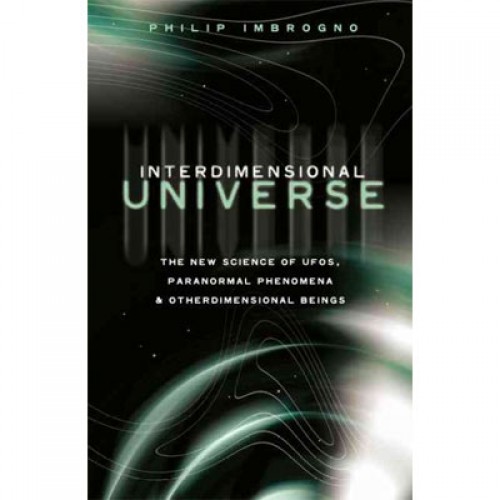
While surveying books purchased as texts in religion courses (something that an editor sometimes does), I came across a book called Interdimensional Universe by Philip Imbrogno. As I’ve often suggested on this blog, the study of the paranormal is related in people’s minds with the study of religion. I suspect a large part of it is because both deal with matters that go beyond mundane, daily experience. Indeed, the tiresome caricature of those interested in the paranormal is that they are individuals dissatisfied with their lives who project their disappointments into bizarre beings or situations to make up for the emptiness. Sometimes the same thing is said of those who are religious. What is really lacking in both fields, it seems to me, is people with strong critical thinking skills who remain open minded. There are serious scholars who study the paranormal—not many of them—and it is clear from the market-informed choices that Hollywood makes, people are intensely interested. So I decided to read Interdimensional Universe.

On the bus, however, I fidgeted to find ways to hide the cover and contents of the book. I don’t want some urban, Manhattan sophisticate seeing the letters U-F-O in my reading material. Still, like most honest, open-minded people, I have to admit curiosity. After a couple of chapters Imbrogno’s work appeared to be a standard UFO book. Then it started to get weird when he suggested that angels and jinn are, like aliens, interdimensional beings. He went from citing declassified Air Force and FBI documents to quoting the Bible. And not just quoting. He assumed the historicity of biblical accounts that scholars have extensively exegeted (oh, that word!) and demonstrated to have more plausible explanations. For the jinn he draws extensively on Islamic lore, believing that they are responsible for much of the trouble in the world, tricksters like the Marvel Universe’s Loki.

I put the book down disappointed. I still consider myself open minded. I admit to not knowing what is really going on with paranormal phenomena. If the number of reports alone are anything to go on much of the human race is either insane or is seeing some unusual things. The subject requires some real academic consideration. When self-proclaimed experts, however, veer into mythology to start explaining the unknown, we are getting no closer to finding the truth that, as Fox Mulder assures us, is out there. At the University of Wisconsin Oshkosh I taught a course entitled Myth and Mystery. It was some of the most fun I had in the classroom. It was also one of the most difficult classes for which I’d ever had to prepare. Is there intelligent life in outer space? I don’t see why not—the universe is awfully big to rule it out categorically. Are there jinn literally lurking in the closet? For that I’m afraid for that there is a much more prosaic answer.


Gods Will Be Gods

“And it came to pass, when men began to multiply on the face of the earth, and daughters were born unto them, That the sons of God saw the daughters of men that they were fair; and they took them wives of all which they chose.” Genesis 6 begins with one of the most unusual stories in the entire Bible. And that’s saying something! The sons of God mating with the daughters of men? A couple verses on we hear about giants roaming the earth in those days, presumably the children of this divine-human miscegenation. What is this stuff straight from pagan mythology doing in the pages of Holy Writ? Over the centuries, translators have tried to tidy up the boldly direct language of the King James here, making the sons of God into angels or some lesser beings. It is too hard to accept that sacred scripture admits of polytheism.

Monotheism, it is clear, came to the Israelites somewhat late in their history. The Bible is full of bold clues that other gods exist, and, worse yet, they are sometimes as powerful as Yahweh. In the light of later theological development, translators often bow to popular pressure and clean up the Bible’s language a bit. Fact is, Israelites, like most ancients, lived in a world populated with mythical creatures. Gods galore, monsters, demons, angels, witches, giants—they all haunt the pages of the western world’s sacred book. But that’s not what we expect the Good Book to say. The Hebrew text here is unequivocal, these are the “sons of God” we are talking about. Either that, or worse, “the sons of the gods.” More and more deities.

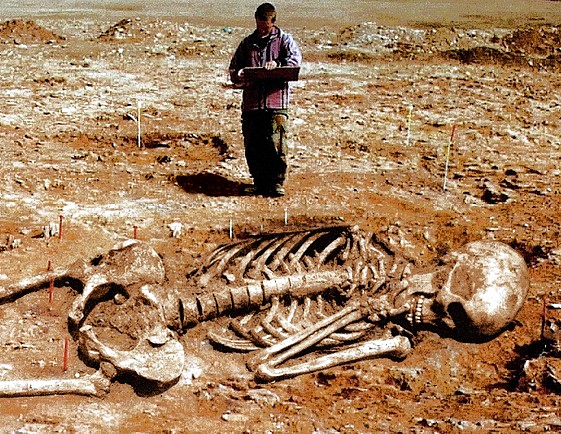
We can’t be sure why the ancient believed in monsters and giants, but it seems likely that such creatures had explanatory value for their world. Lacking science—paleontology was millennia in the future—they had to explain the huge bones found in the earth. We do know that dinosaur bones had been discovered in the Mediterranean basin in antiquity. These big bones often look human to a non-specialist. Heads are frequently missing. It has been suggested that these give rise to our biblical giants. Yet another response has been the recent trend of fundamentalists with Photoshop skills to post photos of archaeologists actually discovering giants on the Internet. Some of these doctored images are very impressive. It is an effort to save the Bible from the truth. A Bible that requires saving, however, should give even the most fervent believer pause for thought. Isn’t it just easier to suggest the sons of God were typical guys and that little has changed since the world was young?


Persistence of Demons

Although released in April, Insidious is a film for the long nights of winter. At least with my schedule of keeping up with a culture that is moving too fast, this feels like a reasonable rationale for having just watched it. I tried not to read reviews of the movie when it came out since I prefer to experience the thrills first hand when I watch a film. Like many horror movies, Insidious revolves around the supernatural. Specifically, Insidious takes on the specter of the afterlife. Unlike The Exorcist, the demon in Insidious is not expelled by a priest, but by a psychic, borrowing a few celluloid feet from Poltergeist. Adding a couple of ghost hunters to the plot reinforces the idea of the secular demon that so often appears in the learned discussions of the TAPS team as they tilt with unseen entities on SyFy.

In an increasingly secular society, the fear of the dead is very much alive. Even a casual stroll through Barnes & Noble (the only show in town now) will demonstrate the popularity of the paranormal. Somehow sitting in pews listening to a sweaty orator go on about what he (sometimes she) thinks God is wanting us to do has disconnected us from the realm of the dead. Paul Tillich famously declared that God is a person’s “ultimate concern.” In an age when technology is hovering on the edge of keeping consciousness alive forever, people wonder what happens to the self when the body dies. Call it soul, consciousness, mind, or personality, we can’t deny—no matter how secular—that something inside makes each of us unique. The myth of flying about with angels playing harps doesn’t match everyone’s expectation of an afterlife any more. At least some of us hope for electric guitars.

Insidious opts for a realm like Limbo known as “the Further.” This is a place we have been before. The hopelessly corny The Seventh Sign gave us “the Guf” as a now empty federal reserve of souls. The Greeks gave us Tartarus and the Zoroastrians “the place of worst existence.” No matter what we call it, our brains like to believe there is some place out there that we go when the biomass we drive each day finally hits the wall. Increasingly it has become a negative place where darkness reigns. Insidious’s “the Further” is a hopeless realm of the dead, acting out their evil intent. There are no angels, but demons abide. It seems that we’ve outgrown the concept that angels are watching over us, but we can’t escape the creeping sensation that diabolical entities are peering at us from the shadows. During these long nights of winter, Insidious invites us to take a journey to where there is no heaven, but hell is surely not hard to find. All we have to do is close our eyes.


Religious Reflections

In a stunning display of alacrity, over the weekend I viewed the movie Mirrors only three years after it was released. Since I watch horror films with a view to how they portray religion, I was preparing myself for disappointment when well over halfway through no overt, or even subtle references seemed to have been made to any holy topic. As Ben Carson, security guard, discovers that the mirrors of his night-watch building are haunted, the story seemed to be evolving into the standard ghost movie. When the missing character of Anna Esseker was finally found, I breathed a sigh of relief—she was living in a convent (because there were no mirrors there). What I supposed was a ghost movie was really a demon movie, and I found yet another example of how fear and religion interact.

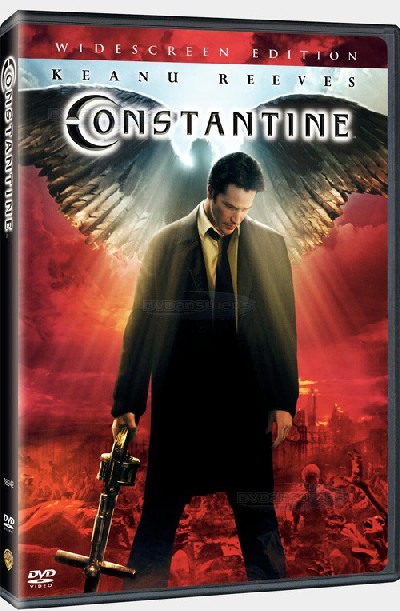
Since I’m currently preparing a program for a local church on the way that Christianity is represented in the movies, I’ve been rewatching a couple of standard films to gauge the scope of this interaction. So this weekend I also watched Constantine. This has never been one of my favorite movies, but as imbued as it is with Christian mythology it cannot really be ignored. When Gabriel is explaining to Constantine why he is bringing the devil’s son into the world, I realized that the reason coincided with some of my observations. Gabriel notes that humans need fear to appreciate God. By bringing fear into the world, Gabriel will force humans to become more pious. Intertextuality in the movies.

If I might indulge in some theological (that word makes me shudder) speculation that may not have been intended by the writers/producers, both of these movies utilize the concept that demons are trapped by mirrors. This may be a reflection truer than ever intended—we are our own demons. Mirrors reflect the vanity of visual appeal; our looks fade and our true self remains. Is that self an angel or a demon? Christian tradition states they are one and the same. Demons are only fallen angels. I’ve seen enough horror films to know that religion is not a universal element, but it often does appear in the role of producer of both good and evil. In this sense, at least, the movies are very honest.


Neverwhere Angel

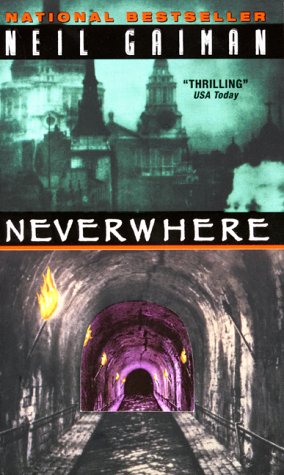
Neil Gaiman is popular among my students. At least among those that still read for fun. A couple of years back one of them lent me a copy of American Gods, and the story stayed with me. Having lived for many years in Wisconsin, and having visited the House on the Rock, the novel was like a kaleidoscope of some of my more pleasant memories of the state. Neverwhere is quite different and yet equally compelling. Gaiman peoples his worlds with characters just on the edge of believability thrown in with protagonists who tend to be completely confused by what they’re experiencing. Instead of gods, in Neverwhere there is an angel with the unlikely name of Islington and we have the myth of Lucifer’s fall retold in fantasy format, rolled together with Alice in Wonderland and the myth of Theseus. For starters.

A person is a composite of what s/he reads and learns and accepts. The books we digest, each in a unique recipe fitting our individual tastes, create new compounds and concepts that explore our personal realities. Neverwhere takes the reader down a rat-hole instead of a rabbit-hole, but nevertheless follows a young girl on a journey of maturity. The hero’s quest is undertaken to actualize both protagonist and idol, and along the way the beast in the labyrinth must be encountered and slain. Theseus, the flawed hero, dominates a world where even saviors have peccadilloes.

The protagonist of Neverwhere does not believe in angels, despite his encounter with one. As Gaiman puts it: “it was much easier not to believe in something when it was not actually looking directly at you and saying your name.” Belief generally involves not seeing. Once the object of belief is empirically confirmed, belief becomes knowledge. Today the belief in angels remains unabated. No empirical proof, nothing tangible confirms this belief beyond the anecdotal accounts of those who claim to have experienced them. Even the fanciful image of their androgynous good looks and unlikely wings remain untainted for all the centuries. Neverwhere raises an intelligent question about angels, but to discover what it is you’ll need to go down the rat-hole as well.


Understudy Angels

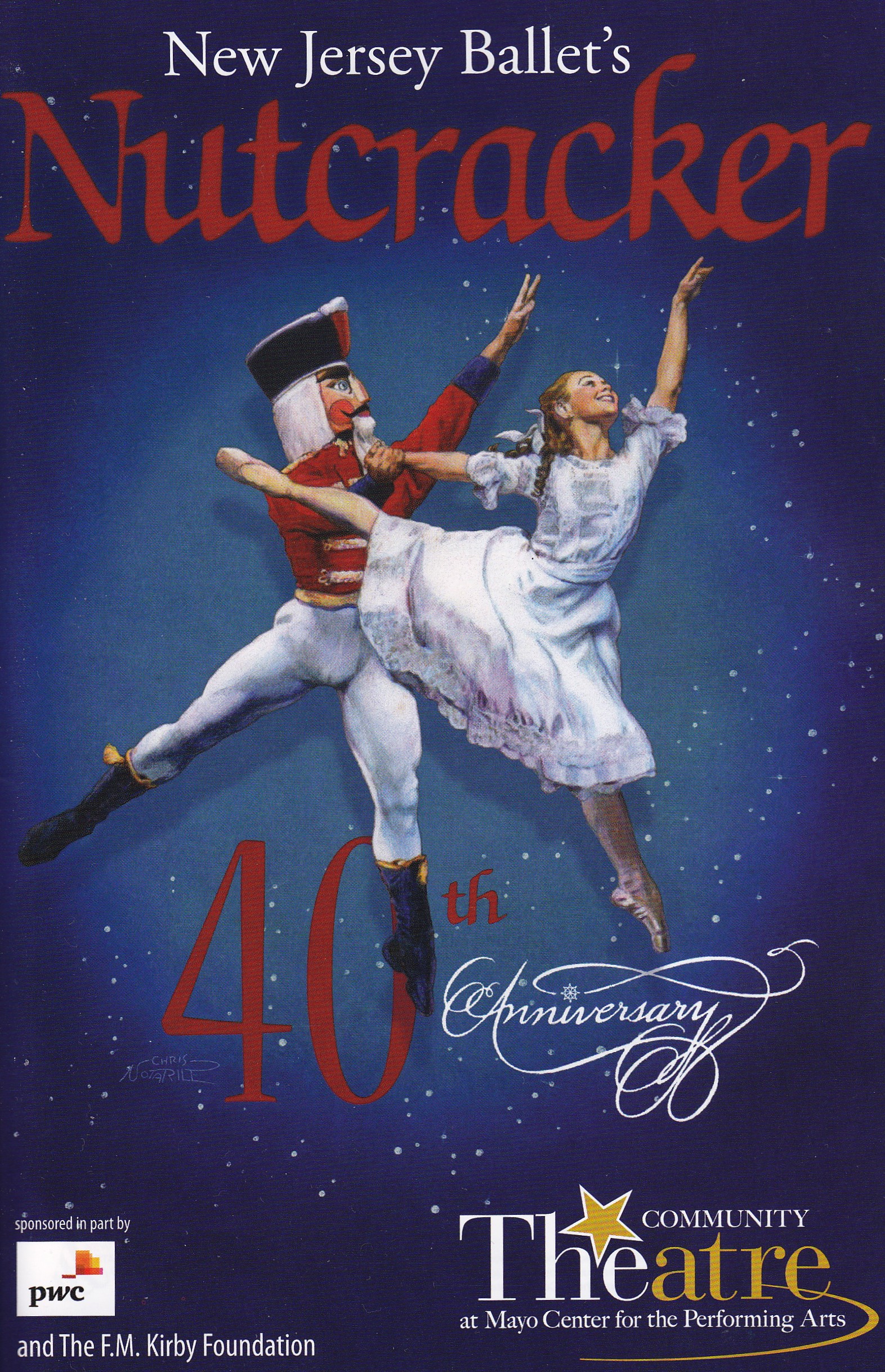
Since moving to New Jersey my family has attempted to sample as much of the vibrant arts scene as we can on our modest income. At times it feels like being a starving man locked in a fine restaurant. So we scrimp, save, and buy the cheap seats when we can. Thus it was on Christmas Eve we found ourselves in the audience for Tchaikovsky’s Nutcracker ballet. I’ve been on this planet for nearly five decades and I’ve never before seen a ballet. I knew the basic story of the Nutcracker: weird uncle gives niece an odd toy, jealous brothers soon break the toy, and the niece has a bizarre, if exceptionally graceful, dream where the toy becomes her escort. Beyond that I didn’t know what to expect. When I looked through the program, I was interested to see that there were angels, snowflakes, clowns, and mice. And there were understudy angels.

Students sometimes ask me what became of the ancient gods. In the cultures surrounding Israel, as well as in early Israel itself, polytheism reigned. Once the Exile had conceived monotheism what happened to the other gods? Did they all get absorbed, Borg-like, into Yahweh? It seems not. Many of these ancient gods continued to eek out their existence as supernatural, yet strictly sub-divinity, beings. We recognize such beings as angels today, and every holiday season they are ubiquitous in store windows and church lawns. It should come as no surprise that with so many angels a few understudies must be necessary.

In popular imagination – (dare I say it?) Christian mythology – angels derive from dead Christians. Many children are taught that if they are good, when they die they become angels wafting through the heavens. This popular doctrine does not match the official teachings of any major branch of Christianity. Angels are different in substance, essence, or whatever else a theologian might care to call it, from humans. You don’t evolve into an angel. Either you’re born one or you’re not. And so it seems we are earth-bound in our existence. No cause to mourn, however; even the gods had to learn how to be angels. We can only hope they had the benefit of many understudies to carry on the tradition.


Bleached Angels

A friend recently asked why, in the canons of western art, angels suddenly made the shift from colorful to predominately white. What was behind this loss of color? The history of angel imagery is complex and a great deal of the complication derives from a generally iconoclastic sensibility in late Israelite religion. Images were frowned upon, so we do not get “Hebrew angels” recorded for us. The current-day perception of angels seems to go back to Mesopotamian Apkallu figures and Egyptian deities. In both ancient cultures various deities and demi-gods were portrayed as winged humans. The Egyptian figures, at least, were colorful. In the world of the Hebrew Bible angels are nowhere cited as having wings and they were likely imagined as being pretty much the same as humans in form. Many biblical characters mistake angels for people.

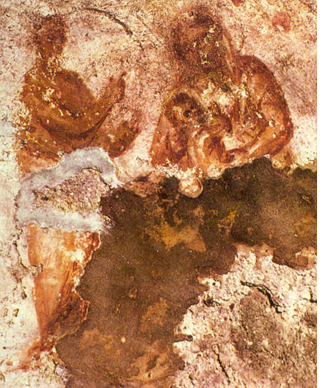
In Greek portrayals, Nike, goddess of victory, is a winged character. Eros, the god of love, also bears wings (and unlike Nike, he is generally bare all over.) In some vase paintings the Harpies are winged women. Since Greek pottery painting was generally monochromatic, we don’t have much color to go on. The earliest Christian angel portrayal comes from the Priscilla Catacomb in Rome. This angel is monochrome and wingless. The more familiar, and lavishly colored angels are Byzantine creations. Since my opinions on art history are not to be trusted, it is advisable not to make too much of this, but Byzantine art made flamboyant use of saturated hues to bring glory to God. This is part of the tradition behind Orthodox icon writing, and angels were simply following suit.

In the Middle Ages in Europe, angels were widely used to represent good and evil. It would stand to reason (if not to art-historical standards) that “good angels” would show their goodness by donning white apparel while “evil angels” would take on darker garb. This also fits with the growing tendency to represent Satan as dark red or black in color during this time period. As angels symbolized goodness, they became bleached of their former, Byzantine color. Symbolic value outweighed aesthetic sensibilities. Today angels retain their ancient legacy of Mesopotamia, Egypt, and Greece. Wings fit the view of angels as messengers, although ancient ideas of their colors depended more on the artistic conventions of the culture than any attempt to be true-to-life.

The earliest Christian angel (left)


Demoted Angels

One of the questions frequently surrounding monotheism is that of angels. Surveys indicate that even non-religious North Americans, by far, believe in angels. So, where do they come from? In a monotheistic context where God is considered omnipotent what role could angels possibly fill?

Angels appear in ancient religions in medias res. Going back to the earliest attested religion, that of the Sumerians, we find winged divine assistants called apkallu. In a polytheistic world, gods could always use a little help. These divine beings, portrayed with wings, are sometimes called “angels” by modern commentators, and they do serve some of the basic functions of an angel, such as doing errands.

Other ancient polytheistic religions knew of differing classes of deities; not all gods were created equal! There were primordial deities, often old and retiring, and there were active ruling deities who received their authority from the primordials but who in fact ruled by might. Below the ruling gods were skilled-labor gods and messengers. It is from this class of messenger gods that angels eventually evolved. We don’t know that messenger deities were portrayed with wings, but in ancient times wings indicated speed — uninterrupted movement — so you could do worse than have wings if you were a messenger. The English word “angel” derives from the Greek term indicating a messenger. Indeed, by the time we reach the Hebrew Bible angels are often indistinguishable from humans.

The problem is that when monotheism developed during the Exilic Period, the Israelites had already become quite accustomed to having angels around. Before prophets showed up angels were often the means of learning the divine will. If there is only one god, what do you do with this tier of messenger deities? Demote them to angels! They are still supernatural, but not as powerful as God.

Probably under the influence of Greek Hermes, angels regained their wings to become the winged humans we know so well today. It is a mistake, however, to call all winged humans from the ancient world “angels.” Angels are the result of the religious evolution from polytheism to monotheism, and their ancient predecessors were truly gods.

Remember when we used to be gods?


Cenobites and Angels

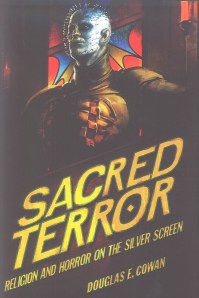
I recently became aware of Hellraiser. Actually, I’d seen images of Pinhead around for years, but never realized that he was a Cenobite until reading Douglas Cowan’s Sacred Terror (see my post on Vampires, Mummies and the Holy Ghost). In fact, Pinhead is featured on the dust jacket of the book and comprises a large part of Cowan’s evidence. Curious enough to watch the movie, I steeled myself for the macabre and terror, but although there were gory scenes it was no more disturbing than the Republican National Convention.

Pinhead for president?

Pinhead for president?

This movie draws its lifeblood from religious, particularly Christian, imagery. Cenobite, of course, is an old word for “monk” and in the movie Cenobites are interdimensional beings known as “demons to some, angels to others.” In a strange convergence of themes, I had recently viewed Dogma again after a gap of a few years. Here Loki and Bartleby are fallen angels, who, rather like myself, move from Wisconsin to New Jersey. Both of these films are pervaded with a healthy ambivalence towards those beings who have the potential for so much good but who opt for what most of us would consider evil.

Angels have a long pedigree in ancient religions, probably originally being gods who only ever achieved supporting roles. Not all gods were created equal. At Ugarit we find a whole class of deities below the power and dignity of reigning gods. Besides, in a non-scientific worldview, angels, especially fallen ones, had great explanatory value. When things unexpectedly go wrong and you’ve made all the proper sacrifices to appease the resident deity, bad angels might just be the cause. Theirs was a world of naive realism; what the eye observes is pure reality and what the eye doesn’t see is divine. Today we know this to be overly simplistic — reality is so complex that even our brightest can’t completely comprehend it. Yet when we have trouble explaining things, even in a scientific world, many are ready to point to the angels in the wings.


Fallen Angels

When did angels become cute? This is one of the ranking mysteries of religious studies. In ages past, way back before monotheism, most people in western Asia believed in a plethora of deities, sub-deities, and heroic characters. A cosmic continuum of animal-to-human-to-superhuman-to-divine seems to have characterized their universe. They had little reason to suspect that anyone or anything more powerful than a human might be “cute!”

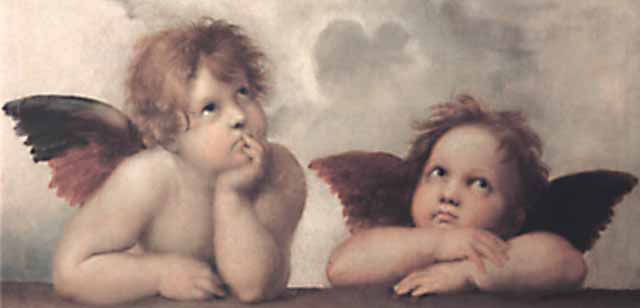
The first angels mentioned in the Bible, cherubim, are today often associated with Hallmark and Valentines: cute little nude boys with wings playing with their bows and arrows. In the world of the Bible, however, cherubim were not so tame. I tell my students to think of sphinxes when they read “cherubim” — scary hybrids of human and lion or ox and eagle. These creatures were intended to be guardians of the very throne of God; they had to be scary.

Your garden-variety angel was indistinguishable from a human being. They had no wings, halos, or — (gasp!) — harps. The reaction to angels by the people of the Bible was essentially that of a visit of a stranger, a stranger who sometimes said weird stuff about what the big guy wanted you to do.

But somewhere along the line, angels had an extreme makeover. They became winged, effeminate people who could save your life or that of your puppy. They became guardians of human interests and loves. In so doing they lost the awe and majesty of being the Frankensteins of the supernatural world. Is this what a fallen angel really is?

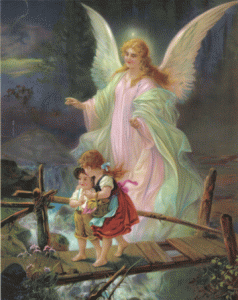
A cheap copy of this popular image hung in my room as a child.

A cheap copy of this popular image hung in my room as a child.