Peter and the Red Giant

Now that my book has been sent off to the publisher, I’m working on the next project. This one has me delving back into the Greek of the New Testament. It may be, some would say, that I’m no longer an expert in such things. Coming to Koiné Greek, however, after lingering among languages like Ugaritic and Akkadian, feels like coming home. It’s Indo-European, after all. One of the books I’ve come back to is 2 Peter. This is a curiosity among the canonical books. All but the most conservatively predisposed of scholars note that this little letter didn’t actually come from the Peter. The idea of using someone famous as a literary pseudonym was a well known and widely accepted practice in ancient times. In fact, the prefix “Pseudo-“ on classical writers is so common that I feel just a little self-conscious. Nevertheless, 2 Peter contains fascinating ideas.

The Bible was influenced, of course, by many outside sources. One of those sources was Zoroastrianism, the religion of ancient Persia. This came to mind because 2 Peter is the only book in the Bible that describes the end of the world as burning and melting. These ideas are tied to the purifying fire of Zoroastrianism. In that religion an evil deity, Angra Mainyu, corrupted this world. Fire, in Zoroastrian thought, is holy. At the end of time, when the blessed ascend to a heavenly mountain, a river of fire will pour down, burning and purifying the polluted earth left behind. The idea is powerful and evocative, and obviously some early Christian writers cottoned onto it. Including 2 Peter.

The idea, in the Bible, stands isolated in this one single book. The real concern of the epistle is false prophets, though. Still, the worldly should take note. The universe in biblical times consisted only of this relatively flat planet—which wasn’t even a planet then—with a starry dome overhead and a fiery Hell beneath. Ironically, 2 Peter’s end is similar to that predicted by modern astronomers. A star the size our sun will likely bloom out into a red giant, parboiling the earth in its death throes. Seems the Zoroastrians, and Peter, may have been correct after all. The thing is they both had an escape hatch that will only come with interplanetary migration, according to science. But then, all of this assumes there will be a world left after the Trump administration. And speaking of false prophets, I wonder what 2 Peter would’ve had to say about that?


Game of Thrones

IMG_2763I risk my already flagging street cred by admitting this, but I don’t watch Game of Thrones. In fact, I started to read the first book a couple years back and I just couldn’t get into it. Well, only 80 pages into it. The fault is, I’m entirely sure, my own. I lack some gene or enzyme that makes life without Game of Thrones impossible. Still, I have to admit curiosity. A story on the Washington Post, by Ishaan Tharoor, suggests “The ancient Persian god that may be at the heart of ‘Game of Thrones’” is Angra Mainyu, aka Ahriman. This managed to catch my attention. Zoroastrianism is a religion that seems to lie behind quite a bit of modern religious thought. Although dating Zarathustra, or Zoroaster, is notoriously difficult, concepts from his religious system show up in Hinduism—one of the earliest forms of religious expression about which we know a fair deal—as well as in Judaism and therefore Christianity and Islam. In fact, many of the ideas you may associate with the central tenets of Judeo-Christo-Islamic tradition may go back to Zarathustra.

One of the certainties about Zoroastrianism is that it was a dualistic religion. Good and evil are engaged in a constant struggle for control. The good god, Ahura Mazda (which sounds like a blend between Star Trek and a Japanese auto maker) struggles constantly against Angra Mainyu. Mazda’s website states that the car line is named after the deity (according to Wikipedia, I note, losing the last vestige of cred), pushing his reach even further east. With this incredible pedigree, it is no wonder that George R. R. Martin may have tapped into it. This kind of dualism is ripe for the picking.

My friend K. Marvin Bruce wrote a satire about the Persian gods, in fictional form, that was published a couple years back in Calliope, a small circulation literary journal. He told me he even won third place in a contest for it. The idea was that a disgruntled professor wanted to start the apocalypse (a Zoroastrian idea) by summoning Ahura Mazda and Angra Mainyu to earth to try to start a fight between the two. It was a fun story, but the point, if I may speak for my friend, is serious. Warring religions stand the best chance of beginning the end of times. We don’t even need the gods to do it, really. Although I don’t watch Game of Thrones, I can’t help wonder if Martin had the same idea in mind. If you want the answer to that, don’t ask me. I’m not even a hundred pages into it, and I don’t have triple play.


Thus Spake Zarathustra

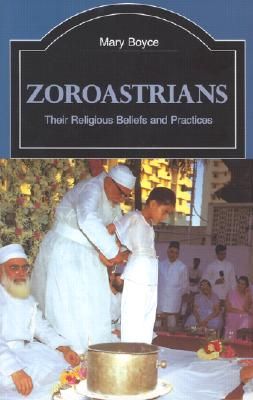
Preparing for another round of my annual course on Ancient Near Eastern Religions, I have been brushing up on Zoroastrianism. For this I generally first turn to Mary Boyce’s standard introduction, Zoroastrians: Their Religious Beliefs and Practices. The book was written in the 1980s and is showing its age a bit, but it remains a seminal introduction to a religion whose humble position among world belief systems belies its overwhelming impact. A strange fact about the religion is that many of its main tenets have been summarily dismissed by the more politically influential religions of antiquity while its secondary features have been dramatically embraced. The classic example is dualism.

Zoroastrianism was founded on a dualistic principle: Ahura Mazda was the entirely beneficent, good creator, while Angra Mainyu was the powerful principle of evil. This cosmic struggle tapped deeply into all aspects of life, leading to the beliefs in two afterlife realms (which evolve into Heaven and Hell), two very powerful entities (that become the God versus Satan paradigm), and two dispensations (present age as opposed to future age, the ultimate source of the apocalypse). Indeed, it would be difficult to recognize Christianity without Heaven and Hell, the Devil, or the final judgment. Boyce carefully traces the earliest evidence for Zoroastrianism back to its formative period and offers detailed explanations for each aspect. Beyond this, however, Zoroastrianism became a forgotten faith, an abandoned parent.

It is a fact that religions evolve. Many believers like to trust that they have the straight information directly from the founder’s mouth and that their brand is the authentic brand of faith. All religions, however, if they survive long enough, change to meet the needs of present-day adherents. Again, Zoroastrianism is instructive. Believing in the sacred nature of fire, during the industrial revolution the use of fire for profane work, such as running a steam engine, was considered inappropriate. How were Zoroastrians then to keep up with society without softening their stance on the secular use of fire? The struggle was real and has never been fully resolved. The same exercise could easily be applied to other religions as well. Until the Zoroastrian-inspired apocalypse arrives, religions will have to adjust to continual societal change and accept that quantity of belief does not affect quality.