The Goodreads Zone

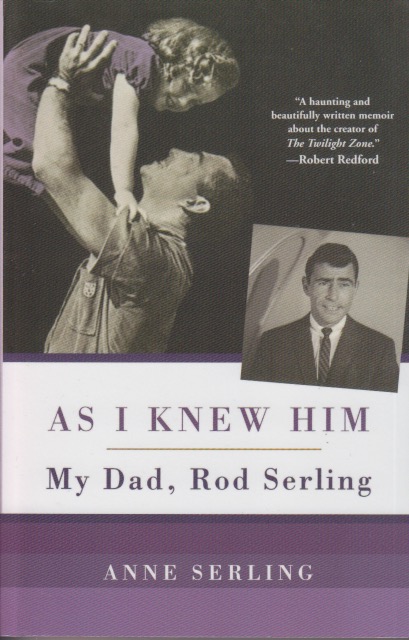
It happened on Goodreads.  I suspect she had no idea how much that simple “like” meant to me.  Social media is too big to be everywhere, so I primarily engage with those who reach out to me (without trolling), on Twitter, Facebook, YouTube, and Goodreads.  Even with my activity on these venues, comments are rare.  Likes a bit more common, and always appreciated.  Several months after I posted a review of her book, As I Knew Him: My Dad, Rod Serling on Goodreads, Anne Serling liked it.  That may not seem like much, but this was the actual daughter of Rod Serling himself, liking something I wrote.  If you feel the way I do about The Twilight Zone this will be a personal brush with greatness.  Almost as if Serling himself approved.
I’ve met a few famous people in my time.  Mostly they are ordinary people and act like ordinary people.  Only those of us around someone famous know that millions of people have heard of one of us.  Heard of and admire.  The rest of us manage to get along, but we do so without notice.  Unless someone “likes” what we do.  It’s kind of like having someone famous blurb your book.  In any case, my childhood consisted of many snippets of things that made me who I am.  One of those snippets was The Twilight Zone.  I watched a lot of television growing up.  We were not a reading family (neither parent finished high school), so the television was the item of choice after work/school.  Much of what I watched washed off.  Not The Twilight Zone.

Like reading through the Dark Shadows novels, I’ve been slowly watching my way through The Twilight Zone alone.  Nobody else in my family cares for it and since I don’t have much free time I only get to it on rare occasions.  Now that mowing time is here, those occasions are even fewer.  I guess I feel that I have to justify why I’ve come around to writing about horror as an adult.  You don’t get to be an adult without having some kind of childhood first, and mine involved The Twilight Zone.  Anne Serling’s involved being raised by the creator of The Twilight Zone.  To me, that’s a validating kind of fame.  To be seen by someone who could, if she wanted, have an instant and ready-made audience.  A reverie, started by something that happened on Goodreads.

The Zone

My youth—who am I kidding?—my life has been a search for father figures.  Since I grew up with television, many of them came from the tube.  The professor from Gilligan’s Island, Mr. Rogers, Barnabas Collins, and Rod Serling.  Serling was like the father I couldn’t remember in that he was always smoking.  But unlike my father, Serling had an imagination in sync with mine.  The Twilight Zone was in reruns by the time I caught up, but it gave me an odd kind of happiness.  The sort that you had as a kid after the bath was over and you were wrapped up snuggly and warm in a bathrobe, and you got to watch one of your favorite shows before going to bed.  I discovered Serling as a writer when I was in Junior High School.  He was right up there next to Ray Bradbury, in my book.

I have to admit to feeling anxious as I read Anne Serling’s As I Knew Him: My Dad, Rod Serling.  You see, she actually was his child and I’m afraid of learning too much about those I put on my personal pedestals.  Her book, however, didn’t disappoint.  Serling lived a writer’s life, something I’ve coveted since I was a kid.  If I couldn’t have a father, at least I could write about life as I saw it.  I still write fiction inspired by, among others, Rod Serling.  Spending much of my time in Binghamton and Ithaca for my own family reasons, I was only obliquely aware of how much I was traversing the region Serling considered home.  As I read his daughter’s autobiography—or is it a biography?  Who can tell the difference?—I was inexorably drawn in.  Fathers and daughters can be the best of friends.

Sometimes I wonder if those who know writers the best are their true fans.  I don’t mean groupies or the like, but rather those whose lives have been transformed by their words.  I’m reminded of Evermore, written by a relative of Edgar Allan Poe.  Family, it is true, see a side of a person that the reader does not.  But who are we, really?  Those of us who write may be saying more in our fiction than we care to admit even to those who know us well.  Rod Serling recognized dimensions well, I suspect.  A writer’s life requires sacrifice and keeping things hidden.  Anne Serling’s book is a gift to those who write, even if it is about someone else’s father.