Red Thread

Theseus would never have survived the labyrinth without the help of Ariadne.  After escaping the minotaur, the two eloped and, according to some versions of the myth, Theseus abandoned Ariadne on the isle of Naxos.  This story has been told and retold countless times, and even served as a source of inspiration for the movie Inception.  Back when I was thrashing about dark academia, trying to make a living as an adjunct professor at Rutgers and Montclair State, I taught classical mythology at the latter.  These were in the days of PowerPoint lectures, and I knew a few things about doing them: slides shouldn’t be overly wordy, and they should have images.  People are visual learners.  During my three semesters at Montclair, I developed my PowerPoints peppered with images found online.  I recently remembered one of Ariadne on Naxos, and I really wanted to find it.

My Oshkosh slides were burned onto CDs, but now tech has moved beyond that and I have no readers for burned CDs.  My hopes of finding the name of the artist in the credits on the slide have not been fulfilled.  I turned to the all-wise internet.  Image search after image search brings up nothing close to that particular picture.  I thought it was a painting, but it might’ve been a pastel or colored pencil drawing (it was from a relatively contemporary artist).  I simply can’t find it.  I remember the subject, and the image, but neither its formal title nor its artist’s name.  The information exists, but on unreadable discs.  On those same discs rest the sermons I preached at Nashotah House.  I sometimes think of them and would like to look at them again, to refresh my memory.  I can’t, however, access them, although they are on discs in the closet just behind my back.
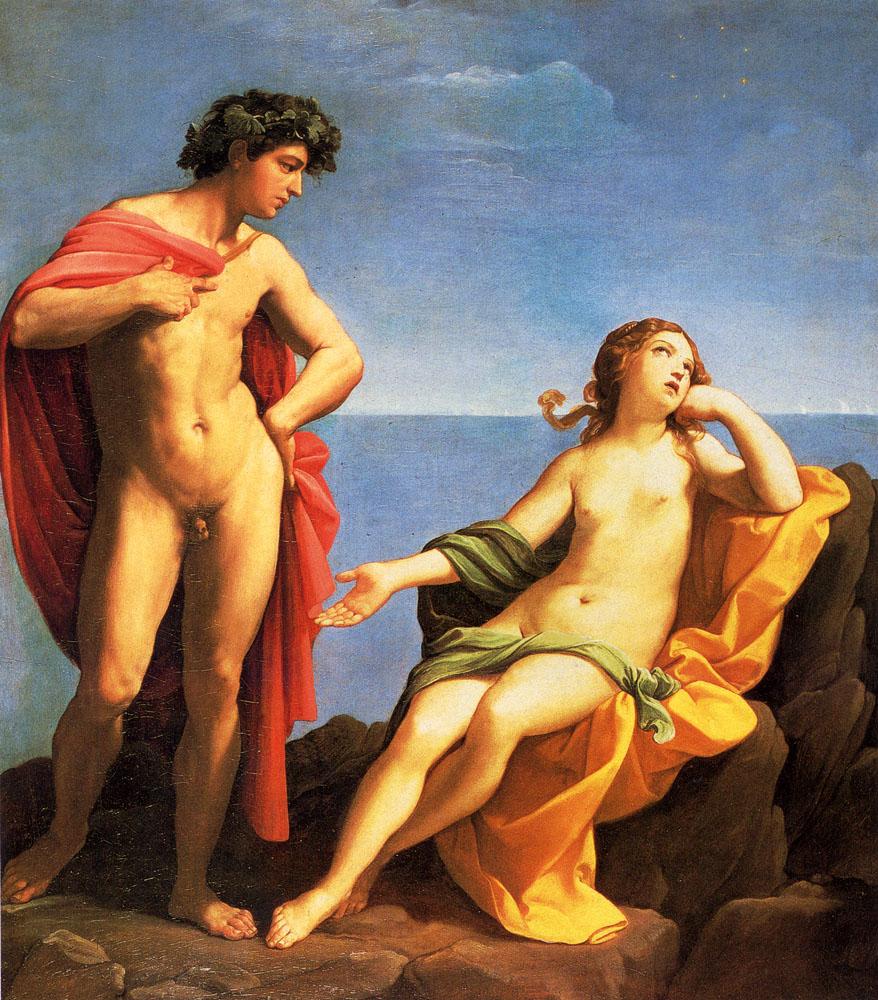
Not the image I was looking for (image: Bacchus and Ariadne. Guido Reni).

We let technology drive our lives.  It comes with costs.  I recently talked to a young person who was buying a nice journal and some writing implements to use in it.  They told me that although they’d grown up with computers, and the internet, they wanted the very human experience of writing by hand.  My default for taking notes is still by hand.  If only I had done that when adjunct teaching…. I remember well how frantic those days were.  I was teaching up to eleven classes in one year (a typical professor has three or four), driving between two campuses.  Eating in my car.  I didn’t really have much of a chance to note individual artworks in a notebook, figuring I’d be pining to remember them many years later.  I could use Ariadne to help me out of this labyrinth.  I know right where she is, but the isle of Naxos is inaccessible.
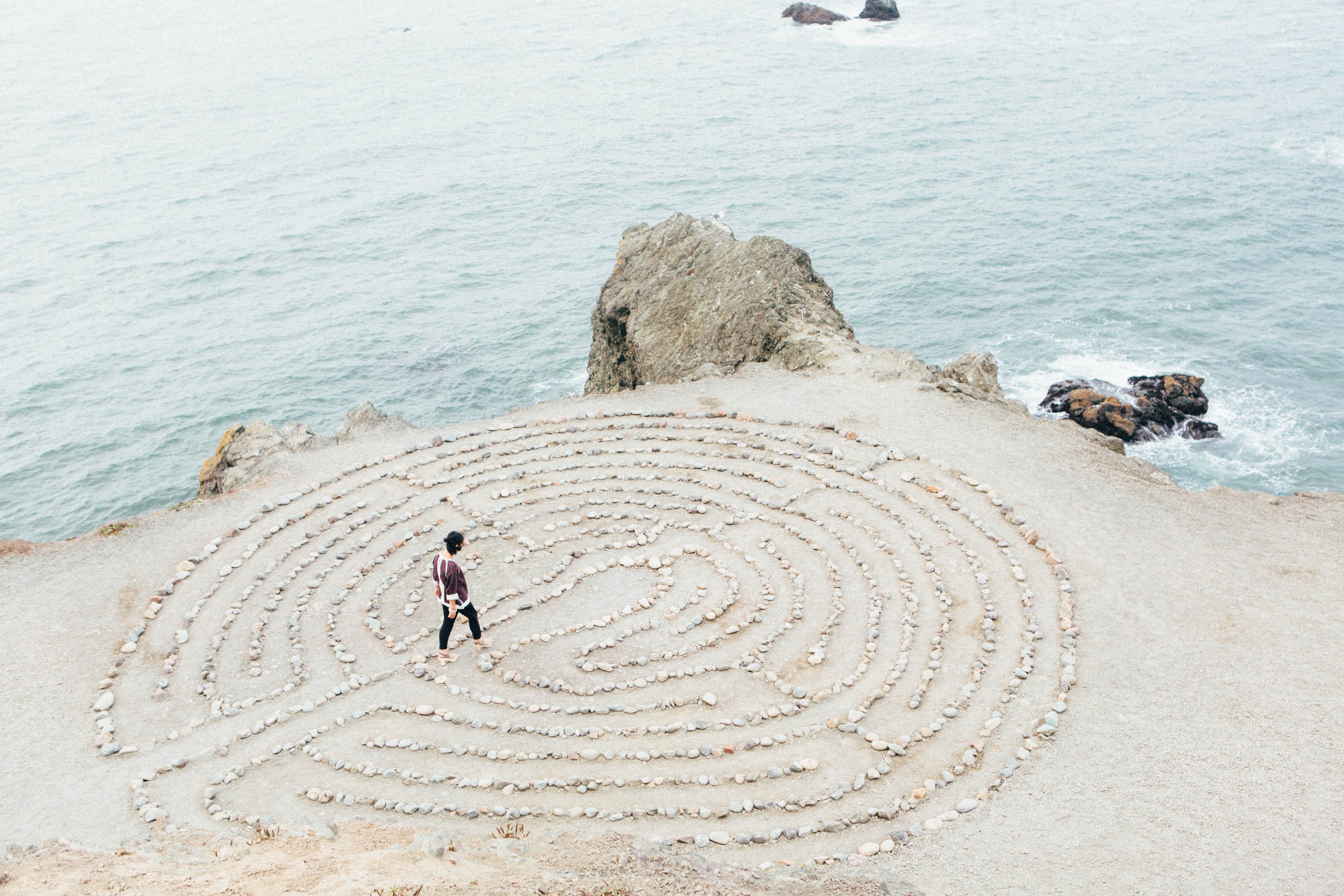

Welcome to the Labyrinth

Do anything long enough and you’ll produce a labyrinth.  I started this blog back in 2009 with the idea of perhaps continuing in the biblical studies/ancient Near East (actually west Asia) studies, where I began.  I always knew this would be a place to talk about books and movies and sometimes current events.  Often it would address American religion because, well, it’s so bizarre.  Over the years the blog has ranged pretty widely.  My interests are fairly diverse and I tend to get obsessed with a subject for some time and then move on.  I suspect that’s one reason followers are few.  People want the same thing—should I dedicate the site to horror films, religion, or social justice?  The weather?  Instead, it’s what catches my interest at the moment.  Thus the labyrinth.

On the rare occasion when someone actually comments on an older post this blog (there was a healthy chain about the Highgate Vampire some years back), I often have to ask myself, “Did I write about that?” “What did I say about it?”   The human mind is a labyrinth.  And life is too short to ever stop learning.  Even if it means that few will be interested in what you’re doing.  The few who’ve known me a long time and read this blog (I know who you are), might be surprised at the horror themes that have become pronounced.  These were, however, part of my childhood.  When I tried to get away from them, they pursued me.  Monsters are like that, of course.  They like to hide in labyrinths.

But labyrinths are contemplative spaces.  Contemporary spirituality has rediscovered labyrinths.  You walk them in intentional thought.  In the moment.  We might be able to forget for some time that the original labyrinth was built to house the minotaur.  And without Ariadne Theseus would’ve never survived.  When he left her on Naxos his actions spoke louder, much louder than his fight with the monster.  Labyrinths make you forget where you are.  One saved Danny Torrance.  And perhaps one might save your soul.  Those who make enough chairs, or write enough books, or design enough skyscrapers leave labyrinths behind.  Manhattan may be a grid, but it’s a labyrinth nevertheless.  It seems to be a part of every story.  The thing about labyrinths is that they have no one goal.  There is no single answer to this mystery.  When you begin making one you may not even realize it.  Until you stop to contemplate it.

Photo by Ashley Batz on Unsplash

Enter the Labyrinth

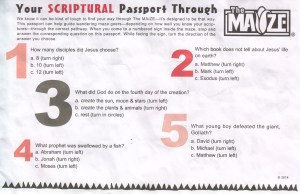
Trying not to think too much about Children of the Corn, I visited a corn maze over the weekend. This particular autumnal activity highlights just how much detail a human mind can pick out in a mass of sameness. You can tell if you’ve been to this particular juncture before—that oddly shaped leaf, or that peculiar stone, or that specific ear with the missing teeth will give you the clues. This particular maze, however, also uses printed clues. Before you enter the labyrinth, you may choose your species of guidance. There were 4-H clues, Girl Scout clues, history clues, and more. One of my companions handed me the scriptural clues. Although it may have been an obvious connection, I thought about it in terms of salvation. A corn maze is not unlike life in the real world; confusion, false leads, and aimless wandering. Having a guide—in my case, knowing the Bible—will lead you out.

corn-maze

Of course, the point of a corn maze is the fun of getting lost. This particular farm had eight acres dedicated to fall fun, and our party did get hopelessly mired in one location and had to ask for help from the corn cop who wanders like a friendly minotaur, or maybe a personal Daedalus or helpful Ariadne, directing those who’ve lost their way. The idea is that once you enter the maze, you look for numbered clues at various junctures—only a few crossroads have them—and answer the question for instructions about which way to go next. Even with the Bible in hand, or in head, we managed to lose our way. Baptized by a sudden cloudburst, we sought shelter in an open field. The only way ahead was to press on.

Those who’ve been with this blog for any length of time know that it is intentionally kind of a labyrinth, often using metaphor. In the case of the literal corn maze and its clues, minimal biblical knowledge was required to figure out the correct way to turn. The trick was even after getting all the hints, there was still some distance to go. Wet, confused, and having only our wits to go on, by trial and error we made it through. Our instructions—for we each had a different set of questions—only got us so far. My biblical guide was damp and see-through with the soaking we received. Metaphors were falling as fast as the rain. After all, the point of a corn maze is that you don’t get your money’s worth unless you get well and truly lost.


Inception of Theseus

Never the first for new cultural memes, but often among the last, I finally took my family to see Inception over the holiday weekend. The Internet has been buzzing with comments about the movie for the last couple months, so it was difficult not to have preconceived notions of what to expect. Nevertheless, I found the film utterly engrossing. At one point I realized that I hadn’t blinked in so long that my eyes had begun to dry out. Having just finished Mark Danielewski’s House of Leaves at the end of June, and having begun my Mythology class on Friday, the Theseus myth has been on my mind anyway. Inception takes the hero’s journey through the labyrinth of the subconscious.

The first hint that Inception was the Theseus story, for me, was the introduction of Ariadne. The daughter of King Minos, Ariadne informs Theseus how to escape the labyrinth, and her first task in Inception is to draw a maze that takes a minute or longer to solve. Dom Cobb, like Theseus, is a deeply flawed hero. Part Theseus, part Daedalus, Cobb has trapped an unlikely Minotaur in the form of Mal, his wife, deep in his subconscious mind. She stalks him in his unsavory work, and when she threatens his very concept of reality, she is slain by Ariadne.

Coupled with classical mythology, the film also raises the unresolved question of the nature of reality. Is conscious existence any more real than the subconscious? This theme was explored in David Cronenberg’s eXistenZ back in 1999 with a similar ending that refuses to answer the question. Both films raise the troubling interference of technology with the most secret of human psychological repositories, the uninhibited subconscious. The closer the Internet comes to a global intelligence, the more the individual mind recoils into its own obscure and unexplored territory. Despite Freud and his disciples, we have not yet even begun to understand our own subconscious minds. Movies like Inception draw on classical sources to help us deal with the Minotaur that surely lurks there.

Ariadne explains her dream to Bacchus