Evolving Instinct

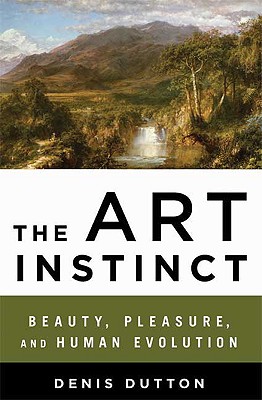
ArtInstinct Evolution has appeared as a threat to the Christian establishment ever since Charles Darwin worked out a mechanism by which it could work without God. In the western world, particularly in the United States, evolution has always been a religious issue; it seems that if we remove God from the development of humankind we remove him from the universe. The thing is, natural selection works on such an elegant scale that the scientific endeavor itself almost hinges on it. And still people believe. I flatter myself with thinking I’m a creative sort, and so Denis Dutton’s The Art Instinct: Beauty, Pleasure, and Human Evolution provided an intriguing consideration of how we might become creators in a world lacking a creator. Well, I shouldn’t be so crass; Dutton has no atheistic agenda—he is interested in exploring what natural function the human love of art might have. We do know that art appears well before civilization itself, and Dutton has a suspicion that natural selection’s lesser known sibling sexual selection might have an explanatory role. He isn’t willing to go all the way and say art is just a mating strategy, but art and love are no doubt bound closely together.

I read The Art Instinct wondering if there might be some collateral insight into the origin of religion. I wasn’t disappointed. Within the first ten pages religion entered the discussion and it never really left. Not that sexual selection evolved religion, but the traits of the religious often parallel those of the artist. As Dutton points out, some theorists almost equate religion and art. For me one of the main features of this thought experiment was the innate questioning of reductionism. While there is no doubt a stark beauty to the idea that an atomistic theory might explain every weird little thing that we do in the name of art and religion, real life just doesn’t feel that way. The reductionist will counter that emotions have evolved as well, and surely there is a measure of truth in that. Nevertheless there is too much that goes unexplained in this mechanistic worldview. Even Dutton occasionally uses the language of the soul.

Sublimity remains a noble state. The feeling that we have standing before a painting that yanks our very consciousness into itself, or when a symphony sweeps us to places we can’t begin to articulate, or a poet distills in a handful of words what an entire lifetime has taught us—these experiences certainly don’t feel like electrons racing through a gray matter racetrack. Even stepping out the door on some autumn mornings can bring the essence of life into a single, compact moment when nature’s art transcends the human capacity for understanding. Science, at such times, is the farthest thing from our minds. Or at least mine. Perhaps it’s a personal defect. As Dutton notes in his Afterword, his thesis has raised the ire of reductionists and the religious alike. To me that sounds like he’s probably headed in the right direction. Religion may not be art, but art is life. Reducing life to a series of earning opportunities in a godless marketplace may make me believe in Hell yet.

Puppet Master

Usually I resist mentioning books I’m reading on this blog until I have finished them. It is probably because of some misplaced Protestant guilt at taking a small measure of undeserved satisfaction at claiming an achievement that I haven’t legitimately earned. Or maybe it is my innate fear that the author will say, on page 200, “by the way, everything before this is wrong.” In any case, sometimes I forget the important initial stages of a grand argument by the time I reach the final chapters, neglecting any ideas that may have arisen along the way. I just started Victoria Nelson’s The Secret Life of Puppets. I read her Gothicka earlier this summer, and couldn’t wait to get started on Puppets. Besides, when was the last time I saw an academic book with a back-cover sound-byte by Neil Gaiman?

The idea that is so compelling in The Secret Life of Puppets is that in the modern era religion and art have reversed roles. That is to say, people tend to turn to literature (and movies or other media) to discover a sense of transcendence—previously the bailiwick of religion. Religion has transformed into the receptacle of literary imagination instead of remaining the inspiration for it. New Religious Movements grow out of fictional sources—consider Scientology or Jediism or the religions growing from Avatar. But the connection runs to even more profound depths. Quoting a screenwriter she met, Nelson points out that horror movies are often the only genre of film in which God comes naturally into the conversation. Elsewhere God-talk feels high-handed.

Religion has become a kind of fiction while fiction writers preserve the prerogatives of the divine. We suffer from repressing our intuitive way of knowing. Perhaps it is only logical that I select an example from science fiction here. Since the late ’60’s the figure of Mr. Spock has stood sentinel over the neurosis of the flawlessly logical. Just one glimpse and we know this is not homo sapiens sapiens’ behavior. We think with both halves of our divided brains. Scientists sometimes commit the oh so human fallacy of supposing evolution is robbing us of passion. Falling in love would be a lot less enjoyable if it made sense. No, we have not outlived our need for the gods. I think Neil Gaiman would back me up on that.


WaterFire

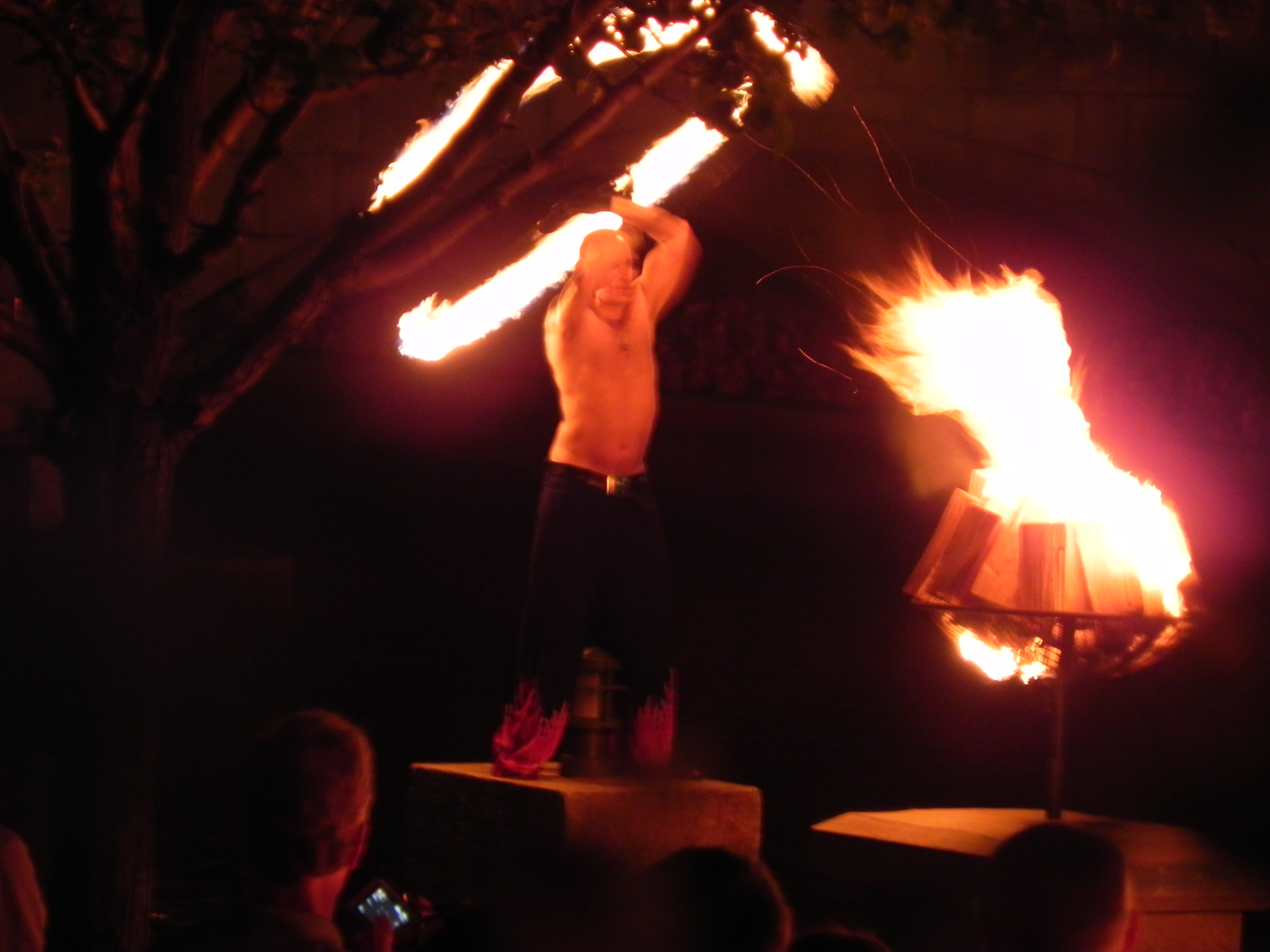
Providence is not always as assured as the divine aid its name suggests. Rhode Island’s capital, like most cities, hosts significant dualities—people who have more than an abundance and those who struggle to get by. There are also those who don’t. In an effort to revitalize the downtown, artists have created WaterFire—an organic sculpture bringing together the pre-Socratic four elements, but focusing on the two encompassed in its name. Great braziers are dot the middle of Providence’s rivers and WaterFire is a new performance art that suggests a religious underpinning. On Saturday, during Brown University’s commencement exercises, WaterFire was performed. Watching fire erupting in the iron braziers as the fire dancer twirled flaming sphere in intricate and dangerous patterns, I felt a primal sense of awe. Indeed, the fire dancer’s motions would be classified as religious by anthropologists in an unfamiliar context.

Religion is generally a response to that which we cannot control. Conscious beings like to think they have some measure of control over their destinies—indeed, people behave that way constantly. It doesn’t take much, however, to demonstrate that our sphere of control is actually miniscule and tenuous. Religions assure us that some cosmic older sibling (whether deity or force or principle) is on our side, watching our backs. Ceremonies propitiate any angry being and bring us back into the graces of elements beyond our control. Is this not the very meaning of the name Providence?

Watching the blazing bonfires tracing the contours of the river, lit by a dancer in time to moving music, WaterFire felt like more than simple performance. Fire is a powerful element, necessary and dangerous to our existence. Water too is crucial, but threatens to overwhelm us as our planet is mostly covered in it. Earth and air often seem the more comfortable elements, often inert and unconsidered. We never confront fire or water in the natural world without giving pause to consider their significance. Whether it is crossing a river or opening an umbrella, water forces itself onto our consciousness. Fire even more so. WaterFire taps into something vital and may just be the real divine guidance that Providence requires at this time.


Grounds for Sculpture

Few people would deny that religion and art share a common heritage. Some of the earliest human art was religiously motivated (I would contend that cave paintings and Paleolithic figurines were religious objects), and much of the contemporary art scene derives its inspiration from religious motifs and constructs. Not all art is religious, however, and not all religions are friendly toward art. Nevertheless, there is a tangible connection.

This weekend was uncharacteristically warm and sunny for a New Jersey March. This led us to take our visiting family to Grounds for Sculpture, one of New Jersey’s often overlooked treasures. Built on the remains of the old State Fair grounds in Hamilton, this park houses an impressive array of outdoor sculpture that is contemplative, innovative, puckishly funny, and even a little weird. It reflects the human experience. My family and I have been there multiple times, appreciating the sculpture from new angles, discovering new pieces, and seeing it all through the eyes of others.

Taste in art is highly personal and individualistic. Just like religious sensibilities. Both art and religion seek to make the human soul accessible to others through profound expression. Several of the sculptures in this unique garden bear biblical titles or suggestions, but they may be enjoyed as secular pieces of expression as well. Here is where art is superior to religion: it does not insist on any single way of expressing the truth. Sometimes, it seems, art may actually attain what religion only aspires toward.

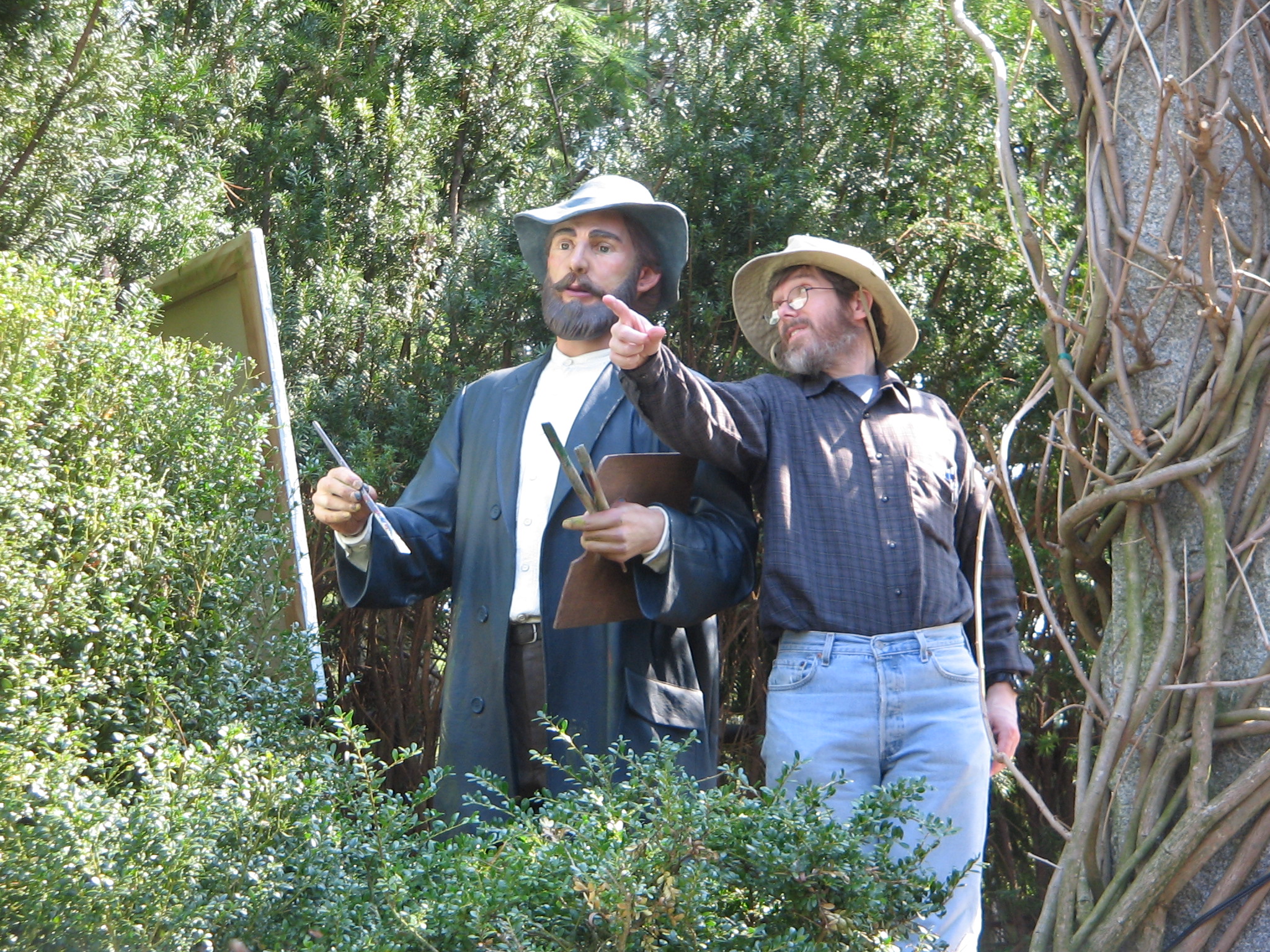
Monet listens attentively to a dilettante