Scary Television

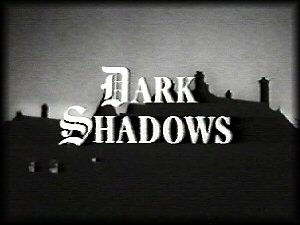
Since noting some months ago that I’d discovered Dark Shadows on Amazon Prime, it’s no surprise that I’m squeezing in an episode here and there, where I can.  Amazon begins “Season 1, Episode 1” at the point Barnabas Collins appears.  This was actually ten months into the daily, but it saves a few hundred dollars buying the DVDs.  I honestly remember little more than impressions of the soap opera from childhood.  I can’t say which episodes I saw during the initial run, but I do know that they were formative in my appreciation of horror.  It turns out that many famous people in various media were childhood fans of the show.  It certainly wasn’t the slickest production but it manages a mood that’s difficult to match.  It’s what Edgar Allan Poe called “effect,”—he felt that a short story should maintain a single effect, something that he did most notably in his macabre tales.

I recently watched, in Amazon’s numbering (and I realize Amazon didn’t come up with this, it was a rebroadcast release that someone decided should start when the show became popular) episode 22 in season one.  This particular episode surprised me in that it actually had a legitimately scary ending.  Now, soap operas are very slow unfolding of stories, as most television watchers know.  Things don’t change quickly and action-packed content requires a lot of time to set up and film, whereas daily shows simply don’t have the time to do that.  They rely on people being drawn into the story and wanting, needing, to find out what happens next.  By episode 22 the savvy viewer had already figured out that Barnabas Collins was the vampire.  Nobody had explicitly said so yet, however.

Maggie Evans, his favorite victim, has been “ill” in bed from loss of blood.  Under Barnabas’ spell, she sends away her boyfriend and Victoria Winters—the original impetus for the entire series—has come to sit with her through the stormy night.  As the two women argue about the proper care for Maggie’s condition, the storm continues, flashing lightning through the French doors in Maggie’s room.  The wind blows the doors open and a flash of lightning shows the silhouette of Barnabas standing in the garden.  I have to admit, even at my age and with my background of horror movie watching, that moment scared me.  The genius of the show is that Barnabas is such a likable character.  As the narrative develops, as it does beginning in episode 23, we come to see that Barnabas is a sad, reluctant monster.  Perhaps if I’ve time enough, I should write a book about it.  But then, I barely have a moment to squeeze in an episode now and again.


Childhood TV

It’s probably safe to say that most Americans my age were influenced by television when they were young.  Since I’m a late boomer, I fit into the “monster boomer” category and I suspect that if you gathered us all in a room you’d discover we had some of the same watching habits.  I confess to having watched a lot of TV.  I will also admit that some of it was absorbed particularly deeply.  I mean, I liked shows like Scooby-Doo, Jonny Quest, Get Smart, Gilligan’s Island, and even The Brady Bunch.  While I still quote from a couple of these from time to time, they never penetrated as deeply as a number of other early fascinations.  I saw nowhere near every episode of The Twilight Zone, but those I did see absolutely riveted me.  They still do.  As an adult I’ve read many books on or by Rod Serling.  There’s depth there.

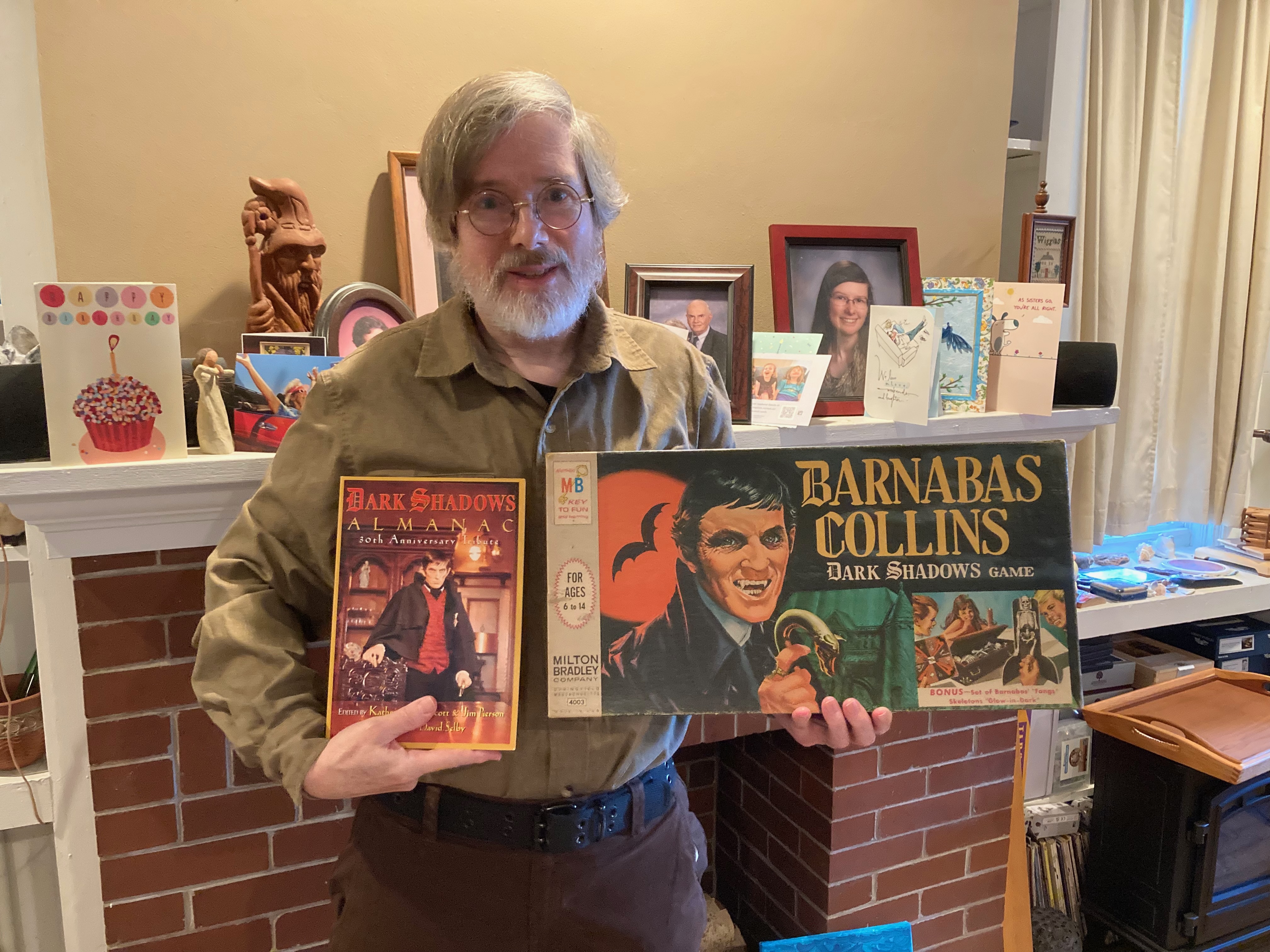
Another strong contender for real influence is Dark Shadows.  Again, I never saw all the episodes but it created in me a feeling that no other television show did.  My breath still hitches, sometimes, when I think of it.  I watched the show and I bought used copies of the novels by Marilyn Ross.  As an adult I even collected and read the entire lot of them.  And I’ve read a book or two about Dark Shadows.  And one about Dan Curtis, the creator of the series.  Recently a good friend, aware of this particular predilection, sent me the Barnabas Collins game and a copy of The Dark Shadows Almanac.  I have to admit that it was difficult to work the rest of that day!

Probably the last very influential television show—more from my tween Muppet Show era—was In Search of…  This I watched religiously, and, like Dark Shadows, I went out and bought the tie-in books by Alan Landsburg.  One thing all three of these series (Twilight Zone, Dark Shadows, and In Search of…) have in common in my life is that I purchased the accompanying books.  Those that I foolishly got rid of when I was younger I have reacquired as an adult.  Sure, there’s some nostalgia there, but these shows were more than mere entertainment.  They have helped make me who I am today (whoever that is).  I rediscovered my monster boomerhood after losing my tenuous foothold in academia and saw that other religion scholars were writing books about these somewhat dark, and deep, topics.  So I find myself with friends ready to help indulge a fantasy and a shelf full of books that many my age would be embarrassed to admit having read.  But chances are they too were influenced by television, even if they hide it better.


Dark House

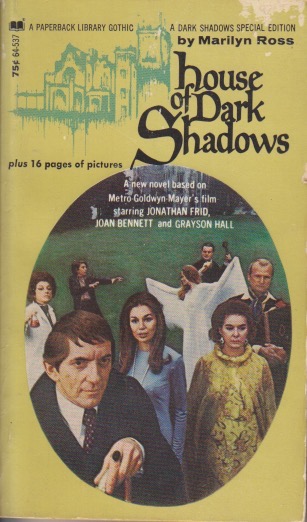
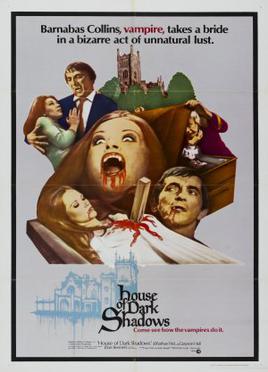
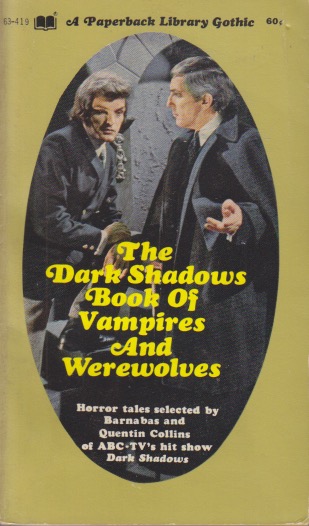
Last year I completed an odyssey that began over a decade and a half ago.  I finished reading the Dark Shadows serial novels by Marilyn Ross.  Not because they were great literature, but because they were an important part of my childhood.  Slowly, over the years, I regathered the books and read them until the whole series was done.  One of the used book sellers was offering a collection of the books, and although the collection had some duplicates of what I’d already found, it contained some of the more difficult to locate titles.  When it arrived, I found it also included House of Dark Shadows.  This novelization wasn’t part of the series, and like most things in my life, I can’t claim to know everything about Dark Shadows.  As a child I didn’t know there had been a movie, let alone a novelization.  (I bought the books as I happened to find them, at Goodwill and watched the TV show.)

In the present, I’d just finished Octavia Butler’s Parable of the Talents and felt that I needed something lighter for my next fictional project.  House of Dark Shadows proved a better read than most of the series books, perhaps because it was based on a movie script written by the screenwriters.  Marilyn Ross was actually William Edward Daniel (W. E. D.) Ross, and he wrote more than 300 novels.  His Dark Shadows oeuvre became repetitious in its dialogue, across the series.  His characters always seem to say “at once” instead of “immediately” or “right now.”  I’m pretty sure the word “mocking” appears in each of them—certainly the latter ones—multiple times.  Having the script must’ve really helped keep those trademarks to a minimum.

Of course, now that I’ve read the novelization I need to go back and watch the movie again.  It’s been almost two years and some of the details escape me.  It’s largely because the movie goes “off script” from the long-running daily show (and the other novels).  I also realized that Tim Burton’s Dark Shadows movie was really a kind of reboot of House of Dark Shadows, unfortunately screen written by Seth Grahame-Smith as a comedy.  I’m no expert on Dark Shadows, just a reasonably enthusiastic fan in search of a lost childhood.  The movie makes the premise of the series untenable—both can’t exist in the same world, so it’s kind of a Dark Shadows multiverse, rather than a simple universe.  And it’s very complex.  I’d need to start again at childhood to become an expert in it, but at least now I’ve read all the books.


Beautiful Vampire

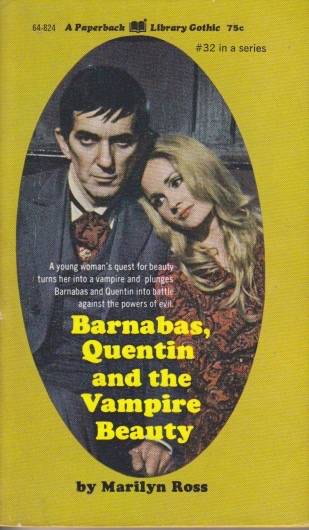
It’s been a quest years in the making.  I first found the Dark Shadows novels by Marilyn Ross at the Goodwill Store in Seneca, Pennsylvania.  The series had recently finished its television run and, as this was a used book bin, and limited in size, you could never tell what you might find.  My teenage self, fascinated by vampire lore, eagerly read those I could find.  I got rid of the volumes I had when I attended college and began to miss them when I was old enough to admit such things.  It took at least fifteen years to locate all of them, and now, for the first time in my life, I have read the entire series.  Barnabas, Quentin and the Vampire Beauty isn’t always easy to find.  I certainly hadn’t read it before.  Not that it’s high art—the campiness shows through the gothic setting from time-to-time—and yet it’s an accomplishment.

This particular story again shows some development from what had gone before.  The vampire beauty is a young woman tricked into having weight reduction surgery in Switzerland.  The surgery, naturally enough, transforms her into a vampire.  She needs help so she seeks out Barnabas Collins, which leads her to Collinwood.  From there a set of adventures head toward the typical climax of this series of books.  Nevertheless, W. E. D. Ross seems to have shown some improvement over the thirty-two novels in the series.  This story seems less similar to others in the series as a whole.  Quite a bit of effort is spent on trying to find a vampire cure, but for Adele Marriot rather that Barnabas Collins.

I have to wonder if Ross knew this would be the last Dark Shadows book he would write for the series.  He did write other gothic fiction, and even a novelization of the movie, House of Dark Shadows, but the initial series ends with a kind of knowing that we’ve reached the end of something.  Was he told by someone at Paperback Library, “Hey, we’re pulling the plug on the series” or did he simply run out of steam?  The daily television show ran for about 1225 episodes.  This original novel series had far fewer.  Still, the thrill of hunting all of them down, lining them on my shelf, and then reading them in order was a rare pleasure.  It was a recapturing of, perhaps even a completing of, part of my childhood.  It may have taken decades to accomplish, but an accomplishment is an accomplishment.


Jekyll and Jekyll

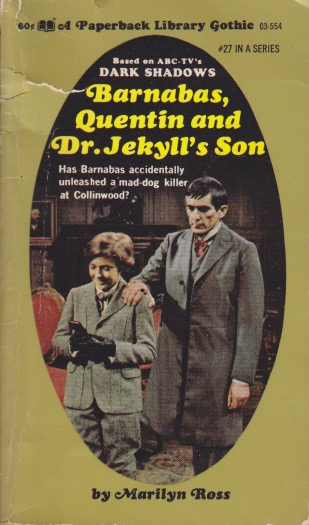
W. E. D. (“Marilyn”) Ross was a journeyman writer.  Prolific, he produced more than 300 pot-boilers, and he only started writing at mid-life, which kind of lends hope to me.  (He, however, didn’t always pay attention to literary niceties.)  I’ve made a determined effort, over the past decade or so, to collect and read all of his Dark Shadows novels.  These aren’t great literature, and I generally have to space them out to recover from them.  I just finished number 27 (of 32), Barnabas, Quentine and Dr. Jekyll’s Son.  Although I watched Dark Shadows as a child, it’s pretty clear that my cosmology of Collinwood was primarily shaped by Ross.  Living in an area without a regular bookstore, and without the cash to regularly buy books, I found what volumes I could at Goodwill and read them avidly.

Barnabas, Quentine and Dr. Jekyll’s Son is now a rather rare item on the used market.  It’s pretty clear that as Ross went on and on in the gothic fiction genre, he tried new things and these generally improved his work.  This story, set in the past, involves Dr. Jekyll’s grown son accompanying Barnabas Collins to Maine in order to escape his father’s reputation and, as a sidebar, to try to cure Barnabas of his vampire curse.  This means that one of the Collins girls, Emily in this instance, falls in love with Jekyll rather than Barnabas.  It also marks the point at which Ross tries to make it clear that both Barnabas and Quentin are good guys, but being under their own curses, they have to follow their vampire and werewolf natures, respectively.

I think I may have read this one as a child.  Although each book was stamped with its number in the series, I was dependent on when my mother decided to go to Goodwill and what they happened to have on hand in their book bin.  Some scenes from this book came back to me in the reading—although it was perhaps forty or more years ago—and one of the most important of these was one where Barnabas and Quentin collaborated on capturing the criminal.  Among the true fans of the series, they are known as the immortals (and Quentin isn’t always a werewolf), and they revisit Collinwood over the centuries.  Quentin can be both good and evil, but Barnabas is generally a sympathetic character.  Dr. Jekyll’s son isn’t such a strange guest at Collinwood, and the stories do seem to have improved over time.  It’s still Ross writing, but this one was more than a surface refinishing of a classic tale.


Shadowy House

The more you learn the more you realize just how little you know.  The House of Dark Shadows was like a key, a missing puzzle piece for me.  Dark Shadows has been on my mind quite a bit lately.  I’m the first to admit that I’m no expert.  I never saw the whole series on television—I saw many episodes once, during my childhood.  Enough to know who the characters were—especially Barnabas—but when I stopped watching it (when? Why?) I started reading the novels by Marilyn Ross.  Clearly the soap opera was gaining enough ratings to merit the building of a franchise.  But the thing was, there is so much in life that I never concentrated on it.  I read the novels occasionally, and I never saw House of Dark Shadows when it came out in 1970.  Not, in fact, until 2022.

Since I was only eight when it came out, even though it was rated PG, I would’ve had neither the means nor the money to get to a theater.  I had, in fact, never even heard of it.  Having been raised a Fundamentalist, I have a tendency to believe there is just one way a story goes.  I know there are variations—they occur in the canon of Scripture, even—but something deep-seated tells me it should go this way.  House of Dark Shadows (which explains a lot of Tim Burton’s decisions for his movie reboot) has a different story line.  Given that it was 1970 it would have been in the midst of the initial series broadcast.  The movie was quite successful.  Still, Barnabas ends up victimizing Carolyn (which in the novels he is reluctant to do), and Roger, and outright killing a number of people.

I spent the movie trying to process how the story should go.  Of course, I haven’t seen the soap opera enough to know.  This Dark Shadows franchise is episodic and it doesn’t add up.  The film was shot quickly and leaves gaps in the story.  It certainly doesn’t track well with the tale of the Maine family who knows about “cousin Barnabas”and that he visits Collinwood from time to time.  Our course, between the series and the novels there are many, many avenues to select.  When Tim Burton got the idea to make a movie he had an abundance of stories from which to choose.  The House of Dark Shadows isn’t a great movie.  It is gothic and moody and a standalone story.  And it has me wondering about what other dark shadows conceal.


Collecting the Past

Some readers, probably, react with embarrassment when I go on about Dark Shadows.  The fact is, however, that our childhoods somehow define us and mine included frequent doses of Dark Shadows after school.  This was complemented by the series of potboiler novels by William Edward Daniel Ross, writing as Marilyn Ross.  We didn’t have much money when I was a child (some things never change) and the only means I had of procuring the books in our small town was Goodwill.  The novel series ran from 1966 to 1972, roughly concurrent with the television show.  Since I was buying them second-hand I could never tell which, if any, I would find in the book bins.  If I did find any, I’d buy them.  I got rid of them when I “grew up.”

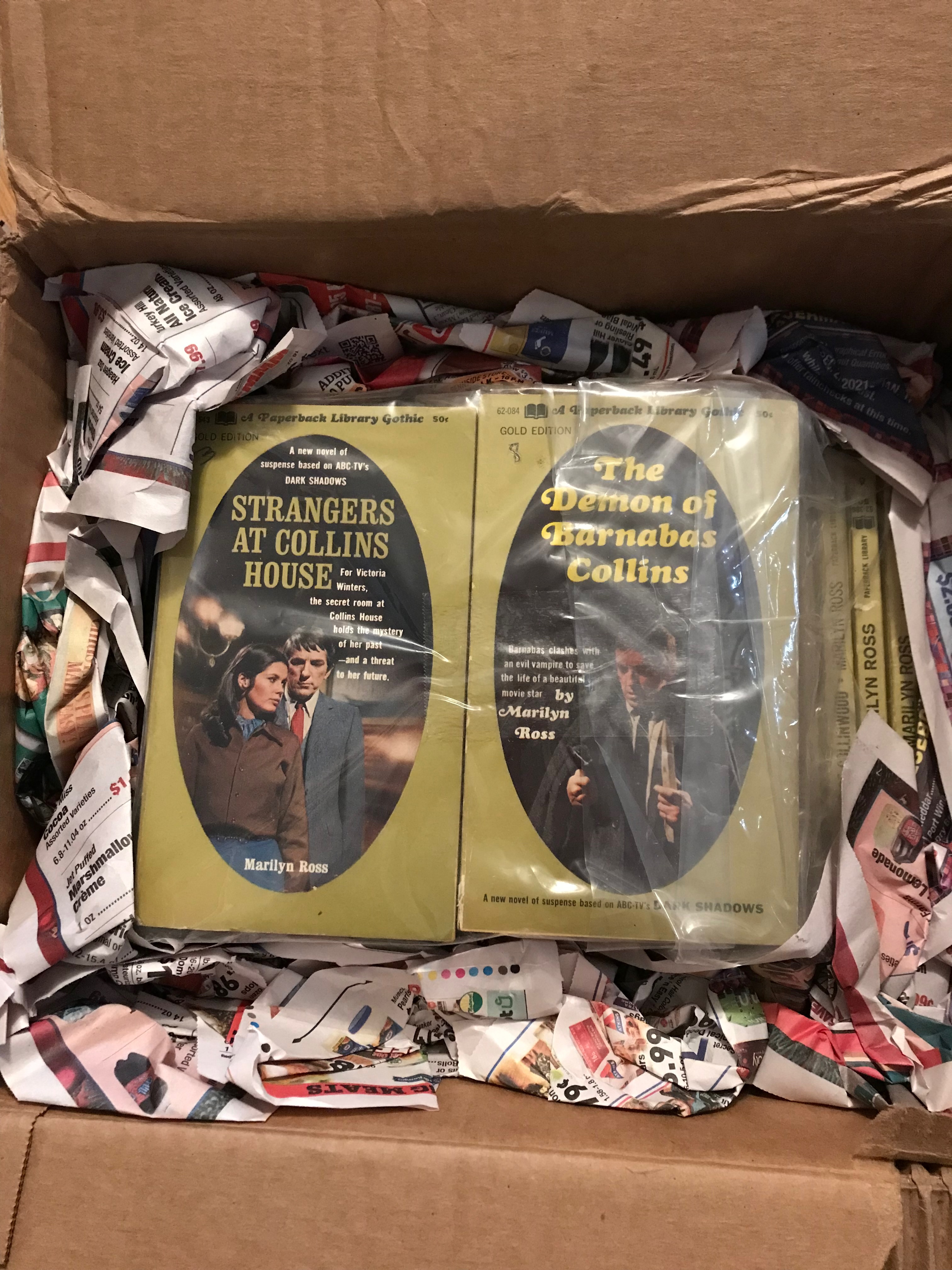
Dark Shadows, however, has come back to me at various points in my life and about a decade-and-a-half ago I began, somewhat shamefacedly, trying to rebuild that earlier collection.  The individual volumes are considerably more than the nickels and dimes I’d originally paid for them.  In fact, the rate of change has been somewhat astronomical.  Some of the volumes are rare.  Given the prices, I suspect I’m not the only nostalgia-poisoned child of the sixties and seventies who’s buying them.  There’s a sense of satisfaction that comes with having finally completed a task years in the making.  When the box containing the last volume arrived, it was a moment of private ecstasy.

All of this has me thinking about other influences Dark Shadows has had on me personally.  It is probably responsible for my lifelong love of Maine.  The television show was filmed mostly in Terrytown, New York, better known by the name given in Washington Irving’s tale, Sleepy Hollow.  I wasn’t aware of this on my visit to Terrytown—which was before the more recent television series based on, but not filmed in that location, aired.  My first publication regarding religion and horror was based on Sleepy Hollow.  There’s a sense of connectedness here.  To get the final volume, which is rare, I had to buy a collection of several of the books.  Like a man who found a pearl of great price went and sold all that he had so that he could buy the field in which the pearl was.  We’re never told what he did with the rest of the field.  If I had to venture a guess I’d say he used it to house his Dark Shadows collection.


Son of Comfort

So the other day I was reading a book proposal for another editor.  It mentioned the mononymous Barnabas.  Since the proposal wasn’t from a biblical scholar I wondered if this was the same Barnabas mentioned in Acts as the sometime traveling companion to Paul of Tarsus.  As I began to type this into the search box—and this was on my work computer, which, I hope, doesn’t know my reading habits—it autosuggested Barnabas Collins as the first choice.  One of the frustrating things about devices these days is they know who we are and sometimes we want an objective opinion from the internet.  Is Barnabas Collins as popular as I like to think he is, or is it just a case of my work computer anticipating my off-hour whims?  I sincerely hope it’s the former.

The proposal, by the way, was surprisingly referencing Paul’s Barnabas.  I wasn’t aware that he was much known outside biblical studies circles.  Probably about as rarely as Barnabas Collins is known in such circles.  There has been a resurgence of interest in Dark Shadows that has taken place in spite of, or perhaps partially because of, Tim Burton’s movie.  The film made many missteps, but people from my generation who’d never heard of him before began to reference Barnabas Collins to me.  I’ve never been a soap opera watcher.  It does seem that many college students used to go through such a phase—again, it’s the story that draws them in—but that never really happened to me.  I’d grown up watching Dark Shadows, however, and I’ve been tempted a time or two to start watching the series again.  With well over a thousand episodes, some of which are lost, it would be a major time commitment.  And besides, it wouldn’t recapture those grade-school afternoons watching what my mom thought was a waste of time.

The name Barnabas probably means something like “son of comfort.” I don’t know how the somewhat desperate writers, trying to gain back a slipping audience, came up with the name.  Their introduction of the supernatural into the daily drama did, however, transform television.  The usual demographic for the show was a bit older than me when it was being aired and I didn’t by any stretch see the entire series.  I did see enough, however, to forever frame my view of vampires.  There have been efforts, including one current, to reboot the series on television.  It may eventually rise again from its coffin. Featuring, of course, Barnabas.


Not Quite Quetzalcoatl

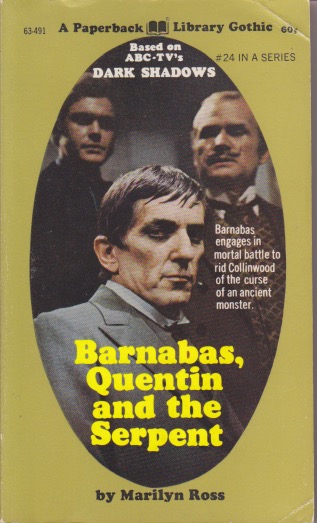
It must be difficult to write the same basic story over and over.  And nostalgic adults like me can be tough critics as we try to recapture faded childhood glories.  Those memories fade like afternoon shading into evening, but still I can’t help myself.  Marilyn Ross wrote 33 gothic tales of Dark Shadows in the spinoff series from the long-running television program, and I’m determined to read them all.  In small doses.  The one, Barnabas, Quentin and the Serpent is actually a bit distinct.  The writing is still journeyman, that of a tired potboiler author, but the plot offers something a little different.  As in the last volume reviewed, Barnabas is free from the vampire curse for a time, allowing him to emerge in the daylight.  And his arrival at Collinwood is actually dramatic and well-timed.  The story is set in the nineteenth century.

Gerald Collins, a professor of archaeology, unexpectedly inherits Collinwood along with his daughter Irma.  They head to Maine from Mexico taking exotic creatures with them, including a dimetrodon that escapes and tries to eat them.  The story revolves around rumors that the professor caught and transported back a flying serpent.  At Collinwood (and let’s think about this a minute—if you add up the body count from all the novels you’ve got to wonder why there’s been no federal investigation) people start to die and reports circulate of a flying snake.  The professor’s going to be driven out of town because angry villagers think he brought this creature back with him.  It’s all very melodramatic.

As in the last novel, Barnabas acts as a detective.  Quentin, who is the werewolf cousin, manages to allude detection by disguising himself.  Even Barnabas is fooled.  The story tries to avoid invoking the supernatural—there’s no such thing as flying serpents—while allowing a werewolf to perpetrate a hoax.  It’s all good fun (except for that body count).  There’s a bit of vim here from our weary journeyman writer, but there are nine novels yet to go in the series.  Writing a series seems to be smart money.  Children (and I first read several volumes of this series as a child) like to complete things and can be loyal series fans.  I never read the full series when I was younger; they were haphazard finds at the local Goodwill book bin.  Of course they were still being published at that time.  I have to admit that I’m curious where it will go from here.  And I do miss Barnabas as a vampire.


Mental Health

Dark Shadows was a formative part of my childhood.  I don’t recall specifics, or even how I found out about it, but I do recall watching it after school and being completely taken by it.  When I do the math I realize I had to have been watching it primarily before I was ten, and then after that I started reading the books when I found them in the used bin at the local Goodwill where they usually cost a quarter or less.  Now they’re collector’s items.  That fact doesn’t change the reality that they are journeyman writing through and through.  William Edward Daniel Ross, under the pen name Marilyn Ross, wrote thirty-three novels in the series as part of his oeuvre of over 300 books.  The stories are formulaic and feature odd word choices, but they are gothic.  Sometimes gothic is just what you need.

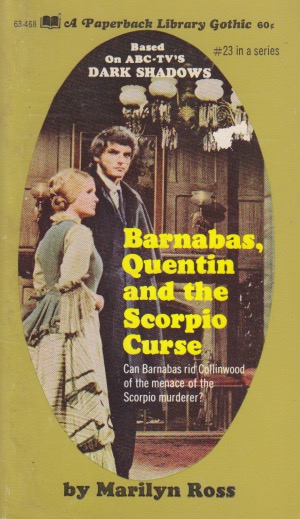
Barnabas, Quentin and the Scorpio Curse is a fun romp through a period when Barnabas has—with no explanation in the novel—overcome the vampire curse.  It introduces some Collins cousins who come to an asylum conveniently located next door to Collinwood where murder breaks out and mayhem ensues.  I have to keep reminding myself to put my critical faculties aside when I read these guilty pleasures.  There are gaps and incredulities that are simply glossed over, and that’s part of the world in which they take place.  Astrology plays a part in this episode, as the title indicates.  It features a psychologist who, it would seem, doesn’t know how to do background checks.

The truly scary part of this Scooby-Doo tale is that the protagonists, Diana and Barnabas Collins, aren’t believed because they’re voluntarily admitted to the asylum.  Mental illness is a serious matter, of course, and it can be difficult to diagnose.  The difficulty here is that it’s used simply to dismiss what Diana observes.  Time and again, as the Scorpio murders continue she’s dismissed as “a mental patient.”  It’s all part of a plot, of course.  It does raise serious issues, though.  In the late sixties and early seventies there was a real stigma attached to mental illness.  There still is, in fact.  Ironically, the more we learn about mental disorders the more common they become.  Just about everyone has some neurosis or worse.  In our efforts to define the “normal” we dismiss those with actually diagnosed conditions.  We’ve come a long way since then, but we still need to work at dispelling the stigma.  One way to do it is, I suppose, to put conflicted vampires into the mix.


Patina

When reading three books by the same author, most of the time, it seems, it’s good to spread them out.  For the past few years my wife and I would visit an independent bookstore in January to pick up a few books for the year’s looming reading challenges.  We slipped behind this year and I happen to have three unread Marilyn Ross books at home.  Barnabas, Quentin and the Haunted Cave was the second of them.  Since, unbelievably, I didn’t have books to fit into the other categories, I read my second Dark Shadows book of the season shortly after the first.  It is a revealing experience to come back to a childhood influence as an adult.  I’m pretty sure I hadn’t read this one as a child, and as much as I like Barnabas Collins, this particular story was somewhat tedious.  And that’s saying something, considering how formulaic the series is.

One of the reasons I found it slow going—especially for a book of less than 200 pages—was that Ross relied too much on dreams to move the plot along.  I read quite a bit of fiction and I always find writing about dreams tricky.  Even within the diegesis of the story you don’t know whether to believe what’s going on in dreams or not.  Just as in real life, dreams are a break from the tedium of consciousness and they permit the mind to wander.  The dreamer can go anywhere, do anything.  Generally without consequence.  You awake back in the more continuous narrative of your life and the dream is forgotten.  In fiction, which is largely made up, dreams often act as filler.  Given the number of times Ross repeated himself in this particular book, it seems that he had to pad the story out quite a bit.  It would’ve worked just fine without the dreams.  Might’ve fallen short of contracted length, though.

It also continues the conceit of Quentin as a Satanist.  I have to confess that the original series was so long ago I don’t remember much about it.  The theremin music of the opening, with the waves crashing against the cliffs of Maine, yes.  Barnabas, tortured but not evil vampire, yes.  Much beyond  that, no.  I’ve had friends discover Dark Shadows as adults.  I watched it on commercial television during its first run and I haven’t seen it since.  I certainly don’t have time for soap operas in days crowded with other demands.  Still, these little books can take me back to a dusty corner of childhood that has a pleasant patina over it.  But it is best to keep such experiences separated a bit in time.


Collinsport

Nothing is ever wasted.  That’s my economy of the soul.  I spent my tween years mooning about Maine.  I’d grown up watching Dark Shadows after school and I’d begun reading the pulp fiction based on the series by Marilyn Ross.  My mother wondered how I could waste my time on vampire nonsense when there was sun shining outside and other kids to play with.  Little did she know that I was learning valuable lessons for the future.  My fascination with Maine—still intact—led me to vacation there whenever possible and over my career I’d applied to more than one or two jobs there based primarily on the potential reward of living in the same state as Collinwood and its spooky mansion  atop the cliffs overlooking the stormy Atlantic.  Once some friends in Norwalk, Connecticut took us to see the  Lockwood–Mathews Mansion, used for Collinwood in the movie House of Dark Shadows.   Such is the draw of childhood imagination.

What were these lessons I’ve mentioned?  Well, Collinwood stands outside the quaint fishing village of Collinsport.  Both are named after the family that houses some very dark secrets, as well as shadows.  Barnabas Collins is a vampire.  He has run-ins with many supernatural creatures, including ghosts, witches, and a few Scooby-Doo kinds of cases where someone’s faking the paranormal.  But Barnabas isn’t the only monstrous Collins.  His cousin Quentin, whom I kind of remembered being his ally, was an unstable werewolf.   Of course, I’m not sure there is such  a thing as a stable werewolf, but still.  Those in the family stay loyal, despite the beasts that lurk within their walls.  Some of the early Collinses were involved in the slave trade.

The Collins family has a long association with the state of Maine.  During the groovy 1970s they seemed somewhat progressive while maintaining the aloofness of the aristocracy they’d become.  Despite Tim Burton’s spin on it, they were the undisputed lords of Collinsport.  You felt you could trust them.  Unelected though they were, they possessed an innate sense of social responsibility.  I also learned as a child that, as appealing and tortured as they might be, you could never really trust a Collins.  Barnabas was not evil, but he was a vampire.  He required blood to survive, and his victims, like those of the current Collins of Maine, Susan, were female.  Any girl who trusted a Collins was in danger, unless she was their willing servant.  I was not squandering my childhood afternoons.  I was learning lessons about trust and its costs.


A Few of My Favorite Monsters

It was a guilty pleasure read.  We’d just moved and I needed a new novel for bed-time reading.  Most of our undamaged books were still boxed up and, well, enough excuses: I like Dark Shadows novels.  Hardly well written, these pulp potboilers are like extended, Gothic Scooby-Doo episodes.  I first started finding them used at Goodwill when I was a kid and I’ve re-collected a number of them as an adult.  Although they feature a vampire, and sometimes a werewolf and witch, the crisis of the story generally devolves to a hoax at Collinwood.  So it was with Barnabas, Quentin and the Avenging Ghost.  I hadn’t thought to write a blog post about it until I came across a passage mentioning Rocain.  In context, one of the characters explains how Rocain, the son of Seth, shows that sorcery goes all the way back to Genesis.

Genesis was one of my lines of research during my academic career, although I never published anything I was working on.  I didn’t, however, recall having read about Rocain.  The internet quickly pointed me to Legends of Old Testament Characters by Sabine Baring-Gould, chapter 8.  Clearly this was where Marilyn Ross, or his source, got his information.  Baring-Gould sits on my shelf as the author of The Book of Were-Wolves.  He also wrote the hymn “Onward, Christian Soldiers.”  There was an era, overlapping with Baring-Gould’s lifetime, when a minister could be an independent scholar of repute.  Although much that’s found in his many publications is now disputed, his was a lively and lifelong curiosity that led to several books.  

Upon reflection, Sabine Baring-Gould, who was a priest fascinated by occult topics, would have fit quite well into the Dark Shadows diegesis.  Although set in the late 1960s into the mod ‘70s when the television show aired, these were Victorian vignettes of a conflicted vampire and his strange, wealthy, and somewhat clueless family.  All kinds of guests, some of them quite Lovecraftian, drop into the Maine mansion and its grounds.  The writing of the novels is tepid at best, but the series was surprisingly literate.  Dark Shadows is nevertheless undergoing a kind of revival these days, and friends sometimes tell me they’ve just discovered this oddly compelling world.  I invite them in.  I’ve unpacked a few more boxes since selecting this pulp novel, and one of them, I note, holds books by Sabine Baring-Gould.  The guilty pleasure read?


Joban Vampires

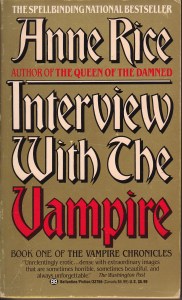
Interview VampireThe first vampire novel I ever read, I remember correctly, was one of the Dark Shadows series written by Marilyn Ross. I don’t recall which one, since I had to buy my books from Goodwill or some such vender utilized by the poor. Now, I’m really a squeamish guy and the sight of blood bothers me. Barnabas Collins, however, was a compelling character—deeply conflicted and a reluctant vampire. The combination of his sadness and the setting in coastal Maine kept me looking for Dark Shadows books every time we went shopping. It surprised me, given all that, that I had such difficulty getting into Anne Rice’s Interview with the Vampire. I started reading it years ago (it was also a second-hand copy, and, interestingly, the color scheme of the cover nearly matched Dark Shadows novels) and some eighty pages in put it down only to forget about it. Starting from the beginning a few weeks ago, I gave it another try. Although Louis is a conflicted vampire, the pace is languid and it was almost as if the self-pity was overdone. I was determined this time, however, to see it through.

One of the recurring themes of the book, and I presume the Vampire Chronicles series, is that vampires are not evil because of the Devil. In fact, there is nothing Satanic about them. Blame tends to fall on God for their state. The more I thought about it, the more the theodicy of the vampire began to resemble that of Job. Like Job, death for a vampire takes a long time. There is much suffering along the way. Louis can love, in a measure, and can loath himself. He never really understands what it is to be a vampire. The other undead he meets help to define him, but he can’t get too close. His life is a kind of Hell without Satan.

Rice’s vampires don’t fear crucifixes or shun churches. In fact, Louis takes a priest as one of his victims, sacramentally near an altar in a church. Religious imagery and discussion abound in the book. It truly is a vampire theodicy. Perhaps, for its day, it was the next step in vampire evolution. Bram Stoker, while the most famous contributor to the modern vampire myth, didn’t corner the market on defining the undead. When Louis meets vampires of the old world, they are mindless, plodding killing machines that even other vampires avoid. Rice’s vampires feel, think, and yes, theologize. I feel strangely satisfied now that I’ve finally finished the Interview. It was a vampire at my bedside for so long that it feels like an accomplishment to have finally laid it to rest.


Modern Vampires

VampiresTodaySometimes I feel guilty. A grown man reading about vampires? Then I think of such puerile things as television and the stock market over which other adults waste their time and my pituitary gland releases endorphins and I carry on. I must say, however, after reading Joseph Laycock’s Vampires Today: The Truth about Modern Vampirism, that I’m not a vampire. Nor have I ever wanted to be. I am fascinated by the idea, however. The more I read—as is the case with most good academic books—the more I questioned definitions. Laycock does a good deal of that questioning himself in this book, and I came away wondering what indeed defines a vampire? As a child it seemed pretty clear. The vampire was a blood-sucker who came out at night. Fangs, a thirst for blood, and a faded aristocracy seemed to be the essential characteristics. But I was only a child.

Before you get the wrong idea about Laycock’s book, I need to say that his is a serious study of modern day vampires. Yes, they exist. No, they’re not easy to define. As an academically trained scholar of religion, Laycock is keenly aware that self-definition is crucial to categorization. Religious believers self-identify. We have no way of categorizing an adult (and some would say no way at all of children) without their own affirmation of what they believe. Vampires Today, however, raises the pointy question of whether those who self-identify as vampires constitute a religion. Or if vampire communities may be considered religious groups. In case you’re confused: many people identify themselves as vampires—sanguinarian and/or psychic. They believe they require the life energy of others to live and prevent illness. They sometimes drink blood—with permission—or siphon the life force of other people. Like all adults, they should be treated as self-identified. Probably not, as Laycock carefully spells out, a religion.

As in his other books, Laycock takes seriously groups that would, based on numbers alone, be considered fringe. Nevertheless, these groups are a part—sometimes an influential part—of larger society. We live in a world where we’re authoritatively told there is nothing but matter and energy, and as biological beings our purpose is reproductive success and then death. Is it any wonder that vampires and others are seeking something more? I’m no vampire. I read the occasional, thoroughly pulp, Dark Shadows novel to recapture a little of that after-school wonder I felt watching the waves pounding on the Maine cliffs while Barnabas Collins lurked inside. And he bore a strange truth that was perhaps instilled in those young years. Age is only partially a biological matter. Defining it any other way is, I have to believe, immature. So I read about vampires and wonder.