Books and Mormons

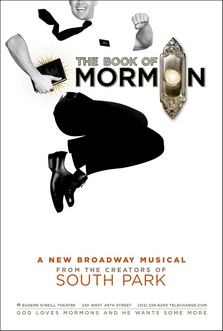
Some time ago we went to see Book of Mormon on tour.  I really knew very little about it other than it was consistently praised as being very funny.  I’m always a little concerned about poking fun at anyone else’s religion because I know people take their beliefs very seriously.  As I reflect on the show (which was quite funny) it seems that it wasn’t so much poking fun at the Latter-day Saints so much as it was poking fun at religion itself.  That’s less problematic as it’s not singling anyone out for ridicule.  It’s a system that’s being made light of.  Or at least any religion that is an effort to convert others.  There’s a kind of violence to it.  And if Book of Mormon is about anything, it’s about missionaries.  Amid the laughs it makes some valid points—trying to convert people without first trying to understand their culture is a fraught activity.

People want religious specialists who thoroughly understand their tradition.  I can say from experience, both as an erstwhile seminary student and a seminary professor, that the time given to become an expert is insufficient.  The older I’ve grown the wider the perspective I’ve tried to step back to see.  To be an expert on a religion really requires some facility with understanding other religions.  To understand, say, Methodism, you need to understand Anglicanism.  To understand Anglicanism, you need to understand Catholicism.  To understand Catholicism, you need to understand early Christianities.  To understand early Christianities, you need to understand Judaism.  And so the widening concentric circles go.  Nobody can be an expert in all of them, and each of these religions mentioned has, in its own right, sub-specializations that have their own experts.  Who has time to learn the religion of those they intend to convert?

Any religion that makes supernatural claims (and many of them do; it’s their nature) makes extraordinary allegations.  Those allegations, when examined closely, reveal some improbable elements.  Trey Parker and Matt Stone, two of the authors (most famous for South Park) apparently said that they had no intention of making fun of anyone’s religion and a spokesperson for the Latter-day Saints indicated that no real offense was taken, acknowledging that it’s parody and parody is only offensive if it’s taken seriously.  Many religions have thin skin when it comes to parody or satire.  The serious part is that some religions, in real life, take conversion of all others with a zeal that could (and does) become dangerous.  Still, this musical is very funny, as long as it’s not taken too seriously.


Who Owns It?

Who owns the Bible?  No, you can put your hands down.  I mean who owns the concept of the Bible?  This question occurred to me while thinking about the Apocrypha.  Does the Apocrypha belong or does it not?  This became a polarizing issue with the Reformation and subsequent Protestant ownership of the concept of the Bible.  The Apocrypha was mostly written by Jews, but has never been part of the Hebrew Bible.  The process of narrowing down the books to include wasn’t straightforward and since God hasn’t spoken on the topic, has never really been settled.  The books of the Apocrypha circulated with the Bible, as did a few other books.  Sometimes they were even bound together inside one cover with the standard Protestant 66 books.  Obviously I’m discussing the Christian canon here.

I’m sure you’ve known someone this has happened to, if it hasn’t happened to you personally.  This person is an actual expert on a topic.  S/he goes to a place where an unexpected discussion on their specialization breaks out but nobody asks them to speak to it.  This person then becomes offended, sometimes even speaking out, loudly, that this is their area, they have expert knowledge of it and should be consulted, at the very least.  More likely than not, their opinion should be considered definitive.  This is the image I have in my head with Protestants and the Bible.  Sure, the Catholics had it long before, but they didn’t encourage individual study.  In fact, they discouraged laity from reading it.  Only when they, the Protestants, came along did anyone really pay attention to the Bible, and, it must be admitted, they do have a point.  All the Bible study that goes on today, no matter what faith tradition (if any) would not have happened without the extreme Protestant reverence for the Good Book.

But still, there are other branches of Christianity that disagree.  There are more Catholics than any single sect of Protestants.  And a great many Orthodox Christians as well.  Some of the latter include the books of 1 Enoch and Jubilees in their Bibles.  Even so, any publisher that wishes to make inroads on selling the Bible must defer to the Protestant canon.  This is the case even though the King James Bible included the Apocrypha.  So as I ponder who it is that owns the image of the Bible, my mind keeps coming back to the same place.  Those who make the loudest, and most prolonged claim are the Protestants.  They own the Bible, in the public eye.


Angles on Angels

Angels and I go back a long ways.  They were mentally part of my childhood, as I suspect is true for many.  When I reached upper-level undergraduate work, I did an independent study on angels with a professor who didn’t provide much guidance.  About the only thing I recall from that class was reading Billy Graham’s book on angels.  Not exactly an academic authority.  In these times of modern Thomas Aquinases, plenty of scholars look at angels from various angles.  I suspect the task of writing a Very Short Introduction on them was taxing.  Although the word count was about 10,000 higher, I had trouble reining myself in on The Wicker Man.  There was so much more to say!  Of course, many academics are preferring shorter books these days.  In any case, angels.

After a brief history of angels, attempting to define them, considering the main ones individually, then looking at the collective as a hierarchy and according to various roles—messengers, guardians, warriors, David Albert Jones then looks at fallen angels.  Having written on this myself in the tragically overpriced Nightmares with the Bible, I found Jones’ approach here to be of interest.  Throughout Jones tries to give equal time to Judaism, Christianity, and Islam.  All three traditions have angels, but Muslims approach demons very differently.  Djinn aren’t fallen angels.  But then it’s time to move on to the conclusion.  Brief books like this are good for making a reader hungry.  Some decades after angels had a resurgence in pop culture, academics arose to explore them.

I enjoy getting a different perspective, or angle, on angels.  It’s so easy to assume that our parents taught us correctly about the layout of the spiritual world.  Culturally, unquestioning acceptance is rewarded (it’s clear that even demons know that).  But looking closely at things, even if just for a brief time, offers a chance to learn something new.  Personally I learned new things about Dionysius the Areopagite, Joan of Arc, and Hells Angels.  I also couldn’t help but think that such a little book written by anybody else would’ve had different nuggets included.  That’s one of the problems with picking up a short book on whose subject you’ve already done quite a bit of reading.  I do it for information, but beyond that, for finding new angles.  I can’t imagine ever learning everything there could possibly be to know about angels.  And we go back a long way.


Non-Saints

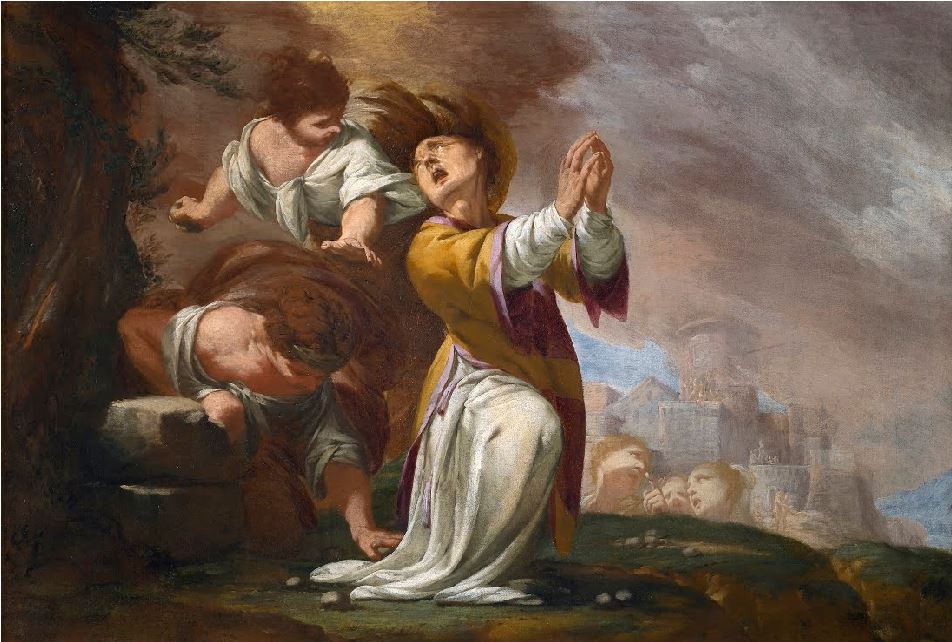
It was an epiphany.  My wife has, on more than one occasion, accused me of playing the martyr.  I know very well that I let other people step all over me.  The epiphany came when I was reading about Stephen’s martyrdom in the Acts of the Apostles (in the New Testament).  Unbidden by me, a memory—more of a distinct impression, a deeply planted feeling—arose.  I started reading the Bible at a young age.  The story of Stephen is disturbing to a child.  The thought of being stoned to death for saying what you believe is a species of horror.  The memory, or impression, was of my mother pointing out how good it would be to be like Stephen.  He is not technically my namesake, but since there were no male role models in my family, I subconsciously made the connection: Stephen the martyr, Steve the martyr.

Giovanni Battista Lucini – Martyrdom of St. Stephen, public domain. Source: https://artsandculture.google.com/asset/martyrdom-of-st-stephen/twGNCf3waLKDvA via Wikimedia Commons

It’s strange to realize this suddenly after half a century of not consciously recollecting it.  What we teach our children stays with them.  If we tell them that it’s good to die for your beliefs, well, we shouldn’t be surprised when they grow up with strong convictions.  (My brother tells me that Virgos think they’re always right and that’s why we’re stubborn; is it the stars or is it the Good Book?)  The Bible puts a positive spin on Stephen’s death.  Formal sainthood isn’t a biblical concept, but he dies forgiving his murderers.  It struck me there in the middle of a working day.  Some of my subconscious personality traits floated to the surface.

My deep desire to avoid Hell also formed my young outlook.  Although my beliefs have to be held accountable to what I’ve learned over decades of study, that fear never departs.  This too was planted in me before I had any real concept to absorb it.  When I grew old enough, the horror became academic, but nonetheless real for it.  I’d studied the history of Hell and I knew New Testament secrets.  To avoid the bad place, be like Stephen.  The dilemma is that as life goes on, we continue to learn.  Young parents don’t know as much as old ones do.  And since we have to teach our children not to run out into the street, or not eat that thing they found, we cast ourselves as The authority.  And that includes things religious.  If we live an examined life, we see shades of nuance where once there was only certainty.  And sometimes we have epiphanies.


End of the Story

You know that feeling?  Like when you’re driving in thick fog and you know you should stop but you’re late and you have to keep going?  There comes a moment as you’re driving when you know that it’s going to end, and probably badly.  Yet you keep on going.  Trump has me thinking of the end of the world quite a bit.  I know there are many evangelicals out there praying for it fervently while the rest of us would like a little more time on this beautiful planet.  I’d be lying if I said I didn’t understand this outlook, because I do.  I grew up with it and I’ve never forgotten the sensation it caused.  And then I pondered that we are story-telling, and story-thinking creatures.  Perhaps other animals don’t think this way, but we constantly tell ourselves stories.

A story has a beginning, a middle, and well, eventually, an end.  We all know, at some level, that we’re mortal.  Life will end, and every completed story has an end.  Why not the world?  It’s a strangely haunting idea, the world continuing on without us here to make it interesting.  Plants will grow in any soil they can find, even microscopic cracks in the pavement.  Every year it’s like one day everything is suddenly green where only the day before we could see the sky through the branches.  And animals continue their quests for food, mates, and shelter.  Some live to hide while others strut.  Each has a role to play and if you watch them closely you’ll find yourself narrating their stories.  That rabbit.  That bluejay.  That fox.  They have a beginning, middle, and end.  If they can’t tell it, we can do it for them.  It comes naturally to us.

Long ago I learned how one version of Bible interpretation came up with the end of the world as we know it.  I also learned that this was contrived, just as all interpretations are.  This particular one has landed, like a seed, in the cracks of our mind.  It grows, just like that weed in the pavement.  This story must have an end.  We can imagine it no other way.  Even when we grow up and realize that the story was only one we told to children—children old enough to handle it, of course—we still have this certainty that an end is coming.  Like driving in the fog, we just know it.  Even when we realize that in reality we should be putting on the brakes.


Who’s Counting?

While joking around recently with my daughter, I started counting to ten in Spanish.  I’ve never studied the language, but I can stumble through academic articles in it with a dictionary.  In a senior moment I forgot that “ten” was “diez.”  We had a laugh about it and got back to life.  The next day while doing my sit-ups, I was counting in German, as is my habit.  (The push-ups get counted in English, thank you.)  It struck me that “dreizehn” is where the “teens” start, and I wondered if this was because of some base-six counting.  I decided to check Spanish to see if the pattern holds.  Those of you who know Spanish know that it doesn’t.   In English, which follows German, our teens begin at “thirt” (third).  

Numbers have always fascinated me.  Math not so much.  While I find the base-ten system natural, there is something to be said for base-six.  I’m not sure if that’s where German “zwölfe” comes from, but it does give us our “twelve.”  But those teens are always difficult, aren’t they?  In human life we hit sexual maturity with all of its complications.  Do we project those onto our numbers?  Do other animals do the same?  We now know that some animals have at least the concept of absolute numbers down.  Some birds know exactly how many eggs are in their nests, and bees know what “zero” means.  Their lives tend to be shorter than ours.  Do their ideas of numbers reflect that?

As human beings we know that that good old base-ten number 100 is kind of a life goal.  We know that 100 is “old age,” but we know that it isn’t exactly unusual for a person to live that long.  Of course “ninety” is compatible with either base-six or base-ten, and is a more reasonable goal.  Numbers are used for marking.  They’re so basic to our everyday life that, unless you’re a mathematician, accountant, or scientist, we hardly think about them at all.  Civilization began, however, with gods and numbers.  Kings wanted to know how many people they controlled (some things never change).  In the Bible God punishes David for trying to find out.  There’s even a book called Numbers.  The Mesopotamians used a base-six system that gave us the 360-degree circle.  We still use it even though a 1000-degree circle would give us much greater precision.  I could muse about numbers and counting systems all day, but it’s time to go do some sit-ups, in German.


Naming Names

I recently saw a story suggesting that Elon Musk was named after the leader of a Martian colony in an unpublished novel written by none other than Wernher von Braun.  Now, I don’t know if this is true or not, but it did get me to thinking about names.  The awesome responsibility that parents have in naming their kids.  I suppose many people don’t think much of it, but I remember asking, at a young age, why I was named “Steve.”  (There’s no “n” at the end, despite what people throughout my life have tried to “correct.”)  An old belief suggests that children might emulate those they’re named after.  Of course, some of us just can’t let things go.  Nobody else in my family was named “Steve,” and being very Protestant, I wasn’t named after no saint.  (Besides, he was Stephen.)

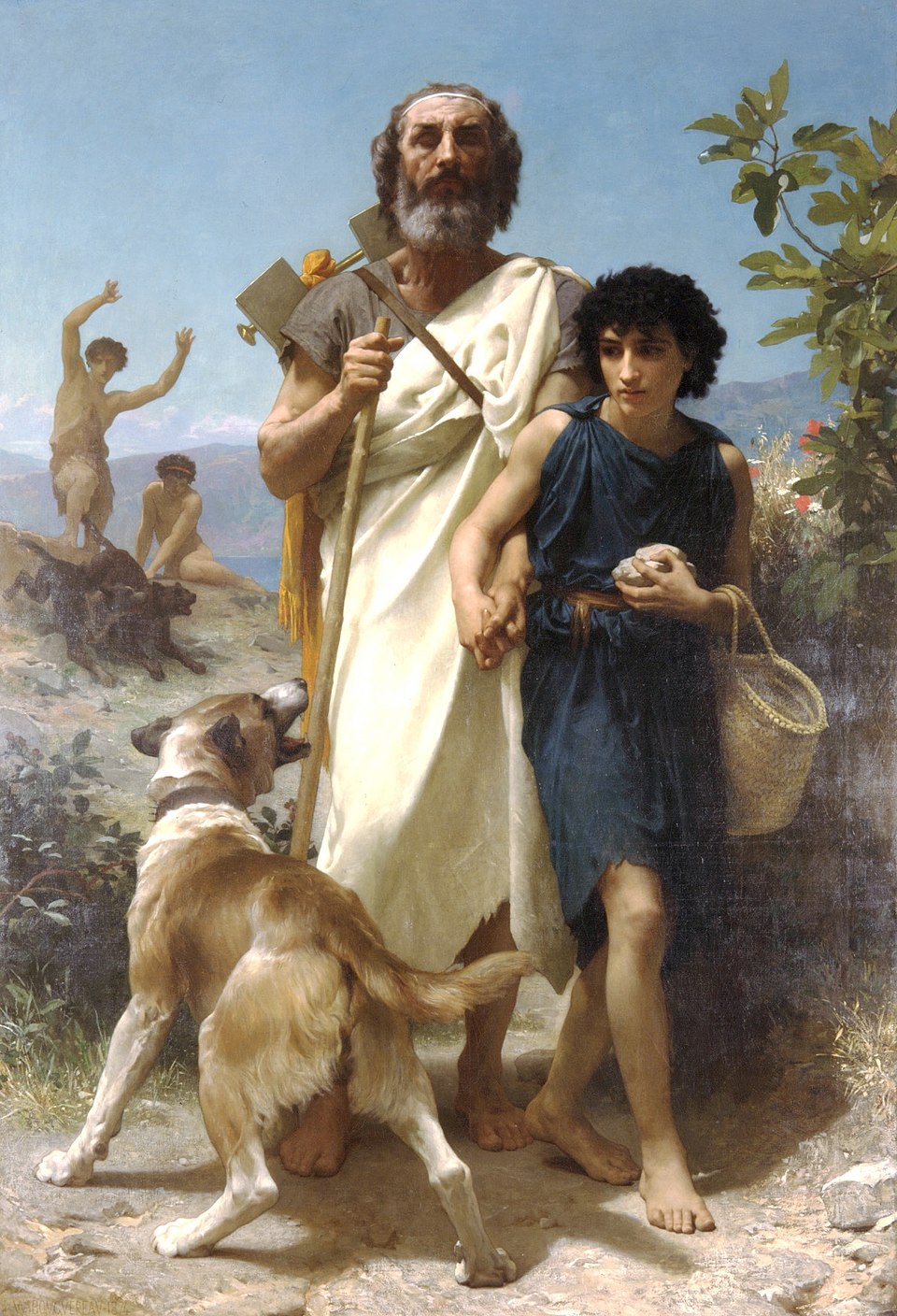
My mom told me a couple of things.  First of all, she wanted to name me after her father, Homer.  As an adult I think it might’ve been worth the childhood beatings I’d have to have taken, but my father vetoed it.  “Steve” was taken from a character in a Dick Tracy cartoon.  Mom liked the sound of it and my father didn’t object.  I’ve never read Dick Tracy—I’m not much of one for newspapers in general—but I did see that Warren Beatty movie back when it came out.  Once I tried to find a character named Steve in the cartoon line-up and I did find that there was a criminal by that name at one point.  Mom never told me this and I only found it as an adult, after I’d already decided against a life of crime.  But still, names sometimes inspire behaviors.  Influence choices.  Don’t they?

Homer and His Guide: Image credit: William-Adolphe Bouguereau, public domain, via Wikimedia Commons

Children named after their parents sometimes follow in their footsteps.  Or those named after a great person in history use that in their internal monologue as they try to attain similar things.  Now, I haven’t researched this—I’m just guessing here.  But for many years it was unusual to find a German boy named Adolf.  There are also names that are retired for someone being, say, the son of God.  Mom swore it was wrong to name a boy “Jesus,” even in admiration.  She didn’t know that the Anglicized Hebrew name was actually “Joshua,” common then as it is today.  Homer was a pagan, and I wondered how my great-grandparents came up with that name.  The best I can figure is that they were from upstate New York and there’s a town called Homer in Cortland County.  And I wonder if he ever asked his parents why he was named that way.


A Christmas Parable

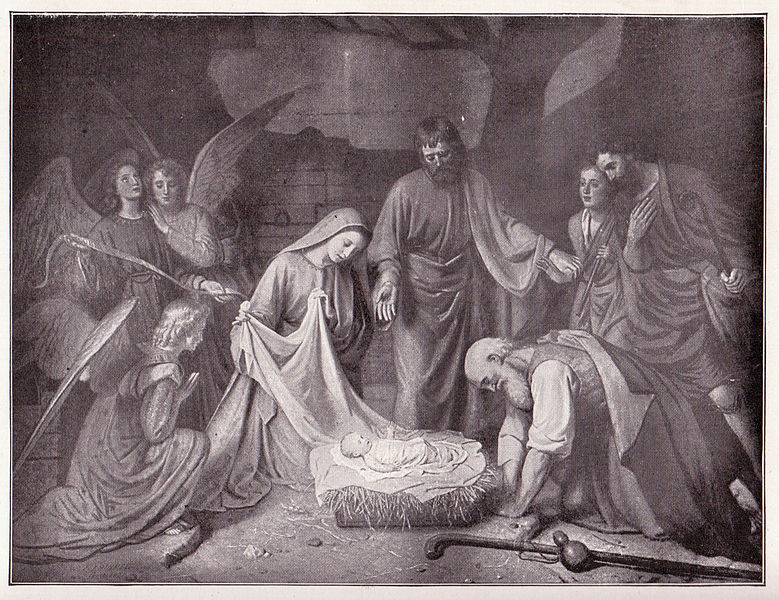
And it came to pass in those days, that there went out a decree from Donald Trump that all the world should be taxed.  2 (And this taxing was first made when American troops were pulled from Syria.)  3 And all were to be taxed, every one to help build a wall.

4 And Joseph had just bought a house in Nazareth, but had to go into the IRS office, unto the city of record, which is called Bethlehem; (because he was of the county of Northhampton:)  5 To be taxed with Mary his espoused wife, being great with child but no insurance.  6 And so it was, that, while they were there, the days were accomplished that she should be delivered at St. Luke’s. 7 And she brought forth her firstborn son, and wrapped him in swaddling clothes, and laid him under a bridge; because there was no housing for them in Bethlehem.

8 And there were in the same country soldiers abiding in their bases, keeping watch over their radar by night.  9 And, lo, drones appeared before them, and the glory of aliens shone round about them: and they were sore afraid.  10 And the ETI said unto them, Fear not: for, behold, I bring you good tidings of great joy, which shall be to all people.  11 For unto you is born this day in the city of Bethlehem a Democrat, which is the Prince of Peace.  12 And this shall be a sign unto you; Ye shall find the babe wrapped in swaddling clothes, lying under a bridge in Bethlehem. 13 And suddenly there was with the UFO a multitude of the heavenly host praising democracy, and saying,  14 Glory to the American ideal in the highest, and on earth peace, good will toward women and men.

15 And it came to pass, as the drones were gone away from them into heaven, the soldiers said one to another, Let us now go even unto Bethlehem, and see this thing which is come to pass, which the ETI hath made known unto us.  16 And they came with haste, and found Mary, and Joseph, and the babe lying under a bridge.  17 And when they had seen it, they made known abroad the saying which was told them concerning this child.  18 And all they that heard it wondered at those things which were told them by the soldiers.  19 But Mary kept all these things, and pondered them in her heart.

20 And the soldiers returned, glorifying and praising democracy for all the things that they had heard and seen, as it was told unto them.

Image credit: The Harmsworth Monthly Pictorial Magazine, Volume 1 1898-9; public domain via Wikimedia Commons

Firebrands

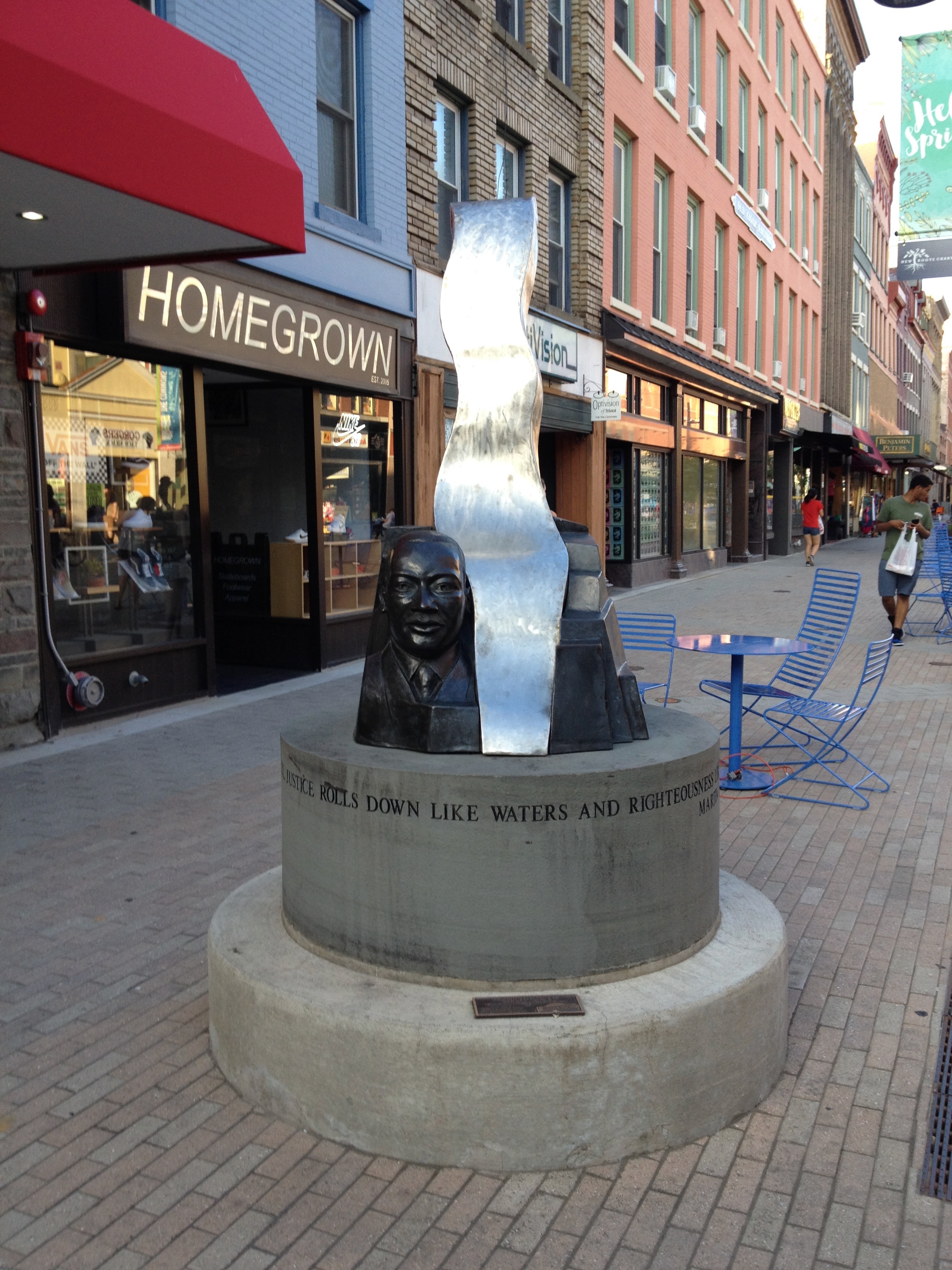
Although I’ve never lived there, I believe I have a fairly good idea of life in Ithaca, New York.  I’ve spent many, many days there over the past few years, often pondering how it is a city that would be an especially good fit for me, despite the fact I’m unhireable at Cornell and Ithaca College has never showed any interest.  It’s a liberal college town where even the street people appear to be educated.  The money of Ivy League students keeps it fresh and evolving.  And the shops in Ithaca Commons are set at eleven.  So it was that a headline in Publishers Weekly some months back caught my eye.  (I’m not behind only on movies, it seems.)  It showed a historical plaque for Firebrand Books, on the Commons.  The story stated that the plaque had to be placed on public land since the owner of the building where Firebrand started has a Christian prejudice against homosexuality.

I suppose I ought to take a step back and give a little history.  Firebrand was established as a feminist and lesbian publisher.  Its offices were on Ithaca Commons, but when the founder, Nancy K. Bereano, retired the press eventually found a buyer in Ann Arbor, Michigan.  (I have also lived in Ann Arbor, but for less than a year.  Likewise, it is the kind of place I felt instantly at home.)  Ithaca, meanwhile, wished to honor its contribution to literature and elected to put up a commemorative plaque.  The objection, however, was based on a particular reading of the Good Book.  (It must be stated that lesbianism is never explicitly forbidden in the Bible.)  To make a statement, the owner forced the plaque to the public domain.

We have a way of letting our prejudices become biblical.  I recently re-read 1 Corinthians—one of the infamous “clobber” texts for any number of people—and realized just how many of the words assumed to refer to “homosexuals” are words of uncertain Greek connotation.  King James, who seems to have preferred the company of gentlemen himself, was apparently not bothered by the text he had translated.  Of course, kings will be kings.  Our concern with sexual behavior is one of the hallmarks of our species.  We’re very concerned about how other people do it, even if it’s no business of ours.  And we consider it one of the highest moral concerns and a source of constant shame.  That was another thing that struck me while re-reading 1 Corinthians.  I wondered why Paul keeps coming back to it.  Maybe he was just being a firebrand.


Word Undefined

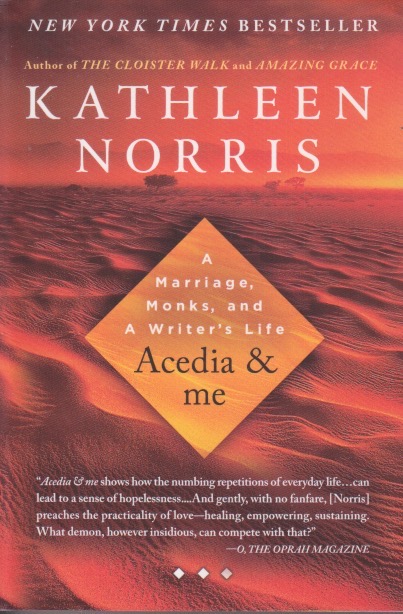
It’s one of those amorphous, uncommon words that can be devilishly difficult to define.  It’s also a churchy word.  “Acedia” was considered both a sin and a demon by various monastics, although the basic idea is listlessness.  Kathleen Norris has made her mark as a spiritual writer, and my wife and I have read a few of her books.  Dakota, her first non-fiction, was stunning.  We just finished Acedia and Me: A Marriage, Monks, and a Writer’s Life.  It revolves around this concept of acedia and for a writer to admit it, it seems, takes courage.  But the question that remains unresolved for me is whether it really exists.  It seems that acedia was devised by monks to name their ennui with monastic existence.  When all you do is pray there comes a time when you just don’t want to.  Or can’t.  They called it acedia.

There is a rich vocabulary for such states, reminding me of The Dictionary of Obscure Sorrows as well as the Existentialist literature I grew up reading.  I think of Kafka.  Of Kierkegaard.  Of angst.  Of boredom.  More to the point in Norris’ case, writer’s block.  This is a terribly personal book for her.  She describes the death of her husband and coping with widowhood.  And on top of it all, that dreaded block of inspiration that is a plague upon writers.  Interestingly enough, the book took me back to my Nashotah House days.  Norris, as do many monks, appreciates the slow reading of the Psalms.  One of the points of contention at Nashotah House—I kid you not—was how long to pause between the halves of the verses in the Psalter.  But is this a demon or only human nature?

“The noontime demon” was another common term for acedia.  This connects it to yet another of its aspects: depression.  We tend to think of depression as a clinical problem, but Norris explores the possibility that it’s a spiritual problem.  Some claim acedia as a sin, as I’ve noted, which shoves it back on the experiencer.  Norris has some interesting definitions of sin in her exploration.  Tellingly, in an appendix she presents the Webster’s Dictionary (1913) words related to acedia and there are over 100 of them.  And these words range from lust to world-weariness.  Is the word too promiscuous to be really useful?  For a writer like Norris, influenced by monastic practice, a poet by trade, and yet a writer of New York Times bestsellers, she makes the word fit.  There’s much to ponder here.


From God’s Mouth

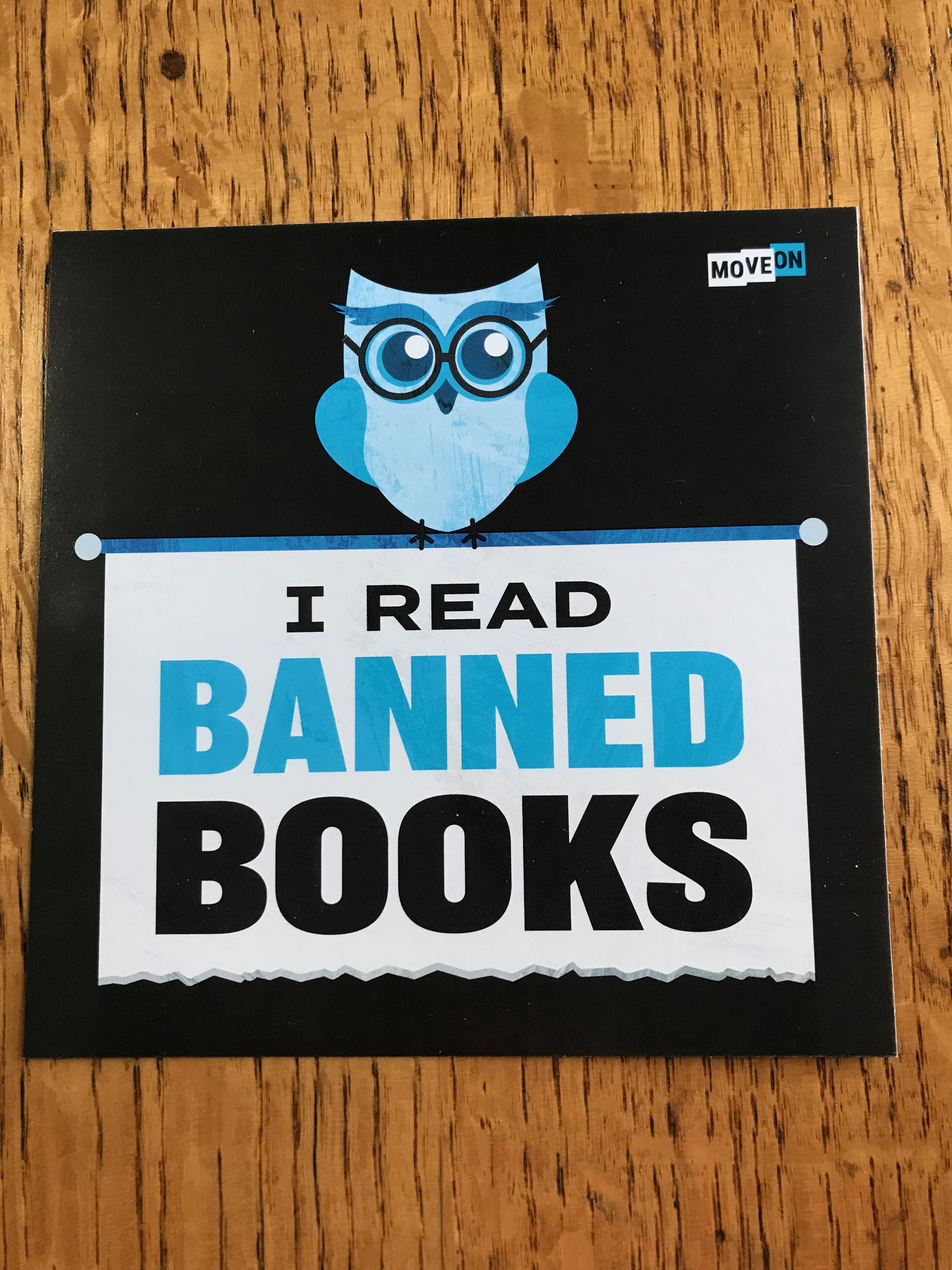
If book banners would actually read the book they claim to protect, the Bible, they would run across the account of Jehoiakim and Jeremiah.  It’s in Jeremiah 36, if you care to follow along.  Jeremiah was not a popular prophet.  In fact, he was often in trouble for speaking what God told him to say.  He wasn’t wearing a “Make Israel Great Again” cap.  In fact, his message was that the kingdom of Judah had to fall in order to be restored.  So in chapter 36 he dictates his message, straight from God, to Baruch, his secretary.  Baruch reads the words in the temple and this comes to the notice of the royal staff.  They arrange for a private reading and it scares them like a good horror novel.  One of them reads the scroll to the king, Jehoiakim, who cuts off a few columns at a time and burns them in the fire.

My favorite part of this story has always been the coda: “Then took Jeremiah another roll, and gave it to Baruch the scribe, the son of Neriah; who wrote therein from the mouth of Jeremiah all the words of the book which Jehoiakim king of Judah had burned in the fire: and there were added besides unto them many like words.”  Many like words.  So we have book banners around the nation trying to stop children from reading.  The hope is they will become unreading adults because reading expands your mind.  Jehoiakim was a book banner—a book burner, in fact.  But the response from God himself is to write the whole thing over and add many similar words.  

The Bible has been, and still is, fairly constantly abused.  What it seems to be is unread, at least by those who use it to stop other books from being read.  I came to believe, while majoring in religion in a conservative college, that if literalism was truly from God there would be no way to stop it.  I took a route unlike my classmates, who tended to go to the most conservative seminary they could find to have their minds further closed.  I figured that if it was true then testing it by reason couldn’t hurt it.  It’s pretty obvious the way that turned out.  I don’t stand with book banners.  This is Banned Book Week.  Read a banned book.  Stand up to those who do the banning.  And if you need something to convince them that their tactics don’t meet with divine approval, point them to Jeremiah 36.


Dictionary Dreams

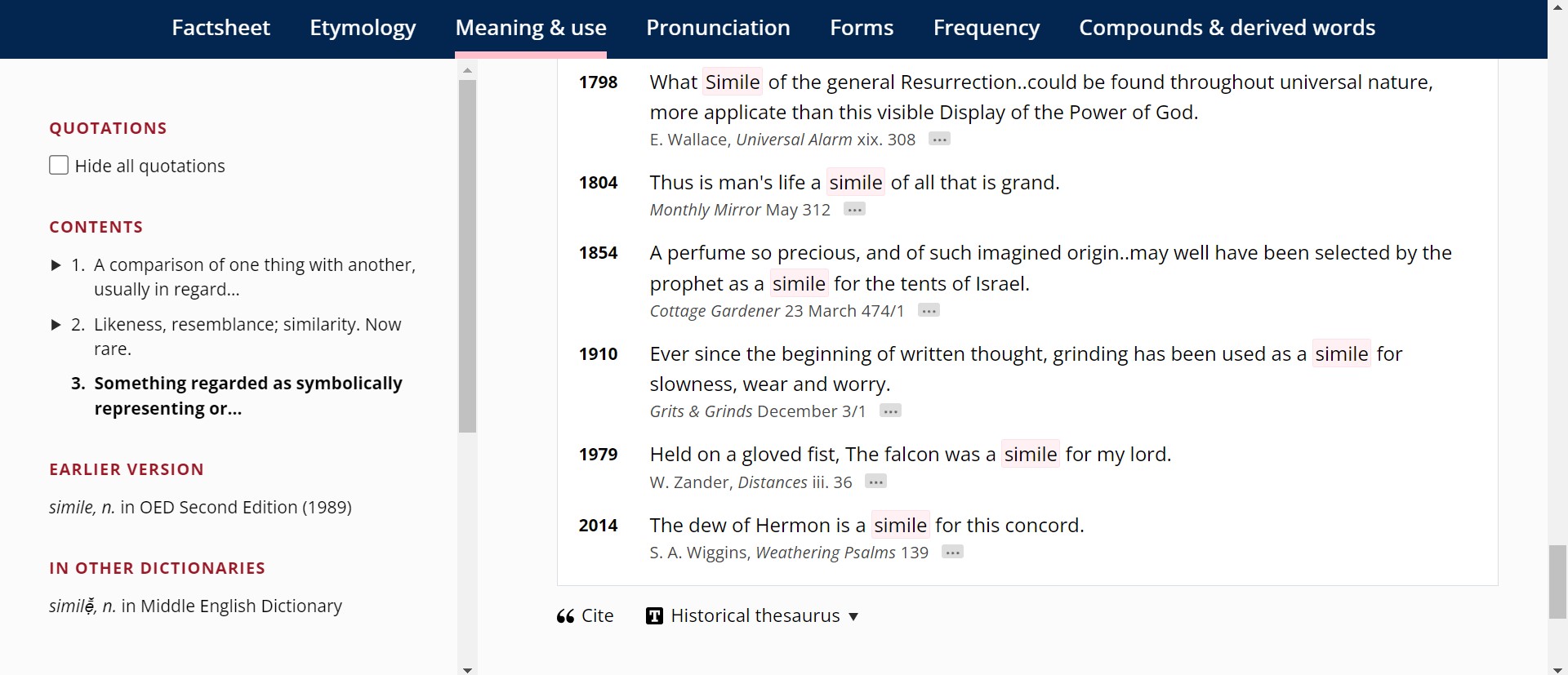
“Lord, now lettest thou thy servant depart in peace.”  Thus begins the venerated Nunc dimittis, familiar from so many years of chanting evensong at Nashotah House.  It comes to mind when I’ve reached a milestone I never dreamed of attaining.  One that makes me feel as if I’ve accomplished my life’s work.  Strangely, it didn’t occur when my name ended up in a study Bible’s front matter.  But a friend recently sent me a note that immediately brought old Simeon’s words to mind.  I have been cited in the Oxford English Dictionary.  My book Weathering the Psalms is quoted (in the web version) under “simile.”  I have no idea how examples are selected for the OED.  It used to be scraps of paper sent in by astute readers, but I suspect things have changed.  How my obscure book ended up there, I haven’t a clue.

There’s an irony here as well.  Like most academics clueless about publication, I initially proposed Weathering the Psalms to Oxford University Press, assuming they published such things.  It was turned down on the basis of a reviewer—one or two I know not—that I later met at a social function, where he was clearly embarrassed.  I really just wonder how the OED found the book to cite in the first place.  In terms of copies sold, it has been my most successful book, but that’s not saying much.  As far as I can tell, it’s only sold less than 400 copies (the royalty statements don’t have the total and I haven’t received a check in years).  I guess all things in the world are connected, whether we notice it or not.

Those who know me personally are aware that validation is a huge thing for me.  I suspect that is true of most people who grew up in difficult circumstances and who managed—and this is never a certain thing—to pull themselves out.  Having been fired from my long-term teaching post (where I was working on this book) only made me want to prove myself more, I guess.  Insignificant things like getting a Choice review for one of my books (which continues to sell poorly) and having that behemoth of a dictionary notice that I used a fairly common word in a fairly common way do tend to release the endorphins.  It’s like maybe someone noticed that I’ve passed this way.  Maybe there was a reason for trying to capture the Wisconsin thunderstorms in a book about the Psalms.  Maybe there’s a reason each working day there concluded with the Nunc dimittis.


Free Word

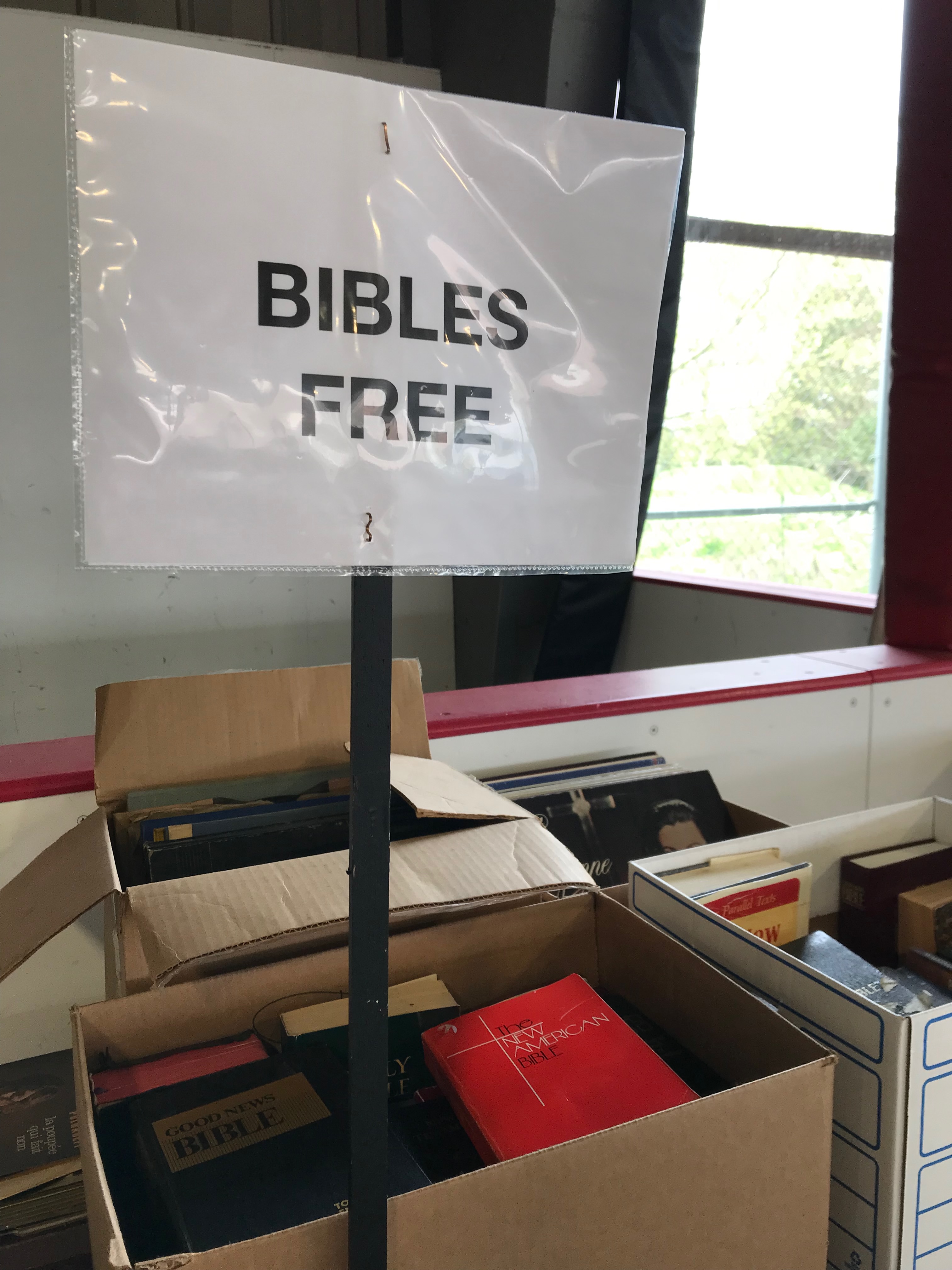
“Anything free is worth saving up for.”  That’s a line from one of my favorite movies of all time.   Free, though, can mean many things.  The “free cookie” is something good to entice you to buy more.  It often works.  Free, for a person, indicates the ability to do what we want (within the constraints of capitalism, of course).  But “free” can often mean cheap, overly abundant.  I like to decorate our lawn with rocks, which are often free, but if you want decorative rocks you’ve got to pay for even the ground beneath your feet.  So it is that when I attend book sales I marvel about the fact that Bibles are nearly always free.  It occurred to me again when I attended a spring book sale a few months back.  I always look through what’s on offer—call it an occupational hazard.

I used to attend the Friends of the Hunterdon County Library book sale in New Jersey.  I believe it is the largest I ever visited.  I used to get there early opening day to stand in line.  One year, one of the volunteer friends came out and announced that they had a really old Bible (only 1800s) that would be $100.  People do, however, tend to donate Bibles to book sales in great numbers.  I suspect organizers are reluctant to put Bibles in the trash.  They also know that people aren’t going to shell out money for them, so they try to give them away.  What does this say about being free?  Is it desirable to be so abundant that you’re left on that table in the back while everyone else is leaning over the more exciting items on offer?  There’s perhaps a message here.

Of course, Trump is selling Bibles for $60.  That’s a bit steep, even for an academic Bible (which his is not).  It might be suggested that this $60 is cheaper than free.  Now, I work with Bibles that are sold at a profit.  One thing I’ve learned is that Bibles sold are always for profit. Those who are honest admit what they do with the lucre.  Although he’s tried to keep it under cover, the Trump Bible does funnel profits to the GOP hopeful.  Yes, he is making money off the Bible and wants to be elected.  If that happens, freedom will disappear.  He’s said as much at his rallies.  Looks like stormy weather to me.  There are organizations that give away Bibles.  Somebody, however, pays for them.  In this strange experiment of a country, anything free is worth pondering.  Nothing, it seems, comes with no strings attached.


Bible Lives

How well do we know our parents?  Occasionally I think about the things I’ve never told my daughter.  This was brought home to me when, looking through a box hurried packed after my mother’s funeral, I came across an artifact.  I should say that my mother died going on a year ago, and the emotions had been a bit too raw to look at the things I’d picked up in a moment of grief.  This particular artifact was one of her Bibles.  Mom never had as many Bibles as I do (or did).  I remember distinctly asking for, as my sole Christmas present, the New International Version when it came out in 1978.  I have no idea how I knew about it (pre-internet) but I was pretty tapped into evangelicalism then.  I still have that Bible.  I also have the Bible my grandmother gave me in 1970, when, at the age of eight, I was, as it is termed, “saved.”

What makes my mother’s Bible an artifact, to me, is the information inscribed on the various dedication pages.  The Bible was my mother’s sixteenth birthday gift.  That made me stop and think.  Mom used to tell me about being a rebellious youth (she did not get along with her mother).  She smoked and drank and eventually married someone her parents disapproved of.  She gave up smoking when she was pregnant and gave up drinking when she saw what it was doing to her alcoholic husband.  I wonder what my mother’s rebellious years were like.  My entire life she was just “Mom.”  As stable as she could be, religious as she needed to be, and as selfless as a saint.

How did she feel as a sixteen-year-old receiving a Bible as a birthday present?  I never got to ask her that, but she saved the Bible and even did a DIY recovering of it with shelf-paper when the faux leather cover began to come apart.  It was a King James Version, and I knew from conversations with her that she preferred The Living Bible because it was easier for her to read (she never finished high school).  Ours were lives defined by the Good Book.  I don’t know the story of what prompted that sixteenth birthday gift.  I was sixteen when I begged for the NIV.  Now I work surrounded by Bibles.  And I’m no closer to knowing what it was that my mother really wanted when she turned sixteen.  I do know, however, that it eventually defined my life.


Spirit Storm

Some time ago, we experienced quite a windstorm.  More than wind, there was a dump of rain, thunder, hail, and all that.  My wife and I were attending a Tibetan singing bowls sound-bath with some others in the cancer support community.  I’ve described this practice before, here.  In any case, the meditation is held in a large room with a tin roof—the kind of place you don’t want to be during a tornado.  We’d just got inside when the gust front hit and knocked out the power.  The instructor still went through the meditation, but the storm sounds blended with those of the singing bowls.  Afterwards my wife asked about Job.  Specifically, God speaking from the whirlwind.  I told her that was God on a bad day, but I understood what she was getting at—there’s a spirituality to the weather.  (I was going to suggest Elijah instead, but “but the Lord was not in the wind.”  Alas.

I thought of Weathering the Psalms.  My contribution to biblical studies, had I been allowed to remain in academia, would’ve been further explorations of weather terminology in the Bible.  But the Lord was not in the wind.  I wrote that book because I noticed the juxtaposition of severe weather with daily chapel at Nashotah House.  We were required to attend, no matter what the weather.  (Such is life on a fully residential campus.)  We were reciting the Psalms one day when a storm blew the power out.  It may have happened more than once, since we’re getting on past two decades hence my memory’s a touch imprecise on the point.  In any case, the spirituality of the power of the storm fascinated me.

It still does.  The next morning, out for my jog, I marveled at the number of branches down.  Thousands in the Lehigh Valley were without power.  This is probably why the ancients considered the storm god chief of the rest.  The violence of nature is something that suggests divinity.  Other primates have been observed screeching back at the sky during thunderstorms.  It’s deep in our DNA.  That doesn’t make it any less spiritual.  There’s a lot of weather in the Bible.  I only explored a tiny piece of it by trying to tackle the Psalms.  The Good Book, however, doesn’t say much about the spirituality of weather.  It’s there nevertheless.  Anything that can snap a tree a foot in diameter like a toothpick has a spiritual message for us.  I mused on the way home—we had to take a detour because of downed trees—that had the storm claimed us as victims, dying while meditating is probably not the worst way to go.  Now I wonder, what might God’s nice words from the whirlwind be?