God and King

Bible01

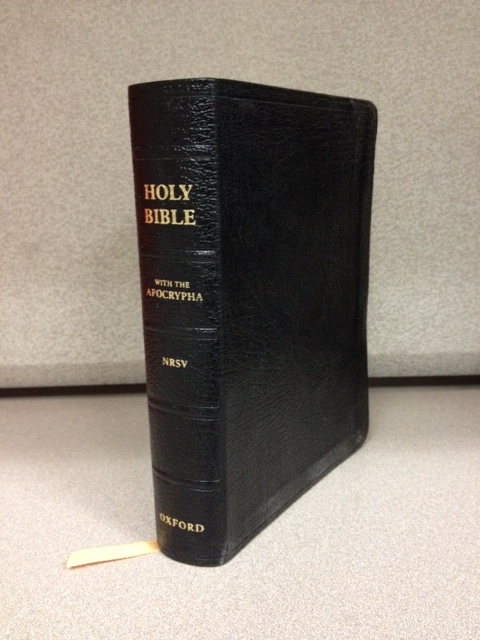
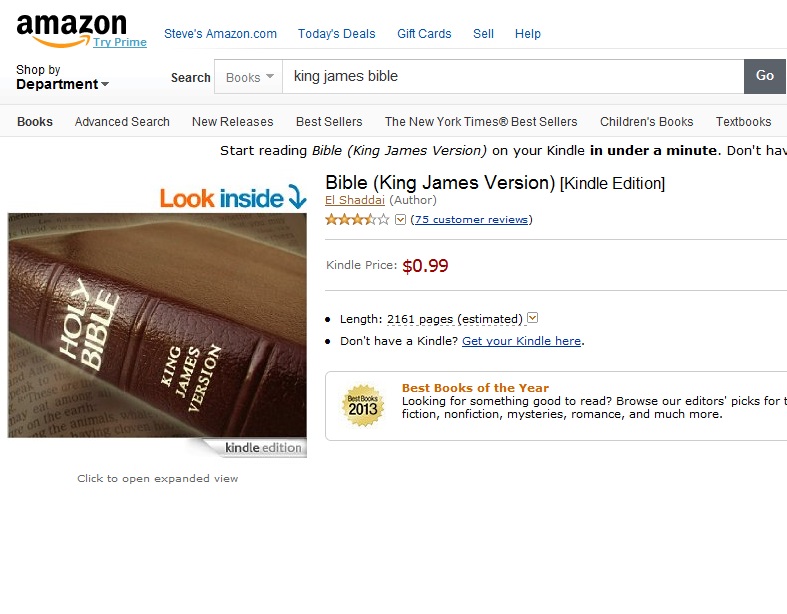
The King James Version of the Bible is in the public domain. (Except in Britain, where it is still royal prerogative to print the King James, and it has be licensed to Oxford and Cambridge University Presses.) In any case, that means that just about anywhere in the world, anyone can take the text of the King James, reproduce it, and sell it. In this day of electronic books, that means many King James Bibles are available online, as well as in print. Just look on Amazon. The other day, I was looking for King James editions when I noted a dilemma. When you’re listing your Bible on Amazon, who do you cite as the author? Seems pretty bold to list yourself as the either author or editor of the KJV, so there have appeared a number of improbable authors of late. The first one I noticed listed the author as El Shaddai. Either an Amy Grant fan or an educated reader, this editor chose the phrase generally translated as “God Almighty” as the author. A good, strong name. It may derive from the phrase “god of the mountains,” or a bit more racily, “god of the breasts.” El Shaddai was likely a pre-biblical god that eventually got merged with Yahweh.
Bible02

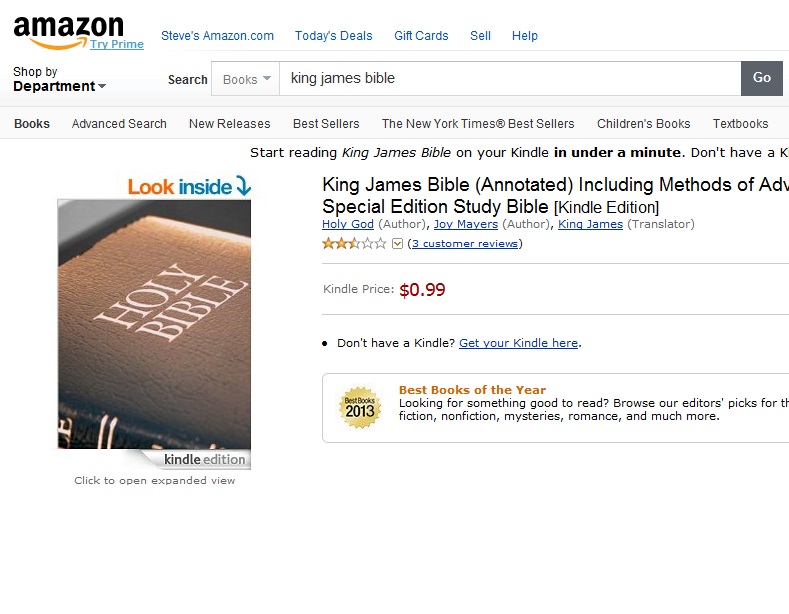
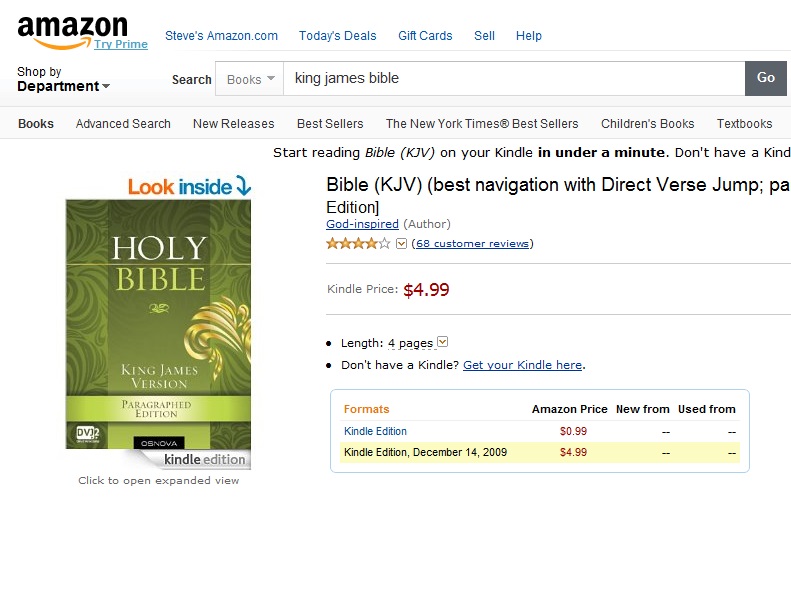
The second version (which looks the same to my untrained eye) lists a trinity of authors: Holy God, King James, and Joy Mayers. What a triumvirate! I’m not sure who Joy Mayers is, but I would certainly blush in the presence of gods and kings. Particularly Holy God. Interestingly, this is not exactly a biblical title for the deity. We do get the encomium “holy” applied to God, but I’m not sure that it ever appears as a name. Well, at least we can look up King James and Joy Mayers. The next edition I found listed the author as the safely hedged “God-inspired” (hyphen and all). The problem is that God-inspired might be taken a couple of ways. One, and likely the intended way, is to see the author, whomever it may have been, as divinely inspired. Another option, and one which sounds more exciting to me, is to think of a coffee-fueled deity scribbling away under the heat of inspiration. The inspired god, writing under a nom de plume, gave us the King James (if that was his real name).
Bible03

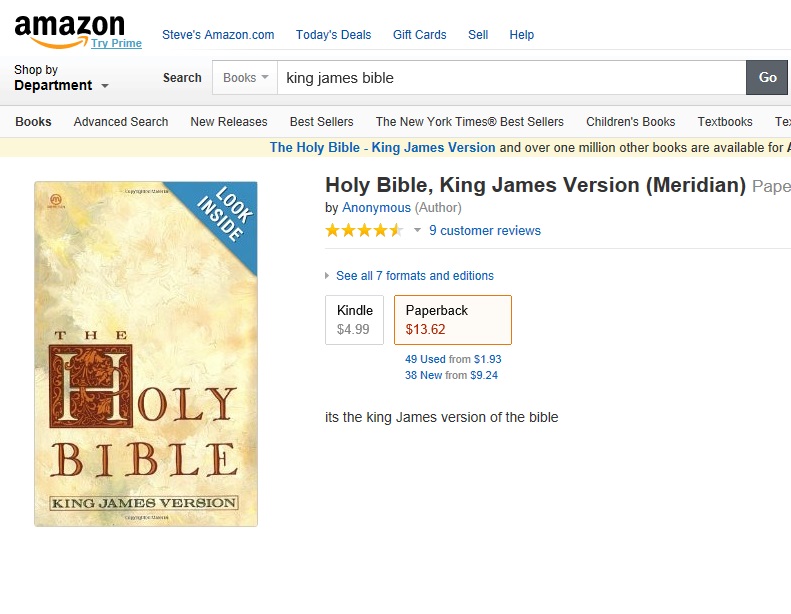
The last one I found was the most parsimonious. The author was listed as Anonymous. This comes the closest to the historical truth of the matter. We know very little about the writers of the Bible. Probably the best attested is Paul, along with his companion Pseudo-Paul. We know this historical person wrote a number of letters. There’s little reason to doubt that people named Matthew, Mark, Luke, and John wrote some gospels. Who these people are, we don’t rightly know. Once we get back to the Hebrew Bible we find authors writing about their own deaths, and events that take place thereafter with embarrassing frequency. It could be that people saw further back then, not having to strain their eyes at a computer daily. Of course, if it weren’t for computers, we couldn’t sell our own Bibles on Amazon. I’m just waiting until I learn the actual author’s name before I post mine for sale.

Bible04


Snow Job

Snow does not get mentioned very often in the Psalms. Sometimes it surprises people unfamiliar with Israel that the Bible mentions snow at all. It does, and snow does fall once in a while on the higher elevations of the hills of the Levant. This year has been a memorable one for snow in the New York City area. Generally speaking, the coastal cities of the northeast are not known for their snow. This year, however, global warming is flexing its muscles as erratic weather brings storm after storm to the region. Interestingly, an internet rumor of a thirty-inch snowstorm (supposed to have come earlier this week) demonstrates just how gullible we’ve become. If it’s on the internet it must be true.

A story in the New Jersey Star-Ledger traces how the rumor began, starting with an experimental weather model by a credentialed meteorologist, which, in the keyboards of novices, grew to biblical proportions. Fact checking is something we just don’t bother with any more. The facile understanding of “global warming” as tropics for everyone shows that. The internet makes information—true or false—available at nearly the speed of light anywhere on the globe. Except where the power is out, perhaps due to weather. Not only does knowledge spread quickly, ignorance is just as fast. People weary of snow are perhaps more open to suggestion than others. We don’t hear our Minnesota or Wisconsin friends complaining (at least not too much).

There was a time when the standard sources of authority determined what we would believe. We didn’t accept just anybody’s word for it just because they had a Facebook account. For all the debunking that we hear about, it is easier to preach than to practice. Don’t get me wrong, sledging to work through piles of snow is not fun and the old circulation isn’t as vital as it used to be, so I have to add more layers than is practical to keep warm. But I’m not expecting palm trees and rain forests in Manhattan any time soon. Nor am I expecting a three-foot dump of snow. I know better than to trust what I read on the internet. After all, they even let me post things on it every day. Talk about your theoretical blizzard…

DSCN0099


Which Bible?

No doubt the Bible holds a privileged place in western civilization. Arguably, it is the most influential book that exists in terms of its cultural influence in this hemisphere. Not that the Bible has had an easy ride of late. Many are vocal about its shortcomings, notably its violence and steadfast consistency with its own social mores of patriarchalism and election. Unfortunately these critiques sometimes (often) discourage people from reading it. (It is a very big book.) Having spent a good deal of my career dealing with the Bible, however, it is like a friend. Most friends have a habit or two that drive you to the brink of madness, but still, you know and trust them and tend to see the good rather than the flaws. The Bible is a holy book with warts. I cringe when I read parts of it. I’m not quite ready to let it go yet, however.

One reflection of this ambivalence I see often is that scholars (among others) have now taken to spelling the Bible without a capital letter: the bible. Perhaps it is the latent editor in me, or perhaps it is the Chicago Manual of Style that hangs like Damocles’ dictionary above my head, but like it or not, the Bible is a proper noun. In English we capitalize proper nouns. On Twitter, Facebook, or YouTube (all of which my computer auto-corrects to capitalized proper nouns), I understand. Most hands don’t get sufficient pinkie exercise to make that stretch to the shift key. But in academic writing? I’m pretty certain that e. e. cummings had nothing to do with the title, and other than loss of prestige, I’m unsure how to explain it. I have read book proposals from biblical scholars (biblical, by the way, is an adjective and does not require capitalization unless it is part of a title) who leave Bible all in lowercase letters. Have we come to this?

Leaving the “Holy” out of the title is academically sound. After all, Holy is a confessional modifier, and scholars strive for neutrality. With the proliferation of bibles—everything from Beer Bibles to Gun Bibles are out there, all capitalized, I note—we should take care to treat the Bible with grammatical care. It shows nothing of one’s faith commitment to capitalize it properly. God, on the other hand, may be used as either a proper noun or a common noun. Usage dictates capitalization. In the Bible Elohim is more often a title than a name. I knew civilization was in trouble the day I saw the phrase “butt crack” in an article in the Chronicle of Higher Education. The least we can do to combat the decline is to stretch that pinkie once in a while as an offering to the god of good grammar.

Bible


Engineering Meaning

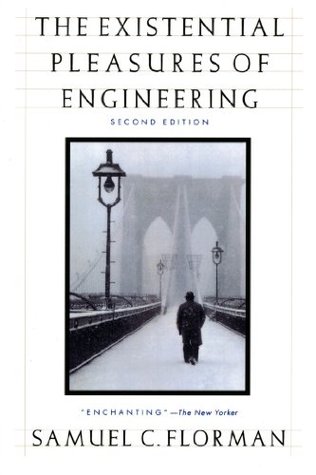
ExistentialPleasuresofEngineeringEngineers have been a part of my life in many ways. My mother’s father was an engineer. Although she did not know it, my grandmother’s grandfather was also an engineer. My wife’s father is an engineer, and grandparents on both sides of her family were either scientists or engineers. My daughter is studying engineering, and other relatives have made it their profession. In fact, had the peril of my everlasting soul not caught my early concern, I would likely have headed into the sciences myself. Not that I would have made it in the profession, but the interest is certainly there. Many years ago my wife bought me a copy of Samuel C. Florman’s The Existential Pleasures of Engineering. Unlike my claims about engineering, I can boldly declare myself an existentialist. The moment I found out what existentialism was, I knew it was my outlook. Now that I am firmly settled in a profession about as far from science and engineering as I can be, I decided to read the book.

Quite surprisingly, I found Florman turning to religion from time to time. Existentialism isn’t inherently religious, but engineering is inherently empirical. Florman notes that the New Testament, with its spiritual values over the physical, often presents serious problems to engineers, enmeshed, as they are, in this universe. That made sense, even if it surprised me a little. A few pages later, however, I was astonished that Florman praises the “Old Testament” for its more earthy viewpoint that has a great appreciation for the physical world its god has created. Perhaps there was a reason my life took this track after all. Although I’m not Jewish, I always felt an attraction to the Hebraic outlook. Maybe I should’ve been an engineer.

Toward the end of his extended essay, Florman once again turns his thoughts toward the spiritual. Noting that massive works of engineering tend to evoke the divine—the most obvious, but by no means only, example being cathedrals—we glimpse a sense of the sublimity in the greatest of human edifices, sacred or secular. The engineer still has recourse to the spirit which is, to a frustrated scientist, a cause for great hope. When I pulled a book on engineering off the shelf, I certainly did not expect to find any religion in it at all. Of course, the book was written before science and religion had become entrenched in such a shrill standoff as they seem to be today. There is balance here, and an appreciation of beauty. And when the engineer does the impossible, it is indeed a work of human divinity.


Stealing God Blind

Photo credit: Raul 654, Wiki Commons

Photo credit: Raul 654, Wiki Commons

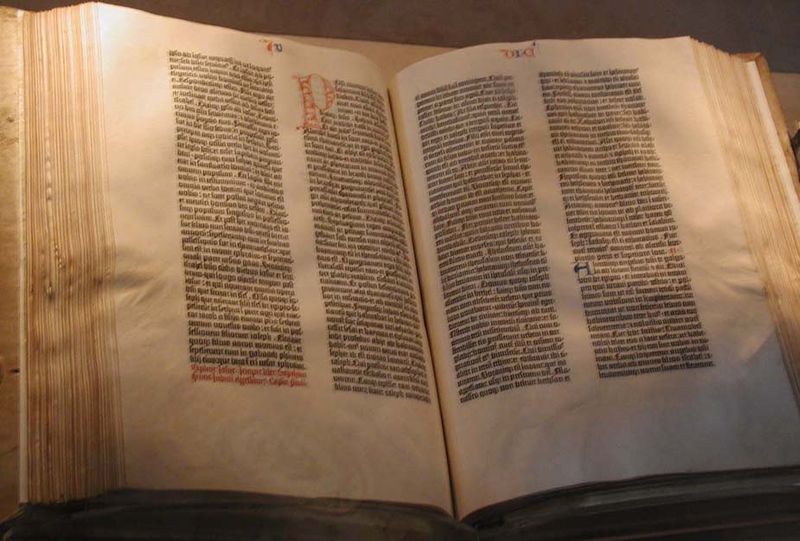
A friend who also works in the book trade recently revealed that the section in one of the few remaining brick-and-mortar book stores most liable to theft is Bibles. I’m not really surprised, I guess. Faith can do strange things to people, giving them justifications for thievery in the name of a higher authority. What it really doesn’t reflect, however, is just what a financial liability a Bible can be. My friend speculated that people believe that the Bible should be free, and, in a sense they have a point. If it is the word of God, as they likely believe, then it should be in the public domain. The problem is, the Bible’s not as simple as all that. The problem begins with the fact that “the Bible” does not exist in any definitive form. Every single one of the original manuscripts has long been lost and we have copies of copies of copies, etc., of those putative manuscripts. And they are in foreign languages—technically dead languages, at that. (Although Greek and Hebrew are still spoken, the biblical forms of those languages died out long ago.) So, are the Hebrew and Greek texts in the public domain?

Maybe, but. The texts from which translators make English (or other modern language) Bibles are based on compilations of various documents that have come to represent the accepted, textually correct ancient language versions of the Bible. These are protected by copyright since they are relatively modern editions. Some of the older ones are available in the public domain, but they are outdated. Even skipping all that, when we get to English Bibles, such as the King James Version (but not the New King James Version, where the “new” modifies “version,” presumably, and not “King James”), the text is in the public domain but the printed book still costs money to manufacture. One of the problems with Bible mythology is that some think this implies that Bibles just drop down from God. In actuality, they have to be edited, typeset, printed, shipped, and stocked, and the people who do this work have to be paid. In short, free text is not free.

I work for a major (but by no means the biggest) producer of Bibles. Even in my short time at the press, I have come to realize that Bible publishing is complex and expensive. Sure, you can print cheap editions and give them away like the Gideons do, but they have financial backing to buy and distribute cheap words of the Lord. There’s a sense of entitlement here: if God spoke, wasn’t it to all people? What about the Quran? The Book of Mormon? Science and Health? Some may castigate the Bible, but it is a genre-defining true original. And although one of the ten commandments declares stealing is wrong, some wonder how this can possibly apply to Bibles. It’s the middle-men and women. Stealing a Bible is cheating someone from a bit of their livelihood. Even if the Almighty turns a blind eye.


In Saecula Saeculorum

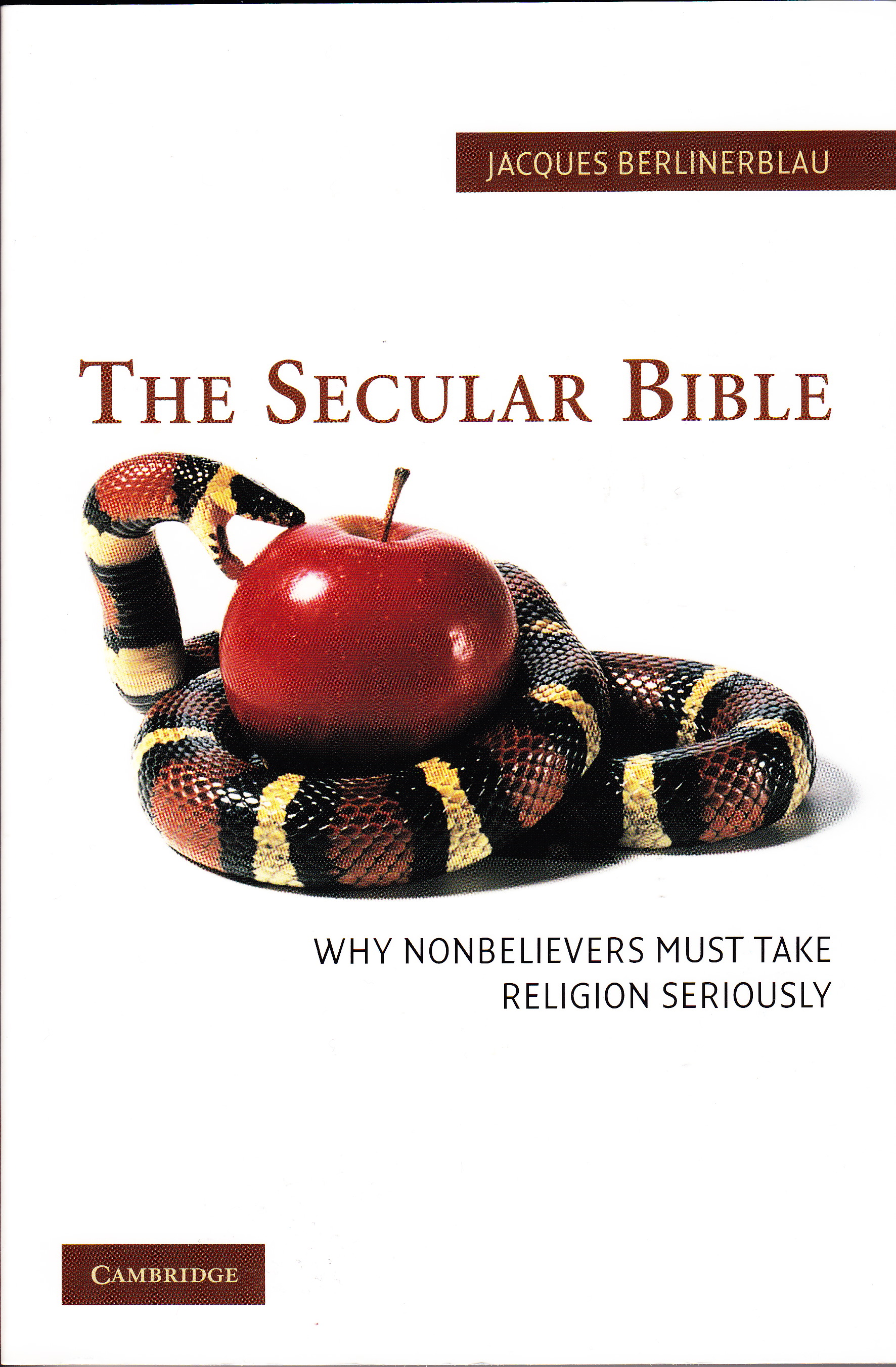
SecularBible“The Hebrew Bible is a misreading waiting to happen.” Jacques Berlinerblau’s The Secular Bible is a book containing much wisdom. My only real concern is that by having published it with a university press Berlinerblau may have inadvertently ensured that it would be read only by biblical scholars. Although yours truly was once such a credentialed scholar, I read The Secular Bible with its intriguing subtitle, Why Nonbelievers Must Take Religion Seriously, looming in my mind like a great raptor. This is an important book. With so very much of our lives heavily influenced by the Bible, eloquently argued by Berlinerblau, we have secularists who don’t know the Bible fighting the impossible battle to subvert it. The rationalizing, leveling influence, for the past two centuries, has come from the much castigated and discarded biblical scholar. Can I get an “Amen”?

Berlinerblau demonstrates unequivocally that we need Bible scholars and Qur’an scholars who know how to speak to their own traditions. Instead we have secularists who belittle and then wonder why the religious strike out. The pattern has repeated itself so many times that it defies reason that intelligent people would delude themselves that religion is a passing fancy. The Secular Bible argues what I’ve said time and again: if we want to avoid the dangers religion can bring, we must spend the resources to understand it. Instead we close departments and force those who know the field credibly well into unemployment. And we wonder why there’s a reaction.

“Self-critical religious intellectuals have never been much appreciated.” Instead we put the extremists on television so we can laugh at them or gape at their ability to do the unthinkable in the name of religion. Ironically, there are thousands of trained experts in the field, many of them languishing in un- or under-employment while towers crumble and mobs burst into violence. I do wonder what future generations will think of us. We have the resources handy, indeed, many of them willing to serve for a fraction of the cost of a business professor or basketball coach, but we choose to ignore them. As Berlinerblau states emphatically, we in the western world have the Bible so deeply ingrained that we can no longer even exegete all the ways in which it plays out in our society. If such influences were at work in a human body, we’d pay a doctor well to understand. Instead, we let the most foundational text in our society be used for duplicitous purposes while the simple reading of a book like The Secular Bible could save us all an eon of grief.


Best Nowledge

Back in the day when paper books ruled, New York City used to be known as the publishing capital of the country. Even though many publishers still call New York home, a depressing lack of interest pervades the city that never sleeps (sounds like it could use a good book). Although I’m no fan of Barnes and Noble, it is just about the last presence left of the brick-and-mortar-style bookstore. When news arrived this week that one of the large New York branches of B&N was closing, a sense of despair settled in. I love my indie bookshops. I literally went into mourning when Borders shut down, even now the sight of a vacant Borders can make me weep. A walk though any trendy mall will reveal no books to be found, and I go home perhaps fashionably dressed and smelling vaguely of perfume but sad nonetheless. Perhaps it is because the book is/was the culmination of one of the most important technologies of all time: writing.

Technology, as we think of it today, is largely electronic. Circuit-boards, nano-chips, embedded in sealed cases constructed in sterile rooms where the humans are more protectively suited than a surgeon. Isaac Newton once famously noted that if he’d seen further than others it was because he’d stood on the shoulders of giants. One of those unnamed giants invented writing. Dragging a stick through clay would probably be considered decidedly low tech these days, but the person who realized that a crude scribble of an ox-head with dots next to it might indicate how many cattle you were selling was a giant. We have no idea who the scribes were who wrote down the first narrative stories of gods and heroes, but the process resulted in a still largely anonymous Bible that is used to decide public policy even today.

There’s no doubt that books take up space that electronic gizmos don’t. Storage has been an issue for libraries constructed before publishing became a major, competitive industry. But electronic books have their problems too. With the ease of self-publishing, you never know who is really an expert without researching the author. Often on Amazon I find an intriguing title only to see that it has been produced by any number of self-publishing software platforms that indicate only the author’s own word for his or her expertise. I wonder what happens when people who don’t know to assess information in that way take anecdote for fact. Where are the shoulders of giants? Perhaps I’m just old-fashioned, but the world without bookstores looks a lot like the stone age to me.

Alas, Babylon!  (Photo credit: Lovelac7, Wiki Commons)

Alas, Babylon! (Photo credit: Lovelac7, Wiki Commons)


Of Cuckoos and Kings

One_Flew_Over_the_Cuckoo's_Nest_poster

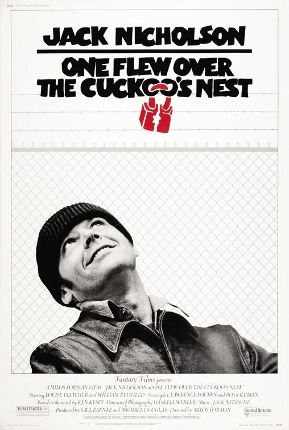
Having a life-long phobia of mental institutions, I shy away from situations that refuse to make sense. Some have attributed this to my having had an alcoholic father and responding with an über-rational expectation of analyzing how other people would likely act. Whatever its cause, the fear is real. So thirty years ago, when I watched One Flew over the Cuckoo’s Nest, I assumed it would be the last time. It was a relatively recent movie at the time, and it was required viewing for one of my college courses. With my phobia I really couldn’t get beyond the heebie-jeebies to consider what was going on beneath the surface, which is to say, most of the movie. Well, a few decades will cure many ills and I sat down to watch the movie again and my own experiences of asylum-like, heartless institutions in the intervening years had indeed hardened me a bit. I noticed much that I’d missed the first time around. For one thing the story of King David kept coming to mind.

For those who read the Bible somewhat objectively, David is a player, and not always the most admirable character. He has a subtle charm that wins the reader of the books of Samuel back time and again. He steps into a situation where his ambition is held back by a kind of Nurse Ratched named King Saul. So what does David do? He pretends to be insane and runs off to join the Philistines. He gathers a band of miscreants about him and goes to towns taking what isn’t his. He even brings a forbidden woman into his house. As R. P. McMurphy goes through these same shenanigans, he comes to really love young Billy (Saul’s son Jonathan). In the course of the movie our ersatz David takes a suffering nation and heals it. There, however, the parallels end and Ken Kesey’s story takes over.

Of course, I’m not suggesting that Kesey intentionally drew on the story of David—that would be crazy talk—but I do often wonder about the aphorism attributed to his son Solomon that there is nothing new under the sun. There were those who felt that Solomon had lost touch with reality as he sat down to write Ecclesiastes. The great stories, in some sense, have already been told. But not all. Those of us who write seek new truths, and sometimes use ancient sources to do it. David is remembered as one of the great biblical characters. One of the reasons, undoubtedly, is that he is so fallibly human—he’s not impossibly pious like Moses, or unfailingly sad like Jeremiah. He is a good man with peccadilloes for which we are willing to forgive him just for the pleasure of watching him go on. No, Kesey may not have had the Bible in his hand as he dreamed up the character of R. P. McMurphy, but he produced a true representation nevertheless. Of course, I might just be insane myself.


Utterly Ineffable

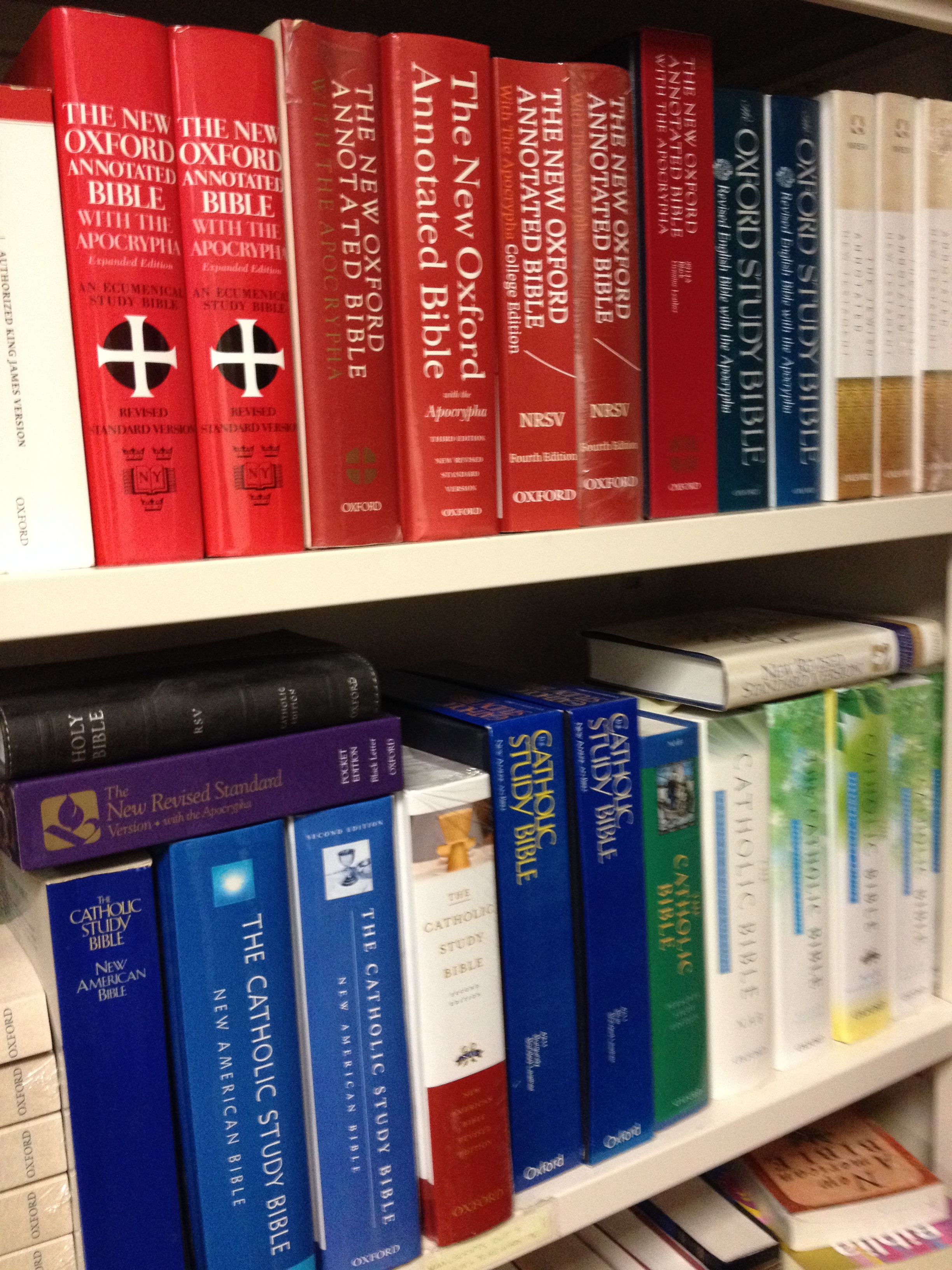
Sitting in an office full of Bibles, I feel well equipped for an apocalypse. At times, however, the irony of editing Bibles is almost overwhelming. Standard publishing contract boilerplate includes the assurance that the work of the author contains nothing “blasphemous.” I once had an author object to this language since just about anything said about religion or the Bible could be considered blasphemous in the right circumstances. In these days when Tea and other parties promote a literalistic reading of Scripture and some of its antiquated perceptions of humanity, I realize that the problem is the strange theological tenet known as “inerrancy.”

IMG_1163

The idea of inerrancy is that the Bible is without error of any kind, itself an errant assumption. Those who hold it do not fully appreciate that we have no original biblical manuscripts at all. The Bibles we read and swear on today are translations of copies of copies of copies in a long regression back to missing originals. Those translated copies have to be typeset and printed, and errors creep in at every stage, as is clear from a glimpse of the manuscript trail as well as many famous misprinted Bibles. Even when the inerrantists are pushed back to the original languages, the problem of not having the autograph remains an unsurmountable barricade to the mind of God. Bibles, like any other books, are subject to human error at each step of the publishing process. On my desk sit contracts where the editor of a Bible swears nothing blasphemous exists in the words. Such contract signers are braver than this tremulous hand.

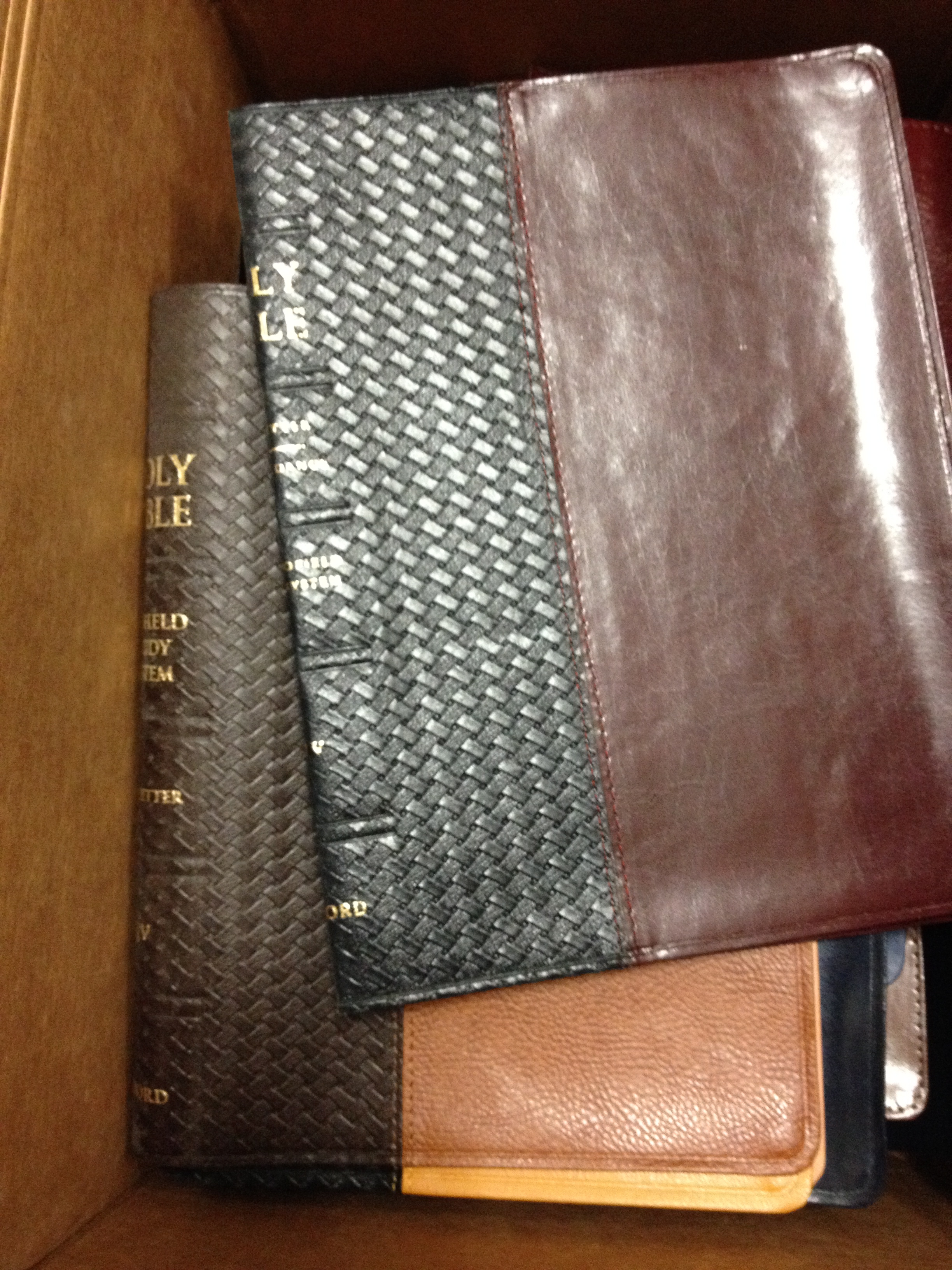
Once I sent a hastily drafted contributor agreement to a Jewish author with the divine name accidentally misspelled. Within literal minutes of hitting the send button, my phone rang. The contributor was civil but reproving. Did I expect a Jewish man to sign off on a document with the ineffable name misspelled? I apologized but otherwise held my tongue. I had inadvertently blasphemed, perhaps, in my need to get too much done in a day. Now I am editing Bibles. One contributor to a study Bible told me his student evaluations state, “he wrote the effing Bible!” Effing? Ineffable? Inerrant? I’m not sure I have the nerves to handle this kind of pressure. Then there is that box full of leather Bible-binding samples under my desk. Bible-binders sure know their leather. Don’t tell me my thoughts have gone astray yet again.

IMG_1131


Exegeting for Peanuts

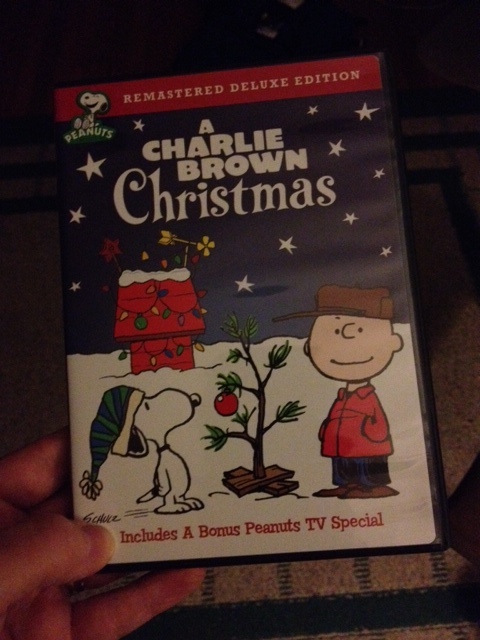
Peanuts, the cartoon, is about as pure as the Bible itself. Like the Bible it is included in ritual, as in the annual viewing of A Charlie Brown Christmas in our home. I grew up in the generation that eagerly awaited the special to be aired on television (if you don’t know what I’m talking about, ask your parents). When we were finally feeling affluent we purchased the DVD to continue the tradition with our daughter. Last night as we watched, however, it struck me that, like the Bible, many variant traditions are present in A Charlie Brown Christmas. I began to suspect a kind of documentary hypothesis. The program begins with Charlie Brown, in his house, wearing his famous yellow zigzag shirt and black shorts, getting ready to go outside. This must be the oldest tradition since wearing shorts in the winter is the lectio difficilior, or the more difficult reading—any good Bible scholar knows the more difficult text is most likely to be the original because later scribes try to make the story make sense. I’ll call this Urtext C. The crisis is evident because as Charlie Brown pulls on his coat to go outdoors, he is wearing shorts. He steps outside in the next scene wearing long pants. This represents a harmonization by a scribe uncomfortable with a child on a snowy day outdoors in shorts—a simple scribal correction. This source, designated H for long pants (lange Hosen in German), subsequently appropriates the script since Charlie Brown is not shown wearing shorts again.

When Charlie Brown consults with his psychiatrist, Lucy van Pelt, however, the real evidence emerges. Lucy’s sign on the front of her stand originally reads “The doctor is out,” each of the first three words occupying its own line. When Lucy spies Charlie Brown she runs over and switches the “out” sign to one that reads “real in,” representing the story line of H. When the tight shot to emphasize “real in” closes on the desk, however, “The doctor is” has now come to occupy two lines instead of three, “The doctor” sharing the top register, and ‘Is” on the line with the new status of the analyst. This is the work of S, the Schilderhersteller, or Sign Maker. A further variant tradition appears in the shot of the two characters talking since “The doctor is real in” once again occupies three lines. Either H is reasserting itself or D, the Deutero-Schilderhersteller has tampered with the text. When the desk is then shown with epigraph “The doctor is in” on three lines, we are clearly dealing with a redactor with literalist tendencies, L, or perhaps this is C, our Urtext, having been further elaborated as “real in” by S, for obviously theological reasons.

The composite nature of the script is even more evident with the Christmas tree. When purchased by Charlie Brown and Linus, the tree has three branches, obviously a reference to the Trinity, so a later addition. It is easier to explain branches taken off a tree than a dead plant growing new ones. In the auditorium, however, the tree has five branches. In the next scene, six. When Linus gives his hortatory address, the tree is shown with four branches. Then in the following scene, seven. When Charlie Brown attaches an ornament, the tree again has five branches (an obvious nod to the Pentateuch), but when the children decorate it, it has transformed into a full tree on which it is impossible to count the number of branches. This will take a more adept scholar than me to unravel. I’ve lost track of the Urtext. Could a university-employed academic help me out here?

If any of this sounds far-fetched to you, remember that Charles M. Schulz bore a German name. Like Moses, he gave us the original text, and like Graf and Wellhausen, he forever changed the way we viewed the faith tradition. It is my hope that you enjoy the holiday season. I’m going to be too busy trying to piece together the corrupt tradition of that miraculous tree.

Final, canonical form.

Final, canonical form.


Eating Your Prophets

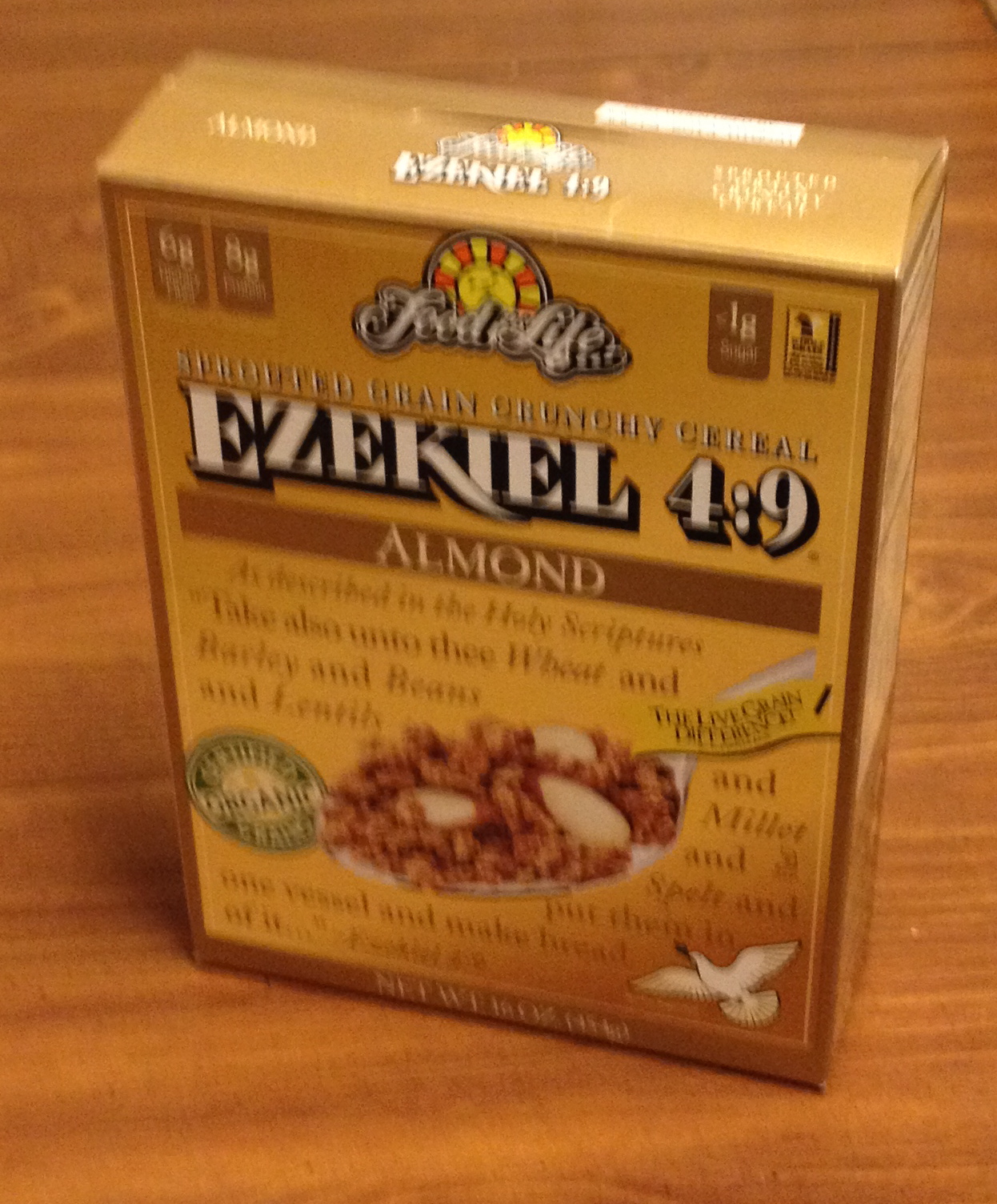
Ezekiel was an odd character, even for a prophet. He’s become a kind of patron saint to ancient astronaut theorists, and his name in fiction often denotes someone slightly off balance. In his defense, he believed that God was demanding his many strange actions. A priest in a period of exile from the “one true temple,” Ezekiel lived an existence as a captive in a foreign land and came to some radical conclusions about the nature of Israel’s god. His visions and actions were considered the original weird, even by his contemporaries. Since Ezekiel believed Babylon would conquer Jerusalem, the people there would have to go on starvation rations. In chapter 4 of his book, Yahweh tells the prophet to try to make a bread out of wheat, barley, beans, lentils, millet, and spelt. This odd mixture is to be eaten in very meager portions to symbolize the coming privation for 390 days (during which time he is to lie on his left side). His bread is to be cooked on dung.

IMG_1156

I eat breakfast around 4 a.m. My bus to the City comes before 6:00 and there are no restrooms on NJ Transit buses. Many New Yorkers eat breakfast in the office, but I’m just too Episcopalian in sensitivity for that to really be an option. I don’t like really sweet cereals, but granolas are often quite sugary unless you want to pay top dollar (and most of my dollars are bottom dollars) for some organic, European blend. Then I spied Ezekiel 4:9. Knowing full well the context of the reference should’ve given me pause, but it was two dollars less a box than some of its competition—downright exilic prices—and my curiosity was roused. What would Ezekiel eat?, I asked myself.

Most people don’t realize that so many of us eat breakfast cereals due to the efforts of our Seventh-Day Adventist friends. Adventists, in addition to being literalistically inclined, advocate healthy living. Will Keith Kellogg, a faithful Adventist, believed that eating cereal for breakfast was healthy and widely promoted the idea through the company he founded to produce cereals. Kelloggs does not produce Ezekiel 4:9. Food for Life, an organic bakery, are the purveyors of this organic breakfast. Their religious convictions, if any, aren’t evident from their website. Just about the time I’m climbing aboard the bus, I know that even as Ezekiel saw the wheel, I’m in for a moving experience. Isaiah-os or Jeremiah Flakes may be difficult to imagine, but with Ezekiel nothing really surprises. Today’s Bible lesson may be as close as the larder shelf. I just skip the cooking on dung part.


Almost Human?

Last week the New York Times ran a story on the efforts of the Nonhuman Rights Project to have chimpanzees declared “legal persons.” Naturally this has set many legal persons at arms, given the unstated, biblical origin of the concept of human superiority. Without the biblical mandate we simply have to admit that we rule over animals on the basis of “might makes right,” a philosophical concept that never makes it far either in the classroom or the courtroom. We hold animals captive and experiment on them because we can. They can’t speak, can’t register protest, so we assume their silence as complicity and carry on. Research over the past several years, however, has pushed the human-separatists harder and harder. Animals are more like us than we are willing to admit. We acknowledge that we’ve evolved from them, but we suppose that at some point—probably the vocal cords—we surpassed them and therefore if they can’t speak they can’t think and they can’t feel. Even today many people still hold to the biblical orthodoxy that animals are merely here for our enjoyment and exploitation.

Considering how we treat other human beings, this is probably, sadly, no great surprise. In a world where many nations still allow women to be treated as property, putting a chimp in a cage and labeling it “mine” doesn’t appear so odd. Only the most crass of chauvinists would dare say that women are not human, but far too many, based mostly on religious biases, have no problem stating that women are inferior humans. Again, “the Bible tells me so.” This kind of thinking, prevalent even up until the 1950s in “civilized” countries like the United States, has yet to die out fully. What is it about the male psyche that insists on its own superiority? The Bible, it seems, has much for which to answer when found in the hands of men.

What makes us think that we are all evolving toward the “high point” of white males? Some of us in that class know that it is long past time that this glass “ceiling” should have been irreparably shattered. Nonsense, however, has staying power. Some of us even feel inferior just knowing such distinctions were ever made. Not that long ago Africans were said, by some, to be closer to apes than Caucasians. Women were said to be closer to snakes than men. What has been lacking is a sense of balance. Common sense. Genders and races equal but variable. Until that minimum bar is reached, how can it be hoped that fair treatment of nonhuman persons can ever be achieved? Some animals have been taught to read, at least in basic, symbolic ways. They understand that certain symbols stand in for defined rewards. Given time it might even be that this most human of inventions could be shared among nonhuman persons. If they do not learn to read the Bible with more sense than some human persons, however, we face a future of many other layers of distressing oppression.

787px-Chimpanzee_Ham_in_Biopack_Couch_for_MR-2_flight_MSFC-6100114


Appreciate Your Job

At a gathering of friends recently, a game of trivia broke out. Well, it was actually planned because we were not using the cards and pie wedges that we grew up with, but were making up our own questions. The submitter of the question was the final arbiter on whether an answer was correct or not. As usual, I probably overthought the process, trying not to make my questions too hard or too easy. Maybe my ideal contestant was a student in one of my intro classes since much of what I submitted was what I covered in my courses. Other questions were drawn from choice bits of this blog (something to which I never subjected my students). In any case, one of my submissions asked for the name of Job’s fourth friend. I was honestly surprised when nobody in the grew knew, or could even name one of poor Job’s friends. My slip of paper went into the unanswered pile in the middle, a stack alarmingly dominated by my own questions. Afterward, the friend who knew me the longest, and who grew up in a church-going family, asked “Did you really think anyone had read the book of Job?” Coming so shortly, as it did, after another friend in a different context had indicated that my interests are arcane, I began to feel my age.

Biblical literacy is a topic for which some scholars actively lobby the reading public. I’m not sure if the entire Bible need be known fully, although my job increasingly relies upon its popularity. Students used to ask if I still found the Bible meaningful, even though I spent my career parsing it apart. The answer is always the same: yes, the Bible is worthy of the attention lavished upon it. It has sections of unsurpassed beauty and even some lessons the world could still stand to learn. It is uneven, however. There are bits that probably should’ve never been canonized. There are moral lows as well as highs. And the book of Job is among the greatest pieces included in it.

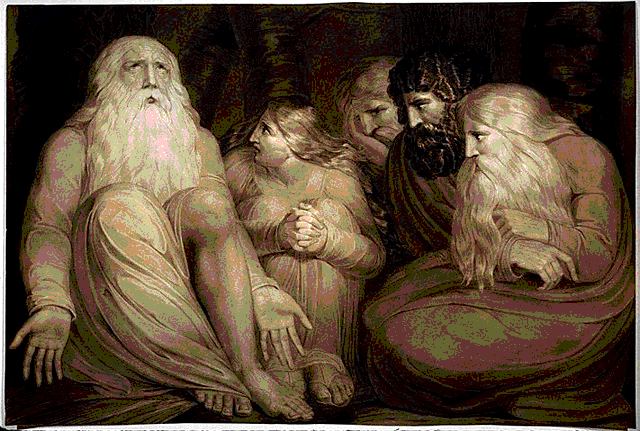
On that point I would receive some argumentation, I’m sure. Many people detest the book of Job. The eponymous hero of the book seems almost blasphemous to some, and a complaining ingrate to others. In the course of his suffering four friends stop by. The last one, surely a later addition to the text, toes the party line of orthodoxy that the book severely shreds. Job also contains some of the finest poetry from the ancient world and has given modern English several catchphrases still currently in use. I’ve always felt a kinship with Job. While my lot has not been as pathetic as his, I have had enough set-backs to lend the book a kind of nostalgic patina. Even in their wrongheadedness Job’s friends can spill out poetry. And there is wisdom to be had in that dusty book. In the end I was probably the one who was wrong. There is nothing trivial about the book of Job.

Blake'sJob


Word of God in Bulk

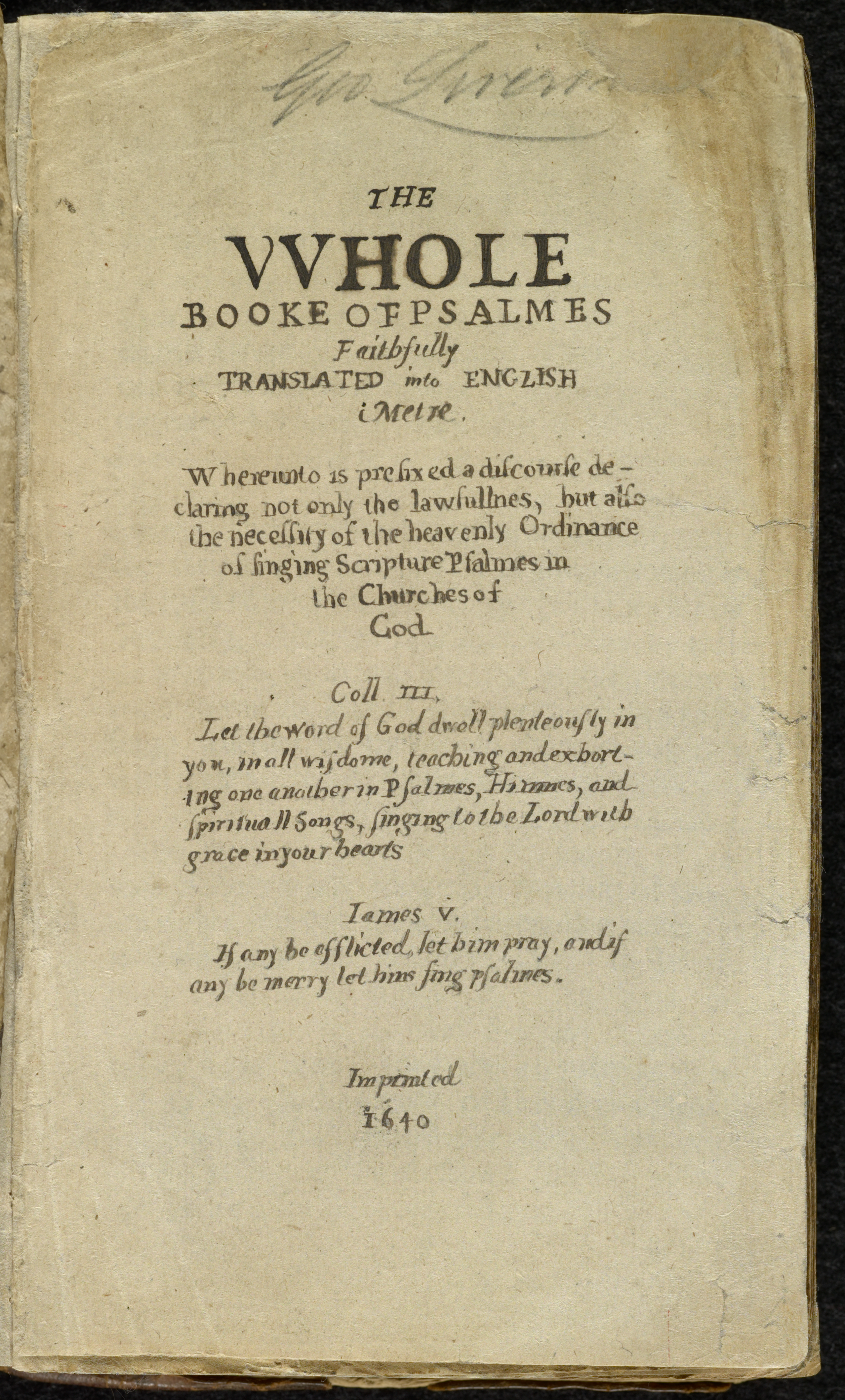
Bay_Psalm_Book_LoCThe Salem witch trials were still half a century in the future. The Puritans, hoping for religious freedom, had come to Massachusetts. Despite prevailing attitudes toward the religious, the Puritans were keen on learning and began printing books. The first book printed in English in North America was the Bay Psalm Book. You see, the Psalms have a particularly important place in Christian (and Jewish) worship. In fact, much of what would later develop into the daily offices in the Church of England, adapted from the breviaries of the Roman Catholic Church, were services that started essentially as vehicles for reciting the Psalms. It is fair to say that Christian worship might have never taken on the elaborate forms that it has without the underlying recitation of the Psalter. The Bay Psalm Book, printed in 1640, is now the most expensive book ever sold at auction. According to the New York Times, one of the eleven known Bay Psalm Books has just sold for over 14 million dollars. The Bible has a way of continuing to surprise us.

As someone who has more Bibles than your average layperson, I find it isn’t difficult to think that Bibles are fairly common. They are. I actually switched to The Green Bible in my classes out of the ecological concern that there have been over six billion Bibles printed. The Gideons give them away, and even the Christian heavy metal band Stryper used to throw handfuls of Bibles into the crowds. Chances are, in the United States, you are not physically far from a Bible at any given moment. So why would someone pay 14 million dollars for one? The answer goes deeper than the suggestion that the Psalms contain timeless truths—you can get those free on the internet anytime—but that it is part of our heritage. We are who we are, in part, because of the “Bible believing” founders of our culture. Survival was not taken for granted in the mid-seventeenth century. The Bible was a pillar of certainty in dangerous times.

Yes, interpretations of the Bible have led to horrendous results. There is no point in denying the guilt. Hermeneutics, however, is a human activity. The Bible gives as well as takes away. Some of us may never have a million dollars to spend. Many people don’t have enough to eat. Specialists tell us that some 45 million Bibles are printed each year. Bibles are big business. In the words of Big Dan from O Brother, Where Art Thou? “Sales, Mr. McGill, sales! And what do I sell? The Truth! Ever’ blessed word of it, from Genesee on down to Revelations! That’s right, the word of God, which let me add there is damn good money in during these days of woe and want! Folks’re lookin’ for answers and Big Dan Teague sells the only book that’s got ‘em!” David M. Rubenstein, the buyer of the book, intends to send it around to libraries to display. Although I’ve spent over forty years studying the Bible, it takes the skills of a man from an investment firm to earn enough money to buy one. And I wonder if that’s Big Dan I hear laughing, or perhaps it’s just the sound of Puritans singing in the wilderness.


Imagine Images

“Thou shalt not make unto thee any graven image, or any likeness of any thing that is in heaven above, or that is in the earth beneath, or that is in the water under the earth.” Thus spake the Lord one day long ago. So the Bible says. The problem is that humans are visually oriented. We teach our young to read by enticing them with books with pretty pictures—images that captivate. We make things that are pleasant to see, some of them are even graven. I used to ask my students what the difference was between a god and an idol. The answer is, of course, perception. “Idol” is a word that implies falsehood. The item represented is somehow divine, but is not actually divine. There are ways around the rules, of course.

IMG_1138

I spent many years in the United Methodist Church. Many people I knew claimed that the local Catholics were idol worshippers, and when I entered a Catholic church for the first time I was struck by the graven images that seemed to stand in blatant contradiction to the second commandment. How could this not be a direct violation of divine orders? After all, this wasn’t some minor infraction—it was one of the very commandments! Back in my Methodist context, I began to wonder, however. We had crosses, some of them in the round, right up there on the altar. True, there was no corpus on our crucifix, but that seemed to be a handy bit of casuistry. Human beings naturally convert images to idols. We all knew, Protestants though we were, that you should never take a sacred object out to the streets and treat it profanely. An image in a sacred venue could be an idol.

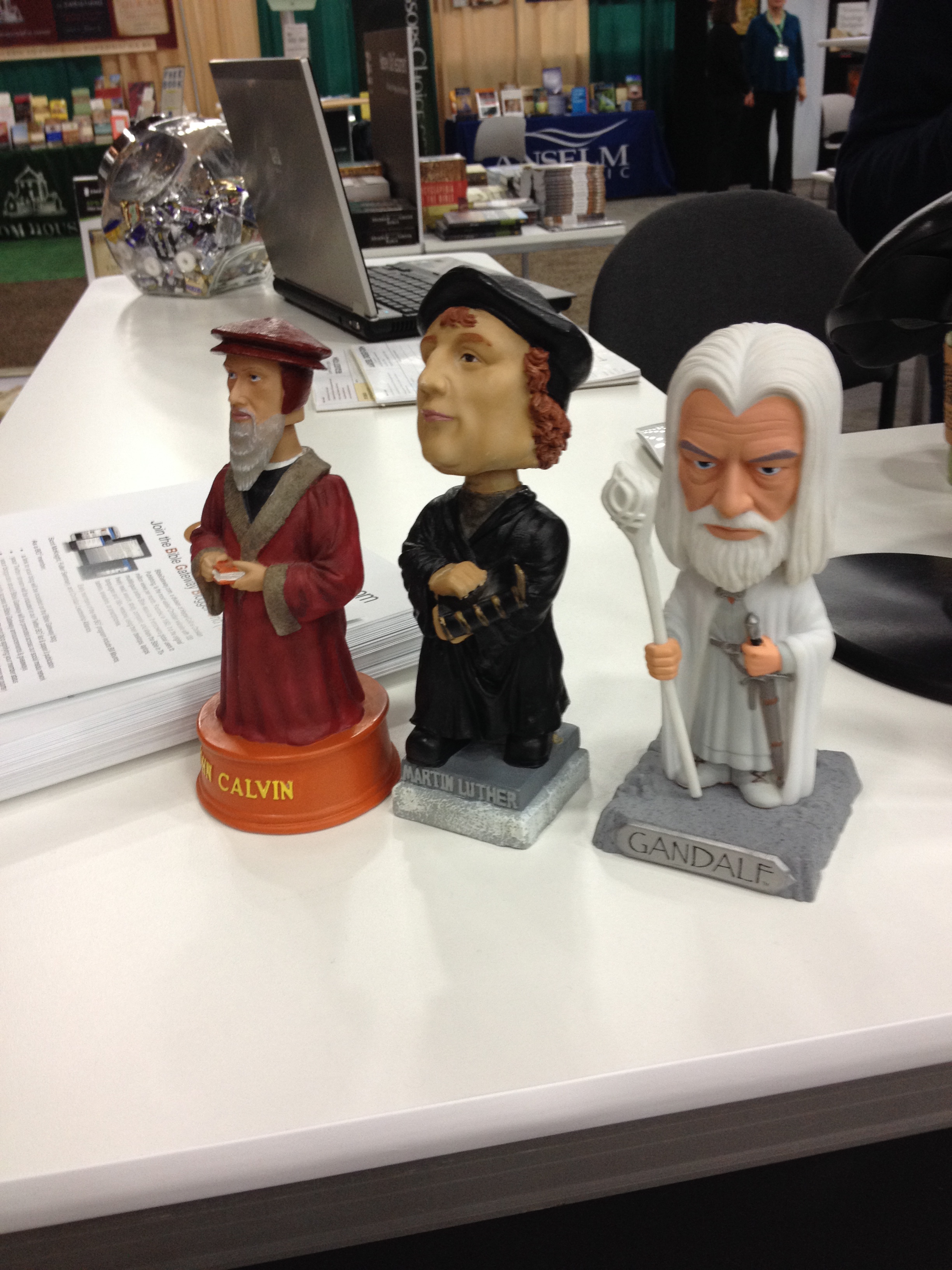
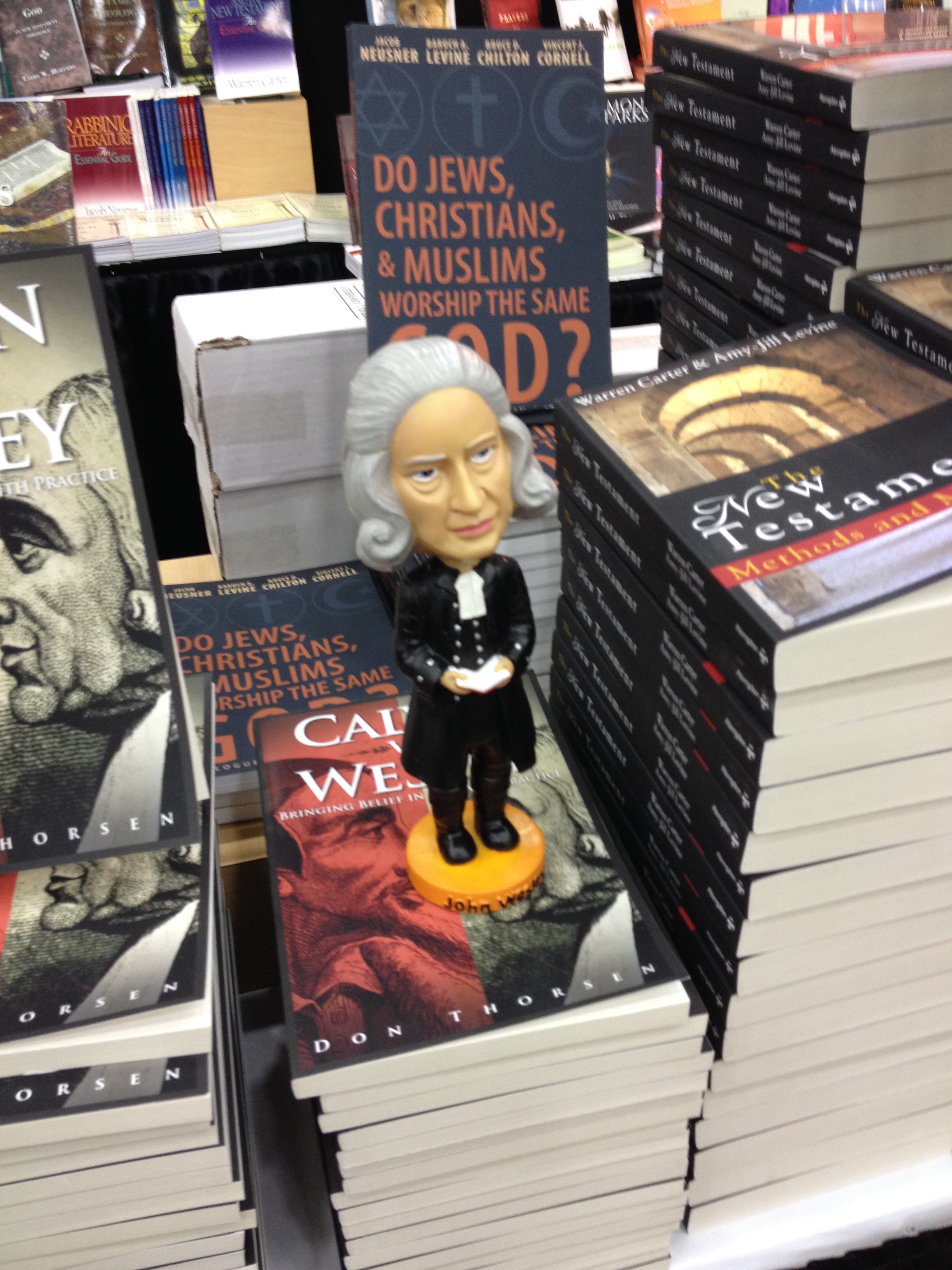
Over the years it seems that the strictures of the ten commandments might have been relaxed just a little. Collectively as a culture, the real has become more and more virtual. We buy our movies, music and books in electronic format. We play our games on computers. In such a context a physical image may seem somehow less real. Our idols have been digitized. It doesn’t seem like the Bible was looking that far ahead when attempting to create an exhaustive list of what might anger the divine. After all, electricity wouldn’t be discovered for millennia. Reality was dry, dusty, and deadly. The prohibition was against physical images. It is no longer an issue for many in the Judeo-Christian tradition that a statue or an icon might be a sign of piety rather than profanity. Things seem to have come full circle when I find a statue of John Wesley, nearly of bobble-head proportions, looking at me with eyes seeking prevenient grace. I guess the powers that be might just be willing to overlook even Methodists gone native.

IMG_1136