Almost Human?

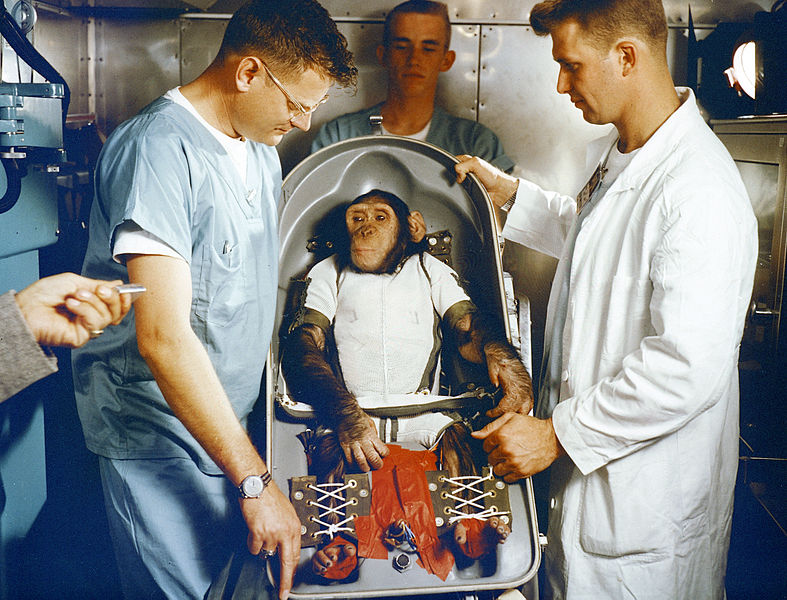
Last week the New York Times ran a story on the efforts of the Nonhuman Rights Project to have chimpanzees declared “legal persons.” Naturally this has set many legal persons at arms, given the unstated, biblical origin of the concept of human superiority. Without the biblical mandate we simply have to admit that we rule over animals on the basis of “might makes right,” a philosophical concept that never makes it far either in the classroom or the courtroom. We hold animals captive and experiment on them because we can. They can’t speak, can’t register protest, so we assume their silence as complicity and carry on. Research over the past several years, however, has pushed the human-separatists harder and harder. Animals are more like us than we are willing to admit. We acknowledge that we’ve evolved from them, but we suppose that at some point—probably the vocal cords—we surpassed them and therefore if they can’t speak they can’t think and they can’t feel. Even today many people still hold to the biblical orthodoxy that animals are merely here for our enjoyment and exploitation.

Considering how we treat other human beings, this is probably, sadly, no great surprise. In a world where many nations still allow women to be treated as property, putting a chimp in a cage and labeling it “mine” doesn’t appear so odd. Only the most crass of chauvinists would dare say that women are not human, but far too many, based mostly on religious biases, have no problem stating that women are inferior humans. Again, “the Bible tells me so.” This kind of thinking, prevalent even up until the 1950s in “civilized” countries like the United States, has yet to die out fully. What is it about the male psyche that insists on its own superiority? The Bible, it seems, has much for which to answer when found in the hands of men.

What makes us think that we are all evolving toward the “high point” of white males? Some of us in that class know that it is long past time that this glass “ceiling” should have been irreparably shattered. Nonsense, however, has staying power. Some of us even feel inferior just knowing such distinctions were ever made. Not that long ago Africans were said, by some, to be closer to apes than Caucasians. Women were said to be closer to snakes than men. What has been lacking is a sense of balance. Common sense. Genders and races equal but variable. Until that minimum bar is reached, how can it be hoped that fair treatment of nonhuman persons can ever be achieved? Some animals have been taught to read, at least in basic, symbolic ways. They understand that certain symbols stand in for defined rewards. Given time it might even be that this most human of inventions could be shared among nonhuman persons. If they do not learn to read the Bible with more sense than some human persons, however, we face a future of many other layers of distressing oppression.

787px-Chimpanzee_Ham_in_Biopack_Couch_for_MR-2_flight_MSFC-6100114


Appreciate Your Job

At a gathering of friends recently, a game of trivia broke out. Well, it was actually planned because we were not using the cards and pie wedges that we grew up with, but were making up our own questions. The submitter of the question was the final arbiter on whether an answer was correct or not. As usual, I probably overthought the process, trying not to make my questions too hard or too easy. Maybe my ideal contestant was a student in one of my intro classes since much of what I submitted was what I covered in my courses. Other questions were drawn from choice bits of this blog (something to which I never subjected my students). In any case, one of my submissions asked for the name of Job’s fourth friend. I was honestly surprised when nobody in the grew knew, or could even name one of poor Job’s friends. My slip of paper went into the unanswered pile in the middle, a stack alarmingly dominated by my own questions. Afterward, the friend who knew me the longest, and who grew up in a church-going family, asked “Did you really think anyone had read the book of Job?” Coming so shortly, as it did, after another friend in a different context had indicated that my interests are arcane, I began to feel my age.

Biblical literacy is a topic for which some scholars actively lobby the reading public. I’m not sure if the entire Bible need be known fully, although my job increasingly relies upon its popularity. Students used to ask if I still found the Bible meaningful, even though I spent my career parsing it apart. The answer is always the same: yes, the Bible is worthy of the attention lavished upon it. It has sections of unsurpassed beauty and even some lessons the world could still stand to learn. It is uneven, however. There are bits that probably should’ve never been canonized. There are moral lows as well as highs. And the book of Job is among the greatest pieces included in it.

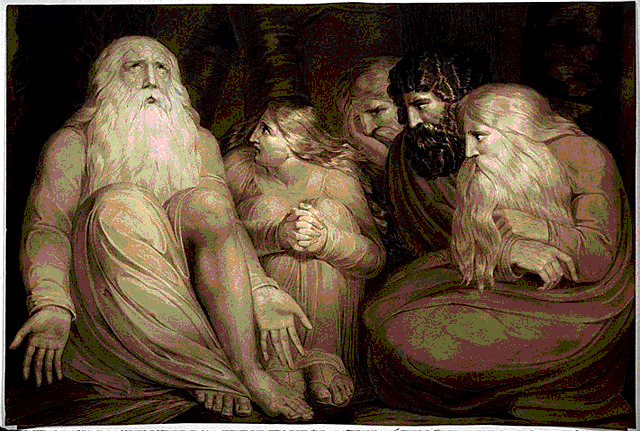
On that point I would receive some argumentation, I’m sure. Many people detest the book of Job. The eponymous hero of the book seems almost blasphemous to some, and a complaining ingrate to others. In the course of his suffering four friends stop by. The last one, surely a later addition to the text, toes the party line of orthodoxy that the book severely shreds. Job also contains some of the finest poetry from the ancient world and has given modern English several catchphrases still currently in use. I’ve always felt a kinship with Job. While my lot has not been as pathetic as his, I have had enough set-backs to lend the book a kind of nostalgic patina. Even in their wrongheadedness Job’s friends can spill out poetry. And there is wisdom to be had in that dusty book. In the end I was probably the one who was wrong. There is nothing trivial about the book of Job.

Blake'sJob


Word of God in Bulk

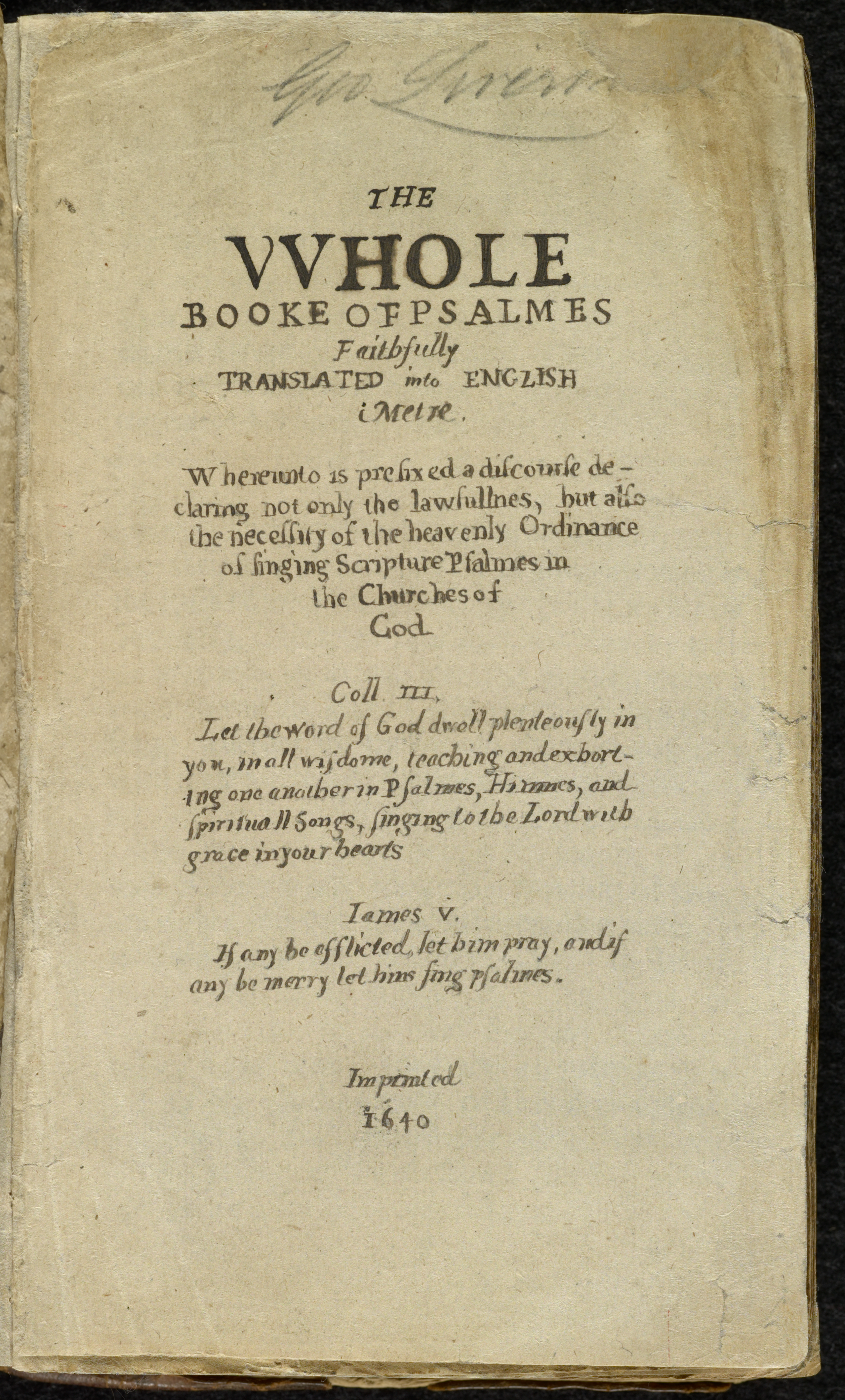
Bay_Psalm_Book_LoCThe Salem witch trials were still half a century in the future. The Puritans, hoping for religious freedom, had come to Massachusetts. Despite prevailing attitudes toward the religious, the Puritans were keen on learning and began printing books. The first book printed in English in North America was the Bay Psalm Book. You see, the Psalms have a particularly important place in Christian (and Jewish) worship. In fact, much of what would later develop into the daily offices in the Church of England, adapted from the breviaries of the Roman Catholic Church, were services that started essentially as vehicles for reciting the Psalms. It is fair to say that Christian worship might have never taken on the elaborate forms that it has without the underlying recitation of the Psalter. The Bay Psalm Book, printed in 1640, is now the most expensive book ever sold at auction. According to the New York Times, one of the eleven known Bay Psalm Books has just sold for over 14 million dollars. The Bible has a way of continuing to surprise us.

As someone who has more Bibles than your average layperson, I find it isn’t difficult to think that Bibles are fairly common. They are. I actually switched to The Green Bible in my classes out of the ecological concern that there have been over six billion Bibles printed. The Gideons give them away, and even the Christian heavy metal band Stryper used to throw handfuls of Bibles into the crowds. Chances are, in the United States, you are not physically far from a Bible at any given moment. So why would someone pay 14 million dollars for one? The answer goes deeper than the suggestion that the Psalms contain timeless truths—you can get those free on the internet anytime—but that it is part of our heritage. We are who we are, in part, because of the “Bible believing” founders of our culture. Survival was not taken for granted in the mid-seventeenth century. The Bible was a pillar of certainty in dangerous times.

Yes, interpretations of the Bible have led to horrendous results. There is no point in denying the guilt. Hermeneutics, however, is a human activity. The Bible gives as well as takes away. Some of us may never have a million dollars to spend. Many people don’t have enough to eat. Specialists tell us that some 45 million Bibles are printed each year. Bibles are big business. In the words of Big Dan from O Brother, Where Art Thou? “Sales, Mr. McGill, sales! And what do I sell? The Truth! Ever’ blessed word of it, from Genesee on down to Revelations! That’s right, the word of God, which let me add there is damn good money in during these days of woe and want! Folks’re lookin’ for answers and Big Dan Teague sells the only book that’s got ‘em!” David M. Rubenstein, the buyer of the book, intends to send it around to libraries to display. Although I’ve spent over forty years studying the Bible, it takes the skills of a man from an investment firm to earn enough money to buy one. And I wonder if that’s Big Dan I hear laughing, or perhaps it’s just the sound of Puritans singing in the wilderness.


Imagine Images

“Thou shalt not make unto thee any graven image, or any likeness of any thing that is in heaven above, or that is in the earth beneath, or that is in the water under the earth.” Thus spake the Lord one day long ago. So the Bible says. The problem is that humans are visually oriented. We teach our young to read by enticing them with books with pretty pictures—images that captivate. We make things that are pleasant to see, some of them are even graven. I used to ask my students what the difference was between a god and an idol. The answer is, of course, perception. “Idol” is a word that implies falsehood. The item represented is somehow divine, but is not actually divine. There are ways around the rules, of course.

IMG_1138

I spent many years in the United Methodist Church. Many people I knew claimed that the local Catholics were idol worshippers, and when I entered a Catholic church for the first time I was struck by the graven images that seemed to stand in blatant contradiction to the second commandment. How could this not be a direct violation of divine orders? After all, this wasn’t some minor infraction—it was one of the very commandments! Back in my Methodist context, I began to wonder, however. We had crosses, some of them in the round, right up there on the altar. True, there was no corpus on our crucifix, but that seemed to be a handy bit of casuistry. Human beings naturally convert images to idols. We all knew, Protestants though we were, that you should never take a sacred object out to the streets and treat it profanely. An image in a sacred venue could be an idol.

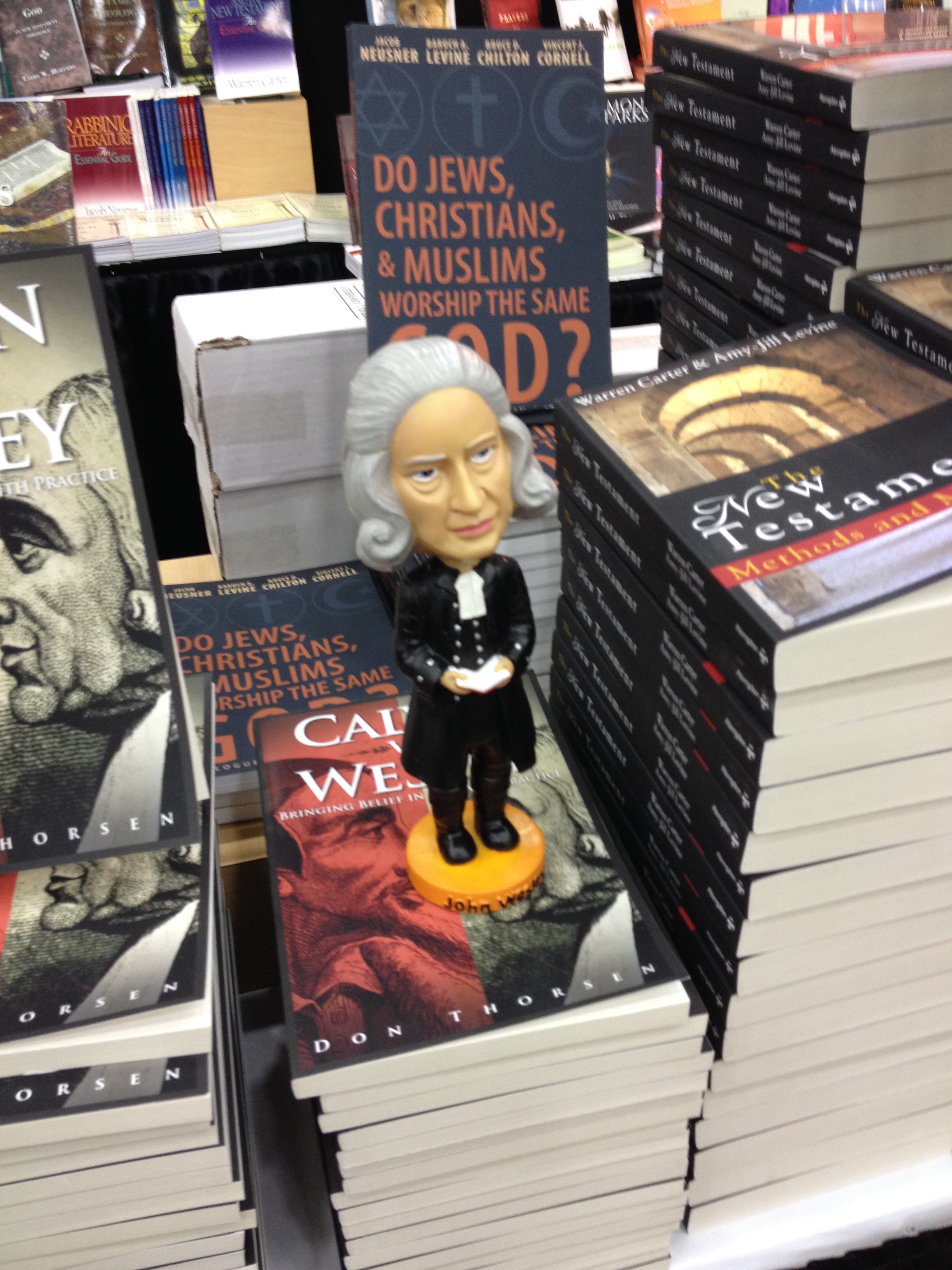
Over the years it seems that the strictures of the ten commandments might have been relaxed just a little. Collectively as a culture, the real has become more and more virtual. We buy our movies, music and books in electronic format. We play our games on computers. In such a context a physical image may seem somehow less real. Our idols have been digitized. It doesn’t seem like the Bible was looking that far ahead when attempting to create an exhaustive list of what might anger the divine. After all, electricity wouldn’t be discovered for millennia. Reality was dry, dusty, and deadly. The prohibition was against physical images. It is no longer an issue for many in the Judeo-Christian tradition that a statue or an icon might be a sign of piety rather than profanity. Things seem to have come full circle when I find a statue of John Wesley, nearly of bobble-head proportions, looking at me with eyes seeking prevenient grace. I guess the powers that be might just be willing to overlook even Methodists gone native.

IMG_1136


Nothing Unusual

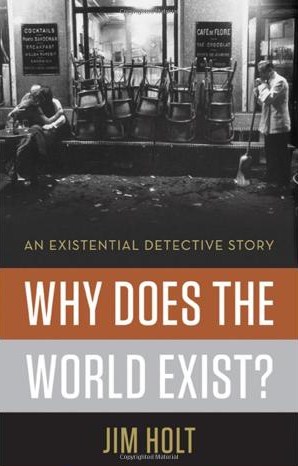
WhyDoestheWorldExist“Is this a world?” Ranger Tom asks seriously, “And if it is, am I in it?” On the lips—or fingertips—of some, this set of questions appears profound. Although I’m not technically a philosopher, I find it impossible to walk by a book with the title Why Does the World Exist? and not pick it up. I am not familiar with Jim Holt’s other work—I engage a little too heavily with books to spend much time with magazines—but the question of the title is one I’ve often pondered. It is right up there with “Why can some people get published and others can’t?” Holt is, however, on a serious quest. Not surprisingly, religion features prominently in the discussion. For the usual existential reasons, including a couple of significant deaths in the family, Holt asks perhaps the most basic of all questions and engages a number of prominent philosophers on the issue. Why is there something rather than nothing? For some in the western world such a question appears a non-starter, because our culture is biblically suffused. Whether we want to admit it or not, our social ocean veritably bobs with the basic belief that God created the world, end of story. We don’t need to ponder it, we just have to accept it. For those who look deeper, however, the answers aren’t that easy.

Holt goes through some serious computation in various forms of logic to try to arrive at a schematic demonstrating that the world is a surprising place. Not trained in such rigorous logic, I was interested to notice how the language occasionally slipped from “world” or “universe” to “reality.” Reality is perhaps the slipperiest concept of them all. Many simply accept their own experience as real, a position known as “naive realism.” Others probe somewhat deeper, seeking to verify reality. How do we know what is really real? It is, however, a different question than the existence of the world. Reality has the distinct ability to haunt with its half-answered questions and surfeit of ambiguity. Every time I wake from a dream I ask myself what is really real.

Once the divine is removed from the equation, why the world is here becomes a much more complex issue. Holt engages the new atheists as well as the neo-orthodox. It turns out that God may not help as much as we generally assume: whence God? Or, in its more childlike version, where did God come from? Once brute fact is ruled out, this becomes a tangled problem indeed. Faced with an endless regression, logic quails. Perhaps, however, we have reached the limits of rationality—even Einsteinian physics breaks down at the Big Bang. No matter what scientists or philosophers may tell us, we will always wonder, “and before that, what?” I put Holt’s book down with a sense that I’d spent a few pleasant hours considering the possibilities, but I still wonder, with Ranger Tom, if this is a world. And if it is, am I in it?


A Dog’s (Inner) Life

Last week’s Sunday Review in the New York Times included a piece tucked under Opinion entitled “Dogs Are People, Too.” Gregory Berns, the article’s author, a professor at Emory University, describes how he trained his dog to enter and remain still inside an MRI machine long enough to scan brain activity. The results, repeated on other trained dogs, indicated that dogs share the same level of sentience as a human child. Berns’ conclusion: dogs are persons. I tend to agree. Although I’m no longer a pet “owner,” I grew up with dogs (and cats, birds, reptiles, and hamsters). There was never any question in my mind that our dogs could think. The also shared emotions with people—as Holmes would say, it’s elementary. Obvious. Staring at you with puppy-dog-brown-eyes-right-in-the-face obvious. Science, however, has always had an uneasy relationship with consciousness, the ghost in the machine. Dogs, many declare, are just machines. They salivate at the sound of a bell, for goodness sake!

Berns, however, has found the holy grail of scientific proof. The brain scan is accepted as a measure of human conscious activity. It is difficult enough to lure a human into an MRI and have her or him hold still. Dogs, however, are smart. They can be trained to do this too. Berns has succeeded and now has evidence that the emotional centers in dogs’ brains respond much like human brains. If they are emotional beings, as many of us knew all along, they are persons. Berns points out that this has legal implications. We make laws about unborn humans, but we treat fully alive canines like, well, dogs. Consciousness is part of the animal, and perhaps even the plant world. That stands to reason, if not scientific proof.

Christianity is largely responsible for advocating the concept of human superiority. We are, after all, made in the image of God. The Bible tells me so. Although scientists tend to abandon the Bible, they retain the myth of human superiority. Some concepts are just too convenient to relinquish, even in a rational world. We assume, since animals don’t talk the way that people do, that they are not thinking creatures. Even scientists appear afraid, at times, to take on the immaterial concept of thought. If the materialistic view is correct, thoughts are only electrochemical signals. Only this, and nothing more. As time nears to get dressed for work, I’d like to send my electrochemical signals out to get the paper. If I do the paper will still be on the lawn when I get home at the end of the day. I’ll have to fetch my own slippers, I guess.

Need I say more?

Need I say more?


Crowing Up

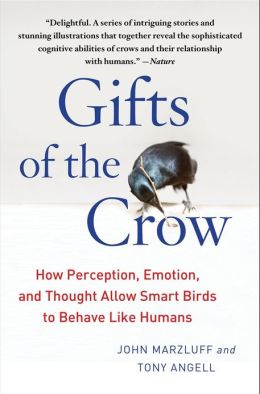
GiftsOfTheCrow Whether we climb up or down the evolutionary scale, one factor remains constant—our human sense of superiority. Despite the castigation of biblical-era thinking in the eyes of many scientists, few are willing to relinquish that Genesis-bestowed sense of being the pinnacle of nature. We know the universe is vast, but we assume we’re the best and brightest in it. Climbing down the ladder a bit, we like to distance ourselves from our fellow creatures because of our superior mental capacity. That is why I am so engrossed by scientists who explore animal intelligence. We find we are not so different after all. Gifts of the Crow: How Perception, Emotion, and Thought Allow Smart Birds to Behave Like Humans, by John Marzluff and Tony Angell is such a book.

If you’re like most people in this electronic age, you probably haven’t given much thought to corvids. Corvids are the members of the crow family: ravens, jays, magpies, and, of course, crows. Scientists have long known that these birds are exceptionally intelligent, and Marzluff and Angell have written a spell-binding little book that shows a remarkable level of intellect among the birds. Documented cases of tool making and use, conscientious interaction, and perhaps even language, have occurred among the corvids. We try to shoo them from our crops with “scarecrows” and we poison them en masse when they become “pests,” but when we take the time to understand them, we find that we may be far darker than the crows.

Not that Gifts of the Crow is all that easy-going. There is plenty of brain physiognomy and quite a bit about brain chemistry here as well. Knowing that not all of us are scientists, though, Marzluff and Angell include a generous portion of narrative description of what corvids have been observed to accomplish. For three days in a row I climbed off the bus stunned, scanning the skies for crows, just to see for myself. In this suburban jungle outside the New York City metropolitan area, crows aren’t so abundant as they were when I lived in the Midwest. They will, however, serve to remind me, when I see one, that our privileged place in nature has more to do with our thumbs than with our intelligence. When I saw a solitary crow atop a tree during a neighborhood stroll after finishing the book, I stopped, smiled, and bowed. Nature belongs to each and every creature, and there sat one intelligent enough to appreciate it.


Ban Ban Go Away

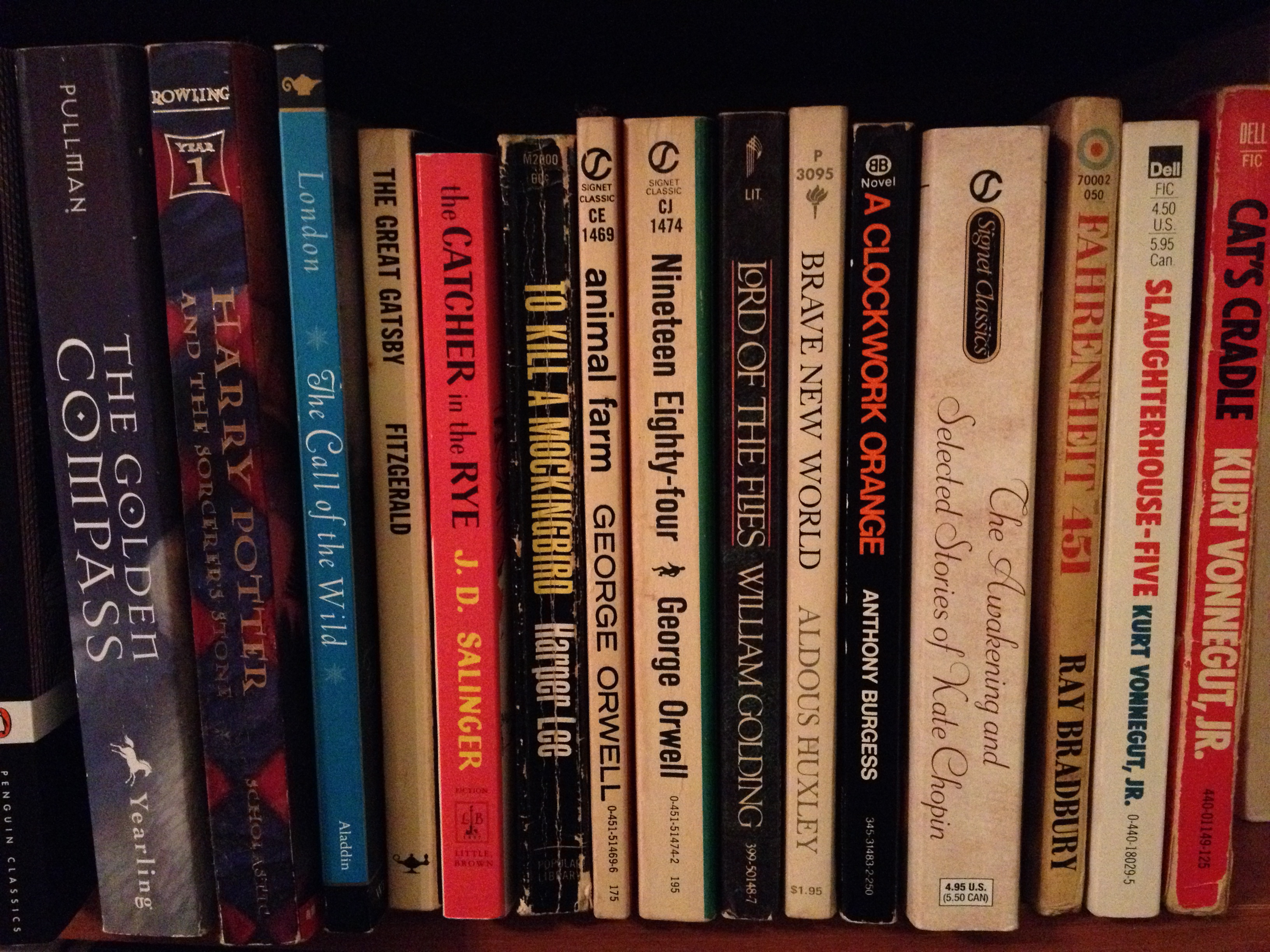
I always seem to discover banned book week in retrospect. With the insane amount of time put into getting to and from work, and actually working, my daily bus ride is my main vehicle (literally) for reading. For eating forbidden fruit. Historically speaking, the first literature was religious literature. Much of it, if anybody bothered to read it, would end up on banned book lists, I’m sure. The Bible is granted a special amnesty, given its reputation as a divinely penned parchment, but it too has its share of unseemly topics. Sex is there almost from the beginning. Violence too. We could go further, but sex and violence are usually sufficient to land a book on the list. And the choices are always so period specific. Catcher in the Rye seems downright tame in the new millennium (or, indeed, Kate Chopin’s The Awakening), and yet we still find new books to condemn. I wonder if such books aren’t forming a new kind of scripture.

There was a time when religion challenged social convention rather than championed it. Religions have been co-opted and domesticated by political interests. Can you imagine the man who overturned money-changers’ tables in the temple on the floor of the stock exchange? We have quantified everything, even—especially—human beings. That which can be quantified can be measured and that which can be measured can be sold. Religions, but only those upholding the status quo, grease those wheels nicely. If we had a chance to know religious founders personally, I suspect we would have found banned books in their libraries. Ideas can be dangerous things.

Despite my generally kind words on this blog, I do read books that I don’t like from time to time. I would never challenge the right of the author to express his or her ideas, nor the publishers (no matter how misguided I think them) for promoting them. I am not the one to quantify. Looking over the American Library Association’s list of banned and frequently challenged books, however, I realize that my fiction-reading hours would be slim indeed. We tend not to ban non-fiction, challenging though it may be. It is the imagination that offends. Such is the power of fiction. Last week was banned book week. Time to look over the list of latest condemned editions to find what to read this week. I am always looking for future scriptures.

The usual suspects...

The usual suspects…


Bible According to Batman

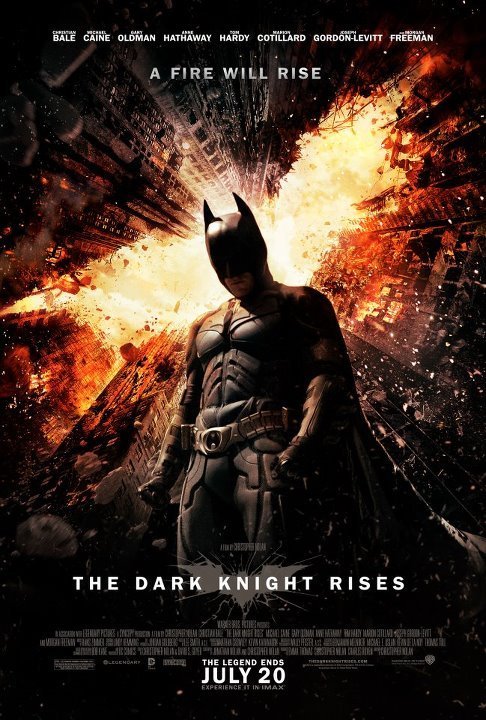
DarkKnightRises Biblical tropes are alive and well in popular culture. Many would choose the flight option rather than admit they enjoy a good Bible story. They may anyway, however, without realizing it. Although The Dark Knight Rises came out over a year ago, I only just had the chance to watch it. For a kid who grew up on the campy 1960’s television series, Christopher Nolan offers adult fare. Put the kiddie menu away and sit up straight at the table. I don’t read reviews, in general, before seeing movies because I don’t enjoy spoilers. I had no idea whether Batman would come out of this alive or not. I wasn’t really even sure who Bane was (even before The Dark Knight everyone knew who the Joker was, or thought they did). The Dark Knight Rises places the whole of Heilsgeschichte (sacred history) before the viewer with verbal cues. Unless you’re reading while watching, you’ll miss it though.

Bruce Wayne is clearly cast as the wounded healer in this final installment of the trilogy. Physically and psychologically crippled, he hobbles around in a combination of Jesus and Yoda figures, somehow supernatural yet fully human. Death and resurrection transpire twice for him in this film. When Bane breaks Batman’s back (an often fatal injury) even Catwoman thinks he might be dead. He is very much alive, however, in the prison only “Bane” escaped (resurrection one). Not only does he rise from the grave, he also ascends into heaven by escaping the well—anyone who’s read Jeremiah, or even Genesis, knows the origin of that motif. Risen, ascended, and glorified, Batman returns to beat the crap out of Bane. But the bomb is still on the loose and before Batman faces his nemesis he tells Commissioner Gordon to arrange “an exodus”—Joseph’s descendants must get out of Egypt. At the Red Sea (the Hudson River) the Pharaoh’s army blocks the exodus of the children of St. Swithun’s who, in response, bow their heads in prayer (am I the only one seeing this?)

Commissioner Gordon, found guilty of betraying the common man, receives the sentence of Exile (“death, by exile” to be precise). Again, those sensitive to Jeremiah know that exile is a kind of death, but death with a noble purpose. The Heilsgeschichte of Israel involves exodus and exile. The Christians added on death, resurrection, and ascension. Christopher Nolan put them together in one Dark Knight. But I mentioned two resurrections, no? Flying the bomb out of Gotham, Batman is definitively blown to smithereens—the blast radius was, after all, six miles. And yet, Alfred has a post-resurrection visitation, where no touching occurs (Touch me not; for I am not yet ascended to my Father) sees his savior. Was the Bat the Holy Spirit on autopilot? Is that Catwoman with him? Might I be so bold as to type Mary Magdalene? Well, I may be over a year late with my observations of The Dark Knight Rises, but as I think Christopher Nolan understands, the Bible has been lying around even longer. If the success of this movie is anything to go by, it will be around for a long time yet to come.


Which Way to Eden?

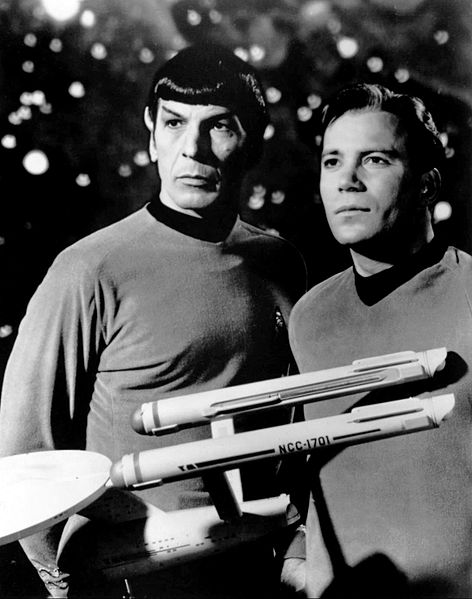
We don’t have television service, and I haven’t watched TV regularly for about two decades. Over the years, however, we’ve collected the DVDs of the shows we miss, or which we wish we’d seen so that we missed them, and use those in lean times. Feeling a bit lonesome over the weekend I downed a few Twilight Zones followed by a Star Trek chaser. On a three year mission to explore strange new worlds, my wife and I have been working our way through Star Trek, the original series. We’ve finally reached the final chapters of the final frontier. I’ve noticed as we’ve gone through the episodes just how biblically literate the series is. Even Spock quotes the Bible from time to time. Over the weekend, to keep my mind off present reality, we ended up watching “The Way to Eden.” As much as I enjoyed Star Trek as a kid, when it was still new, the overtly ’60’s-themed episodes bother me as an adult. I’m very much still a hippie at heart, but I don’t like lingo, and the alien cool cats in their weird shorts and funky hairdos chanting “Herbert! Herbert!” still really bother me. Somewhat predictably the aliens hijack the Enterprise to reach their fabled paradise.

Leonard_Nimoy_William_Shatner_Star_Trek_1968

Spoiler alert! For those of you who’ve been asleep since 1969, or have had no curiosity about the inspiration behind all those geniuses who’ve ushered in the technological revolution, I’m about to reveal some details. Eden is deadly. The landing party finds the short-pants wearing, funky guitar-strumming crooner dead under a fruit tree. “His name was Adam,” Spock laconically notes. The scene of Dr. Sevrin’s burned foot has stayed with me since childhood, and I still cringe when he leaps out of the shuttlecraft to take a bite of the poisoned fruit. It was only as an adult that I realized his name was reminiscent of Eve, indeed, a kind of blending of the words “sin” and “Eve.” In a kind of homoerotic death scene, the two male leaders end up under the tree together. Probably my overactive imagination.

Sometimes I ponder how much a biblically illiterate society misses. I frequently told my students that the Bible is foundational for our culture. Whether or not you’re aware of it, it is reinforced regularly in ways both ortho- and heterodox. Despite our very secular self-awareness, entire movies, such as The Book of Eli, can be based on the premise of biblical literacy. It is entirely possible to watch movies and television shows, and to read novels (graphic and literary) with enjoyment and not notice the allusions. The reasons they are there, however, is that despite the abuses of literalism, the Bible does have some profound things to say. It’s up there with Shakespeare and Chaucer. And even with Roddenberry and his host of staff writers. And I suspect that it still will be, in some form, in the twenty-third century.


Playing Civil

In a piece written for the Los Angeles Times, Joseph Margulies warns of the potential dangers of civil religion. I first learned about civil religion in college in the early 1980s, when the concept was still relatively young. The idea is as deceptively simple as it is accurate: when nationalism reaches its natural limits, the divine is invoked. Civic ceremonies become religious ceremonies—presidents lay hands on Bibles, whether or not they believe. Civil religion dictates that all presidents be portrayed as believers, but that is something we have to take on faith. Civil religion leads to sculptures of the Ten Commandments on courthouse lawns and the flying of United States flags in churches. The danger with this innocent-looking triumphalism is that some people take it too seriously. It is not limited to Christianity, either. Civil religion is a disguised, albeit thinly, form of nationalism.

The vast majority of people in the world hold religious beliefs without deep reflection. That is not to suggest that they don’t believe deeply, but simply that they don’t lift the edges to peer under the surface much. We are taught what to believe by religious specialists. To question them is to question the deity they represent. Since fear is easily ingrained in the human psyche, the angry god is among the most effective of weapons ever devised. We fear for our eternal peril, and it is easier to believe the clergy have the answers than to divine the truth for ourselves. Those who think profoundly about religion, outside the confines of the professional clergy, are always a suspect lot. What business do we have, poking around the beliefs of others?

Civil religion shocked me when I first learned of it. Like the majority of my peers, I had assumed that public displays of piety were to be taken literally. As I began to hang out with clergy and to see how they often transformed outside the church with a fellow “insider” beside them, I started to understand. The cynical asides whispered outside the hearing of the faithful, the double lifestyles, the on-stage personae. This may not have been civil religion, but it was not always what it seemed. Teaching in an Anglo-Catholic seminary, I saw high mass as carefully choreographed as an off-Broadway production of A Chorus Line. Civil religion relies on its partnership with the unquestioned belief of the Saturday-night and Sunday-morning crowd. It all fits easily together and runs as smoothly as a pink Cadillac. Just don’t look under the hood.

IMG_0088


Corn is King

For those who no longer believe in Hell, the DMV can serve a very useful function. Actually, the Department of Motor Vehicles is truly the great leveler of society—just about everyone has to cross its threshold, it is just that they all try to do it at the same time. Waiting in lines has always been a problem for me. It’s not that I think my time is more important than anybody else’s, it’s just that I have so much to do without standing in endless lines. Especially since work keeps me away from useful pursuits for over eleven hours out of every twenty-four, weekends seem somehow too sacred to be spent at the DMV. But the Devil must be paid his due. When paying the Devil, I take along Stephen King to pass the time. So it was over the weekend that I found myself reading “Children of the Corn.”

Of course, like most horror movie fans, I have seen the movie a time or two. I’d never read the story before. This is one of the King tales based most directly on religion gone wrong; the children, as any reader/watcher knows, have distorted Christianity into a midwestern corn-god religion. It may seem unlikely to urban folk, but I have stood next to corn stalks that have towered high above my head, ominously silent like triffids on a sunny Wisconsin afternoon. It can be unnerving. Almost a religious experience. But turning back to King, the story differs from the movie, of course, and what the written version makes clear is that the children distort the New Testament, but leave the Old Testament intact. King, like many horror writers, is biblically literate. Yet, this picture of Old Testament god versus New Testament god is stereotypical and a little misguided. The god of Christianity is a deity of many moods. The wrath in Revelation, or even some of Jesus’ sermons, however, stems directly from Yahweh’s darker moments.

Diablefaucheur

How do we know what is demanded by this mercurial deity? The theological ethicists argue over this daily, but nowhere in the Bible does God have a problem with people treating each other as they would want to be treated. Some of the punishments for minor infractions seem a bit severe—or very severe—but the basic principle, given the Weltanschuung in which it operates, need not cause undue fear. Women, homosexuals, gentiles, Jews, anybody reading parts of the Bible will no doubt be offended by the details. As the saying goes, the Devil is in the details. And that’s why I’m spending my entire Saturday morning at the DMV.


And the Band Played

One of the more curvilinear sequences of numerals has taken on demonic attributes over the centuries. Even the most secular of people, at least in the United States, can identify 666 as some kind of bad juju. The more literate among them will be able to pin the origins more precisely to the book of Revelation, often likely as not misnamed “Revelations”—something sure to drive your New Testament professor as mad as a beast. Fans of true precision will surely want to add that it is Revelation 13.17-18 that makes the number infamous. The latter verse starts out with “Here is wisdom,” which already spells disaster, for who doesn’t want to think him or herself wise? 666 is said to be the number of a man, and is conflated with the “mark of the beast”—one of the quickest ways to bring evolution and economics into the discussion. In popular culture 666 is said to be effective in invoking the devil. This idea is not found in the Bible, but it sure makes for an easy way to identify the Prince of Darkness in movies and popular culture.

The other day I received a mysterious email at work from a “Dr. Strangelove” with the email username of “camus666ster.” Indeed, the topic was appropriately apocalyptic and it managed to make it through a pretty strenuous spam-filter. Here was something apparently supernatural during the work-day. I’m also conscious that a building visible from the window behind my desk is 666 Third Avenue, but I’m pretty certain that these two sexagesimal cousins have nothing to do with one another. It is only a certain religious sensibility that brings them together. Where else in the world do authorities have trouble with people stealing roadsigns for route 666? And why do I get the feeling that someone is watching me?

IMG_0696

Revelation may have had more impact on our culture than any other single book. Whether it’s checking your iPhone for the weather, or wondering what is going to happen next in the Middle East, we all want a view into the future. It is a view that some suppose old John saw while exiled on Patmos. Others recognize that Revelation was a thinly veiled contemporary account to give hope to persecuted Christians in an era of imperial violence. Either way, the book, despite some effort to keep it out, ended up having the final say in the Christian canon. In a nation where every person possesses several unique identifiers, we still look over our collective shoulders for an anonymous beast who is about to bring down society. Don’t worry, folks, I’ve got his number.


Fair Country?

One of the lesser known Bruce Springsteen songs is “County Fair.” I hadn’t heard the song until I purchased The Essential Bruce Springsteen some years back when you actually had to buy a disc to get the music. Not a rock-n-roll anthem, it is a quiet, poignant song about the existential pleasures of a county fair. My daughter has been a 4-H member for six years and we’ve annually attended our county fair-the largest free fair east of the Mississippi, it is said-each of those years. In a good year 10,000 people will wander through, looking at farm animals that seem so foreign in our urban lives and which most people only recognize covered in gravy or some glaze. They see the exotic animals and pets so cute that they should be illegal. Like a fledgling college campus there are Arts and Sciences tents. Model planes, model trains, and model automobiles. To a sophisticated adult this might seem like pretty mind-numbing stuff, but I never fail to leave feeling inspired. I play “County Fair” religiously before heading out the door. Yesterday saw the close of the sixty-fifth Somerset County 4-H Fair, and despite the periodic showers, people seemed to be enjoying themselves.

Under the commercial tent stands the Gideons’ table. Each year the fair is literally littered with free Bibles. I noticed with interest that the sign, which had originally read “Free Testaments” had been redacted to “Free New Testaments.” I tried to imagine the conversations, or confrontations that led to such a change. I can’t say for certain, but I suspect Hebrew Bible professors are not among the higher demographics of fair attendees. Most of the colleagues I know would never confront a poor Gideonite about ambiguously handing out New Testaments. I did, however, experience a kind of existential downgrade here. Christians used to declare, doctrinally at least, that the “testaments” were equal. Sure, when you’re standing on the George Washington Bridge trying to decide whether or not to jump, there’s some parts of the older testament that you’d probably be better off not reading. Nevertheless, doesn’t the rule book say the two are part of a whole?

IMG_0922

Nationally, as I well know, there are fewer “Old Testament” jobs than “New Testament.” But that slick little book the Gideons hand out feels a lot more streamlined than the bulky full edition. And I also realize that walking around a relaxing event like a county fair, seeking the most innocent kinds of fun imaginable, that a Bible in your hip pocket is probably overkill. There seems to be no devil lurking here among the sheep and the goats. Feet damp from the rain, under a cloudy, August nighttime sky, sitting in the car my daughter reflects on how this is her last fair as a 4-H member. I wish there were some twinkling stars overhead to make this a storybook ending. But all I’ve got is a truncated Bible in my pocket, and it is missing my favorite part.


Five Man Electrical Band

I grew up looking for signs. If you sincerely believe the Fundamentalist worldview, then we are all part of a great, divine dramaturgy in which we have expected roles to fulfill. The script (Holy Scripture) is a little vague on the individual details, but if you know where to look you can find signs. They may be obvious and literal or subtle and ambiguous. The faithful, however, know they must seek them out and take their chances. I grew up in a decidedly blue-collar world. In my head, though, it felt like I was meant for something more. My career ambition was to be a janitor, but my reading and the counsel I received from those who knew more than I did suggested I might have a higher calling. The concept was unfamiliar at first, but compelling. I had to be able to read the signs. I remember hearing about seminary for the first time. If I was going to be a preacher, I had to go to seminary. The summer before starting college, I sat on the dilapidated front porch of my step-father’s house and taught myself to draw the Greek alphabet. Signs were rare, but when spotted, definitive.

Seminary came to define my existence in a way that I couldn’t foresee. I started college with the idea that, all things being equal, I’d end up at seminary. Still, I was drawn to the life of a faculty member in a liberal arts setting. Eventually, I recognized it as my calling. Getting to seminary proved more difficult than I’d imagined. It wasn’t the grades—it was the expenses. I was in debt and I knew that bank barons did not forgive us ours as we forgave others theirs. In seminary, signs came to take on differing interpretations. Maybe I was correct about ministry or maybe not. Looking closely, I could see that the script had marginal notes, and that it wasn’t even the original manuscript after all. I’d learned original languages only to become more confused about the signs. When I left seminary I knew one thing for certain—I didn’t ever want to teach in one.

My first professional job, of course, was teaching in a seminary. It was not a matter of free choice as much as free economy in free-fall. In the early ’90’s recession, jobs were few and signs completely distorted. When impolitely asked to leave my seminary position after a decade and a half, I was type-cast as a bit-player. The washed-up seminary teacher. I began to see signs along the highway for seminaries trying to recruit potential clergy. This was no longer a calling, but a job option. Don’t enjoy the rat race? Why not try opting out? The pay won’t be as good, and society will come to despise the very doctrines you’ll be taught, but at least it’s a living. I still see such signs. And I’m still not sure if I’m reading correctly. And even today, I notice with appreciation when a floor is expertly stripped, cleaned, and waxed.

IMG_0723