Nothing Unusual

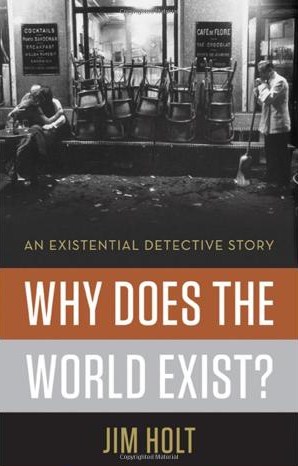
WhyDoestheWorldExist“Is this a world?” Ranger Tom asks seriously, “And if it is, am I in it?” On the lips—or fingertips—of some, this set of questions appears profound. Although I’m not technically a philosopher, I find it impossible to walk by a book with the title Why Does the World Exist? and not pick it up. I am not familiar with Jim Holt’s other work—I engage a little too heavily with books to spend much time with magazines—but the question of the title is one I’ve often pondered. It is right up there with “Why can some people get published and others can’t?” Holt is, however, on a serious quest. Not surprisingly, religion features prominently in the discussion. For the usual existential reasons, including a couple of significant deaths in the family, Holt asks perhaps the most basic of all questions and engages a number of prominent philosophers on the issue. Why is there something rather than nothing? For some in the western world such a question appears a non-starter, because our culture is biblically suffused. Whether we want to admit it or not, our social ocean veritably bobs with the basic belief that God created the world, end of story. We don’t need to ponder it, we just have to accept it. For those who look deeper, however, the answers aren’t that easy.

Holt goes through some serious computation in various forms of logic to try to arrive at a schematic demonstrating that the world is a surprising place. Not trained in such rigorous logic, I was interested to notice how the language occasionally slipped from “world” or “universe” to “reality.” Reality is perhaps the slipperiest concept of them all. Many simply accept their own experience as real, a position known as “naive realism.” Others probe somewhat deeper, seeking to verify reality. How do we know what is really real? It is, however, a different question than the existence of the world. Reality has the distinct ability to haunt with its half-answered questions and surfeit of ambiguity. Every time I wake from a dream I ask myself what is really real.

Once the divine is removed from the equation, why the world is here becomes a much more complex issue. Holt engages the new atheists as well as the neo-orthodox. It turns out that God may not help as much as we generally assume: whence God? Or, in its more childlike version, where did God come from? Once brute fact is ruled out, this becomes a tangled problem indeed. Faced with an endless regression, logic quails. Perhaps, however, we have reached the limits of rationality—even Einsteinian physics breaks down at the Big Bang. No matter what scientists or philosophers may tell us, we will always wonder, “and before that, what?” I put Holt’s book down with a sense that I’d spent a few pleasant hours considering the possibilities, but I still wonder, with Ranger Tom, if this is a world. And if it is, am I in it?

A Dog’s (Inner) Life

Last week’s Sunday Review in the New York Times included a piece tucked under Opinion entitled “Dogs Are People, Too.” Gregory Berns, the article’s author, a professor at Emory University, describes how he trained his dog to enter and remain still inside an MRI machine long enough to scan brain activity. The results, repeated on other trained dogs, indicated that dogs share the same level of sentience as a human child. Berns’ conclusion: dogs are persons. I tend to agree. Although I’m no longer a pet “owner,” I grew up with dogs (and cats, birds, reptiles, and hamsters). There was never any question in my mind that our dogs could think. The also shared emotions with people—as Holmes would say, it’s elementary. Obvious. Staring at you with puppy-dog-brown-eyes-right-in-the-face obvious. Science, however, has always had an uneasy relationship with consciousness, the ghost in the machine. Dogs, many declare, are just machines. They salivate at the sound of a bell, for goodness sake!

Berns, however, has found the holy grail of scientific proof. The brain scan is accepted as a measure of human conscious activity. It is difficult enough to lure a human into an MRI and have her or him hold still. Dogs, however, are smart. They can be trained to do this too. Berns has succeeded and now has evidence that the emotional centers in dogs’ brains respond much like human brains. If they are emotional beings, as many of us knew all along, they are persons. Berns points out that this has legal implications. We make laws about unborn humans, but we treat fully alive canines like, well, dogs. Consciousness is part of the animal, and perhaps even the plant world. That stands to reason, if not scientific proof.

Christianity is largely responsible for advocating the concept of human superiority. We are, after all, made in the image of God. The Bible tells me so. Although scientists tend to abandon the Bible, they retain the myth of human superiority. Some concepts are just too convenient to relinquish, even in a rational world. We assume, since animals don’t talk the way that people do, that they are not thinking creatures. Even scientists appear afraid, at times, to take on the immaterial concept of thought. If the materialistic view is correct, thoughts are only electrochemical signals. Only this, and nothing more. As time nears to get dressed for work, I’d like to send my electrochemical signals out to get the paper. If I do the paper will still be on the lawn when I get home at the end of the day. I’ll have to fetch my own slippers, I guess.

Need I say more?

Need I say more?


Crowing Up

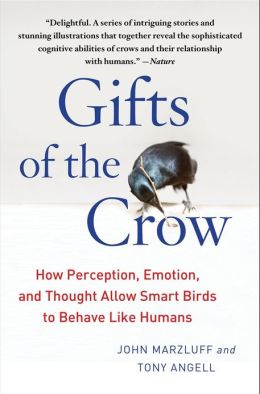
GiftsOfTheCrow Whether we climb up or down the evolutionary scale, one factor remains constant—our human sense of superiority. Despite the castigation of biblical-era thinking in the eyes of many scientists, few are willing to relinquish that Genesis-bestowed sense of being the pinnacle of nature. We know the universe is vast, but we assume we’re the best and brightest in it. Climbing down the ladder a bit, we like to distance ourselves from our fellow creatures because of our superior mental capacity. That is why I am so engrossed by scientists who explore animal intelligence. We find we are not so different after all. Gifts of the Crow: How Perception, Emotion, and Thought Allow Smart Birds to Behave Like Humans, by John Marzluff and Tony Angell is such a book.

If you’re like most people in this electronic age, you probably haven’t given much thought to corvids. Corvids are the members of the crow family: ravens, jays, magpies, and, of course, crows. Scientists have long known that these birds are exceptionally intelligent, and Marzluff and Angell have written a spell-binding little book that shows a remarkable level of intellect among the birds. Documented cases of tool making and use, conscientious interaction, and perhaps even language, have occurred among the corvids. We try to shoo them from our crops with “scarecrows” and we poison them en masse when they become “pests,” but when we take the time to understand them, we find that we may be far darker than the crows.

Not that Gifts of the Crow is all that easy-going. There is plenty of brain physiognomy and quite a bit about brain chemistry here as well. Knowing that not all of us are scientists, though, Marzluff and Angell include a generous portion of narrative description of what corvids have been observed to accomplish. For three days in a row I climbed off the bus stunned, scanning the skies for crows, just to see for myself. In this suburban jungle outside the New York City metropolitan area, crows aren’t so abundant as they were when I lived in the Midwest. They will, however, serve to remind me, when I see one, that our privileged place in nature has more to do with our thumbs than with our intelligence. When I saw a solitary crow atop a tree during a neighborhood stroll after finishing the book, I stopped, smiled, and bowed. Nature belongs to each and every creature, and there sat one intelligent enough to appreciate it.


Ban Ban Go Away

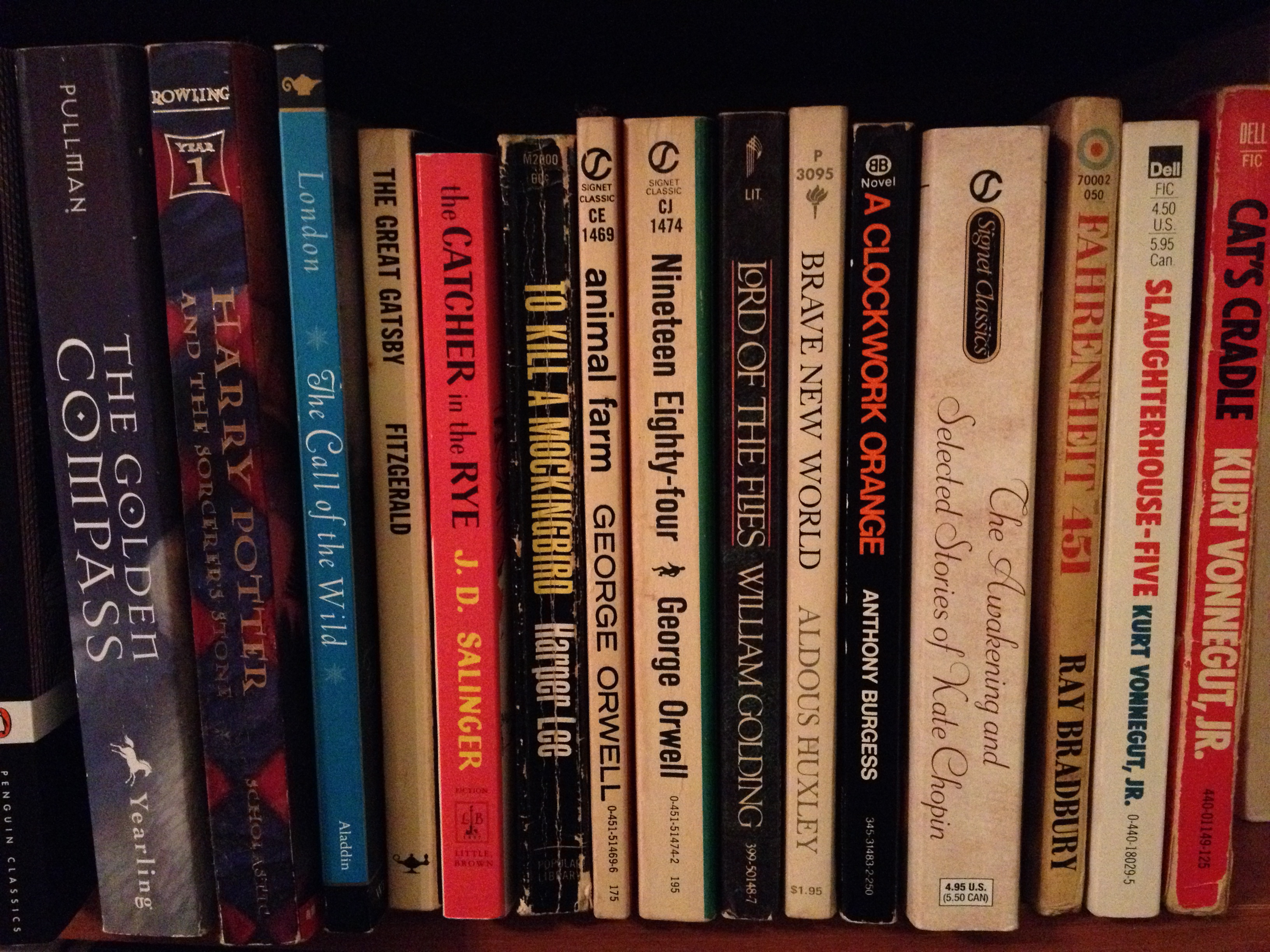
I always seem to discover banned book week in retrospect. With the insane amount of time put into getting to and from work, and actually working, my daily bus ride is my main vehicle (literally) for reading. For eating forbidden fruit. Historically speaking, the first literature was religious literature. Much of it, if anybody bothered to read it, would end up on banned book lists, I’m sure. The Bible is granted a special amnesty, given its reputation as a divinely penned parchment, but it too has its share of unseemly topics. Sex is there almost from the beginning. Violence too. We could go further, but sex and violence are usually sufficient to land a book on the list. And the choices are always so period specific. Catcher in the Rye seems downright tame in the new millennium (or, indeed, Kate Chopin’s The Awakening), and yet we still find new books to condemn. I wonder if such books aren’t forming a new kind of scripture.

There was a time when religion challenged social convention rather than championed it. Religions have been co-opted and domesticated by political interests. Can you imagine the man who overturned money-changers’ tables in the temple on the floor of the stock exchange? We have quantified everything, even—especially—human beings. That which can be quantified can be measured and that which can be measured can be sold. Religions, but only those upholding the status quo, grease those wheels nicely. If we had a chance to know religious founders personally, I suspect we would have found banned books in their libraries. Ideas can be dangerous things.

Despite my generally kind words on this blog, I do read books that I don’t like from time to time. I would never challenge the right of the author to express his or her ideas, nor the publishers (no matter how misguided I think them) for promoting them. I am not the one to quantify. Looking over the American Library Association’s list of banned and frequently challenged books, however, I realize that my fiction-reading hours would be slim indeed. We tend not to ban non-fiction, challenging though it may be. It is the imagination that offends. Such is the power of fiction. Last week was banned book week. Time to look over the list of latest condemned editions to find what to read this week. I am always looking for future scriptures.

The usual suspects...

The usual suspects…


Bible According to Batman

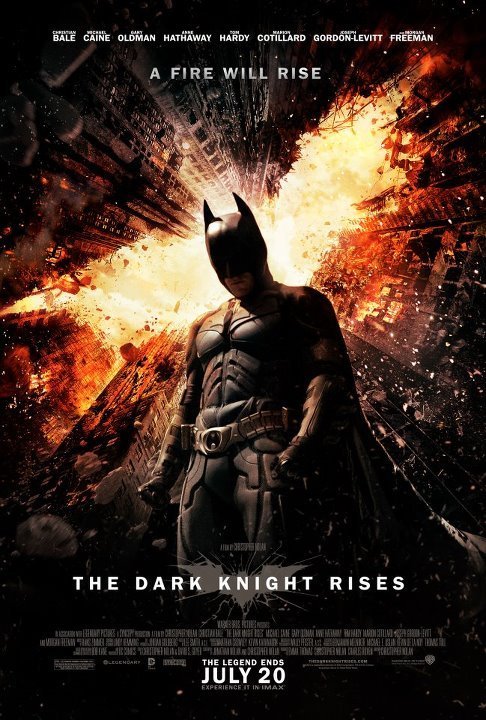
DarkKnightRises Biblical tropes are alive and well in popular culture. Many would choose the flight option rather than admit they enjoy a good Bible story. They may anyway, however, without realizing it. Although The Dark Knight Rises came out over a year ago, I only just had the chance to watch it. For a kid who grew up on the campy 1960’s television series, Christopher Nolan offers adult fare. Put the kiddie menu away and sit up straight at the table. I don’t read reviews, in general, before seeing movies because I don’t enjoy spoilers. I had no idea whether Batman would come out of this alive or not. I wasn’t really even sure who Bane was (even before The Dark Knight everyone knew who the Joker was, or thought they did). The Dark Knight Rises places the whole of Heilsgeschichte (sacred history) before the viewer with verbal cues. Unless you’re reading while watching, you’ll miss it though.

Bruce Wayne is clearly cast as the wounded healer in this final installment of the trilogy. Physically and psychologically crippled, he hobbles around in a combination of Jesus and Yoda figures, somehow supernatural yet fully human. Death and resurrection transpire twice for him in this film. When Bane breaks Batman’s back (an often fatal injury) even Catwoman thinks he might be dead. He is very much alive, however, in the prison only “Bane” escaped (resurrection one). Not only does he rise from the grave, he also ascends into heaven by escaping the well—anyone who’s read Jeremiah, or even Genesis, knows the origin of that motif. Risen, ascended, and glorified, Batman returns to beat the crap out of Bane. But the bomb is still on the loose and before Batman faces his nemesis he tells Commissioner Gordon to arrange “an exodus”—Joseph’s descendants must get out of Egypt. At the Red Sea (the Hudson River) the Pharaoh’s army blocks the exodus of the children of St. Swithun’s who, in response, bow their heads in prayer (am I the only one seeing this?)

Commissioner Gordon, found guilty of betraying the common man, receives the sentence of Exile (“death, by exile” to be precise). Again, those sensitive to Jeremiah know that exile is a kind of death, but death with a noble purpose. The Heilsgeschichte of Israel involves exodus and exile. The Christians added on death, resurrection, and ascension. Christopher Nolan put them together in one Dark Knight. But I mentioned two resurrections, no? Flying the bomb out of Gotham, Batman is definitively blown to smithereens—the blast radius was, after all, six miles. And yet, Alfred has a post-resurrection visitation, where no touching occurs (Touch me not; for I am not yet ascended to my Father) sees his savior. Was the Bat the Holy Spirit on autopilot? Is that Catwoman with him? Might I be so bold as to type Mary Magdalene? Well, I may be over a year late with my observations of The Dark Knight Rises, but as I think Christopher Nolan understands, the Bible has been lying around even longer. If the success of this movie is anything to go by, it will be around for a long time yet to come.


Which Way to Eden?

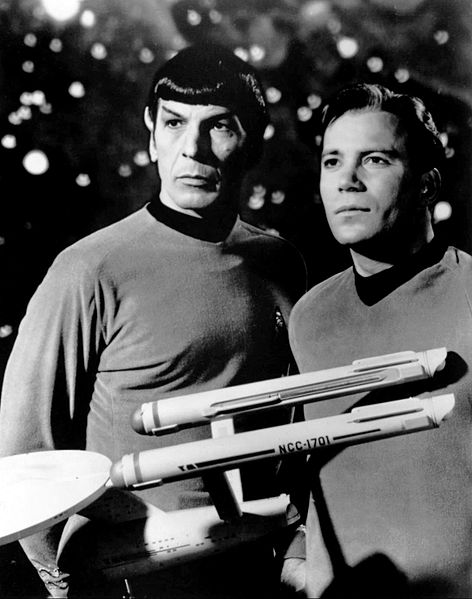
We don’t have television service, and I haven’t watched TV regularly for about two decades. Over the years, however, we’ve collected the DVDs of the shows we miss, or which we wish we’d seen so that we missed them, and use those in lean times. Feeling a bit lonesome over the weekend I downed a few Twilight Zones followed by a Star Trek chaser. On a three year mission to explore strange new worlds, my wife and I have been working our way through Star Trek, the original series. We’ve finally reached the final chapters of the final frontier. I’ve noticed as we’ve gone through the episodes just how biblically literate the series is. Even Spock quotes the Bible from time to time. Over the weekend, to keep my mind off present reality, we ended up watching “The Way to Eden.” As much as I enjoyed Star Trek as a kid, when it was still new, the overtly ’60’s-themed episodes bother me as an adult. I’m very much still a hippie at heart, but I don’t like lingo, and the alien cool cats in their weird shorts and funky hairdos chanting “Herbert! Herbert!” still really bother me. Somewhat predictably the aliens hijack the Enterprise to reach their fabled paradise.

Leonard_Nimoy_William_Shatner_Star_Trek_1968

Spoiler alert! For those of you who’ve been asleep since 1969, or have had no curiosity about the inspiration behind all those geniuses who’ve ushered in the technological revolution, I’m about to reveal some details. Eden is deadly. The landing party finds the short-pants wearing, funky guitar-strumming crooner dead under a fruit tree. “His name was Adam,” Spock laconically notes. The scene of Dr. Sevrin’s burned foot has stayed with me since childhood, and I still cringe when he leaps out of the shuttlecraft to take a bite of the poisoned fruit. It was only as an adult that I realized his name was reminiscent of Eve, indeed, a kind of blending of the words “sin” and “Eve.” In a kind of homoerotic death scene, the two male leaders end up under the tree together. Probably my overactive imagination.

Sometimes I ponder how much a biblically illiterate society misses. I frequently told my students that the Bible is foundational for our culture. Whether or not you’re aware of it, it is reinforced regularly in ways both ortho- and heterodox. Despite our very secular self-awareness, entire movies, such as The Book of Eli, can be based on the premise of biblical literacy. It is entirely possible to watch movies and television shows, and to read novels (graphic and literary) with enjoyment and not notice the allusions. The reasons they are there, however, is that despite the abuses of literalism, the Bible does have some profound things to say. It’s up there with Shakespeare and Chaucer. And even with Roddenberry and his host of staff writers. And I suspect that it still will be, in some form, in the twenty-third century.


Playing Civil

In a piece written for the Los Angeles Times, Joseph Margulies warns of the potential dangers of civil religion. I first learned about civil religion in college in the early 1980s, when the concept was still relatively young. The idea is as deceptively simple as it is accurate: when nationalism reaches its natural limits, the divine is invoked. Civic ceremonies become religious ceremonies—presidents lay hands on Bibles, whether or not they believe. Civil religion dictates that all presidents be portrayed as believers, but that is something we have to take on faith. Civil religion leads to sculptures of the Ten Commandments on courthouse lawns and the flying of United States flags in churches. The danger with this innocent-looking triumphalism is that some people take it too seriously. It is not limited to Christianity, either. Civil religion is a disguised, albeit thinly, form of nationalism.

The vast majority of people in the world hold religious beliefs without deep reflection. That is not to suggest that they don’t believe deeply, but simply that they don’t lift the edges to peer under the surface much. We are taught what to believe by religious specialists. To question them is to question the deity they represent. Since fear is easily ingrained in the human psyche, the angry god is among the most effective of weapons ever devised. We fear for our eternal peril, and it is easier to believe the clergy have the answers than to divine the truth for ourselves. Those who think profoundly about religion, outside the confines of the professional clergy, are always a suspect lot. What business do we have, poking around the beliefs of others?

Civil religion shocked me when I first learned of it. Like the majority of my peers, I had assumed that public displays of piety were to be taken literally. As I began to hang out with clergy and to see how they often transformed outside the church with a fellow “insider” beside them, I started to understand. The cynical asides whispered outside the hearing of the faithful, the double lifestyles, the on-stage personae. This may not have been civil religion, but it was not always what it seemed. Teaching in an Anglo-Catholic seminary, I saw high mass as carefully choreographed as an off-Broadway production of A Chorus Line. Civil religion relies on its partnership with the unquestioned belief of the Saturday-night and Sunday-morning crowd. It all fits easily together and runs as smoothly as a pink Cadillac. Just don’t look under the hood.

IMG_0088


Corn is King

For those who no longer believe in Hell, the DMV can serve a very useful function. Actually, the Department of Motor Vehicles is truly the great leveler of society—just about everyone has to cross its threshold, it is just that they all try to do it at the same time. Waiting in lines has always been a problem for me. It’s not that I think my time is more important than anybody else’s, it’s just that I have so much to do without standing in endless lines. Especially since work keeps me away from useful pursuits for over eleven hours out of every twenty-four, weekends seem somehow too sacred to be spent at the DMV. But the Devil must be paid his due. When paying the Devil, I take along Stephen King to pass the time. So it was over the weekend that I found myself reading “Children of the Corn.”

Of course, like most horror movie fans, I have seen the movie a time or two. I’d never read the story before. This is one of the King tales based most directly on religion gone wrong; the children, as any reader/watcher knows, have distorted Christianity into a midwestern corn-god religion. It may seem unlikely to urban folk, but I have stood next to corn stalks that have towered high above my head, ominously silent like triffids on a sunny Wisconsin afternoon. It can be unnerving. Almost a religious experience. But turning back to King, the story differs from the movie, of course, and what the written version makes clear is that the children distort the New Testament, but leave the Old Testament intact. King, like many horror writers, is biblically literate. Yet, this picture of Old Testament god versus New Testament god is stereotypical and a little misguided. The god of Christianity is a deity of many moods. The wrath in Revelation, or even some of Jesus’ sermons, however, stems directly from Yahweh’s darker moments.

Diablefaucheur

How do we know what is demanded by this mercurial deity? The theological ethicists argue over this daily, but nowhere in the Bible does God have a problem with people treating each other as they would want to be treated. Some of the punishments for minor infractions seem a bit severe—or very severe—but the basic principle, given the Weltanschuung in which it operates, need not cause undue fear. Women, homosexuals, gentiles, Jews, anybody reading parts of the Bible will no doubt be offended by the details. As the saying goes, the Devil is in the details. And that’s why I’m spending my entire Saturday morning at the DMV.


And the Band Played

One of the more curvilinear sequences of numerals has taken on demonic attributes over the centuries. Even the most secular of people, at least in the United States, can identify 666 as some kind of bad juju. The more literate among them will be able to pin the origins more precisely to the book of Revelation, often likely as not misnamed “Revelations”—something sure to drive your New Testament professor as mad as a beast. Fans of true precision will surely want to add that it is Revelation 13.17-18 that makes the number infamous. The latter verse starts out with “Here is wisdom,” which already spells disaster, for who doesn’t want to think him or herself wise? 666 is said to be the number of a man, and is conflated with the “mark of the beast”—one of the quickest ways to bring evolution and economics into the discussion. In popular culture 666 is said to be effective in invoking the devil. This idea is not found in the Bible, but it sure makes for an easy way to identify the Prince of Darkness in movies and popular culture.

The other day I received a mysterious email at work from a “Dr. Strangelove” with the email username of “camus666ster.” Indeed, the topic was appropriately apocalyptic and it managed to make it through a pretty strenuous spam-filter. Here was something apparently supernatural during the work-day. I’m also conscious that a building visible from the window behind my desk is 666 Third Avenue, but I’m pretty certain that these two sexagesimal cousins have nothing to do with one another. It is only a certain religious sensibility that brings them together. Where else in the world do authorities have trouble with people stealing roadsigns for route 666? And why do I get the feeling that someone is watching me?

IMG_0696

Revelation may have had more impact on our culture than any other single book. Whether it’s checking your iPhone for the weather, or wondering what is going to happen next in the Middle East, we all want a view into the future. It is a view that some suppose old John saw while exiled on Patmos. Others recognize that Revelation was a thinly veiled contemporary account to give hope to persecuted Christians in an era of imperial violence. Either way, the book, despite some effort to keep it out, ended up having the final say in the Christian canon. In a nation where every person possesses several unique identifiers, we still look over our collective shoulders for an anonymous beast who is about to bring down society. Don’t worry, folks, I’ve got his number.


Fair Country?

One of the lesser known Bruce Springsteen songs is “County Fair.” I hadn’t heard the song until I purchased The Essential Bruce Springsteen some years back when you actually had to buy a disc to get the music. Not a rock-n-roll anthem, it is a quiet, poignant song about the existential pleasures of a county fair. My daughter has been a 4-H member for six years and we’ve annually attended our county fair-the largest free fair east of the Mississippi, it is said-each of those years. In a good year 10,000 people will wander through, looking at farm animals that seem so foreign in our urban lives and which most people only recognize covered in gravy or some glaze. They see the exotic animals and pets so cute that they should be illegal. Like a fledgling college campus there are Arts and Sciences tents. Model planes, model trains, and model automobiles. To a sophisticated adult this might seem like pretty mind-numbing stuff, but I never fail to leave feeling inspired. I play “County Fair” religiously before heading out the door. Yesterday saw the close of the sixty-fifth Somerset County 4-H Fair, and despite the periodic showers, people seemed to be enjoying themselves.

Under the commercial tent stands the Gideons’ table. Each year the fair is literally littered with free Bibles. I noticed with interest that the sign, which had originally read “Free Testaments” had been redacted to “Free New Testaments.” I tried to imagine the conversations, or confrontations that led to such a change. I can’t say for certain, but I suspect Hebrew Bible professors are not among the higher demographics of fair attendees. Most of the colleagues I know would never confront a poor Gideonite about ambiguously handing out New Testaments. I did, however, experience a kind of existential downgrade here. Christians used to declare, doctrinally at least, that the “testaments” were equal. Sure, when you’re standing on the George Washington Bridge trying to decide whether or not to jump, there’s some parts of the older testament that you’d probably be better off not reading. Nevertheless, doesn’t the rule book say the two are part of a whole?

IMG_0922

Nationally, as I well know, there are fewer “Old Testament” jobs than “New Testament.” But that slick little book the Gideons hand out feels a lot more streamlined than the bulky full edition. And I also realize that walking around a relaxing event like a county fair, seeking the most innocent kinds of fun imaginable, that a Bible in your hip pocket is probably overkill. There seems to be no devil lurking here among the sheep and the goats. Feet damp from the rain, under a cloudy, August nighttime sky, sitting in the car my daughter reflects on how this is her last fair as a 4-H member. I wish there were some twinkling stars overhead to make this a storybook ending. But all I’ve got is a truncated Bible in my pocket, and it is missing my favorite part.


Five Man Electrical Band

I grew up looking for signs. If you sincerely believe the Fundamentalist worldview, then we are all part of a great, divine dramaturgy in which we have expected roles to fulfill. The script (Holy Scripture) is a little vague on the individual details, but if you know where to look you can find signs. They may be obvious and literal or subtle and ambiguous. The faithful, however, know they must seek them out and take their chances. I grew up in a decidedly blue-collar world. In my head, though, it felt like I was meant for something more. My career ambition was to be a janitor, but my reading and the counsel I received from those who knew more than I did suggested I might have a higher calling. The concept was unfamiliar at first, but compelling. I had to be able to read the signs. I remember hearing about seminary for the first time. If I was going to be a preacher, I had to go to seminary. The summer before starting college, I sat on the dilapidated front porch of my step-father’s house and taught myself to draw the Greek alphabet. Signs were rare, but when spotted, definitive.

Seminary came to define my existence in a way that I couldn’t foresee. I started college with the idea that, all things being equal, I’d end up at seminary. Still, I was drawn to the life of a faculty member in a liberal arts setting. Eventually, I recognized it as my calling. Getting to seminary proved more difficult than I’d imagined. It wasn’t the grades—it was the expenses. I was in debt and I knew that bank barons did not forgive us ours as we forgave others theirs. In seminary, signs came to take on differing interpretations. Maybe I was correct about ministry or maybe not. Looking closely, I could see that the script had marginal notes, and that it wasn’t even the original manuscript after all. I’d learned original languages only to become more confused about the signs. When I left seminary I knew one thing for certain—I didn’t ever want to teach in one.

My first professional job, of course, was teaching in a seminary. It was not a matter of free choice as much as free economy in free-fall. In the early ’90’s recession, jobs were few and signs completely distorted. When impolitely asked to leave my seminary position after a decade and a half, I was type-cast as a bit-player. The washed-up seminary teacher. I began to see signs along the highway for seminaries trying to recruit potential clergy. This was no longer a calling, but a job option. Don’t enjoy the rat race? Why not try opting out? The pay won’t be as good, and society will come to despise the very doctrines you’ll be taught, but at least it’s a living. I still see such signs. And I’m still not sure if I’m reading correctly. And even today, I notice with appreciation when a floor is expertly stripped, cleaned, and waxed.

IMG_0723


Firelands

BayardFirelandsPiper Bayard has been a long-time blogging buddy of mine. She’s kind enough to comment on many of my posts and even kinder to like even more. Piper recently published her novel Firelands, and she sent me a copy that I began reading right away. My schedule this entire month has been unfriendly to literacy, but I was always glad to have a few minutes to read a few more chapters of an intriguing post-apocalyptic future. What’s more, Piper is keenly aware that religion is behind much of politics—a point she boldly makes by constructing a dictatorship based around a miracle-claiming prophet-king who oppresses those who don’t believe—the Seculars, or “Secs.” Interestingly, Piper decided on the name Josephites for the religious rulers, and there are dark undertones here for those who know their religious history. As an unabashed fan of allegorical writing, I saw quite a lot here that was, well, apocalyptic, in the literal sense of the word.

In a misogynic future, the Josephites, who dwell in cities, burn many women for various heretical crimes in autos-da-fé entitled Atonements. These human sacrifices ensure fertility and also help to explain the trials of life in a post-cataclysmic world. The protagonist, Archer, has to not only survive, but to try to save her cousin, a grandchild of the eponymous Joseph, from the flames. The Josephites live in a society of thinly rooted but strongly mandated religion. There is an underground of true Christians, and Archer, although a Sec, acts with more compassion than any of the Josephites, except perhaps her cousin. In a world that has lost its bearings, religion both undergirds and undermines a dystopian society where differences of faith have come to define everyone’s role in a harsh world. (Those who have ears to hear, let them hear.)

In this world where heaven is a fiery hell, I realized that Archer was more familiar than she first seemed. A female warrior, she opens the book by tracking a large stag to feed her starving people. Nevertheless, it took me many chapters to realize that she was a hypostatic Artemis, the goddess of the hunt. No wonder she couldn’t convert to the standard religion! Her example leads the way toward a renewable and sustainable future, in touch with nature, while the “religious” in their urban environment are dying on the vine as they appear to thrive. This is a world where old gods are more authentic than an enforced religion that few believe and that only rules through fear. There is much more I could say about Piper’s fascinating book, but I want you to read it for yourself. Visit Piper’s website for more information, and support the work of an author who really has something to say!


Tempting Truth

Recently I was discussing the internet with friends. Real ones, I mean, physically in the room with me. One asked if the internet made conspiracy theories more believable. My response was that the internet has changed truth. That probably seems like a bold statement, I know. Truth, however, is an abstract very difficult to pin down. Science, for starters, does not deliver truth. Science is theoretical, and since it is falsifiable, a scientific theory, while based on facts, is always contingent; it is the best explanation that we have at the moment. Scientists generally know not to conflate this with truth, deferring the latter to the realm of philosophy. The average person probably conceives of truth as that which is literally real. Reality itself is, however, a very slippery concept—quantum physics reveals realities where many are not comfortable going, and which very few truly understand. Truth is a philosophical concept that reflects what humanity collectively accepts to be reality. It is in this sense that the internet has changed truth. It is the Wikipedification of the mind.

People, for as long as they’ve had the luxury to consider abstracts, have struggled with the question of truth. For a few centuries—almost a couple of millennia—in much of the western world, the Bible was considered a source of truth. If it was in there, it was true. The source of authority here was that of a deity who oversaw the writing of the Bible, word by sacred word. When science began to demonstrate that this Weltanschuung was untenable, people realized that truth was a bit more complex. When westerners came into contact with other religions, the complexity grew. Large swaths of humanity believed things completely different from the rest of us. What was the truth? A rear-guard action was often the result. Those who had the Bible had the truth already, and since truth doesn’t change, what more was there to be said.

Truth or dare?

Truth or dare?

The internet is not yet a mature adult, but an entire generation has now grown to a kind of maturity with it. It is the first line of recourse for true information. Who has a phonebook in their house anymore? When is the last time you opened a physical dictionary? Some of us routinely look up Bible verses online, since the internet is the ultimate concordance. Instead of turning to the Bible, or any other source, we turn to the collective “wisdom” of humanity as the measure of what is true. Snopes aside, we plow ahead with what we read online, confident that with all those millions of users, we just can’t be wrong. How strange a concept to unplug and look at the actual reality behind the screen. We might be surprised to learn that there are great and terrible wizards back there after all.


The Good Magazine

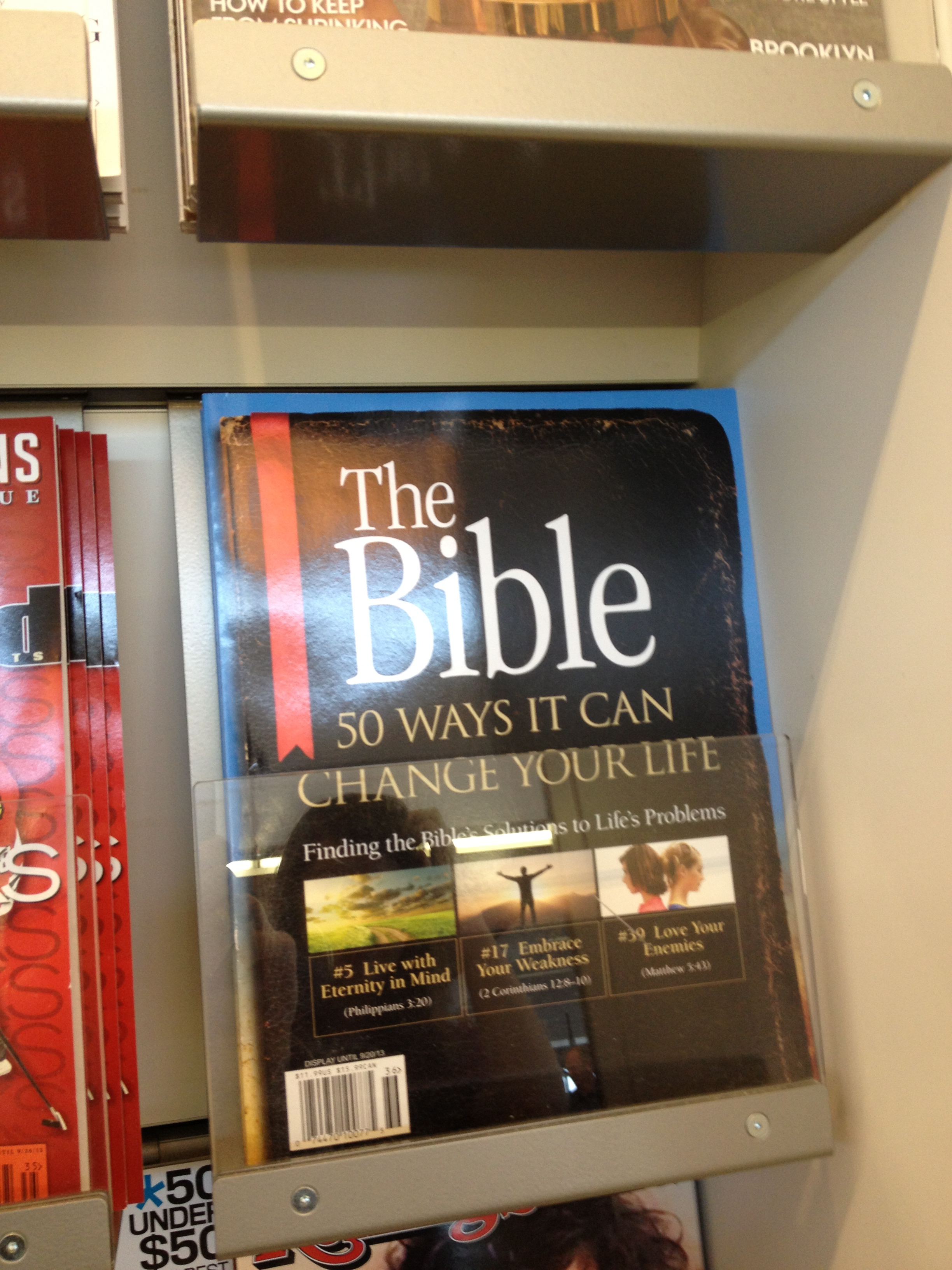
IMG_0902I saw this magazine in a store recently. The temptation to buy it was compelling, but with international trips and a child about to start college to pay for, it felt a little superfluous. Presumably what was meant by this jaunty title, “The Bible: 50 Ways it can Change Your Life,“ was that by reading and applying the Bible and its precepts respectively, your life will be transformed. The problem is that there is no expiration date. Not to be too entrepreneurial with scripture, but how long do you have to apply all this before the blessings take hold? One of the criticisms atheists frequently bring to the discussion is that in order to explain the truly difficult aspects of the universe, the faithful often resort to laying claim to the divine mystery. God works in a mysterious way. Rationality squirms with discomfort at the thought of unsolvable mysteries. In our cause-and-effect world you might expect a fairly quick turnaround with the almighty. I know the Bible has changed, indeed, shaped my life. In more than 50 ways.

Lest I be accused of being too cynical, I feel obligated to explain that I grew up utterly convinced that the Bible was literally factual. Even working around the contradictions I studiously denied, it seemed that the goal was more to make your after-life better, rather than the one here and now. Too many nasty things attended living by the word. People were dying in the Good Book, in droves. The trade-off was a better world coming. If something transformative, in the prosperity gospel sense, were going to happen, it had plenty of time to come along in my younger years. Instead, the Bible led me to a foreshortened career in teaching it and a job in which applying its principles is a sure path to getting fired. Can the Bible change your life? It sure can.

The ways listed on the cover—live with eternity in mind, embrace your weakness, and love your enemies—all fit parts of the Bible. They are all part of “the secret” that makes for best-selling self-help books. The Bible, however, isn’t a book about making your life better. Taking Holy Writ at face value, you obey because that is what is demanded of you. Commandments have no suggestion of option about them. It’s not that I take the Bible lightly; quite the opposite. Something tells me, however, that if I need a magazine to help me figure it out, I must be missing something. Instead of reading the Bible, this is reading about the Bible. The iconic book is alive and well, even in this secular society.


Something to Believe

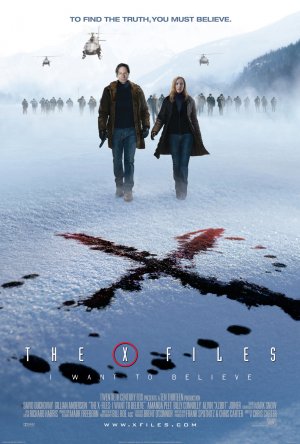
Xfilesiwanttobelieve After a rough week at work, nothing helps so much as simple escapism. Thinking back to my glory days in the classroom, I remembered the movies I used to get students thinking about how the Bible is represented in popular culture. One of those movies was The X-Files, I Want to Believe. Not that the movie was my favorite, but escapism isn’t picky—there’s one reality I want to escape, and just about any other will do. As I watched the film again last night I was struck how very much the whole movie is premised on religion. I suppose the title should’ve given that away, but since it is the slogan of Mulder’s famous poster, I’d not really given it serious thought. Scully is now a practicing doctor in a Catholic hospital, and the number of lingering scenes with stained-glass icons in the background simply can’t be ignored. She has given up chasing monsters in the dark, and come to live in a very Gnostic kind of light. Through a pedophile priest (Father Joe), the darkness finds her again. How could I have missed the centrality of a priest to the plot?

The scene I always pointed out to my students was where Father Joe goes into a seizure while quoting Proverbs 25.2, again citing Gnostic hidden ways. The Bible slips from his trembling hands and falls, closed, to the floor. Later, as Mulder is literally about to be axed to death, Scully finds him by noticing the mailbox number 25-2. A proverb was a prophecy and the Bible retains its ability to guide the believer toward salvation. Through paranormal means, of course. After all, this is the X-Files.

Faith versus science, religion versus reason; these are the underlying motifs of the entire film. Scully the skeptic is the one who believes. Mulder, the high priest of the preternatural is just waiting for her to come home. It isn’t the greatest of movies, but it is based on some classic themes. Wanting to believe, but not being able to believe—isn’t this one of the most religious tensions possible? For years now the internet has been buzzing with rumors of a third, and probably final, X-Files movie. And yes, many people are wanting to believe. And if work continues with weeks like this past one, I’ll be needing a lot more escapism as well. Yes, I want to believe.