Liberty and Justice for

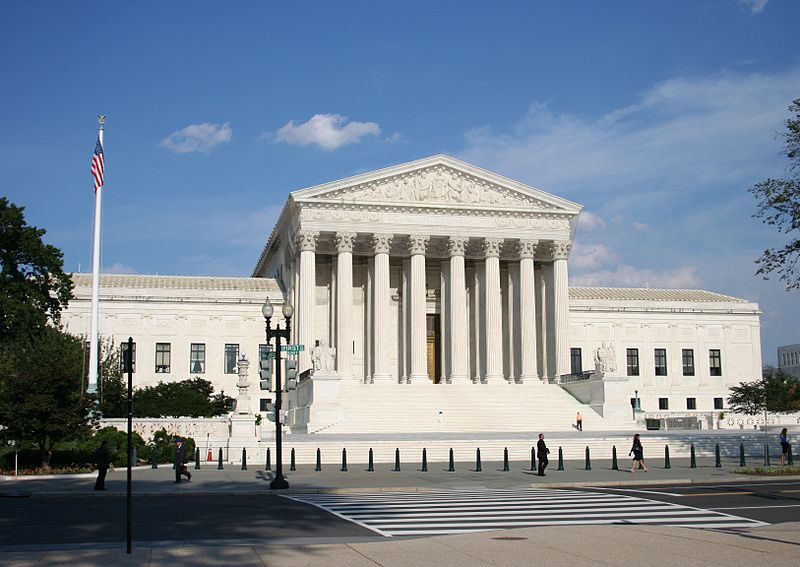
Looks like America will be divorcing the self-proclaimed “Defense” of Marriage Act. It’s a small step, but a small step in the right direction. Religious dogma has too long held sway over politics in this land of religious freedom. It must seem astonishing to rational people the world over how a country founded for the very purposes of religious liberty has homed in on a very narrow sect of one religious tradition and used that as the basis for discriminatory laws. After all, even the Bible says very little about marriage—something about taking your main squeeze into the tent with you and voila, you’re married. The Bible never asks what they’re doing in the privacy of their own tabernacle. Now we have a political system that legislates what can legitimately turn you on. Finally we see some light beginning to dawn in the judiciary system.

I don’t take marriage lightly; those of us who are married seldom do. I also don’t take my status as being the only possible way of finding love in a world that sorely needs more of it. Every day I witness acts of uncaring and sometimes outright cruelty, often in the name of the progress of business. And until yesterday I had to live with the knowledge that it was perfectly legal to discriminate against committed couples just because their gender’s don’t fit a preconceived mold. The land of the free? Maybe, just a little bit yes, now.

Our legal system, which pours out its love on corporate culture, protecting business owners more readily than employees, shielding the wealthy whose lifestyles are beyond scrutiny, ends up telling citizens whom they may love and whom they may not. And we complain against countries with arranged marriages. Freedom for some is not freedom for all. Until we as a nation recommit ourselves to life, liberty, and the pursuit of happiness, we’ll have to take the small steps towards freedom when they come. Yesterday, for at least a little while, I was glad to see that the system can work for the good of all, when it puts its mind to it. America, you can be proud. Say it loud!
800px-Joseph_Anton_Koch_006


Just Plain Bible

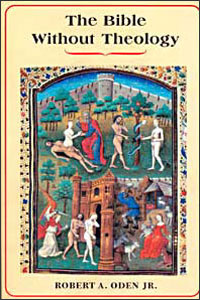
BibleWithoutTheologyBack when I was teaching Hebrew Bible in a seminary for a living, I purchased a book entitled The Bible Without Theology by Robert A. Oden Jr. I had intended to read it as a sanity break from the over-compensatory theological glosses that even the slightest reading of the Bible had in that setting. As the years passed and the book remained unread, I came to think of it as a systematic deconstructing of theological readings of the Bible, which it is not. Instead, Oden has gathered in this useful little book several essays centered on the topic of how the theological reading of the Bible has all but drowned out any other interpretations and has secured the privileged position of the Bible not only in society, but also in academia. Naturally, many people see such privilege as a witness of undisputed truth, even though how that truth is interpreted remains an open question.

Scholars, however, have the obligation not to favor their worldview over the evidence. Oden begins by discussing how history itself is perceived differently among those of various mindsets. History is an important part of the Bible’s theological reading since many Judeo-Christian interpretations revolve around a sense of historical veracity. After illustrating how history and mythology both lay claim to the text, Oden points out that even obviously mythological episodes have been blockaded by a theological reading of the scriptures. With examples from socio-anthropological studies, he demonstrates that parts of Genesis are best understood by investigating how kinship structures work, as well as how clothing serves as a status marker rather than a hidden justification for sacrifice, or chilly nights outside Eden.

Although The Bible Without Theology wasn’t exactly what I’d come to suppose it was, it remains a proper prologue to the issue. When Oden’s book appeared in the 1980s, the Religious Right was just finding its feet, fueled by a hyper-theological reading of the Bible. Since that time, the Bible has been used as theological justification to repress everyone from women to those biologically inclined toward their own gender. Bible scholars have, in general, known this is wrong. However, theologically inclined institutions won’t pay instructors for honestly engaging the text. Bible scholars are expected to throw their expertise behind the theological outlook of their institution in a way that Oden rightly points out, no other academic discipline would accept. In reaction to the biblical abuses of the Neo-Con crowd, many Americans are wondering why this one holy book is so privileged. While it may not have all the answers, Oden’s riposte will help to explain why the Bible deserves better.


Suit Yourself

I guess I’m going to have to sue myself. In this litigious society I have few options left. Instead of understanding and forgiveness (some of the positive motivations that religions have encouraged) our culture is controlled by those parsing out the finest particles of the law, seeking violations, and making somebody else pay for their mistakes. Money makes everything better. It is like the new God. I have to sue someone for this coffee I spilled on myself.

You see, I’m an early riser. I’m not really a coffee addict—I have a cup first thing in the morning, something I’ve been doing since college, and that’s generally it. Still, that first jolt is helpful in the waking process. I shlep around in my Edinburgh University sweatshirt for a pajama top. I like to be reminded of my post-graduate days in Scotland, and I appreciate the irony that my PhD never got me anything but this comfy shirt. This morning, laptop humming on my, well, lap, I baubled my coffee and spilled it all down my Edinburgh sweatshirt. It seared my skin, but I couldn’t jump up because of the laptop and any sudden moves would only slosh more of the hot liquid onto my burning chest. My mind immediately went to Liebeck v. McDonald’s, where the fast food giant was sued for selling hot coffee. I don’t know about you, but I’d almost rather suffer a burn than to drink tepid coffee. But somebody has to be sued, right? The question is: whom? Mr. Coffee for making my morning cup so hot? JSW for making my Edinburgh sweatshirt so absorbent? The unnamed pottery house in England that made the mug that wobbled in my sleepy fingers? Or maybe God for making the morning so early? If there’s anyone to blame, it’s me. Oops—I’ve admitted culpability, so I’ll have to sue myself.

800px-SCOTUSbuilding_1st_Street_SE

For a society in love with the Bible, we’re far bigger on lawyers than forgiveness. Of course, the Bible is a pretty legalistic book. You can’t get very far in the Pentateuch without figuring that out. Only with the Bible it often isn’t a matter of suing; the stakes are considerably higher. Disrespecting parents can get you the death penalty, and mixing plant and animal fibers can get you expelled. Thumbing through my concordance I don’t see anything about coffee. I do see that I might be unclean for a day, but that’s okay because the Sabbath’s nigh. In any case, I’m too busy dreaming about what I’m going to do with all of that money.


Fearful Christianity

So some North Carolina Republicans want to declare themselves a state religion. I wonder which one it will be? Hmmm, let me think… Whatever that religion will be it will be one that is afraid. Only religions that are uncomfortable with challenges have to back themselves with militaristic force. Seems to me some North Carolina politicians have never read a book on Medieval history. Ironically, the religion they wish to select was probably itself the result of the Reformation, the original challenge to state religion in the history of Christianity. It is also clear that these misguided lawmakers have not fully acquainted themselves with the vast diversity of forms of Christianity. The Christianity they want is televangelist, conservative, Protestant Christianity. Even that, however, is no longer a uniform religion. Why would there be more than one channel?

Those who spend long hours gazing at religion, both from inside and outside, realize that religious belief is not, cannot be, a static entity. Should a genuine apostle walk into an evangelistic Christian service today, chances are great that said apostle would leave wondering what religion this was. According to the Bible itself (ironically, taken only partially seriously by those who promote it) the first Christians were communists. Those who refused to sell everything and give it to the common good were struck dead, or so the book of Acts tells us. My guess is that free market economics has trumped the Holy Spirit here. What legislators really, really want is a religion to back up their secular plans.

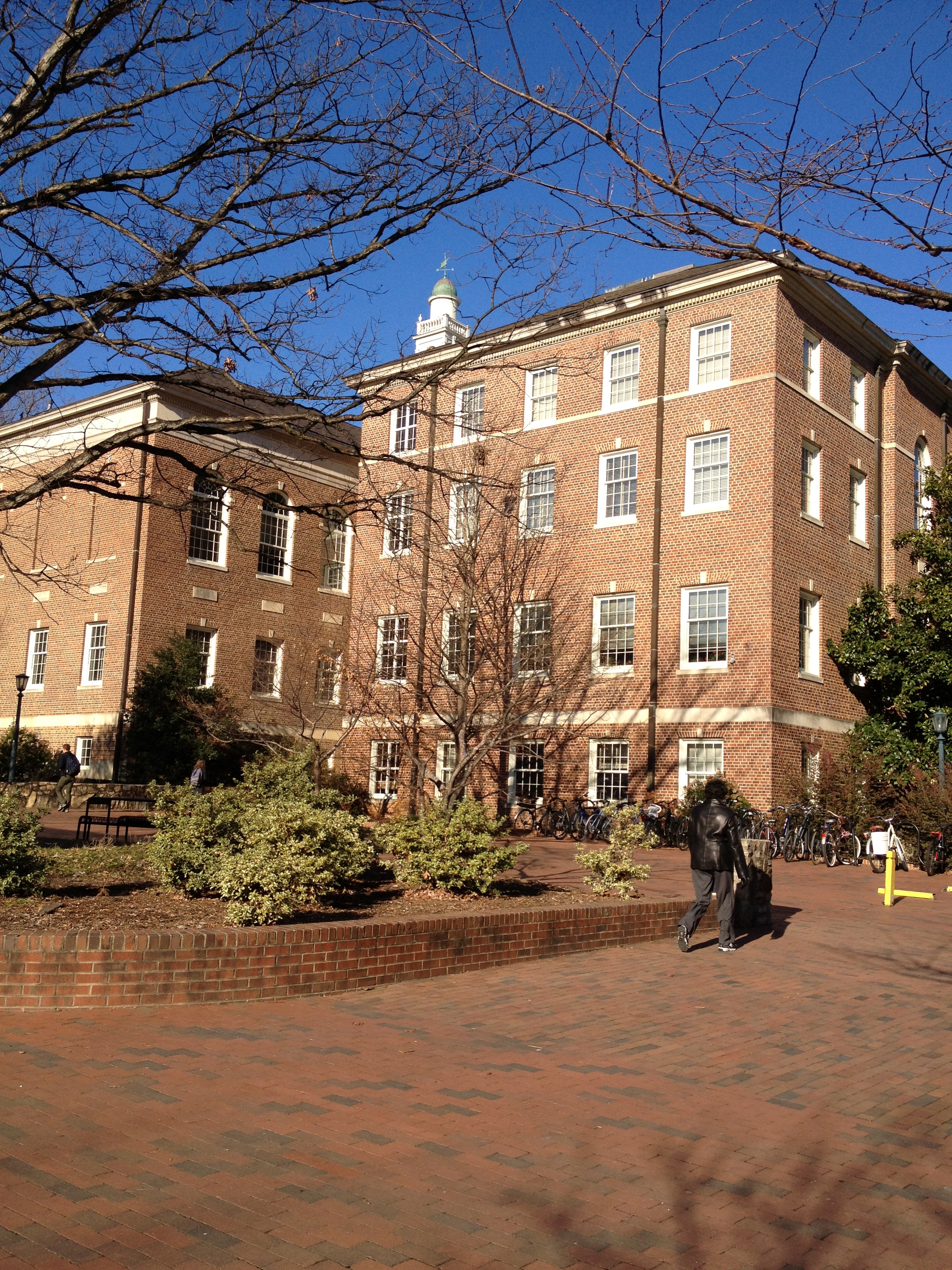
Which Christianity would they choose? Who would be welcome in New North Carolina? Mormons? Mennonites? Methodists? Catholics? Well, at least Catholics vote the right way on key issues. Or some of them do. What we are talking about is actual state support of religious ideology. In a country where some of the finest state universities do not even have departments of religious studies, the University of North Carolina, Chapel Hill, has one of the finest in the country. And not all the faculty fill North Carolina’s preferred demographic.

IMG_0019

Religions do not take such rear-guard actions unless they are afraid. What does Christianity fear? It depends on which Christianity you mean. Studies have shown that over 41,000 Christian denominations exist. Think about that a minute. If one flavor-of-the-month Christianity becomes official state religion, what becomes of the other 40,999? I’m no math whiz, but it just doesn’t add up. Seems to me that before states start declaring their religions publicly funded, legislators should go back to school. They should be required to take Religion 101. Might I suggest they enroll at UNC Chapel Hill?


Scouting for Boys

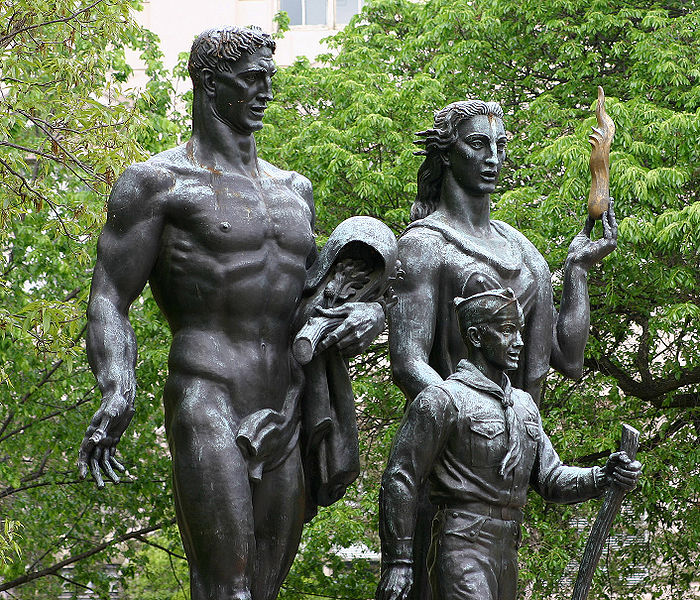
I guess losing a bid for a presidential nomination sanctions a guy to speak for God. Of course, that goes for just about any Republican these days. I’m frankly amazed that Moses managed to write the Ten Commandments without them. So Rick aptly-named Santorum has gone after the Boy Scouts. To remove the duplicitous ban on gay scouts, according to Santorum, is to remove God. Obviously Mr. Santorum was paid no attention in Boy Scouts himself. I spent many hours at Scout camp and I can attest that God was already the last thing on most boys’ minds. Maybe our former presidential hopeful ought to look back a little further, for Webelos and Cub Scouts may imply the love that dare not mewl its name. I predict this: if the ban is lifted, as it should be, no one will notice the difference. Santorum will continue beating his dead horse and the rest of America may achieve just a hint of maturity.

“Scouting may not survive this transformation of American society, but for the sake of the average boy in America, I hope the board of the Scouts doesn’t have its fingerprints on the murder weapon,” Santorum declared, according to CNN. I have to wonder what he knows about the average boy in America. Or the average girl. Santorum would have a difficult time finding the word “gay” in his Bible, for it is not there. But apparently God is not God without someone to hate, without the “Right” to show him the way. And God favors straight, white men, as the last presidential election clearly shows.

Any religion that makes someone feel better by repressing others is not worthy of propagation or emulation. Look at any oppressed group. What’s the backing always cited by the oppressor? Is it not narrow religious belief? Anyone can say “God says.” There—I just wrote it. And I could distort the Bible to make God dance to my prejudices as well. The problem is that I recognize how cheap and tawdry such eisegesis is. Of course, hot air expands. The Texas governor that God told to run for president, but then changed his divine, omniscient mind, and who never thought closely about the implications of that—aka Rick Perry—also had to weigh in on the issue. CNN quotes him as stating, “Scouting is about teaching a substantial amount of life lessons… Sexuality is not one of them. It never has been; it doesn’t need to be.” Mr. Perry needs to spend a weekend at camp with his eyes and ears open and his mouth shut. In the best of all possible political worlds, his bosom buddy Rick Santorum will be right there beside him. Maybe it will take a little child to lead them after all. And that actually is biblical.

From WikiCommons, AgnosticPreachersKid--worth a thousand words

From WikiCommons, AgnosticPreachersKid–worth a thousand words


Secular Oaths

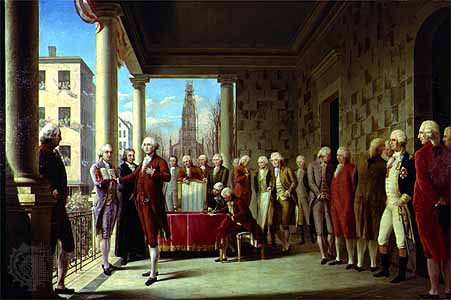
“I do solemnly swear that I will faithfully execute the Office of President of the United States,” so begins the story. With President Obama’s second inauguration so fresh in the public mind, an article in the Sunday New Jersey Star-Ledger raised the question of using Bibles for taking this secular oath. As A. James Rudin points out, not every president has laid a hand on the Bible to take the oath—John Quincy Adams preferred a law book to do the job. Rudin points out that commentators have started to question the practice of using any religious book for taking a vow for a government position. As I read this article I had to pause for a thought. It was the particular turn of phrase “the Bible, and by implication all other religious writings,” that stopped me at this brain crossing.

Washington's_Inauguration

Anyone who has taken time to study the phenomenon of religion seriously (admittedly not a large cohort) has stumbled upon the blue whale in the room: what exactly is religion? We all know, but nobody really knows. Many scientists equate religion with superstition and claim that we are evolving out of it, but we still seem preternaturally powerfully attached to it, if that’s the case. While religious writings have been around for ages, the idea of a sacred book seems to have its origins in the societal reception of the Bible. There are older religious books, but the Bible seems to have defined the category. What’s running rampant in my mind is where the line is drawn between a religious and a secular book. For some, it would seem, Fifty Shades of Grey, or Twilight would fall into that category. Some thinner, more glossy and heavily illustrated literature favored by teenaged boys might also qualify. What makes a book religious?

In current understanding, religion is a matter of belief. Not all religions insist on belief, but in the United States, in any case, it’s not properly religion without it. In our secular society belief is atomized into millions of varieties, even within the same religious family. Step outside the church, synagogue, or mosque, and the sheer varieties of religious experience would make even William James blush. “All other religious writings.” Those might include just about every pen stroke on paper (or electron on whatever it is that I’m typing this into). Those of us who venture to write know that at some level it is a sacred activity. I would swear it with my hand on my dissertation. (At graduation at Nashotah House students are hit on the head with a Bible. Perhaps this might be more appropriate to swearings in?) We lay our hands on that which is sacred, otherwise there’s no vow involved. Whether it be Bible, law book, or saucy literature, we pledge on it because all books are religious, regardless of definition.


On a Wager and a Prayer

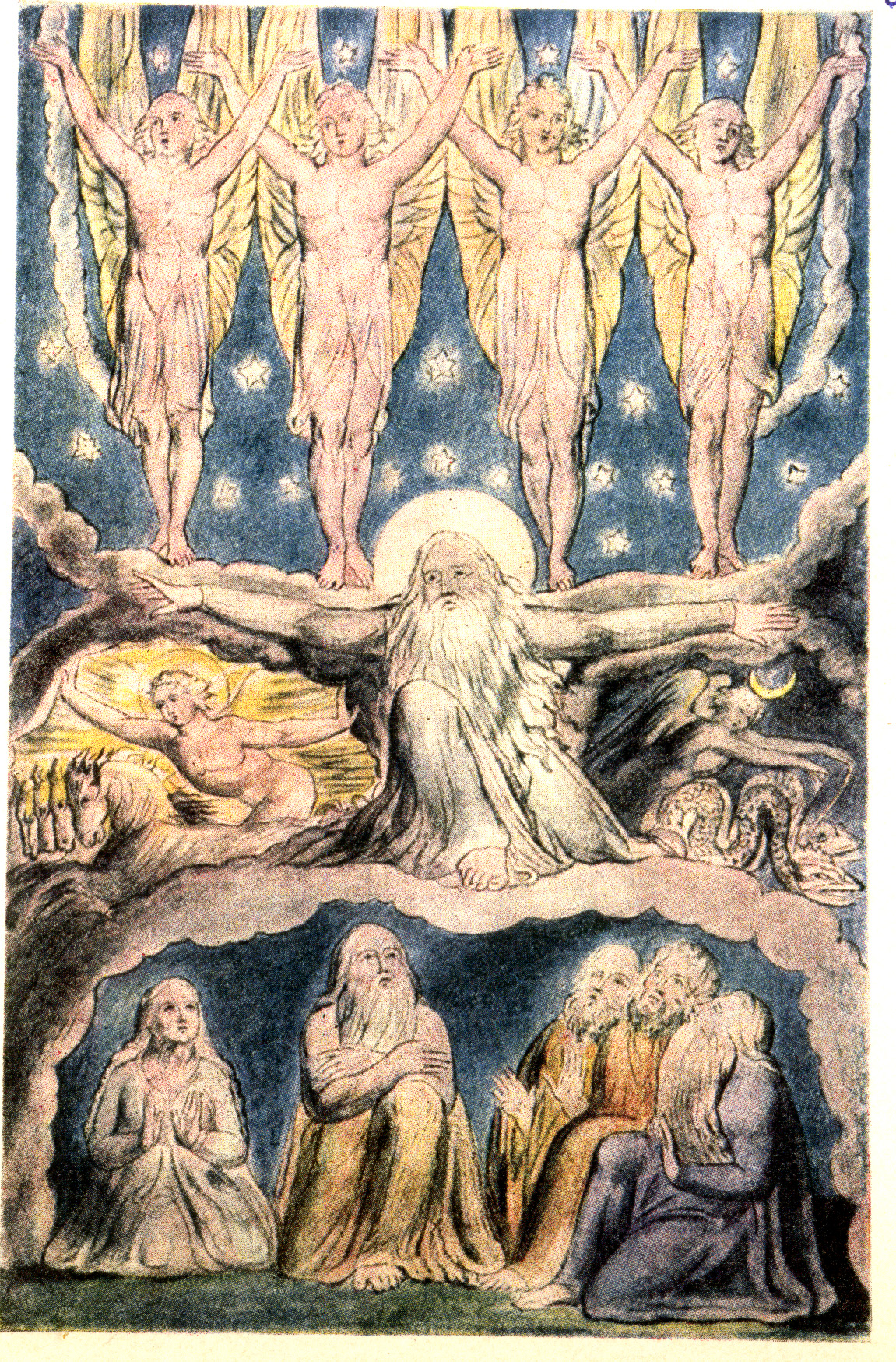
I’ve been thinking about Job a lot lately. Not my job, but the biblical book. Way back when I was preparing my initial classnotes on Job, I remember a commentator—I forget who—stating, as commentators are wont to do, that people have strong reactions to Job. Either they love it or they hate it. I have enough imagination to consider some people being somewhat ambivalent about it, but I have observed many people over the years revealing powerful reactions to this Wisdom book. One of the reasons, I suspect, is that God doesn’t come off looking particularly good in this story. This was recently reintroduced to my awareness in Steven Cahn’s God, Reason and Religion. The reader, unlike Job, knows the real reason for Job’s suffering. It was a divine wager, instigated by God, that Job would not curse him even if allowed GBH by the Satan. We know, however, and we are culpable for that knowledge. It puts a burden on the reader.

BlakesJob

When God does explain to Job why he shouldn’t question God’s acts, as Cahn points out, the answer rings hollow in the knowledge of the truth. God can’t admit to Job that he was playing fast and easy with his health and the death of his ten righteous children. A roll of the dice and Job is vulture-bait. The book of Job should make us squirm. We base our morality, we are often told, on the ideals of the Bible. If we were Job, who ends the book never knowing about the bet, we might be content. But the author, with a sly wink to those who face life squarely, points out that this is all a charade to justify God’s confidence in one of his many carroms. I suppose that might be small comfort to the pawns.

For Job there is no answer given to why he suffers. He doesn’t even really ask why—God’s right on that count, Job is very good. Yet the reader is not so lucky. How can we gain any comfort knowing that God sometimes lays us on that altar, not for any just cause, but as a wager against the divine prosecutor? No, the Satan in Job is not the Devil. He too is a divine character, an attorney borrowed from Zoroastrian mythology. He’s just doing his job. His Job. He is present to make us feel our guilt. And if Job, who the Bible itself says is perfect, can barely restrain his soul from cursing, how much of a chance do the rest of us have? There are many who hate the book of Job. I am not one of them. A more honest book I have a difficult time imagining. If it comes to justice in this world, however, I wouldn’t bet on it.


On My Honor

Some old fashioned institutions fear new learning. Although I was a Boy Scout for only a couple of years, I grew up in Cub Scouts and Webelos and had a pretty good idea what boys talked about when they were together. It would’ve shocked me at the time to learn that some Scouts were gay, but then, I was young and most new things shocked me. I later came to learn that not only some Scouts, but also many of the guys I knew from conference-wide church groups were gay. It wasn’t so much that they were in the closet as the rest of the world was. Society wasn’t ready to admit anything that challenged male patriarchy (this was the 60s and that was beginning to shift), and homosexuality did challenge that hierarchy. The Bible could be used to back a husband’s superiority over his wife, but if two men formed a couple—as B-movie computers used to say—”that does not compute.” A society that declared sex had one purpose only—procreation—was already deep in denial about the symbolic power that sexual relations inherently possess, something even the ancient Greeks knew about. How could a culture that out of sync with nature come to embrace true equality?

In the socially conservative icebox of the fin de siècle nouveau (pardon my French), evangelical forces began to declare the Bible as the basis for defining marriage. The problem is that the Bible doesn’t do such a good job of it. Marriage is far from a sacrament, and its main purpose seems to have been to make sure men were kept accountable for the children they sired. After all, they could have as many wives as they could afford, eh, Solomon? The Boy Scouts, so loyal to God and country, preferred not to admit what was already part of their culture. You isolate a bunch of boys together in a cabin in the woods, and what happens? The old myth of Platonic hero-and-sidekick pairs with nary a thought of the pounding chorus of hormones surging through the atmosphere held up remarkably well, considering.

We like to think we live in a more enlightened age. Sexologists tell us that mating is hardly just for reproduction—the natural world belies that. The Bible says little about its purpose, not being of a scientific bent. And yet the Boy Scouts hold up three fingers and go beyond don’t ask, don’t tell. I’m glad to see that they are again considering a look at the obvious. In the Bible that cotton-poly blend you’re wearing is mentioned as evil just a few verses away from one of the few passages that says the same thing about homosexuality (and even that is an overstatement). The Bible was a product of its time, just as the Boy Scouts were a product of theirs. If they want to honor their pledge about keeping morally straight, the Boy Scouts need to consider morality in the light of what we know and open the closet doors to what society has been keeping hidden all along.

Read the green words.

Read the green words.


King’s Highway

Sometimes I forget the beauty of the Bible. With its constant current of misuse in our society, it is sometimes easy to forget that, like an abused child, the Bible is not to be blamed for being the victim. As a civilization we owe a great deal to it, and even on its own, when we overlook the insensitive and sexist parts, it remains a literary masterpiece. Just over a year ago I visited a true friend I’ve known since high school. He is not a religious man, but in his living room, on a stand, stood open the Bible. It is more than a jingoistic symbol. Even the more we become aware of other great spiritual writings: the Rig Veda, the Tao Te Ching, the Gilgamesh Epic, we shouldn’t let the sublime messages from the Bible escape our notice. Even in this secular, workaday world, the words of the Sermon on the Mount often come to me, grand and resplendent. Parts of Isaiah still bring tears to my eyes. Writers from Shakespeare to Bradbury drew on its noble sentiments.

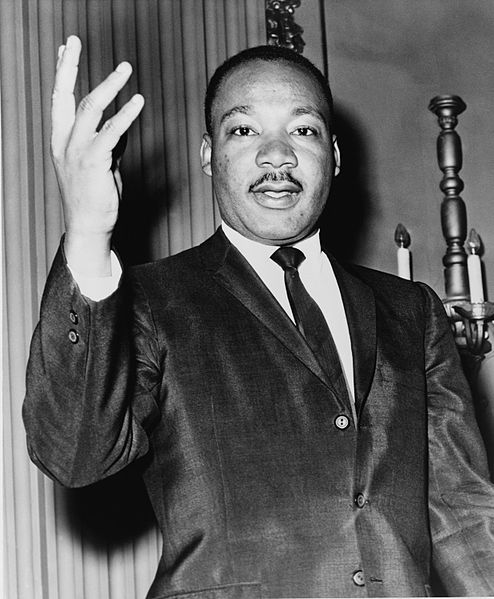
The Bible comes to mind when thinking of Martin Luther King, Jr. Our chronological spans overlapped by just five and a half years, but I followed him to Boston University School of Theology, walked the same corridors he did, meditated in the same chapel. Even then, some two decades after his martyrdom, his vision had not been fully realized. It still remains unfulfilled. At Brown University in May of last year, I was fortunate enough to be in the crowd when John Lewis received an honorary doctorate. His remarks to the crowd were humble, few, and profound. He said he never thought of the civil rights movement as a way to greatness. He was only trying to help. He admonished the affluent, the comfortable sitting on a hot Ivy League green, “Find a way to get in the way.” Injustice must come to end. The color, gender, sexual orientation, place of birth or financial status of no person should ever be used to judge her or him. With remarks I’ve heard about President Obama, most vulgarly on Facebook, we still have a long, long journey ahead of us.

In a day when the internet weaves millions of people into a fabric that should remind us we are all part of a whole, some still insist that their shading, location, or special pedigree make their part of the cloth the most valuable. Even as revolutions against injustice—something with which Americans especially should sympathize—take place in “backward” nations by using social media, we in the “first world” still judge one another by the origins of our ancestry and the mythical superiority of our skin tones. The greatest asset the United States offers to the world is its unique blend of people from everywhere. Our country demonstrates what can happen when people from every continent put their minds and wills together to work for the common good. This clashes with the biblical brand of separatism, I know. But even Isaiah, even if it is in his third incarnation, reminds us, “Also the sons of the stranger, that join themselves to the Lord, to serve him, and to love the name of the Lord, to be his servants, every one that keepeth the sabbath from polluting it, and taketh hold of my covenant; Even them will I bring to my holy mountain, and make them joyful in my house of prayer: their burnt offerings and their sacrifices shall be accepted upon mine altar; for mine house shall be called an house of prayer for all people.”

Martin_Luther_King_Jr_NYWTS


Forget this Alamo

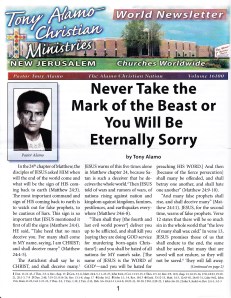
A person’s car is a haven of sorts. Very expensive, dangerous and yet necessary, they have made life a fair bit easier than caring for horses when you need to trot down to the Apple store to pick up a charger for your iPhone. When we leave our cars we don’t have to strap on the feedbag, but in many parts of the world, we do have to lock them up. From a young age I was taught not to touch somebody else’s parked car. People are very possessive of them and some folks get upset at even a smudged finish. I always find it strange, then, when a flyer ends up tucked under the windshield wipers. Not that it happens often, but around the holiday season some promoters will go in for the cheap advertising trick of that paper that first makes your heart skip since it looks like a ticket, and then annoys you when you find out it’s just more junk mail. The other day my wife came home with a new type of flyer under the blades. It was from Tony Alamo Christian Ministries.

To be honest, I’d never heard of Tony Alamo before. I seemed to remember the last part of his name, though. In any case, the earnest-looking evangelist warned loudly in the headline “Never Take the Mark of the Beast or You Will Be Eternally Sorry.” This was a cheerful way to greet the holiday season, but I decided to give him a hearing, or at least a brief reading. By the second short column I’d discovered his “Bible only” technique included interpolating [in brackets] his own reading of the Scriptures, but still enclosing them in the quotation marks. This is, categorically, not so different from preaching—the practice of making your followers believe that you have an inside line on what God meant to say in the Bible, but obviously didn’t spell out very clearly. This is the problem with all Bible literalists movements: they claim solely Bible [but only when interpreted their way]. Those who’ve found their windshields thus violated have grounds to be suspicious [if I understand this technique correctly].

It turns out that Tony Alamo is currently in prison [one suspects the parallel to Paul of Tarsus, or at least Silas, has passed his mind] for ten counts of transporting children across state borders for illicit purposes. I’m not sure which Gospel condones child molestation [perhaps “suffer the little children to come unto me”], but from the Illinois State Pen he still reaches out to put his grubby flyers beneath the nation’s windshield wipers. He also seems to be terribly worried about the end of times. With a 175 year prison sentence, anybody would be [unless, of course, they’ve be persecuted for righteousness sake, in which case they are blessed—and that’s actually in the Bible]. So beware the paper that get wadded up beneath your wipers. Sometimes the Alamo is best forgotten.

Alamo


Faith and Freedom

Schadenfreude is not my usual response to the downfall of a religious leader—with perhaps the exception of televangelists. After all, religious leaders are only human. Occasionally one crosses a very serious line, as the news about Nechemya Weberman, a Hasidic counselor who was found guilty of molesting a girl under his profession care, reveals. The sad part of this situation, apart from the tragic consequences for his victim, which are very serious in their own right, is that the Satmar Hasidic community insisted that it should have had the right to do its trial in secret. Sects that take their cue from the Bible are seldom fair to women. The Bible, after all, is not a very female-friendly tome, no matter how much feminists may try to rescue it from its androcentric world. Religions based heavily on the Bible feel they have the right to judge by their own standards—something a secular court can’t understand. It is back to the paradigm of the two swords here.

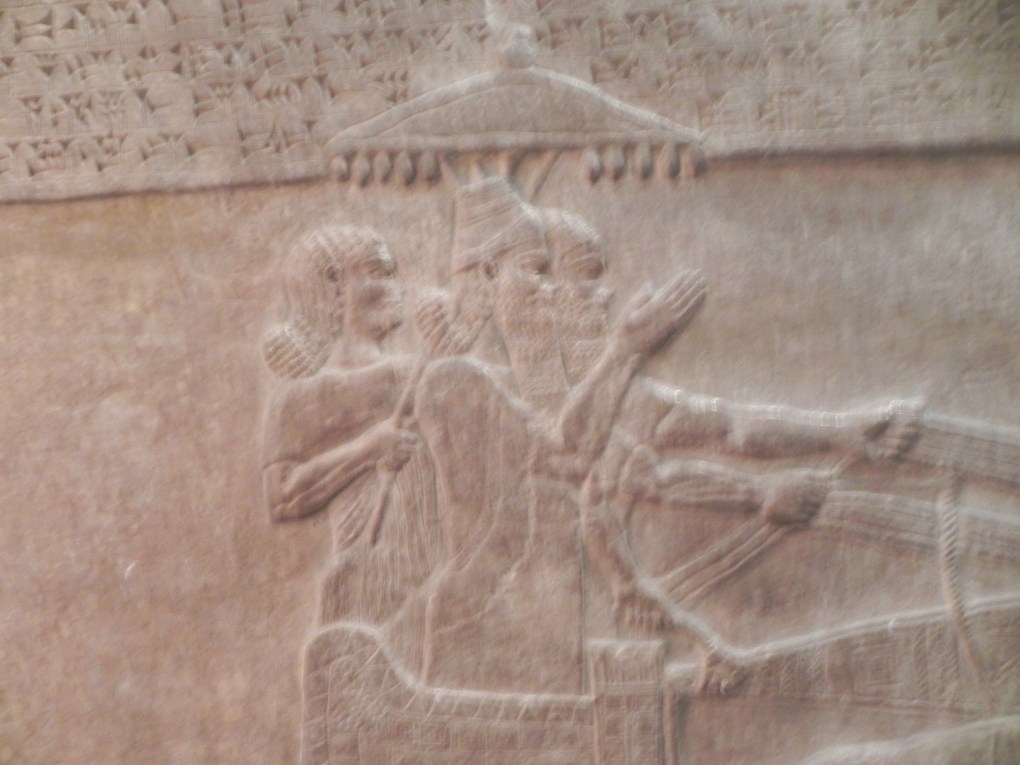
What are we to make of the civil crime that violates no religious laws for any one sect? What is wrong in one book is all right, or at least forgivable in the other. For a secular crime committed in a closed religious community in a country of religious freedom, who is to decide? These questions are decidedly more than rhetorical. Any religion that says women are here to serve men—and there are a disturbingly large number of such religions—can claim that God trumps gent d’armes every time. What’s more, they believe the decree is eternal and they are violating the divine will if they don’t keep to it. This situation is nothing new; at least as early as Tiglath-Pileser III, and probably earlier, ancient religions sometimes had to compromise under the hegemony of a higher power. But they were only biding their time until the political situation would grant their autonomy once more.

DSCN1828

It is simplistic to suggest that the two swords represent the two hemispheres of the brain, but we do have a rational versus emotive issue here. Rationally, would an unseen force endowed with a human personality demand the unfair treatment of some people simply because of an unexplained favoritism? It does not seem likely. But religions are seldom logical. “Credo quia absurdum,” Tertullian is remembered as sighing—“I believe because it is absurd.” Theologically profound? Certainly. Helpful in society? Not so much. Freedom of religion is a classic ouroboros, a serpent biting its own tail. Religions are free to declare their own beliefs, but their own beliefs may challenge the very authorities who grant them that privilege. Secular authority may have the ability to put to death, but resurrection is the prerogative of religion.


The Last December

December 2012—it is supposedly the last month in the world. Yesterday did dawn with the date being 1212012, but since the local tree farm opened its gates yesterday, my family set out to select a tree anyway. As we wandered amid the pines it was clear that for many the iconic sign of Christmas is the tree. We learned on our first year in New Jersey that you’d better not wait until reasonably close to Christmas to pick out a tree—we visited this very lot then only to discover that precut trees were all that were available (and they were from Pennsylvania) and we had established a tradition of picking our own. Getting to know the tree first. Walking around and looking from all angles, trying to learn if it was healthy or too dry. Were there any gaping gaps that would be an obvious problem? Hard to tell when the tree is wrapped up in fishnet plastic and tucked into a corner like an old umbrella. Here, so close to the Big Apple, you need to claim your tree early. If you don’t want to cut it down right away, you can tag it—claim it as your own and come back later to chop it down. We weren’t the only ones taking great care in selecting.

IMG_0514

Tree farming is a business with a long view. Trees don’t mature overnight. When it’s the last month of the world, one must take these weighty things into consideration. Even before this terminal date, you would need to make an awful lot of money in just one month of the year to keep the business going. Maybe they need a green Christmas. Of course, greenery in winter symbolizes life in the midst of death. The germanic originators of the tradition were keeping a very appropriate pagan idea alive when they dedicated their trees to Christmas. Last year when we couldn’t have a real tree, it felt like we’d lost a friend. Our tree farming friends know that feeling very well.

The “Keep Christ in Christmas” signs and bumper stickers have begun sprouting up in yards and on bumpers in their annual exuberance. Funny thing is, Christmas has its base in ancient pagan customs. To hear the Bible tell it, Jesus’ birth was an understated event. The only people who had an angelic concert were some shepherds (we don’t know how many) on the hills outside of a small town. And, as far was we can tell, it would have probably been in April. As the days grow wearily short, however, we need a little light to keep us going. That was the pagan wisdom behind the Yule Log and various festivals of light to encourage nature to bring some brightness back. These short days can be difficult enough even in the age of artificial light and constantly glowing electronic screens. And knowing this is the last month of the world, we want to festoon our trees with tiny pinpoints of expectation and hope that nature somehow gets the message that we’ve had enough of darkness and wish for a 2013 redolent with light. But we’ll just have to wait and see.


Au Fait in the Manger?

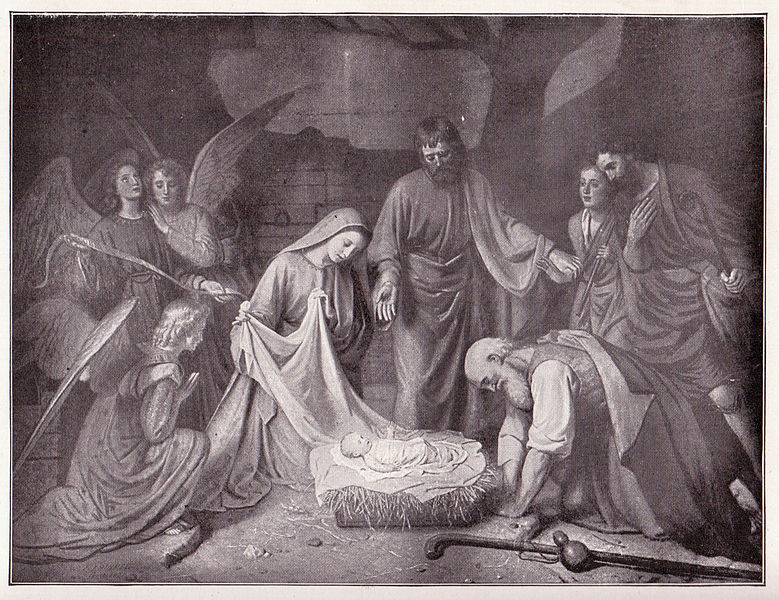
On Friday CNN ran a story about the Pope’s new book “debunking” myths surrounding Christmas. The headline certainly looked intriguing, but it turns out that the “myths” debunked are those of a very dim magnitude. Is anyone surprised—gasp!—that Jesus wasn’t actually born on December 25? And, guess what—those cows you’ve always seen in the manger? The Bible doesn’t actually mention them! Angels aren’t at the manger either! What kind of Christmas will this be? A biblical one, it sounds like. I haven’t read Jesus of Nazareth—The Infancy Narratives, but it really doesn’t sound like I need to. The Bible is very spare on stories about Jesus’ birth; nobody knew he would be a Lloyd Webberian superstar at that point, so we have a few loose traditions that tell of humble origins in an obscure setting. Not very good for commercial interests, however, and besides, the average person doesn’t read the Gospels to find out about Christmas. There are far too many television specials to be bothered with “Lo, there were in the same country…”

Christmas was not a big deal until relatively recent times. Now, don’t get me wrong—I’m not a grinch who believes the holiday shouldn’t be celebrated. I see nothing wrong with people giving things away, even if it is to pretend that they are celebrating an ancient Roman-occupied Judean birthday. This is the essence of what being religious should be all about; holidays should be occasions for thinking about others before one’s self. In my lowly opinion anyway. We’ve built an entire economic cycle on it, however, otherwise Black Friday might just be a free day to spend with family and friends instead of being trampled to death at Wal-Mart. Perhaps if society could find a way to distribute wealth more equitably every Friday would be in the black.

The Pope’s new book is an attempt to make the Catholic tradition appear up-to-date with scholarship. Plans are for the book to be published in an entire Septuagint of languages with a print-run the envy of nearly every academic editor in New York. The problem is there is no real news here. News should be, by definition, new. A book by the Pope declaring the true equality of all people, throwing open full sacerdotal participation to women as well as men, and the distributing of papal wealth to the poor—that would be a Christmas present worth the waiting! Instead, when you pull the shiny paper off this book on December 25, you’ll only discover that you’ve received it on the wrong date and there will be no angels singing. The cattle will be lowing, however, if you can use your imagination.

What’s wrong with this picture?


Star Tract

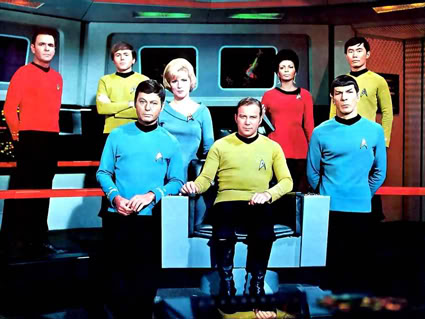
Over the past few years my wife and I have been watching the episodes of Star Trek (original series; please, we are connoisseurs). As a religious child watching Star Trek I had noticed that some of the episodes had biblical titles or themes, but now that I’ve been watching them systematically, if not swiftly, I have noticed a general trend towards more biblical themes as the series goes on. I suspect most readers know that Star Trek had only three seasons. During the first season references to the Bible were a bit vague and indistinct. Episodes 23-25 (“A Taste of Armageddon,” “This Side of Paradise,” and “The Devil in the Dark”) make reference to biblical motifs in their titles, but nothing too explicit. Paradise and the Devil are, after all, in the public domain.

Season two stepped up the ante a bit. In “Who Mourns for Adonais?” the pagan god Apollo appeared, but in “The Apple” the Enterprise was transported back to Judeo-Christian themes in the paradise genre again. “Journey to Babel,” episode 10, brought a biblical place into the title, and “Bread and Circuses” (episode 25) famously put the crew into the world of the Roman Empire where the rebels were found to be sun worshippers. But no! Worshippers of the son of God, we learn. The move away from Apollo is complete, we have come back to a comfortable, Christian world.

The third and final season delved even further into the biblical repertoire. Once again, “The Paradise Syndrome” (episode 3) brings Heaven to the heavens, but episode 4 also has a biblical title “And the Children Shall Lead.” Episode 16, “The Mark of Gideon,” takes considerable thought to unpack the biblical parallel, and episode 19 is entitled “Requiem for Methuselah.” Paradise, obviously a favorite theme, returns in “The Way to Eden,” or episode 20. Each season goes boldly further than the one before.

Quite apart from the titles of episodes, Star Trek, despite the technology and unflinching logic of Mr. Spock, is an extremely biblically literate show. Even as the 1960s were fading into the 70s it was a safe assumption that watchers would pick up on the many biblical motifs and themes. Now when younger people mention Star Trek, they inevitably mean one of the various spin-off series that have grown from this original root. Biblical references are surely there, but like the times themselves, I suspect they aren’t nearly as overt as they were when I was a kid. For many even paradise has lost its shine.


Watch, and Pray

Religion is a lucrative business. There is likely a deep, evolutionary urge for fair play nestled somewhere in primate DNA. Monkeys and apes seem concerned about it, and certainly nothing gets people more upset than a cheater who does prosper (unless he, less often she, is the protagonist of some gangster movie). Most of us work pretty hard to make a living, often doing tasks that push us beyond our comfort range in order to ensure some kind of success. The same is true of clergy. Yes, stories of lazy or lackadaisical ministers abound, but many work long hours under often stressful conditions. Most are not paid very well. Their eyes, according to unwritten writ, are turned toward a larger prize. In an economy that has become a nearly universal capitalism, everything has a price. People want to feel that they are pleasing God but there are oh so many rules and regulations! The Hebrew Bible alone has 613, and then add the Christian Scriptures and two millennia of ecclesiological dogmatism and you’ve got one hefty bill. We don’t mind paying a bit of that for a religious specialist to take care of the details while we get on with the real business of life.

Now add a little math. How many people does it take to add up to a small fortune? Already by the Middle Ages the Catholic Church, really the only show in town across Europe, had amassed a real treasury. Although individually the clergy could claim to own nothing, collectively they were flush. Even today the wealth (and therefore power) of the Vatican is nearly beyond comprehension. A colleague recently pointed me to a story I had missed back in April. This involved the computer age and lucre in an unexpected place. Russian Orthodox Patriarch Kirill I was photographed sitting at a high-gloss table, wearing a Breguet watch valued at $30,000. There was an outcry. The Russian Church, long under the pressure of a communist state, could hardly be described as opulent. Well, liturgical vestments and accouterments are expected to be costly, but personal items such as watches, are expected to be modest. Thirty-thousand dollars is a lot of money to be reminded of when to show up for mass.

In response, some church leaders turned to technology for a solution. The watch was Photoshopped out of the picture and, as if a miracle, the scandal disappeared! Except they forgot the glossy tabletop—the reflection of the watch, like Dorian Gray’s portrait, remained as evidence. (The story may be found here, along with the damning photos, if you can stand the snarky writing.) Owning such a watch may be considered bad form among the humble clergy, hiding it, however, is even worse. I don’t mean to single out Patriarch Kirill—the Russians have had a pretty rough go of it, what with Stalin and Reagan and all—but religions seldom like to have their coffers examined. The laity will pay handsomely to avoid the extra work salvation demands. Herein lies the rub: salvation has become less tangible as material wealth has expanded. Many people have mistaken one for the other. It’s just that they don’t want to get caught enjoying a little too much of the one at the expense of the other.

Now watch this, for time is fleeting