Bible Belts

The Bible’s been back in the news. Specifically the Bible and politics. Like twins separated at birth. Jeff Mateer, Trump’s nominee for a federal judgeship, has gone on record saying Satan’s plan is working. Perhaps even more stridently, Roy Moore down in the Sweet Home state has been quite vocal that the Christian God is the one who makes America’s laws. Standing on “biblical principles” that have nothing to do with the actual Bible, politicians have found a biblically illiterate population a field of white-headed grain ready for the reaping. As sure as the sparks fly upward. The response in the educated class is predictable. Cut any funding for departments studying religion. Haven’t you heard? It’s dead!

Having grown up in a conservative, religious family, and working my way through a doctorate in a closely related field, I’ve been watching in dismay as the past quarter-century has been marked by decreasing positions in religious studies. If you can pull your eyes from the headlines surely you’ll agree that religion is something we just can’t afford to study. Wasting resources, it is, since if you teach economics you have an actual shot at the White House. Yee-haw! Pull out your six-shooter and celebrate! And no, “yee-haw” is not etymologically related to the name of the deity of ancient Israel. It’s only a matter of time before discovery of who’s been uncovering whom’s nakedness becomes public. Then you just need to say the Bible says nothing about divorce. It’s okay, nobody will bother to look it up. Intellectuals will scratch their heads—why didn’t somebody tell us religion actually motivated people?

Universities (consider the name!) used to be places where the value of all subjects was acknowledged. Of course, where there’s knowledge there’s money to be made. Once you’ve gone to the dark side, there’s no coming back. Departments that don’t earn mammon must go the way of the mammoth. Times have become so hard it’a almost like schools want to open Religion Departments just so they have something to shut down. We’ve got to keep those fields that are actually important going. Never mind if your funding depends on a government increasingly elected on the basis of perceived religious faith. Since the Prosperity Gospel is now in vogue, economic departments are always a safe investment. Slap a copy of the Ten Commandments on the courthouse lawn and follow the crowds to DC. Good thing none of this matters, otherwise me might be in real trouble.


Shipping Good News

Some say the infrastructure of this country is crumbling. It’s something I try not to think much about when I’m on the Helix or in the Lincoln Tunnel, but the concrete of those aging piers doesn’t look too healthy to me. So when I see a truck with a religious message, I guess I’m supposed to take comfort. On a recent drive along interstate 80, the great New York to San Francisco highway, we passed a Sam Kholi truck. You can tell a Sam Kholi truck because they declare “Jesus Christ is Lord, not a swear word” in bold letters on the side. The back has just the first part of the aphorism followed by “Almighty God the First and the Last.” A little research revealed that Sam Kholi is from Syria and now lives in San Diego. Many Americans, in these days of Trump, don’t realize that many “middle easterners” are indeed Christian. I got my start in publishing from a Syrian Christian. Prejudging is seldom a good idea.

Sam Kholi is combining his faith with his practice—something that harkens back to more ancient forms of religion. Lived religion used to be the only kind of religion. Once it was systematized, it became an academic pursuit. Knowing precisely what you believed became more important than what you did with it. Today’s religion, at least in these hallowed states, seems to be purely a matter of what you believe. Whether you live morally, treat others justly, or even pay attention to what the Bible says about caring for those in need, none of this matters as long as you believe the right thing. The result is people suffer. No matter, orthodoxy is secure.

Since our actions are more vocal than our words, I’m amazed and perplexed by what many evangelicals say. They are the ones who claim for themselves the literal truth of Jesus’ words. How they can deny the rights and needs of others based on race, gender, or sexual orientation is a mystery given the many passages in the Bible concerning forgiveness and love. When it comes to religion as how you live, apparently it is one size fits all. Driving, it seems to me, is one of the places where lived religion is put to its harshest test. Religion is how we live with others, and driving is how we show what we really believe. It takes a tremendous amount of faith to paint your belief on the side of a truck.


The Way

Part of the problem is that I’ve never been fortunate enough to learn Chinese. You see, scholars of religion are often insistent on reading scriptures in their original languages. It has been a long time since I’ve picked up the Daodejing, one of the formative scriptures of Daoism, and I was struck by a number of things. First (and I have the confirmation of Sinologists on this), the Daodejing is difficult to understand. This isn’t just a translation issue. Nor is it an issue of Chinese thinking. All world scriptures are difficult to understand. One of the major problems with the Bible is that it has been translated into English for so long that many assume the language concerns are negligible. They’re not. The Bible has many obscure parts. Also it’s worth noting that the Daodejing has been translated nearly as much as, if not more than, the Bible. It is a very influential text, in part, I’m sure, because it’s not easy to understand.

Paradox isn’t within the comfort zone of many western religions. We like our belief structure to be (mostly) rational and believable. In fact, to start an argument just point out the fact that the Bible has contradictions. (It does, for the record.) The point being that a westerner will want to believe it is consistent and coherent throughout. If they can’t have that in English then they’ll say it’s inerrant in the original languages (it’s not). Religions shouldn’t make your brain hurt. Paradoxes, however, require deep thought. They can’t be read quickly to be stored away as factual information. They do, however, constitute a large part of life. Look at Washington and meditate. Daoism, the religion that generally follows the teachings of Lao Tzu (the putative author of the Daodejing), finds truth in contemplating opposites which are both simultaneously true. And not true. Interestingly, many of the sayings in the Daodejing are similar to ideas attributed to Jesus in the New Testament.

Dao is often translated “way.” One of the striking things about Edmund Ryden’s translation is his choice to use the feminine pronoun for “the way.” This is motivated, as I read it, out of concern to do justice to the presentation of the dao in the Daodejing itself. While the dao is not god, nor personal, it is powerful. The recognition of feminine power is clear in many aspects of the Daodejing. That’s not to say that the culture wasn’t patriarchal, but merely that it recognized balance—the famous yin and yang—as being inherent in the way the universe works. If such an idea could truly take hold the world might be a better place even today.


Bible Hobby

Hobby Lobby needs a hobby. Besides the Bible, I mean. The amorphous media has been buzzing about the new Bible Museum set to open in Washington DC soon. The Lobbyists seem to think the Bible will save America. Not the Bible exactly, but their narrow, constricted, and uncritical view of the Bible. Seems a lot to expect from a museum. Museums, the Green family apparently hasn’t considered, are monuments to the past. When I last saw the politically incorrect Elgin Marbles I didn’t feel inspired to run out and build a parthenon. Instead, I simply wondered about the past and how it must’ve been cool back then. I didn’t want to live there though.

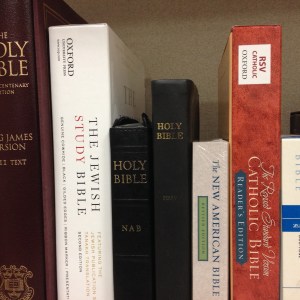
I’m sure there are great plans for the Good Book in the Bible Mausoleum. Looking at displays of the same text over and over can surely get a little dull, if we’re being honest with ourselves. I like Bibles as much as the next guy. Actually, I probably like them more than the next guy, but that’s beside the point. I don’t need to go to a museum to see them. There are Bibles all around my office, a mere arm’s length away. Here at home I can take in many of them at a glance—there are Bibles on three sides of me even as I write this from my favorite chair. Saving a nation that’s had the Bible from the very beginning sounds just a touch ambitious to me. But then, I’m no billionaire with nothing better to do with my money. There’s probably a tax write-off in there somewhere.

The thing about the Bible is, once you learn about it you can’t unlearn what becomes clear along the way. Cover your eyes or ears if you will, but we know the Bible had a long and complex history before becoming “the Bible.” It doesn’t have much of a plot without Revelation tacked onto the end—and seriously, that was one of the reasons it made it into Holy Writ to begin with! The circumstances that led to the Bible were often quite profane, in fact. It was the recognition of it as a sacred book that was a religious activity. The next step was to spread it as far as possible. That’s pretty much been done. The end result? The election of Donald Trump. If that’s salvation we’re all screwed. At least when we’re all standing in the bread line we’ll have a museum to visit while we wait. And it will be an encomium to something that was great once upon a time.


The Price of Worship

The wind resistance alone must drive the cost of gas up considerably. Of course, with Yahweh on your side you don’t need to worry about pocket change. We were driving through a sleepy town in the Poconos. A light rain was falling. We came upon a truck advocating not for the usual and expected Christ, but instead for Yahweh. Promising “dramatically affected” lives for those who do so, the implied message on this portable billboard is somewhat ominous. We are apparently being restrained by “non-mortal, non-native beings of ill-intent.” The grammar of the placard confuses things a bit since it seems to suggest that calling on Yahweh will “release restraints on” said non-mortals, and that’s hardly a good thing. I suppose they can’t reveal the nature of these entities without giving away spoilers for drawing the curious in.

This vague, supernatural world presided over by the personal name of the deity seems just a little out of place in Bible country. There’s a kind of literalism about Pennsylvania that I find strangely comforting. It is where and how I grew up. I never encountered God’s personal name—at least not with first-person familiarity—until I attended college. Even then we were encouraged to be careful with its use. The commandment about taking the divine name in vain is just a bit disconcertingly unspecific, considering that it isn’t spelled out in more detail. And who exactly are these beings of ill-intent? They’re all the more frightening for not being named. Demons, I must suppose, but I don’t recall the Good Book saying anything about their restraints being released. This is a new kind of apocalypse maybe.

The thing about the Bible is that it’s everybody’s book. Some modern translations use Yahweh rather freely, opting for the admission that translating it leads only to more questions and “Lord” is obfuscation. Still, it seems awfully familiar. The need to air one’s personal beliefs, in some quarters, is very intense. There’s a passion behind this proclamation that I can’t help but admire. People stop and stare. Some, like yours truly, will want photographs of your vehicle. I suppose that’s the point, nevertheless, not too many people like being stared at. Evangelical culture demands it, as I recall from my youth. Putting your personal beliefs out there comes with a price. Part of that may be reduced gas milage and, consequently, pocket change.


On Jordan’s Stormy Bank

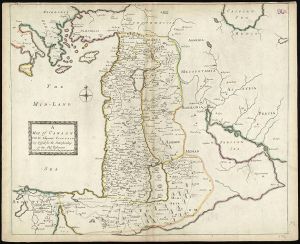
All you have to do is spit in the cup. Well, you have to do it quite a few times, but that’s the basic idea. Then you send the contents to a religiously motivated lab and your genetic ancestry will be emailed back to you. (There will be a fee involved, of course.) Genetics, a science of which Darwin didn’t have the benefit, is capable of mapping out where various “races” originated and ended up. Enter the Bible. One of the most disputed groups among scholars of the ancient Near East is the Canaanites. There was, as far as we can tell, no “nation” called “Canaan.” No people called themselves “Canaanites” but the term was used by others to designate them. Yahweh had a vendetta against them and ordered them wiped out. And, according to parts of the Bible, the Israelites acquiesced. So where are the Canaanites?

Image credit: http://maps.bpl.org, via Wikipedia Commons

According to a Washington Post article by Ben Guarino, DNA sequencing has revealed that they’re still there. This should come as no surprise to most anthropologists. Racial purity is always partially a myth, since “race” is no barrier to love. Or at least lust. And genetic traits don’t lie. Tracing ancient DNA from “Canaanite” (I’m getting myself scared using all these scare quotes) burials, scientists have discovered the biblical nemesis still survives in abundance, especially in Lebanon. Interestingly, on a cultural level, there is no distinction between Israelite and Canaanite. They are virtually identical. This creates one of the many embarrassments for biblical scholars, since the differences should be more than just skin deep. As with so many cases of racial distinction, the reality is mostly imagination.

Literalists, of course, have been in a rear-guard position for well over a century now, so the news should cause minimal shock. The problem will be keeping them from finding new excuses to carry out an extinct mandate. Biblical scholars, that heathenish race, long ago capitulated with the enemy. You’d expect no less from those who would dare use reason when approaching Holy Writ. It’s the real-world application that’s a problem. What do you do when the biblical enemy is found, hiding in plain sight like a purloined Lebanon? The solution might be as old as the story itself. Darwin didn’t have genetics, but he did have the Bible. The issue in the nineteenth century was what to reject when worldviews clashed. The answer was to jettison the godless science. We can only hope that this time-honored technique will prevent future crusades fomented by scientific discovery.


Making Lovecraft

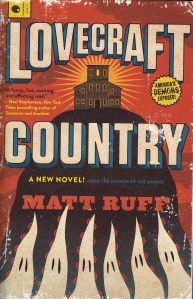
Perhaps it’s all just coincidence, but once in a while a number of unexpected things come together. Since I do a lot of reading this often happens in the context of books. The current case begins with my first noticing Matt Ruff’s Lovecraft Country. I saw a review online, and since I enjoy contemporary novels that build on the worlds created by H. P., I added it to my reading list. The first coincidental aspect of it was that I found in Buffalo Street Books in Ithaca. Like most independent bookstores, it’s not huge, so the selection of books that cater to my odd tastes is always adventitious. I found it on the staff recommendation shelf and recalled that it was on my reading list. A second coincidence came in finding Neal Stephenson’s name under a cover blurb. My brother-in-law’s name is enough to get a book onto the bestseller’s lists, but I had no idea this kind of book would be to his tastes as well.

I began reading it right away. The third happenstance is that Ruff crafted a biblically literate story here. In a day when those of us associated with the Bible are definitively passé, it is nice to see popular fiction fighting back a little bit. Not that Ruff is advocating or proselytizing, but his finely tuned story is definitely enhanced with a bit of biblical knowledge. He’s unapologetic about it. In our religion-critical outlook these days we sometimes forget that the Bible has several stories that maintain, and even reward, contemporary interest. The most obvious example in Lovecraft Country is the story of Cain. There are plenty of others that can be dug out as well, and Ruff even leaves some on the surface so that they aren’t hard to find. Not that this is a religious book. It’s just not afraid of religion.

Some may find that odd in a homage to the noted atheist Lovecraft. What they may not see is that the master himself used religion from time to time in his tales of horror. Also, for those who are willing to be honest, we know that an unsavory racism resided in Lovecraft’s outlook. Ruff, like other writers who see the positive side of this author’s work, tells a story of African-American struggles in the “idyllic” 1950s. The protagonists, dropped into a world of real Lovecraftian magic—and in a very self-aware way—are all a close-knit black family and their friends. Which led to another coincidence. Quite unconnectedly, I’d been reading Dr. Jekyll and Mr. Hyde. This plays an important part in the story as well. Sometimes reading itself can lead to a cascading set of coincidences. Lovecraft Country is one instance where it happened, but that may just be my unusual taste in books.


Devonian Dreams

Toothbrush and dental pick in hand, I go at it. Not that I’m a professional, mind you, but curiosity drives me to this. You see, this crinoid before me is at least 358 million years old and anything that can make me feel young deserves all the attention I can give it. Crinoids are also know as “sea lilies,” but they aren’t plants. They’re actually echinoderms, and the fossils I’ve found in the past have only been cross-sections of their “stems,” a stone circle, as it were. This one has tendrils visible, and I can’t believe that it was a chance find on one of my recent walks through Ithaca’s gorges. I’m dreaming Devonian dreams, and I want to brush away the plaque of the eons and see what I’ve actually found.

Fossils are a kind of eternal life. The creature that died to leave this impression lives on as a monument in stone. It reminds me of my unfortunately brief stint as an archaeological volunteer. Scraping away dirt to reveal a piece of pottery that hadn’t been touched by human hands for 3,000 years. Of course, that’s merely a second ago when you’re talking about something pre-Carboniferous. The dinosaurs won’t even show up for another 100-million years. And I think I have to wait too long for the bus. Time, as they say, is relative. Did this medusaized creature before me realize just how terribly long it would take for enlightenment to arrive? And how so very swiftly it could fall one foolish November night? Careful, this fossil’s fragile.

I grew up among the Devonian substrate in western Pennsylvania. The Bible on my shelf told me to disregard the evidence before my eyes. Some clever true believer had declared Noah’s flood the culprit, never bothering to explain how freshwater fish showed up after the deluge. Those we tried to keep in our aquarium never seemed to handle the slightest disturbance of their salinity. The ages of the literalist are by definition short-sighted. 6,000 years seems hardly enough time to account for any sedimentary stone, let alone that riddled with fossils. I’m hunched over my bit of slate, dental pick hovering nervously over what will never come again. The Bible behind me says it’s an illusion. You may be right, Mr. Scofield. You may never have evolved. But as my fingers glance a creature dead before even the crocodile’s grin I have to declare that I have.


The Ezra Puzzle

America loves the Bible. Thing is, most Americans have no idea how complex the Bible actually is. Jewish, Protestant, Roman Catholic, and Christian Orthodox Bibles all have different contents. I was reminded of this the other day while trying to look up 4 Esdras. If you’re scratching your head saying, “4 Esdras? Is that even in the Bible?” it only makes my point. The books we call “the Apocrypha” are also known as “the Deuterocanon” by Catholics. The reasons are complicated, but the Apocrypha consists of books that were never in the Jewish Bible. Jerome, the 4th-5th-century biblical scholar translated the Bible into Latin (it was originally written in Hebrew and Greek, mostly). When he came to the Apocrypha, he translated those books too, but with a special heading saying they weren’t in the Jewish Bible. During the Middle Ages the headings were often left out and the Apocrypha was included with the “Old Testament.” During the Reformation, Protestants rejected all kinds of excess, including excess scripture. The Apocrypha was out. The Counter-Reformation, living up to the title, led to the definitive inclusion of the Apocrypha in Catholic Bibles. Meanwhile, different Orthodox groups kept some, rejected others, and added still others. When Americans say “the Bible,” they generally mean the Protestant Bible.

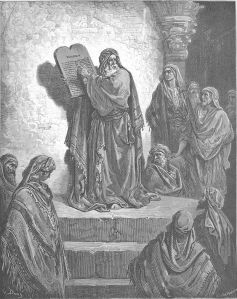
There are some implications to be thought through here, given that we’re talking about holy writ. Not all Christians agree on the same Bible. What’s more, the disagreements about what to include started pretty early. Does it count if you swear on an incomplete Bible? Would a New Testament do in a pinch? What if you’re Jewish? Having a national holy book is somewhat problematic when we can’t all agree on the contents. Many people would have some trouble opening right to some of the less popular books, say Ezra. Unless you’ve got a New Testament only, you’ll have Ezra. Go ahead, take a look. (It’s somewhere in the middle.)

Everybody’s complete Bible has the book of Ezra. So far, so good. 1 Esdras (“Esdras” is Latinized “Ezra”) is not in the Deutorcanon of the Catholic Church. It is, however, included in an appendix. It is part of the Orthodox canon, and it also goes by the names of 2 Esdras and 3 Esdras. Just to make it interesting, the Vulgate, or Latin translation of the Bible associated with Jerome, calls Ezra and Nehemiah 1 Esdras and 2 Esdras. Need a score card yet? It gets more confusing later! So 1 Esdras is either Ezra, 2 Esdras, 3 Esdras, or 1 Esdras, depending on whose Bible you’re borrowing. But where’s 4 Esdras? Well, there is a 2 Esdras (not the same as 1 Esdras or Nehemiah) in Slavonic, but not Greek, Orthodox Bibles. 2 Esdras is known as 3 Esdras and 4 Esdras, the latter when it is in the Vulgate appendix. The fun’s not over yet! 2 Esdras is broken into 3 parts and they are called 5 Ezra, 4 Ezra, and 6 Ezra. There is, however, no 1, 2, or 3 Ezra (unless the Latin name is Anglicized). If you’ve got a headache, take two Esdras and call me in the morning.


The Preacher

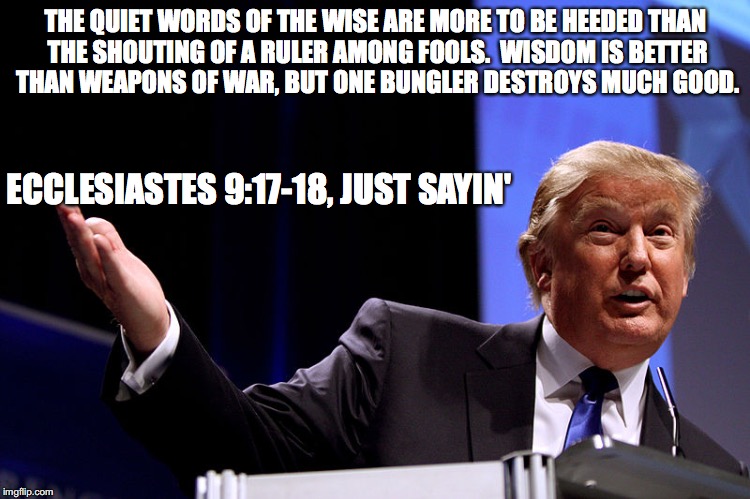
Ecclesiastes, I used to tell my students, is one of the most unusual books of the Bible. And that’s saying something. When we think of the Good Book we think of pious thoughts and lofty feelings—you know, the white-shirt, evangelical sort. The Bible, however, isn’t what most people think it is. Ecclesiastes, nestled right there near the geographic center of the Protestant Bible (and there’s more to say about this) is a book unlike any other. It is philosophical, weighty, and somewhat gloomy. It is a book where God can’t be relied on to help you and the world may very well be against you. It honestly admits that things just aren’t as they should be. “The quiet words of the wise are more to be heeded than the shouting of a ruler among fools,” it says, “Wisdom is better than weapons of war, but one bungler destroys much good.” (That’s 9:17-18, in case you want to check me out.)

America used to be known around the world for its pragmatism. Now it’s being laughed at as the master of irrationality. I remember when elections were matters of gravitas and serious consideration of the issues. They’ve now become high school popularity contests, even including the locker-room talk. Trump insults his own party and they kiss up. We have a president more impressed by kid’s toys in Saudi Arabia than by the top-notch research universities in his own country. I turn to Ecclesiastes for consolation. It’s a good book to read when everything’s going wrong. “For there is no enduring remembrance of the wise or of fools, seeing that in the days to come all will have been long forgotten.”

My white-shirted friends will surely object. I’m taking verses out of context—prooftexting, it’s called. But, my evangelical friends, you say Scripture is the word of God. Fully inspired and inerrant, is it not? How can you dismiss the wise, wonderful, woeful book of Ecclesiastes? The world is a complex place. Those who seek office as public servants should at least be able to distinguish the servant from the master. They lay their hand upon the Bible to take a sacred oath of office. Beneath that withered hand lies the book of Ecclesiastes, forsaken among its more cheerful siblings. Do not forget Ecclesiastes. It is the book that best makes sense of our day. “Better is the end of a thing than its beginning; the patient in spirit are better than the proud in spirit.” Herein lieth the truth.


Cloaking Device

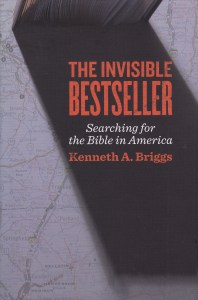
America’s book is seldom read. Those of us who spend an unusual amount of time with the Bible know this from personal experience, but others are starting to notice too. Kenneth A. Briggs’ The Invisible Bestseller: Searching for the Bible in America is a rambling account of the way a variety of everyday people from prisoners to academics and clergy use, read or not read, and perhaps inwardly digest the Good Book. There are moments of stark insight in this book, but with no narrative arc it is somewhat easy to feel like you’re reading about what random people say about the Bible. I don’t need a book to tell me that I’m odd, but much of what I read here was old hat to a guy who grew up Evangelical, went to seminary but never got ordained, completed a doctorate and taught the Bible nearly two decades before being booted out of its company. I’m not sure what I expected to find. Perhaps redemption?

Briggs does provide some useful statistics, and not as maniacally as sociologists do. We learn that few people read the Bible and the numbers are declining. Still, people buy the Bible and tend to have multiple copies in their domiciles. It is cheaper than insurance, after all. Holy Writ, however, is an alien among us. Few people have any idea what it was like to live before smart phones, let alone before the smelting of iron. The concerns and dialogues of the Bible seem so terribly provincial and, to be honest, unenlightened (if one can say such a thing about divine revelation). Still, we won’t accept a president who doesn’t lay his (and it’s always his) hand on the Good Book and swear to uphold America.

The Invisible Bestseller gave me plenty of information to ponder. Some of the tales Briggs tells are interesting. Others are so mundane as to be stultifying. The overarching fact is that the Bible is an established object in our culture. Some take it seriously enough to read it and stick with it—this isn’t easy to do, and I speak from experience here. Such people are rare. After all, apart from getting you a hall pass out of Hell, the Bible doesn’t seem to do much for people these days. Still, when I take a moment to read the Sermon on the Mount, I can’t help but feel we might be missing some wonderful rhetoric by ignoring the Good Book so much. But then again, I’m fully aware that I’m the one that’s odd. Briggs’ book stands as a testament to a couple of testaments that continue to wield enormous power without ever being read.


One Size Fits All

The divide between religion and science is often artificially widened by one side or the other. Of course the divide’s artificial—both science and religion are human constructs, after all. This is illustrated well in the sense of wonder in an article titled “True Story Of Volcanic Eruption Told By Aboriginal People For 7,000 Years” by Robin Andrews on IFLScience!. The very concept that a scientifically verifiable event survived in oral tradition for thousands of years completely unbalances those accustomed to think that the ancients were superstitious dupes who looked to the gods to explain everything. What’s often not realized is that the gods were an early version of science. Think about it—ancient people observed their environment for cause and effect. They couldn’t use the empirical method because it hadn’t been invented yet. That didn’t mean they were unsophisticated.

We look at the pyramids and wonder. How could such archaic people construct such advanced monuments? The rudiments of science actually begin to appear in the human record very early. Our species is a curious lot. The explanations for the close observations tended to be mythological. Gods are great for filling gaps. What we don’t see is any conflict between knowledge acquired by reason and ideas conjured by imagination. They fit together nicely. Human brains evolved that way. Belief is a strange thing—it influences reality, at least on a quantum level, but somehow it must be denigrated when compared to “pure science.” A large part of the blame, of course, has to go to those who had learned to take the Bible literally, particularly beginning in the eighteenth century.

The Bible had a disproportionally influential role in the founding of European empires. From the regular Roman under Constantine to the Holy Roman under Charlemagne, what became Catholicism informed political structures. In the British Empire, ever vacillating between Catholic and Protestant, the Bible played a major intellectual role. Real problems developed, however, when the idea of science alone took over. This was after Newton, Galileo, and Darwin. None of these lights suggested religion had no place. The real issue isn’t vanquishing, but finding proper balance. No matter how well calibrated our instruments may become, until we learn to detect “spirit” we have to admit that science can’t replace religion. Such harmful ideas as eugenics and behaviorism indicate that we need a balance and not a slam dunk. Who knows? Some of even the Bible may be true. Unless we learn to admit we don’t know all, those sitting around the fireside telling stories should be given credibility regarding what they’ve seen.


Size and Its Matters

Have you ever wondered where your Bible came from? No, I mean physically. There are many possible answers to such a query, so the other day I was searching for Bible printers on the web. A great many Bibles are printed by Royal Jongbloed, in the Netherlands. They specialize in the super-thin paper used in much Bible printing. The reason the paper is thin is purely pragmatic. The Bible is an economy-sized book and if printed with “regular” paper it would be large and unwieldy—something desirable only by those with nefarious purposes, I suspect. Bible paper, by the way, was developed originally by Oxford University Press. And in case you’re wondering, the convention of printing Bibles in two-column format is also a space-saving convention. So I was looking over the Jongbloed site, wondering if they’re nervous at all about the increase of Nones. Then I remembered that in many parts of the world Christianity is actually growing, so there should be security in the Bible printing market for some time.

The Netherlands had a large role to play in the development of Protestantism and its love of the Bible. Many English non-conformists found it a welcoming place. Bibles were welcome. But Bibles aren’t all that Jongbloed does. They print scientific manuals too. Now that caught my attention. There’s nothing mercenary going on here—some scientific manuals are really big and are printed on (of all ironies) Bible paper. Is there some kind of conflict on interest going on here? I mean, which is it—science or religion? Or maybe there’s a third way. Maybe it’s not an either/or proposition. Maybe Occam shaves a little too closely.

The craziness flooding out of the District of Columbia has us all worried. Science is being attacked. If you’re being attacked you look around for your enemies. Religion! But wait, is religion really science’s enemy? How easy it is to forget that science developed from alchemy and astrology, both religious practices. Even today many scientists see no inherent disagreement between the two. If we want to be effective in warding off the pressing insanity we need to realize who the real enemy is. Science and religion can both be honest searches for the truth of this universe we inhabit. No, the natural enemy of science is personal greed. It’s also, if we take any kind of religion at it’s word, the enemy of religion as well. What we see bursting the floodgates of Foggy Bottom is the desire for personal gain cloaked as governance for the masses. We should never forget that the Netherlands facilitated a movement that changed everything. Besides, it’s just too expensive to print Bibles in a land badly in need of a Reformation.


Sideliners

Sidelines can be interesting places to sit. You’re close to the action, and you’re privileged with a close view that few others have. You can’t, however, play the game. Sidelines are familiar to biblical scholars. I can’t count the number of times and/or ways the input of those who spend their lives trying to comprehend the Good Book are, well, sidelined. In the publishing world those who work with Bibles are simply ignored by most others, despite the enormous revenue Bible sales generate. In the academy religion departments overall are fair game for any potential budget cuts. And since what religion study survives tends to be intercultural, the Bible faculty are deemed somewhat less necessary than other sub-disciplines. It’s easy to forget that Christianity is the largest organized religion in the world and that some 2.2 billion persons claim that name. The Bible’s their foundational book. It tells us what motivates them. And yet, it’s easier simply to ignore the whole thing. Then something insane like an Evangelical-fueled Trump election, and everyone continues to say, “we can safely ignore this.”

I recently saw an article by scientists which explored why people engage in dangerous behaviors. The main idea was that although we know certain things are bad for us individually or as a planet, we still do them. We do them with the full knowledge that they’re deadly and will likely hasten our demise. Ignoring religion (and in the case at hand, the Bible) is very much like that. A well-armed true believer can ruin your day pretty quickly. Religion, in recent years, has generated over $82 billion in revenue per year. At least those in the dismal science ought to sit up and take notice of that! Hey, for once, the numbers are with us! Statistically, religion is very important. Sounds like a good thing to pretend doesn’t exist.

Having grown up a Fundamentalist, I often ponder this state of affairs. The Bible, we all knew, was the most important thing. Studying it formally does tend to force new ways of considering it, but few Bible scholars would want to dismiss the Good Book out of hand. It still means too much to too many people simply to ignore. Far safer is the proper handling of Holy Writ. This is much easier to instill when institutions support it. It really is a necessary kind of education. Still, it gets sidelined for industries with lesser profits and lesser baggage. I grew into a career defined by the Bible, but even if I hadn’t I’d hope that I’d be able to recognize that some things just shouldn’t be ignored. Yet I’m on the sidelines cheering on those who consider such a career a tragic mistake.


Filling the Frame

Those who study the Bible have to reckon with the fact that someone else probably said it first. This is one of the inherent liabilities of studying something a couple thousand years old. Still, scholars have to keep their jobs, and so they come up with new ways of looking at something ancient. One of my favorite new methods is the use of movies to understand the Good Book. Clearly nobody in ancient times had any ideas about films, let alone stills, but still, they liked to tell stories. They have that in common with modern cinema. Although I’m naturally distrustful of collections of essays—there are so many of them and they are all of mixed quality—I decided to read Close Encounters between Bible and Film: An Interdisciplinary Engagement, edited by Laura Copier and Caroline Vander Stichele. I have to admit that I picked it up with some trepidation, but I was pleasantly surprised in the end.

Like all edited volumes, Close Encounters is uneven. Nevertheless, a fair number of the essays are well done and insightful. The others may be insightful too, but my exile from academe has led to a drop in tolerance for method-heavy essays. They make me think the Bible should mean nothing to anyone but experts, which, if true, is a sad state of affairs for a world that depends on it for salvation. But I digress. The fact is movies quite often draw on similar collections of brain cells as do sacred texts. That’s interesting. Not only that, but flicks show just how deeply embedded the Bible is in western consciousness.

Having read many books on cinema and the Bible, I was pleased at how well this one seemed to flow. At times it’s as if that authors are struggling to find some common ground, but the realization that both sacred text and cinema are part of the cultural sphere suggests that the connections are there. More than that, they suggest that the Bible might still retain some relevance for modern people after all. Hollywood hasn’t lost sight of Holy Writ either. Just a few years back three major biblical epics came out in one season. For me this makes it clear that the stories of antiquity still speak to modern people. They have to be gussied up with CGI and big-name actors, but the underlying tales go back to a day before lights and camera were necessary for action. And we might learn something while our intention is simply to be entertained.