End of the Story

You know that feeling?  Like when you’re driving in thick fog and you know you should stop but you’re late and you have to keep going?  There comes a moment as you’re driving when you know that it’s going to end, and probably badly.  Yet you keep on going.  Trump has me thinking of the end of the world quite a bit.  I know there are many evangelicals out there praying for it fervently while the rest of us would like a little more time on this beautiful planet.  I’d be lying if I said I didn’t understand this outlook, because I do.  I grew up with it and I’ve never forgotten the sensation it caused.  And then I pondered that we are story-telling, and story-thinking creatures.  Perhaps other animals don’t think this way, but we constantly tell ourselves stories.

A story has a beginning, a middle, and well, eventually, an end.  We all know, at some level, that we’re mortal.  Life will end, and every completed story has an end.  Why not the world?  It’s a strangely haunting idea, the world continuing on without us here to make it interesting.  Plants will grow in any soil they can find, even microscopic cracks in the pavement.  Every year it’s like one day everything is suddenly green where only the day before we could see the sky through the branches.  And animals continue their quests for food, mates, and shelter.  Some live to hide while others strut.  Each has a role to play and if you watch them closely you’ll find yourself narrating their stories.  That rabbit.  That bluejay.  That fox.  They have a beginning, middle, and end.  If they can’t tell it, we can do it for them.  It comes naturally to us.

Long ago I learned how one version of Bible interpretation came up with the end of the world as we know it.  I also learned that this was contrived, just as all interpretations are.  This particular one has landed, like a seed, in the cracks of our mind.  It grows, just like that weed in the pavement.  This story must have an end.  We can imagine it no other way.  Even when we grow up and realize that the story was only one we told to children—children old enough to handle it, of course—we still have this certainty that an end is coming.  Like driving in the fog, we just know it.  Even when we realize that in reality we should be putting on the brakes.


The Idea of Scripture

Although the academic field of biblical studies is slowly dying—this is something I wrote about a long while back on this blog—the Bible and its kin nevertheless continue to shape and control society.  I was recently reading that Islam takes quite a different view of the Qur’an than Christianity does of the Bible.  It’s also clear that Judaism has yet another way of looking at Scripture.  What underlies these Abrahamic faiths is, however, the idea of sacred texts.  They don’t have to be understood, let alone read, in order to alter perceptions of reality.  The idea that God wrote a book, combined with the idea that God doesn’t show Godself or intervene in the world for good in any obvious way, has transferred a kind of godhood onto sacred scripture.

People desire the second coming because of a deep-seated need for God to part the clouds and demonstrate that their way of looking at things is the correct way.  It may be influenced by Scripture or politics or a favorite news channel, but the result is the same—they want divine intervention and since it’s not forthcoming, their sacred texts become the rallying point around which they gather.  Like many people I’m puzzled how a man like Trump, known for his proud womanizing and lack of care for anyone other than himself, came to be seen as a messiah.  Perhaps the key is that moment he gassed American citizens for a photo op holding up a Bible he never reads.  How this comes to be interpreted as a kind of divine moment only makes sense when we realize it’s the idea of Scripture that becomes the reality of many.

I’ve read through the Bible many times.  I have to confess that trying to get through the Qur’an is a struggle for me, but I suspect quite a lot of that is cultural.  I’ve read a few other sacred texts over the years, and have found some wisdom in all of them.  It’s when they become divinities in their own rights that society begins to pay the price.  If a non-interventionist God remains invisible, that identity will be transferred to the divine surrogate—Scripture.  People will coalesce around the idol they can see rather than the invisible one they can’t, right Elijah?  These sacred books have survived partially because they contain old wisdom, and old wisdom is often better than new knowledge.  But they also survive because they have become, in some sense, gods.


Leathers

It’s an occupational hazard for the vegan Bible editor.  Leather.  Leather Bibles, although expensive, are popular.  If you want free fetishistic deliveries of colored leather to arrive at your door, well, it’s part of a Bible editor’s life.  Morally I’m opposed to leather and I eagerly await the day when cactus leather is considered a suitable alternative.  Leather began being used in bookbinding early on, when books were treasured possessions.  It was readily available because animal slaughter was a part of everyday life.  It’s also extremely durable.  These days it’s just a status symbol.  When Bibles are produced there’s generally a market for whatever translation in leather.  In my time I’ve seen some well enough used to perhaps justify such extravagance, but not very often.  Usually it’s merely for show.

There’s an entire vocabulary associated with leather bookbinding.  Tooling, or engraving the smooth leather to look like something else, embossing, or pressing a design in the leather, gilding, or the use of gold paint on leather, and dentelle, or having a border run around the outside edge.  All of these were (and still are) signs of the artistry of the binder.  The practice dates back to before the nineteenth century when books were bound by booksellers, not publishers.  Perhaps this is why we shouldn’t judge a book by its cover.  In any case, apart from tradition there’s no need to kill animals to bind books any more.  Law books and Bibles are the major purveyors of leather binding.  It continues simply because it continues.

One term used for traditions unwilling to change is “hidebound.”  While this seems originally to have referred to emaciated cattle, it has come to be associated with codified, as in leather books.  Pigskin, or other cheaper hides, are often used.  Or “bonded leather,” which is as much plastic (if not more) than actual leather.  The Bible isn’t a terribly animal-friendly book.  Dogs are unclean and cats aren’t mentioned at all (except the large, wild kinds).  Yes, there are shepherds—both good and bad—but sheep were kept to be exploited.  And perhaps turned into leather.  There’s something strangely symbolic about this.  And not in a propitious way.  Where does obeying the rules get you?  Sheep are praised for their docility, their willingness to be thoughtlessly exploited, slaughtered, skinned, and eaten.  To do the job, a Bible editor must learn about leather.  Perhaps its a profession best left to carnivores.


Finding Freedom

I recently discovered The Incarcerated Christian website.  To be more factual about it, the women who run the site (Robin Mitchell Stroud and Debra Levy Martinelli) reached out to me about an interview concerning Holy Horror.  I hustled on over to the website to see what it was about and I was impressed.  In my own fumbling way, I would describe their use of “incarcerated” as people damaged by Christianity.  Imprisoned by various groups that require later healing.  Far more than a religion, Christianity has, of course,  become a cultural system removed from the teachings of its founder—the Trump administration made this abundantly clear—and bent on power over the lives of others.  In its efforts at control it leaves a lot of damaged people in its wake.  I must say that my interview with them convinced me that they really get what I was trying to do with Holy Horror.

Not that I have a great deal of confidence in my ability—life leads you to question such things—but a lot of my writing is on more than one level.  Here on this blog, several of my metaphorical pieces have raised objections from readers who took what I was saying literally.  Isn’t literalism often a problem?  In philosophy class we learned to call it “naive realism.”  Things may not be what they appear to be.  Getting underneath the surface requires some digging.  Maybe that’s why I enjoyed being on an archaeological dig so much.  To anticipate the posting of the interview a little bit, what some people automatically associate with horror is lack of depth.  In fact, much of horror runs into the profound, for those willing to watch.

Part of it, I must say, is that horror attracts outcasts.  The “Christianity” that dominates western culture actively seeks to create outcasts.  Creating, even if imaginatively, “the other” is a way of asserting one’s own superiority.  Reading the New Testament somehow I don’t think that’s what Jesus had in mind.  The cultural Christianity we see today has very little to do with Jesus.  “Believing in” has replaced listening to his words, or doing as he did.  Throughout the Gospels, if I recall correctly, joining the movement was voluntary.  They wanted to make the world a kinder, more compassionate place.  Look around at those who wear the badge loudly these days and tell me if that’s what you see.  What does all of this have to do with horror?  Listen to the interview when it’s posted on the podcast in October.  Don’t worry, I’ll let you know.  In the meantime, your hours spent on The Incarcerated Christian will be rewarded.


Mapping the Apocalypse

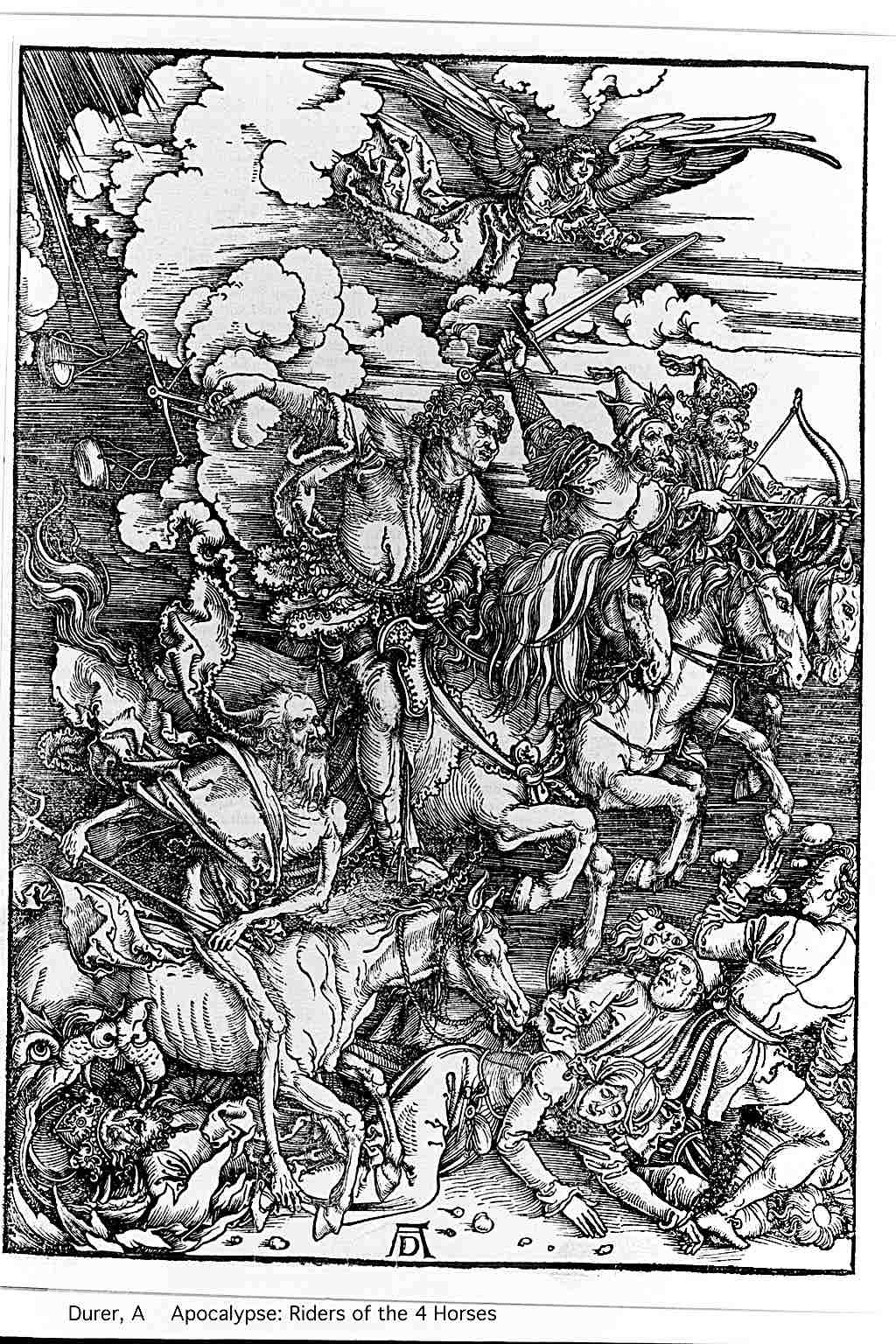
“Is this the end of the world?”  The question came up often early in the pandemic.  The end.  It’s so logical that just about every religion addresses it.  It bookends “the beginning” with the symmetry that we so covet that it’s almost impossible to think the world won’t end.  Even astronomers tell us the sun will betray us, eventually becoming a red giant and consuming our home planet.  Apart from being the greatest equalizer, however, religious speculation places the end way, way before then.  A friend sent me an article in National Geographic by Greg Miller titled “These 15th-Century Maps Show How the Apocalypse Will Go Down.”  It describes literal maps of the eschaton, and guess what?  It was right around the corner back then too.

Maps to the end of the world have been around for a long time.  With a bizarre Schadenfreude, many Christian groups eagerly anticipate the end of all this.  I grew up with charts and maps telling just how it was going to happen.  Like all of you, I’ve lived through many ends of the world.  These folks must be the strangestly optimistic bunch on the planet—when it fails to come on schedule they pencil in another date, preferably in their own lifetime.  They want to see it.  It will, after all, prove that they were right and the rest of the world was wrong.  Who wouldn’t want that kind of validation?  The apocalypse has been around since long before the fifteenth century.  It started in the New Testament, if not before.

This eagerness to end the world would be considered pathological were it not religious.  We’ve been about the closest we’ve been to a human-made apocalypse under Trump.  Make no mistake, some Christians were banking on it when they cast their ballots.  We tend to overlook this destructive way of thinking because some biblical literalists (and they don’t all agree, just put a premillennialist together in a room with a postmillennialist and watch what happens) claim that it’s what the Good Book says.  The rest of society, disinclined to look it up for themselves, accept that roadmaps to the end of the world exist in the Bible.  They don’t, but that doesn’t prevent everyone from fifteenth-century monks to present-day televangelists declaring when it will be.  That there is an end is taken for granted.  The astronomers look at their watches and sigh that we’ve got a couple billion years left, at least.  No, the pandemic wasn’t the end of the world although many Christians were hoping it just might be.


Bible, or Not?

Chosenness comes with a price.  Everyone, it seems, wants to feel special.  One way to ensure that feeling is to believe that you were specially chosen by God to fill a pre-ordained mission on earth.  Since such views are always human views there will be inevitable conflict when another group thinks itself the truly chosen one.  The process goes on and on with history laying waste one claim after another, but belief continues on just the same.  America is a young country, at least compared to much of the world.  Those who “govern” it (originally invaders) felt they were on a mission from God.  Believing themselves the “new Israel” they felt a Calvinistic faith was the only true one.  The people who put the government together were largely deists who’d left that thinking behind.

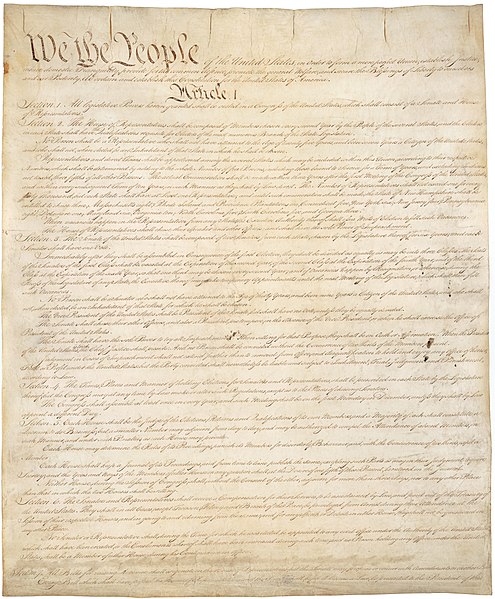
A recent story in the Washington Post cites such concerns with the God Bless the USA Bible, on sale in September.  This particular Bible is bound together with the US Constitution.  The reason people are concerned is a valid one—whenever something is bound with the Bible a significant number of people can’t tell the Bible from the other content.  Believing the Bible to be magically revealed by God, the entire content between the covers becomes sacred revelation.  Putting a secular document like the Constitution in there suggests to some (perhaps many) that said Constitution belongs to the canon of Scripture.  It’s a real enough concern, as easily attested by any who teach the Bible.  Even college-level students don’t know what’s Bible and what’s commentary.

Photo credit: U.S. National Archives and Records Administration, via Wikimedia Commons

Both the Good Book and the Constitution are documents in the public domain.  You can do with them what you please.  You could bind the King James Bible together with Moby-Dick if you wanted to, and if you wanted to make a long book even longer.  The price is confusion among those who can’t really tell the difference.  Many of the more evangelical stripe say “I don’t interpret the Bible, I just read it.”   Putting aside that reading is interpretation, the problem becomes clear.  That which is bound together in one book is one book.  After all, The Book of Mormon mentions Jesus in America.  The hazy view that many readers have of what’s actually in the Bible makes it dangerous to put other documents together with it.  The problem becomes clear when a nation believes itself chosen.  Chosen for dominion, it look to a specific book in support of that idea.  Even if it doesn’t know much about what that book actually says.


Buried Truths

I owe a lot to fossils.  Growing up just a block from a fossil-laden river in western Pennsylvania, as a kid I’d go fossil hunting with my brothers.  They weren’t difficult to find.  Maybe not museum-quality, but not bad considering that they were free for the taking.  I’d pour over some rock with many shells perfectly impressed in it and wonder.  Of course, my childhood religion taught that the earth was quite a young place because that’s what the Bible seemed to indicate.  Other than Chick tracts and related comic books we didn’t have many books around the house to explain this discrepancy.  One thing was pretty clear—the fossils were quite real.  We had no doubt that there had been dinosaurs.  How they fit into the Bible’s chronology (since the Good Book was written long before dinosaurs had been discovered) was unclear.

Mine was not an educated family.  We simply believed what the preacher told us.  Since Fundamentalist preachers don’t attend seminary, their response was probably something along the lines of, “the Bible says…”  Thinking about how to apply the Bible in a complex world was not their strong suit.  So we’d be taught that evolution was evil, but just literally a stone’s throw from the church hundreds of fossils could be found.  I suppose the evidence of those fossils kept me grounded.  I never could buy the “theory” that God created the world with apparent evidence of great age to test our faith.  A deity like that isn’t worthy of the name.

I still pick up fossils when I find them.  Apart from a brain coral and some crinoids, mostly I just find shells.  Knowing that this particular rock is evidence of the sea floor millions of years ago is thrilling.  It puts me in touch with the great antiquity of our planet, the times when people had not yet evolved to complicate everything.  Just a few days ago I found a rock with a vignette of life under the sea.  Looking at it closely there are crinoids among the shells, and what appear to be a drag mark where some unknown creature disturbed the silty Paleozoic sea bottom on its way someplace long before humans showed up.  Fossils always remind me of the responsibility of reading the Bible with an eye toward rationality and a recognition that a guide isn’t the same thing as a taskmaster asking you to believe the ridiculous.  That, I suppose, is why I can’t pass up a fossil on the ground. 


Around the Bible

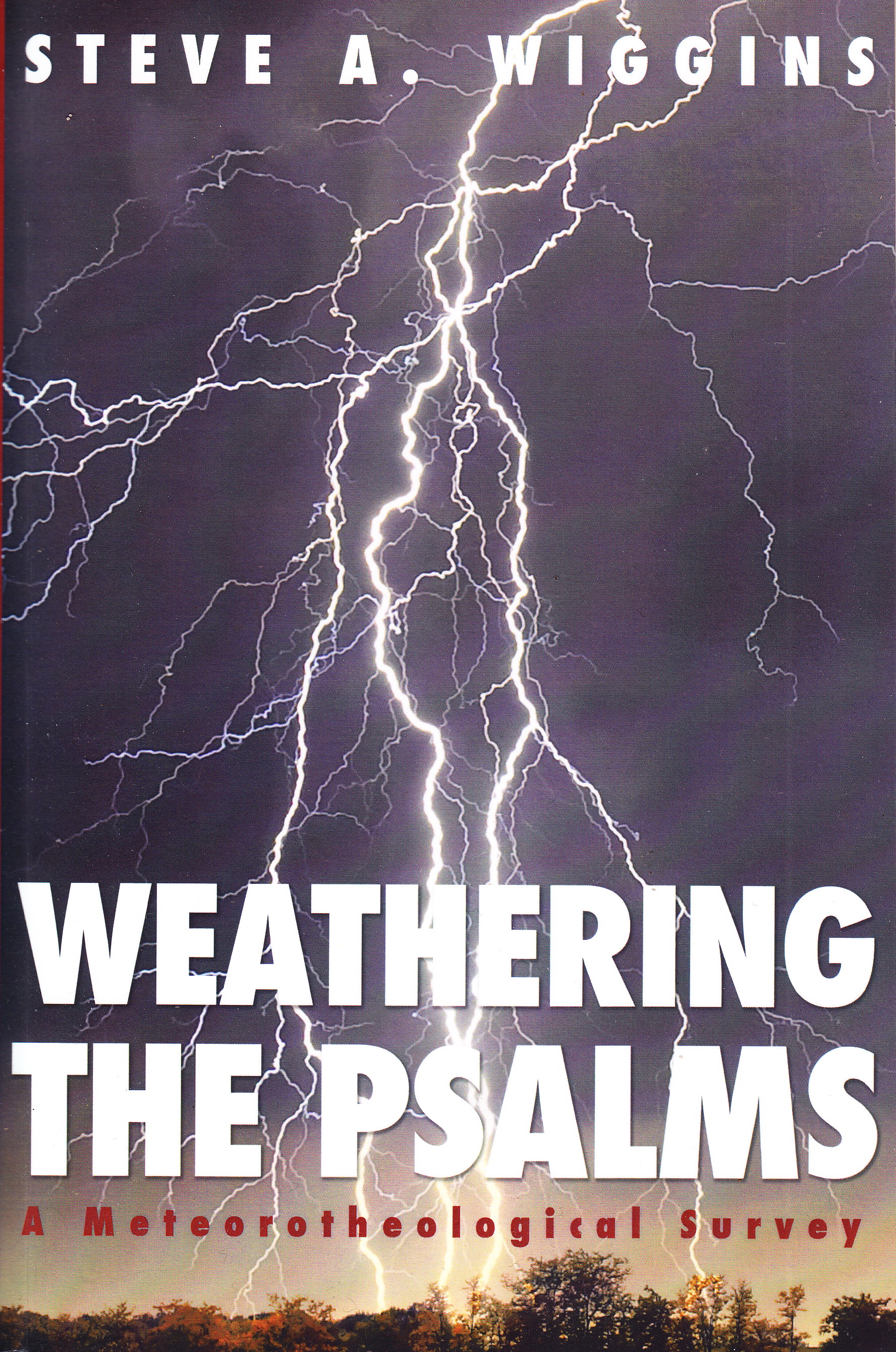
Perhaps it’s happened to you.  You grow curious about something adjacent to the action in the Bible and you go online to find information.  Instead you discover that Google (or Ecosia—plant trees!) searches round you up time and again into the biblical realm.  It seems as if nobody is interested in exploring the world of the Bible not mentioned in the Bible itself.  This has been an avocation of mine all along.  After a while you get tired of hearing what yet another commentator has to say about the Bible itself and you start to want information on, say, places Jesus didn’t go.  A startling apathy meets you online. If it’s not mentioned in the Good Book it’s not worth knowing.  Now quite apart from sending me to the pre-biblical world for my doctoral work, this was also the impetus for Weathering the Psalms.  Nobody seemed particularly interested in the larger picture.

I’m guessing this has improved somewhat in the academy, but it doesn’t translate well to the web, at least not the versions available in America.  Searches for topics around the Bible always herd you back to the Bible itself, as if it is the only reason one might be asking about the weather, geography, or natural flora and fauna of Palestine, Israel, Jordan, Lebanon, or Syria.  Who’d possibly have such an interest for its own sake?  Our bibliocentric culture seems to feed into search-engine algorithms and brings up Scripture time and again.  Try this for maps, for example.  You’ll come up with plenty showing places the Bible names.  If it’s not named there, you won’t find much.  Curiosity for its own sake isn’t encouraged.

This is related to the phenomenon of trying to search for something you don’t know the name of, I suppose.  Those who post content on the web, if they want to be successful, anticipate what others are interested in.  What of those of us who think differently?  Some of us put unusual stuff on the web, but how do you find it if you can’t put it into words?  Secular society doesn’t have much interest in the Good Book.  I’ve suggested many times why I think this is misguided—the Bible is foundational for the American way of life, whether you’re religious or not.  You might think curiosity would abound on related topics.  The thing is you have to get through all the clutter to get there.  I guess we need to be archaeologists of the web.


Whale Tales

Photo by Richard Sagredo on Unsplash

Always I’m surprised when other people seem surprised, specifically about animal intelligence.  Then I have to remind myself that our culture has absorbed the biblical view that people are different so thoroughly that even scientists believe it.  I watch the birds out my window quite a lot.  What they do is intentional and often quite intelligent.  True, not all animals are college material, but they are far brighter than the “automaton” paradigm with which I grew up.  So when I saw a piece in The Guardian titled “Sperm whales in 19th century shared ship attack information” I kept the tab open until I could read it.  Then I woke up this morning wondering why one of my many open tabs had the header “Sperm” on it, only to remember that I was going to read about whales.

I’ve written about Moby-Dick many times on this blog.  Although Melville didn’t experience financial success with it, he managed to pen one of the most profound and memorable novels ever.  One of the things he stressed was the intelligence of the whaler’s prey.  The Guardian article describes how, due to the magic of digitized log books, researchers can now compare captains’ notes about whaling.  What this comparison makes clear is that whales shared the information about attacks and avoided the areas where they occurred.  Despite the massive size of their brains, researchers had supposed whales to be rather stupid—or automatons—simply waiting to get slaughtered.  Animal intelligence is visible anywhere as long as we’re not afraid of that bogeyman, “anthropomorphism.”

We’ve been taught that human beings are so special that we think other animals act like us only because we’re projecting onto them.  Since the Bible informs us that we’re special and they’re further down the food chain, we must assume that creatures who destroy their own planet believing that they’re serving the will of God are somehow smarter than animals living in harmony with their environment.  We’re so smart that we had to add an extra sapiens to Homo sapiens to show just how special we are.  I’ve long suspected that animals are far more intelligent than we allow them to be.  Philip Hoare’s article offers us yet more evidence that we’ve underestimated our non-sapiens companions time and again.  Ironically we can accept that evolution explains how life forms change over time, but we somehow can’t let go of the story that says we’re somehow different.  I think we need to get out more and simply watch how animals behave.


Redefinition

The striking thing about Evangelicalism is its protean nature. The earliest forms of this conversion-based “Christianity” began with the Reformation among Pietist Protestants. They sincerely believed in two things: the Bible and Jesus. Today Evangelicals deny both. They believe in Donald Trump. Racism and subordination of women are their two main foci. And yet, they wish to keep the brand. Daily we see the standards of traditional “Christianity” tumble: turn the other cheek, love your neighbor as thyself, if a man asks your cloak give him your coat also. All of this jettisoned like so much non-capitalist clap-trap. Thing is, it’s in the Bible. Thing is, it was said by Jesus. And also anyone who even looks at a woman with lust in his heart is guilty of adultery, let alone those who pay them off so they can grab another on the way out the door. All of that’s now “Christianity.”

The funny thing is that those who object to such behavior are what Evangelicals scornfully call “liberals.” So much for the group that just three short years ago advocated the reinstitution of biblical law. Now that 45 would have committed a capital crime according to such laws, they have changed the Good Book rather than rebuke the pastor in chief. Ironically, some of the children of famous evangelists have drunk deeply from that Kool-Aid. It’s fine to sleep around as long as you lie the right way at the right time. Bear false witness? What does that even mean? You’d think liberals were suggesting that those God loves are chasteneth by him, for goodness sake!

Many of us feel as though we woke up to an alternate reality in November of 2016. We supposed the Republican Party would show some backbone, but when they didn’t we weren’t all that surprised. What shocked us most is that the leopard has changed its spots. Those of us brought up with the Bible were led to believe this impossible. After all, who can change a hair from black to white (although some of us would rather have it go the opposite direction)? We thought that Holy Writ would guide the Evangelical heart. We thought they would remember who Jesus was. All of this is negotiable now. The only solid rock on which they build their church—those to whom they give the keys to the kingdom—are those that fall into goose-step behind a “leader” for whom the truth changes daily. Opportunist be thy name. Were Jesus alive to see all this, surely he’d weep.


Literary Hunter-Gatherers

Perhaps the clearest place my hunter-gatherer roots show is in my tendency to collect. In principle, in Manhattan, I leave coins on the pavement for those less fortunate than myself. This past week on the way to work, I walked past a scattering of pennies on the sidewalk. It physically ached to leave the shiny coins there—one of my recurring dreams is to find a bunch of coins that will lead to the end of my constant fear of want. News of ancient hordes found excite me inordinately. As a child I collected odd things if they came in numbers: stamps and coins and baseball cards go without saying, but also fossils, bottle caps, little HO scale military figurines, even pockets full of punched metal slugs that had obviously fallen from a truck leaving the steel mill just across the river in blessed abundance. My mother asked, not unreasonably, “what do you plan to do with those?” My brothers and I had no answers, but we had found something in profusion. The hunter-gatherer urge was to collect.

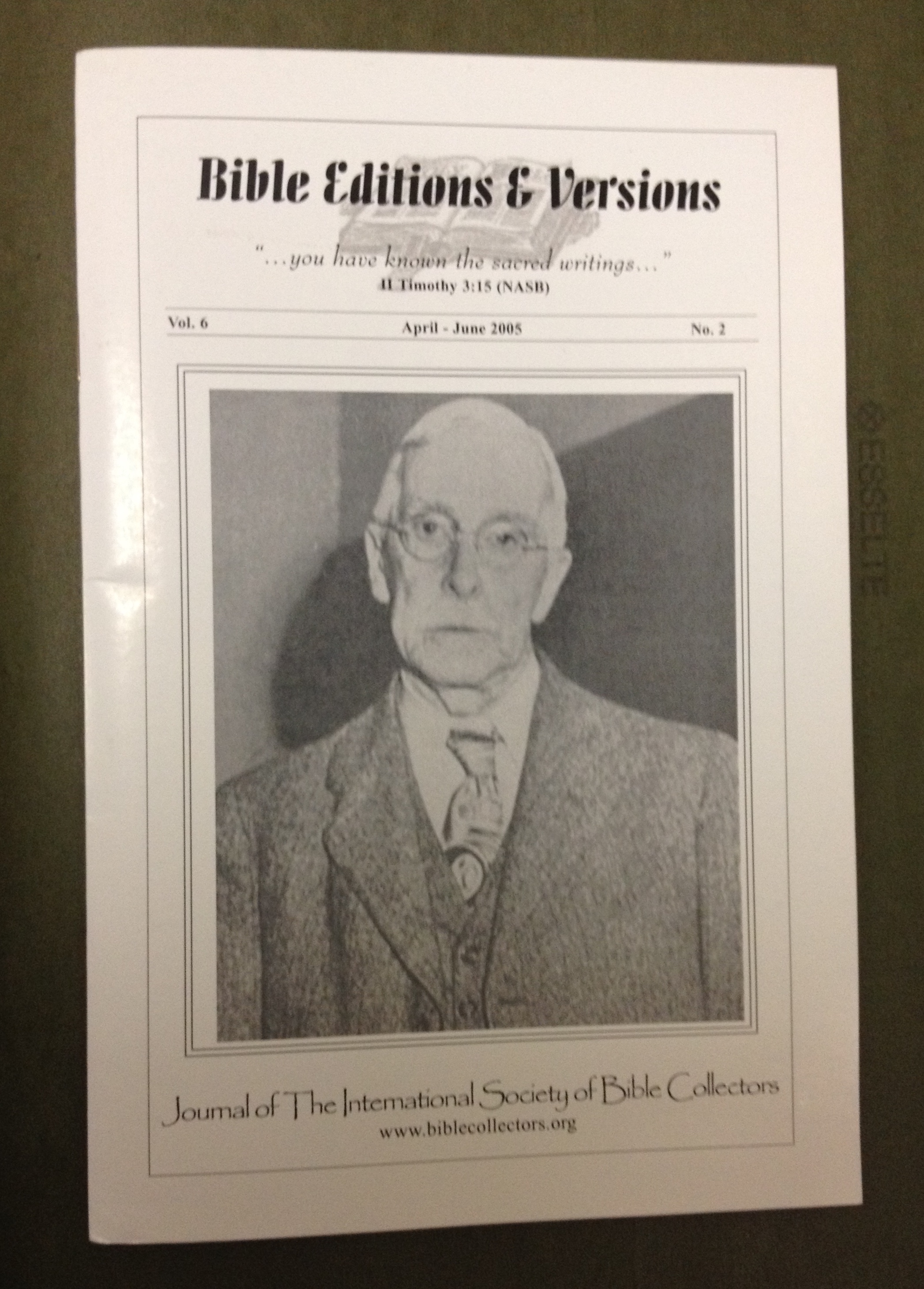
IMG_1642In my teenage years my collecting focused on books. It has remained there ever since. Even in times of penury when I’ve visited the used book store with intent to sell, I’ve always skulked out with more guilt than cash. The Judas Iscariot of the publication world. While sorting through some old files at work, I found a magazine called Bible Editions and Versions. Now, Bibles are books, and I have a fair collection of them, and have even read most of them cover-to-cover. I never knew, however, that Bible collecting was a recognized avocation. And one with a society and magazine. Looking closer, I found the address: www.biblecollectors.org, online home of the International Society of Bible Collectors. Yes, they have a website and the magazine still exists. Porn for sacred writ aficionados. The society has been around since I was two, but it took me half a century to find it.

The Bible is a totem. One colleague describes it as an iconic book. The more secular elements of society simply dismiss it until the loss of the senate makes them scratch their heads and say, “there are people who still take this stuff seriously?” While the numbers may have fallen off a bit, Bibles remain big business. Large print editions may be selling better these days, but the species is hardly endangered. In a world where so much seems uncertain, there is a natural appeal to a book that hasn’t really changed too much for a couple thousand years. Oh, and which claims to have God as its author. As I walk by that pile of pennies on the sidewalk, an almost magnetic force slows me down. I really want to stop and pick them up. I walk on knowing that in a box in my attic I have some real collectors items, in certain segments of society. For the ISBC I might be considered already a wealthy man.


Genizah Bible

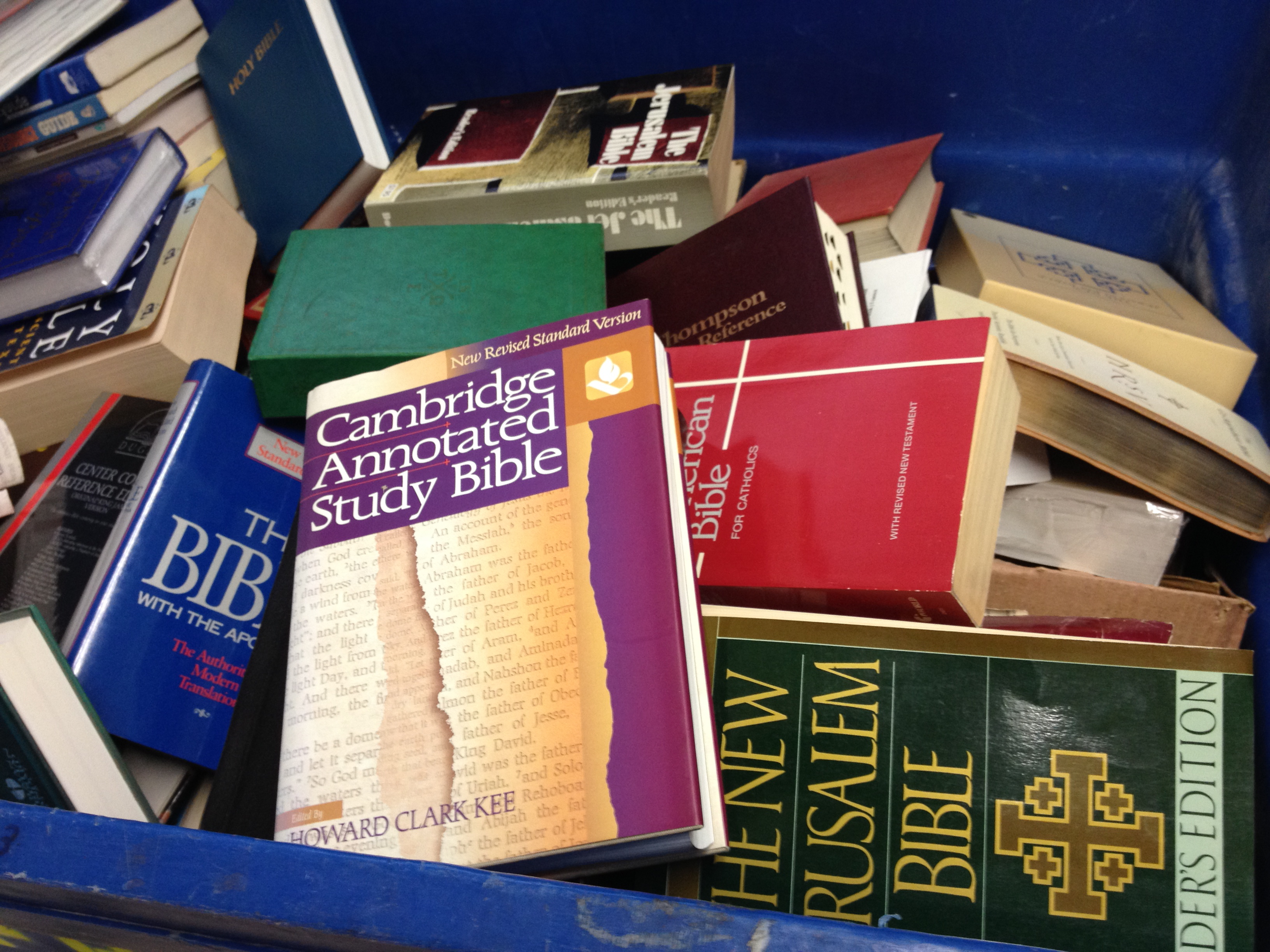
Overproduction is a survival strategy among many animal and plant populations. Just consider the number of acorns under one oak tree, or “propellers” under a maple in the spring. Swarms of ants or the legendary multiplication of rabbits. It’s as if nature knows most won’t survive, so you’d better prepare plenty. The same applies in the publishing industry. Every book is a gamble, and you can’t know which one will sell out and which one will collect the dust of ages on a warehouse shelf—a shelf you have to pay dearly to lease. This applies to best-sellers as well, such as the Bible. By almost any standard the Bible is among the best selling books of all time. Literally more than a billion have been printed. It exists in multiple translations and in many languages. And many copies end up sitting on the shelf. So many, in fact, that eventually a kind of limit is reached and you either need to rent another warehouse or thin the stock a bit. In my position, knowing what other publishers are doing is vital, so buying their Bibles is important. Then someone else needs your shelf-space.

A genizah is a repository for “retired” sacred scripture featured in some synagogues. Texts that are too sacred to toss into the garbage when they’re worn out may be buried among others of their kind in a genizah. Well, a storage room at work isn’t exactly a genizah, but it is a room where hundreds of out of print Bibles lie forgotten. Salvation in dry storage. As the new kid in the department, I get to clean the closet. Our own Bibles we are able to sell, but the hundreds amassed from other publishers over the years, well, we aren’t running a genizah here.

My instructions are: “see that dumpster over there?” For a kid who grew up believing that it was an order of sin even to place another book on top of a Bible, the idea of filling a dumpster with the good book presents a crisis of a greater magnitude. The simply is no room in the inn. Besides, I’ve lost a job or two already. And I’ve seen the damage that Bibles can wreak in the wrong hands. Still, I followed the Bible through three degrees, and in some form or another my entire life has revolved around that book. But I’m talking like an idolator. Bibles are big business. Few Bible publishers can’t turn a profit. And profits, we all know, lead us to produce even more.

IMG_1364


And the Band Played

One of the more curvilinear sequences of numerals has taken on demonic attributes over the centuries. Even the most secular of people, at least in the United States, can identify 666 as some kind of bad juju. The more literate among them will be able to pin the origins more precisely to the book of Revelation, often likely as not misnamed “Revelations”—something sure to drive your New Testament professor as mad as a beast. Fans of true precision will surely want to add that it is Revelation 13.17-18 that makes the number infamous. The latter verse starts out with “Here is wisdom,” which already spells disaster, for who doesn’t want to think him or herself wise? 666 is said to be the number of a man, and is conflated with the “mark of the beast”—one of the quickest ways to bring evolution and economics into the discussion. In popular culture 666 is said to be effective in invoking the devil. This idea is not found in the Bible, but it sure makes for an easy way to identify the Prince of Darkness in movies and popular culture.

The other day I received a mysterious email at work from a “Dr. Strangelove” with the email username of “camus666ster.” Indeed, the topic was appropriately apocalyptic and it managed to make it through a pretty strenuous spam-filter. Here was something apparently supernatural during the work-day. I’m also conscious that a building visible from the window behind my desk is 666 Third Avenue, but I’m pretty certain that these two sexagesimal cousins have nothing to do with one another. It is only a certain religious sensibility that brings them together. Where else in the world do authorities have trouble with people stealing roadsigns for route 666? And why do I get the feeling that someone is watching me?

IMG_0696

Revelation may have had more impact on our culture than any other single book. Whether it’s checking your iPhone for the weather, or wondering what is going to happen next in the Middle East, we all want a view into the future. It is a view that some suppose old John saw while exiled on Patmos. Others recognize that Revelation was a thinly veiled contemporary account to give hope to persecuted Christians in an era of imperial violence. Either way, the book, despite some effort to keep it out, ended up having the final say in the Christian canon. In a nation where every person possesses several unique identifiers, we still look over our collective shoulders for an anonymous beast who is about to bring down society. Don’t worry, folks, I’ve got his number.


Just Plain Bible

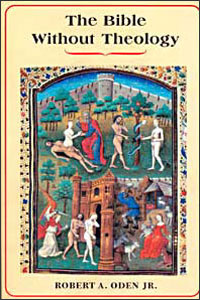
BibleWithoutTheologyBack when I was teaching Hebrew Bible in a seminary for a living, I purchased a book entitled The Bible Without Theology by Robert A. Oden Jr. I had intended to read it as a sanity break from the over-compensatory theological glosses that even the slightest reading of the Bible had in that setting. As the years passed and the book remained unread, I came to think of it as a systematic deconstructing of theological readings of the Bible, which it is not. Instead, Oden has gathered in this useful little book several essays centered on the topic of how the theological reading of the Bible has all but drowned out any other interpretations and has secured the privileged position of the Bible not only in society, but also in academia. Naturally, many people see such privilege as a witness of undisputed truth, even though how that truth is interpreted remains an open question.

Scholars, however, have the obligation not to favor their worldview over the evidence. Oden begins by discussing how history itself is perceived differently among those of various mindsets. History is an important part of the Bible’s theological reading since many Judeo-Christian interpretations revolve around a sense of historical veracity. After illustrating how history and mythology both lay claim to the text, Oden points out that even obviously mythological episodes have been blockaded by a theological reading of the scriptures. With examples from socio-anthropological studies, he demonstrates that parts of Genesis are best understood by investigating how kinship structures work, as well as how clothing serves as a status marker rather than a hidden justification for sacrifice, or chilly nights outside Eden.

Although The Bible Without Theology wasn’t exactly what I’d come to suppose it was, it remains a proper prologue to the issue. When Oden’s book appeared in the 1980s, the Religious Right was just finding its feet, fueled by a hyper-theological reading of the Bible. Since that time, the Bible has been used as theological justification to repress everyone from women to those biologically inclined toward their own gender. Bible scholars have, in general, known this is wrong. However, theologically inclined institutions won’t pay instructors for honestly engaging the text. Bible scholars are expected to throw their expertise behind the theological outlook of their institution in a way that Oden rightly points out, no other academic discipline would accept. In reaction to the biblical abuses of the Neo-Con crowd, many Americans are wondering why this one holy book is so privileged. While it may not have all the answers, Oden’s riposte will help to explain why the Bible deserves better.


God Particle

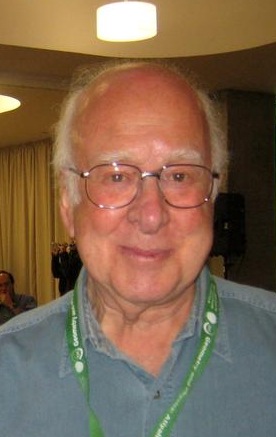
Over the last couple of days the Higgs boson has been in the news. Although I seldom ventured too far from New College and the faculty of divinity at the University of Edinburgh, it makes me glow with a special pride knowing I inhabited a small corner of the university of Peter Higgs. (And many other luminaries, including Charles Darwin.) My hopes of understanding the Higgs boson are more remote than even finding a university post (very long odds indeed), but I know that it is so important to physics that it has earned the moniker of “the God particle.” I first learned of the Higgs boson through Morgan Freeman’s Through the Wormhole series. At that stage it hadn’t yet acquired its divine status. Godhood must be earned, after all, at least in the eyes of humans. It is the proposed particle that stands to make sense of quantum physics, the world of the very small and the very weird.

There is an object lesson hidden in here. When even scientists get pushed to the limits of human knowledge, superlatives grow diminished. What can we call such a radical, powerful force in human thought? The particle itself, the boson, is not inherently stronger than a proton or electron, but its divine designation comes from its ability to, dare I say, replace god. In other words, it is the particle that explains so much that it is like the new god. News stories do not tell us where the nickname arose, but the best guess seems to be that some journalist with a flair for the dramatic brought God into the equation. God sells copy. But has the name also got enough room for a snake around the tree—or rather, around the nucleus?

In America, where science is under siege, any claims for God will be taken literally by some. We have witnessed again and again sheer silliness being paraded as “science” by Bible “experts” who take nearly half the population with them. The mental gyrations of the intelligent design crowd as they try to force God back into the equation should be warning enough. The God particle is baiting them and most Americans are ill-equipped to decide for themselves what is actually science. No sooner do we get a grip on nanotechnology than we begin building nanocathedrals. In that cathedral if scientists find the Higgs boson, it will not be god. It will, like god, open the door to many more unexplained phenomena, for god is not an explanatory principle. If we need a name to convey the great, rational explanatory power of such an elusive sub-atomic bit it seems to me—and I may be biased—that we call it the Edinburgh particle instead.