Naming Birds

I’m no Jane Goodall, but I grew up loving animals.  I still do.  I’d spend many hours poring over animal identification books.  When I was young I could tell a crab from a lobster from a crayfish.  I knew moths from butterflies.  Megafauna?  I had it covered.  One thing, however, eluded me.  Bird identification.  Now, I can tell the obvious ones apart, but ornithology seems to delight in making the trade difficult.  For example, I was on a walk with a couple friends in May.  We spotted a small bird—smaller than finch size but larger than a hummingbird.  Short tail.  Its coloration was an unusual shade of brown.  We got a good look at it.  Back home I pulled out my bird identification books.  Nothing like it.  I tried online, even Cornell’s famed ornithology lab website.  According to all the specs what we saw doesn’t exist.

The problem with birds is that they come in different colorations.  Most bird identification books and sites focus on the males.  They tend to be more colorful and their identification is easier.  Not only that, but young birds’ plumage often changes as they mature.  This is such an issue that some bird books warn the would-be watcher not to try to identify by the color.  You should look for things like eye-rings, beak shapes, and that tiny spot on the tip of the tail, when seen in flight.  Right.  After a couple of days of searching in my spare time, I gave up.  Given how small it was, this was likely a juvenile.  Which sex I have no idea.  It bothers me when I can’t identify what I see.  The world is full of such wonderful things!

Many years ago in Scotland, some friends willingly crawled to a cliff’s edge with us on a rainy day in the Orkney Islands.  We’d come here to see the puffins.  Puffins nest on cliffs overlooking the sea.  They have colorful bills and are similar in looks (but not physiognomy) to penguins.  We were rewarded with a view of a cliff-full of sea-birds, including puffins.  I often ponder, living inland now, why the bright, colorful birds tend to hide.  I know, I know—predators.  But still, I can count on one hand the number of times I’ve seen an adult male oriel with their bright orange plumage, despite living in an area where they’re listed as common.  Birds can be so coy.  Maybe that’s why dedicated bird watchers have such passion.  I love animals.  The problem with birds is, despite hours with books and websites, some of them I just can’t identify.
Stories in the Snow

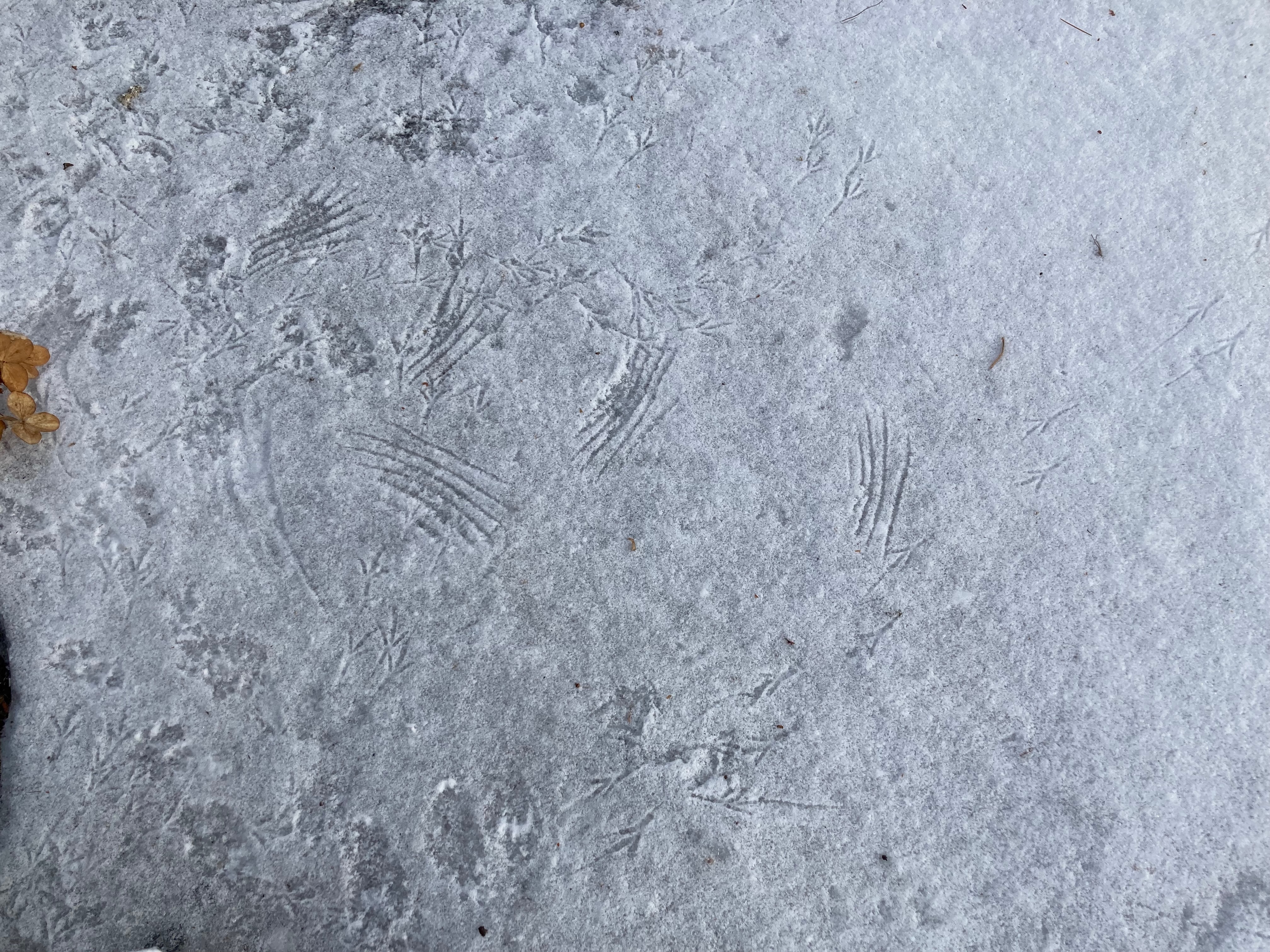
Birds are quite capable creatures, but some have learned that by hanging out around human dwellings, some of our species give handouts.  For me, the sight of a cute little junco shivering outside the window leads me to break up the hardened bread slices that I save for them and toss them outside when things are either buried in snow or ice.  This year we’ve had a bit of ice and some snow on top of it, which makes a kind of canvas for seeing who’s come to visit our crumbs.  My daughter pointed out to me that we had some feather prints as well as footprints, so I thought I should go ahead and record them.  If this were mud and a few million years had passed we’d perhaps have ended up with fossilized feathers.  And nature’s canvas is endlessly beautiful.

I imagine people tend to be partial to birds because they look so delicate and fragile.  Well, at least the little ones do.  Our natural sympathies make us feel sorry for them when nature makes finding food difficult.  The survivors among them, however, are tough.  Birds skirmish over food and can be quite aggressive around both a bird feeder or a crumb pile.  They were, after all, once dinosaurs.  And around here winter locked in before Christmas and has stayed around for quite some time, temperatures barely rising above freezing for many days in a row.  And I look for feather prints in the snow.  Try to find the beauty in the starkness of harsh weather (while looking askance at the energy bills).  Our animal companions can teach us much about life.  Their stories leave traces for us to follow.

Our species has often tried to advance itself at the expense of others.  I think of the tremendous environmental damage that we’re willing to inflict to enable AI.  What pollution we’re willing to dump out for using fossil fuels.  How much forest we cut down for our own use.  We drive vulnerable species extinct.  This makes me think of those creatures that have adapted to us.  Who speaks highly of rats, pigeons, or cockroaches?  Even sparrows, which can be quite aggressive, or even mean, reflect our attitudes toward the rest of nature.  I’m sure some sparrows come for the crumbs, even though I put them out with the juncos in mind.  Those that appear here in winter have likely migrated from even further north.  They handle cold I have difficulty tolerating.  And they leave art in the ephemeral snow.


Flighty Thoughts

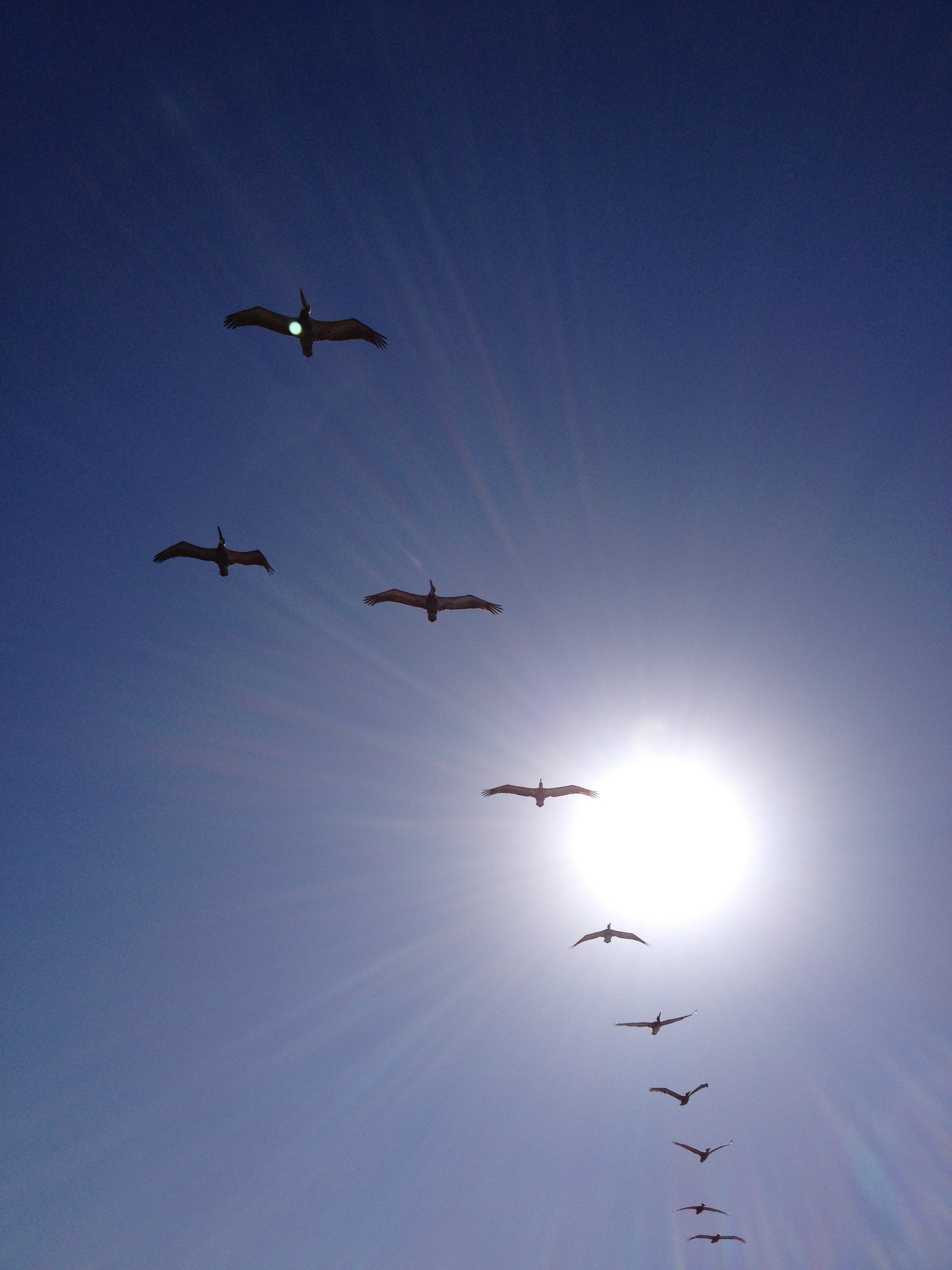
Life, domain, kingdom, phylum, class, order, family, genus, species.  My apologies if I’m bringing back bad memories of high school biology, but I’m doing an experiment.  It has to do with the class level.  (I have to confess that this has become more complicated since high school since there are a lot more of them than I remembered.)  Specifically, I was thinking of those of us with backbones (which seems to exclude many congressional Republicans these days), namely fish, amphibian, reptile, bird, and mammal.  I read somewhere—I can’t recall where; I seem to be reading all the time—that the only other order of animals that human beings see every single day, apart from other mammals, is birds.  I suppose some of this depends on location, but it seems to be true even for landlubbers who don’t work in zoos.  I’ve been watching, however, to see if I do see birds every day.

I work in an office with two windows, one facing south and another facing west.  There are trees outside the west window and during spring, summer, and fall birds are abundant.  Yes, I see them every day.  Winter, however, is a bit more dicey.  Songbirds famously either migrate or retreat into more sheltered places for the season.  The other day, during a cold snap, I got to thinking I hadn’t seen any birds at all.  The only thing that rescued the allegation was that I remembered I saw some birds that I startled out on my jog, before it was fully daylight.  The rest of the day I keep my peripheral vision on alert for any motion outside my windows.  Late in the day I saw a crow dart between two trees.  I do see birds most days, but I’ll be keeping a watch this winter for birdless days.

It’s not that I want to prove this author wrong—I can’t even remember who s/he was.  No, this experiment is driven by pure, naked, curiosity.  I’m pretty sure that the author wasn’t writing in a literalist tone (that’s more of a problem with my wiring).  The point that was being made is that people pay special attention to birds since they are so prevalent in our world.  They’ve adapted from conditions of arctic to desert and they can get around many obstacles that might prove troublesome to our class, even bats.  I know that I rarely see amphibians, reptiles, or fish.  Certainly not on a daily basis.  So birds do seem to be top of the class, and, so far, I have seen at least one every day since reading this from a fellow mammal.