Black History

The first of the “blaxploitation” movies, Blacula is a period piece.  In 1972 vampires were still all the rage, following from Dark Shadows and the continuing Hammer hammering of the monster.  They even produced Dracula AD 1972, not to put too fine a point on it.  American International Pictures wanted in on the action and produced the first Black vampire in cinematic history.  Rather than a remake of Bram Stoker’s novel with a Black cast, the story begins with Mamuwalde, an African prince, entreating Dracula (whom he doesn’t know is a vampire) for help ending slavery.  Instead, Dracula turns Mamuwalde into a vampire that he names “Blacula,” and places him under a curse.  In the seventies, a homosexual couple purchases Dracula’s castle, intending to sell the contents on the antique market.  One of those antiques is a locked coffin.
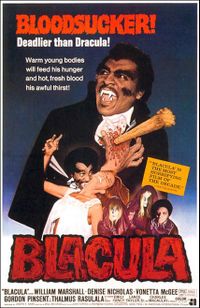
Once he’s freed in America, Blacula quickly runs into Tina Williams, the spitting image of his long-deceased wife.  Meanwhile Tina’s friend Dr. Gordon Thomas, suspects that there is a vampire on the loose in LA.  Although the opportunity for camp is clearly present, this movie is played straight.  Mamuwalde is a monster—he kills several people—but his real motivation is to regain his dead wife, whom, he is convinced, is Tina.  When Tina is shot by a trigger-happy cop in the tunnels below a chemical plant, Blacula turns her into a vampire.  When she is staked, Mamuwalde tells the doctor that he need no longer pursue him.  He voluntarily climbs into the sunlight and dies.

Now, this wasn’t a great movie but it does seem to have a reasonable bit of social commentary.  It was the seventies, but racial and orientation slurs were still widely accepted.  And people dressed like, well, it was the seventies.  The Black characters, however, are portrayed with dignity, and Mamuwalde is presented as nobility.  Perhaps more importantly, this movie opened the doors for further horror films featuring African-American lead characters and plots.  A few decades later Blade, based on a comic book hero, would once again foreground a Black vampire who’s on the side of good.  It’s still some distance from Black Panther, but the process had to begin somewhere.  Watching Blacula was like watching history, and I suppose viewing movies is like a selective piece of history.  By this point AIP was well established, and influential in its own way.  I’d heard about Blacula since childhood, but until streaming it never really came across my screen.  Nevertheless it remains an important piece in this country’s ongoing vampire mania.


Now You Don’t

Quite some time ago I realized I should read Ralph Ellison’s Invisible Man.  What put me off, as usual, was length.  Long books take a real time commitment, but since Black History month is coming up, and we’ve just celebrated Martin Luther King, I planned ahead and read.  A profound book, at several points I felt like a voyeur reading it.  The African-American experience of life is something I always feel uncomfortable approaching.  I’m afraid of appropriation, and I’m afraid of not paying attention.  I grew up not having a sense of racism, but nevertheless am implicated in the whole.  Maybe that was intentional.  As a story Invisible Man is often described as a picaresque, but having an unreliable narrator who was a victim of my own culture was difficult to countenance.  It was hard to know what to think.

We never understand another person’s experience of life.  We sympathize, we empathize, but we can’t really get inside the head of even our best friends.  I can’t help but think we’d all be better off we recognized that race is a social construct, and a potentially evil one at that.  We are all human beings and we should act that way.  But this novel left me wondering if it’s really possible.  Good novels will do that to you.  So I’m sitting here scratching my head and a little bit flummoxed by what I’ve just experienced.  Was it authentic or can I not help but project my own experience as an non-minority upon someone else’s writing?  Even questions like this are socially conditioned.  I too am trapped in my own mind.

You might think that by this time we would have evolved beyond our distrust of those long separated from us by natural barriers.  Homo sapiens are distrustful of strangers, and even the internet hasn’t brought us the understanding we require.  Not yet, anyway.  The background to “race relations” in the United States can’t be separated from slavery and the attitudes it engendered.  On almost every page of Invisible Man its traces can be seen.  That kind of cultural memory, and other cultural memories such as Jews being routinely castigated by Christians, or monotheists being raised to combat polytheism, are deep dividers.  Our cure for these evils is understanding.  I had to keep reminding myself that this was a work of literary fiction.  It rings true, however, and although it represents a world I do not know the fact of its publication invites  those of us outside the tradition to read.  Indeed, doing so is one way of attempting to reach understanding.


Walking Monsters

It was a moment of weakness, or at least tawdry cheapness, that made me watch The Monster Walks. Just the day before the Cable Vision guy had stopped by, detailing how much money we could save by switching. We haven’t had television service since 2004, and even then it was only with a cheap aerial. Back in the days of Borders, I sometimes caved in and purchased the “Classic Features” movie boxes with 50 B, C, or D movies for what seemed a steal at less then 25 dollars. Maybe five or six of the movies from each set were actually worth the time spent watching them, but many of them proved an education. So it was with The Monster Walks.

Now, I readily confess to having a weakness for B movies. Made by people who were really trying, but who seemed to lack talent, I often identify with their efforts. So when I popped The Monster Walks into my DVD player, I had no idea what I might learn. The first revelation occurred in the opening credits where a character named “Exodus” was introduced. Since this was 1932, the character had to be African American. And comic relief. To spare you the pain of watching the movie, the plot is rather simple: rich man dies, helpless daughter inherits all to the chagrin of surviving brother and domestics, who plot to kill her by pretending to be a murderous ape. There also happens to be a murderous ape locked in the cellar. You get the picture. Aptly named Exodus is purely there as a foil for the educated, privileged white family. He was played by the talented but underappreciated Willie Best. As might (nay, should) be predicted, the scheme of killing the girl backfires and the ape kills the killer. Okay, so I can confess an hour wasted and get on with my reading. But the final scene arrested me.

Exodus wonders to the lawyer (who is there to read the will) why the rich man even had an ape. The lawyer, metaphorically transformed into a judgmental William Jennings Bryan, states that it was because he believed in Darwin’s theory of evolution. Exodus responds by noting some family resemblance to the ape. The blatant racism was hard to take, but in Black History Month the painfully obvious collective sins of our society should be laid bare. In 1932 Fundamentalism, often implicitly allied with racist causes, castigated Darwin’s theory for bringing all of humanity down to the same level. As long as a white god is creating the universe, the Anglo-Saxon can claim superiority. Never mind that Genesis was written by a Jewish writer living in Asia. Self-righteousness comes in many forms, but it always involves bringing others down to a rung below where the blessed stand. Has not the great Rick Santorum told us that even the Crusades were merely misunderstood?