Best King

I suspect most people have read one or two at least.  Most reading folk, that is.  I mean Stephen King novels.  He’s sure written plenty.  By my count I’ve read nine: The Shining, Carrie, ‘Salem’s Lot, Pet Sematary, It, The Stand, The Tommyknockers, Revival, and Cujo.  I probably have one or two more in me.  The dilemma is that I like King’s writing—I’m not one of those nay-sayers who call it clap-trap.  There’s real literary merit to much of it (sometimes just too much of it), and he integrates religion into horror really well.  The thing is, not all of his books are made equal.  I suspect that’s true of any writer.  I’ve consulted some lists to see which are the best and I’ve watched some movies before reading the books, but I’m starting a ranking of my own here—it will probably be revisited from time to time, as events warrant.

What’s his best?  Well, such lists are supposed to start with the worst and work their way forward.  I’ll cave to convention this time.  So, The Tommyknockers and Cujo are tied for least favorite.  Each has a reason: The Tommyknockers is too long and lacks sympathetic characters and Cujo is just too nihilistic.  The premise is good but the bleakness got to me.  The Stand comes next primarily because of the length.  I like the way that one ended up, though.  Revival, my most recent read, comes here, about in the middle.  It was enjoyable to read, even with its length.  I think King has a little trouble writing convincing kids, but the story was good.  Next I would put ‘Salem’s Lot.  Who doesn’t like a good vampire story?

Not that kind of book.

My top three are, perhaps predictably, generally among the top ranked.  My order is perhaps a bit different than most, however.  I really, really enjoyed The Shining.  The movie, I believe, is better.  That may be heresy, I know.  Carrie has all the freshness of a novelist breaking through, and it’s effective.  Better than the movie.  That leaves Pet Sematary as my current favorite.  The story there caught me up and it’s the only one of my top three that I read before seeing the movie (both of them).  The book is way, way better than the movies.  Compared with Revival, which also deals with what happens after death, Pet Sematary offers a commentary on grief that doesn’t involve everyone dying by suicide.  It’s on a much more human level.  As I read more, I’m sure I’ll form other opinions, but for the time being, these three of the King’s early novels, are, in my standing, the most deserving of the crown.

Hopeful History

We could all use a little hope.  Given the rate of change in the world it often feels impossible to catch your breath.  And not only that, but the change often feels decidedly negative.  Few would opine, for instance, that we live in the golden age of politics.  And while it has its supporters, AI seems bent on our destruction.  So why not eat, drink, and be merry?  Scott Edwin Williams, whose last book Lightbulb Moments in Human History I reviewed here, has been at it again.  His basic idea is that our “lightbulb moments” give us hope for a better future.  Lightbulb Moments in Human History II: from Peasants to Periwigs, keeps the same general idea afloat, but barely.  As history progresses it’s harder and harder to say that the lot of humanity, tout court, has improved.  True, we live in relative comfort in “the developed world,” but we still have looming Trumps and other nightmares in the wings.

This book tries to cover large swaths of history, and that’s a difficult task.  Williams tries to keep it lighthearted but even he struggles to do so when discussing the rise of big business.  The chapter “Takin’ Care of Business” really showcases the negative traits that humans are too often willing to display when they form companies.  Capitalism may have been a lightbulb moment, but the untold misery it has introduced into the world gives the reader pause.  For example, the East India Company’s business decision to addict as many Chinese to opium as possible, seems quite strange in the context of a “war on drugs” being used as a means of incarcerating “undesirables” because, well, drugs are bad.

There are some signs of hope, and some lighthearted moments in the book.  It does, at times, seem to work against its own thesis.  It makes me glad for living in an age of anesthesia, and of general agreement that people should respect each other’s boundaries (unless you live next to Russia).  Even the lightbulb moments of Mesoamerican/South American history demonstrate the kind of cruelty humans often perpetrate against “outsiders.”  Williams notes here that two more books are in the works (authors know that a series isn’t a bad thing) but it does make me wonder if light and dark don’t balance each other out.  I know from my own family history that some of my ancestors died of things quite curable today, and they lived not all that long ago.  And that I can write these words and publish them instantaneously (whether or not anyone reads them).  And I can buy most necessities of life (apart from toilet paper during a pandemic) fairly easily.  And I do appreciate books that give me hope.  But balance isn’t such a bad thing either.


Learning to Write

It’s a reciprocal relationship.  Ideally a symbiosis.  The publisher has a reach, and know-how, that an author lacks.  An author provides content the publisher needs.  Yet publishing is a business in a capitalistic world and has to (unless subsidized) turn a profit.  As an author who works in publishing I’m skewered on the horns of this dilemma.  It’s heartbreaking to see the lengths some authors go to only to find out their book is priced the same as a week’s worth of groceries.  Or three tanks full of gas.  Who buys a $100 book?  Libraries.  Well, some libraries.  Occasionally a publisher will run sales, if you order direct, but by then interest in your book (which may be timely) has passed on.  You become just another name on the shelf in the Library of Congress.

I’m looking for a publisher for my sixth book.  This has to be someone who understands that even $45 is beyond the reach of most intelligent readers.  “What the market will bear” feels like the death sentence to the years of your life you’ve put into writing the thing.  A friend once asked me, “Why do you do it?”  For authors the real question is “How can you not do it?”  The need for the validation through publication runs very deeply in some people.  More deeply than our national love for Taylor Swift.  It has to do with meaning.  Purpose.  A sense of what we’re put on earth to do.  

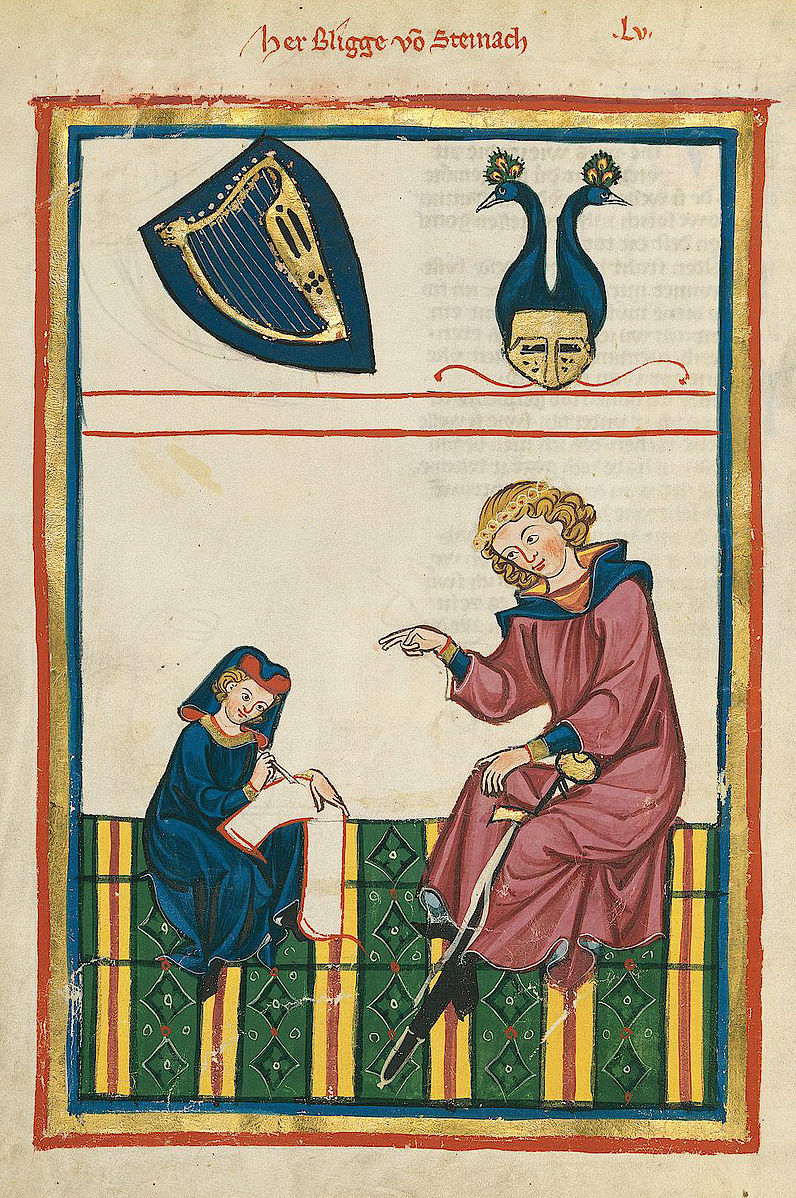
Image credit: Codex Manesse, public domain via Wikimedia Commons

The standard “wisdom,” and practice, is to publish in hardcover, priced for the library market, and if it sells well at $100, perhaps offer a paperback.  Hopefully priced lower than $45, but don’t hold your breath.  “What the market will bear,” should be your mantra.  It’s a wonder that civilized people ever got educated.  I grew up on cheap books from Goodwill, which is all I could afford.  College, on borrowed money, taught me the price of reading seriously.  It was a lesson I never forgot.  I’d begun my faltering steps to writing books while in high school.  I started writing short stories even earlier than that.  It has been a life of writing.  Even series books, I’ve come to see, are too easily exploited in this way.  My shortest book is priced at $40.  At least I know that I’ve written some collectors’ items.  Take heart, my fellow writers trying to emerge from academe.  There are other ways of being in the world.  And some of them may even be symbiotic.


Tracing Writers

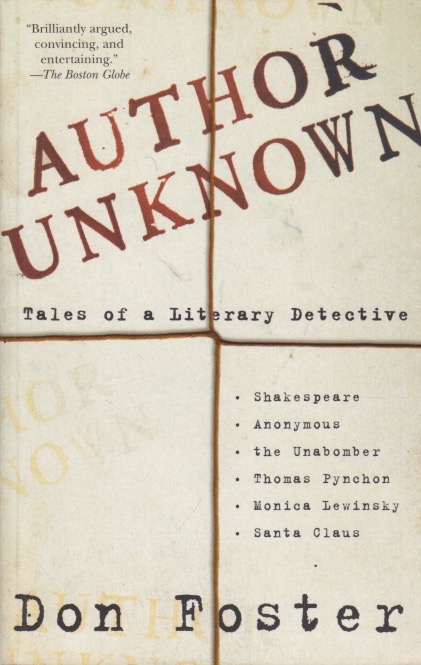
Ratiocination.  Detection.  There’s something compelling about that clear, crystalline logic that leads to solid conclusions.  I was floored by Don Foster’s Author Unknown: Tales of a Literary Detective.  I found the book by following up a reference to “A Visit from St. Nicholas,” aka “’Twas the Night before Christmas.”  Like most Americans I credited the poem to Clement Clarke Moore, but he did not, in fact, write it.  If you trust anyone with literary detection, it should be Don Foster.  Although this cleverly written book is not an apologia for the author’s personal accomplishments, it nevertheless builds trust in his methods and his sense.  It begins as he discovers an unacknowledged text was written by Shakespeare.  The evidence is carefully laid out, and is convincing.  Then others began to ask him to “prove” who wrote other pieces.  It’s quite a ride.

While Foster takes great care not to claim the ideas as his own, he’s nevertheless drawn into the case of the Unabomber, and Monica Lewinsky, and Thomas Pynchon.  His methods of ratiocination demonstrate repeatedly what he explains in his excellent introduction—our writing is every bit as indicative as our DNA.  With an adequate writing sample size, a piece with an unknown or disputed author can, with a great degree of probability, be attributed to the correct author.  You don’t even need to know of the cases to find the outcomes fascinating.  And those who disagree, being human, are simply not convinced by his conclusions.  They’ve already made up their minds.  In this regard the case of Wanda Tinasky (I’d never heard of her) is utterly compelling.

The Santa Claus chapter, the final one in the book, is a real pay-off.  Henry Livingston Jr., of Poughkeepsie, wrote the famous poem that defined Santa Claus as we know him.  Considering Christmas’ importance in our capitalistic society, this attribution is an important one.  Clement Clarke Moore was a very wealthy professor of Bible at the newly formed General Seminary.  Foster demonstrates probable cause in his claiming, and keeping alive, the mythology that he wrote the famous poem.  The way that this chapter is laid out and presented is especially witty.  Those interested in getting at the truth behind who wrote what will find this a page-turner.  Although he wasn’t seeking out the attention that came (most of us, as academics, are surprised when anyone show any interest at all in what we write) Foster has given the world a real gift in this book.  It reminded me once again why research is the most intriguing thing on earth.  And learning can be like reading a good mystery.


Mirror Gothic

I have a soft spot for gothic novels.  I get the sense that Rebecca James set out to write the most gothic novel ever in The Woman in the Mirror.  Although the supernatural persists in the background throughout the novel, it’s mainly the reflection of two women who encounter the mysterious Winterbourne Hall, high on a cliff over the Atlantic in Cornwall.  Rachel Wright, in the present day, is a self-made woman.  Overcoming the life of being raised an orphan, she has opened a successful art gallery in New York City when she receives an unexpected letter informing her that she’s inherited an expansive property in England.  Not knowing who her parents were, this is a world-changing surprise, so she heads to Cornwall to find her past and to figure out what to do with her inherited property.

Her story is intertwined with that of Alice Miller.  An English woman from two generations past (I’ll come back to that), Miller grew up with a bully for a father and a desire to make it on her own.  She’s hampered, however, by a past secret.  She takes up employment as a governess at Winterbourne where a Rochesterian Jonathan de Grey is lord of the manor.  His two children, fraternal twins, require keeping and the last governess threw herself off the cliffs—you see what I mean by most gothic—so Miller takes the post.  The massive house, however, has a strange effect on her.  Not only on her, we learn, but on most of the women who live there.  The final housekeeper, however, does seem to be immune, perhaps because she’s older.

The story is slow paced, with a fair amount of romance thrown in.  Both Rachel and Alice have lost lovers and are coping with their pasts.  They never meet, of course, being from separate generations.  Perhaps this is just the perspective of an old geezer, but putting Alice Miller in, presumably, her twenties in 1947 doesn’t really seem long enough in the past for the story to unfold as it does.  I couldn’t help but think that this makes her about my mother’s age and I would have to admit that my own daughter is old enough to inherit an estate while having already become a successful artist in Manhattan.  The timing just seemed a little off to me.  The perfect gothic novel seems to require some Victorian aspects, in my opinion.  Nevertheless, this story becomes quite gripping toward the end.  If you want a modern-day gothic romance, you’ll likely enjoy The Woman in the Mirror.


Showing Gratitude

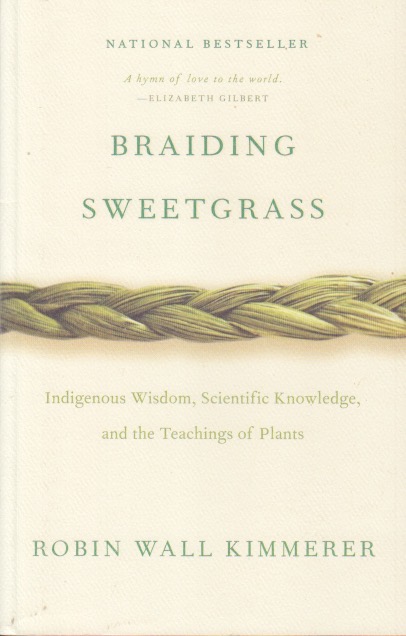
Stealing is something that we all, except some capitalists, know is wrong.  I think quite a lot about the land that was stolen to make America possible and I know that simply giving it back isn’t an option.  Nevertheless, I do believe that we should listen, and listen attentively to those who’ve been here longer than Europeans.  Robin Wall Kimmerer’s Braiding Sweetgrass is an important reflection of this dilemma.  Kimmerer is Potawatomi and she’s also a professor of Environmental Biology.  The book is a series of essays that focus mostly on plants and what we can learn from them.  It also brings in indigenous teaching, contrasting the outlook of gratitude against that of greed.  By turns sad, funny, and profound, Braiding Sweetgrass contains a message that is vital to counter climate change.  To correct our attitude before it’s too late.

There’s so much in this book that it’s difficult to know what to touch on in this brief notice.  Throughout, Kimmerer notes that the First Nations viewed life as a gift.  The earth is constantly giving and the native way was to be thankful and to accept the responsibility of being given a gift.  Seeing how the European attitude was “take until there’s no more to take,” she points out that taking what you need and leaving for others is a way out of our current dilemma.  She does this, most strikingly, by the story of the windigo.  The windigo has become popular among monster fans as a consuming beast, but Kimmerer shows how the story has a profound point.  If all you do is consume you become a monster.  You stop a windigo by showing gratitude.

Perhaps the most striking thing, to me, was how Kimmerer describes her own experience becoming a scientist.  How standard academics refused to believe they had anything to learn from Native American outlooks, especially when borne by a woman.  How she was told she couldn’t be a scientist, not with that outlook.  And how she learned the European way but didn’t give up her native understanding.  How she brings two worlds together and does so with a sense of urgency and hope.  Things have gone too far simply to turn back the calendar and say that our ancestors had it all wrong, but it’s not too late to learn from those who lived for millennia on this land and were untainted by ideas of private ownership.  Those who knew how to live sustainably with nature.  Those who knew, and still know, how to defeat monsters.


Finding Books

This is a public service announcement to those who try to find books that aren’t issued by one of the big publishers.  I’m not shy about saying that my books all fall into that category.  One of the things I’ve noticed is that books feed out to different internet venues at an odd rate, before they’re published.  Some publishers use what they call New Book Announcements (NBAs) to get the metadata out to wholesalers, distributors, and other vendors.  Sometimes a book comes to public light in strange ways.  I’ve had my eye on a book that a friend pointed out.  I don’t know how they heard about it, but I went searching for it and found it on Barnes & Noble’s website, but not Amazon.  Well, that’s not quite true.  It is on Amazon, but not in North America.  Amazon China and Amazon Singapore have it, but you can’t find it here.  Yet.

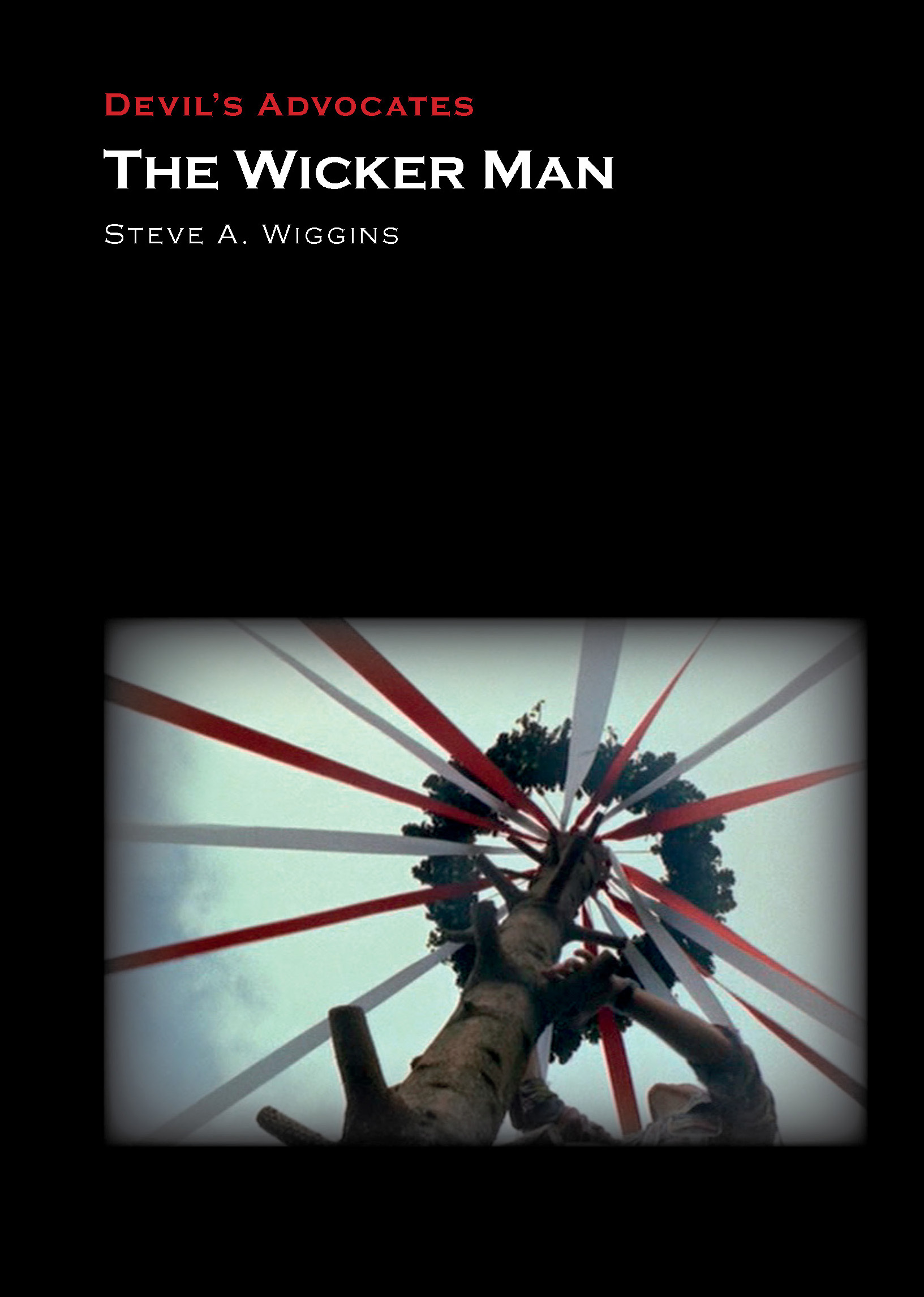
I noticed a similar thing with The Wicker Man.  An anxious author, I kept searching for it online when I didn’t hear from the publisher.  It was first announced at German booksellers.  Eventually it got around to English-speaking sites, and eventually (it took a few months after publication), it became available in “all channels.”  Although, several websites still only list the hardback which retails for more than a dollar a page.  Now that’s inflation!  Even $40 for such a short paperback is a lot, but that’s why I’m looking for anything but an academic publisher for the next book.  But there’s a larger issue here.

Like old Joe, I sometimes can’t remember things.  I have an elaborate and Byzantine set of reminders that fit my neurological profile (mostly).  For books I want to remember to look up after they’re published (I can’t generally afford to buy them right away, so this takes advanced planning), I have an online list.  That online list is associated with a bookseller and I can’t easily add to my list until the book appears on said seller’s site.  I suppose I could write it down in my zibaldone, but will I recall that I wrote it there?  (Those little notebooks get filled up pretty quickly.)  It would just be easier if information on the internet could feed out instantaneously.  If, say, Amazon Singapore could let Amazon USA know that a book that is publishing in the United States can be listed—well, wouldn’t that make sense?  Systems are complicated.  So complex, in fact, that architects must be hired to keep them in order.  Or maybe books could be announced when they’re actually available? What? Lose the buzz?  In the meantime I’ll put a bookmark in this page and hope that I remember to look it up when the time comes.


Iron Age Angst

Browsing can lead to unexpected finds.  Such is the magic of bookstores.  Most of the books I read are recommended to me either through online sources or from people who have an inkling of my tastes.  Often such books are on the long side.  While I don’t object to really getting into a book, like most people I wonder where the time goes and a short read gives you a sense of accomplishment.  So it was that I was browsing a local bookstore for something brief.  I came across Ghost Wall by Sarah Moss.  The back cover bore no BISAC info telling the genre, but in this case the blurbs convinced me that I’d find this a rewarding read.  It’s not horror, but it has a sense of doom about it.  There may be some spoilers below but I won’t give away the ending.

Told from the point of view of Silvie, a teenage minor, it recounts a college anthropology experiment on the moors of northern England.  Silvie isn’t one of the students, but rather a high-school-aged daughter of a bus driver enamored of Iron Age Britain.  A professor has three students set to live part of the summer like Iron Agers, and Silvie’s father has brought her and her mother along to do “the women’s work.”  Yes, he’s a chauvinist and he has violent tendencies.  He clearly wishes he’d lived in “simpler” times.  I suspect what makes a novel like this work is that many of us know people like the father.  Hard, angry men.  As the story unfolds we witness his abuses and the clueless professor simply continues play-acting Iron Age.  Until they get the idea of sacrificing a victim like the bog people of northern Europe.

The style is spare, like Cormac McCarthy’s The Road.  As one of the blurbs says, there are echoes of Lord of the Flies as well.  What do groups of men get up to when unleashed from civilization?  It took me some time to figure out, since this is entirely first-person narrative, that there are only three students—one woman and two men.  With the chaperones it’s two men and a woman.  This uneven power structure raises its own questions.  Meanwhile Silvie is coming of age, beginning to realize her own sexual awakening.  Her best role model is the co-ed among the group since her working-class mother lives in fear of her husband.  The story is compelling and a bit scary.  It’s also a rewarding read that won’t take a month or more to finish.


Boo-Boo

After an unfortunate encounter with a paper-cutter in which one of my thumbs didn’t fare so well, I sought a bandage.  This led me on a reverie since the bandage I found was in a box that I’d brought home from my mother’s apartment.  Mom was a practical woman and I’m sure she would’ve approved, although the item was selected in a moment of grief that still hasn’t completely dissipated.  As my wife was binding my wound the thought recurred that my mother wouldn’t be needing these physical assuagements any longer.  Like all of us, if cut she bled.  She’s beyond that now.  A person’s affects linger and contain pieces of their memories.  This particular box was plastic and therefore reusable—which is precisely what Mom did.  She taught me how to bandage myself and I’ve used that knowledge many times over the decades.  It’s something I don’t need YouTube to figure out.  Time is a gift.

When writing about recent times, I recently learned new vocabulary regarding decades.  For example, the first two decades when I was culturally aware were the seventies and eighties.  Together they’re known as the xennial period, named, presumably, after “generation X.”  (I’m a very late boomer, as well as a late bloomer.)  I found that fascinating.  Then I was reading something that made reference to the “noughties.”  This delightful word is the British term for “aughts” or “aughties”—the years between ’00 and ’09 of any given century.  We hear plenty about the “twenties,” “thirties,” and so on, so I became curious about the correct term for the second decade of a century.  Either “tens” or “teens” is acceptable, but it seems that in formal writing this should be transcribed by numbers. I guess teen ages are always difficult.

Our divisions of time demonstrate our preoccupation with both mortality and round numbers.  More and more people are living the entire way through a century, from aughties through nineties.  For most of us, however, we can, if things go well, use our birth decade as a rough guide.  I’m not likely to make it through the fifties, but it isn’t impossible.  If I do I guess I’ll need to upgrade my WordPress account because my daily posts will have used up my allotted memory by then.  In the meantime, I do need to buy some new bandages for the time in between.  When I do I’ll put them in a simple plastic box, and I will remember the gift of time I shared with my mother.


A Bookseller’s Son

Be kind.  One of the best reasons, apart from innate rightness, is that we don’t know the burdens other people carry.  Yes, some will tell us and others will not, but one thing is certain: we all bear scars.  I met Andrew Laties because of the Easton Book Festival that he organized.  Andy is half-owner of Book and Puppet Company, an independent bookstore in that town.  A colleague of mine from Lafayette College introduced us back in 2019.  Whenever I go to Easton I stop in the store and pick something up.  Andy has kindly slotted me into each annual Book Festival, except last year, because of a burden I happened to be carrying.  I recently finished his book, co-authored with his son Samuel, Son of Rebel Bookseller: A Very Large Homework Assignment.  Andy had revealed one of his burdens before I read it, and I appreciated the slight cushioning of the shock.

Samuel is a posthumous co-author.  I have had friends—too many—who have lost children.  It is a devastating blow.  I’d casually chatted with Andy for five years without realizing he had this to bear.  This book is an unflinching stare at the unfairness of life.  You get a good idea of what Sam must’ve been like, through his writing and his father’s description.  His brilliance is evident, even as we learn of his mental illness.  The two often go together, and even contemporary successful authors, such as John Green, have  revealed their mental struggles to the world.  There are many great writers, like Edgar Allan Poe, who clearly had some issues.  The stigma must disappear.  Our culture would be so very poverty-bound without it.

Son of Rebel Bookseller is available on Bookshop.org.  Or, if you’re in Easton you can stop into the shop.  The title makes reference to Andy’s previous book, Rebel Bookseller, which I mentioned here a couple years back.  This, however, is a much more personal story.  An anguish screaming to be released.  Something that I’ve picked up on during editorial board meetings at work is that books by authors with a compelling personal story have something special about them.  They may not end up published by the Big Five, and they may really find only a local readership.  That doesn’t mean, however, that they can’t have an impact.  The vast majority of books have limited readerships, and some of them are far more important than those that line bestseller lists.  And this one reminds me once again the importance of kindness, and striving to be as humane as a human can be.


Fear of Spiders

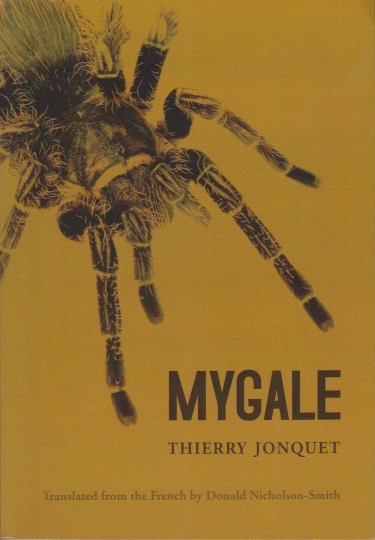
To anticipate, “mygale” is French for “tarantula.”  I learned about Mygale, also published under its English translation, or else Serpent’s Tail, from a Goodreads review.  It’s increasingly difficult to find good, short books.  I knew little about it other than it is a “thriller” by Thierry Jonquet.  The book contains one of the most cleverly drawn plots I’ve encountered in some time.  I also believe it could slip into the horror genre.  I’m reluctant to say much because the pieces are revealed so intricately that to summarize would be to ruin the effect.  I will say that if you’ve seen The Skin I Live in you know the basic idea already.

I will opine that this story demonstrates that a book need not be excessively long to be a good novel.  Some of us appreciate the economy of language that illustrates Pascal’s famous quote, “I have only made this letter longer because I have not had the time to make it shorter.”  My first relatively descent novel was about 230,000 words, or, in other words, well over 400 pages.  The publishers I half-heartedly queried said it was too long.  When writing short stories I quickly learned that many journals only take them if they’re under 3,000 words, some only under 2,000.  As a result, I began writing short.  That’s not exactly true.  I write the story as I want to tell it, then I cut it down.  Again and again.  Short seems to be the fashion in the internet age.  Ironically, the books on my too read shelf all seem to be quite long.  That’s why I decided to give Mygale a try.

I’m glad I did.  The story may not be for the most squeamish, but it’s certainly not blood and gore.  It’s a little confusing at first, but it comes to make sense.  And the ending is somewhat satisfying.  It’s not happy by any means, but it’s well told.  Some classify it as science fiction, but there’s nothing too impossible about it.  It’s set in France around the 1980s.  No space ships or ray guns to be seen.  Genres can be tricky in the face of creativity, but the final act, if you will, reveals this to have been horror all along.  Well, I hope I’ve been able to give a sense of this book without giving any spoilers.  Talking around a subject comes with years of classroom experience, I guess.  I will say the spider isn’t literal.


Clergy Problems

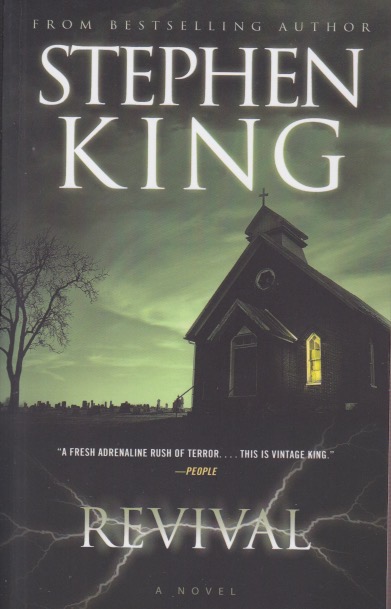
I believe Revival is the most recently written Stephen King novel I’ve read.  It was pretty good—it certainly scores high on the religion and horror scale, although it takes quite a while to get to the horror part.  Part of the problem for me is that I liked Charles Daniel Jacobs.  I tended to relate more to him than to Jamie Morton (the narrator/protagonist).  Perhaps this was because, like Jacobs, I studied to be a Methodist minister.  And like him, came to have a rather different view of what is really going on in the world.  He’s clearly King’s villain, however.  Or “fifth business” as he’s termed in the novel.  The secret lightning he seeks turns out to be a kind of MacGuffin.  I was curious to know more about it.  The novel, as is typical, has several subplots but the main one is how Jamie and Charlie face what’s after death in a tragic climax.

Charlie starts out as a Methodist preacher.  When his wife and son are tragically killed, he becomes a huckster who actually has tapped into an electrical power that can heal people.  It often, however, leaves bad aftereffects.  Jamie, who knew him as a kid, is cured by him from a heroin addiction.  Their paths continue to cross over the next fifty years or so—this is a longitudinal story—as Jamie comes more and more to distrust his childhood hero.  Charlie can use electricity to perform wonders and it make him rich.  He wants more, however.  He wants to see beyond death to assure himself that his wife and son are in a better place.  It seems to me that that motivation isn’t a bad one.  The only way he seems a villain is that he doesn’t really care for other people.

The story is well told but it doesn’t have the same “classic” feel as some of King’s earlier novels.  He well understands, however, that horror and religion belong together.  I haven’t read all of his novels—not by a long shot—but clergy aren’t rare and when they’re present they’re implicated in the horrors, or in this case, responsible for them.  These are important insights, as others have also noticed.  Revival is one of those books that requires some reflection.  It certainly feels like something written by a man facing the limitations of the aging process.  And not necessarily at peace with it.  Ministers sometimes do go bad—they’re only human—but they can also lead to real change.  I, for one, am interested to hear what King has to say about it.


A Footnote

I was recently compelled to use footnotes.  I don’t mean the clever asides that capable writers sometimes utilize to spice up subjects by making points off topic.  No, I mean the kind with author, date, title, city, publisher, page number.  I deal with footnotes daily—it’s an occupational hazard.  As a recovering academic I’m trying to get away from using footnotes on everything from grocery lists to daily meeting reminders.  Cite your sources!  That’s the kind of rhetoric that’s pounded into the heads of bright young people, often preventing them from learning to think for themselves.  At this stage of my life a footnote is more often trying to find someone who agrees with what I’ve observed for myself.  Hmm, did anyone ever say that before?  If so, where?

My concern goes down to the level of cities.  Yes, cities.  Standard format requires you cite the city in which a book was published.  This ridiculous pre-internet artifact had a purpose originally, but I have worked for two international publishers and I can tell you two related, and perhaps contradictory points: employees can tell which office a book is from: New York or London.  And unless you work for said publisher there is almost no way for you to know.  So if a publisher has offices in a dozen cities, you need to write a dozen of them in your footnote.  Does this sound like a rational thing to do?  Don’t get me wrong—it’s important, very important to cite the publisher.  But it’s not like there are a ton of presses around with the exact same name.

There’s a move among some reference experts (refperts, if you like) to do away with the city in footnotes.  It’s a reasonable guess that Cambridge University Press is pretty widely recognized.  And that Cambridge is located in Cambridge.  Or course, there’s a Cambridge in Massachusetts, and I hear there’s a university there as well.  In any case, if you don’t know where a publisher’s located, there’s a remarkable invention called the internet where you can look it up!  Pedanticism comes naturally to academics, I suppose.  Had I not been one I would probably have had no reason to write such an anal post as this.  Still, there’s a larger point: when is one able simply to assert what one knows?  I frankly don’t remember the page on which I read most facts I point out in my writing.  Often I notice them myself and recognize them as facts when there’s good, solid evidence.  Of course, I really should footnote that.  If I can remember in which city the appropriately named Random House is located.

How do you footnote this?

Drac Ops

Just don’t ask, okay?  Like most things in my life, I discovered Dr. McNinja way past when it was popular.  Who knows?  Maybe it’s still popular.  I’m not the best judge of that kind of thing.  I’ve read a few graphic novels in recent years, generally when someone lends them to me, or when a movie I like is based on them.  Now, the thing about Dr. McNinja is that it started out as a webcomic.  People younger and more with it than me have shown me other people younger and more with it than me making a good living web cartooning.  They don’t have 9-2-5s and they live, going by their videos, in nicer houses than I do.  So when someone suggested I look up Dr. McNinja I found an old-looking website saying it was no longer online.  The author had published it in book form.

Even though I work in publishing, I find it difficult to tell if a book is out of print.  We live in that strange purgatory where IP (intellectual property) can be kept on life support until copyright expires without ever really having to print more books when they run out of stock.  They’re never truly out of print.  I’m guessing that’s what happened when on Amazon you see that only used copies are available.  So which McNinja to select?  The one with a cover that riffs off Plan 9 from Outer Space, of course.  That movie keeps coming back into my life.  It’s one of Fox Mulder’s favorites on the X-Files.  In any case, I was hardly prepared for the amazingly creative imagination that Christopher Hastings has.  If you start with Operation Dracula! From Outer Space you’re entering the story in media res, as the academics say.

I confess to liking Teenage Mutant Ninja Turtles when it first came out.  These days the exoticism of eastern Asia is frowned upon by academics, but it’s still there in Christopher Nolan’s Batman Begins, so why not?  In case you’re wondering, there is a reason behind all this.  I can’t tell you at the moment, however.  I can say that if you’re looking for a wild, wild story with lots of unexpected twists and turns, Dr. McNinja will not fail to win approbation.  I’m dithering on whether to go back and start from the beginning—these print volumes are becoming collectors’ items, it seems.  And no matter how much fun it is, reading graphic novels always feels like cheating to me.


One Another

Like much of the other information that I’ve managed to pick up in these six decades of wandering the planet, my knowledge of horror is self-taught.  In truth, I’m an eclectic reader—my various, periodic obsessions generally stem from books I’m writing.  For my unwinding time, however, horror stories seem to do the trick.  Nobody I know in person reads horror, so my recommendations are generally the results of other books I read.  That’s how I found Thomas Tryon’s The Other.  Although I’d only learned of it recently, it has been a classic in the field for many decades.  After having read it, I can see why.  And unlike many fiction works with an afterword, this edition has one worth reading.  Maybe you’re unfamiliar with the novel?  If so, in brief, it’s about twins.  It’s about twins.

Identical twins.  Holland and Niles Perry were born over the cusp of midnight, giving them different birthdays while still being the same age.  Unlike stereotypical identical twins, however, Holland is evil and Niles is good.  As the novel unfolds it contains some twists that, if like me you haven’t heard the story, really do work.  They live in a small town in Connecticut with their widowed mother, older sister and brother-in-law, maternal grandmother, and a couple of domestics.  An aunt and uncle, along with a cousin, settle in.  (It’s a large house.)  Family dynamics are strange and the locals grow increasingly impatient with Holland’s antics.  The Perry family is, however, long established and well respected.

Doesn’t sound very scary, does it?  That’s the genius of the work.  It’s a slow burn but when the fuse reaches the powder it leaves you trembling.  Nobody taught me how to find and read horror.  I’m still pretty much a novice and it seems that novels these days tend to have weight problems.  I was glad to find The Other wasn’t excessively long.  It shows that literary horror is possible as well.  Like Shirley Jackson, Tryon received acclaim for his work.  (And like Jackson, his novel doesn’t balloon out to over four hundred pages—something of a rarity these days.)  I guess I’m just a bit surprised it took so long for me to find out about this one.  I don’t want to give any spoilers because this is a beautifully constructed novel and knowing what happens might deter other readers.  I wouldn’t want to do such a disservice to a book I wish I’d known about when I was younger.