Covid Books

There’s a fairly new phenomenon called “Covid books.”  No, I don’t mean books about Covid-19, but books affected by the virus.  (Not infected.)  Let me explain.  Many publishers, unaware of the menace, continued scheduling books through what became the pandemic.  You see, books take a long time to put together, and, interestingly, much of the work can be done remotely.  That meant that even as we locked down, books still published.  But in 2020, few people were interested in books on other subjects.  Children’s books and others intended for young readers did really well.  Online ordering made this possible.  Fiction for adults didn’t fare too badly.  What suffered was nonfiction on topics unrelated to the pandemic.  This is so much so that publishers designate as “covid books” those that underperformed and appeared in the early twenty-twenties.

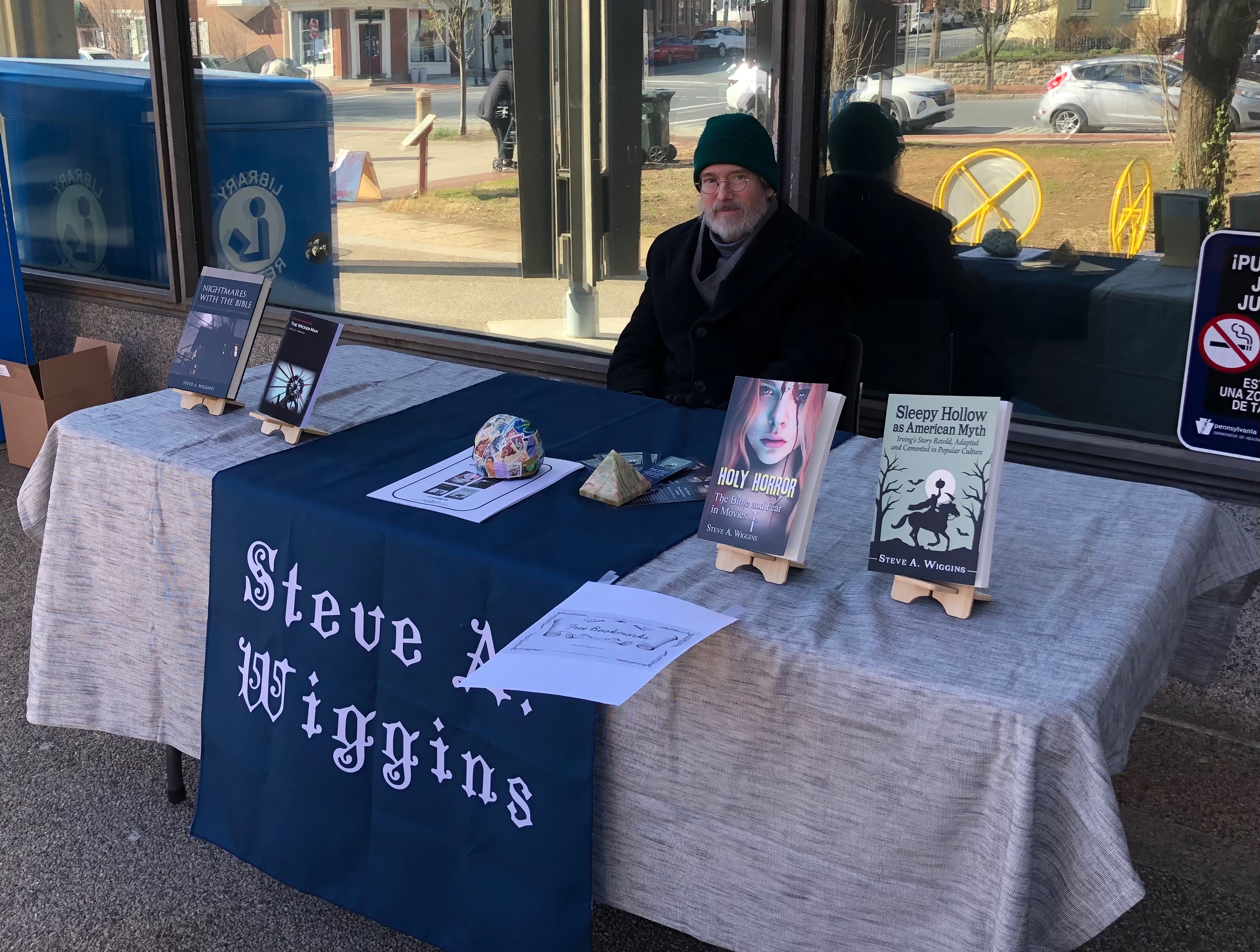
To put a more personal spin on it, I published a covid book.  Nightmares with the Bible came out late in 2020.  Granted, the topic didn’t appeal to everyone, and the price was about $100 when people were wondering if their jobs would be there after this was all over.  (Is it over yet?  I still wear a mask in crowded places.)  The reason that I consider it a covid book is that although it has received more reviews than any of my other books, it has sold the worst of them all.  Less than its dollar amount.  The publisher, which was bought by another publisher, has no inclination to do it in paperback, so it will remain an obscure curiosity.  Interestingly, I found a Pinterest page that was a listing of unusual book titles and mine was there.  But it was a Covid book.

In the wider world, even in 2025 publishers discuss Covid books.  A promising author whose book appeared in the height of the pandemic may have sold down at my levels.  What with the gutting of government programs and agencies since January, it’s difficult to tell if we’ll ever get a pronouncement that the pandemic has ended.  Where two or three are gathered, I’ll be wearing a mask.  And I’ll likely be thinking of books of that lost generation.  Information that will never be processed.  Book publishing survived, despite being a nonessential business.  People still buy and read books.  Some day some bibliophile might write a book for other readers about the year that robbed us of interesting but ultimately irrelevant books.  There’ll be too many to list, of course.  But we have been given a lesson.  Let’s hope we continue to do our homework.


Dangers of Dark Shadows

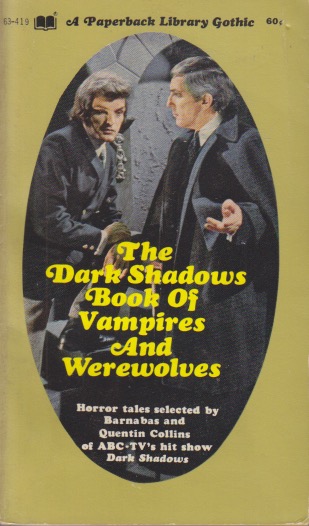
A friend’s recent gift proved dangerous.  I wrote already about the very kind, unexpected present of the Dark Shadows Almanac and the Barnabas Collins game.  This got me curious and I found out that the original series is now streaming on Amazon Prime.  Dangerous knowledge.  Left alone for a couple hours, I decided to watch “Season 1, Episode 1.”  I immediately knew something was wrong.  Willie Loomis is shown staring at a portrait of Barnabas Collins.  Barnabas was introduced into the series in 1967, not 1966, when it began.  Dark Shadows was a gothic soap opera and the idea of writing a vampire into it only came when daily ratings were dismal, after about ten months of airing.  Barnabas Collins saved the series from cancellation and provided those wonderful chills I knew as a child.  But I wanted to see it from the beginning.

I’ve gone on about digital rights management before, but something that equally disturbs me is the re-writing of history.  Dark Shadows did not begin with Barnabas Collins—it started with Victoria Winters.  There were 1,225 episodes.  Some of us have a compulsion about completeness.  The Dark Shadows novels began five volumes before Barnabas arrived.  Once I began collecting them, I couldn’t stop until, many years later, I’d completed the set.  I read each one, starting with Dark Shadows and Victoria Winters.  Now Amazon is telling me the show began with Barnabas Collins.  Don’t get me wrong; this means that I have ten months of daily programming that I can skip, but I am a fan of completeness.

You can buy the entire collection on DVD but it’s about $400.  I can’t commit the number of years it might take to get through all of it.  I’m still only on season four of The Twilight Zone DVD collection that I bought over a decade (closer to two decades) ago.  I really have very little free time.  Outside of work, my writing claims the lion’s share of it.  Even with ten months shaved off, I’m not sure where I’ll find the time to watch what remains of the series.  The question will always be hanging in my mind, though.  Did they cut anything else out?  Digital manipulation allows for playing all kinds of shenanigans with the past.  Ebooks can be altered without warning.  Scenes can silently be dropped from movies.  You can be told that you’ve watched the complete series, but you will have not.  Vampires aren’t the only dangerous things in Dark Shadows.


Childhood TV

It’s probably safe to say that most Americans my age were influenced by television when they were young.  Since I’m a late boomer, I fit into the “monster boomer” category and I suspect that if you gathered us all in a room you’d discover we had some of the same watching habits.  I confess to having watched a lot of TV.  I will also admit that some of it was absorbed particularly deeply.  I mean, I liked shows like Scooby-Doo, Jonny Quest, Get Smart, Gilligan’s Island, and even The Brady Bunch.  While I still quote from a couple of these from time to time, they never penetrated as deeply as a number of other early fascinations.  I saw nowhere near every episode of The Twilight Zone, but those I did see absolutely riveted me.  They still do.  As an adult I’ve read many books on or by Rod Serling.  There’s depth there.

Another strong contender for real influence is Dark Shadows.  Again, I never saw all the episodes but it created in me a feeling that no other television show did.  My breath still hitches, sometimes, when I think of it.  I watched the show and I bought used copies of the novels by Marilyn Ross.  As an adult I even collected and read the entire lot of them.  And I’ve read a book or two about Dark Shadows.  And one about Dan Curtis, the creator of the series.  Recently a good friend, aware of this particular predilection, sent me the Barnabas Collins game and a copy of The Dark Shadows Almanac.  I have to admit that it was difficult to work the rest of that day!

Probably the last very influential television show—more from my tween Muppet Show era—was In Search of…  This I watched religiously, and, like Dark Shadows, I went out and bought the tie-in books by Alan Landsburg.  One thing all three of these series (Twilight Zone, Dark Shadows, and In Search of…) have in common in my life is that I purchased the accompanying books.  Those that I foolishly got rid of when I was younger I have reacquired as an adult.  Sure, there’s some nostalgia there, but these shows were more than mere entertainment.  They have helped make me who I am today (whoever that is).  I rediscovered my monster boomerhood after losing my tenuous foothold in academia and saw that other religion scholars were writing books about these somewhat dark, and deep, topics.  So I find myself with friends ready to help indulge a fantasy and a shelf full of books that many my age would be embarrassed to admit having read.  But chances are they too were influenced by television, even if they hide it better.


King and the Rest

Stephen King is an author I admire, although I haven’t read all of his books.  Not even close.  Still, his cultural cachet is high, as it has been pretty much since the seventies when horror literature was first being recognized.  I’ve been fascinated by his outlook on religion, or, in broader terms, the supernatural.  Rebecca Frost approaches things from a different angle, but her Surviving Stephen King: Reactions to the Supernatural in the Works by the Master of Horror is a volume worth pondering.  Quite often, as was the case with Douglas Cowan’s America’s Dark Theologian, I haven’t read all of the books and short stories the author discusses.  Frost gives good summaries, however, which help frame the discussion.  One of the reasons I enjoy King is that he allows the supernatural in, but something I hadn’t really realized until reading this book was that the supernatural is generally a threat.

Now, knowing King as a horror writer, it’s obvious that there has to be a threat, but in what Frost explores, standard Christianity doesn’t always work well against the supernatural.  One of the points I made in my expensively-priced Nightmares with the Bible is that physically fighting a demon crosses ontological lines if demons are spiritual beings.  Frost discusses how quite often “success” in a King story involves destroying the physical aspect of the supernatural threat.  It doesn’t always work permanently, but for the protagonists, at the time, it tends to be sufficient for them to get on with their lives, sans supernatural.  Having studied religion through three degrees, this made me stop and think.  The impetus to start on that career track was the idea that the supernatural tends to be good.  Enter King.

I only started reading King after my doctorate, and I haven’t read as much as true fans, I suppose.  Still, I tend to try to analyze what I read—thus the many posts about books on this blog—and it helps to have the guidance of someone more familiar with his oeuvre than myself.  Reading books like Surviving Stephen King also gives me an idea of which of his books I should pick up, and also which I might safely avoid.  Frost is an able guide, considering the various appropriations, or Christian solutions to the supernatural, in King’s imagination, and whether they work or not.  The ideal reader for Frost has probably read King a bit more widely than me, but I still found this study enlightening.  And it added some novels to my to read list.


Word Words

So, in the old days, when books were paper, printers would rough out the typesetting on trays called galleys.  Prints from these plates would be sent out for review.  Naturally enough, they were called galley proofs, or simply “galleys.”  After those came back from an author marked up, corrections and further refinements, like footnotes, were incorporated.  Then page proofs, or second proofs, were produced and sent again.  The process took quite a bit of time and, as I’ve now been through six sets of proofs for my own books, I can attest it takes time on both ends.  Electronic submissions have made all of this easier.  You don’t have to physically typeset, much of the time, unless you merit offset printing—books in quantity.  You can often find uncorrected proofs in used bookstores, and sometimes indie bookstores will give them away.  That’s all fine and good.  The problem comes in with nomenclature.

These days proofs are sometimes still called “galleys” although they’re seldom made anymore.  If someone asks about galleys, it is quite possible they’re asking about page proofs.  It is fairly common in academic publishing for an author to see only one set of proofs—technically second proofs, but since no galleys were set, they could be called that.  Or just proofs.  Now, I have to remind myself of how this works, periodically.  It was much clearer when the old way was in force.  There were a couple reasons for doing galleys—one is that they were, comparatively, inexpensive to correct.  Another is that authors could catch mistakes before the very expensive correction at the second proof stage.  Even now, when I receive proofs I’m told that only corrections of errors should be made, not anything that will effect the flow, throwing off pagination.  This is especially important for books with an index, but it can also present problems for the table of contents.

Offset printing. Image credit: Sven Teschke, under GNU Free Documentation License, via Wikimedia Commons

The ToC, or table of contents, also leads to another bit of publisher lingo.  When something is outstanding and expected before long, many editors abbreviate it “TK” or “to come.”  Why?  “TC” is sometimes used to mean “ToC” or table of contents.  There are hundreds of thousands of words in the English language, yet we keep on bumping up against ambiguities, using our favorites over and again.  That’s a funny thing since publishers are purveyors of words.  None of my books have printed in the quantity that requires galleys.  In fact, academic books, despite costing a Franklin, are often pulped because they’re more expensive to warehouse than they are to sell.  This is always a hard lesson for an academic to learn.  The sense behind it is TK.


Then Again…

C. S. Lewis wrote somewhere (I can’t recall, but it was probably in Surprised by Joy) that when reading autobiographies, he found the youngest years the most informative.  I found that true for So, Anyway… , John Cleese’s memoir of his life up until the founding of Monty Python.  My wife and I read this book together—I tend not to gravitate towards autobiographies of living persons unless it’s someone I’m utterly fascinated by, but since we both enjoy Monty Python, why not?  It gave me quite a bit to think about.  Some parts are very funny, others more mundane, but mainly it was the path to a writer’s life that interested me.  I typecast Cleese in my mind as an actor, specifically a comedic one.  Of course, comics often write their own material.  Or at least some of it.  What became clear is that Cleese thinks of himself primarily as a writer.  That helps me understand.

It struck me that becoming a writer might’ve been easier had I started trying to get published when I was younger.  Of course, I didn’t have the advantage of attending Cambridge, or any other university where connections might’ve paid off.  Or having my writing encouraged after high school.  Already by college I’d been writing both fiction and non for many years.  In any case, Cleese found a teaching job because he’d attended the school himself, and then studied for a career in law.  Performing, however, and the attendant writing, soon came to be his self-identified career.  Anyone interested in Monty Python would find this an interesting account.  It only goes up to that point in the author’s life, which was, of course, only until he was still a fairly young man.  These days it’s difficult to be taken seriously as a writer without a degree in English or journalism.  The rest of us founder.

Monty Python was a group effort.  My wife and I read Eric Idle’s memoirs a couple years back (for some reason I didn’t post about it).  So, Anyway… was, however, a find at a used book sale, and we’re not actively looking for Michael Palin, Terry Jones, or Terry Gilliam’s reflections.  (Graham Chapman died young, of course.)  Mental typecasting is probably a crime against a fellow creative but the space someone moves into in our consciousness tends to be the same room they will always rent there.  It’s difficult to make a living as a writer and many who declare that as their identity work other jobs to make it possible.  Sometimes, such as the case of the famous, that other job may be the one where all the recognition lies.  Such is the creative life.


Writing, as We Know it

Times New Roman, I believe, is the font of this blog post.  I grew curious about how our fairly long-lasting Roman letters came to be in this form we use today.  The Romans, like the Greeks, tended to write in uncial form—what we call “upper case” because printers literally kept them in a case above the “lower case” or minuscule type.  Apparently the reason all caps faded from popularity wasn’t that people felt they were being shouted at all the time, but they took too long to write.  You’ve probably seen examples of medieval manuscripts where the letters are an odd mix between uncial and minuscule forms.  These eventually settled into what is called Roman half-uncial, a font that eventually favored minuscule to majuscule—a name for uncial that has very small, or no, ascenders (as in lower case b or d) or descenders (like lower case p and q).

As the power of the Roman Empire waned, a variety of scripts developed in different parts of Europe.  One that eventually came to have influence on the nascent Holy Roman Empire was scriptura Germanica, or the German script.  Under Charlemagne, the Holy Roman Emperor, the favored, and widespread form of writing Roman letters was carolingian minuscule.  This isn’t too difficult to read for modern people but it’s not the script we use.  Carolingian minuscule was eventually replaced by blackletter.  This heavy, Gothic-looking script isn’t always easy to read.  (It was used for German publications until 1941; I used to have an old German book written in blackletter.)  Keep in mind that during all this time there was no printing press in Europe; manuscripts were handwritten and read by few.  Literacy was rare.  Even so, the difficulty of reading blackletter eventually led writers to go back to carolingian minuscule to develop a new writing style, influenced by blackletter as well.

Blackletter. Image credit: Arpingstone, public domain, via Wikimedia Commons

The new writing style, called humanist minuscule, also known as “whiteletter,” is basically what we use today.  It comes in several different fonts, of course, but the basic idea of capital letters beginning sentences and proper nouns, but most letters being minuscules, has become the standard for most typefaces based on Latin letter-forms.  This history of writing, let alone individual scripts, is amazingly complex.  Today fonts have to be licensed to be used by publishers of print materials and techies can invent new fonts to license or sell.  I still have a soft spot for the “Roman” style, which is why this blog post, at least on my screen, is in Times New Roman. 


Talking Sleepy Hollow

After writing a book comes talking about it.  I very aware that this blog has quite a limited reach, which is why I’m very grateful for friends who are willing to chat about my books.  John Morehead’s TheoFantastique is a blog I’ve known about, and appreciated, since I began this blog sixteen years ago.  John has always been very gracious and generous with his time and has interviewed me about each book since Holy Horror on.  Yesterday we had a chance to talk about Sleepy Hollow as American Myth.  The blog post with the recording is located here.  Please give it a watch if you have any interest.  To those of us not inclined to inflate opinions of ourselves, doing self-promotion feels awkward, and so it’s always good to have a friend willing to help us over the hurdle.  John has written and edited many books himself, and we’ve both published with McFarland. You might enjoy some time on his blog.

Writing a book on a subject may not automatically make you and expert, but it does give you a voice in the conversation.  Talking about a book helps you to think of aspects you might’ve missed or things that you really need other eyes to see.  Those fortunate enough to have academic posts sometimes have colleagues willing to read their nascent books and discuss them.  I never had colleagues who wanted to read what I was working on, but then, I was never really in a position where people paid much attention.  As a result, I work on my books alone.  This one had a peer reviewer when an agent took a temporary interest in it, and I received some feedback then, but otherwise it was me wondering what others might think of it once it was available.  The strange thing is, after writing a book you often feel like you could write another on the same subject, looking at different angles.

Since I’m trying to break into that rare sphere of getting a supplemental income from my books (free advice: academic writing really isn’t the way to do this), getting even a little buzz is immensely helpful.  I have contacted bookstore owners and museum shop holders in the Hudson Valley to tell them about my book.  I’m trying to arrange for a local book festival slot to talk about it.  But, of course, I have a 9-2-5 that doesn’t really make an allowance for time off to support your sideline job.  So I’m very grateful for John Morehead’s willingness to talk about my work.  If you’ve got some time, and interest, you can hear a bit more here.


Dark Romance

My study of genre leads me to believe that there really may be no such thing.  Or at least many aspects of genre are open to question.  In the case of Steffanie HolmesPretty Girls Make Graves, there’s no doubt that one genre is dark academia.  Indeed, this is book one of a duology titled “Dark Academia.”  Although self-published it is quite well done.  There’s a lot of backstory, and George (Georgina) Fisher, the protagonist and narrator, is a character from a previous series by Holmes.  Another genre that fits here is romance, although this novel is more than that.  Maybe a bit of the story will help.  George is a new student at Blackfriars University in England.  From California, she has trouble fitting in among the blue bloods that are the usual make-up of the student body.  She soon learns about the Orpheus Society, the secretive organization that pulls the strings on campus.  Then her roommate, the girlfriend of a prominent Orpheus Society member, goes missing.  George decides to investigate. 

Consciously aware of dark academia, Holmes aims directly at the heart of it and offers a compelling story that keeps readers interested from cover to cover.  I was never quite sure what was going to happen, and I do have to add a warning—this first book does end on a cliffhanger, so be ready to commit yourself to book two.  George is so well drawn that it’s not hard to care for her and start rooting for her against the secret society types who can buy themselves out of anything, including murder.  (I have to say, that part is a little too close to reality in the current US of A, so it may be a trigger for some.)

My regular readers (if any) know that I’m on a dark academia kick at the moment.  There’s so much to like in the genre.  Holmes makes clear the close ties between dark academia and horror; they share a common ancestor in the form of gothic literature.  The sheer variety in the novels classified this way means that not all of the books will contain every element associated with the genre, but Pretty Girls Make Graves comes close.  Holmes also effectively writes the ostracism of the outsider into the tale.  Anyone who’s had trouble fitting in (or may still have trouble fitting in) will recognize the scenario and its fallout.  Let’s hope, though, that they don’t end up like George at the end of volume one, even when they enjoy reading the book.


Dark Introduction

Since I’ve discovered that I live in dark academia, I’ve grown curious.  Kara Muller has put together The Little Book of Dark Academia as a kind of first step in the discussion.  I have learned that some academic articles on dark academia are starting to appear, but this is pitched more toward those who maybe need some tips on how to get started.  By the way, this is a full-color, heavily illustrated book.  In practical terms, that means it doesn’t take too long to read it.  It’s also self-published, so less expensive than many books, but without editorial shaping.  It begins with history and definitions.  The term came into use in 2015 but the concept had been around much longer than that.  Sometimes a label is necessary to bring together thought on something that’s been floating around for a while.  As Muller points out, it tends to revolve around books.

My imagination isn’t so constrained as to believe that ebooks have no place in dark academia; they have their own special kind of darkness.  Still, the setting for these stories often takes place in real life, in studies and libraries full of books.  This is not a Star Wars paperless universe.  Muller gives a list of acclaimed dark academia titles with a brief paragraph or two about them.  In other words, a reading list.  And also a movie viewing list.  She also includes some television series that fit the aesthetic.  If you’re in the mood for dark academia, you’ll find plenty of places to indulge your hunger here.  The lists aren’t comprehensive, of course.  A bit of searching online indicates that many such lists exist, not all of them in full agreement.

Muller then presents a section on style and design.  Dark academia is, in many ways, like cosplay.  There’s a look and feel to it that can be emulated.  And I can’t help but say it’s backward looking.  A longing for classical education, the way that it used to be.  To me, this seems to be behind much of the current fascination with it.  This lifestyle is rapidly disappearing.  Even professors are now using AI instead of getting their hands dirty in the library.  And publishing online rather than in print form.  Showing up to class in tee-shirts and jeans.  Some of us, and I count myself in their midst, miss the feel of armloads of books and professors that wore tweed and could read arcane languages.  And nobody was trying to cut their funds because, well, the world was smarter then.  And everyone knew education was important.


Missing the Rose

It was Edinburgh, my wife and I concluded.  That’s where we’d seen The Name of the Rose.  Edinburgh was over three decades ago now, and since the movie is sometimes called dark academia we decided to give it another go.  A rather prominent scene that we both remembered, however, had been cut.  If you read the novel (I had for Medieval Church History in seminary), you knew that scene was not only crucial to the plot, but the very reason for the title.  In case you’re unfamiliar, the story is of a detective-like monk, William of Baskerville, solving a suicide and murders at an abbey even as the inquisition arrives and takes over.  It isn’t the greatest movie, but it does have a kind of dark academic feel to it.  But that missing scene.

Of course, it’s the sex scene between Adso, the novice, and the unnamed “rose.”  Sex scenes are fairly common in R-rated films, often gratuitous.  But since this one is what makes sense of the plot, why was it cut in its entirety?  Now the internet only gives half truths, so any research is only ever partial.  According to IMDb (owned by Amazon; and we’d watched it on Amazon Prime) the scene was cut to comply with local laws.  More to the point, can we trust movies that we stream haven’t been altered?  I watch quite a few on Tubi or Pluto and I sometimes have the sneaking suspicion that I’m missing something.  How would I know, unless I’d seen it before, or if I had a disc against which to compare it?  There was no indication on Amazon that the movie wasn’t the full version before we rented it.

The movie business is complex.  Digital formats, with their rights management, mean it’s quite simple to change the version of record.  Presumably, those who’ve pointed out the editing (quite clumsy, I’d say) in reviews had likely seen the movie before.  Curious, I glanced at the DVDs and Blu-ray discs on offer.  The playing time indicated they were the edited version.  Still, none of the advertising copy on the “hard copy” discs indicates that it is not the original.  Perhaps I’m paranoid, but Amazon does run IMDb, and the original version is now listed as “alternate.”  Now that I’ve refreshed my memory from over three decades ago, it’s unlikely that I’ll be watching the film again.  I’ll leave it to William of Baskerville to figure out why a crucial scene was silently cut and is now being touted as the way the story was originally released.


Dark Poetry

Playful.  Serious. Weird.  Very intelligent.  These are the words that come to mind.  Adrienne Raphel’s Our Dark Academia is a poetry book unlike any other I’ve read.  The poems take many forms from impressionistic reflections on life to a crossword puzzle.  From cutout paper-doll clothes to a faux Wikipedia article on dark academia.  It’s quite difficult to summarize since it’s more of an experience than anything else.  It’s the kind of book that makes you want to get to know the author.  Economy of language and an ability to manipulate words are required for poetry, and although I still dabble in it now and again, my tortured mind finds long-form prose a bit easier to produce.  I do try to keep these blog posts short, but I write a lot of other stuff as well.  In any case, Raphel’s keen intellect is obvious throughout this collection.  And she holds a doctorate from Harvard.

I’ve been exploring what is now being called dark academia pretty much my entire life.  And it has an articulate spokesperson here.  The academic life, although I love it, isn’t always the cushy existence it’s thought to be.  It requires a lot of work and long hours.  Those jealous of the lifestyle probably know it by fantasy.  It has taken a hard turn towards the political since about the seventies, something I didn’t know as I enrolled in a doctoral program in the next decade.  You learn by experience, and it’s clear Raphel has that.  The life of the adjunct instructor, which I tried to live for two years, demonstrates the inhumane things educated people can do to one another.  Of course it’s because of money.  In a late capitalist society, what else really matters?

One thing I know about myself is that I tend to take on the characteristics of authors I read, while I’m reading them, if they have distinctive voices.  Thought processes carry on in the mind even after a book is put down.  I find reading endlessly fascinating and wish I could share this enthusiasm with everyone.  I have to stop and remind myself, however, that our society only works with those who are doers as well as thinkers.  It works best, it seems to me, when those who are thinkers are in charge.  But not all thinkers are good.  My solution, at the moment, would be to have them read Our Dark Academia.


Book Stories

I’m a headline browser.  Sometimes a story will make me sit up straight and click.  I was browsing the headlines in Publisher’s Weekly’s daily updates earlier this week.  One of their regular sections is on independent bookstore news.  When I saw “Oil City” and “Pennsylvania” in the same headline, well, I sat up straight.  I grew up very near Oil City, and attended Oil City High School.  One thing I noticed, even as a child, is that the nearest bookstore we knew of was over in Meadville.  (Eventually a B. Dalton’s, or Waldens, I can’t remember which, opened in the local mall that is now a very sad superstructure to visit.)  I would work the summers and after buying my school clothes would beg mom to take me to Meadville so that I could visit the bookstore.  It was a place that made me happy.

I don’t remember a bookstore ever being in Oil City (or Franklin, except a Christian bookstore).  I wish Raven’s End very well.  If it weren’t six hours away I’d drive there this weekend just to support them.  In these times of challenging human intelligence, we need more bookstores.  We need more readers.  That’s one of the reasons, I suspect, that Publisher’s Weekly informs readers of new bookstores opening.  As a young person you tend to accept things the way that they are.  In one of my philosophy classes I learned that this was called “naive realism.”  I also learned along the way that our brains evolved to help us survive, not to discover reality.  We have to work at the latter, and that means reading.

I live in the Lehigh Valley, a community that has had to remake itself after the closing of Bethlehem Steel.  I grew up in the Oil City and Franklin area which would eventually have to remake itself after the closing of Pennzoil and other large, heavy industries.  As I was growing up there I found books, but in department stores like Woolworths, or more commonly, secondhand at Goodwill.  People are changed by the books they read and, given their own devices, most won’t go online looking for books.  After work I tend to shut the computer down and pick up a book to read.  I also try to carve out reading time each morning.  I grew up without easy access to bookstores.  It gladdens me to see one opening in the small town where I began to realize the importance of picking up a book and learning about this ever-changing world.


Club Frankenstein

Reading YA novels once in a while reveals that younger folk have quite a good selection of literature from which to choose.  Goldy Moldavsky’s The Mary Shelley Club is a good pick for horror fans as it takes several cues from horror movies and mixes them with the anxieties of high school.  Rachel Chavez is a new student at Manchester Prep in New York City.  Her mother moved her there after a break-in and attack at their old home on Long Island.  With really only one friend at her new school, she finds out about the secretive Mary Shelley Club which meets to watch horror movies—or so she thinks.  Rachel then learns that the club’s real raison d’être is to play a game called Fear Test in which a targeted student is frightened, sometimes to death.  Rachel settles in the the club, being a horror fan, but grows increasingly uncomfortable with the game.

I won’t say much more than that about the plot, but I will say it is compellingly written and a page turner.  I didn’t quite buy the resolution, but that’s often true of horror movies.  It captures well the anxiety of high school, and of moving to a new location.  And Moldavsky certainly knows her horror movies.  I sometimes ponder what makes a novel YA.  I suppose it’s the focus on high school/college kids and a restrained vocabulary, shall we say.  While there’s no explicit sex scenes, there is some making out with intent here (this isn’t a romance), and there are a few f-bombs dropped.  And there is a body count.  Still, for horror, it doesn’t feel as gristly as “adult novels.”  Young people seem to lack the more developed evil of their elders.

My motive for reading it, apart from the horror aspect, was that The Mary Shelley Club is occasionally cited as an example of dark academia.  It’s easy enough to see why.  An exclusive school, wealthy families, and a dark subtext involving a secret society.  These are often hallmarks of the genre.  Dark academia may blend with horror, as it does here, or other genres.  That’s part of its appeal.  In this case the school, Manchester Prep (the name borrowed, it seems, from Cruel Intentions) may not be the center of the story, but it is what brings the main characters together, even if the horror is extra-curricular.  It was a fairly quick read, despite its size, and it bodes well for other good reading while exploring this particular aesthetic.


Mexican Philosophy

Once upon a time, I applied for a teaching post at Syracuse University.  (Actually, twice upon a time, but that’s a longer story.)  I was able to gather that one reason I failed to merit an interview was that the religion department prided itself on its dedication to continental philosophy.  Lacking imagination, I couldn’t see how that might apply to teaching Hebrew Bible but then again, I don’t know much.  I’m starting off with than anecdote because it is in keeping with the spirit of Carlos Alberto Sánchez’s excellent Blooming in the Ruins: How Mexican Philosophy Can Guide Us toward the Good LifeI recently wrote about how reading philosophy is something I enjoy when I can find the time, but what really struck me about this book is that Mexican philosophy is a counter to continental (i.e., European) philosophy and it is much closer to my own outlook.  I’m not in any danger of being offered a new job so it’s safe to say so.

I actually picked up a copy of Sánchez’s book because of a chapter that I’d read.  Much of the work begins with anecdotal accounts, followed on by something original, amplified, and solid (you’ll need to read the book to flesh that out).  Mexican philosophy rejects the idea of universals because each of us is socially located.  What may have seemed universal to European philosophers of the seventeenth through the nineteenth centuries, many of them quite privileged, simply doesn’t apply to a person raised poor in Mexico.  (Or Pennsylvania, for that matter.)  I read the continental philosophers in school, but they had not had my experiences.  My traumas.  And yes, Sánchez emphasizes that trauma is part of the picture.

While I can’t summarize this wonderful little book here, I can recommend it.  If you have an interest in the larger questions, and if you want some philosophy that doesn’t try to impress you with big words and complex grammatical formulations, this may be for you.  Sánchez writes as if he’d be willing to sit down with you and discuss the matters that make life worth talking about.  The chapter that sold me on his book was the one on the Mexican view of death.  It is only one of several that deserve a bit of your time to chew over.  So I was not welcome among those who specialize in continental philosophy.  Maybe I was looking in the wrong place.  Maybe those who are open to homegrown thinkers of sometimes deep thoughts live south of the border.