A World Without Borders

When Borders announced it is closing its remaining stores earlier this week, part of me died. My first Borders experience was with the original Ann Arbor store after moving to Michigan to be with my (then) fiancée. Since then my wife and I have spent many happy weekend hours browsing at Borders. The sensory, indeed, nearly hedonistic pleasure of being among books in a casual, friendly environment where ideas seemed to roam as freely as the bison on the plains before the Louisiana Purchase, is, sadly, about to end. Barnes and Noble never attained that balance nor has it ever aspired to it. I once met Jeff Bazos, the founder of Amazon, and he is a very nice guy. But when I buy books from his store, I never leave my living room. One of the intellectual’s guilty pleasures has been eradicated.

I grew up in a town with no bookstore beyond the local Christian supply shop. When a mall was built nearby and a Waldenbooks came in, I thought I was in heaven. Even the town where I attended college had no bookstores beyond the campus supplier. Borders represented the intelligent side of book buying, without appealing to the lowest common denominator. I can hear the nails being driven in from the pillow in my coffin. Our society is a post-literate one. As a person who has had many an unrepentant love affair with words, it feels like civilization itself has received a mortal blow. As I tell my students: the mark of true civilization is writing. Ever since the Sumerians invented it, it has been a means of release from reinventing the wheel with each generation. Our hearts, however, have gone after technology and gadgets and left bookstores in the dust.

Please allow me my eulogy here—I realize that reading will continue, but its context has morphed almost beyond recognition. I have watched while every employment for which I am suitable has silently gone extinct: higher education, libraries, museums, publishers—the pillars of culture itself. Gone is the day when a kid receiving his summer paycheck would beg his mother to drive the forty miles to the nearest bookstore where he would come out with not a cent in his pockets but his arms full of books. We can read about such idiotic behavior online. A border has been crossed, but some of us will linger on the other side hoping that the civilization we knew might somehow survive.

I had no idea this would become a collector's item
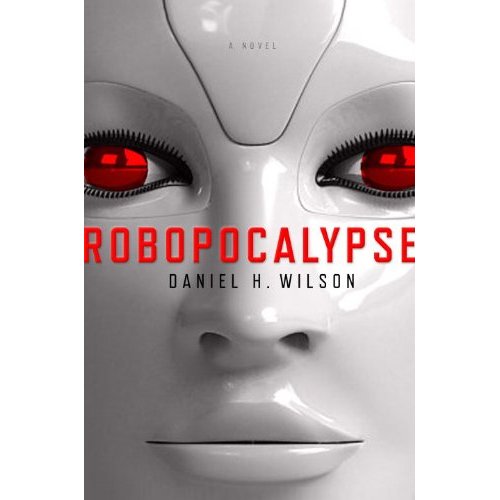

Robopocalypse


Yesterday the long anticipated novel Robopocalypse was released. Although I seldom indulge in hardcover fiction, I headed to my local Borders to purchase a copy. Sadly, it seems, my local is cutting back on first-day releases because I walked out of the store empty handed but with a robotic Armageddon in my head. Last summer I became acquainted with Daniel H. Wilson’s How to Survive a Robot Uprising, but word on the street is that this novel is serious. Steven Spielberg purchased the movie rights even before the book was released. And the concept owes its existence to religion.

If it were not for human religious sensibilities, would the concept of an apocalyptic end have ever arisen? Probing into the ancient psychology that lead Zoroastrians to suppose an ultimate conflict was just down the theological road, it is clear that even a strong moral sense alone does not dictate ultimate dissolution. By personifying evil in the form of Angra Mainyu, Zarathustra gave a (divine) human face to wickedness, and thus opened the possibility of battling against it. Evil as an abstract, non-personified force might simply be accepted as part of the universe we inherited. By providing it with will and intention, however, Zoroastrians allowed for a natural human response. Fight or flight is hardwired into our brains, but would we have dared fight a foe that is immaterial, amorphous, and completely abstract?

The nature of the enemy has transformed itself many times over the ages. Wilson, a scientist working with robotics during his education, has taken a religious theme and placed it in the context of a godless world of cybernetics. I must use caution here, since I haven’t yet acquired a copy of the book, but it remains clear that it is the humanization of non-human entities that gives force and pathos to a final conflict. Jesus charging his white horse into a foul-smelling cloud lacks the same impact. Thus mythologies are born. Mythologies that people live by and for which they frequently die. I do hope it all holds off until I can get a copy of Robopocalypse to read. Better yet, the end won’t come until after the movie is released.


Pilgrims’ Regress

In March alone I had to build expanders for three of our bookshelves. I claim the problem began when, as a faculty member at Nashotah House, I had use of a house with a built-in, floor-to-ceiling library. My wife claims the problem began long before that. We own a lot of books. The only silver lining to Borders’ recent bankruptcy was that we hovered like buzzards at one of the closing stores and walked out with books we might not have otherwise bought, but whose prices demanded their owners find a new home. Orphaned books are a sad sight. So I purchased my first Christian satire book in many a year. I just finished reading Becky Garrison’s Jesus Died for This? A Satirist’s Search for the Risen Christ. Having spent many years among the Episcopalians, Garrison’s point of view set me at ease: had this been an evangelical attempt at humor I would have orphaned the book myself. Nevertheless, as I read through this travelogue/memoir, I rarely found myself laughing.

Nothing robs one’s sense of humor quite like being in higher education for a couple of decades. I still find plenty to laugh about, but I realize the reprieve is only temporary before more serious issues once again cloud the skies. Garrison’s attempt to find genuine “Christ-like” behavior among Christians was, predictably, peppered with the failures to find it. As she repeatedly notes, the odd marriage of religion and politics in the United States has tainted both institutions (and both had already tainted themselves without the other’s help many times previously). It doesn’t take a satirist to see that many religious figures have made a joke of their belief systems by touting them as the only way to heaven.

What became increasingly clear to me as I read this personal and revealing book was that Christianity has splintered into countless subcultures that attempt to reclaim the original Christian experience. The problem is that time doesn’t stand still. Religions are, by definition, conservative. Progress, by definition, is not. Ever since the first hominid hefted a wedge-shaped rock and used it as the first Paleolithic weapon, our course was set. We would continue to try to improve our lot. Institutionalized religions began appearing a mere six-to-seven thousand years ago, very late in the game, and they’ve been driving with feet firmly on the brakes ever since. Once we figure out what the gods want we need to – wait, don’t change that! We’ve just figured it out! So we find ourselves in a highly technological twenty-first century with pre-medieval religions trying to tell us how to survive the Black Death. Each time religions change, some get left behind. When we finally implode, some future archaeologist may find an apartment crammed full of books and she’ll declare that my wife was right: the problem began long ago.