Hunting Vampires

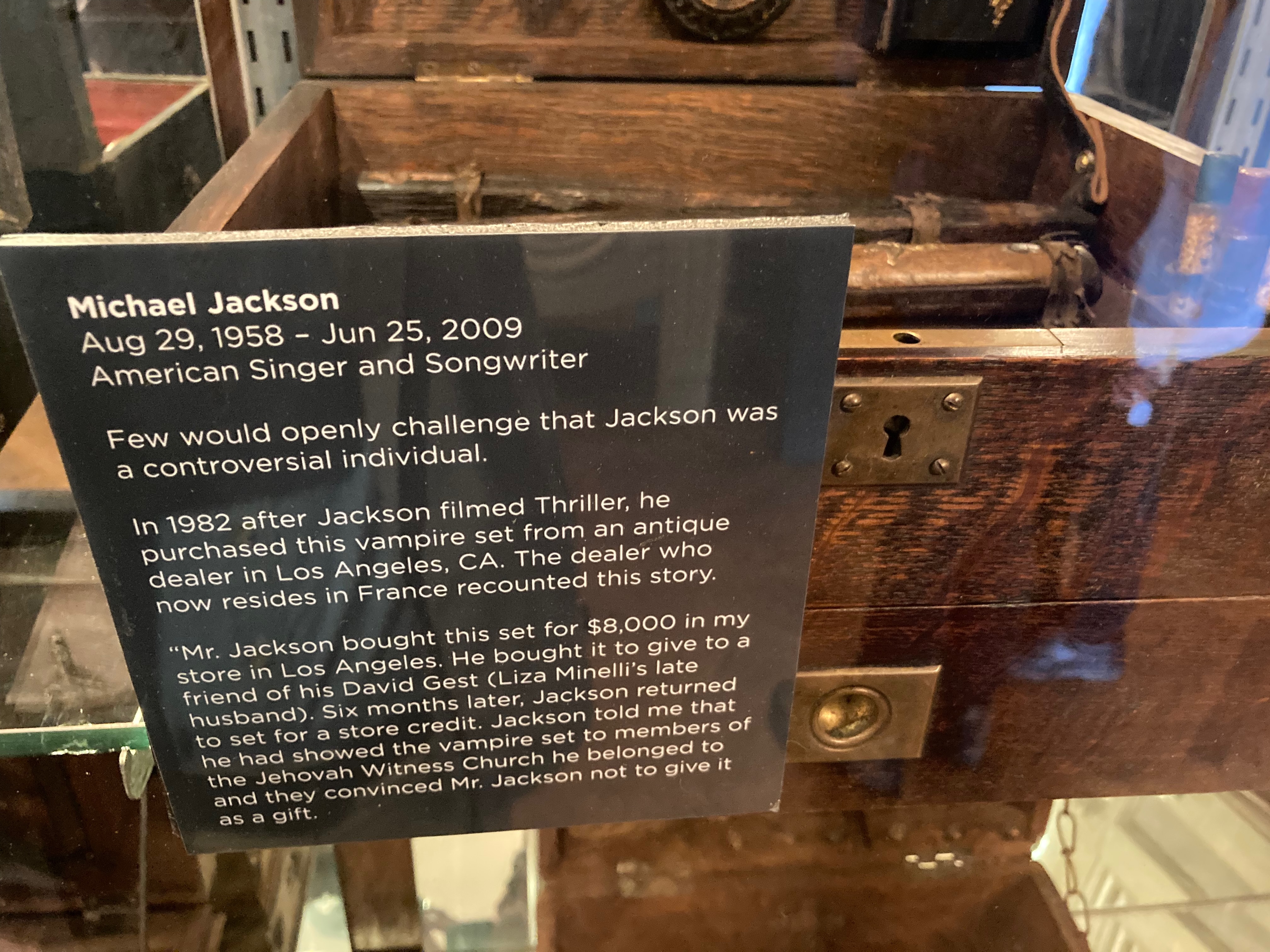
Many years ago some friends took us to the Mercer Museum in Doylestown, Pennsylvania.  Bucks County is one of those places where oddities persist, and I was very impressed by the fact that the museum had an actual vampire-hunting kit.  Now this was before the days of sophisticated cell-phone cameras and my snapshot, through glass, wasn’t very good.  There was no way to know, at the time, that a few years later Vampa: Vampire and Paranormal Museum would open up just a few miles down the road.  And that the latter would have a whole room full of actual vampire-hunting equipment (advertised as “Largest collection of vampire killing items ever in one location”).  A very real fear of vampires existed in Europe up until the technologies of the last century showed that humans don’t need the undead to create fear.  In any case, many chests of vampire-banishing implements line the first room.
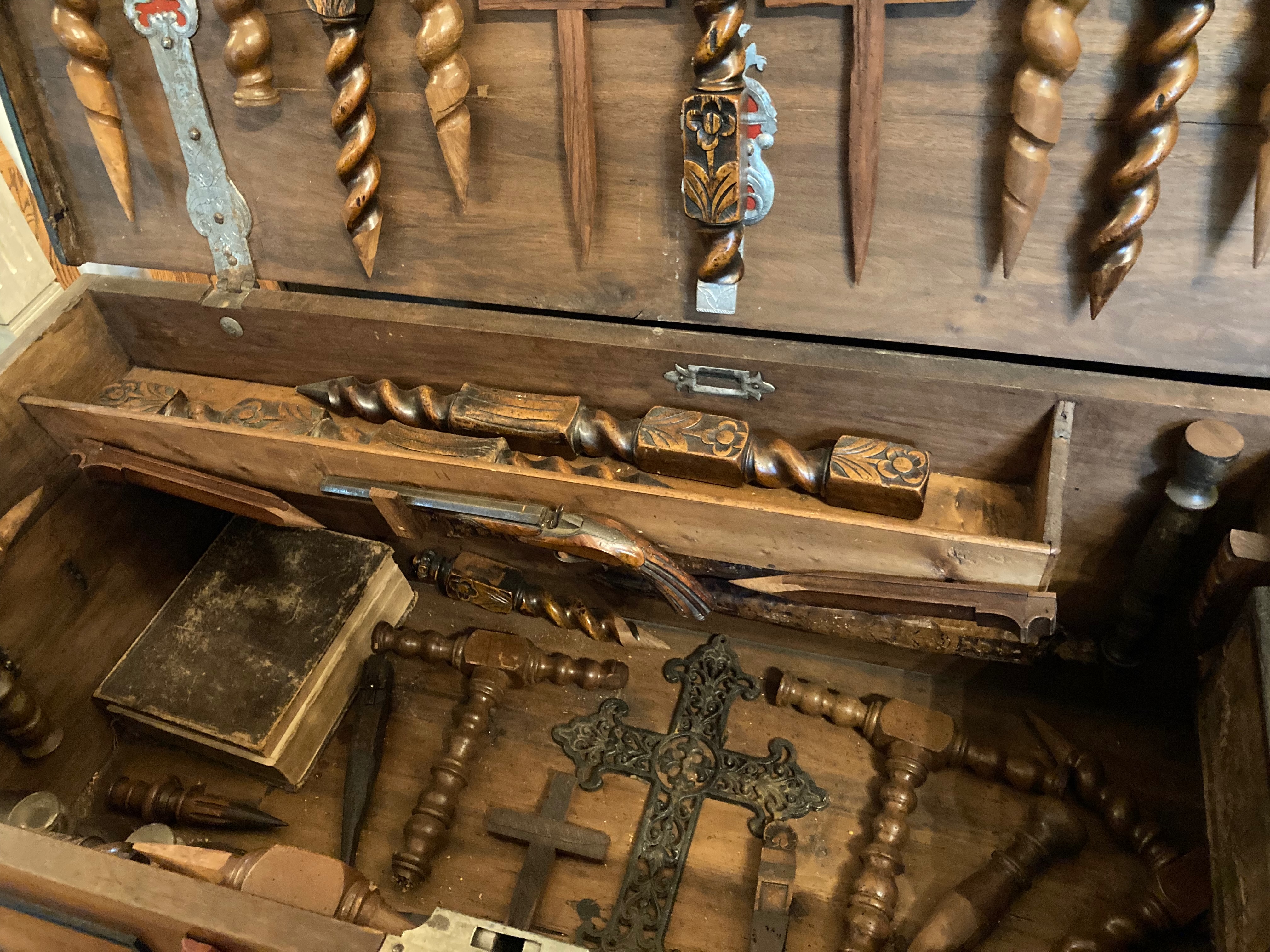
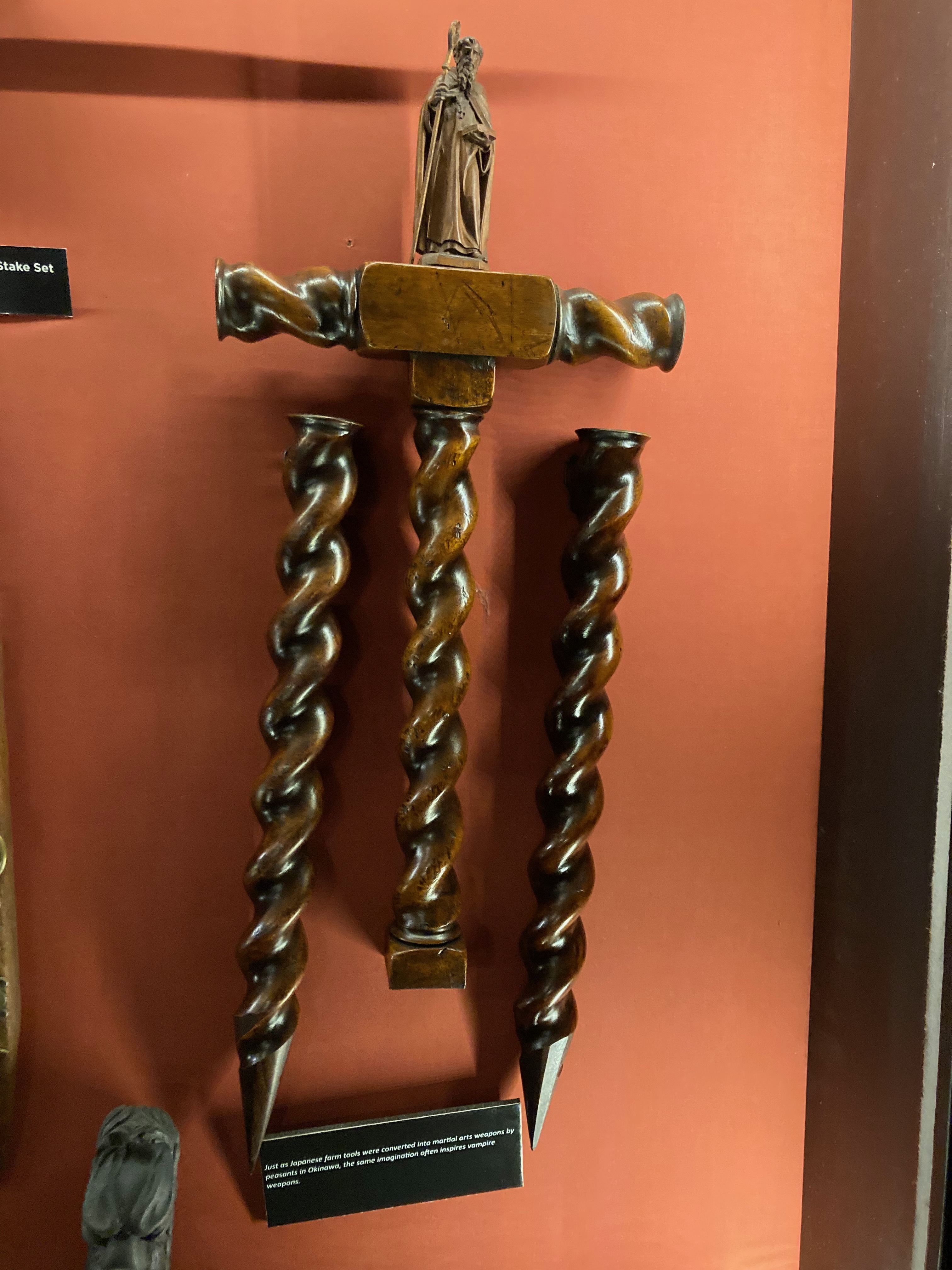
And stakes.  As my wife noted, in the movies they just grab a stake and mallet and get to work.  These were stakes made by craftsmen.  Many of them intricately carved, and, one suspects, officially blessed.  Matching sets of stakes and mallets seem like they were for display, rather like some firearm collectors these days proudly show off their guns.  The odd thing, to my mind, is that most of these artifacts weren’t medieval, but from the early modern period.  The earliest I saw was from the seventeenth century.  I had to remind myself that Europe was undergoing a very real vampire scare the decades before Bram Stoker wrote Dracula.  John Polidori, Lord Byron’s associate, had written a vampire novel in the early nineteenth century, well before Stoker’s 1897 classic.
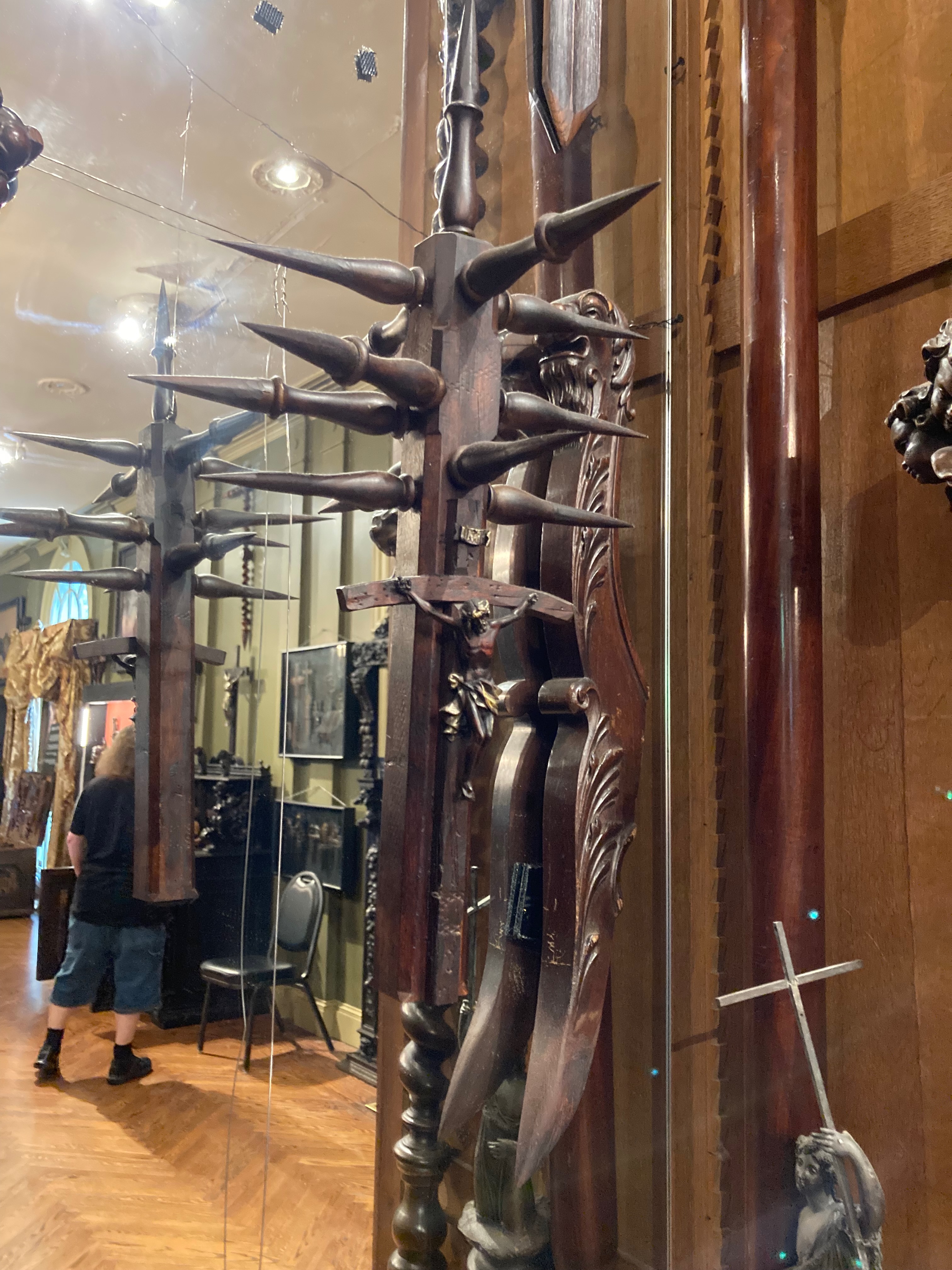
Vampire maces were of a higher magnitude.  The spiked mace, with crucifix, shown here, is an impressive piece of woodworking, as well as enough to make any vampire think twice before biting any necks in this house.  The idea of the Prince of Peace adorning such an instrument of violence encapsulates the contradiction of being human.  And the depths of our fears.  This museum is a testimony of our collective phobias.  Few people in this electronic age really believe in physical, supernatural, vampires.  There are people who do, of course, but most of us are so entranced by our phones as to completely miss a bat flitting through the room, let alone a full-fledged undead monster with fangs.  The fact is, over the centuries many people did gather what was needed to protect themselves from vampires in chests and cabinets, all in the name of fear.  
One final note: one of the vampire hunting kits was owned by Michael Jackson.  As the sign (with a typo) notes, the Jehovah’s Witnesses (to which both he and Prince belonged) convinced him not to give it as a gift.  Belief, it seems, persists even into the late twentieth century.

Drac Retold

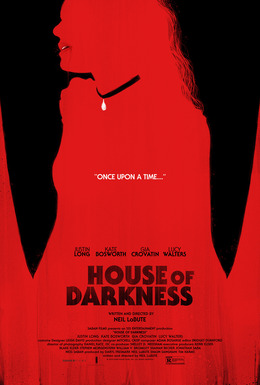
House of Darkness is one of those horror movies that doesn’t seem like horror until a good way in.  I knew nothing about it, other than it had to do with vampires, when I watched it.  A guy named Hap, a bit drunk, is trying to score with a woman, Mina, who he’d just met in a bar.  They don’t know each other’s names yet but she lives in a castle far from town.  Just as things begin to get intimate, another woman, Lucy walks in.  At this point Bram Stoker comes to mind.  The two main female characters in the novel are Mina Harker and Lucy Westenra, so naming the sisters (for so the two are) after them lets you know you’re in vampire land.  As Mina is off fixing a drink, Lucy takes Hap on a tour.  He begins to suggest a threesome, but the women want to tell ghost stories instead.

In the guise of fiction, Lucy narrates their past as sisters who rescued an abused girl and who moved from town to town to wipe out the men.  Hap is then startled by a third sister, Nora.  He is now growing quite annoyed by their game and when he tries to leave, they attack him.  Now, I was watching this on a Sunday afternoon after having been up late the night before.  My motive in watching movies at such times is to help keep awake (as well as to have something to blog about).  The pacing of House of Darkness was so slow that it struggled to meet my expectations in that regard.  Still, it isn’t a bad movie.  It has a feminist message, and as I read about it later I learned that it was intended to be a modern retelling of Jonathan Harker and the three women in Dracula’s castle.

Then I learned the film was written and directed by Neil LaBute.  That name is seared forever in my mind as the man who tried to remake The Wicker Man.  Suddenly things began to fall into place.  Many stories—some would argue all—are retellings of classic tales.  LaBute seems to enjoy trying to make them into something slightly different.  His directorial vision, however, doesn’t seem cutting edge.  House of Darkness is mostly banter, some of it clever, between Hap and the women he wants to seduce.  I kept thinking, “It’s a work night for him,” and wondering how he’d manage to function the next day.  Of course, I was probably projecting since I knew that, if I made it through this soporific afternoon, I would be at my desk bright and early the next day. 


To Dracula, a Daughter

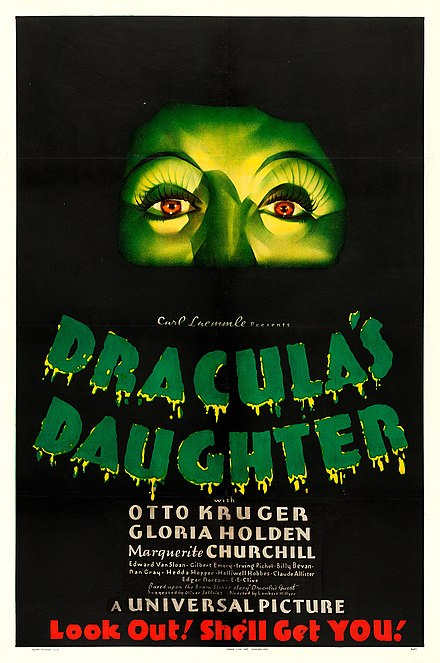
Nosferatu, by F. W. Murnau, was deemed in copyright violation of Bram Stoker’s Dracula, and ordered destroyed.  Rights to the novel were properly purchased by Universal and the horror film proper was born.  Other studios wanted to get in on the action, so the rights to the story of the Count’s daughter were bought by MGM.  They then sold the rights to Universal so that the latter could produce a sequel to their earlier hit.  Dracula’s Daughter didn’t do as well as the original, but it kept the vampires coming.  Some years later, Son of Dracula came out, keeping it in the family.  Having watched Abigail, I had to go back to Dracula’s Daughter to remind myself of how the story went.  I recalled, from my previous watching, that it wasn’t exactly action-packed, but beyond that thoughts were hazy.

Picking up where Dracula left off, von Helsing (that’s not a typo) is arrested for staking a man.  Then a mysterious woman arrives and steals the body to destroy it in an attempt to rid herself of vampirism.  We see that just five years after Dracula the reluctant vampire was born.  Creating a scandal at the time, Dracula’s daughter also seemed to prefer females.  Apparently the script was rewritten several times to meet the approval of censors during the Code era.  The modern assessment is that this is based more on Sheridan Le Fanu’s Camilla rather than an excised chapter of Bram Stoker’s novel.  Since the world wasn’t ready for lesbian vampires in the thirties, she falls for Dr. Garth, a psychologist that she wants to live with her forever.  Kidnapping his secretary to Transylvania, she draws him to Castle Dracula.  Her jealous servant Sandor, however, shoots her with an arrow.  Von Helsing explains that any wooden shaft through the heart will do.

Already as early as Stoker, at least, Dracula had brides who were vampires.  It makes sense that there might be daughters and sons.  And studios, learning that people would pay to watch vampires on the silver screen, were glad to keep the family dynamics rolling.  Vampires proved extremely popular with viewers—a fascination that has hardly slowed down since the horror genre first began.  Some of the more recent productions explore themes and approaches that simply wouldn’t have been possible in the early days of cinema.  We don’t see Dracula’s daughter actually biting victims—one of the many things the Production Code wouldn’t allow—and there’s no blood.  Nevertheless, the story itself went on to have children and they are still among us.


Old Dracula

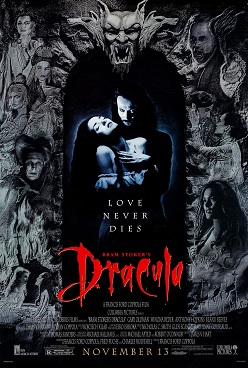
Francis Ford Coppola’s Bram Stoker’s Dracula is one of the “old movies” about which I posted some time back.  I’ve seen it at least a couple of times, and I wrote a previous blog post about it (October 11 2009).  This is a film about which I have conflicted feelings.  It has immense visual appeal and it influenced a tremendous number of followers.  It also did exceptionally well at the box office.  Since 1992 was a year in which I’m pretty sure I saw no movies in the theater (finishing a doctorate, moving back to America, and commuting weekly from Champaign-Urbana to Nashotah House drained my time and energy.  Besides, still being fairly newly married, I had not transitioned to horror movies again (that’s a different story, also involving Nashotah).)  Being a former literalist, when I first saw it I resisted the title since it takes significant liberties with Stoker, but the overall story is probably the closest of any vampire movie I’ve seen.

The strengths of the movie include its interaction with religion.  Vlad begins by renouncing God and becoming an agent of evil, stabbing a cross, and drinking the literal blood that pours out.  A number of Stoker’s own religious elements are also portrayed, and the ending brings God back into the picture, implying a kind of redemption for the defeated vampire.  The stylishness and opulence of the movie also make for engaging viewing.  It doesn’t have the gothic feel that it might—there seem to be some almost Burtonesque elements to it and some of the casting decisions feel ill fitting.  Anthony Hopkins just doesn’t do it for me as Van Helsing.  His one-liners feel out of place, and his interpretation of Van Helsing as a whole doesn’t resonate with me.

I do like Gary Oldman’s Dracula, however.  He’s right up there with Lugosi (but not quite at that level).  The conflicted vampire is an appealing character—much more intriguing than the pure evil kind.  This Dracula forsakes God because church rules about suicide keep his Elisabeta out of Heaven.  Even now the rulings seem not to allow for much nuance.  At heart, the vampire is a religious monster.  Fear of the crucifix may go back to Bram Stoker, but this movie tries to give it a backstory.  It’s a question of theodicy—why bad things happen to good people, essentially.  This is probably the biggest reason people end up turning away from religion, and it’s something theologians ponder.  While it isn’t my favorite vampire movie, Bram Stoker’s Dracula is stylish and accurate to a degree.  But it also turns back the pages a bit further than Stoker’s book does.


Re-untold

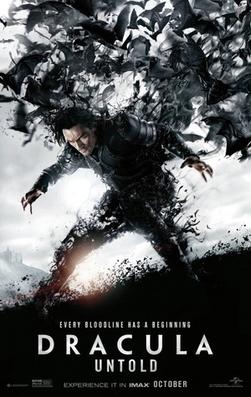
In retrospect, Universal’s Dark Universe, itself a shadowy concept, could have been a thing.  With the budget behind it, Dracula Untold could’ve been spectacular.  As so often happens, however, poor writing seems to have brought Vlad the Impaler to his knees.  I suppose it was rather tacky of me to fall asleep during it when a friend showed it to me shortly after it was available on streaming.  My excuse was that we started late and I’m a very early riser.  Finding it on a network to which I have access, and on a free weekend, I decided to give it another try.  I didn’t fall asleep the second time, but I did end up disappointed.  Action-horror is a tough sub-genre to pull off well.  As some critics pointed out, if Dracula could defeat 1,000 men singlehandedly (which he does shortly after being turned), then why does he not do so when it’s crucial?

What I did find intriguing is the older vampire that lives in Broken Tooth Mountain.  What is his backstory?  And why, if Dracula can just die, does the older vampire not do so himself, when he clearly wishes to?  He just has to step out on a sunny day.  The menace of the classic vampire isn’t on the battlefield, but in the one-on-one situations.  At night, when you’re sleeping.  Or otherwise unable to protect yourself.  The movie does have some good moments—and with a budget like that, it should have—but overall it struggles.  

Part of the difficulty is understanding Vlad the Impaler being, at heart, a nice guy.  Although he impaled thousands of people, he really just wants peace and a domestic life with his wife and son.  He’s reluctant to challenge the Turks until one taunts him upon taking his son hostage.  He tries to protect his people, but when they help save him (as vampires that he personally has turned), he destroys them all when it’s over.  The question of motivation hangs unanswered over the whole thing.  Dracula is never evil, not even when he declares himself the son of the Devil.  He attacks only in self-defense and although he does shed unnecessary blood, it is only in the fog of war.  And the motivation issues also apply to his pre-vampiric allies.  They don’t seem to be able to make up their minds whether Vlad is a good guy or not.  They try to kill him then they fight next to him.  There’s a lot going on here—maybe too much—and it seems that the story wasn’t thought out well enough to make it all work.  Vampires, it seems, don’t always cooperate.


Not Bram

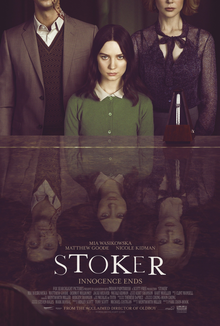
I guess I wasn’t sure if Stoker was horror or not.  It’s similar to Hitchcock in many ways, and some suggest it’s a “thriller” rather than horror proper.  One of the refrains of this blog is that horror is a poor genre designation.  Too many other genres bleed into it and it grows into several others also.  Still, Stoker was conceived of as a horror movie and it fits that, generally.  The title made me think of Bram, the most famous bearer of that surname, at least in my mind.  I’m pretty sure that others had the same impression, since some websites take pains to mention that this is not a vampire story.  It’s not.  It is, however, a story about a psychopath or two.  But it generally gets compared to Shadow of a Doubt rather than Psycho.  I’ll spoil things below.

On India Stoker’s birthday, the family receives the news that her father has died.  She was very close to her father and distant from her mother. During his funeral she notices someone watching from afar.  It’s an uncle she didn’t know existed and who’s decided to live with them.  This uncle, we learn, was released from an asylum.  As a child he’d killed his younger brother.  After arriving at the Stoker mansion, people who recognize him disappear.  India was trained as a hunter by her father and senses something is wrong.  The uncle meanwhile seduces her mother so she doesn’t see his obvious faults.  (He’s a charming psychopath.)  He’s goal is to have his niece, India.

There’s a creepy atmosphere throughout, and it’s difficult to determine what India’s end game is.  She’s able to take care of herself, mostly.  She does rely on her uncle to save her, though.  India discovers that he’d been institutionalized at the fictitious Crawford Institute, interestingly in Crawford, Pennsylvania, not far from where I grew up.  Instead of accepting his plans for her, however, she charts her own violent course.  This is an odd film as far as determining character motivations go.  It’s not really clear what India or her mother really wants.  The uncle’s straightforward about it, but he’s a serial killer.  It’s difficult to know upon whom to cast your sympathies.  A movie about family dynamics as much as about horror (a character kills both his brothers, his aunt, and a housekeeper that he feels is in the way), it has no clear message.  And there are no vampires anywhere to be seen.


Enabling Vampires

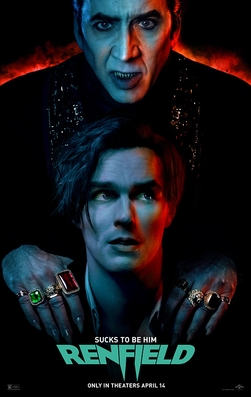
I was skeptical at first.  Nicolas Cage as Dracula?  How could this possibly work?  Nevertheless, Renfield works.  A box office flop, I suspect that audiences may not be ready for a comedic treatment of Dracula, but this is a smart, savvy take on a classic, combining superhero films with vampire lore.  Let me take a step back here.  Renfield is a bit of a slippery character, shifting places with Jonathan Harker in Bram Stoker’s original.  He is Dracula’s servant, but here he’s presented as becoming aware that he’s a codependent enabler.  In his seeking victims from the narcissists who cause pain in the lives of a church support group, Renfield comes to realize that he’s also a victim.  He teams up with the one honest New Orleans cop who’s not on the payroll of the local mob, and together they rid the Big Easy of both vampires and organized crime.

Overly ambitious?  Yes.  But the comedy actually works here.  This is a funny movie with several laugh out loud moments.  Maybe it’s CGI, but in several shots Cage actually looks like Bela Lugosi.  Nicholas Hoult does a wonderful interpretation of Renfield, the madman of the original movie, as well as factotum to the dark prince.  Those who know and appreciate vampire lore will find many subtle insider jokes here.  And Cage undertakes a campy, yet compelling version of Dracula.  Endlessly self-referential, the movie is a skillful blend of vampires, self-help wisdom, and even social commentary.  I’d heard that my expectations shouldn’t be too high here, so I was pleased when they were exceeded on almost very point.  

Horror comedy is difficult to pull off so that viewers feel satisfied that they haven’t wasted their time.  Renfield manages to do this with style, action, and even a bit of drama.  I have an inkling that over time this will become one of those movies that appreciates with age.  The story is convoluted, but this is in service of the comedy.  Everything is so wildly improbable—from eating bugs to gain super powers to Dracula’s blood bringing the dead back to life—and hilariously overblown that it overcomes the difficulties attending such a mashup.  It’s as if Cage knows viewers don’t always take him seriously, and yet he rises to the occasion.  With nods to The Matrix and Pirates of the Caribbean, as well as the vast library of Dracula films, Renfield is the result of homework done and boundaries crossed.


Not Archives

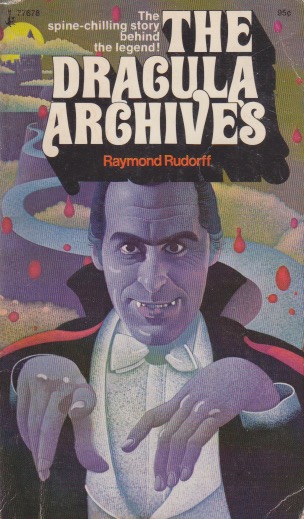
There was a historical Dracula.  The cognomen of Vlad Tepes, or Vlad III of Wallachia, Dracula’s association with vampirism surprisingly dates back only to Bram Stoker’s Dracula.  And much of what I read about Vlad III as a child has been reevaluated, with much of it being reassigned to exaggeration.  (I often wonder if this isn’t part of the reason so many of my generation have become conservative—it can be unsettling to have the certainties with which you were raised topple like so many dominoes.)  In any case, I started reading about vampires when I discovered our high school library had historical books on them, and so I recently picked up Raymond Rudorff’s The Dracula Archives at a book sale, despite its lurid cover.  The reason?  The back cover classification is “nonfiction.”

Clearly that was a marketing ploy, and although the book cost me merely pennies on the dollar for a mass-market paperback from that era (1973), I was a little disappointed to find it was a novel.  I figured it out within a page.  (You have to understand—at a book sale the normal rational faculties don’t always apply.  Anyone who’s been to a library book sale in Scotland knows that little old ladies throw elbows to get at a book they want, and you have to think fast if you’re on the fence.)  So The Dracula Archives is intended to be the prequel to Dracula.  Mirroring the latter, Rudorff’s work is comprised of diary entries and letters, slowly building up a fictional identity for Stoker’s titular character.  It isn’t as fast paced as the cover blurbs indicate, but it does manage to sound historical although it’s clearly not.

Reading such a book during a crisis of truth makes me question the marketing wisdom of the back cover label.  Yeah, it’s kinda cute, I admit.  And Trump didn’t seem like a national threat in the seventies.  But still, the mixing of the fundamental category of book (fiction or non) doesn’t seem quite fair.  Of course, caveat emptor applies to small purchases as well as large.  I go into book sales with a list, and I try to limit myself to it.  But then, I’ve not heard of every book—not by a long shot—and finding an unknown treasure is part of the draw.  Raymond Rudorff wrote several books but hasn’t merited a Wikipedia page yet.  This one is by far his most famous novel.  It’s a fun read and a reasonable prequel, but it won’t likely scare anyone as much as Republican politics do these days.


Reading Lights

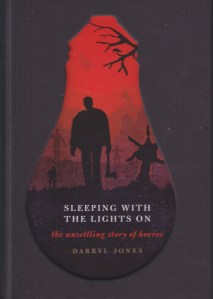
Late one night in Wisconsin—I had just come off the train from Champaign-Urbana—one of the students from Nashotah House was driving me to my spooky apartment on campus as part of his work-study job.  He mentioned what seemed an obscure topic to me, and I asked him why he liked it.  “Who can say,” he responded, “why they like anything?”  He had a point.  Work on Nightmares requires reading current studies of horror, and one that came out just before Halloween was Darryl Jones’ Sleeping with the Lights on: The Unsettling Story of Horror.  I don’t know why I like such things, but when the book was first announced I knew I’d need to read it, and soon.  It had to wait until the Warren books were finished, however.

This little gift book (with a novelty cover, even) contains quite a bit of insight.  In fact, while reading it I discerned that Jones had spotted something that I’d begun to write down independently.  Horror does that to people.  The book is divided up into chapters addressing different genres of monsters and analyzing why they have proven so popular with both horror authors and auteurs.  The discussion is lively and even witty at times, as befits a topic that most people really misunderstand.  I myself used to misunderstand it—I went through a terrible period of repudiating the things I liked when growing up (who could say why?).  I jettisoned my interest in the Gothic even as I visited ruined castles in the Scottish highlands, and thought that horror was something best left to the uneducated.

One of the realities of my own life—perhaps some of my readers will find it true as well—is that once you’ve been put through the mill once or twice your mind starts going back to childhood in what may be a vain effort to start all over again.  The likes of your youth come flooding back—this is why I began reacquiring Dark Shadows novels.  They aren’t fine literature, but they were one of the guilty pleasures with which I grew up.  As Jones notes, vampires are one of the most enduring of monsters.  He suggests that Bram Stoker’s Dracula was among the notably influential books of Victorian English literature.  As Jones points out, there are people who back away from him when he tells them he studies horror.  He also makes a clear case for its enduring connection with religion.  I might add as a coda here, that telling people you study religion often gets the same response as telling them you study horror.


The Nature of Evidence

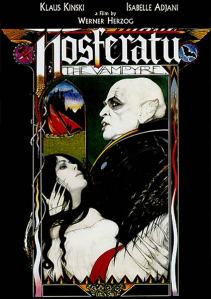
Home alone on a Friday night, I turned to Werner Herzog’s Nosferatu. Not a typical horror film, this art house production is an updating and remaking of F. W. Murnau’s technically illegal 1922 adaptation of Bram Stoker’s Dracula. It has been a few years since I’ve watched it, but the beauty of the cinematography kept coming back to me at unexpected times. Klaus Kinski is an unforgettable Count Dracula, hideous and compelling simultaneously. He draws pity and revulsion. When he’s not on camera you can’t wait for him to appear. There’s not much new in the story, of course, as it follows Murnau pretty closely, with some shots being nearly identical. One exception to this is the plague. Wherever Dracula appears the Black Death accompanies him. This leads to one of the most unusual twists of this retelling—the role of Dr. Van Helsing.

Instead of being the authority on vampires and leader of the attack, Van Helsing is here a reluctant rationalist who doesn’t accept superstition. He encourages the town elders to respond calmly to an outbreak of the plague. When Lucy Harker insists that Jonathan has been the victim of a vampire (which he has) the professor again urges caution. He insists that this must be approached scientifically, empirically. You don’t pull up wheat to see if it’s growing, he notes philosophically. Take time, trust science, and all will be well. Meanwhile the audience knows the reality of the vampire. There is a supernatural threat and it is moving fast. Lucy knows they must strike against Dracula before the vampire destroys the whole town. Despite the mounting number of deaths by plague, Van Helsing still clings to slow and steady evidence, only realizing after Lucy’s death that she had been right all along.

There’s quite a bit to unpack in this retelling after all. A female takes the lead. Lucy is the one determined to stop the vampire. She does so out of belief. Van Helsing rightly points out that this is a dangerous way to approach a problem. One ponders what might’ve happened had science been allowed to run its course. Van Helsing, if science be science, would’ve had to at last come to the same conclusion that Lucy had experientially. She’d read Jonathan’s diary and she had a late night conversation with Dracula where he did not appear in her mirror and did shy away from her crucifix. She too is evaluating evidence, only she has to allow for the reality of the supernatural. Since the story is old and the production artistic, this is no bloodbath horror spectacle. It is a thoughtful, almost quiet reflection on how we perceive reality. Even among the many vampire films it remains a thing of beauty.


Joban Vampires

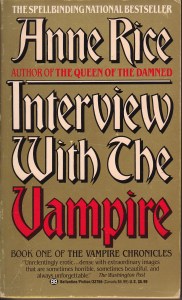
Interview VampireThe first vampire novel I ever read, I remember correctly, was one of the Dark Shadows series written by Marilyn Ross. I don’t recall which one, since I had to buy my books from Goodwill or some such vender utilized by the poor. Now, I’m really a squeamish guy and the sight of blood bothers me. Barnabas Collins, however, was a compelling character—deeply conflicted and a reluctant vampire. The combination of his sadness and the setting in coastal Maine kept me looking for Dark Shadows books every time we went shopping. It surprised me, given all that, that I had such difficulty getting into Anne Rice’s Interview with the Vampire. I started reading it years ago (it was also a second-hand copy, and, interestingly, the color scheme of the cover nearly matched Dark Shadows novels) and some eighty pages in put it down only to forget about it. Starting from the beginning a few weeks ago, I gave it another try. Although Louis is a conflicted vampire, the pace is languid and it was almost as if the self-pity was overdone. I was determined this time, however, to see it through.

One of the recurring themes of the book, and I presume the Vampire Chronicles series, is that vampires are not evil because of the Devil. In fact, there is nothing Satanic about them. Blame tends to fall on God for their state. The more I thought about it, the more the theodicy of the vampire began to resemble that of Job. Like Job, death for a vampire takes a long time. There is much suffering along the way. Louis can love, in a measure, and can loath himself. He never really understands what it is to be a vampire. The other undead he meets help to define him, but he can’t get too close. His life is a kind of Hell without Satan.

Rice’s vampires don’t fear crucifixes or shun churches. In fact, Louis takes a priest as one of his victims, sacramentally near an altar in a church. Religious imagery and discussion abound in the book. It truly is a vampire theodicy. Perhaps, for its day, it was the next step in vampire evolution. Bram Stoker, while the most famous contributor to the modern vampire myth, didn’t corner the market on defining the undead. When Louis meets vampires of the old world, they are mindless, plodding killing machines that even other vampires avoid. Rice’s vampires feel, think, and yes, theologize. I feel strangely satisfied now that I’ve finally finished the Interview. It was a vampire at my bedside for so long that it feels like an accomplishment to have finally laid it to rest.


Summer of Frankenstein

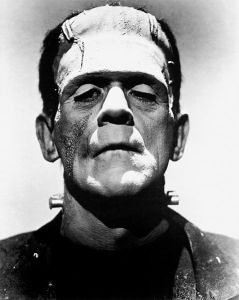
Two centuries can make an enormous difference. Just two-hundred years ago Napoleon’s defeat at Waterloo was merely one year in the past. North America and parts of Europe were experiencing “the year without a summer.” Perhaps due to that cool and rainy summer, when Mary Godwin and Percy Bysshe Shelley called on their friend Lord Byron, their thoughts turned to ghosts. According to the legend, together with Byron’s personal physician John Polidori, the friends spent a night writing scary stories. Polidori, although not widely remembered today, invented the vampire that would, in Bram Stoker’s hands, become the aristocratic Dracula, and eventually, with Anne Rice’s influence, Lestat, Louis, and Armand. Mary Godwin, soon to be Shelley, gave birth to perhaps the most successful of new monsters ever created—that of Victor Frankenstein’s construction. Many have claimed the monster’s pedigree to have been that of the golem, but Shelley’s creativity went beyond this forebear into the sympathetic misfit who, like all of us, never asked to be born. The two centuries since that summer have been haunted.

477px-Frankenstein's_monster_(Boris_Karloff)

Quite apart from the monster tale, Frankenstein is also about building that which we, in our hubris, can’t understand. Progress without forethought, as Epimetheus could never learn, housed immediate and very real dangers. The two centuries since Frankenstein have proven Mary Shelley a prophet. An early supporter of women’s equality, she profited from her novel, but never managed to thrive. Just six years later her famous future husband would die tragically in the Romantic genre of a shipwreck. Even with important friends, Mary found it difficult to capitalize on her success. The monster was real enough.

We’ve become accustomed to making things we can’t control. When’s the last time you were able to fix a car broken down by the road, apart from the occasional flat tire? Can you really stop your job from becoming completely different from what you signed up to do? What about when that bully wanders from the playground into the political field? Once you’ve figured out how to split an atom, you never forget. It may have been Napoleon still recently in the news, or the fact that 1816 failed to warm up like it was expected after the solstice. Perhaps it was the fact that Mary Godwin was a liberated woman in a world still utterly determined by men. We can’t know her intimate and ultimate reasons for creating a monster, but we do know that once the monster is unleashed we can never bind it again.


Teaching Vampires

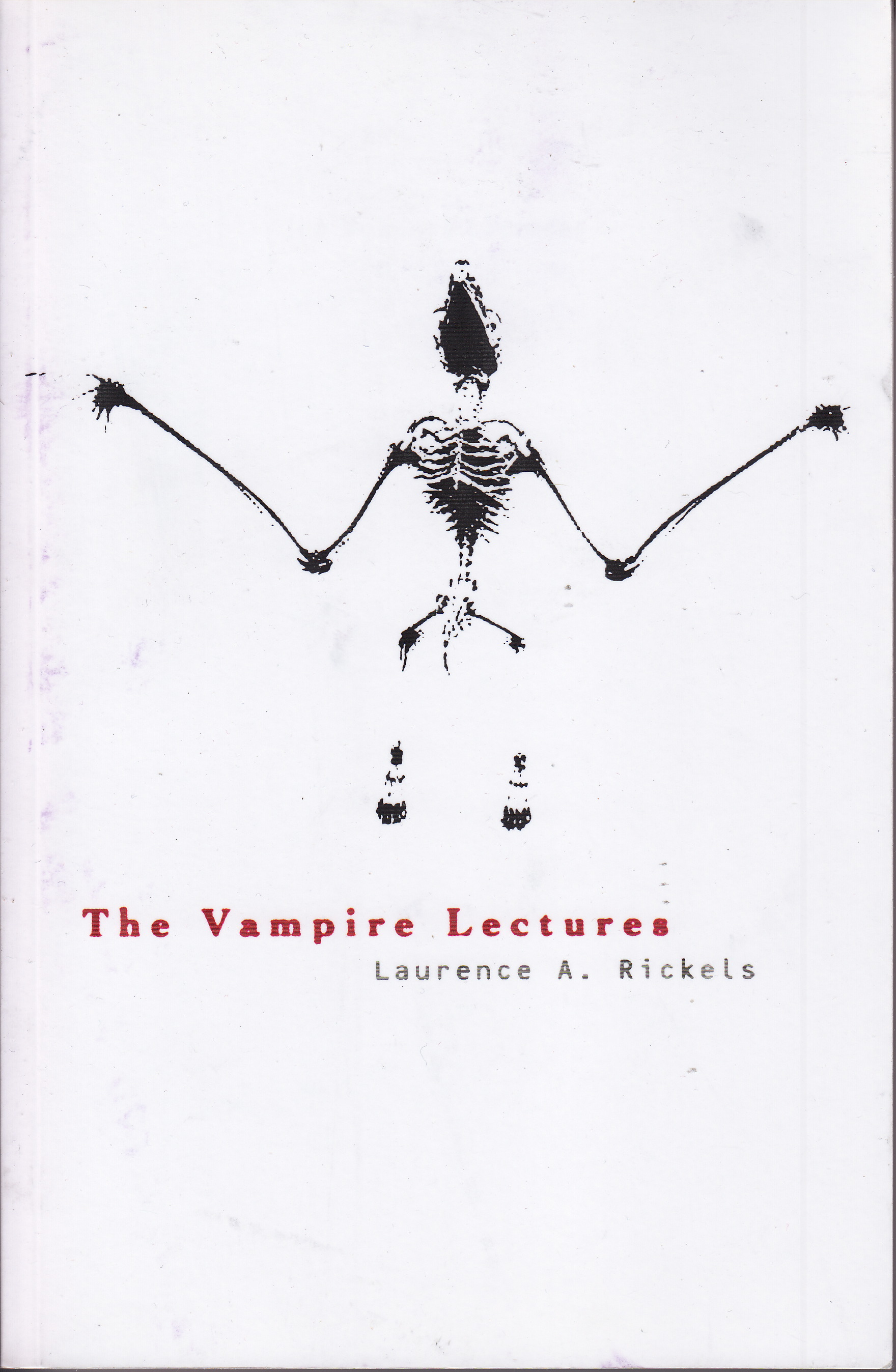
VampireLecturesWhat do you get when you cross German literature, psychology, and the undead? The Vampire Lectures, of course. Laurence A. Rickels, one gets the feeling, must be one interesting guy in the classroom. When I was a student the thought that anyone would take vampires seriously enough to offer college credit to study them was, well, a foreign concept. We all know that there’s no such thing as vampires, or werewolves, or Frankenstein’s monsters, or mummies—wait, mummies are real, but just not animated. In the reigning cultural paradigm, if something’s not real, it’s a waste of time. The human psyche, however, disagrees. The fact is there’s an awful lot of mental baggage that the vampire addresses. So much so that the University of California at Santa Barbara can offer a twenty-six lecture course on the topic. The results are what we have in this unusual book.

Rickels has read widely in the literature of the undead. The vampire’s share of the material goes to Bram Stoker’s Dracula, the novel that defined, in many ways, the modern concept of vampires. The lectures do cover earlier and later literary representations, but when movies began to be made, they started with Stoker. One of the most interesting aspects of the lectures is the utter breadth of movies Rickels addresses. Movies that I’d never heard anyone else mention, let alone analyze, are here, alongside the more famous examples. It becomes clear that vampires have been a favorite of film-makers as well as readers. Culturally they are omnipresent. One gets the impression that Rickels might have an inkling of why we have this fascination, although his analysis is often Freudian, he does come back to the concept of mourning. Vampires (who would’ve guessed?) mask our unresolved sense of loss.

The style of The Vampire Lectures reflects the kind of literary criticism that isn’t always easy to follow. The book has more puns per hour than any other academic title I’ve ever read. Perhaps such serious topics as loss, parental relationships, and sexuality require a good dose of humor to make them less overwhelming. Still, the puns show the shifting nature of the ground beneath your feet when you try to take a topic like this seriously. Not surprisingly, Rickels does spent some time reflecting on the religious nature of vampires. There’s no question that monsters trespass on—or maybe even arise from—sacred precincts. They also occupy similar mental spaces. Perhaps it’s no surprise that as the number of nones grows so do the fans of monsterdom. We need an outlet for our surfeit of fear and loss. Come to think of it, perhaps I need to take a class in this as well.


Once Bitten

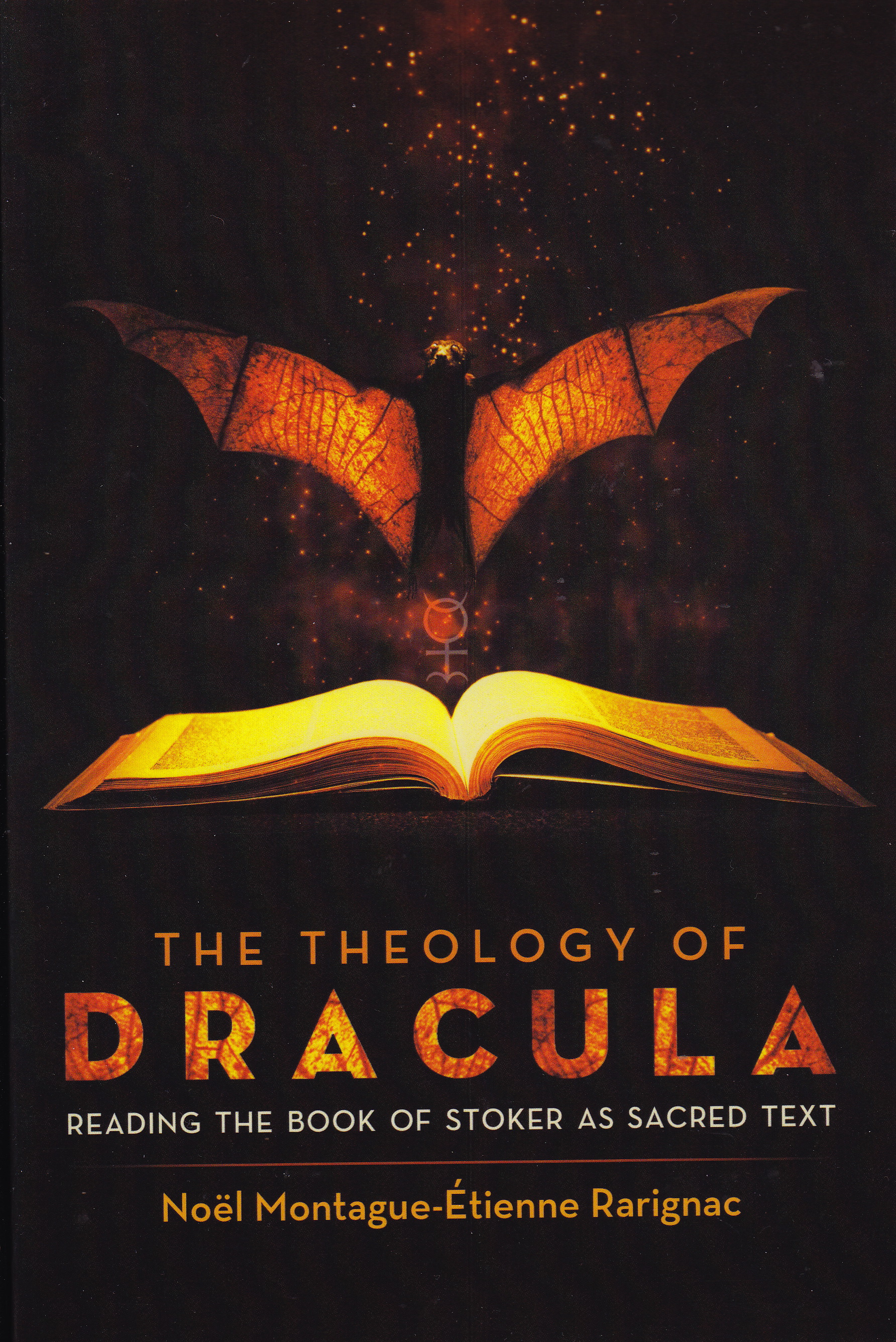
TheologyOfDraculaOnce vampires sink their fangs into you, it’s hard to shake them. I’m referring to an intellectual connection here, instead of a physical one. M. Jess Peacock’s book on theological vampires spurred me to read Noël Montague-Étienne Rarignac’s The Theology of Dracula: Reading the Book of Stoker as Sacred Text. It has been on my “to read” list for some time, and since I finished re-reading Dracula recently, I felt the canonical text was still fresh enough in my mind to take on an analysis. I have to confess that even though I grew up as a religious kid, and I loved monsters, I had no idea that the two were connected. Strangely, religion tended to elicit a fearful response while monsters gave me a kind of comfort. Of course, I always supposed that was normal. Then I learned that mature adults didn’t talk about, or even think about, monsters. I had to try to find solace in religion instead. Rarignac clearly figured out, however, that Dracula was a sacred text long before I came along.

What exactly does it mean to treat a book as a sacred text? Before anyone gets any funny notions, I need to say that Rarignac is not suggesting vampirism is, or should be a religion. That hasn’t prevented other people from seeing it that way, but that’s not what this book is about. It is about Bram Stoker’s Dracula. Devoting the kind of attention to detail that is often reserved for biblical texts, The Theology of Dracula examines the many religious traditions (not all of them Christian) that lie behind the novel. Stoker drew on many “pagan” traditions, including those of ancient Egypt and of Nordic mythology. Clearly Dracula responds to Christian symbols pretty violently, but he isn’t a classic Catholic. In fact, he seems to shy from Catholicism while admitting that its symbols work.

Rarignac, however, suggests more than this. He suggests that Dracula was written intended to be a sacred text. Not a Bible—we already have one of those, thank you—but a text that has its own mythology and symbols. Dracula‘s characters are not always what they seem. Careful scrutiny reveals that they often have celestial connections that tie them to ancient mythologies long forgotten by most modern people. We read the book expecting it to be about a vampire. Well, clearly it is. But not only a vampire. There is a much larger story at work in Dracula, and Rarignac has done an admirable job tracing its Vorlage (if I may step into jargon for a moment) and its wider context in the world of literary creations that specialize in our nightmares. There is much at which to marvel in this little book. I’m not convinced that Stoker intended his book to be read this way, but it is nonetheless a richer experience for it. Rarignac gives a simple monster tale real teeth.


War in Heaven

Van_Helsing_poster

Van Helsing, about which I’ve posted before, is not a great film, but it is perhaps the closest that modern cinema has to offer for my childhood Saturday afternoon viewing. Vampires, werewolves, and Frankenstein’s monster all appear together in a ménage à trois that Universal would’ve been proud to own in the 1960s. With lines cribbed from some of the Universal originals, plus some less believable chatter from Steven Sommers, the campy film is unrelentingly in dialogue with religion and its monsters. Indeed, the plot revolves around the church’s plan to save humanity from monsters by the employment of the eponymous van Helsing. I’ve probably seen the movie half a dozen times, and I’m a bit embarrassed to admit the this is the first time I’ve stopped to wonder at why, unlike Bram Stoker’s van Helsing, the one in the movie is named “Gabriel.”

It should’ve been obvious at the first viewing, but this time I was watching the movie with the intention of parsing its theology. In medieval Roman Catholic angelology, there are seven archangels. Two of them (or three, depending on whose Bible you are reading) are named in Holy Writ. Gabriel is, of course, one of them. The movie also shifts Dracula from being son of a Wallachian nobleman to being the “son of the Devil” (clearly by adoption). The Devil’s gift of resurrection (with which the movie is rife) comes with the vampiristic curse. And the climax of the film has the leader of God’s army (“the left hand of God”), Gabriel, battling the son of Satan. This is none other than the war in Heaven of which the Bible speaks. The leader of the archangelic army is actually Michael, but having “Mike van Helsing” as your lead just doesn’t carry the gravitas of Gabriel.

The movie opens with Dracula claiming that science has triumphed over God, and yet the mythology of monsters prevails. Frankenstein’s creation is morally pure, being a loving child of science, and the church declares him anathema. Throughout the movie all the monsters claim to want is to live, to survive. In fact, they are already resurrected. The werewolves get the dog’s share of the theology, however. They are infected or cursed rather than reborn. The war in Heaven has come to earth as angels and demons battle for supremacy. In the end, it is the human family chosen by God that goes extinct. I’m not sure all the theology adds up at the end of the film, but again, that is the very nature of mythology. And a film that can bring back a careless Saturday afternoon really doesn’t need to make sense at all.