Have It All

You can’t have it all.  I know, I know.  People are all the time saying, “I want it all.”  But you can’t have it.  This is where my Buddhist side kicks in, I guess.  It’s the constant desire that makes people unhappy.  And you don’t have to take my word for it.  About having it all, I mean.  The Catholic Church backs me up on this.  There are seven sacraments.  If you follow the rules most strictly, no one can receive all seven.  Holy orders and marriage, at least for much of church history, have been mutually exclusive.  As Paul was rattling on about spiritual gifts in one of his letters, he makes the point that nobody gets them all.  And you don’t even get to choose.  

Humans are acquisitive.  It’s probably an evolved trait.  Think of squirrels hoarding more acorns than they can ever eat.  (By the way, squirrels are the real heroes when it comes to planting trees, and they don’t even mean to do it.  It just comes naturally.)   Life gives us what we need for as long as we have time on this earth.  If you’re reading this you’re living proof.  We fear for the future, however.  What if tomorrow something I need goes away?  I’ve lost jobs and I know the desperation that immediately sets in.  So we want to store up more than we need.  But those sacraments.  Those spiritual gifts.  They remind us of something important.  Something a carpenter from Galilee once said.  It’s essentially the same as therapists have told me: be in the moment.  You have what you need right now.  As a coda: tomorrow will take care of itself.

Those of us who can’t stand incompletion (don’t show me a series of books with one missing!  Please don’t.) suffer from this quite a lot.  Here’s where we need to nod to Siddhartha again and take a deep breath.  Center yourself.  When I was a seminarian discovering Roman Catholicism for the first time, really, and that mostly through the Episcopal Church, I wondered about the sacraments and why, if they were things we should strive for, we couldn’t have them all.  By seminary I was pretty sure I wanted the matrimony route.  As my wife can attest, however, I still crave a monastic existence from time to time.  Torn between two sacraments and I’m not even a Catholic.  I guess I’ve known all along that you can’t have it all.  Those who try for it, if they’re lucky, end up under the Bodhi tree.
Photo by Mattia Faloretti on Unsplash

Wachet auf

I have a proposition.  Some folks in town have a big “Anti-Woke” (aka, “asleep”) flag on their house, along with various Trump paraphernalia.  Since the Republican Party has largely become reactionary and would, admittedly, still prefer to be asleep, perhaps Democrats should adopt Buddha as a symbol.  I know this would be dangerous in a nation that prides itself as being the city set on a hill, but “buddha” means “awoken one.”  I’m not a Buddhist but I have no problem with it.  The Eightfold Path makes a lot of sense to me.  In any case, a good symbol is something to be cherished.  I think of Gordon Deitrich having a Qur’an in his house, even as a gay man, in V for Vendetta.  Symbols are important.  The anti-woke seem to have forgotten Matthew 24.42 “Watch therefore: for ye know not what hour your Lord doth come.”  The Bible generally advocates wakefulness.

Photo by Mattia Faloretti on Unsplash

Trump-branded Christianity is a strange beast.  Certainly the use of a Buddha symbol would become a cudgel.  Ironically so, for a faith that promotes nonviolence.  The “foreignness” or “not-Christianness” outweighs the positive outlook it entails.  Any religion that advocates violence should reassess its principles.  Buddhism isn’t perfect—no religion is.  The basic ideas of right view, right intention, right speech, right action, right livelihood, right effort, right mindfulness, and right concentration work well enough with Christianity, as Thomas Merton discovered.  For some, however, the Asian outlook (overlooking that Christianity began in Asia) is a deal-breaker.  Strange for a global religion.  Not so unusual for those who prefer to be asleep because Fox News sings them a lullaby.

One of the most stirring Christian hymns is “Wachet auf, ruft uns die Stimme,” based on a Bach cantata.  Perhaps better known as “Sleepers Awake,” the words take their origin from Matthew 25, the parable of the ten virgins.  If I recall correctly, the virgins ready to be woke are those who fare better in this tale.  They’re less concerned with condemning other religions and more interested in being able to wake and trim their lamps swiftly when the time comes.  As I told a friend the other day, I’m an unrepentant idealist.  I do believe that we have it within ourselves to treat all people as having inherent worth and dignity.  The real draw to having Buddha is a symbol would be the introspection.  Instead of telling other people how to live, the principles are applied at home.  Of course, a person has to want to wake up for any of this to work.


Eclipsing the Earth

We need a new word.  One for the high an eclipse brings you.  I’m finding myself having difficulty coming down from it.  It seems so mundane to have to do something as ordinary as work after experiencing totality.  We only caught very brief glimpses of the moon over the sun through small breaks in the clouds, but we did get to experience totality.  How do you come down from that?  The next day we had a several-hour drive to get home so that we could all be at work yesterday morning.  What could be more ordinary than that?  And the eclipse happened on a Monday, not an unusual day for a holiday.  Only it wasn’t a holiday, but a “vacation day.”  So was the driving day.  At my age you need a day to recover from all the driving too.

Several friends have posted their amazing photos and videos of the event, so I’ve decided to “release” my video to the wild.  A few explanatory notes: we were in upstate New York, on the shore of Lake Ontario.  It was chilly and we were bundled up (we came home to 80-degree temperatures, which was quite a shock).  The video may seem to have not much happening for the first couple of minutes and this is because electronic cameras tend to “even out” the light (film photography is much better).  When I started filming this it was getting dusky but the phone smilingly tried to make it look like normal daylight.  That wasn’t the case.  (Be patient—drama takes time to build!)

It occurred to me that many people (who had clearer skies) thought totality was all about the moon over the sun.  I take a more Buddhist approach.  The Buddha admonished not to mistake the hand pointing at the moon for the moon itself.  The real experience of an eclipse is what is going on down here on earth.  My video shows how the sun faded, and then went completely dark and back again in a matter of minutes.  My experience of this was quite a spiritual one.  If I’d been looking up I very well might have missed it all.  In other words, being in a cloudy situation, totality was an opportunity to take in what was happening on earth, in real time.  There is a lesson in this.  Life tends to deceive us into thinking the most important thing is the peripheral one.  Experiencing an eclipse is all about being, and living, on earth. 


Feeling Elephants

There’s an old story about an elephant (the noble kind).  It involves visually impaired men—they always seem to be male—feeling said pachyderm and coming up with different ideas of what it is they’re touching.  I’m sure you’ve heard this before—it’s repeated constantly.  The other day I was reading yet another author using this analogy and he specified that there were three blind men.  I stopped.  Scratched my head.  Where did he come up with three?  An elephant has lots of parts and you need someone to touch at least the trunk, the tusks, the legs, and the tail.  At least.  So I decided to find out where this story came from.  This particular author said it was from India, which seemed likely enough.  And so I went looking.

Image credit: From The Heath readers by grades, D.C. Heath and Company (Boston), p. 69, public domain via Wikimedia Commons.

It turns out that the earliest rendition of this story is a Buddhist text from the sixth century BCE.  In case you’re biblically oriented, the sixth century is the era of Jeremiah and Ezekiel, as well as Deutero-Isaiah.  Things were happening, that is, religiously.  While the prophets were busy dealing with the fall of Jerusalem, someone during the lifetime of the Buddha was writing this story into the Tittha Sutta (the story spread to Hinduism and Jainism as well).  Now I’m quick to admit that I’m no specialist on Buddhism.  I know a few Buddhists, but they don’t talk to me much about the tenets of their religion.  Still, I marvel at how much our culture has been influenced by the religions of India, including Buddhism.  So how many men are there? I hear you ask.  Well, the most usual answer is “a group.”

A typical early version had men feeling the trunk, ear, leg, side, tail, and tusk—double the three I’d just read about.  But you see, literalism is the problem here, as it generally is.  Nobody has suggested, at least in my limited research on the topic, that an actual group of visually impaired males found an actual elephant to feel up.  And that these men weren’t curious enough to reach beyond the trunk to the head, or feel along its side.  The story is told to make a point, not to establish history.  And like all stories, it changes over time.  So much so that when innocently reading about something else, I discovered that somebody had heard that there were three men.  Rather like wise men, I expect, who are numbered by their gifts rather than Scripture.  Instead, wouldn’t it be best to feel the whole elephant and find out what it really is?


Biggest Book

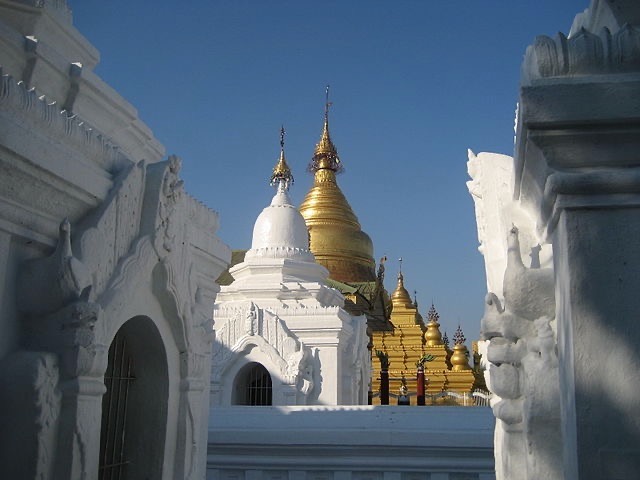
As a bibliophile it’s kind of embarrassing to admit that I’ve only just learned about the world’s largest book.  If you’re like me you’re probably imagining an enormous tome that required acres of trees and fifty-five-gallon drums of ink to print.  But that’s not it at all.  This particular book is located in Mandalay in Myanmar.  If I say it’s a religious text you might be clued in that it represents the Tripitaka, or Pali Canon.  These are Buddhist scriptures.  They are extensive, as scriptures tend to be.  I’m certainly no expert on religions in that part of the world, but it’s clear that the world’s largest book, as a monument, required a massive amount of effort to put together.  Housed at the Kuthodaw Pagoda, the texts were inscribed on stone housed in 729 stupas that are stunningly beautiful.  (Take a look for other photos online—it’s impressive!)

Photo credit: Wagaung at English Wikipedia, published under GNU Free Documentation License

The monument was completed in 1868.  When the British invaded southern Asia, however, there was much looting and damage was inflicted on the shrine.  It was eventually repaired and still stands as the largest book in the world.  It’s no real surprise that this honor would be relegated to a religious text.  Bibles of all sorts become symbols and their symbolic nature often supersedes what’s written inside.  The idea of the sacred book has an unyielding grip on the human psyche, whether we think the book comes from God or an enlightened human being.  Indeed, the sacred itself is an integral part of being human.  When one group wants to dominate another, it often goes for its sacred artifacts.  Cathedrals as bombing targets in the Second World War demonstrate that well enough.  Ironically, we’ve ceased paying much attention to the sacred but we still revere it.

Books represent the best of our civilizing nature.  They’re ways of coming to see the point of view of others.  It really is a privilege to read.  Banning books is, in its own form, a crime against humanity.  Those who ban almost inevitably end up promoting yet more sales of the offending book.  I often see books that make me angry or upset.  My knee-jerk reaction is to want to deface them—this is a human enough response.  But taking time to reflect, I realize that these writers are entitled to their opinions, benighted though they may be.  A civil exchange of ideas is essential to getting along in a world with billions of different opinions.  Every nation should have a monument that shows its love for books.


Mystical

I would never have experienced Tibetan singing bowls were it not for a family member’s cancer diagnosis.  Something you quickly learn is that many resources are available to help you cope.  One of those local to this area was/is Tibetan singing bowls.  I had no idea what to expect, but as a lifelong explorer of religion, I had gathered that the session would likely involve ways of thinking more common in East Asian cultures.  I was taken, however, on a spiritual journey.  In a darkened room with twenty-to-thirty cancer survivors, on our backs on the floor, we experienced sound.  Now, my musical training and ability are quite limited.  I could not identify most of the instruments (I kept my eyes closed), apart from the singing bowls which I had heard in other, western religious contexts as well.  I’ve had mystical experiences before, but I don’t know you well enough to tell you all about them.

Photo by Magic Bowls on Unsplash

The first thing I noticed this time was the color blotches in my closed eyes.  Everyone sees those kinds of things, but as the sounds increased the colors began to range outside their usual purple into whites and yellows.  It was almost like a segment from Fantasia.  The colors then began to take shape, some forming into flowers.  I knew my imagining mind had taken hold when images began to appear.  Although it was my usual bedtime by this point, I was fully cognizant of being awake.  There was no real storyline, but I was conscious of losing my sense of individuality and becoming part of the greater whole, which is what being a being on a small planet is all about.  As the sound meditation wound down, I realized that it had been many years since I’d put myself into such an environment.  It took some time to reorient myself.  When we arrived at home I was, paradoxically, too relaxed to fall asleep.

One of my college professors warned me against mysticism.  Mystical experiences are rare, in my life anyway, but unforgettable.  If you live long enough and pay the right kind of attention, however, you can find them.  They leave you with a profound sense of hope.  I’m not about to go off and join a Buddhist monastery, but Thomas Merton reminds us that Buddhism and Christianity are perfectly compatible.  This particular college professor was afraid, I surmise, that spiritual experience might outstrip dogged devotion to a single book.  Mysticism can take you to places that convince you what passes for reality is not all that’s real.  Being with lovely people who’ve had to face cancer is a spiritual experience in its own right.  Why shut out the light inside?


Zones of Twilight

The other day I saw a beautiful twilight moon.  This was in the morning twilight.  I suspect many people don’t realize that twilight comes twice a day.  Twilight is when dayglow either begins or ends but either before or after the sun itself is visible.  Most people are familiar with evening twilight since they stay awake until after dark.  Morning twilight, so full of hope, is beautiful to the point of being painful.  The other day it was twilight as work was starting—the days are beginning to lengthen since I’ve been starting work in the dark for months now.  A waning gibbous moon shown through a gauzy cloud cover in an indigo sky.  It was very cold outside, so I went to the window to take a picture with my phone.

The modern phone camera often misses the point.  I zoomed in on the moon—phone cameras are wide-angle, by default—and it kept sliding in and out of focus.  The sky was getting lighter by the second, and I was losing the opportune moment.  I tried moving the phone closer to the glass, then back a little.  Still out of focus.  Then I realized what was happening.  My phone was focusing on the dirt specks on the window.  (Hey, it’s winter, hardly the time to be out with the squeegee.)  It occurred to me that a life lesson was being offered.

Thich Nhat Hanh recently died.  He was a Zen Buddhist master, and his passing reminded me of the old Buddhist saying that the Buddha is not the moon but rather the hand pointing at the moon.  Religions often confuse the hand pointing for the truly sublime realm to which it points.  Worshipping the person instead of following her or his teachings is a standard feature of religions worldwide.  It is the reason for much of religious conflict.  Those who worship the figure soon come up with their own teachings that are unrecognizable when held up next to those of the departed leader.  They focus on the window, not the glowing moon beyond.  The sky was growing too light to capture the image that had struck me.  The moon was blurry in a way that my eye hadn’t experienced it.  The moment of teaching was past.  The lesson was over.  The best that I could do was spend  a long day working then try to recapture a moment that had occurred in twilight.


Change Management

Calendars fascinate and flummox me.  When I try to convert from Julian to Gregorian, or vice versa, I get hopelessly lost.  The same applies to time zones and that horror known as springing forward or falling back.  Time, as something that is constantly moving, isn’t easy to grasp.  I’m in charge of a scheduling activity at a local organization.  (Whoever thought that was a good idea I’ll never know.)  While trying to sketch out 2022, with fear and trembling, I noticed something for the first time.  In a non-leap year the dates correspond to the same days of the week for January and October.  This is also true for February, March, and November.  And September and December.  This would’ve been helpful to know, it seems, in the previous half-century of my life.  There’s solidity underlying the flux.

It was really only in the 1890s that “eastern religions” were discovered by Americans.  Our nation was so thoroughly biblicized that we had forgotten that there are other ways to view the world.  The idea, prevalent in the sixties and seventies, that we can gain wisdom from exotic religions was probably misguided.  After all, to truly understand them you need to have years of immersive experience in them.  It also helps to be a true believer.  Still, I find the conceptions of change from Buddhism and Taoism particularly helpful.  Change is permanent.  If we spend our lives fighting it we’ll be frustrated rather than enlightened.  Of course, for those of us who are chronologically challenged this isn’t necessarily good news.

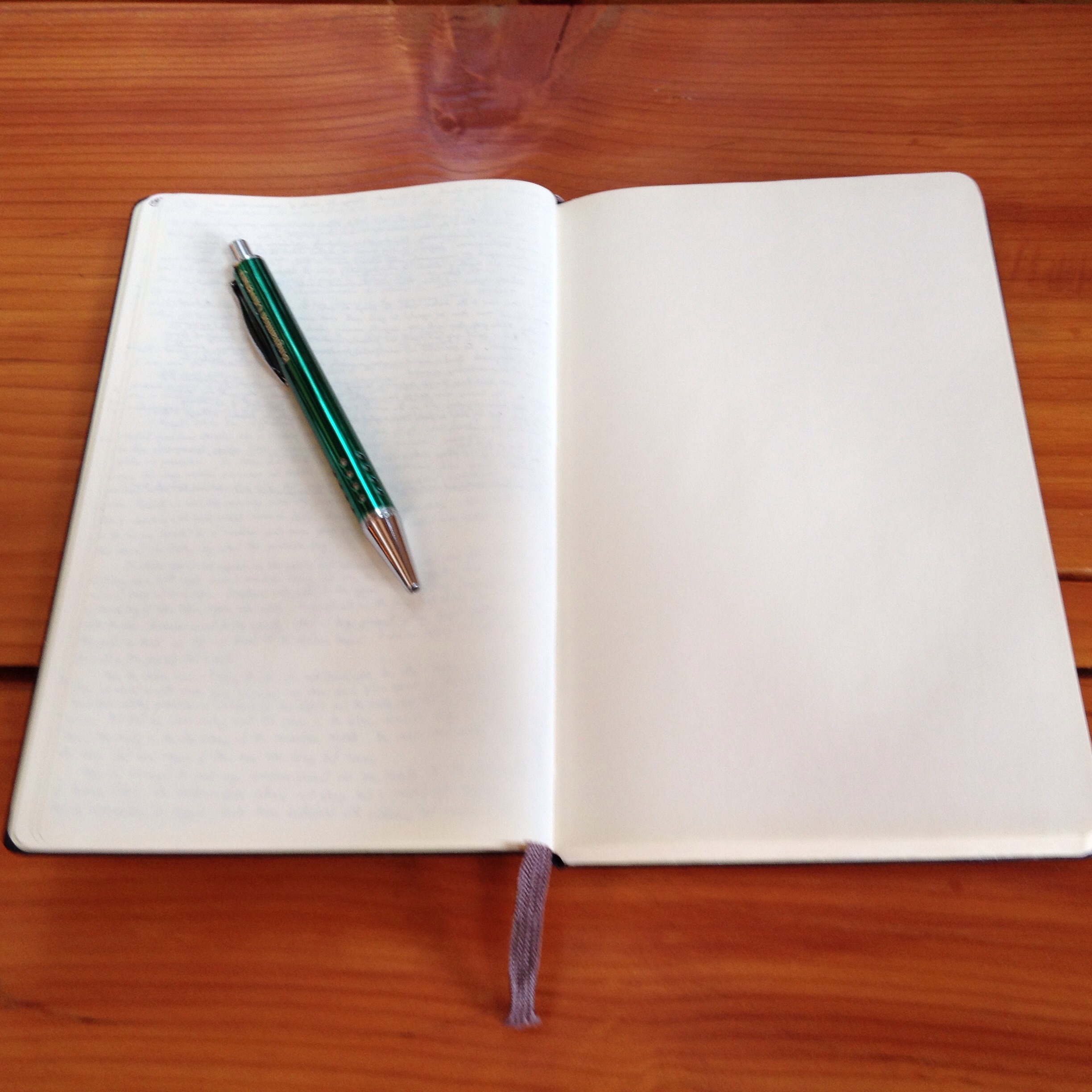
Employers are busy hiring change managers.  These people work at a pretty theoretical level that doesn’t always address the desire for stability.  Sometimes I want to say, “Hey, for the first two decades of my career change was slow, and now that I’m aging I’m being told to go faster.”  I do try to keep up, but the automobile hadn’t been invented when my grandmother was born and we were walking on the moon before she died.  Since the internet, however, things have speeded up even more as ideas are shared worldwide and we see new ways of looking at things.  We may desire stability, but change is indeed permanent.  The pandemic has changed much, and things aren’t going to go back to the way they were.  I look to the notebook in front of me.  I probably would never have noticed the correspondence of January and October if I hadn’t been writing the dates out on old-fashioned paper.


Yellow Jackets

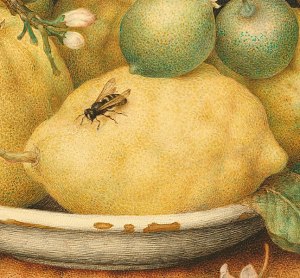
Deeply conflicted.  That’s how I feel about calling the exterminator.  The longer I’m alive the more eastern my thinking becomes.  What right do I have to kill other animals for doing just what they’ve evolved to do?  The yellow jackets who made a nest in our siding were doing just what nature directed them to do.  In what sense is our house natural?  When they started getting inside, though, memories of having been traumatized by stepping on a yellow jacket nest when I was younger came to too sharp a focus.  Terror is probably the right word.  We were catching and releasing five or six a day and summer doesn’t look to be about to give way to autumn very soon.  There’s nothing like being startled by an angry bee when you walk into a room in summer-weight clothes.  So the exterminator came.

As the yellow jackets fled into the house to escape the poison I pondered what right I had to deprive them of their lives (here’s the eastern thinking part).  How was my comfort, or my lack of terror, more important than their need for a home?  Couldn’t we peacefully coexist?  You see, I’m no fan of violence of any sort.  In my ideal world there would be no war and no meanness.  You might not be able to call yellow jackets cuddly, but they don’t seem the happiest of creatures with whom to interact.  They’re industrious, like business owners want their drones to be, but their people skills aren’t too good.  Maybe it’s just projecting, but when they swarm the only word that comes to mind is anger.  Even their evolved body armor reflects that.  Still, I didn’t want them killed.  I just wanted them not to misunderstand our human interactions while shut in during a pandemic.

Life is a gift to all creatures.  I became a vegan years ago because of humanitarian concern for our fellow creatures.  The mess our world’s in now because of our lack of care for anything but money plainly shows.  Bees, it could be argued, make more of a contribution to the well-being of the planet than I do.  Who am I to make any claim of superiority?  Still, I’m responsible to pay half my salary on a mortgage that will keep me in one location until the situation betters.  When I see that silhouette in the window a sting of terror from my childhood comes back as I grab an empty peanutbutter jar to catch and release, only to have another bee replace the first.  Childhood traumas are like that, of course.  But now I apologize for bringing on the death of fellow creatures and I walk through the rooms through which they had freely flown.


Permanently Changing

Classifying the world of thought into “eastern” and “western” is a gross oversimplification.  Nevertheless we require some handles by which to grip this unwieldy beast of mental life.  One of the first distinctions that we’re taught is that western thinking tends towards the default of permanency while eastern thought emphasizes change.  Change, of course, is the lack of permanence.  The older I get the more I see the wisdom in accepting change as the only thing that’s really permanent.  It’s a lesson you learn as a homeowner.  In my typical western way of thinking, I assume things will pretty much stay the same, but the myriad of small, external forces work constantly toward change.  The only way to keep a house well is with constant upkeep.

The other day I found a rotted windowsill that our inspector somehow missed.  That it hadn’t happened on our watch was clear by the fact that the previous owners had slapped a thick layer of paint over what was clearly a broken and decaying sill, in essence ignoring the problem.  Change, you see, is constant.  Things really get interesting when you start to apply this to religion.  Although the Bible only hints at it (for the view isn’t entirely consistent) God is considered unchanging.  The same yesterday, today, and forever.  Meanwhile everything down here is constantly in flux—changing, evolving, decaying, reproducing.  Religions of eastern Asia tend to embrace this change as a given.  Our frustration in life, as Buddhism recognizes, has its roots in attachment to permanence.  Things inevitably change.

On the one hand this is so obvious that it might appear simplistic.  But then think how we live our lives here in the western hemisphere.  Our employers hire “change management” teams.  We suppose things will return “back to normal” after this pandemic is over.  We’ve been living the cloistered life for nearly six months now and things have been changing.  Especially in the early days people could be heard lamenting how quickly information and circumstances shifted.  Change is permanent.  For the homeowner anxious about the ability to keep up with upkeep, the constant growth of the lawn and the aggression of weeds can be their own kind of trial.  At times it feels like you need to be paid just to take care of your home since it’s a full-time job.  It is overly simplistic to draw an arbitrary line from pole to pole, but it does seem that some cultures, tending toward the east of the birthplace of monotheism, have some basic insights from which we might learn.


Nothing To Eat

Some stories are unsettling to the point of spirituality.  That’s my impression of Han Kang’s The Vegetarian.  My wife wanted my opinion of it and when she used the adjective “Kafkaesque” I knew I had to comply.  The comparison is eerie in that Franz Kafka essentially starved to death because no way could be found to feed him with his underlying medical condition.  The Vegetarian shifts focus in its three parts, but the protagonist, Yeong-hye, is a young woman who finds her life run by other people in her family after she decides to become a vegetarian (in actual fact, a vegan).  Basing her decision on disturbing dreams she has, those in her Korean culture cannot accept vegetarianism and attempt, by various forms of coercion, to change her decision.  Throughout the account, Yeong-hye becomes silent—we’re never given her point of view—but those around her can’t accept her decision.

This is a challenging book to read, given my own personal history, but after scratching my head a bit when I finished it I came to reflect on this spiritual side of it.  My own vegetarianism was an ethical decision.  I realize that I can’t and shouldn’t impose my ethics on others, but I’ve not had much resistance from others (apart from colleagues who occasionally make reservations at eateries with no hint of the concept).  Likewise, I became a vegan a few years back based on further reflection of an ethical kind.  This is actually a spiritual practice.  I don’t often express it in those terms, but clearly it is.  In the novel when Yeong-hye’s brother-in-law tries to direct her life, he takes her to a Buddhist restaurant because he knows nowhere else to find vegetarian offerings.

Yeong-hye believes herself to be becoming a plant, and that leads to the next logical step in this progression of thinking.  Eating is, or at least can be, a spiritual exercise.  Many religions advocate fasts of various durations to derive the benefits to the soul.  Daily life is a matter of routine for many, often based around our culturally driven mandate of three meals a day.  I’m not alone at working through lunch while trying to get more done at my job.  By the final meal of the day I find myself exhausted.  It’s about more than food.  This strange little book has put me into a reverie about the ethics of eating.  I don’t know if Han Kang is a vegetarian or not, but she does understand the soul of one.


Diverse Colors

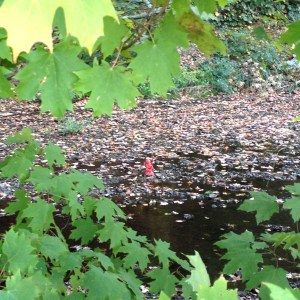
After a warm snap, we’re not at peak color here in New Jersey. Some trees have changed, yes, and leaves have begun to fall, but green prevails. While on a walk with my wife—a luxury only available on weekends with my commuting schedule—I spotted a bit of red amid the leaves on a local stream. Litter, and not just the leaf kind, is a bit of a problem in Jersey, but this splotch of red seemed intentional. It was taller than it was wide. It was standing in the middle of a shallow brook. Its placement looked intentional. What couldn’t be discerned from the bank is just what this was. It might be a Buddha. It might be Ganesh. It does seem, no matter how it’s reasoned out, to be religious.

Archaeologists often find objects with no known utility. If an artifact has no practical function such an object is generally deemed religious. For much of human history, before the madness of capitalism, people owned only the necessities. Life was hard and lifespans were short. Accumulating stuff as an end in itself was a luxury only for kings and priests and the relatively few merchants in urban settings. An object found from that time, then, with no known function, must somehow be religious. An object of cultic devotion. Those of us trained in the history of religions would sometimes laugh at this predisposition. Religion is the basket for anything that can’t be otherwise explained. So it seemed with this red statue—it was clearly human-made—standing in the stream. We were walking by a ritual site, perhaps. Maybe it was just a joke.

Then I recalled Ganesh Chaturthi, the ritual submersion of Lord Ganesh that transpired in late August this year. It is a numinously charged season, this descent into autumn. My Jewish friends have just celebrated a new year. Pagans made proper observation of the equinox. Preparations, at least of the commercial kind, are well underway for Halloween. They are all colors. Although spring’s first buds are welcome after a monochromatic winter, soon we transition into the green of summer. We miss the benefits of many colors. At moments like this on the banks of a brook with yellow and brown highlighting the green that remains on the trees, I’m again reminded how wonderful diversity truly is. I am in the presence of a god. It may not be my deity, but I’m not threatened by the difference. Nature is a patient master for those willing to attend to the lessons.


World Stories

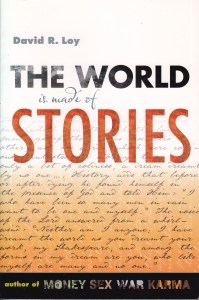
worldofstoriesAlthough I’ve not formally studied it, Buddhism has long been part of my thought process. Like Thomas Merton—and this may be the only point of comparison between us—I find little difference between the contemplative worlds of Buddhism and Christianity. Mindfulness knows no denominations. I suspect David R. Loy’s book The World Is Made of Stories would cause anxiety for some. Those not comfortable, for example, with paradox. Or those who believe that only the literal is meaningful. Separated by the vast land mass of Asia, eastern and western ways of thinking about the world—telling their stories about the world—diverged widely in antiquity. There was a kind of “rediscovery” of south and east Asian thought in the late nineteenth century western hemisphere. Since then occasional famous explorers such as the Beatles, or professional practitioners such as the Dalai Lama, have brought Buddhism’s ideas to the mainstream, but because they coexist well with Christianity there has been no cultural reason to displace them.

I found Loy’s world compelling. All is narrative. That’s the way human brains work. If you’re reading this right now, you’re following my narrative. If you’re not really paying attention, another narrative has gripped you. Science is a narrative just as religion is. It is the way we think. The internal monologue. Consciousness itself. Stories. People will follow a story quite naturally, which is one of the reasons it’s such a shame so few people read for pleasure. We can watch our stories (what is a sporting event but a narrative playing out before a fan’s eyes?) and many people do. The written story often, however, takes us deeper.

Contemplation is an endangered species. Although I found the enforced quiet days at Nashotah House (such as Ash Wednesday) to be an onerous rule, I would arrive home with little to say in any case. The world of busyness that we’ve made our business can choke the meditative spirit. Although some workplaces offer yoga sessions (themselves based on Hindu spirituality) they hardly encourage meditating at your desk. It seems the natural enemy of productivity when, in reality, it increases it immensely. Who doesn’t work better after a vacation? The business world often presents the religious life as one of indulgent non-productivity. I remember being made to feel stupid asking for one Good Friday off while working my first full time job in retail. When cash transactions grew to be too much I’d find a church on my lunch hour and just sit. Now I only find time to read Buddhist books on the bus on the way to work. Look deep enough and there’s a story in that.


Growing Up

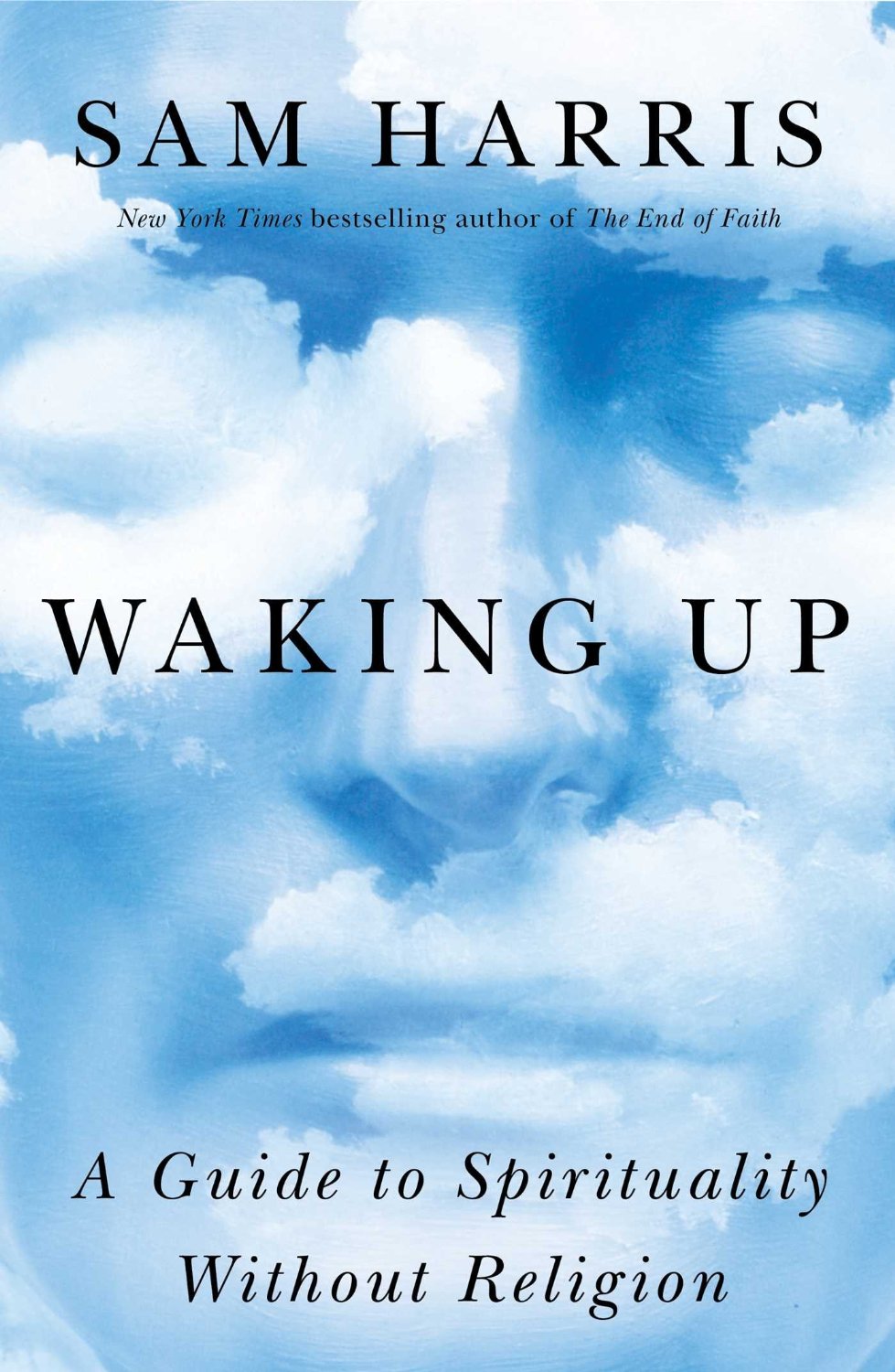
WakingUpI am in two minds about Sam Harris’s Waking Up. Literally. I haven’t read Harris since The End of Faith, and I have to admit that I found Waking Up to be a very engaging book. I can’t agree with everything Harris writes—that’s an occupational hazard of acquiring advanced degrees—but to have a scientist, an atheist no less, praise spirituality felt incredibly genuine. Spiritual experiences happen. I’ve had a few doozies over the years. I’ve also read a number of scientists who tell me they’re all an illusion. Harris admits that consciousness is a mystery. His use of “mind” instead of “brain” won me over from the beginning. I discovered that the atheist can also be a seeker. Dogmatism, of whatever stripe, is the enemy.

Harris has considerable experience meditating. This is no activity for posers or wimps. It is, despite minimal physical demands, hard work. Throughout the book we get the sense that Buddhism is among the least objectionable religions, when divested of its myths. I do wonder, however, if demythologized Christianity was ever given a fair chance. From my own experience, some of the selflessness advocated by Harris can be found in taking aspects of Christianity seriously. I understand, I think, Harris’s objections to religion. It can, and does, lead to horrors both obvious and subtle. Yet, every once in a perhaps great while, it does offer redemption. Meditation, for example, has its roots in religious practice. It is this that Harris calls spirituality. And it is good.

A Guide to Spirituality without Religion is an apt subtitle for this brutally honest and open book. Harris’s knowledge as a neuroscientist endows his ideas with great authority. He opines, and he is not alone, that meditation demonstrates that “I” is only an illusion. This loss of self will haunt me for some time. For decades I is all I seem to have. Still, I am pleased to find an open-minded scientist on this same path I tread. Raised to be both spiritual and religious set the trajectory of my otherwise logic-driven life. You can’t go back and change all that, but you can grow up. To read of Harris’s spiritual experiences in the geography of great spiritual masters as well as in the laboratory instill in this reader a profound hope. Whether or not this reader is merely an illusion. There may be morning after this long night, after all.


June Bugs

On my way to work yesterday, I came upon an overturned June bug clawing at the air, trying to regain its feet.  I’m always in a hurry getting to or from work, but I decided to stop, offering the insect a leaf to grip, and turning it back over.  I knew, as I spied birds flying overhead, that its chances weren’t good.  In the course of nature, insects are radically overproduced because so many get eaten.  In my apartment they can even be a source of sudden terror when they find their way inside.  I knew the June bug was probably nearing the end of its short time on the earth, but as I held out that leaf to it, I knew that in the act of struggling we were one.  That sounds terribly Buddhist of me, I know.  Insects and humans share, on the most basic level, the desire to survive.  Who likes to feel vulnerable—soft, unprotected underbelly exposed to the air?  Defenseless and helpless?  Certainly not this poor beetle.

Photo credit: Patrick Coin, Wikimedia Commons

Photo credit: Patrick Coin, Wikimedia Commons

Stepping off the bus in New York City, I began my daily power walk to work.  The bus had arrived a few minutes late, and my anxiety level about clocking in works as if it’s on steroids.  I have to buzz past the interesting things happening in the city, the people who merit a second look, the architecture that has an unexpected amount of detail, only to be lost in the overwhelming number of buildings.  Big buildings as numerous as bugs on a summer morning.  Then I saw a box pulled up on a low sill outside some swank bank.  I often need boxes at work, and I can’t help stopping to appreciate how this unbroken expanse of paperboard would be useful.  Then I noticed the feet sticking out the end.  There was life in this box, not so different from the beetle I’d stopped to help an hour and a half ago, in its exoskeleton, grasping for some kind of salvation.

I arrived at work agitated. I had been able to help the beetle, but what could I do for the sleeping human being in his box? I had no money in my pocket, and even a twenty would stay the exposed, raw human on the city street for no more than a few hours. To care for a person takes commitment, long-term willingness to make sure that those who fall on their backs are set again on their feet, given the resources, the opportunities they need to get along in a world where those circling above are far more dangerous than the birds in my neighborhood. I looked at my calendar. June is nearly over. The June bugs will soon disappear. And yet I couldn’t erase the image from my mind. How much relief seemed to show on that inexpressive June bug face when it could finally crawl away from the center of the sidewalk. Something was terribly wrong here. And a man was sleeping in a box just two blocks away. In the act of struggling we are one.