
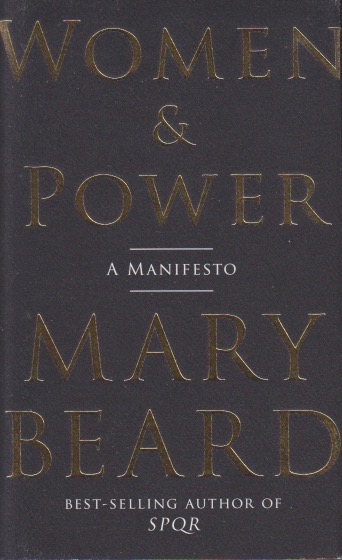
One thing we repeatedly heard during the early days of the pandemic is that people couldn’t wait for things to get back to business as usual (BAU, in corporate speak). I told others then that we shouldn’t strive for “as usual,” but we should try for something better. I got that same sense from Mary Beard’s Women and Power: A Manifesto. Beard is a classicist. She’s studied ancient Rome and earned her reputation in that area. Women and Power is the publication of two public lectures on, broadly speaking, why women aren’t ever truly allowed to share power. The first essay focuses on how women’s voices are routinely silenced, as they have been since classical times. The second essay, more akin to what I was hoping about the rebuilding of society, is that we need to redefine power and how it is ascribed.
You see, as a society we have the opportunity—mandate even—to decide what’s truly important. Electing angry old men like Trump only served to set back our progress by refusing to address the problem. The idea, and this has been true throughout history, is that what men value is more important than what women value. And we can’t assume all women value the same thing. In other words, some serious thinking has to be done. It doesn’t surprise me that some of this thinking has been undertaken by a classicist. Those of us interested in how ideas began can have insights into why things are the way they are. That won’t hand us the answer to the dilemma—as Beard says, hard thinking must be done—but it does show that we can begin to understand. Beginning to understand is the first step to coming up with a solution.
Biology, and the history of biology, has something to do with the dilemma. Childcare is a necessity and although we might be able to train brains, it does seem that women tend to have more empathy than men. History tells us that prior to the invention of baby bottles women had to be available to unweaned children to meet their nutritional needs. Meanwhile, men had to provide the social structure that made the agricultural revolution possible. As far as we can tell, hunter-gatherers (and there’s no going back to that) were more egalitarian. Beard is right—we haven’t hit an impenetrable wall. There are ways forward. Equitable ways. Different ways. We need to stop longing for “business as usual” and imagine a better future.

 Steve A. Wiggins