Words for Play

IMG_2849

Maybe you’ve seen it too.  Corporate-style psychobabble.  Memos land on your desk, whether real or virtual, jostling with neologisms, indicating the trendy new directions the business is going.  Apparently a legal requirement is that old vocabulary is vorboten in such information-bytes.  You can’t call a spade a spade—it might confuse somebody.  Do you mean a playing card spade, or something to dig with?  And do people even use spades anymore?  Why not call them loam-moving facilitators?  Isn’t that really what they are?  If you can get through a memorandum without a dictionary (slang or otherwise) you’re much more fluent in my native language than me. Or I.  I often wonder how much this has to do with an inherent inferiority complex.  A cog in this corporate machine has to prove it’s usefulness.  If nobody can understand what you’re doing, it seems, your job is secure.  I imagine think tanks as being like big aquaria, but with fewer viable ideas than captive fish.  I once read a memo that had to give each and every stage of a process a chic new name.  I felt like I needed to update my wardrobe and get a fashionable haircut just to read the thing.

Perhaps it’s just that a simply guy like yours truly prefers things explained clearly.  I can imagine a meeting taking place where nobody really understands what’s going on but they all have to nod their heads in approval for fear of feeling stupid.  New phrases, of course, have their place.  We needed a portmanteau for “telephone” back in the day, since there had been nothing like it before.  Most of my memos, by contrast, have been about plain old things that have been around for centuries.  Or millennia.  And if an old word is used, such as “idea,” it has to be in quotes.  Business must find a way of ensuring stakeholders that it’s on top of the latest developments.  Who uses a fax any more?  Most people consider email outmoded.  The period itself, I’ve read, is about to go extinct.  Still we have time to make up corporate-speak.

I work in the publishing industry, which is notoriously slow.  Unhurried attention to detail is a sign of quality.  If you want a book to be good, you need to take your time at every stage of the process.  Sure, a book can be churned out mere days after an important event, but if you read it you’ll see the corners that have been cut.  We even received an issue of Time once that had the “e” accidentally chopped off by a hasty cutting machine.  You want quality, you need to take your tim.  Adopting the newest coinage in the busyness business hardly seems a way for minting success.  Utilizing quality ideas isn’t the same as the fabrication of nonce words.  Of course, attention to detail takes away from time that could be spent making more money.  Churning out new verbiage creates the illusion of being ahead of the game.  If you need a dictionary to understand what your company is doing, perhaps it’s a good thing to work in publishing, even if you have to look words up online.


Buying Intangibles

Perhaps it seems that I’m writing quite a bit about music these days. Being a theoretical and practical failure in the practice of music, it may seem presumptuous. If I’m honest, I’d admit that visiting the site of Woodstock was kind of a religious experience for me. That experience and the fact that popular musicians from my younger days have been in the news of late compel me to analyze a bit. My wife shared a blog post on John Pavlovitz’s website entitled “Bono Called Out Christian Musicians For a Lack of Honesty. He Didn’t Go Far Enough.” The screed is both about the Christian music industry and about current trends in evangelistic super-churches that share in the glitz and glam and leave you wondering what Jesus would do. The message of early Christianity and the sixties was similar: social justice, peace, non-judgmental attitudes, care for others, love all. Don’t worry about the bottom line.

Many churches, it has become clear in this age of nones, are struggling to compete in the spiritual marketplace. Since every institution must have “product”—not books, music, reverence, or worship, but “product”—money must change hands. If you have any doubts look at what the mega-church pastors are driving. Christian bands seem not to have a social conscience so much as a desire to feel good. It’s a thriving industry, for sure. Music that makes you feel safe is delivering false promises, though. The deity thundering on that mountain might ask you to sacrifice your own son, and there could be a good, solid backbeat to that. What is the role of religion in an entrepreneurial society? It used to be that you couldn’t buy what they were giving away. Everything now has a sale tag on it.

Back in college we used to argue about whether U2 was a “Christian band” or not. Clearly they recorded on a secular label. Amy Grant, the darling of 1980s believers, matured and seemed to fall from grace. Larry Norman, never part of the establishment, died too young. Music and religion both stand, in fact, out of the reach of sticky capitalist fingers. Anything that you have to pay for is more a cheap imitation. YouTube has made all of recorded history available for all. Even mainstream churches are experimenting with tablet hymnals and virtual communion. Grace mediated through a touch screen. Debit cards accepted. The only thing that seems to be missing is that human touch. That down in the mud reality of it all. Music that had a message and that message wasn’t about supporting convention. “Upon this rock,” you can almost here the man say, “I will build my church.”

IMG_2833


Human, Nature

Wild EarthSomeone recently told me that a city blocks a certain vibration that people draw from contact with the earth. I know that vibration often sets off “new age” alarms, but this person was rational, scientific, and had grown up in New York City. I grew up in a town on the edge of the woods. We didn’t live on concrete. In fact, the floor of our shack was so thin in some places that you could see the actual soil underneath. Even our driveway was gravel. Although it was a dysfunctional family, I felt more connected to my planet back then. Wild Earth, Wild Soul: A Manual for Ecstatic Culture, by Bill Pfeiffer, is just what it says. It’s a manual for how to get back in touch with nature. Basing his ideas on those of indigenous cultures world-wide, with a healthy dose of shamanism, he explores the vibrations of the earth. I had, at times, to force myself to listen. He’s right about so much that I stayed with the narrative to the end.

Civilization comes with a price tag. A very high price tag. The rates have been set by a small group of “progressives” who operate with the idea—mistaken—that all nature is a machine. Physics, they claim, and chemistry, show that all of life is mathematical. Nothing in the universe doesn’t add up. But biology, as Pfeiffer repeatedly shows, often doesn’t. The mistake is as fundamental as it is reductionistic. Life isn’t quantifiable. Biology messes up the nice, neat system we’ve invented. Indigenous peoples, while not idealized, lived in much better harmony with the land, not over-exploiting. It was a sustainable existence. What “civilized” people wanted was more. More of everything. A surplus, in fact. Without that surplus there is no business, right? Capitalize on that!

We’ve lost touch with nature. Our “leaders” want to exploit it. Mine it, refine it, and make it “useful.” When’s the last time I looked at a tree just to appreciate it as nature? Civilization can’t envision a tree without an axe. If it grew it can be improved. Even our food has to be genetically modified because obviously nature can’t make a profit on its own. No, Wild Earth, Wild Soul hasn’t made the impact on the world it might have. I’d never have found it if it weren’t for a used book sale. That doesn’t mean, however, that it isn’t right. We need to dismantle. We are not electronic devices, as much as the internet tells you otherwise. I knew that as a child. And as my feet ache from walking over acres of concrete on my way to “work” I know it’s true. There are indeed good vibrations out there, but here they’re too deep under my feet to feel.


Map to Eternity

One of the most remarkable things about Christianity is its fascination with the end of the world. Far from being the obsession of nineteenth-century dispensationalists alone (the other Mr. Darby), the earnestly anticipated end goes back to Paul of Tarsus, the first known Christian writer. Before even a Gospel was penned, this sect was expecting the end to come any day now. It still is, at least among many sub-sects. My wife, however, recently sent me a story on National Geographic about a map collection from the 1480s that depicts a geography of the apocalypse. If you were wondering where to make that left-hand turn, this book may be for you. One wouldn’t want to drive a German mile into Hell without an indicator signal on.

The story by Greg Miller describes this late Medieval manuscript and its assurance that the world will end in 1651—talk about your great disappointment! The unknown author of the codex feared Islam almost as much as Donald Trump but instead of running for the GOP nomination he wrote a book showing just how the end would take place. Illustrated, of course. Map is territory after all. I grew up reading fundamentalist tracts that did essentially the same thing. The more progressive bits of the propaganda left out the actual dates because an earlier Miller seems to have missed the doomsday boat, along with various and sundry telltale timekeepers. There in front of me I could nevertheless unfold the future and once the European Common Market gets its tenth member—wait, what? Has yet another head of the beast been lopped off?

Maps give more than directions.

Maps give more than directions.

Ironically, early Christianities were anti-materialistic. Money was considered the root of all evil and communism was the ideal. If you doubt me ask Ananias and Sapphira. They thought long-term investment was a bit of a foolish notion—something that I have somewhat naively, if unintentionally, followed my whole professional life. You can’t be vested without three years of servitude after all, and I was expecting the Second Coming after one year. Two, tops. If only I’d had a roadmap. It’s only 1777 German miles from Lübeck to paradise, so maybe I can catch the next doomsday boat and still get there in time.


Big Boxification

When was the last time I purchased an actual book at Barnes and Noble? In a vain hope that they might have something intellectual and edgy, I stop in once in a while. If I were a faster learner I might have known that I’d leave disappointed. You see, it’s been rainy a lot around here and rainy Saturdays are perfect for book stores. But where are the good books? I’m not just picking on B&N. I stopped in Bed, Bath, and Beyond (they don’t really use the Oxford comma, but then, who had time for commas?). This is not a frequent occurrence since we rent and it’s hard to gentrify bohemian decor, but we needed a practical household item. After wandering enough aisles that I thought it was time to hire a jungle guide, I found that the choices were actually rather limited. If I don’t like what they tell me to like, well, I’m out of luck. The local stores were driven out of business, you see, and you have to like what we have to offer because we are the BIG GUYS.

It’s not just housewares. It’s everywares. We’re a big box society. Costco and Sam’s Club and SUVs to haul it all home. Once, back when paper was still a thing, I had to find some file folders. I tend to like color coding—my non-Harvard-educated mind just rolls that way. So I went to the local stationary store and found a virtual reading rainbow of options. A year or so later, strangely, more papers had accumulated. I went back and the store was out of business. A Staples had opened nearby. Everyone was going there. They offered a superfluous loyalty card—where else would you go? They had four colors of folders. Just four. In industrial cardboard boxes that mean business. I mean BUSINESS. You want choices? There’s a clinic down the road. Unless you’re female, of course.

Photo credit: Ben Schumin, Wikimedia Commons

Photo credit: Ben Schumin, Wikimedia Commons

I’m not a genius, but I can recognize repeating patterns. Big box settles outside your town then limits your choices. I consume, therefore I am. To buy, or not to buy? I am not a number, I am a—what? What am I if I’m not a consumer? A communist, I guess. And everyone knows the Bible says communism is evil. And if you need a Bible you can purchase one from Sam’s Club. To be part of the resistance, you need to buy from Amazon. What a radical I’ve become! At least at Amazon they still have books.


Mother Earth

Son, behold thy mother.

Behold thy mother.

As a planet-locked earthling, I’m thinking about Earth today. Such a quotidian planet. While I’ve been to others in my mind, this is the only one on which I’ve ever been or am likely to be. And yet there are no laws protecting it from my own species. Corporations are treated as individuals, legally. Only they’re much, much bigger and have lots more money. They can drill and dig and spew and slew all they wish. I can mutter a feeble, “Hey!” but they legally have to pay no attention. It’s like that guy with a loud device on a quiet bus. Or someone smoking too close to the door. They invade the little space you occupy and there’s nothing you can do about it. We look to our politicians to learn how to be better bullies. Our corporations look past us to the bottom line. When the planet dies, that will indeed be the bottom line.

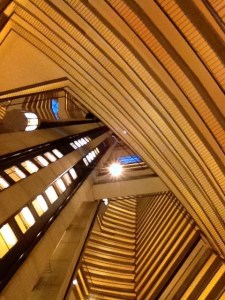
We tend to make fun of those who believe there’s other life out there. Whether sci-fi nerds or gullible believers in conspiracy theories, we tell them all intelligent life is located right here. In your bank account. Your net worth. The contribution you make to the GNP. It all comes down to numbers. As if there weren’t something magical about walking in the woods. As if all of this is just dress rehearsal for the play of getting rich. The beasts we had to fear used to lurk in the jungle. Now they brazenly drive through our cities in expensive cars with tinted windows. They build towers to defy the spacemen to come down. “Don’t worry,” they seem to say, “our money is great enough that we can come to you.” And yet, we are still left with only one planet. And it seems to be getting quite stuffy down here.

I worry about our throwaway culture, because there’s nowhere else to go. You can’t prevent me from fracking the very ground beneath your feet. Or like Martin Luther, prevent me from flying over your head. You don’t like my loud music? You don’t like my noxious fumes? I can blow my vape into the shared, public airspace if I want. Ownership is a funny concept. Our species has been on this planet for a geologic sneeze and yet we plant our flags and bray our allegiances. It takes treaties and accords for us to act like civilized people. We won’t call it “global warming” because that offends those big people called corporations. If it feels a little warm in here to you, turn on the air conditioner. If we use up this planet, we can always buy another one.


Seeing Red

Not being commercially minded, it took many years for me to understand why it is called Black Friday. To many people “black” indicates negativity, sort of the opposite of Good Friday which, when you think about it, doesn’t seem so good. After I was forced into jobs in the money-making business, I came to realize that budgets were written in black and deficits were written in red. Since my lifetime, with a few exceptions, has been a series of economic disasters following one another (the implications should be obvious) and businesses operate in the red while projecting budgets ever higher the next year. This model is, in a world of limited resources, the very definition of unsustainable, and yet we keep raising our sights and getting disappointed. Nobody knows for sure where the term Black Friday originated, but it is a modern term. A holiday for those who measure celebration in terms of dollars and cents. (Mostly dollars.)

As I was pondering this phenomenon, my thoughts turned to red letter days. Red here is a positive thing—special days on the calendar that let us step outside the usual routine of pushing ourselves to make this year’s budget and allow us to relax with family and friends. The black and the red have switched places here. In fact, red letters, apart from the dismal science, have historically been considered good. Think of the red letter editions of the Bible. These Bibles had the putative words of Jesus printed in red so that they would stand out. The concept dates back to the change of the twentieth century. Red letter Bibles caught on among Evangelical readers. Red letters, however, go back even further in history.

Who said what now?

The book that Catholic priests used to set on the altar was a missal. Missals contained the instructions for saying mass, and during certain parts of the ceremony priests were supposed to make specific gestures. The places at which these actions were to be made were printed in red to draw the priests’ attention. They were called “rubrics” since they were written in red. Missals date back to the Medieval Period and they give us perhaps the first positive use of red writing that we know. Even further back in history when inks were organic, red writing was found. Epigraphers of antiquity know of red inscriptions but the meaning at that time remains speculative. We call this Black Friday because the one percent hope to get a bit richer. Those of us further down are supposed to enjoy the trickle. For me, in principle I don’t go shopping on Black Friday. I see it as a red letter day.


To Whom? For What?

Thanksgiving remains one of the few relatively uncommercialized holidays. Not tied to a specific religion, but with a general sense that gratitude is important, there’s nothing really to sell. Grocery stores may see a bump in profits, but we need to eat every day, so this is only a matter of degree. The icons of Halloween quickly transform to those of Christmas and even Thanksgiving begins to pale next to Black Friday as companies give employees the only four-day weekend of the entire year. Without money changing hands what can there possibly be to celebrate?

The strident question of to whom one is thankful is graciously subsumed under that of for what. History has demonstrated that the relative abundance that we enjoy in matters of gustatory gifts is indeed not to be taken for granted. Droughts are realities. Dustbowls and depressions occur. In many parts of the world starvation is stark reality. Having enough—even too much—to eat is less a sign of blessing for good behavior than it is an obligation to help others. Want is a specter that no one can debunk. The homeless here in a land of plenty remind us that holidays are truly opportunities to be thankful. Thankful simply for being able to get by. Not for what we buy.

IMG_2601

Holidays have their origins in religion. They may wander far from their foundations, but we have religions to thank for every day there’s a break in the routine of trooping into the office for yet another stint of work. Days when staying home is acceptable and spending is purely optional. The stretch from Labor Day to Thanksgiving is long. This goal can only be reached by a frame of mind rather than a state of one’s bank account. Having a day when money falls from focus is cause for thankfulness indeed.


Go to, Let Us Make Brick

Next year marks a quarter century. It’s a sobering thought. A quarter century of attending the Society of Biblical Literature annual meeting. A lot has changed over the years. Much of the loss, I fear, has been of innocence. When I first flew into Kansas City, naive at 29, and still believing the world offered opportunities for those who would work hard enough, the academic job market was tight. I had no interviews whatsoever, and spent many hours in the employees’ hopeless lounge, dreaming that someone might call my name. Although no jobs came of it, I could hardly blame the academy for “market conditions” outside their control. An economy based on unadulterated greed and emulating the worst practices of the business world was eating higher education alive, from within. I had no way of knowing. For a couple of decades I attended more often than not, optimistic that the lies I’d been told might yet turn out to be false. That those who had the gifts and abilities would be recognized for what they were. I was so terribly young then.

Through a variety of roles I have continued to attend this conference for all these years. I have not seen so much hopelessness until this. Colleagues come to me, barely holding back tears. Conditions in our universities are bad and are getting worse. We have no students, but clients. The hours of preparation for the classroom are now being measured in metrics like “return on investment.” The basic vocabulary of higher education has evolved to the point that it is a new Tower of Babel. It sits on Wall Street and considers what is offered to our young as commodities. Nobody worries if they learn anything or not. The exchange of goods at personal advantage is the only way that one can exist in a market economy.

IMG_2610

The only hope any culture may dare to claim for its future lies in education. Those economies that have not suffered as much as our own are those where education is still revered. Where you don’t have to hold a MBA to speak with authority. Where truth might just be an abstract and where not all things can be measured in shekels. I have been attending this conference for a quarter century and never I have I seen despair such as this. I have to wonder about a nation that takes those highest achievers and those with the most initiative and slaughters their hopes on the altar of the angry deity of vain baubles of self-aggrandizement. We bet on futures that are no futures at all. My beard is whiter now, and my glasses stronger. I am still able to see, however, the folly of launching into the North Atlantic in early April before any kind of radar has been invented with lifeboats made only of money. I only hope I’m wrong.


City of Lights

As the civilized world struggles to make sense over the senseless attacks of ISIS in Paris, the question of where to turn emerges. An attack has taken place. Innocent people have died. We are in mourning, and we want to analyze what happened to make the world feel a little less insane. As my wife pointed out an article on CNN, I was shocked by the terms in which the attacks were described. Here I read about ISIS extending its global reach. Top leaders, we’re told, planned the attack. And ISIS is “getting into the international terrorism business.” These phrases are common in just about every business meeting I’ve ever attended. This commodification of terror frightens me. The way we’ve chosen to handle terror is by making it into a business. These are human lives that have been lost—futures of the most promising kind. Not only are we the victims of blind terrorist groups, but we are victims of a world that can’t see beyond capitalism.

Terrorism is not a business. It is evil, but in a world where religious value is never invoked outside the few who still find meaning in matters of the soul, the vocabulary has been lost. How do we deal with ISIS? Just like you would any business. A hostile takeover bid? Gather your resources, make some deals, and if retaliation takes innocent lives, well, some bonds and chattels aren’t worth that much anyway. Have we lost the ability to describe the world in anything other than economic terms? Is humanity simply another business?

Paris_SPOT_1017

I do not wish to downplay the horrible events that took place in Paris Friday night. At least 120 are dead for doing only the kinds of things people do on a Friday night. Yet there is a terror that has been creeping through the world that refuses to be named. When it feels threatened it clears out Zuccotti Park. It has taken over our institutions of higher education. It buys political offices and rewards those at the top until the rest of us become commodities. Yes, some goods are lost or damaged during shipping. We need to have a metric to measure that. And when our eyes are streaming with tears we grasp the nearest—the only way we have of describing what has happened. A new business has come to town. When terror becomes a business all hope is already lost.


Soaring Prophets

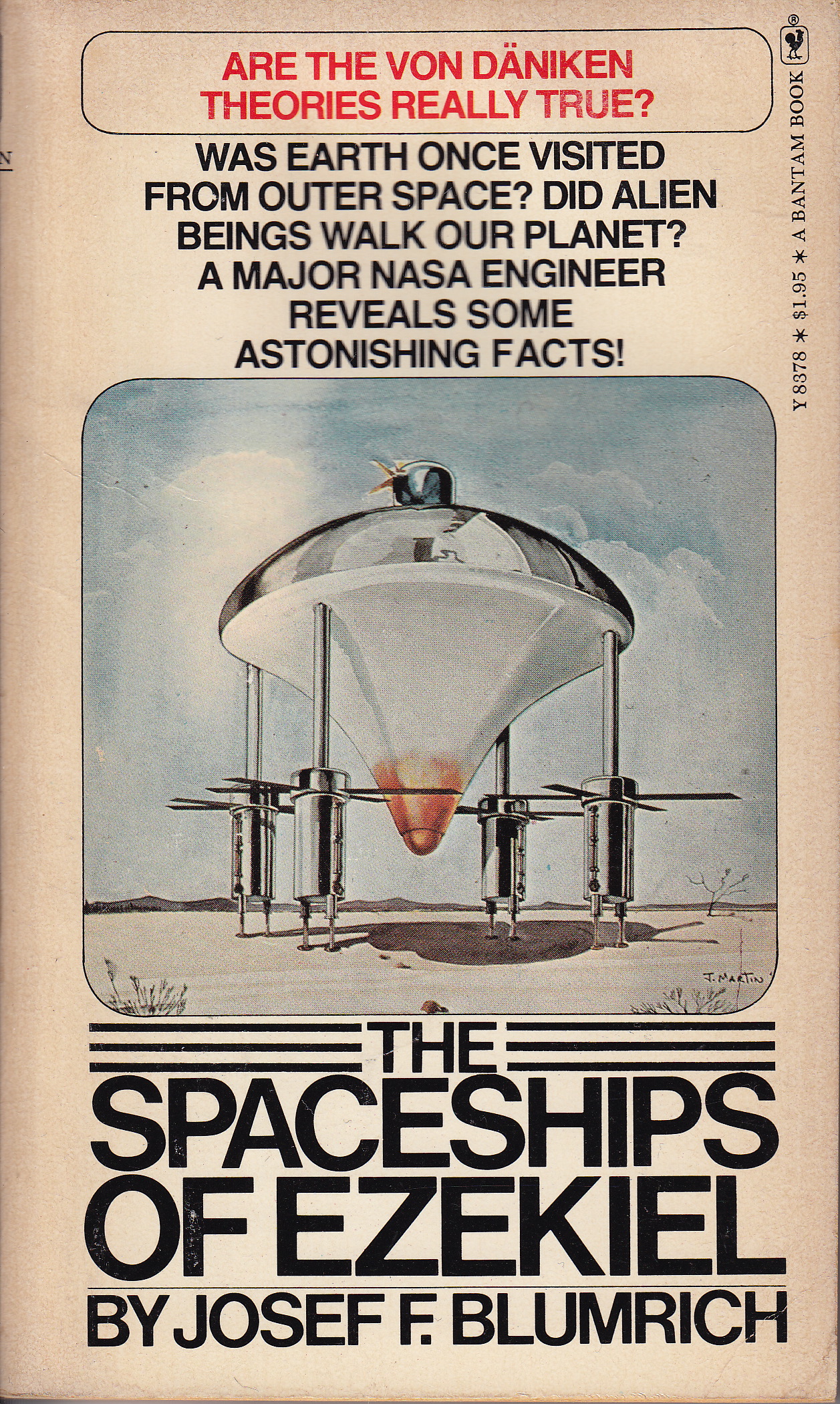
EzekielSpaceshipOkay, so I pulled the book off the shelf, and I feel now like I need to read it. Call it an occupational hazard. Josef F. Blumrich’s The Spaceships of Ezekiel, despite its von Däniken-like sales, has never been taken seriously by biblical scholars. Blumrich, no doubt a brilliant engineer, simply had no street cred among biblicists. His handling of biblical passages is awkward and he leaves out anything that really can’t be explained by his theories. Not exactly professional exegesis. He suggests, of course, that the “chariot” vision of Ezekiel was, in fact, a spaceship. The figure Ezekiel assumes is God is actually a commander of the ship and the message (which accounts for the vast majority of the book) really doesn’t matter in this context. In my earlier post, having not read the book then, I made the error of supposing that the helicopters were impractical in space. Reading it, I instantly saw my error. This was engineered as a landing craft from the mothership circling the earth above our heads. Boy, do I feel stupid now.

The overall mistake Blumrich makes is the “unforgivable sin” of eisegesis. Suspecting that he has a well-engineered spacecraft on his hands, he draws out the implications—such as the propellers—which would not be necessary, but must be there because of a “literal” interpretation of Ezekiel. Once the eisegesis is done, it can be used to explain further episodes throughout the prophetic book. The message of Jerusalem’s destruction and the hopeful prospect of a return from exile get lost in the space dust raised by these propellers. Blumrich was quite right, however, that technical people and humanities people need to be willing to learn from one another. Ezekiel may have seen something unexplained, but his function was that of a prophet, and prophets say the strangest things.

Even more odd, from my unprofessional reading, was the sense that Blumrich saw capitalism as the default economic system of the galaxy. Time and again he mentions how expensive such interplanetary travel must have been. How do we know, I wonder, that aliens like to exploit each other as capitalists do? If they are a more advanced species, surely they must have an imagination that reaches beyond one percent controlling 99 percent of the wealth to aggrandize themselves. I can imagine a society without money. A society with fair trade where everyone is cared for by medical individuals who don’t charge an arm and a leg to treat an arm and a leg. A world where doctors don’t worry about being sued by lawyers. A world where dreamers are free to dream and society values it. Ah, I’d better be careful since, it seems, I may be beginning to sound like a prophet.


Father’s Day

DadI’m not completely stupid.  I know that the Father’s Day ads with which I’ve been peppered all month are nothing personal.  They’re intended to tug at the sentimental heartstrings and get me to spend some money on dear old Dad.  As one of the generation for whom computers were a new household commodity well after college was over, I know that I’m part of a fairly large demographic of middle-age users.  I do wonder, when I see these ads, how many other readers ponder the fact that their fathers have died and that Father’s Day is an occasion as much of mourning as it is of celebrating.  While I know, dear reader, that you’re not my therapist, my father died many years ago after a lifetime of separation from my brothers and me.  I can’t claim to have known him, except in unguarded moments looking into the mirror at the blue eyes he contributed to my genetic code, along with other aspects I can only imagine.
 
Father’s Day can, of course, be a day to honor the memory of, as well as buy things for, dad.  Holidays, however, aren’t really holidays without the changing of hands of lucre.  Although I never tried to think much about it, I never spent a Father’s Day with my father.  I know I’m not alone in this, but many are the days when I believe I would have benefited from a bit more instruction than I received on that front.  “Majoring in religion is not the best career choice,” might have been one of those nuggets I could’ve done with hearing.  The women in my family seemed  to think it was okay.  Even one of my dad’s ancestors was a clergyman.  I like to think that fathers might be able, in some cases, to see farther than their sons.  Call it male bonding.  Call it being a man in a post-patriarchal world.  Call it confusion.
 
I’m all for honoring parents.  I also tend to think people are basically good and that by far the majority of people try to do what they think is right.  They may not have much with which to work, but they try.  I can also think of better ways of honoring them than spending money.  Maybe we could try restructuring society so that those who start out with little might have resources available to move ahead.  If some father’s child has obvious gifts, might we not offer a way for that child to use them and thrive?  As a father myself, I can think of nothing that would make me happier than to see my child have better prospects than I’ve had.  Instead I see a society of one-percenters encouraging us to spend a bit more since, after all, fathers measure their worth in stuff.  The stuff that really matters, at least for this father, include those no longer here as well as those who are yet to inherit.


Mother for a Day

In a world set on tearing itself apart because of its differences, there is one thing every single person has in common. We all have a mother. In societies enamored of domination and competition, we take one day out of the year to stop and remember those who gave of themselves so that we could live. We place this day on a Sunday, the most passive of days when it will not interfere with regular business. We give chocolates, flowers, fruit-baskets, and then go back to the same usual grind come the next day. At the risk of gender stereotyping here, I do wonder how much wisdom we must miss by relegating our mothers to the background.

Growing up, we all know, is inevitable. We need to release ourselves “from the apron strings” and learn to cope in a hostile world. Not only do those overseas, different from us, wish us harm, but even our neighbors become our competitors and although friendly, we look for a way to find our advantage. Motherhood is a reminder that there is another way. Families, at least ideally, are built on cooperation. A willingness to set aside our own personal agenda for that of those for whom we care deeply. Used to be that the largest families (before family became a weapon used by religion) were those best placed to succeed. You had a set of people who shared a common mother, who united in a cooperative venture. Capitalism has little room for such a dynamic. It’s “each man for himself.”

Although churches around the country will mention mothers in their services today, Mother’s Day is a secular holiday. Hindus, Buddhists, Muslims, and Mormons all have mothers. Many religious groups, however, do not. Just last week some Roman Catholic women were ordained as priests here in New Jersey. Of course, the “mother church” disowned them, as priesthood is a male prerogative. Mother’s Day is not on the church calendar. It grew out of the Civil War with the sad realization that, left to their own devices, men will make wars that pit brothers against one another. Although I am stereotyping again, I have a hard time imagining a mother who would do such a thing. Mother’s Day should be an opportunity. Not only should we thank or remember our mothers, we should take to heart what motherhood means. I can’t help but believe the world would be a better place for it.

DSCN1941


Biblical Art

Although the United States is a religious nation, according to all polls, not many Americans know about the American Bible Society. This organization, based in New York City, has been vastly influential in the history of the nation. Even more influential, however, has been the Bible itself. It pervades every aspect of life in America, whether acknowledged or not. It is an integral part of the fabric out of which the nation is cut. I used to ask my Rutgers students: if there were some unseen force that impacted your life every day in ways that you couldn’t imagine, wouldn’t you like to know about it? Of course they would! But our society has very little tolerance for actually learning about the Bible. As a story in the New York Times states, the American Bible Society had to sell its historical Manhattan property recently. I visited the site on my first trip to New York as a seminary student. Here amid the towering secular concerns of money and greed, was a building dedicated to Sacred Writ.

IMG_1272

The New York Times piece, however, is pointing to the fact that the selling of the building has led to the closing of the Museum of Biblical Art. As Randy Kennedy makes clear in his piece, the Museum was (technically will have been) dedicated to showing the impact of the Bible in secular contexts. The American Bible Society is an evangelistic organization. They arrange for the distribution of Bibles not for secular reasons, but for good, old fashioned conversion of the heathen. This set the Museum a little bit at odds with its host. The Museum, critically acclaimed according to Kennedy, is (was) generally secular in outlook. It recognized that the Bible has influenced us in ways far less than obvious, pervading into our artistic sensibilities.

Although I’ve worked in Manhattan for about four years now, I never had occasion to nip into the Museum of Biblical Art on a lunch break. (Lunch break? What’s that? Money takes no breaks.) This is unfortunate. It seems that the message I had been trying to pass along to my temporary charges was being openly displayed here for New York society to see. Little do people realize, I suspect, that the principles of capitalism—the very system that transfuses the lifeblood into the city—developed out of biblical outlooks on private property. Not that the Bible itself is capitalistic, but it gave a society the basis to develop a form of thought that is, honestly, quite foreign to the biblical outlooks themselves. And ironically, the American Bible Society will continue, even though its intent may be less in keeping the spirit of the very book whose impact the Museum attempted to display.


Post Script to Art

At work Christian Century is a magazine that sometimes lands on my desk. I suspect the book reviews are the main reason for this, but I like to skim the headlines to see what the more progressive, popular periodical has to say about the world. I always glimpse the news in brief section, and quite often the quotes of the week are poignant. This past week I read one from Paul Simon, who was speaking at Princeton University. The quote ran, “We are living in an anti-art age. The world is now a brutal place and obsessed with speed and wealth.” I found my head nodding as I read that sentiment. While I was a little too young to be aware of Paul Simon’s considerable contribution to popular music while it was happening (although I was old enough to appreciate Graceland when it came out), I nevertheless listened to Simon and Garfunkel during college and beyond, amazed at the depth and accuracy of Simon’s poetry. Here was a true artist.

What a difference half a century can make. I find myself not recognizing the world that I took for an assured thing as a child. Drawing back to get some perspective—which is something I think Paul Simon would appreciate—I think about the world without technology. Other species, for example. The behavior of, say, deer is the same today as it was when Europeans first invaded these shores. While deer still wander out onto roads in their natural quest for food, we race at them in heavy machines that leave them dead and twisted grotesquely at the roadside. Deer may not have the mental capacity to think, “hey, there’s fewer predators than there used to be,” but they are frequently brought into contact with a technology that is so nineteenth century, and the result is fatal. Where has the artistry gone? The deer remain the same.

I read a lot of older stuff. When I see the literature that was clearly published for its beauty of language and artistry, it brings a tear to my eye. We don’t publish work like that any more, unless it can make money. Everything has become a calculated capital venture. If you can’t make money off it, it’s not worth doing. When I was stressing out in college over exams, I would sometimes put on my old Simon and Garfunkel records and listen to the deep and complex lyrics to “Mrs. Robinson,” or “Bridge over Troubled Waters,” or “The Sound of Silence.” Despite the angst, this was a world that had a place for beauty for its own sake. It’s not just the music that’s changed since then, because I knew that I was listening to the words of a prophet. And prophets only appear when there’s trouble ahead.

Graceland