Alien Jesus

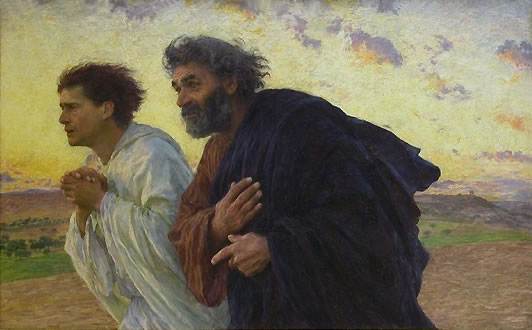
While trawling the internet over the weekend, I came upon an interesting article that ties together religion and paranormal belief. According to ADG, a unnamed woman (already the question marks erupt) in Galilee in 1967 was visited by aliens. Instead of photographing them, as most unnamed women would, she followed their instructions to point her camera at the lake (Sea of Galilee) and snap one for the album. When she turned back around the aliens were gone, and when she had the film developed there was a picture of Jesus and a disciple or two, walking along the sea in earnest conversation. Well, one doesn’t have to be a scholar of Tobit to spot the apocryphal, and this obviously bogus story received far more hits than any of my posts do. People are fascinated by the concept, even though most of the comments show some healthy skepticism.

To me the fascinating aspect is that religion and paranormal topics hold hands so easily. That is not to suggest they are the same thing, but rather that they are both perhaps directed toward a similar goal. We find ourselves in a cold world, often. There are cruelties, atrocities, and a disheartening lack of care for others. We want to believe that somebody out there has got our backs. Is it so different to believe that God dwells in the sky than to believe that aliens do as well? What is more important than the putative fact of such celestial dwellers is the belief in them. Our minds, no matter how we may protest otherwise, are perfectly well aware of their own limitations. We can’t know everything, and so we must believe.

Many of us find ourselves in an uninspiring cycle of work, sleep, and work. Sometimes we actually even do sleep, too. Cogs in a capitalistic money machine, we leave our weekends free (sometimes) to pursue a little meaning. As much as some may castigate religion, we should not forget that without it we would not have the weekend! For a little while we can break the meaningless cycle, the treadmill upon which we heavily thump our way through five days out of every seven. Is it any wonder that so many want to believe that, like Calgon, aliens might come to take us away from our drudgery? If that doesn’t work, there’s always religious services. All you have to do is point your camera and believe.

BurnandJeanPierre


Arduino Anything?

Before my daughter enrolled in college I’d never heard of an Arduino. Since her high school robotics team leadership has now passed into more able hands, I figured that I’d go back to my naive days of not thinking about automated mechanical devices, devoting my gray matter to grayer matters. Still, over the past several weeks robots keep seeking me out. A spread in Delta’s in-flight magazine for July featured robots, as did an alumni magazine for August. Now the issue of Time for September has a story about robots. When my daughter sent me the Arduino video, by TED, I knew I’d better try to pay attention. Technology will change us, whether we want it to or not. It seems that from the first knapping of flint our destiny was set to manipulating our world and making it into something we create. Robots make us gods.

Arduino_Uno_-_R3

The real issue, however, in the TED video is that Arduino is open-source. Open-source means that the designs, instructions, and application of the device are voluntarily not held under copyright. Academics throughout the world are increasingly favoring open-source material—not just software and hardware, but the knowledge behind them. In my work at a for-profit (i.e. “commercial”) publisher, I know that open-source is a huge concern. It used to be that open-source, that is, free—information, was considered inferior. Like the early stages of recycled grocery bags. Arduino puts the lie to that supposition. An international team has made a device that is extremely flexible in application, and is giving it away. Many academic journals, traditional cash cows for the publishing industry, are now going open-source. Those of us who research and write don’t often do it for money—we just want our ideas shared. Commercial interests, however, are heavily vested in turning a profit from information. It is a clash of worldviews.

Never one of the great capitalists, I find open-source an intriguing concept. The problem is that those who think need to find a way to make a living in a society over-awed by spending. Universities charge tuition because professors have to be paid. Publishers charge a week’s wages for textbooks because editors have to be paid. Knowledge—the most valuable commodity people possess—fits uneasily with entrepreneurial ideals. This blog is open-source. Maybe that is why it has never garnered much attention, like a first-generation recycled paper bag. These same ideas, however, when presented in the context of university classrooms were subject to fees of thousands of dollars. Registration filled up every semester. The source is the same, a guy with a Ph.D. from a major research university making observations about how religion impacts each and every one of us, often in unexpected ways. Some things you can’t even give away. Well, if trends continue I shouldn’t be surprised if someday even this is taken over by a robot. Right, Mr. Čapek?


Hire Education

Physicians are trained to notice symptoms before a condition becomes fatal. That’s their job and our society pays them well for it. Who wants to die? “Where your treasure is, there will your heart be also,” a very wise person once said. If we had a physician to look over the health of the nation, I would tremble at the diagnosis. A colleague just reminded me of this by pointing out Un-Hired Ed, an infographic that reveals the chart the doctors don’t want the patient to see. My daughter is starting college. Long ago, however, we gave her that talk that parents give their kids—you know the one—the beware of the lure of higher education talk. As Un-Hired Ed points out, our society has been putting on weight: universities consume far more doctoral candidates than there will ever be jobs. I speak from first-hand experience with an earned doctorate from a world-class research university and a list of solid publications, in saying that the prognosis is distressing, likely fatal. I spent nearly a decade of my “best earning years” functionally unemployed because I was “overqualified” for job after job after job. How many people don’t even rate an interview to become a meter reader for the electric company? Well, with the unending awarding of doctorates, that, like the national cholesterol level, is sure to rise.

Universities have turned greedy eyes towards the profit margins of businesses since about the 1980s—those years of “me first” that have plunged us into an economic dark age. Salaries and privileges skyrocketed and so did college enrollments. I worked at a university that was seriously considering a “Marina Management” major. To cover all the additional courses that universities must offer to “educate” the vast numbers of students, they face a financial brick wall. College presidents expect to earn a certain (unrealistic) salary, and football coaches deserve even more. Stadiums don’t come cheap, you know! So they hire adjuncts; Ph.D.s who are functionally unemployable, and pay them less than the janitors. Woo-hoo! We’ve beat the system of fair compensation and it has only cost us the livelihood of those whose professors encouraged off to grad school because they were the best and brightest in the class!

“Like lambs led to the slaughter,” as the saying goes.

Can higher education be redeemed? I have to believe so. You see, back in the Dark Ages some of the theologically literate began to congeal into clumps of readers and writers that eventually became universities. They valued learning and passing that learning on so that, like the physician, society might heal itself. And it did. Bologna, Oxford, Paris, Cambridge, St Andrews, Edinburgh—lights began to shine in the darkness. Then business models assured our great institutions that more is better, and doctorates spread like an unstoppable disease. Society’s interests had moved on. Who needs higher education when there’s something really entertaining on YouTube? Prognosis: chronic obesity. Don’t you agree, doctor?

Un-Hired Ed: The Growing Adjunct Crisis
Source: Online-PhD-Programs.org


Great Caesar’s Cost

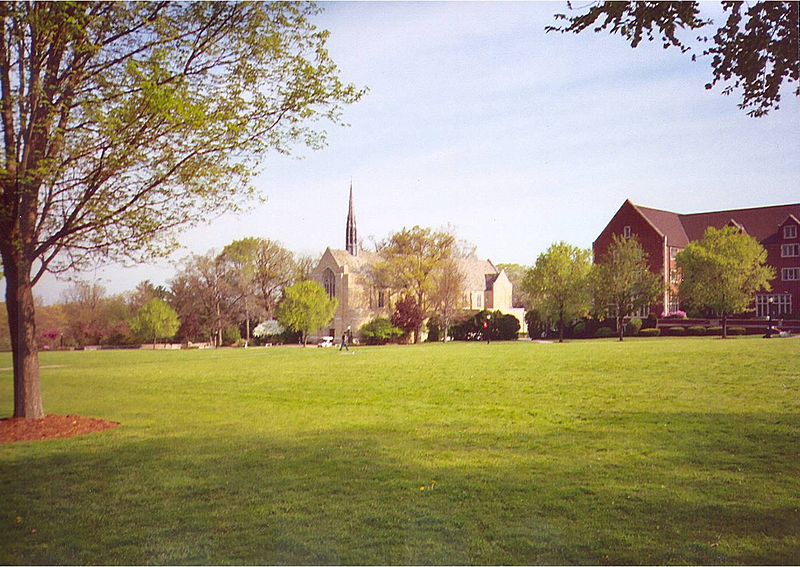
College has been on my mind quite a bit lately. Thinking back to my own experience, I chose a school, as a first-generation college student, based on what I knew at the time. It wasn’t much. I chose a school close to home, and safe. A place friendly to, in what I believed to be a world in open hostility to, “Christianity,” by which I meant the conservative, Evangelical variety. The school I settled on, Grove City College, was at the time a selective school. This was the early 1980s and the “Religious Right” was just beginning to appear on the political horizon. Grove City was a Presbyterian college, and the Reformed, although sometimes theologically conservative, have generally been a bit more socially progressive. I recall the admissions numbers being trotted out to the incoming class, about how elite we were (something I’ve always denied and find personally objectionable) at having been admitted to a selective, private enclave such as GCC (“God’s Country Club” as it was locally known). Many of the kids did come from monied families, but I was there on the basis of government subsidized (and unsubsidized, as if I knew the difference) loans.

When my daughter was considering colleges she had been warned about Grove City. One of her friends was contemplating it, but soon wisely cast her thoughts elsewhere. Nevertheless curious, I picked up the Princeton Review’s The Best 376 Colleges, a kind of Bible for the collegiate-bound, to see if my old alma mater rated a mention. Sure enough, Grove City was present. For those wishing to make it in the heartless world of business, it can be a good training ground. What caught my attention, however, was the acceptance rate. According to the 2012 edition, 74% of applicants were admitted. So much for selective! This figure swirled around my gray matter for some months as I started to sort out the implications.

Over the past few decades, Grove City College—which was always conservative—has allied itself closely with the posturing of Tea Party types. Herein lies a true dilemma for the educated bourgeois: how to be intellectually progressive and socially repressed at the same time. To accomplish this difficult trick, a non-negotiable bedrock is required, and since even the earth is spinning crazily on its axis the only true solidity in the universe is religion. Claiming that, despite the 14.5 billion years of this universe’s elapsed lifespan, only one thing never changes and that is a particular interpretation of Scripture, you can go ahead with your science and your arts. But most of all, with your business. Although black holes may exist, and textual criticism may indicate Scripture has its own gray areas after all, nothing counts much at the end of the day if you don’t have capital to back you up. Open admission policies can be interpreted in more than one way, depending on your point of view.

Photo by "the Enlightenment"

Photo by “the Enlightenment”


Lower Education

Many people have asked me, as a former professor, why universities are so expensive. Ironically, many of these people are in flourishing businesses where the story ought to be as tired as the excuse that’s usually trotted out: faculty are paid too much, mismanagement, etc., etc. The truth is much more insidious and it begins with governments and corporate executives who can’t handle the sharp sting of criticism. I have experienced this firsthand, and unlike many academics, I have an authentic blue-collar background so that my perspective is unclouded by generations of privilege. I recently found this post on The Homeless Adjunct, and I was glad that someone is actually willing to write the truth. The high cost of higher education is because a subtle series of changes—often deliberate—that have been instituted since the 1970s to change colleges and universities into engines to power capitalistic ventures rather than to educate potential critics. Those who have a hard time accepting conspiracy theories may be disturbed by how well documented this development is.

I realize that I am a mere proverbial voice crying out in an even more proverbial wilderness. The fact is, this change in higher education, implemented since the era of protest that was the 1960s, goes on without the knowledge of by far the majority of university faculty. They still tell their promising students to continue on to graduate school, that the bottleneck that has been holding up new, or even replacement, jobs is bound to burst. Things will get better. Not. As the Homeless Adjunct points out, corporate interests now run the universities, sucking up their prestige like bloated vampires, while endorsing their own manipulative interests. How can “educated” people believe global warming is a myth? Get corporations who “oppose” global warming to fund science programs and see what happens. The truth becomes quite malleable when lucre is involved.

Even more chilling, as our brave adjunct reveals, this model has begun to filter into high school, and down to Kindergarten. The way that educational decisions are made is based only, always, and ever on the bottom line. Not for our children, but for corporations that decide what our children can, and more importantly, can’t do. Their future is being undermined.

catalog

As a former adjunct who went blindly through the system, ending up with a doctorate from a major European research institution only to fall afoul of a thickly entrepreneurial administration, the clouds were wiped clean out of my eyes. I believe in higher education. And I believe that those of us with any moral sense are obligated to take it back. We will likely be destroyed in the process, since money is the only value our society recognizes, but if we want a world where our children can thrive, education must be true education.


Ruby Tuesday

If you’re reading this, you survived Cyber Monday. Not that I personally remember the Middle Ages—I have no desire to return to them—but there was a time when nearly every day of the year was known by a saint’s name. Even as an Episcopalian, nominally Protestant, I was surprised just how many red letter days there were. Black letter days seemed special by comparison. Now, however, our days are named by the shopping expectations. Not only do we have Black Friday and Cyber Monday, we have the moveable feasts of “shopping days before Christmas.” And many other holidays participate in this bonanza dedicated to Mammon. Halloween is a major cash-generating holiday and Valentines can be counted on for buying love. St. Patrick’s for buying green with gold. Ironically, all of these were once, at some remote time, holidays decreed by the church. Many of them are even older than that, going back to pagan times, but religious nonetheless.

In a sluggish economy such times are indeed anticipated. Still, I don’t hear of the one percenters suffering during these difficult times. “Let them eat cake,” Marie Antoinette once was supposed to have said. Cakes are celebratory desserts, of course. We make them everyday occurrences with birthdays that should, in theory, keep the river of cash flowing all year long. The great corporate cathedrals require the offerings of the average citizen, and they insist on far more than a tithe. Then the investment firms complain that people don’t think ahead and save their money for retirement. We see many who live long enough to experience want in their declining years. There should be an app for that.

I wonder if there is something much deeper going on. Those who run so fast usually have something from which they wish to hide. There is the story of King Herod who, according to popular reconstruction, tried to buy the favor of his subjects by monumental building. Herod was not a popular king, and he had a reputation for being bloodthirsty when enraged. It is difficult to verify, but the basics of the story still ring true; when his way of running society was threatened he decided to kill the innocents. Such stories, one might hear a pontiff declare, fall within the genre of the folktale, the story told to make a point. What might that point be? Might it not be that each day is itself a gift and that spending money is not the only way to make time sacred? Of course, as long as you’re online, why not just PayPal your way to true happiness?

A techno-log on Cyber Monday.


Dreaming of a Black Xmas

By my best reckoning, Thanksgiving has not yet taken place this year. Since Halloween, such as it was, is now over, we must still be in November. As I was exiting my office building last Wednesday, I noticed that the holiday tree was already going up in the lobby. A few blocks away and I heard the first Salvation Army bells of the season and shouts of holiday cheer. The great tree in Rockefeller Center was being erected. (I picture burly guys with a super-sized tree stand swearing in the cold air—”Left, nudge it to the left!”) Maybe it’s just a storm-weary city glad to be rid of Sandy, but it does seem to be a bit early to me. Holidays, in any modern sense of the word are about opening wallets and injecting cash into the system. The very corpuscles of capitalism. I enjoy holiday cheer as much as the next guy or gal, but I don’t mind waiting for it to arrive. Antici-

Holiday seasons are as old as holy days themselves. In our work-obsessed culture, however, convincing bosses of the regenerative utility of granting more than a single day off at a time is an uphill battle. Productivity is what we’re all about. And so we lengthen our public show of holidays instead. Thanksgiving’s not much of a banker except for grocers, and although turkeys may make great primary school decorations, they don’t really match the productivity and professionalism that corporate offices like to promote. The December holidays, however, give us Black Friday. Listening to the news over the last few days, it is clear that many people are biding their time, already ready to get those distant family members out the door, and let’s get those bargains! pation.

Holidays reflect what we hold sacred. I’m not one of those purists grinches who see gift-giving as some inherent evil—in fact, giving things away is one of the under-utilized tenets of most major religions—but I do wonder how much of it is an appeal to the ego. I feel good when I make someone else happy. Yet at some level, I’ve indebted them to me. I’ve made a business deal. The holy days have been infected with capitalism. Warm memories of not having to go to school for nearly two whole weeks, being with my family—the place I was unquestioningly accepted—and getting presents as well? What could be more sacred than that? But I’m getting ahead of myself. It is still mid-November. After all, Black Friday (and what’s that day before that called?) hasn’t even started yet.

A waif in a manger?


Babel’s Gate

Up north past Edinburgh, beyond the Cairngorms, on the shores of the chill North Sea lies the village of Cromarty, Scotland. A death occurred in Cromarty, according to CNN earlier this week. And why would CNN be concerned with a single death in a small village in a remote corner of Scotland? Because with Bobby Hogg’s death, his language also died. Hogg was the last speaker of Cromarty. Having lived in Scotland for over three years, I heard many an impenetrable accent, but even as I strained to understand, I loved it. The loss of Cromarty is part of an on-going, world-wide extinction of languages. Sure, the big ones survive, thrive even. The small ones pass away, often forgotten. Those who unabashedly champion “progress” take no time to mourn the passing of the idiosyncratic, the individualistic, the non-conformist languages. Dominoes are easier to stand, after all, if they are all a uniform size and shape.

I taught Hebrew to my students for many years. Those who wish to be clergy should be able to read God in his original tongue, it stands to reason. As complaints began to simmer, as they always did, at the difficulty of learning a semitic language, I liked to remind students that a language is far more than a collection of vocabulary and a smattering of grammar and syntax. Languages are worldviews. We don’t know who invented language, but we do know that it evolves more rapidly than biology, once human populations are separated. As in the case of Cromarty, languages often reflect lifestyles—they preserve the words and phrases necessary for distinct ways of life. Automation, however, prefers one-size-fits-all. Those who can’t understand are less efficient players in the colonialization of the world by capitalism. Languages allow for diversity and specialization. Cromarty was the language of fishermen.

Yes, multiple languages reduce efficiency. You don’t have to read too far into your Bible to discover that. Yet even efficiency comes with a price. Year by year, the cacophony of human expression becomes more uniform. Yesterday there were a thousand languages, today only nine-hundred-ninety-nine. Yarns were spun in Cromarty, just as surely as they were in Hebrew. Young ears will never hear that ancient language, and with it a way of looking at the world also died. Yawn if you will, but if all the minor languages disappear the one remaining worldview will be all the poorer for it. Yiddish to Aari, languages reflect who we are—and Mr. Hogg’s passing is a loss to all humanity.

Do you hear what I hear?


Watch, and Pray

Religion is a lucrative business. There is likely a deep, evolutionary urge for fair play nestled somewhere in primate DNA. Monkeys and apes seem concerned about it, and certainly nothing gets people more upset than a cheater who does prosper (unless he, less often she, is the protagonist of some gangster movie). Most of us work pretty hard to make a living, often doing tasks that push us beyond our comfort range in order to ensure some kind of success. The same is true of clergy. Yes, stories of lazy or lackadaisical ministers abound, but many work long hours under often stressful conditions. Most are not paid very well. Their eyes, according to unwritten writ, are turned toward a larger prize. In an economy that has become a nearly universal capitalism, everything has a price. People want to feel that they are pleasing God but there are oh so many rules and regulations! The Hebrew Bible alone has 613, and then add the Christian Scriptures and two millennia of ecclesiological dogmatism and you’ve got one hefty bill. We don’t mind paying a bit of that for a religious specialist to take care of the details while we get on with the real business of life.

Now add a little math. How many people does it take to add up to a small fortune? Already by the Middle Ages the Catholic Church, really the only show in town across Europe, had amassed a real treasury. Although individually the clergy could claim to own nothing, collectively they were flush. Even today the wealth (and therefore power) of the Vatican is nearly beyond comprehension. A colleague recently pointed me to a story I had missed back in April. This involved the computer age and lucre in an unexpected place. Russian Orthodox Patriarch Kirill I was photographed sitting at a high-gloss table, wearing a Breguet watch valued at $30,000. There was an outcry. The Russian Church, long under the pressure of a communist state, could hardly be described as opulent. Well, liturgical vestments and accouterments are expected to be costly, but personal items such as watches, are expected to be modest. Thirty-thousand dollars is a lot of money to be reminded of when to show up for mass.

In response, some church leaders turned to technology for a solution. The watch was Photoshopped out of the picture and, as if a miracle, the scandal disappeared! Except they forgot the glossy tabletop—the reflection of the watch, like Dorian Gray’s portrait, remained as evidence. (The story may be found here, along with the damning photos, if you can stand the snarky writing.) Owning such a watch may be considered bad form among the humble clergy, hiding it, however, is even worse. I don’t mean to single out Patriarch Kirill—the Russians have had a pretty rough go of it, what with Stalin and Reagan and all—but religions seldom like to have their coffers examined. The laity will pay handsomely to avoid the extra work salvation demands. Herein lies the rub: salvation has become less tangible as material wealth has expanded. Many people have mistaken one for the other. It’s just that they don’t want to get caught enjoying a little too much of the one at the expense of the other.

Now watch this, for time is fleeting


Pack on the Back

One of the joys of corporate culture is receiving office memos. Of course, memos are now electronic and our environment hopefully benefits from that. A couple weeks back a memo announced Operation Backpack, a charitable cause. Fully employed for the first time in what feels like an eternity, I signed up to contribute. When I read the memo through, however, I was shocked. In New York City 11,000 children attend public schools from homeless shelters. Eleven thousand. The number is still large enough to boggle my blue-collar brain. That is over eleven times the size of the town in which I grew up. And that’s just the children. Urban culture has become the predominant paradigm of capitalism, but it comes with a considerable price tag. I see homeless people foraging through garbage for food—a more degrading example of picking berries and nuts in the woods, I suppose. What’s worse, nobody seems to think this is unusual or distressing.

A frequent visitor to university campuses, I am familiar with urban troubles. The low land values around tax-free campuses mean that many universities abut the harder neighborhoods in our cities. The city is considered the epitome of civilized living—humanity removed from the dirtiness and wildness of unpredictable nature. When did it become okay to forsake those who came to cities to make a living? How can one of the most affluent cities in the world let 11,000 children live in homeless shelters while others in the same city have far too much to satisfy any individual’s needs? We send troops to other countries to liberate them from oppressive regimes, mistaking free trade for freedom. We need to help those who cannot help themselves.

The biblical ideal of a just society is not one without wealth, but one where wealth comes only after everyone has enough. Yes, there will be some who take advantage of the system. I wonder, however, if not working is any different from taking advantage of the system on the other end—to “succeed” in a culture driven by the market, you must take advantage of the system. One kind of taking advantage means getting by with basic needs and services met, the other kind of taking advantage means living the life of royalty in a democracy. One we excoriate, the other we emulate. I don’t have the answer, but I do hope that a backpack of school supplies will make a difference in a young idealist’s life.

Still so far away…


The Times they are a’Chanin

Across from Grand Central Terminal in Midtown Manhattan rises the Chanin Building. Named for Irving S. Chanin, the tower is no longer easily picked out among Manhattan’s dizzying skyline, but the building is a monument to the humanistic spirit that was beginning to flower in the 1920s between the harsh realities of the world wars. Outside the building, above the ground floor shops, runs a bronze frieze that still catches the breath of visitors who stop to stare for a moment or two. Interestingly, the frieze is a monument to evolution, showing the development of “lower” life forms among the water flourishing into birds and fish. Although prosperity gospelers would object to its inherent Darwinian message, they would appreciate a huge monument to the triumph of capitalism in Chanin’s dream, as much of Manhattan reflects.

Antipodes are a fact of geography and human understanding. It would seem that they are also a paradigm for those who “want it all.” Perhaps it is ironic in coming from a Disney movie, but I’ve always found Mary Poppins’ maxim apt: “enough is as good as a feast.” Indeed, leaving the table after eating more than I need I feel miserable and disgusted. There is only so much that people can have, and this is a matter of physics as well as biology. If God wanted us to be wealthy, why didn’t he make us that way? (Surely the God who promotes personal wealth must be male.) Evolution and capitalism could be a dangerous mix should we forget that evolution is not goal-oriented. Natural selection works by trial-and-error, only the trial isn’t planned or intelligent.

This dialectic reminds me of that old chestnut, Beneath the Planet of the Apes. Ursus, the gorilla warlord, gives a jingoistic speech concerning the Forbidden Zone. “It is therefore our holy duty to put our feet upon it, to enter it, to put the marks of our guns and our wheels and our flags upon it.” Of course, this second, lesser installment of the Planet of the Apes movies raises the entire specter of nuclear war to a disturbingly sacred level, but that’s a topic for another post. What I notice is the full circle of evolution here—not just human to ape, but human to capitalist ape. Apes that wish to own and control their entire world, including that region where, in the original movie, both ape and human fear to go. It should not surprise me to see talking apes in Manhattan, but then again, it might just be the bright sun reflecting off the bronze of Irving Chanin’s monument to economic growth.


For the Love of Gold

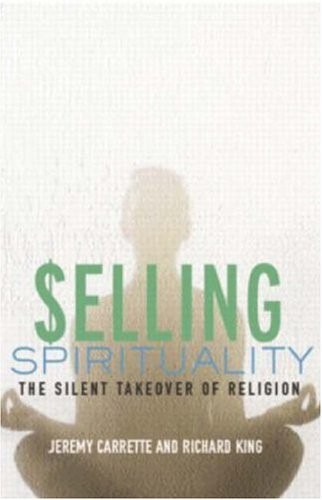
Do you ever get that feeling that you’ve been led along by a false premise that has gotten out of hand, like a practical joke that has gone too far? If I had to rate the books discussed on this blog in terms of urgency, Jeremy Carrette and Richard King’s Selling Spirituality: The Silent Takeover of Religion would top that list. I’ve felt for a long time that something’s been wrong, but I didn’t possess the training or resources to discern what it might be. I think Carrette and King may have named it. Just a few pages in and I knew there was profound insight here. Religion has been taken over by capitalism and the result is that alternatives to the godless, sanctified free market are rapidly disappearing. In a truly Orwellian sense, we have been taught the language of capitalism and have lost the ability to frame our ideas in any other way. Free markets take no prisoners—one must assimilate or die. Religions, which had traditionally served as correctives to selfishness and greed, have been co-opted into the forces of unbridled gain for the few. Amorphously marketed as “spirituality,” what sounds like religious conviction now lives in the service of consumerism.

By slowly shifting all our language and metaphors into those of Reaganomics (the very fact that you know what that means shows how far gone we already are) the capitalist machine, supported by the flaccid terms of spirituality, has established a new god—capital—and has pilloried any who dare question it. Think of the trashy phrase “prosperity gospel” for just one minute and you’ll see what I mean. Those of us who disagree with the orthodoxy that meaning can be found in money have become the resistance in a war we did not start. The twin hellions of privatization and corporatization have sunk their fangs deeply into the jugular of society and its old-fashioned value of caring for others. People are, like strangers in a strange land, just marks for the powerful. We’ll buy anything if it looks attractive enough.

The problem with consumerism is that it is easy. We all love to play along because—who knows?—we might end up getting rich in the process. We have gained the world and lost our souls. Carrette and King show clearly how entrepreneurs have learned to market the language of religion while divesting it of its venom. Go along, it urges, everything is fine. Even the economic collapse brought on scarcely two decades after Reaganomics has failed to convince the average citizen that they are but a petroleum bi-product to grease the unrelenting gears of commerce. Anything, even salvation, can be sold. Back in April I stood beside the graves of Eric Arthur Blair (George Orwell) and Karl Marx. And maybe in an unguarded moment I shed a tear or two that critical thinking seems to have been buried along with those who were brave enough to state the obvious.


Lost Professors

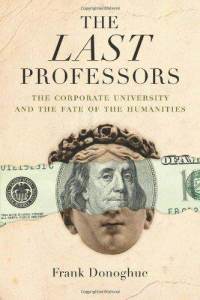
In front of my desk at home sits a chair.  That chair came to me when Gorgias Press was subleasing some of its office space and was necessarily divesting itself of unnecessary furnishings. Gorgias Press came to inherit the chair with the closing of the for-profit Katherine Gibbs School of Business, a branch of which leased half of the building.  I sit in that chair, contemplating the future of education.  I have just finished reading Frank Donoghue’s The Last Professors: The Corporate University and the Fate of the Humanities (as recommended by my friend Marvin).  Despite the fact that it is the first academic book I can recall leaving me in tears, it is a book every Ph.D. and potential Ph.D. in the Humanities should read and/or be forced to read.  Buck the trend!  Buy a book!  Donoghue is a rare individual who actually takes time to research what is going on in higher education and who has the courage to report it directly.  My regular readers will know that for nearly two decades I worked in higher education, spending every one of those years hoping that the next year things would get better.  Thank you, Dr. Donoghue, for speaking the truth.

I didn’t enter higher education as a child of privilege.  My career ambitions in high school were to be a janitor.  Encouraged along the way by well-meaning teachers and professors, I eventually found a job (lackluster as it was) in higher education.  What I didn’t realize is that the game had been rigged.  I recall being told with crystalline clarity that college and university positions were headed for a vast turn-over in the 1990s and jobs would be abundant.  Donoghue heard that story too.  His research shows that the writing had been inscribed on the wall as early as the 1970’s (before I reached high school) that this would not happen.  This is not hindsight either; studies were already indicating that higher education was going after the vaunted business model of the glitzy for-profit world.  Shiny baubles.  Worse yet, the roots of this inevitable transformation reached back to the Civil War and the nation that emerged from it—replace the dead on the battlefield with the dead in the factory.  Only only method of judging value existed: money.

The most disturbing aspect of all of this is the irreversibility of this trend: in today’s world only one value system is admitted, and it is purely material. No other way in higher education is capable of assessing worth. Rather, the alternate ways are being ruthlessly silenced by the transformation of university to corporation. That transformation was well underway long before the 1970’s, of course.  I had recognized at a young age that capitalism is a cancer that eats away the soul of people, convincing them that financial success is the only goal worth pursuing. I protested.  I spent years earning a doctorate in the Humanities to show that other values still throbbed away in the hearts of those who weren’t taken in by shiny baubles.  If you have any interest in resuscitating the human spirit, read Donoghue and weep with me.  The only consolation that I have is that I am sitting on a chair of a for-profit school that fell victim to the value system it once supported.  Capital and cannibal are too close for comfort.


Ancient Wisdom

The Huffington Post recently ran a story on Stonehenge. Part of the endless fascination with the ancient monument is that no one really knows why it was constructed. Given the tremendous amount of effort the building represents, it is clear that this was important to the cultures constructing it. The article in Huffington cites archaeologist Mike Parker Pearson as suggesting that Stonehenge was a monument to the unification of Britain. While not as sexy as explanations that draw on human sacrifice, precision astronomy, or alien visitation, something rings true about it. In the long course of human development, we’ve had to overcome many, many hardships. At one time humans were relatively easy prey animals for large predators. Our evolution didn’t endow us much in the way of body armor or built-in weaponry. Our eyesight and other senses pale next to various other animals. Even with all these deficiencies, our biggest challenge hasn’t been nature, but other people.

Archaeologists have also been discovering that a peaceful prehistory to humanity does not match the facts. Warfare and strife have been as much a staple of human behavior as the perennial hunt for food and safe shelter. Civilization involved cooperation at unprecedented levels. People had to trust one another and work to maintain the infrastructure that allowed diversification of talents and abilities. Fighting and wars still occurred, of course, but less frequently and with less brutality. With economies of surplus, however, capitalism also eventually evolved. It is an aggressive organism. It is visible in the greed embodied in the thought process that the only good in life is financial and the only worth of humans can be calculated in dollars and cents. It is this thinking that has erected the monuments more familiar to us today in our cities and centers of civilization.

Stonehenge could never have been a money-making venture (not until the development of capitalism at least). It is in the middle of nowhere, in a sense. The Salisbury Plain is fairly empty—no large cities nearby, no grand scenery as one might find in Cornwall or the Grampians. According to the theory, its location has to do with it being in a very rough middle between various regional cultures. Building impressive monuments is very difficult to do if one has to watch constantly over one’s shoulder. I suppose in my Romantic notions Stonehenge will always represent a mysterious past suffused with unanswered questions. For the present, however, Pearson’s explanation seems more than likely—it sounds absolutely vital in a world so dangerously divided as ours. Perhaps it is time to start a truly monumental building enterprise involving every nation. It will give future generations something to wonder about.

Time to build another henge.


Fighting God

Quoting Orson Scott Card, P. W. Singer notes in Wired for War that two of humanity’s “primary occupations” are war and religion. These two aspects of life are simultaneously very distant while abutting each other. While analysts cite many causes of war, there is no agreement concerning why we seem to be constantly belligerent. As a species we are keenly aware of small differences, perhaps like ants, and use those minor points to excuse the exercise of violence. Yet we are also a profoundly religious species as well, believing in supernatural powers that sometimes deliver us from, sometimes into, war. The Bible, just by way of example, contains many accounts of war. Often they are undertaken at the behest of deity. Religion and war coexist a little too comfortably.

Although Singer’s purpose in this book is to analyze the impact of robotic technology on the practice of war, he also finds indications about the origins of war itself. In today’s affluent world, dominated by technology, we should expect that armed conflict would be on the decline. Instead, it would be difficult to find any historic era when unfair distribution of basic goods has been more pronounced. As Singer notes, social disruption today tends to begin in cities, places where those in squalor daily see the opulence of their neighbors’ lifestyles. Our culture awards the aggressive—those with bigger houses, bigger cars, bigger payrolls. To these we defer. At the same time, the vast majority have difficulty finding enough to survive, let alone thrive. Still, we offer tax breaks to those who don’t need them and remind the poorest of their social obligations. This is often done in the name of religion. God is the ultimate capitalist.

The sum result, it seems, is not to lessen human hopes for religious deliverance. The belief in fairness, biologists inform us, is deeply embedded in primate evolution. We believe in fairness, and when it is elusive we thrust it toward the heavens, trusting in divine justice. Millions have died awaiting that justice that isn’t forthcoming. Again, another quote from one of Singer’s sources, “Amid galaxies of shining technologies there is a struggle to redefine human meaning… Half the world is looking for God anew, and the other half is behaving as though no god exists” in the words of Ralph Peters. Although the reference here is to technology, it could just as easily be to money or war. It appears as though we have an actual trinity of casus belli that are inseparable: technology, money, and God.

Some of our earliest technology