Underestimated

Under-printing, ironically, can create great demand.  Books are generally under-printed because publishers don’t see much of a market for them.  Back before the days of inexpensive print-on-demand (POD, in the lingo) books may not have even existed as electronic files.  Often a publisher won’t print a book unless it anticipates that it can make back its costs.  If they think it won’t sell that well, they’ll print just enough.  And they might even melt down the typeset plates to reuse them for other books.  I’m not sure if that happened in the case of a book I’ve been looking to consult, but something has made this under-printed book extremely rare.  It’s not on Internet Archive.  WorldCat shows it in only two libraries world-wide, the nearest one over 3,000 miles away.  Its price used (and there seems to be only one copy) is $46,000. I can’t tell you what it is because you might buy it before I can.

For the purposes of my research, this is actually the only book on this particular topic.  (The subject isn’t even that obscure.)  The book is cited everywhere this topic is mentioned, and at least one person on Goodreads has actually seen a copy of it.  I have to conclude that all those who cite it must live within driving distance of one of two libraries worldwide.  For the rest of us the book is simply inaccessible.  As an author this is one of the worst fates imaginable.  Even if some price-gouger is selling a copy for $46,000 the author gains nothing from it.  Royalties are null and void for used book sales.  The only profiteer is the person who happens to have found a rare book (from the 1990s!) and is determined to ensure only the most wealthy will be able to purchase it.

I’ve known people who sell used books online.  Those who want to move books try to undersell the unfortunate under-printed title by pricing a bit lower than the competition.  There is no regulation, however.  You can charge whatever you like.  The funny thing is, if someone eventually forks over $46,000 for this book, and then has it appraised (it is a paperback from the 1990s), its actual worth is probably at most in the hundreds of dollars.  Back when we watched the Antiques Roadshow we always knew that the poor person who brought in a book would be disappointed in the appraisal.  Last time I was in Oxford I saw rare books from the 1400s for sale for far, far less than $46,000.  I only hope that my books, as obscure as they are, are never deemed that expensive.  And I would encourage publishers to print a bit more generously, for the sake of knowledge.


Routine Interruptions

Ironically, having just written about routines, we experienced a power outage with a wind storm.  Sitting home of an evening, the lights in every occupied room began to flicker.  We grabbed flashlights, suspecting what would come next.  The power outage led to a temporary loss of the internet, the god of this age.  Routine was interrupted.  This brought to mind just how fragile all this is.  As supply-chain issues have demonstrated, everything has to work just right for our society to operate at expected standards.  And an internet outage leads to an interruption of routines.  Whenever this happens, it reminds me of how complex our lives have become.  And how unfair.  There are people across the world who struggle with daily necessities such as clean water, safe homes, and reliable sources of power.  And a wind storm in eastern Pennsylvania doesn’t mean that the company’s power in another state is out.  Does this mean I take a vacation day?

As this winter winds down I again lament the loss of snow days.  They were local holidays, of course, and based on the unpredictability of nature.  Our power outage, followed by internet outage, was a personal kind of snow day.  Nobody wanted it and we all planned to work today.  Other than the outage, we’re fine.  Just like a snow day.  There’s a feeling of helplessness to it.  To fix the internet we rely on someone who knows how to do such technical wizardry.  Anyone can stuff a rag in a hole in the window, but to replace the glass it takes an expert.  How do you contact them when the internet’s out?  (Of course, everything’s back on in time for work.)

No doubt, many aspects of our lives are better.  We can pay our bills without using a stamp.  We can look up basic information online.  Even attend religious services virtually.  (Who doesn’t want to linger in their pajamas on a Sunday morning?)  Yet, for all of this to happen our power must be on and steady.  Our internet connectivity must be strong.  We have to be able to connect to work so that we can be paid so that we can keep the power on.  It seems an odd way to spend our time.  Obviously, if you’re reading this they—that mysterious they—have got things working again.  The power is on so that I can type this, and the internet is connected so that I can post it.  And yet I don’t feel any more secure.  And I know I’m one of those who has it easy.


Pennsylvania Dreaming

“I finally understand what I’ve come here to learn,” I said.  I was incredibly happy.  I recall the sun was shining, making its way up from my feet to my legs in a symbolic way, soon to reach my head.  I was on the cusp of an epiphany.  That’s when I woke up, needing to head to the bathroom.  Of course, after that it’s difficult to fall back asleep.  I knew that even if I did it would be to a different dream and I wouldn’t learn what it was that I’d come here for.  So it is with the great experiment of consciousness.  Either we’re continuously learning or we’ve already died.  Nobody has all of the answers.  Consciousness may be the true final frontier.  There is no scientific explanation for what it is that is universally accepted.  We all, however, know what it is though daily experience.

Dreams are considered part of our subconscious.  While we sleep we’re said to be not conscious, although we all know that at times we are.  Sleep can be somewhere between.  And we don’t even know what consciousness is.  The study of dreams is still valued in psychoanalysis—it is a form of thinking too—but in our materialist, capitalist society we tend to dismiss dreams.  They generally don’t bring in money.  In ignoring them we move further from understanding consciousness.  Enlightenment, while not a scientific category, still seems possible, even should it come in dreams.  If only we could stay asleep long enough to see it through.

I have a friend who also thinks too much.  He sometimes wonders if this constant focus on what the “they” want isn’t a plan to keep us too busy to think things through.  I often think that the monastics had it mostly right.  At least the part about taking time to contemplate.  When you encounter an idea that feels like a key and you know the door that it opens will be profound, it always seems that work comes to interrupt right at that point.  The job where you can wrestle with ultimate reality and not worry about not producing “product” for which you’re paid, is rare indeed.  That’s why waking from this particular dream was so difficult.  I had a semester break while teaching where I read three books that changed my outlook forever.  It was possible because I had a few weeks before I had to be back in the classroom.  Since then the dream, I guess, has been to return to where you’re paid to learn, for the betterment of all.


Love on a Monday

I hope you may find love on a Monday.  I have a feeling that if we took Valentine’s Day more seriously the world would be a better place.  Capitalism, however, abhors interruptions (unless you buy lots of stuff) so many of us are at work this Monday.  I was recently reading how the full, unbroken eight hours’ sleep is a product of the industrial revolution.  I’d never thought of that before.  Everyone is different, of course, but it is natural for our species to wake in the night and be up for an hour or two and then to fall back asleep.  That, of course, interferes with the nine-to-five (925) that capitalism holds so dear.  In response, humans have altered their natural sleep patterns to conform.  The results are predictable: a line at the coffee machine every day at the office.

When I raised this with a friend, I was reminded that much of our life-style has been determined by the industrial revolution.  Certainly the concept of the weekend was.  And the constant feeling of never having enough time to, well, exist.  I awake when my body tells me it’s slept enough.  Generally that’s around 3:00 a.m.  I begin work early because Protestants have this work ethic going, but then I always get sleepy around 8:00 a.m.  Napping on the job is essentially the same as being a communist, so like many others I struggle through the rest of the day, not quite as efficient as I was for the first couple of hours.  In many cultures a nap is built into the after lunch slump.  Intravenous coffee is preferred by capitalists everywhere.

What if love catches you on a Monday?  Is it a sick day?  A vacation day?  A personal day?  Or all of the above?  It’s an opportunity to be human, but less than a true capitalist.  Someone could be making money off your time!  And whoever heard of more than ten paid holidays in a year?  I’m not complaining.  I love weekends and the scattering of holidays I receive, I really do.  Still, I miss the spontaneity of life.  The flight from a predator.  The shutting of the eyes when tired.  The celebration of love when it’s found.  A Faustian bargain was made when Christianity wed capitalism.  We’re encouraged to buy valentines for our sweeties, but show up to work and be there bright and early again the next morning.  May you nevertheless find love on your Monday.


Prolonged Re-entry

It’s a trope as old as holiday decorations themselves.  We all know the house (or plural) where the Christmas decorations remain until it’s warm and light enough to go out and take them down.  The same thing happens inside our house, on a smaller scale.  Bits of the holiday—whether it be Christmas cards on the mantle, or the not quite spent candles from the Yule log—remain, while we reluctantly reenter BAU (business as usual).  It’s a process best taken slowly.  I suspect many of us find AU (as usual) to be not really ideal.  Too many bills, too much Covid, too much of a demand made on that non-renewable resource, time.  I know people happy to see the holidays go, but I’m already counting the days until they come again.

January, whose end is fast approaching, is a waiting time.  Waiting to recover from perhaps a little bit too much holiday spending.  Waiting for a bit more light and warmth.  Waiting for that package to arrive.  Waiting for the plumber to call back.  Waiting for, well, business as usual.  I read about holidays quite a lot.  They wouldn’t be special if they happened all the time, of course.  And we need the supply chain that demands steady production of goods and services from those not actually chained to a desk all day.  Still, I can imagine a different world.  One in which there is time to get the non-work stuff done as well as filling obligations to capitalism, pouring out our libation to the emperor.  Many analysts are suggesting technology has increased efficiency to the point that a four-day work week is optimal.  Who’s going to pay the same for less, however?

Time is a commodity.  I’ve got a lot of projects outside work that I really want to finish.  Some of them, like that junk car in my step-dad’s yard, could turn a profit if only I had the time to spend on them.  Meanwhile there’s work to be done.  Long days in front of the computer knowing there’s something more exciting after it’s all over.  When work’s done I’m too tired to get much accomplished.  It’s like the endless lapping of the waves on the sea shore.  Unchanging.  Persistent.  Aware there’s always a coming storm.  So I’m sitting here with Tom Petty, waiting.  Even if we don’t know what comes next.  Let’s call it a holiday.


Getting Used

Unknowing is a blessing in disguise sometimes.  There is so much to learn and, regrettably, little time outside work to do it.  Books are my life.  I work in publishing, so I know a passable amount about the book business.  I have much still to learn.  To support my research, which doesn’t include a university library, I often have to purchase academic books.  I know quite a bit about academic book pricing (hint: what the market will bear), and I know that it’s assumed academics have university professor-level salaries.  The “independent scholar” is as much a ghost as the next revenant.  So I buy books used.  The best clearinghouse I know of is Bookfinder.com.  They list other sellers who have the book and facilitate your buying of it.  I strongly suspect they take a small cut.

While looking for an obscure book (it pains me to say, for I met the author), I wondered if Amazon’s used copy had the lowest price.  So I went to Bookfinder.  The Amazon copy was there, along with seven comparably, slightly lower, priced other copies.  Reading the descriptions, I realized these were different vendors hawking the exact same copy of the book.  Some of the description wording was oddly specific and that led to this epiphany.  Down at the bottom was a lone seller some $4 to $5 dollars cheaper, selling the book directly.  Navigating to this page I discovered it was the self-same book—the same physical book being marked up by the other vendors.  Each reseller along the way, with wider reach, stopping at Amazon with the widest reach, was charging a finder’s fee for this same object.  It was available directly from the seller.

Used books are a thriving business.  Many publishers these days are focusing on “the electronic future,” scratching their heads that people are still reading paper.  What will happen to walking into that impressive library?  Have you ever walked into someone’s impressive iPad or Kindle?  It looks the same no matter how many electrons you add.  The internet has been taken with the photo of the late Johns Hopkins humanities professor Richard Macksey’s library.  Would it be possible to have walked in there and not been impressed with the obvious love of books?  As a Hopkins professor I doubt he had to resort to used books much, but I kind of think he probably did anyway.  Bibliophiles are like that.  A first edition is a thing of beauty forever.  And so I find myself on Bookfinder and I’m willing to give them a cut just for the privilege of holding a coveted book.

Richard Macksey’s home library. Credit: Will Kirk/Johns Hopkins University

925

Sometimes you just know.  One of the things I know is that nine-to-five schedules are killers.  Literally.  I grew my permanent teeth as a teacher.  Before that I had been set on being a minister.  Something they have in common is that neither profession relies on a nine-to-five schedule.  The hours are much longer than a forty-hour work week, but they’re flexible.  If you’re not in class, or in church, or a committee meeting, or your office hours, you can dash out to the store if you need to.  You can shut your eyes for a few minutes if you didn’t sleep well the night before.  As long as you get your work done adequately, nobody really bothers you about your time.  My initiation into the nine-to-five, in my mid-forties, was a shock from which I’ve never quite recovered.

A few years into this unnatural territory, my nine-to-five (925 is quicker to type) evolved into the commuting variety.  I didn’t live terribly near New York City, so that meant catching a very early bus.  I’m a morning person, so that’s not really a concern.  The problem is that my brain’s not a 925 brain.  Like one of my professors, I still awake at 1:30 (having gone to bed about five hours before) with an idea that won’t let me go.  When that happens you have to put on heavy layers of clothes against the night’s low thermostat and make your way downstairs to the computer.  By three a.m. your body’s in the fully awake commute mode.  Thing is, you’ve got a 925 day in front of you.  When I was teaching I’d be able to snooze again before even my eight o’clock class (I was never one to object to the early shift) began.

The idea behind the 925 is an atavistic throwback to pre-internet days.  Pre-pandemic days.  Days when you had to be watched to ensure you were working.  When you had to sit in a cubicle where nobody and everybody can see you.  If you’re not staring at your screen or not in a meeting you’re not working.  So this antiquated thinking goes.  Teachers and ministers don’t hold to regular hours.  They identify with their jobs—the very definition of “professional.”  If it’s what you’re born to do you don’t complain.  And if you happen to awake at 1:30 with an idea that just has to be expressed, those who pay you will understand if you yawn a time or two the next day when, ideally, you won’t be stuck staring at a screen.


A Haunting Story

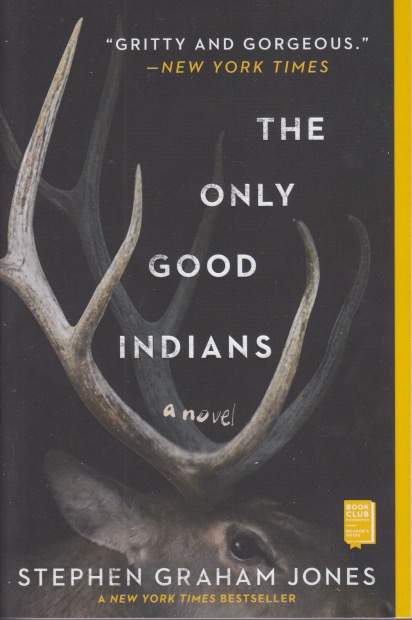
The last book I finished in 2021 didn’t quite make it under the wire for my year-end blog post.  It was the second Stephen Graham Jones novel I read in the year.  I guess I’ve been reading a lot of American Indian books lately.  The Only Good Indians is a horror story and more.  There’s reconciliation.  There’s tradition.  There’s hope.  As part of the privileged “white” class, I’m always a little afraid that writers from oppressed cultures will take it out on me.  It may’ve happened here, but if so it was done in a way that I didn’t feel the sting.  This is a story of friendship, mistakes made, and a monster who has a righteous cause.  There’s a lot going on here.

One of the persistent cultural fears of the unwoke, I suspect, is that there’ll be payback if all things were to become equal.  Perhaps on the scale of karma that’s true, but in reality the people that’ve been oppressed simply want the oppression to stop.  To be recognized and acknowledged as being human.  As if that decision is up to white folk to make.  This novel simply deals with American Indian life as it’s lived.  The characters all pretty much live in poverty but they lack the greed so many white protagonists have.  They’re happy if they have a few hundred dollars, or even a few twenties.  Life is more than playing the capitalist game.  It really all comes down to relationships.  And family.

Stephen Graham Jones writes with a deft hand.  He offers some humor amid scenes of violence and loss.  He speaks plainly and without pretense.  And there are parts of this novel that are genuinely scary.  Since I had no idea how it might end, I wasn’t even sure even while I was on the last page.  

The best monsters are those that teach us to be better human beings.  Quite often they teach us that the truly monstrous ones are those who look and act like people usually look and act.  We take the natural world, assuming it’s ours.  We think our small problems are those of the entire world.  Monsters help to fix our perceptions.  Without them we carry on as if it’s business as usual.  This is a good novel to read in the midst of a pandemic.  There’s hope here that we’ll come out of the crisis better than we went in.  Perhaps scarred and changed for good.  In every sense of the word.


Christmas Classic

While it’s a story I know well, I’d never read the book.  I suppose I tend to think of Christmas when it’s already hard upon me, or perhaps I’m just making excuses.  After all these decades I’ve finally read Charles Dickens’ A Christmas Carol.  The story is so well known there’s no point in laying out the action here.  A filmic version of this has been part of our family tradition for many years now and sometimes it’s difficult not to think the cinematic version has somehow got it right while the book might’ve somehow missed something.  I’m generally disposed to read the book before watching the movie, but I believe I saw this as a young person and we had no Dickens in the house.  Besides, who could miss the endless parodies?

It’s a ghost story, yes, but it’s primarily about redemption.  It’s difficult for me to watch (or read) without getting a bit misty about the eyes.  Our world, especially during the Trump years, seemed a hard and heartless place.  Winter all the time while somehow being Hell also.  It will take many years—perhaps I won’t live to see it—before people unlearn the bad habits they saw being modeled each and every day of those four long, long years.  Every year as I watched the movie I thought, “I wonder if 45 has ever seen this?”  Always the answer came back in a resounding “Humbug.”  A miser who cares only for himself doesn’t change as easily as Scrooge.  So the world had to suffer, and so it will suffer yet a good long time.

The thing about redemption is that it can’t be privatized.  It’s on free offer to anyone who desires it.  While A Christmas Carol may not be Dickens’ best work, it nevertheless bears a message well worth the repetition.  Perhaps there aren’t ghosts enough in the world.  We need to learn to listen.  Were it not for the haunting Scrooge never would have changed.  The sad part is that there are people actually of his ilk.  I hold out hope for redemption to all of them.  I’ve known too many people who seem to care only for themselves.  I need to remind myself that they may not have the reinforcement of this tale every year.  The world could perhaps be better if that were the case.  Dickens clearly had fun as a writer.  Sometimes it seems to get in the way.  But if it makes one’s heart light in December, what can the harm be in that?


True Value

It’s a funny idea, net worth.  (Who says Capitalism isn’t a religion?)  We decide what people are worth by what corporate executives and small-minded economics determine what they will be paid.  We seem to think entitled, essentially worthless, inheritors of ancestral money are of more value than the workers who actually fuel the economy.  Economics is called the “dismal science” for more than one reason.  This system can’t help but to make individuals question their self worth, which, according to Capitalism, is different from net worth.  (Net requires taking the cost of goods into account, and is less than the list worth.)  And you must never tell anyone your net worth.  Why do we still hold to this system that future historians will see as just as archaic and cruel as feudalism?

Photo by Sharon McCutcheon on Unsplash

Nashotah House could hardly have claimed to be competitive with salaries.  Still, to those hired the title “professor” indicated you were a cut above many other professions.  Certainly above most clergy, the future cohort of which you were teaching.  Even so, it took a dozen years in publishing for me to reach the salary level at which I was asked to leave said seminary.  Net worth?  I tend to think of it as idol worship.  Many well-meaning colleagues congratulate me on my LinkedIn work anniversary.  None ask “How are you doing there?”  None wonder “Have you yet caught up with your net income of 2005?”  We’re all too busy bowing at the altar of the Stock Exchange.

People are worth far more than money.  For some, money, and only money (which is a symbol only), is worth having.  Some run for president on that very platform.  Holding up a Bible they’re careful that it doesn’t fall open to the place where it says love of money is the root of evil.  There is no such thing as evil in the religion of Capitalism.  Except Communism.  Interestingly enough, the New Testament advocates for a form of communism, but Acts is easily overlooked on the way to Leviticus.  I tend to stop about half-way between, at that comfortably uncomfortable book of Ecclesiastes.  It’s there that we read that all is vanity.  Money is merely a symbol of what we value.  Looking at what those who’ve devoted their lives to it have done with it, net worth sends me back to the cynical old preacher wondering about the meaning of it all.  It seems an appropriate place for the musings of a mere editor aware that his colleagues are valued much more by this “Christian” society.  I think the “net” in net worth should be cast much further.


Horror Week

“Remember, remember, the fifth of November,” the old rhyme goes.  Earlier this week I advocated for Halloween being the start of the holiday season.  There’s been a lot going on this week and I’m now reflecting on how Halloween also took some of its identity from Guy Fawkes Day (or more properly Guy Fawkes Night), here on November fifth.  Halloween, as we know it, incorporates traditions from Samhain (actually November 1), All Souls Day (November 2), as well as Guy Fawkes (November 5).  All the while the Hispanic world is observing Dia de los Muertos, a multi-day holiday whose origins are somewhat uncertain but which shares similarities with Halloween.  In other words, it’s a veritable week of spookiness to get our November started off right.

Ironically, at least in corporate America, none of these are work-free holidays.  For the Celts Samhain was the most important day of the year.  A day when the dead might wander into our realm or we might stumble into theirs.  For the modern person it’s a day of checking email, making deals, trading and evaluating how well we did at it.  Pretty mundane stuff.  The message of all of these holidays is that there are matters of deeper import going on.  We should perhaps look up from our monitors and see.  Just as that veil between the living and dead thins at this time of year, so does that line between work and personal life, when our laptops are as omnipresent as a haunting deity set to keep our minds on the sin of not working.  

Guy Fawkes is about rebellion.  More specifically, putting down rebellion.  Keeping the status quo.  Halloween and its siblings are all about challenging the way things are usually done.  I often wonder what it would be like if people took it seriously.  The costumes are fun, yes, and the trick-or-treating, but there’s something more serious underneath.  Perhaps symbolically we pretty much ignore All Saints to Guy Fawkes, or Dia de los Muertos as pleasant diversions.  There’s some spiritual heavy lifting going on behind the scenes, however.  It’s not all about fun and games, because fear is always with us.  We know there are problems but it’s more comfortable keeping things as they are.  Guy Fawkes, perhaps for a cause we see as obsolete—restoring a Catholic monarchy—was trying to change things for the better.  What’s more, his motivation was religious.  There are spooky parallels here, even today.  It might be good to take a day off work to ponder the implications.


Eve’s True Desire

Psst—don’t tell anyone!  There is a free copy of my first book available on Academia.edu.  I thought I was kind of radical for doing that, but people who write books want people to read them.  Having a book priced $70 or more, heck, even $30 or more, means only diehards will buy it.  Nightmares with the Bible promptly sank at $100 cover price, released during a pandemic.  I’ve always admired scholars who’ve bucked conventions to make their work available.  Recently I needed to consult a book.  I won’t say what it is because I fear a take-down order will be issued where I found it.  The author, aware the book was hard to access, actually photocopied the entire book and put it on a website.  I stand up and cheer!  Photocopying an entire book is a lot of work, a labor of pure love.

Now, I’m all for authors getting royalties.  It takes a lot of time and energy to write a book.  It can cost years of your life.  You ought to get something back for it.  It seems to me, however, that a different model is required for academic books.  Why are they so expensive?  Not only that, but smaller publishers without the distribution channels often publish worthwhile books, but in small quantities and they go out of print after the initial run is sold.  The academic enterprise (knowledge for knowledge’s sake) has become a captive of capitalism.  There’s no other way to trade in that market.  Books that have willing, even eager, readers are sequestered in libraries only accessible to employees.  Is there anything wrong with that picture?

Academics at less wealthy institutions often find ways around the rules.  I did my research for Weathering the Psalms at a small seminary that had trouble getting unusual items on interlibrary loan.  Bigger schools were distrustful of this tiny enclave called Nashotah House.  Would they ever get their rare property back?  Meanwhile worldwide mail service crisscrossed with offprints sent for free from scholar to scholar.  It was like your birthday, or Christmas, when a long-awaited piece of research landed in your mailbox.  Nobody was in it for the money.  We were beguiled by learning.  Eve looking wistfully up into the tree.  Now it’s all business suits with dollar signs for eyes.  The academic who puts their book up for free on the internet is nothing less than a saint.  Seeking knowledge is never really a sin.

Tasty fruit of knowledge

Thy Sting

“It’s hard to imagine a more alarming sign of a society’s well-being than an inability to keep its citizens alive.”  This quote is from the New York Times’ The Morning team yesterday.  Life expectancy in the US has been dropping.  Not coincidentally, the article notes, so has the wealth disparity in the country been rising.  And guess whose lives are shorter.  Isn’t it often the same people who vote for those whose wealth keeps them (the candidate) alive longer, and in luxury?  This story struck me as poignant.  Have we lost our national will to live?  We see politicians who give no mind to what the people want getting themselves elected to further their own means.  People know they’re not being cared for.  That they’re being lied to.  Perhaps it’s working its way into our national mortality rates.

I think quite a bit about mortality.  Death is a natural part of life and we seem to have bought into the capitalistic idea that more is always better.  The debates in ethics classes were always about such issues of quantity versus quality.  Is a good life better, even if it’s shorter?  Improving the lot of others increases, we hope, the number of good lives.  Not everyone wants to be rich.  Part of the problem with our current system is that we’re narrowing it down to one way of existing—the way of earning more money.  Those occupations suffused with meaning are disappearing because they’re not profitable.  Does the will to keep on living grow when money is substituted for meaning?

Books on “the good life” sell well.  Whether it’s stoicism, Buddhism, or feel-good Christianity, people want to read the answers.  In a capitalistic system only so many can be rich.  They accumulate power to themselves and many have nothing beyond this for which to strive.  How many classes are available for finding meaning in life?  As universities continue their march towards the status of business schools, the philosophy and religion departments struggle.  They don’t bring in money, but they do, I suspect, discuss the systems that give meaning to people.  That could instill the will to press on.  The article makes the point that although Covid-19 has led to a good part of the decline, it isn’t the only factor involved.  We’re all so busy that we don’t have time to think about it and yet, finding a reason to continue to improve might give us what we need.  Maybe slowing down a little and pondering things would help.

Carlos Schwabe, Death of the Undertaker; Wikimedia Commons

Peak Complexity

I remember being a kid.  Things probably weren’t as simple as some adults seem to remember—society, even as a child, is complex.  You soon learned the important lessons: who the bullies were and how to avoid them.  Cars are dangerous, particularly if they’re moving.  God is always watching you.  Then you start school and you begin to learn things you simply didn’t understand before.  You study math and although addition and subtraction seem pretty easy, division and multiplication require some concentration.  By the time you get to high school the math has become so complex that hours of homework are required to figure it out.  I don’t know about you, but nobody explained to me what jobs you needed this for.  I just hoped it wouldn’t be mine.

I’ve managed to get through so far with only the obligatory mathematical complexity of trying to explain certain problems to my daughter when she was in a similar situation.  Fortunately she understood how things worked better than I ever did.  The complexities, however, also come in other species.  I learned that being an adult meant constantly negotiating complexities.  That’s tricky for a guy like me because I tend to understand things by tracing them to their origins.  (There’s a reason history appeals to me.)  Social complexities often don’t allow such tracing—you need to figure out relationships and their implications and how you fit into the picture.  The same is true of jobs.  I’m sure many of you’ve had a job where the requirements change as circumstances alter.  You may have been hired to do one thing, but now you do another.

Then big life events come in with all their own complexity.  The other day I was wondering if there’s such a thing as peak complexity.  If there is, what happens when we reach it?  Do things in life simply become so intricate that society (I’m thinking here simply in human terms) implodes?  Or do we start to make things simpler again? Is there any going back?  I used to tell my students that my own grandmother was born before heavier-than-air flight.  By the time she died we’d been to the moon more than once.  Yes, rural life had its complexities, but since the industrial revolution the pace has been—what’s more than breakneck?  I know computer engineers and they tell me code is so complex that it’s actually a job to sort it out.  Just because you can fly a helicopter doesn’t mean you can put one together.  If we ever do reach peak complexity I have a suspicion that we won’t be able to tell, until in retrospect.  Childhood’s beginning.


Weathering the Sleep

Weather still has a tremendous, if incremental, effect on life.  Patterns where a repeating weather cycle seems stuck in place are a good example.  While not exactly uncommon in summer around here, thunderstorms develop during the hot and humid days.  Our current pattern is that thunderstorms arrive in the middle of the night.  For days in a row.  We had a few days in our current series.  Some of us can’t sleep through thunderstorms, not least because we have to get up and close the windows, pulling fans out, so that the water doesn’t invade.  This means several nights of interrupted sleep and rather unforgiving work schedules the next day.  Companies don’t often take this fact of the weather into consideration.  I’m not the only one yawning all day.

Of course, other things interrupt sleep as well.  Any parent of a newborn has those perpetually baggy eyes that we’ve come to associate with trying to get an infant to sleep through the night.  Work doesn’t smile on that kindly either.  Both of these (and many others) are very real human concerns regarding slumber.  HR, on the other hand, looks at the clock with a frown.  This sort of work ethic is particularly bad in America where work is a kind of sacred obligation (unless you’re a minor, rich, or retired).  You owe that time, no matter how sleepy you are or sloppily you may work because of it.  In my case it’s the weather that’s been causing my drowsy days.  I guess I shouldn’t have given up caffeine a few years back.

Weather, although it’s treated as a “neutral” subject, affects everything.  There are deniers, but climate change is real.  It’s measured across centuries and millennia, however, and our point of view spans only the few decades of our own lifetimes.  We come again and again to the myth that this planet was created for us rather than the more factual realization that we grew organically out of it.  Our civilization is complex and grows more so all the time, requiring less and less time in nature.  Nature isn’t predisposed to be nice to us, or to any species.  It’s a matter of balance.  So it is with the weather.  This massive atmosphere above us seeks to balance itself out but we’re making it hotter than it should be.  Many suppose that God will sort it all out, if, indeed, forcing a crisis won’t compel divine intervention.  I just hope the “man upstairs” has been getting enough sleep.