The Prom

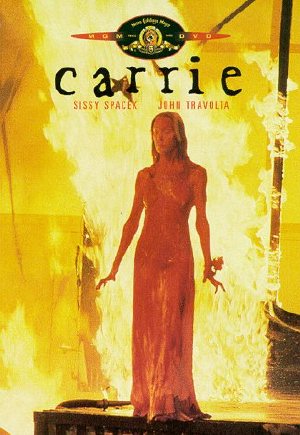
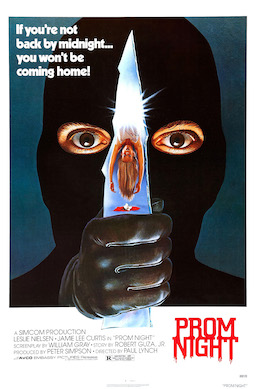
I had always assumed Prom Night was a knock-off of Carrie, and in some ways it is.  The story is significantly different, however, and the impetus to watch it came from Scream, where it’s referenced a few times.  In case you’re under the same delusion I was, here’s how it unfolds.  Jamie Lee Curtis, after starring in Halloween and The Fog, takes the role of Kim Hammond, older sister of a girl (Robin) accidentally killed at the start of the film.  A kids’ game at an abandoned building leads to the death, in which four children participated.  Six years later, it’s prom night.  The kids present at Robin’s death all receive mysterious phone warnings that they dismiss as crank calls.  Meanwhile, a Carrie-inspired sub-plot is introduced as Wendy, the leader of the killer kids, is outvoted as prom queen by Kim.  She gets a local thug, Lou, and his buddies, to plan a disruption to the crowning of the king and queen.  No pig’s blood, but this isn’t Stephen King.
Meanwhile, yet another subplot is introduced, riffing on Halloween, of an escaped psychopath as suspect.  The police are fearful after finding the body of a nurse he kidnapped at the site of Robin’s death.  He was falsely accused of Robin’s murder and was disfigured in a fire.  They fear he may be targeting the kids there that fateful day.  Nobody except the four kids know what really happened.  There’s a hint that someone saw the accident, however.  If you’re getting confused, apart from my faulty summary, it may be because the movie goes to great lengths to misdirect your suspicions of who the murderer may be.  Since the movie is over 45, there will be a spoiler in the next paragraph.  You are warned!

The killer is Robin’s twin brother, who is also Kim’s younger brother.  He witnessed Robin’s death and tries to murder those he holds responsible on prom night.  He succeeds in killing three of the four.  I’ll leave it at that.  This is one of those teen movies and a fairly early slasher.  The plot is too complex to hold up, however, with characters simply dropping out because the action shifts focus.  Too many false lead-ons and too much disco music make it less than stellar.  Of course, as a very religious kid shy around girls, I never attended my high school prom.  I guess I may have missed out on what was, by then, becoming a night of horror.  At least in the eyes of those exploring the emerging slasher genre.  


Best King

I suspect most people have read one or two at least.  Most reading folk, that is.  I mean Stephen King novels.  He’s sure written plenty.  By my count I’ve read nine: The Shining, Carrie, ‘Salem’s Lot, Pet Sematary, It, The Stand, The Tommyknockers, Revival, and Cujo.  I probably have one or two more in me.  The dilemma is that I like King’s writing—I’m not one of those nay-sayers who call it clap-trap.  There’s real literary merit to much of it (sometimes just too much of it), and he integrates religion into horror really well.  The thing is, not all of his books are made equal.  I suspect that’s true of any writer.  I’ve consulted some lists to see which are the best and I’ve watched some movies before reading the books, but I’m starting a ranking of my own here—it will probably be revisited from time to time, as events warrant.

What’s his best?  Well, such lists are supposed to start with the worst and work their way forward.  I’ll cave to convention this time.  So, The Tommyknockers and Cujo are tied for least favorite.  Each has a reason: The Tommyknockers is too long and lacks sympathetic characters and Cujo is just too nihilistic.  The premise is good but the bleakness got to me.  The Stand comes next primarily because of the length.  I like the way that one ended up, though.  Revival, my most recent read, comes here, about in the middle.  It was enjoyable to read, even with its length.  I think King has a little trouble writing convincing kids, but the story was good.  Next I would put ‘Salem’s Lot.  Who doesn’t like a good vampire story?

Not that kind of book.

My top three are, perhaps predictably, generally among the top ranked.  My order is perhaps a bit different than most, however.  I really, really enjoyed The Shining.  The movie, I believe, is better.  That may be heresy, I know.  Carrie has all the freshness of a novelist breaking through, and it’s effective.  Better than the movie.  That leaves Pet Sematary as my current favorite.  The story there caught me up and it’s the only one of my top three that I read before seeing the movie (both of them).  The book is way, way better than the movies.  Compared with Revival, which also deals with what happens after death, Pet Sematary offers a commentary on grief that doesn’t involve everyone dying by suicide.  It’s on a much more human level.  As I read more, I’m sure I’ll form other opinions, but for the time being, these three of the King’s early novels, are, in my standing, the most deserving of the crown.


The Best Religious Horror Movies Streaming Now

Here’s an extra-special second guest post this week, enjoy!

Many horror movies have religious themes, plotlines or undertones. Here are a handful of the best religious horror movies to make you pray the bad away, in order of release.

Rosemary’s Baby (1968)

Rated R

Director: Roman Polanski

Starring: Mia Farrow, John Cassavetes, Ruth Gordon

A young couple moves into a NYC apartment with a haunted past. When the wife gets pregnant, she experiences an array of strange feelings, believing her baby may be the spawn of Satan.

Stream Rosemary’s Baby on Hulu, Sling TV, The Roku Channel and Amazon Prime Video.

The Exorcist (1973)

Rated R

Director: William Friedkin

Starring: Ellen Burstyn, Linda Blair, Max von Sydow

An increasingly strange-acting 12-year-old girl causes her mother to volley between scientific and supernatural explanations. Ultimately, she seeks the aid of a priest who himself is experiencing a crisis of faith.

Stream The Exorcist on Netflix.

The Exorcist spawned two sequels: Exorcist II: The Heretic (1977) available to stream on Apple TV, Vudu and DirecTV and The Exorcist III (1990) available to stream on Apple TV and FuboTV. There was also a 2016 television remake of The Exorcist that lasted two seasons and is now available to stream on Hulu and Amazon Prime Video.

Carrie (1976)

Rated R

Director: Brain De Palma

Starring: Sissy Spacek, Piper Laurie

Based on a novel by Stephen King, the master of horror himself, this is the story of a shy, introverted and sensitive teen bullied by her schoolmates and abused at home by her highly religious mother. Then, she becomes imbued with the devilish power to take revenge on them for the suffering and humiliation they’ve made her endure. This is such a timeless and beloved horror classic, it’s been remade twice: once made-for-TV in 2003 starring Angela Bettis and Patricia Clarkson in the leading roles and again in 2013 starring Chloë Grace Moretz and Julianne Moore in the leading roles.

Stream all three versions of Carrie on Apple TV, Vudu and AMC On Demand.

The Omen (1976)

Rated R

Director: Richard Donner

Starring: Gregory Peck, Lee Remmick, David Warner

When the wife of an American diplomat gives birth to a stillborn child, he adopts a child named Damien. After the child’s first nanny commits suicide, the family calls in a priest, who delivers a dire warning: the child may be the anitchrist himself.

The original The Omen spawned two sequels and one remake.

Stream the original The Omen on Hulu, Paramount+, Epix on Amazon Prime Video or Epix On Demand, Tubi and DirecTV.

Stream Damien: Omen II (1978) and Omen III: The Final Conflict (1981) on Apple TV and Vudu,

Stream the 2006 remake of The Omen on HBO Max.

Summary

Catch up on these, and you can say you’ve survived the most harrowing classic religious horror films of all time.


Remaking King

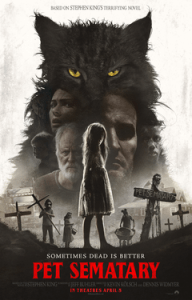
Pet Sematary is (or was), according to Stephen King, his most bleak book.  The first movie made from it (Mary Lambert, 1989) never reached the iconic status of The Shining or Carrie, but it nevertheless conveyed the dread of resurrection.  It also followed the novel pretty closely.  The new movie version, which came out last year, uses the more slick, modern horror style that just doesn’t have the same feel as the slow pace of dread.  The whole thing feels rushed to fit too much in.  It does add some nice touches, however.  Borrowing the creepy animal masks of The Wicker Man, it adds a religious procession of children to the eponymous cemetery right at the start and uses a mask to add menace at the end.  There will be spoilers here, so if you’re even slower than me at getting to movies, be warned.

The main source of fear, which is only shown a couple of times before the accident, is the speeding Orinco trucks along the road that kill people and pets.  Since horror is an “intertextual” genre there are several knowing nods toward the 1989 film, sometimes lulling the viewer into a false sense of security.  (Can you have security watching horror?)  King’s novel, and the original movie, point to the impending death of Gage, the young son of the family.  Faking out the viewer, the new film has the truck killing Ellie, Gage’s older sister, instead.  While this must’ve made Jeté Laurence’s role fun to play (for the dead child comes back—and when the monster is a fragile little boy of four or five it’s hard to believe) but it interferes with the explanation of death to her that makes up so much of the story.

Why the wendigo is brought in only to be dropped is a mystery.  The wendigo would make for a great movie monster, but trying to squeeze mention of it into an already crowded plot doesn’t really help.  The ending of the new movie is well set up, and the realization that she’s living dead on the part of Ellie is well played out.  Otherwise the film assumes the watcher already knows how it goes.  I suppose that’s a perennial problem with remakes.  The source of horror in the novel and in both films is the idea that the dead can come back.  It’s an ancient fear and one with which all of us eventually deal.  Now that the nights and early mornings are turning cooler and darker, movies like Pet Sematary come readily to mind and we know the horror season has begun.


Reading Connections

It’s flattering to have someone notice your work.  The other day I had the very first email from someone who’d read Holy Horror and wanted to discuss it.  It was from an undergraduate, no less, who was doing a report on religion and horror.  She’d read my book (and yes, it’s undergrad friendly) and wondered if I’d be willing to talk about it.  I can’t express how surprised I was (and still am).  You see, I have emailed authors after reading their books.  Many of them show no interest in carrying on a conversation with someone they’ve “met” through email.  I’ve had so many single-sentence responses with no enthusiasm whatsoever that I’ve begun to think of those employed in academia as hopelessly stuck in tunnel vision.  If you write a book you’re wanting conversation with those who read it, I should think.  At least I am.

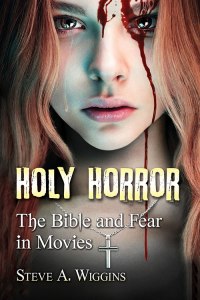
Those of us outside academe don’t have tenure committees to please or effectiveness committees to placate.  We write books to try to engage readers.  Unfortunately Holy Horror is priced for the library market.  During our phone interview, my interlocutor asked about the cover.  She said something publishers should hear: when walking around with Holy Horror her friends asked what the book was about because the cover is intriguing.  (It’s actually based on Chloë Grace Moretz from the reboot of Carrie, discussed in the book.)  In the midst of a pandemic, this first show of interest made my day, like seeing the first crocuses after a long, hard winter.  I do welcome conversation about my book.  I don’t have a classroom of students to force to buy and read it.  It’s out there for discussion.

Nightmares with the Bible is nearly finished.  Of course, publishers have hit a bit of a slow patch with many of their business partners shutting down.  Some publishers have gone into hibernation during the pandemic.  Books, though, will get us through.  A colleague of mine said the industry reports are showing that novels continue to sell while nonfiction is suffering.  Well, I’m no expert, but I do wonder if nonfiction might do better if authors would be willing to respond to this who express an interest in their work.  I know it’s a radical idea.  I also know that my books reach nowhere near what most publishers consider a viable readership.  What people are looking for during enforced isolation is a sense of connection.  Reaching out to find someone reaching back.  Books can do this, even if we never physically meet.


Carrie On

Stephen King was still a fairly new writer when I first read “Lawnmower Man” for an English class in high school.  Carrie had been published by then, but I didn’t read any more Stephen King until after my academic job ended.  (There is, for those who are curious, a correlation between that traumatic change and my interest in horror.)  Like many, I suspect, I saw some of the movies before reading the King books behind them.  With a writer as prolific as King there’s always the issue of where to start, and I’m often subject to the selections independent bookstore owners make.  I seldom buy fiction through Amazon—I have to see the book for it to grab me (a kind of King thing to happen).

A used copy of Carrie recently came my way.  Now, I’ve seen the movie (both versions) many times; it is discussed at some length in Holy Horror.  I’d not read the novel until now.  Obviously there are differences between book and movie, but as this was Stephen King’s debut novel it struck me just how central religion was to the fearful scenario he paints.  That’s pretty clear in the film, I know, but it’s even more so in the novel.  Carrie is made into a monster by religion.  One could argue that she was born that way—telekinesis as a genetic marker is also a theme in the book, although absent from the films.  Still, it is Carrie’s rejection by others, largely because of her religion, that leads her to use her powers to destroy Chamberlain, Maine.

In a strange way, Carrie is a coming-of-age story from a girl’s perspective.  Strange because King is a man and some literary magazines won’t even accept stories written from the point-of-view of someone of the opposite gender.  Men can’t know what women go through.  Indeed, most of the male characters in the story are less than admirable, while some are downright wicked.  The real question is whether religion saves from wickedness or causes it.  There’s not much ambiguity here on the part of Mr. King.  Holy Horror, although it deals with movies and not novels,  makes the point that films based King don’t infrequently use religion as a source of horror.  Long-time readers of this blog know that I frequently make the point that this genre, more so than most, relies on religion as an engine to drive it.  And religion also has a role in repressing women.  Coincidence?  Ask Carrie.


Frozen Over

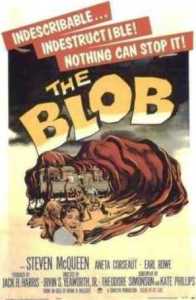
The_Blob_poster

For reasons that may eventually become clear, I was watching The Blob. It seems that each generation’s fears are unique to its time—let the reader understand. For whatever reasons, star-appeal I expect, Steve McQueen was cast as the teenage Steve Andrews. A little unbelievable as a twenty-eight-year-old teen (Sissy Spacek was a more convincing teenage Carrie at twenty-six) Steve drives around his small town trying to find and stop the Blob. What is the Blob? Nobody really knows. Emerging from a meteorite, it seems to be an EBE (Extraterrestrial Biological Entity) that encompasses, dissolves, and assimilates animal life forms, getting bigger all the time. In a day when the Russians were actual enemies, this is hardly an intentional vision of capitalism but an apt description nevertheless. If it touches you, you’re dead. Since it can ooze through air vents, there aren’t too many places at hide. It forces itself upon you.

Steve’s love interest, Jane Martin, has a lisping little brother named Danny. While big sister is out on a date battling the jello-monster, Danny—a future NRA member—charges outside in his pajamas shooting at the thing with his cap gun. Can this be? One capitalist shooting at another? Don’t be fooled. This is the nature of the free market. Either the Blob ends up on a dinner plate, or Danny does. We know that prior to 1960s monsters seldom kill little children (but don’t get me started on Frankenstein), so it is the Blob that will succumb. As the town’s teens combat the goo with fire extinguishers, freezing it, Jane, Danny, and Steve escape to go hunting another day.

Those of you who’ve read my blog for any time know that subtext is often the point. I’m counting on you following along with me here—think of what day it is. The small town police chief, Dave, calls in the Feds. No wall will keep this alien out. It has to be deported. To some place that will never thaw. Like all good monsters, the Blob never really finally dies. It must be kept frozen to keep humanity safe. The final words Steve utters are indeed chilling, “As long as the Arctic stays cold.” Getting on sixty years later our “industriousness” has begun to melt the ice caps and the friends of the Blob deny global warming. I’ve seen The Thing from Outer Space too, and I know the last thing you want to do is thaw the Arctic. Remember what day it is, and do the right thing.


Carrie the Cross

Carrie1976With all the buzz about the new Carrie movie just released, I decided to go back and watch the Brian De Palma version again. I’ve written here before about the religious symbolism of the movie, but I have to confess to never having read the novel. This time a particular symbol stood out, and I’m not sure whether it derives from De Palma or King. Crosses abound in the 1976 Carrie. This is a bit odd because of the indeterminate religion of Carrie’s mother. Clearly she has a belief in Jesus, but an odd Jesus it is. In Carrie’s prayer closet the statue—presumably of Jesus, since it is never clearly identified otherwise—is of a man whose abdomen in pierced with arrows. Those familiar with saints immediately recognize Saint Sebastian, but the arms are outstretched, as if this poor victim were both crucified and superfluously shot with arrows. The traditional cross, however, seems to be missing in that dark room. It reappears on prom night.

While Carrie is getting ready for the prom, her crazed mother peers out the window at passing cars, telling Carrie that Tommy isn’t coming. In one shot, as two cars pass in the street, there appears an inverted white cross on the road. I supposed at first that this was a painted parking space marker, but then, this is a residential street, and no such markers appear in other shots. Carrie’s mother had accused her of being a witch, and the upside-down cross is an oft-claimed symbol of Satanism (not the same, however, as Wicca). At the prom, Tommy insists that Carrie vote for them as the prom queen and king. When Carrie makes her x, the camera angle rotates slightly to reveal the sign as a Latin, as opposed to Saint Andrew’s cross. After Carrie kills everyone and goes home, her mother stabs her and, chasing her through the kitchen, makes the sign of the cross with her knife. Finally, Sue—in a dream?—wanders to Carrie’s burnt down house to lay flowers at the foot of a “for sale” sign that is a white cross, with the clashing words “Carrie White Burns in Hell” scrawled on it.

I may have missed more since the use of the symbol only dawned when the passing cars pointed me toward it. There is a strange kind of misuse of the cross here—not visible on the Sebastian-Jesus, and ultimately also Carrie’s mother figures, but inverted on the street, a sign of pride at the voting, made with a knife by the mother, and scrawled with an arrow pointing to Hell in the final scene. Carrie’s fiery end appears to confirm her mother’s interpretation of telekinesis as witchcraft. There is no forgiveness in this film. Well, I suppose I’ll have to go see the remake now. And maybe even read the book. I need to know if I’m just seeing things or if I’m still sleep-deprived from worrying about jobs and a surfeit of imagination as October’s chill settles in.


Used Against You

Many times I’ve confessed to being a reluctant Luddite. My reluctance arises from a deep ambivalence about technology—not that I don’t like it, but rather that I’m afraid of its all-encompassing nature. This week’s Time magazine ran a story on how smartphones are changing the world. My job, meeting the goals set for me, would be impossible without the instant communication offered by the Internet. Everything is so much faster. Except my processing speed. We all know the joke (which would be funny if it weren’t so true) that if you’re having trouble with technology, ask a child. In my travels I see kids barely old enough to walk toddling around with iPhones, clumsily bumping into things (i.e., human beings) as they stare at the electronic world in the palm of their tiny hands. And once the technocrats have taken over, “progress” is non-negotiable.

I made it through my Master’s degree without ever seriously using a computer. Even now I think of this very expensive lap-warmer before me as a glorified word processor. Over the weekend I succumbed to the constant lure of Mac’s new OS, Mountain Lion. Some features of this blog had stopped working, and, being a Luddite, I assumed that it was outdated software. Of course, to update software, you need an operating system that can handle it. So here I am riding on a mountain lion’s back, forgetting to duck as the beast leaps dramatically into its lair. In this dark cave, nursing my aching head, I realize that I have become a slave to technology. For a student of religion who grew up without computers, I’ve got at least half-a-dozen obsolete ones in my apartment, each with bits and fragments I’m afraid to lose, despite the fact that I’m not even sure where to take them to retrieve the data. When I sat down to write my post this morning I received a message that Microsoft Word is no longer supported by Mountain Lion. Fortunately my daughter had the foresight to purchase Pages, so life goes on.

This blog has an index. It is an archaism. Indexes are not necessary with complete searchability. It is there mostly for me. In my feeble attempts at cleverness, I sometimes forget what a post is about, based on its title. The index helps me. In a truly Stephen King moment, I found this morning that my index had infinitely replicated a link to my post on the movie Carrie, so that any link after that will lead you directly to the protagonist of Stephen King’s first novel. It will take a few days to clean that up. There’s probably an app for it. For those of us brought up before household computers were a reality, however, there is a more religious explanation. Yes, my laptop is clearly haunted. And in the spirit of Stephen King I type these words while awaiting the top to snap down with the force of an alligator byte and break off my fingers. I should be worried about it, but instead, I’m sure there’s an app to take the place of missing digits. Even if there isn’t I’m sure my iPhone will happily survive without the constant interference of a Luddite just trying to call home.

Not a lap-pet.


Carrie That Weight

When it comes to keeping up with the classics, I have a lot of catch-up to do. This even applies to classic horror films – I’ve been a fan since college but slipped out of the groove for a decade or so and now I’m working my way back in. Recently I watched Carrie for the first time. Considering that it came out in 1976 (I still remember the original trailers), it has held up remarkably well. The story of the child struggling to become an adult against the wishes of an overweening parent never goes out of style. In keeping with a long-term theme on this blog, the religious element was fully represented as well.

The portrayal of Margaret White as a religious fanatic included incongruous elements that had clearly been selected for their ability to set a creepy mood. The statue of St. Sebastian with an abdomen full of arrows seems a strange fit for a Christianity that is apparently Protestant. Mrs. White’s veneration of the Bible settles better in a Protestant milieu than the Catholic background of director Brian De Palma. The decidedly unnerving scene where Carrie returns home from the prom to find hundreds of candles burning recalls a more Popish atmosphere, but the prayer closet resonates better with reformed traditions. This unholy mix creates a disturbing lack of specificity, as if religion itself is the danger.

Writers and movie-makers attempting to scare audiences have long drawn on the stock character of the over-zealous religious believer. One reason may be the lack of understanding such characters demonstrate towards those who do not share their views. While it would be comforting to suggest that this is a mere caricature, experience unfortunately belies this assertion. Religions around the world all have adherents who brook no rivals and claim victory only in convert manifests or body counts. Truly classic horror films draw their power from a deep honesty. And many people are honestly afraid.