Implied of Course

The American terrorist attack in Charlottesville over the weekend should have us all frightened. Despite declarations of “it couldn’t happen here,” fascism is an adaptive disease that finds its way to new hosts quite readily. The atmosphere coming out of Washington only promotes contagion. Trump’s response—bad behavior all around, no one party to blame—left the supreme white commander open to criticism. The appropriately named “White” House spokespersons responded with an implied “Of course that includes white supremacists,” according to the Washington Post report. That’s an awful lot of weight for an adverb to bear. The past six months have given many of us reason to doubt it’s true at all. “Of course” 45 loves all Americans. Or at least their cash.

Of course, I could be making a lot out of an implied deflection. A national leader should not hesitate to point the blame squarely at any supremacist group. Listen closely: no group is superior to another. Anyone’s background, examined closely enough, is likely to turn up a character or two who would be suspect. Trump’s election gave a new boldness to fascist groups—this is the way America’s going, isn’t it? Republican leaders, full of squees and shivers, refuse to say anything negative about a man whose thumbs can’t even reach the humility emoji. Hate crimes are wrong. They used to be illegal. What has happened to leadership? It’s more than just the CFO, wait, I mean Commander in Chief, who’s implicated here. It’s an entire political party that won’t stand up against injustice. What ever happened to “truth, justice, and the American way,” Clark? There’s never a phone booth nearby when you need one.
Back when I worked at Nashotah House, we had a conflicted environment. One of my colleagues told me something that has stayed with me ever since: “silence implies consent.” If you don’t condemn evil, you are complicit with it. We all need to stand up and say racism isn’t just an opinion—it is evil. Human rights are more than just civil rights. All people have the right to be treated fairly. Someone who hates others enough to climb into a car, start the ignition, and accelerate toward a group of pedestrians is guilty of premeditation. A president who won’t say as much is tacitly saying it might just be okay. Of course, it might just be that he’s too self-absorbed to get the thumbs going on the words we’ll never read: “I’m sorry.” Of course I’d be glad to be proven wrong.
Year of Poe

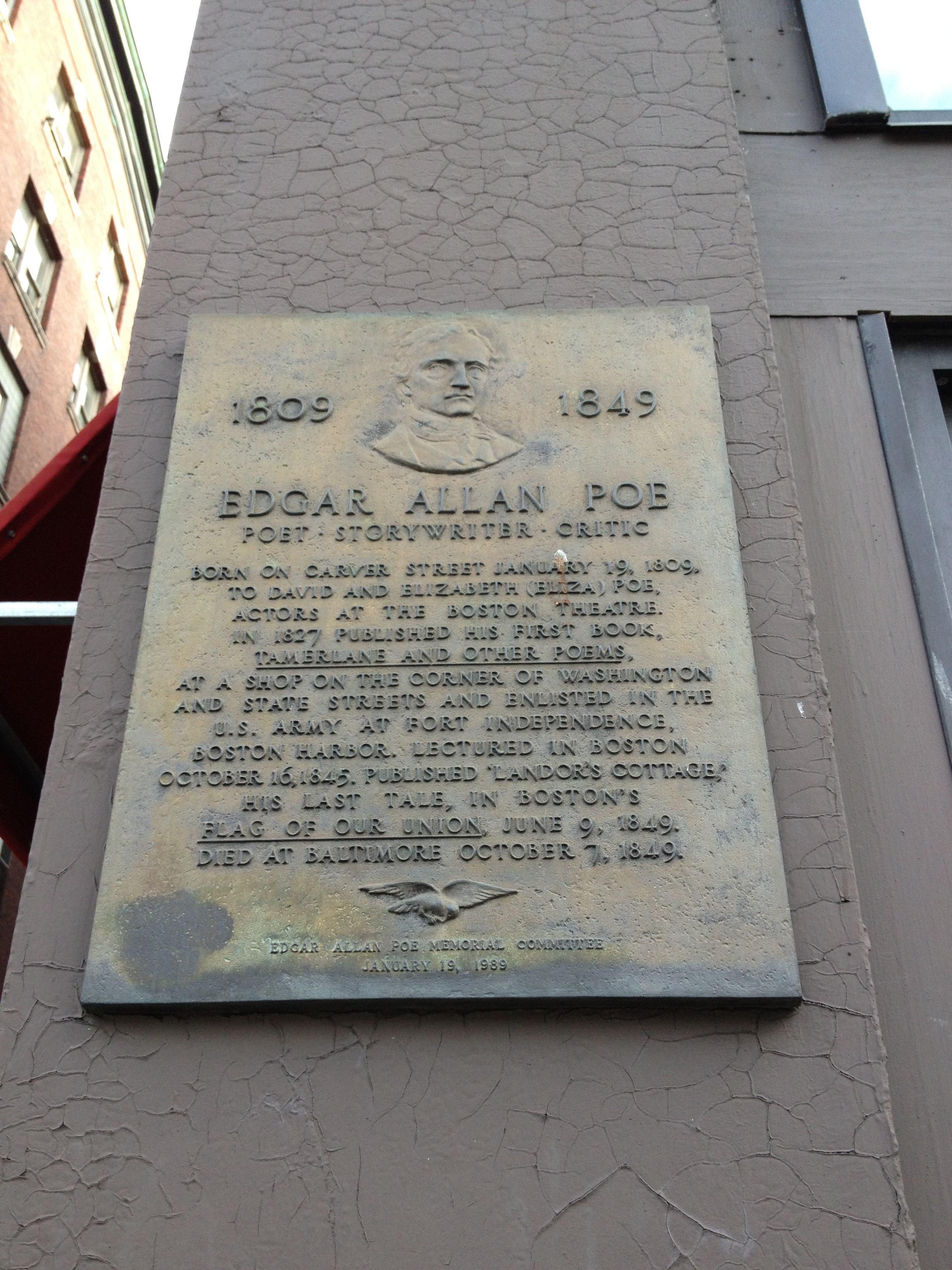
Apart from sharing a “middle” name, I would never dare compare myself to Edgar Allan Poe. Yes, I dabble in the literary arts, but every acolyte recognizes a true priest when he sees one. So as my train pulled into Boston, a city that has deep emotional resonances for me, I decided to stop and see where Edgar Allan Poe was born. The actual site is now a parking structure, an unexpected parallel between our emerging universes. All of my childhood homes, with one exception, are now parking lots. Standing at the foot of the memorial plaque near Emerson College, I reflected on my Poe year. I visited his college room at the University of Virginia in February, his one-time apartment in Philadelphia in March, his burial site in Baltimore in August, and now his birthplace. Not in any chronological order, but a voyage of discovery nevertheless.

This is the essence of pilgrimage. It is not rational and not really practical, but it is something people do. With religious intensity. I am in Boston as part of my secular job, but the city has sacred associations for me. I met my wife here, and that single event has changed my entire life. Boston will always be the place where something extraordinary happened to me. Poe did not like Boston, but for me it is the eternal city. Even the places with negative associations stake claims upon us. Over the weekend a friend posted a picture online taken before combat forced his evacuation from Vietnam many years ago. I kept coming back to that picture throughout the day. Lingering. Staring. Even though I’d never been there, it was like place had the ability to haunt those who’d even dared to look.

Poe and my friend are both writers who’ve drawn me into their worlds. What better way is there to learn that the universe is indeed infinite? Looking out my window at a Kenmore Square I recognize only by the giant Citgo sign that shed its garish light on many an evocative student night, I realize even eternal cities change. The last time I was in South Station I was saying goodbye to the woman I hoped, but did not know, would become my wife. Almost as if on cue, ” Lola” by the Kinks spills out of a local store as the Citgo sign flickers to life over the scene of my coming of age. In Boston I will always be twenty-three, wars will be long over, and Poe will remain alive forever.


Traces in Between

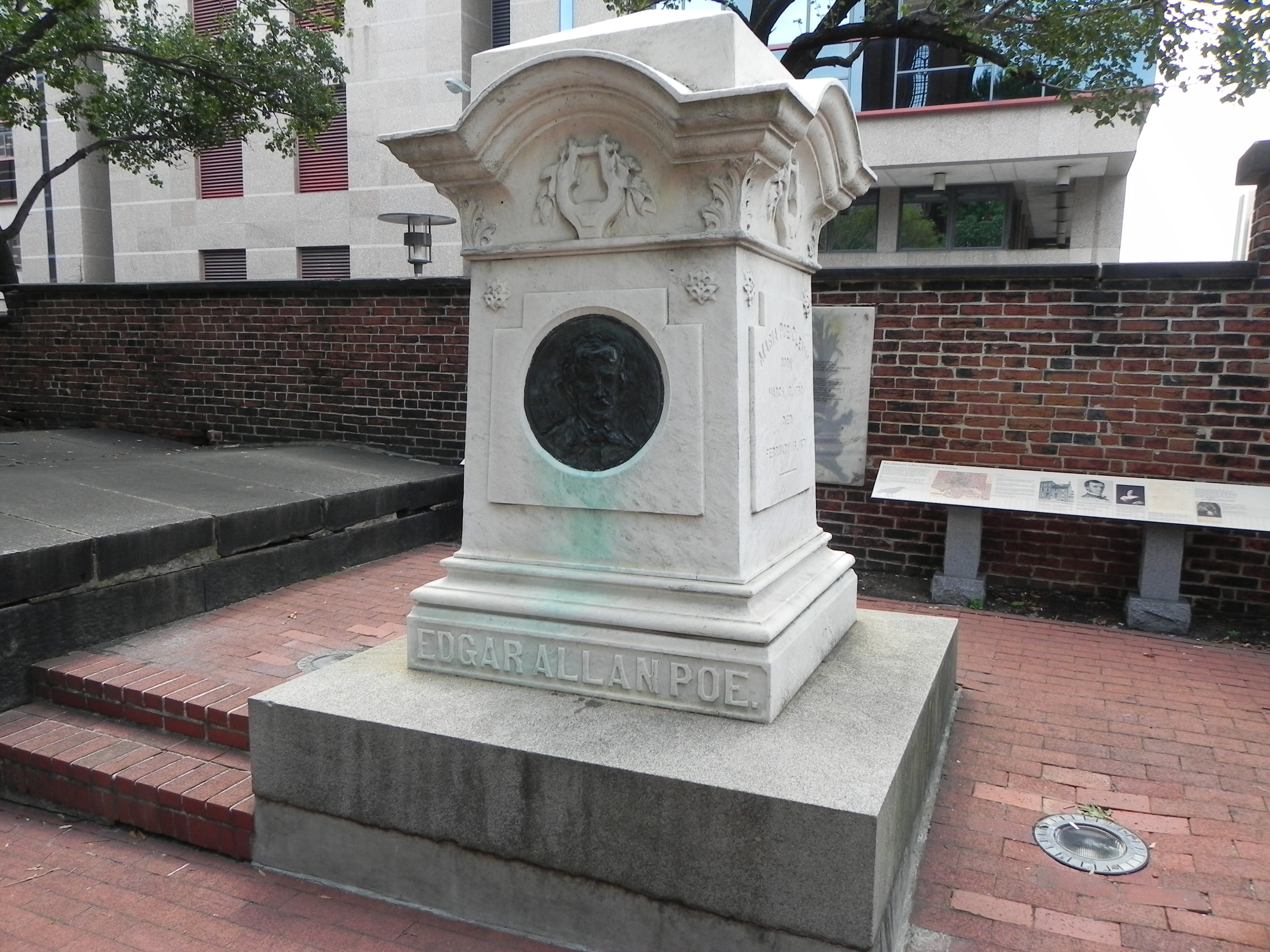
I first discovered Edgar Allan Poe as an adolescent who believed monster movies actually represented physical malefactors. By the time I was writing high school term papers, Poe had become my favorite author, and I delved a bit into his sad life story. It has taken a few decades for me to realize that no lives really fit into the prepackaged paradigms that we’re sold. We think of Poe as a writer, but he was also a man who wandered from place to place, dying in Baltimore and nobody really knows why he was even there at the time. Sure, he had lived in Baltimore fourteen years earlier, but his fractured career had taken him many places in between. Having nothing but his published writings and gut feelings to go on, it seems to me that Poe was a man who felt unconnected to any single place. His view of the world made others uncomfortable, as even a cursory reading of his obituary demonstrates. He may have been attempting to find a place to belong. Maybe that’s why I’m standing here in Baltimore next to his burial place.

In a world characterized by xenophobia, having a sense of place can be a matter of life and death. I often wondered, as a child, at the fact that I was born in a different state than either of my parents, and that my mother was born in a different state than either of hers. Where was my place? I really didn’t start to travel until attending seminary, and since then I’ve lived in many places. At times I think of Poe and his peregrinations—not that I would dare compare myself to him; Poe was a genius in a world that couldn’t understand him. I am merely a disciple.

On a recent college-visiting trip, I found myself in Charlottesville, Virginia, where Poe spent a few weeks as a student before being forced out by his debts. Later that day I was in Baltimore, and I could not neglect a stop to pay my profound respects. Throughout my life I have felt a connection with writers whose work I admire. Perhaps as an erstwhile dabbler in the literary arts I feel as though I might somehow connect to the guild. The sense of knowing, I realize rationally, is entirely one-sided. Standing here in Westminster Cemetery, however, feels like being in the presence of a friend. Even had I lived in the nineteenth century I would unlikely have ever met Poe, just as I am unlikely to meet most of the authors I read who still walk among us. Maybe I just feel no fear of rejection—call it a sense of place—among the deceased, unquiet spirit who is Edgar Allan Poe.


Jefferson’s Legacy

With the gears grinding in the political machine and candidates for the GOP nomination each trying to show they are more righteous than the others, the name of Thomas Jefferson gets used quite a bit. Jefferson’s famous Bible, literally cut-and-pasted together by one of our better presidents, removed miracles from the picture, and Jefferson’s writings leave open the question of whether Deist or Atheist is a more accurate description. I’m in Charlottesville, Virginia right now, home of that paean to Jefferson, the University of Virginia. For a state university, UVA has perhaps the largest religion department in the country. I noted with some irony, that the religion department is housed just above the political science department in Gibson Hall. While waiting for my first appointment, I sat in an alcove where two students began talking about politics. (This was in the religion department.) My chagrin grew as my grin faded with their lament about how poor the Republican candidates are, “but we have to get Obama out of the White House.” In order to do so, they’d elect a man whom they believe unqualified for the office.

Winston Churchill is often quoted as saying a person who doesn’t start out as a liberal has no heart, but who remains a liberal as an adult has no brain—or some such nonsense. The fact is, compassion never should go out of style. It seems to me that somebody changed the terms and what they mean. “Conservative” used to equate to a fiscal position that, while it favored the wealthy, still had sympathy—or even empathy—for those less well-off built in. Now it has come to define “selfish disregard of those different than me.” We see it all the time, not just in political speeches, but in acts passed in the name of Christianity. Jefferson’s Bible is being trampled underfoot. And we are told repeatedly that America was founded as a Christian nation. Of the students discussing politics here, the more conservative of the two was the woman.

Does she not realize that without the liberalizing tendencies of the suffragettes her own future would be limited? That does not excuse in any way the patriarchy that made suffrage necessary in the first place, but it does speak to how quickly we are taught to forget. Even in the land of Jefferson, there are those who would protect privilege and call it divinity. “It does me no injury for my neighbor to say there are twenty gods, or no god. It neither picks my pocket nor breaks my leg.” The words of Thomas Jefferson. In our great universities those who actually do learn are sometimes taught that empathy is weakness and fiscal gain is god. Unless it’s an election year. With great wealth going into the carnival we call the nomination process, we might legitimately ask what’s to become of us if those with no empathy are elected. After all, what are we, apes?

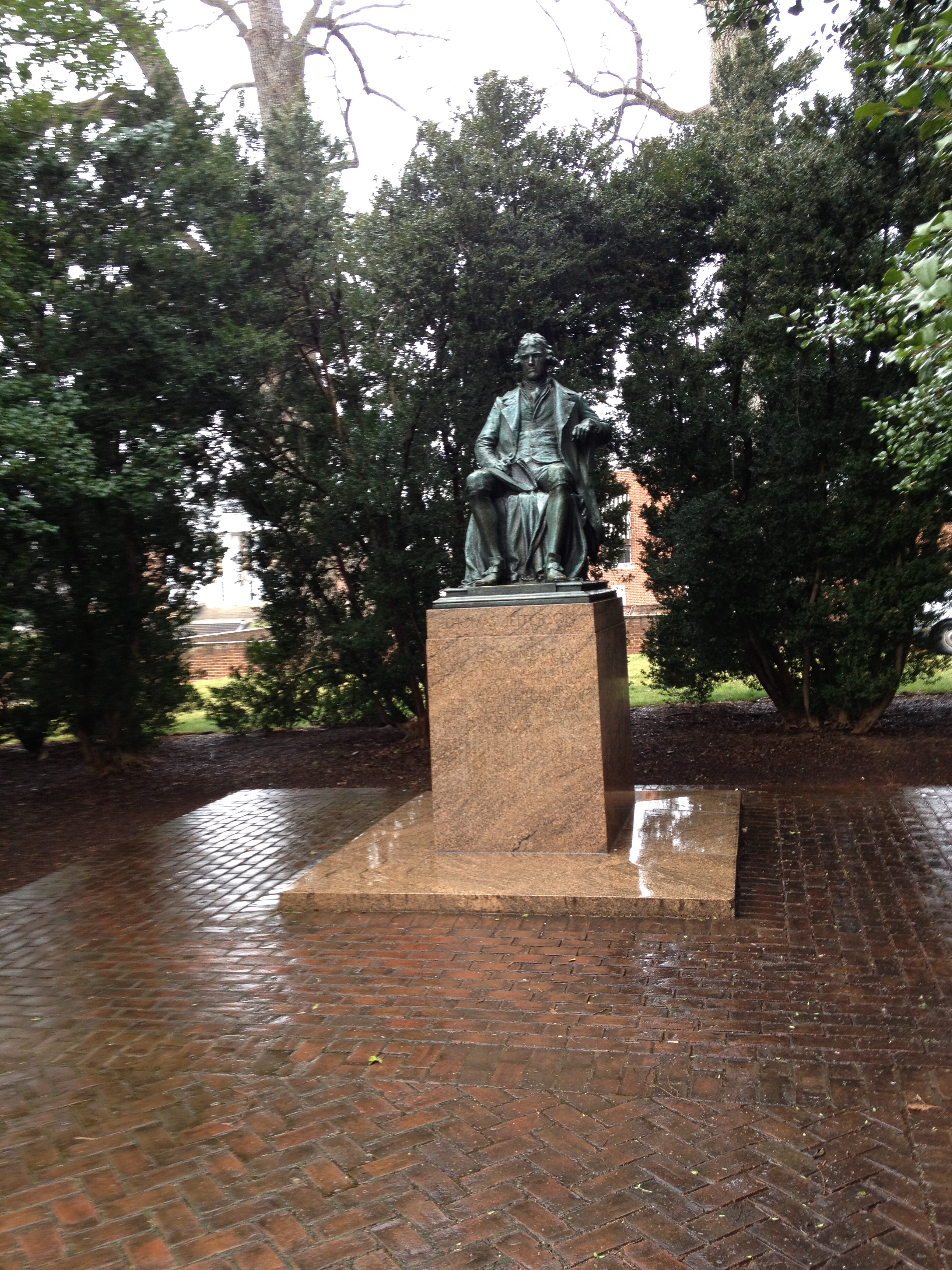
One of the few presidents worth casting in bronze