
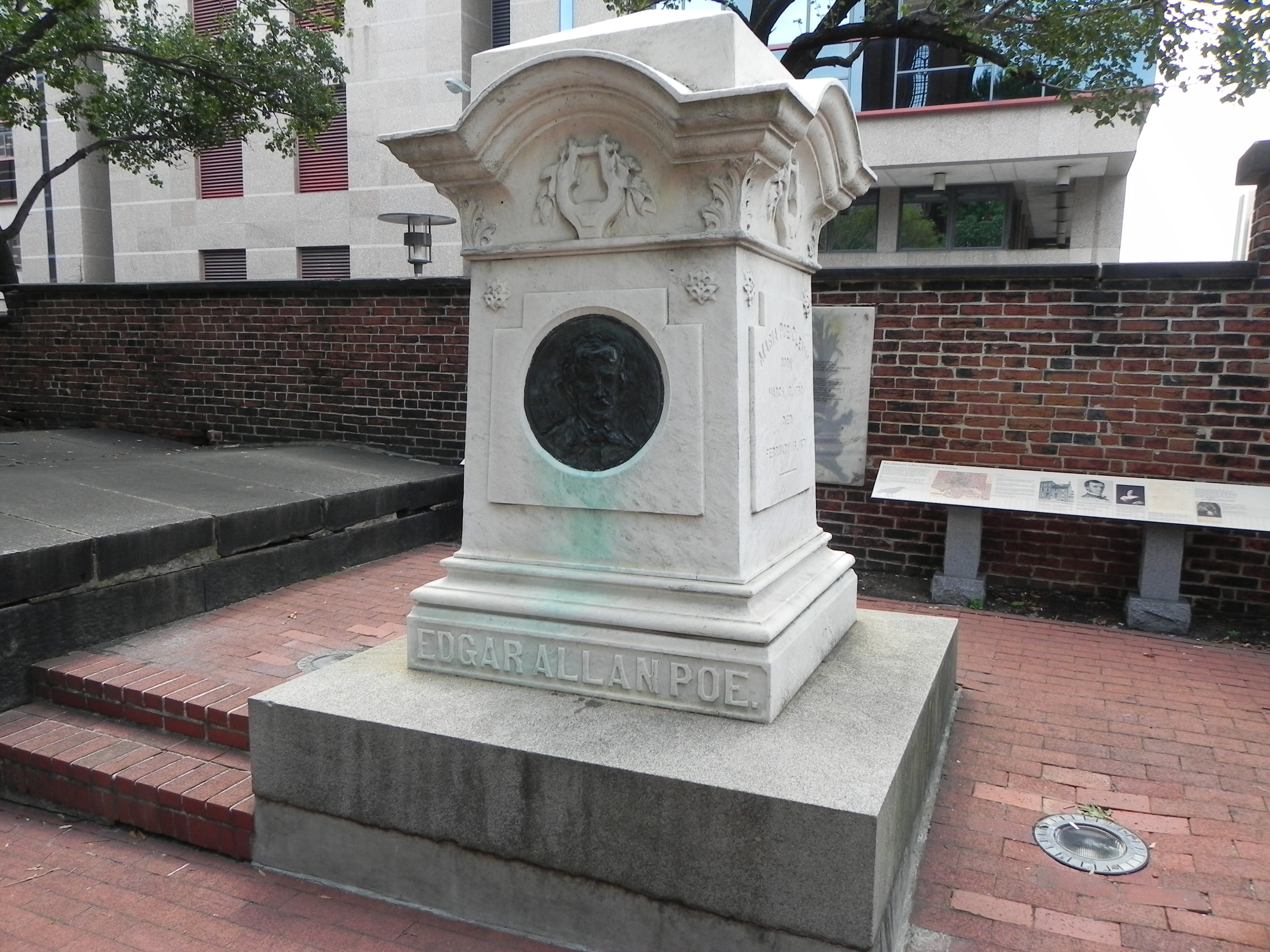
I first discovered Edgar Allan Poe as an adolescent who believed monster movies actually represented physical malefactors. By the time I was writing high school term papers, Poe had become my favorite author, and I delved a bit into his sad life story. It has taken a few decades for me to realize that no lives really fit into the prepackaged paradigms that we’re sold. We think of Poe as a writer, but he was also a man who wandered from place to place, dying in Baltimore and nobody really knows why he was even there at the time. Sure, he had lived in Baltimore fourteen years earlier, but his fractured career had taken him many places in between. Having nothing but his published writings and gut feelings to go on, it seems to me that Poe was a man who felt unconnected to any single place. His view of the world made others uncomfortable, as even a cursory reading of his obituary demonstrates. He may have been attempting to find a place to belong. Maybe that’s why I’m standing here in Baltimore next to his burial place.
In a world characterized by xenophobia, having a sense of place can be a matter of life and death. I often wondered, as a child, at the fact that I was born in a different state than either of my parents, and that my mother was born in a different state than either of hers. Where was my place? I really didn’t start to travel until attending seminary, and since then I’ve lived in many places. At times I think of Poe and his peregrinations—not that I would dare compare myself to him; Poe was a genius in a world that couldn’t understand him. I am merely a disciple.
On a recent college-visiting trip, I found myself in Charlottesville, Virginia, where Poe spent a few weeks as a student before being forced out by his debts. Later that day I was in Baltimore, and I could not neglect a stop to pay my profound respects. Throughout my life I have felt a connection with writers whose work I admire. Perhaps as an erstwhile dabbler in the literary arts I feel as though I might somehow connect to the guild. The sense of knowing, I realize rationally, is entirely one-sided. Standing here in Westminster Cemetery, however, feels like being in the presence of a friend. Even had I lived in the nineteenth century I would unlikely have ever met Poe, just as I am unlikely to meet most of the authors I read who still walk among us. Maybe I just feel no fear of rejection—call it a sense of place—among the deceased, unquiet spirit who is Edgar Allan Poe.


2 thoughts on “Traces in Between”