
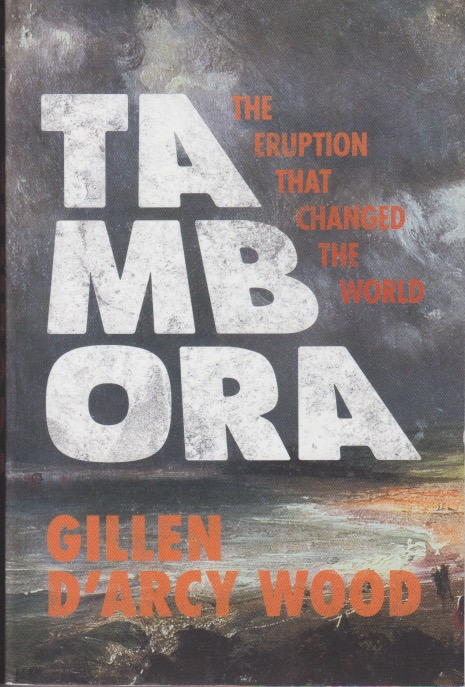
Despite the many books on Tambora, it surprisingly gets little press. Of the volumes on the volcano I’ve read, Gillen D’Arcy Wood’s Tambora has been the best. He, like many others, makes a case for the world-changing impact of that eruption that led to “the year without a summer” in 1816. Knock-on effects remain with us to this day. Wood also throws in a good bit of concern about our current climate crisis. As he points out, the volcanic aerosols of Tambora remained in the stratosphere for three years (leading to three chilly summers), but our current carbon emissions, on-going, have no end in sight. We all already know that weather has become more extreme. As I write this, family members in Europe are experiencing 100-degree temperatures that used to be unheard of on that continent. We’ve seen hurricanes increase in intensity, and have had our own erratic weather for a few years now. The atmosphere’s too large for us to predict just who might receive the God-like wrath of the weather.
Wood uses Mary Shelley’s Frankenstein both as an illustration of the year without a summer and as the atmospheric monster we’ve created. He also narrates other historical events brought on by the temporary change in climate in the eighteen-teens. One of them was the breaking up of Arctic ice that led to the ill-fated Franklin expedition many years later. (I was unintentionally also reading Dan Simmon’s The Terror even as I read Wood’s chapter about the expedition.) More than that, this book describes the typhoid outbreak and pandemic that followed on from erratic weather in South Asia. And deadly changes in parts of China. The disaster of the breaking of the Giétro glacial ice dam, and an earlier famine in Ireland fueled by British hostility toward the Irish, as well as Tambora’s weather.
The developments that grew out of the human response to the changed climate caused by Tambora led to many institutions still with us. Governments, slowly, of course, realized that disaster preparedness and care for the working class were necessary for any nation to remain strong. The privileged lose said privilege when there’s nobody else left to compare it with. (Capitalism has blood all over its hands.) Overall, this is a provocative book making the case that the world we recognize today evolved this way largely in response to an environmental crisis that occurred before steam engines had been invented, when sails drove shipping and horses drew vehicles. When a single volcano changed everything. And although we should learn from such things, being what we are, we tend to overlook that largest volcanic eruption in recorded human history.

