Summer of Horror

Summer vacation—or at least what used to be known as summer vacation—is winding down.  Unlike most years when the season is marked by a carefree sense of time off and travel, many of us spent it locked down while the Republicans have used revisionist history on the pandemic, claiming against all facts that America handled it best.  Is it any wonder some of us turned to horror to cope?  My latest piece in Horror Homeroom has just appeared (you can read it here).  It’s on the movie Burnt Offerings.  The movie is set in summer with its denouement coming just as vacation time ends.  I’ve written about it here before, so what I’d like to mull over just now is transitions.  The end of summer is traditionally when minds turn to hauntings.
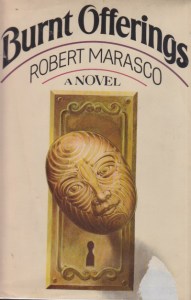
Doing the various household repairs that summer affords the time and weather for, I was recently masked up and in Lowe’s.  Although it was only mid-August at the time, Halloween decorations were prominent.  Since this pandemic—which the GOP claims isn’t really happening—has tanked the economy, many are hoping that Halloween spending (which has been growing for years) will help.  My own guess is that plague doctor costumes will be popular this year.  Unlike the Christmas decorations that we’ll see beginning to appear in October (for we go from spending holiday to spending holiday) I don’t mind seeing Halloween baubles early.  There is a melancholy feel about the coming harvest and the months of chill and darkness that come with it.  Burnt Offerings isn’t the greatest horror film, but it captures transitions well.  (That’s not the focus of the Horror Homeroom piece.)

Many of us are wondering how it will all unfold.  Some schools have already opened only to close a week or two later.  Those in Republican districts are sacrificing their children (this is the point of the Burnt Offerings piece) in order to pretend that 45’s fantasy land is the reality.  The wheels of the capitalist economy have always been greased with the blood of workers.  (Is it any wonder I watch horror?)  As I step outside for my morning jog I catch a whiff of September in the air, for each season has its own distinct scent.  I also know that until the situation improves it will likely be the last I’ll be outdoors for the day.  It has been a summer of being cooped up and, thankfully, we’ve had movies like Midsommar and Burnt Offerings to help us get through.
Time Slip

Perhaps you’ve noticed it too, or perhaps it’s just something those of us in the strange world between Mac and PC see.  A couple of months ago I noticed something strange: the time clock on my work computer (PC) differed from that on the various Mac devices scattered about the house.  The difference was about a minute, possibly a bit less than that.  PC, symbolically, was running behind Mac time.  Now, I have no idea where either platform gets its data regarding what time it is.  I do know that I never have to set clocks anymore, and that the traditional clocks in the house all have trouble keeping up with electronic time.  Still, it is odd that time signatures that had, for many years been the same are now off by a number of seconds.

Time is a mystery.  We know it’s passing and many of us looked up suddenly a few days ago and said “How did it get to be August?”  A summer without vacations, without the usual markers, has silently and sickly slipped by.  We’re all waiting for something undefined, and time has begun to slip.  The phrase always makes me think of “The Time Warp,” and that may be more appropriate than I realize.  We live by the clock.  My jeremiad—surely not mine alone—is that I never have enough time.  The pandemic and its endless Zoom meetings have taken much of what had been a quiet, if time-stressed, life and made it a very busy time-starved life.  Meanwhile HR measures your loyalty by the hour and minute and many of us therefore overcompensate.  “Time,” Morpheus says, “is always against us.”

So you can see why I’m concerned about that missing minute.  There’s a question as to who owns it, but still, it’s another busy moment to slip into a life with barely enough time as it is.  If I perchance glance at my phone during work hours I notice the discrepancy.  Can we not agree about what time it is?  Businesses, of course, like the more conservative PC image.  Many creative types prefer the freedom and ease of use of Macs, particularly those of us who learned the computer world on one.  And since conservatives drive with a foot on the brakes it does make me wonder if they’re slowing down time or Apple is speeding it up.  The end result is the same—we don’t know what time it is anymore.  A deeply divided society can’t even agree on that, it seems.


Almost Ancestors

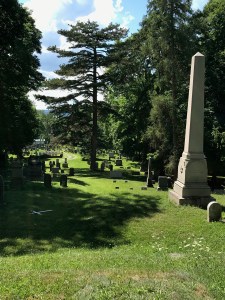
During the Covid-19 crisis, cemeteries seem to be safe places.  Not too many people are in them, at least not people that can spread the virus, and they always provide grounds for rumination.  Besides, being outdoor spaces they can get you someplace outside the same four walls you see all the time.  My wife and I both have an interest in genealogy.  We’ve worked on our family trees and even try to keep our Reunion software up-to-date.  This past weekend we visited a family burial plot in upstate New York.  My wife’s family has a more accomplished pedigree than mine does, and one of her ancestors here actually merited an obelisk and was written up in local histories as a noteworthy member of the community.  I also have ancestry in upstate, and we’ve traveled to some of their sites in the past, although their markers are usually harder to find.

Being in a cemetery, the logic of ancestor worship suggests itself.  Without these people history as we know it would’ve been different.  Without those who are our direct ancestors we wouldn’t even be here pondering our own insignificance.  We wish these headstones could talk, saying more than the names, vital dates, and perhaps a quote from the Bible.  We listen, hoping to gain knowledge of who they were.  It seems to me that cemetery histories would be a boon to genealogists.  For those of us whose predecessors were buried in small towns, such guides could be a real boon.  As it is, Find A Grave dot com is often a helpful resource, but who wouldn’t like to be written up in an actual book?  Network reception often isn’t great out here in rural America.

Graveyards are gateways to the past.  In a world that feels like it’s changing way too fast, it seems right to have these places—these sanctuaries—to stop and reflect.  They represent lives lived.  Peaceful after the trauma of day-to-day angst and struggle.  Unfortunately the pandemic is daily adding to the number of those who’ll be buried in cemeteries across the nation and around the world.  Although somewhat preventable, we have no national will to stop the tragedy.  So it is I find myself staring at a monument erected to someone I never knew, but without whom my life would’ve been vastly different.  It’s a sunny day and I’m outside amid a crowd that can cause me no harm, but who, at times like this, inspire me. 


Enough

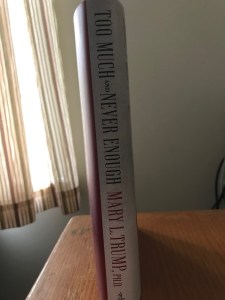
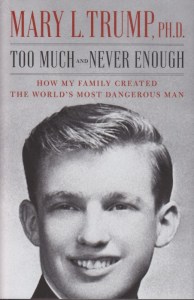
Stories of the wealthy never interest me unless they have a mysterious, ageless cousin who’s really a vampire.  Unfortunately fantasy can’t save us from the reality of a once great nation that’s now crumbling.  As I wrote earlier on this particular book, we already know, at some level, what it says.  Mary L. Trump, who alone has courage among her family, exposes quite a lot in Too Much and Never Enough: How My Family Created the World’s Most Dangerous Man.  There’s no point in ascribing blame for deeds done.  I also fear there’s no hope that justice will ever be served in this case.  Dysfunctional families are all too real and all too common.  Some of the traits (but none of the money) from Fred Trump’s cruelty were as familiar to me as my own childhood.  A powerful, overbearing stepfather riddled with a sense of his own inadequacy, taking it out in his own empire within the walls of his house.  The damaged children it leaves behind, each struggling to cope in their own way.

The family Fred Trump raised was bound to become damaged goods.  It is to the everlasting shame of the Republican Party that it could come up with no other viable candidate for the highest office in the land.  Not so long ago I would’ve written “world,” by that day’s gone past us.  Not only did “the party” accept his nomination, it has enabled him, as Mary Trump shows, every step of the way.  Knowing that something is deeply wrong—that more people will have to die in this country of Covid-19 than anywhere else, just to stoke one man’s ego—and refusing to act should be a sin in anybody’s book.  Who still emerges as his defender?  The Evangelical.  This mess is so convoluted that it will take historians (presuming anyone survives it) decades to try to unravel it.  That’s because nobody in the GOP has any empathy for those already born.  Strange form of “Christianity,” that.

This book is a depressing read.  Still, I’m glad I did it.  Not that it will change much.  Those who are psychologically like Trump, incapable of distinguishing truth from fiction, will say it’s all lies.  You can always play that card.  There are facts, however, and they are recorded.  Those who are able to weigh evidence know (and already knew) that a dangerous man had been coddled by a dangerous party that puts self-interest over nation.  You know, I think there may be a vampire in this story after all, but I just don’t have the heart to look any further.


Narrow Passage

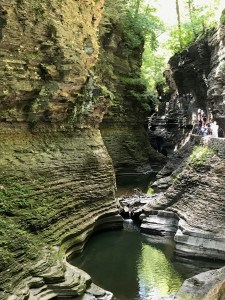
While on a rare family visit (it’s scary to get out too much) we visited Watkins Glen State Park in upstate New York.  My mother’s family has roots in this area, and we’ve visited it several times in the past.  There are always people there, but in manageable numbers.  The website declared it was mandatory to wear a mask (“New York tough”!) and to keep social distancing.  It perhaps didn’t help that we went during a heat wave when a walk along a waterfall-laced path seemed like a refreshing idea.  I guess I had in my head the modest crowds we’d encountered in our many past visits.  We were, however, not the only tourists (although somewhat local) with that particular plan.  Not by any metric I can conceive.

If you’ve never been to Watkins Glen, the park has a Civilian Conservation Corp-built stairway and trail (approximately 600 stairs) through a glacial and water-cut gorge.  The sedimentary layers are fascinating for anyone with an interest in geology and for those who like to ponder the millions of years required for the laying down and lifting up of multiple bedding planes.  The gorge itself has a curvilinear appeal that is almost mystical.  Waterfalls produce negative ions which, everyone knows, tend to make people happy.  I was, however, more on the terrified side of the spectrum.  It became clear even before we reached the gorge that there were hundreds of people already in the park.  Most of them unmasked.  Large crowds gathered around the more picturesque waterfalls, blocking the narrow walkways.  Tourists have no idea what “six feet” might possibly mean.  Stair-climbing is an aerobic exercise, and wearing a mask in such circumstances is the only smart thing to do.

While on the considerably less crowded trails of the Pennsylvania outdoors venues we more commonly frequent, I’m nervous when someone walks even more than six feet away in the opposite direction.  This felt like a nightmare to me.  Too many people paying too little heed to the mandated caution.  I’ll be quarantining myself for two weeks for sure.  Maybe more.  I don’t get out much in any case, but even though we were obstructing our view through cloudy glasses and trying to get adequate oxygen through made-to-specification cloth masks, there’s only so much that prophylactics can do.  I jog at first light to avoid other health nuts on the local trails.  I go to stores only for necessities.  Being in a canyon with the careless invincibles inspired less than confidence in this petrified pilgrim.  Knowing human nature, it seems closing popular state parks until people get smart may be the best way out of a tight squeeze.


Virtual Bible Study

Like just about everybody else, I spend my days online during the pandemic.  Well, actually, I spent my days online before that since I’m a remote worker.  Even before that, when spending a considerable part of each day commuting to and from New York City, once I got there I’d sit in a cubicle and work online all day anyway.  To borrow a tagline, the truth is out there.  Somewhere on the internet, I think.  Probably on the deep web, but I understand that’s a scary place.  I’m not sure why it is that I started receiving email ads for something called Virtual Bible Study.  I suppose I spend enough time, and my computer eats enough cookies on Bible Gateway that the Virtual Bible Study people think I’m the typical customer.  

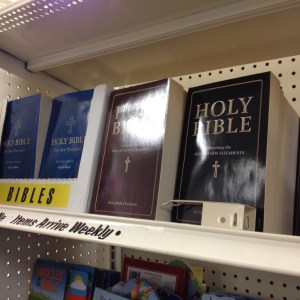
Having led many Bible studies in my life, and having taught biblical studies professionally, I’m aware that you can never learn it all.  Indeed, biblical study is the original never-ending story.  Stay with it long enough and you’ll earn plenty of enemies.  Recently my mother was telling me that she’s doing a Bible Study where you follow a schedule and read the “liner notes” that come with a particular curriculum.  She mentioned to me that she was having trouble with Deuteronomy 28.  It’s a chapter with which I’m quite familiar.  I remember reading it as a young person and being terror-struck by it (those who wonder what horror might have to do with the Good Book ought to read it.  Go ahead, I’ll wait.  You can find it on Bible Gateway.).  This is one of those places where God spells out the blessings (somewhat limited) for obedience and the curses (very many) for failure.  The list is long and terrible.  I’m not a chapter-and-verse citer, but from my very first read-through of the Bible I could tell you what was in Deuteronomy 28.  It was burned into my memory.

I do have to wonder about the efficacy of online Bible Study.  I sure do appreciate not having to look everything up in a print concordance any more.  That was quite a time-consuming activity and you needed to be very familiar with the particular version you were using to make it work.  I know I grouse a bit about technology on this blog, but given my vocation, and avocation, I sure like having Google on my side when I need to look up a verse that I can only partially recall.  I do have to wonder, however, since the truth is out there, whether anybody’s found a good way to comfort their elders who get stuck on the curses that essentially wrap up the covenant in good old Deuteronomy.

Virtually the Bible


November Dreaming

I recently took part in a non-partisan postcard-writing effort sponsored by Moms Rising.  The idea is simple enough: encourage people to get out and vote.  Such is the state of our country that some people see this as a liberal agenda.  An anti-patriotic act.  Who would object to people voting (apart from the Republican Party, that is)?  Apparently we’re now simply supposed to accept what the present administration hands down, including its desire to retain power legally or illegally.  Those who suggest that people should be given their constitutional voices are considered radicals.  This would be ironic were it not so dangerous.  The only reason the powers that be are in office is because of an election, and one that was “won” by that gaming of the system known as the electoral college.  Now that Covid-19 is ravaging our country, those who refuse to do anything about it want to strengthen their grip.  And their followers blindly say “Amen.”

Postcard writing does not involve telling the potential electorate whom to choose.  The message we’re instructed to write is simply encouraging others to vote.  Gerrymandering and making people stand in Covid-laced long lines have been “tactics” used by current supporters of the modern-day plague to keep their hold on power.  When trying to get people to vote is considered an act of sedition we need to stop and think what democracy has become.  If you don’t believe everyone should vote then you have no right to object—your voice is your vote.  I stand with Moms Rising to test the room.  Let’s see if what’s happening here is really the will of the people.  And I don’t mean that house of lower education, the so-called electoral college.

If you’re inclined to help with the effort, all it costs is a little time.  Check out Moms Rising’s website.  They’ll send you a packet of postcards for free with a postage-paid envelope to mail them back.  All you need to do is write a sentence or two in the blank space on the back, put the cards in the envelope, and drop it in a mailbox.  It costs so little and so much is at stake.  Time is a commodity, I know.  Given that our time is running out, however, it seems that sparing a bit of it to keep democracy breathing is important.  No— vital.  My regular readers know how I often express my wish/need for just a little more time to accomplish what I’d like to squeeze into a day.  I’ll gladly sacrifice ten minutes for the good of the country I call home.


Everybody Knows

One of my favorite Leonard Cohen songs is “Everybody Knows.”  On a related note, the best-selling book in America last week was Mary Trump’s Too Much and Never Enough: How My Family Created the World’s Most Dangerous Man.  With the publisher citing 900,000 copies sold upon release, it produced numbers that most publishing houses only dream of.  I’d preordered it on Amazon but for the first time ever I did not have a copy on the day of release.  There were a lot of people ahead of me in this line.  That’s even more remarkable than it sounds because we all pretty much know what the book says.  We also know that its subtitle is true: we have a very dangerous man (daily rising Covid deaths show this to be true) given free rein by Republican senators.  Even adults without high school educations that I talk to know there is something seriously wrong.  Indeed, anyone who knows how to fact-check can see it.

A very popular way to deal with inconvenient truths is to posit a conspiracy theory.  Evangelicals (now defined as Trump supporters) have long used conspiracies as ways of explaining how facts simply don’t support their views.  From the moment “alternative facts” left the lips of the administration in January 2017 I knew we were in deep, deep trouble.  Funny thing is, many Evangelicals had to read Orwell in school, like the rest of us.  How they could support anyone that had such a long, long track record of criminal cases against him before placing his hand on the Bible and swearing to uphold a constitution he’s been daily dismantling since is anybody’s guess.  Daily life, it seems, is now a conspiracy.  

One of my favorite Leonard Cohen songs is “Everybody Knows.”  The lyrics suggest that whatever it is we want to keep secret everybody, well, knows.  That’s what’s so distressing about America’s current decline.  Everybody knows that being president is a very difficult position and that it’s only handled adequately by well-trained and smart people who, despite their faults, put country above self.  With the election of 2016 it was clear from even before day one that ego was the driving factor behind 45.  Americans love their outrageous television personalities and somehow think that appeal on the small screen somehow translates to leadership ability.  We’ve learned before that this isn’t true.  I haven’t read Mary Trump’s book yet—it just arrived in the mail—but when I do I’m sure I’ll find out what everybody knows.


Missing Markers

Something truly remarkable happened this week.  The Society of Biblical Literature, which, along with the American Academy of Religion, meets annually in November, has canceled its in-person meeting.  I’ve been attending this conference since 1991 (with a few years off for good behavior).  It always meets the weekend before Thanksgiving, stretching to the Tuesday prior.  Some academics use the meeting to have an exotic Thanksgiving break with their families, particularly when it congregates someplace warm.  (It was scheduled for Boston this year.)  So I’m ruminating what this will mean for a year of missing markers.  Some of you may recall I missed two years ago, electing to stay in Newark Airport instead, but this is different.  We’re all being changed by this virus.

Missing markers.  That’s what my wife calls it.  March 12 was the day that Covid-19 became a crisis.  In my extended family that’s in the middle of birthday season.  Travel plans had to be altered.  Trips to see loved ones had to be delayed.  Then cancelled.  Memorial Day came and went.  It was a long weekend, but for most of us it was a long weekend at home.  Our usual summer trip to the lake was also a victim.  A remote lake may be the safest place to be, but you have to get there.  Flying doesn’t seem safe and we don’t have enough vacation days to drive all the way out and back.  Here we are halfway through the summer and each day feels pretty much like the one before, even if it’s a day off work.  Time seems out of whack.  Back in April it was hard to believe it was still 2020, now it’s difficult to comprehend that the year’s more than half over and there will be no AAR/SBL in November.

Growing tired of the phrase “unprecedented times,” I prefer “missing markers.”  Yes, the weather’s still doing its time-keeping job.  This summer has been quite hot around here, for the most part.  I remember shivering in my study sometime not so long ago, bundled up in layers and thinking that when summer rolled around this coronavirus would be a bad memory.  If only there were something governments could do to keep people safe.  If only there were people in the White House who cared.  I had visions of professors, hundreds and hundreds of them, wearing masks with their tweed.  It was a vision of wonder.  They’d walk up to you, extending an elbow to bump, but you’d back off.  That’s actually too close.  And lecturing spreads germs very effectively.  Over time 2020 itself will become a marker.  I’m not sure anyone will miss it, however.


Like an Egyptian

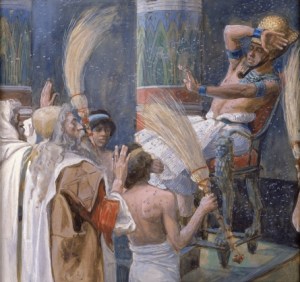
“And Pharaoh’s servants said unto him, How long shall this man be a snare unto us? let the men go, that they may serve the Lord their God: knowest thou not yet that Egypt is destroyed?”  The words are from the Good Book.  Specifically Exodus 10.7.  They’ve been on my mind as the coronavirus is beginning to yield in all developed nations but our own.  Let me set the scene: the Israelites have become slaves in Egypt.  Moses was sent to set them free, but a Trumpian Pharaoh stood in the way.  Plague after plague was sent, but the president, er, I mean Pharaoh, refused to acknowledge what the evidence indicated.  Moses would appear before the senate and declare the coming disaster.  In the mythical world of the Bible, though, the senate actually saw reason.

“Knows thou not yet that Egypt is destroyed?”  Instead of addressing the Covid-19 crisis the White House has decided to turn a blind eye.  Nearly one-fourth of the worldwide cases of the disease are recorded in the United States.  In the past week several record-setting days of new case numbers were set even as the administration was insisting that schools be opened without any plans, or even ideas about how to help.  “Have them make bricks without straw,” you could almost hear echoing around the Oval Office.  Ah, indeed, this is the most biblical of administrations.  Our economy has been tanked for years to come.  The environment has been degraded to the point of disaster.  And yet Moses is ignored.  The real plague was the Pharaoh.

“This is the finger of science!”

Exodus is a story of liberation.  What’s more, according to the Good Book, God himself wanted Israel to be set free.  The Pharaoh, it seems, was not personally afflicted with the plagues until the darkness fell.  Prior to that, if it didn’t affect him personally he simply didn’t care.  Too many self-aggrandizing monuments to be built to his own name.  Ancient Egypt was like that.  Meanwhile plagues brought the mightiest nation of the time to its knees.  Beyond that.  It brought them prone.  Most of us, I expect, are ready to get on with life.  We’ve been self-isolating for over three months and yet the number of cases continues to increase.  We could use a word or two of guidance from a sympathetic leader.  Instead we’re entering hurricane season.  I can’t speak for anyone else, but I’ve got my Bible all ready.  And right now it’s open to Exodus.  


Layers of Brick

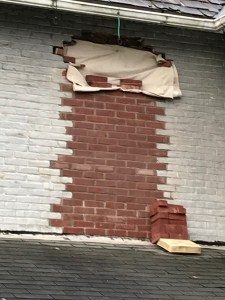
If, like me, you can’t see a neighbor’s brickwork without thinking of “A Cask of Amontillado,” then I need not explain why I watch horror films.  I know that as of late some literary scholars have challenged the idea that Edgar Allan Poe wrote horror.  There is now, and always has been, a bias against the genre.  In fact, many would point out that Rod Serling’s Twilight Zone wasn’t really horror, no matter how creepy some of the episodes were.  Some would cast Ray Bradbury into that lot as well, and others would not.  I spend a lot of time pondering this because those of us who enjoy some of what’s called horror are often cast as misfits.  And misfits have a lot in common with monsters.

The connection with religion is a palpable, yet intangible one.  It does seem that religion has its origins in fear and as it branched out it came to have different emphases.  Jesus, for example, apparently stressed love, at least according to the gospel of John.  That religion of love came, eventually, back around to fear.  Calvinism, especially, is suffused with it.  There’s a reason that it is the religion expressed in particularly effective horror.  Apparently they meet similar needs, but psychology is not an exact science, and our tastes in it differ.  Even our interpretations do so.  As the bricklayer puts down row after row of masonry, the thoughts get walled up in days where work prevents serious consideration of the deeper questions.

It’s been years since I’ve read “A Cask of Amontillado.”  The story has stayed with me, however, whether it’s horror or not.  Stories about imprisonment are like that.  The other day a police car stopped outside our house.  We live in a working-class, but descent neighborhood.  From the bits and pieces glimpses out the window revealed, there was a problem with a car that had been parked on the street for quite a while, and that didn’t belong to any of the local residents.  The natural response to seeing that car just outside was fear.  We fear criminals and we fear the police.  We fear what Covid-19 is doing to us, even to those of us who’ve managed not to contract it.  Traditional religion would tell us punishment comes from the Almighty.  These things are all related.  And across the way the bricklayer keeps up his work, row after row.


Independence Day Wishing

It’s Independence Day and what we most need independence from is our own government.  History is full of ironies.  Federal holidays falling on a Saturday, for instance.  In any case, here we are on the Fourth of July and still stuck under a repressive government that a small portion of people like.  Republican groups supporting Biden are starting to arise, but we can only dream on Independence Day.  Many of us would like to be independent of the coronavirus, and not a few people are acting like we are.  Cases are spiking, so the rest of us are staying indoors.  Fireworks are okay, but I have trouble staying awake until dark these days and more often than not they just keep me awake as I’m starting to doze.

Maybe for Independence Day I’ll take leave of reality.  Maybe I’ll imagine a government that isn’t so utterly corrupt that some people might have some faith in it.  Maybe I’ll dream that black lives matter and that our leaders would believe it.  Maybe I’ll think what it would have been like if caring officials addressed the Covid-19 crisis directly instead of brushing it off, so that like all well-run nations cases would be going down here instead of back up.  There’s so many possibilities and the one thing they all have in common is that they point to independence from the Trump Administration, if that’s what it can be called.  Maybe it’s time to light a sparkler of hope.

Independence Day can be a day of looking forward instead of looking back.  If we can look ahead we might see a country where anyone will be allowed to exist and not be condemned by “Christianity.”  We can come to see that privileging any one “class” or “race” or “sexual orientation” is a form of bigotry from which we can and should be independent.  We can try to think what it must be like to experience life from somebody else’s skin.  We can try to understand instead of standing ready to condemn that which is “different.”  Fact is, everyone is different from everyone else, it’s only a matter of degree.  And difference can unite rather than divide.  The whole idea behind uniting different states was that those who were different could support one another and figure out how to make room for everyone to fit.  It won’t be easy to do, but we might use today to envision a country where we can work together, and figure out that leaders who bring people together are the only hope we have for the future.


Insubstantial Reading

Because of the shortness of time, I recently bought an ebook so that I could get it done under deadline.  Although the coronavirus still has book delivery slowed down, things are much improved.  There was a book, however, I absolutely needed to read for my current research that is available only in ebook form.  Sighing, but emboldened by my recent experience, I began reading it electronically.  Shortly after I started my critical faculties kicked in and I began wondering whether the book was fact or fiction.  The author has an internet presence but is seldom addressed by scholars.  I found myself thinking, “if this was a real book, I’d stop right about now and examine my physical copy for clues.”  I’ve done that more than once when it comes to questionable material.  Books, you see, come with built-in indicators of their trustworthiness.

The ebook, however, gives you scant information.  For example, this one has no copyright page.  I may be a publishing geek, but a copyright page is essential for determining what kind of book you’re reading.  Then I would, if this were an actual book, close it and look at the back cover.  There in the upper left I would look for the BISAC (Book Industry Standards and Communications) code.  These are the words that classify the genre and subject of the book for you.  It is often a publishing professional, such as the book’s editor, who assigns the BISAC code, so depending on who the publisher is, you have an accurate description.  This ebook on my Kindle software has no BISAC code.  The publisher itself often tells you something about a volume, but this is a small press without much online information available.

I’m walking you through this because of our current crisis of critical thinking.  With a president unwilling to stick to facts and crying out “fake news” when empirically proven realities don’t match his liking, being able to assess our sources is essential.  Ebooks have eroded the possibilities.  I read esoteric stuff, I admit.  The authors had to have convinced a publisher (and don’t get me started on self-published books!) that their project was viable.  The book in my hands has a number of ways to assess whether it is accurate or not.  The ebook on my lap does not.  I’m working on a longer article on this topic.  Our ability to think critically includes the necessity of assessing the clues as to the nature of our reading material.  Right now I’m reading an ebook stripped of the helpful clues of the print book and fact-checking is limited to Google.  The truth may be out there, but if this were a printed book chances are it would be right in my hands.


Aching Backs

The other day someone mentioned to me (virtually, of course, since real conversation is limited to immediate family) that she was going to the chiropractor.  This simple spinal adjustment comment made me curious since my mother has used a chiropractor to manage back pain for as long as I can remember.  I also had heard many disparaging comments about chiropractors over the years and decided to look up some information.  Medical science, if we can hypostatize it that way, considers chiropractic a pseudoscience.  Part of the reason is that the medical training required to be a chiropractor doesn’t come up to the level of a MD degree.  The main reason, however, as far as I can determine, is that chiropractic was founded on the basis of receiving information from “the other world.”

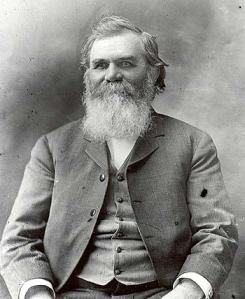
Creator unknown, via Wikimedia Commons

Daniel David Palmer founded chiropractic in the 1890s.  His knowledge of how to do it came from a doctor dead for half a century.  Some of the tenets of chiropractic are spiritual rather than physical.  Not being based on empirical studies going back to such traditional medical ancestors like Galen, the new way of understanding medicine was labeled as a kind of religion—an alternative medicine.  Now, I’m not a medical person.  In fact I’m rather squeamish.  I try not to look too deeply into biology, but this is fascinating.  There are more than 70,000 chiropractors in the United States alone.  If what they are doing doesn’t really help people then why do they keep going back?  Is it a matter of believing that you’ve been helped relieving pain?

Often cost effectiveness is given as the reason people use chiropractors.  In these days of Covid-19 we know that medical practitioners have been on the front lines for many months.  We also know that in the United States many people can’t afford standard medical treatment.  Our government has staunchly refused to nationalize health care, as every other government in developed nations has done, preferring to keep it a free market.  The end result is many people simply can’t afford to go to the doctor.  I don’t know if chiropractic is a pseudoscience or not, but if it provides at least short-term relief for people who can’t afford standard treatment is this a bad thing?  I don’t know much about the topic, but the whole thing seems worthy of further exploration.  Any time the mind in brought in to help heal the body, I suspect, we are knocking on the door of religious thinking.


Letterbox

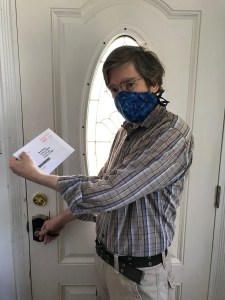
It’s kind of scary.  I mean, I know that Google Maps has everything recorded.  Some family members recounted, a few years back, how they were shown raking the leaves in their yard on street level photographs.  I guess everything’s part of your permanent record now.  What was scary to me was receiving a letter with a picture of my house on the envelope.  Yes, it was from an insurance agency, and insurance thrives on the feeling of vague threat that rattles around our primate brains most of the time.  Is something  or someone out to get me?  Oh no!  They know where I live!  Maybe it was supposed to be friendly, like a good neighbor.  It just didn’t come across that way.  Smile, you’re on Candid Camera.

Not that being recorded doesn’t have its advantages.  We live in an older house, and like most older houses it has had some additions over the decades.  That means the roof is complex.  That complex roof turned out to be leaky also.  When the roofer was trying to explain why he couldn’t do just the one part where the water was getting in (we have been re-roofing on an installment plan), I had trouble imagining it.  You see, when you’ve got neighbors all around it’s pretty tough to get the right angle to examine your own roof.  I googled our address and shifted to satellite mode.  I zoomed in and found the layout of the roof.  Screenshot and save.  Otherwise I don’t think I’d ever have understood how complicated rain deterrence can really be.

But getting a letter in the mail with your own house on it—this seems to cross some kind of line.  Yes, I like our place.  I feel comfortable here.  It’s got space for lots of books.  It isn’t fancy, though.  It still needs quite a lot of work both inside and out.  And I like to spend my scant free time reading.  It’s cheaper than buying all the lumber and tools I need to do things the way they should be done.  Maybe if my job were driving around filming other peoples’ houses I’d make enough to have some contractor come in and fix things up.  But the insurance agent knows where I live now.  Covid-19 probably stops him from knocking at my door, but I do value my privacy.  Like most things, being recorded is a mixed bag.  Who couldn’t use a little extra anxiety once in a while?