Unlikely Heroes

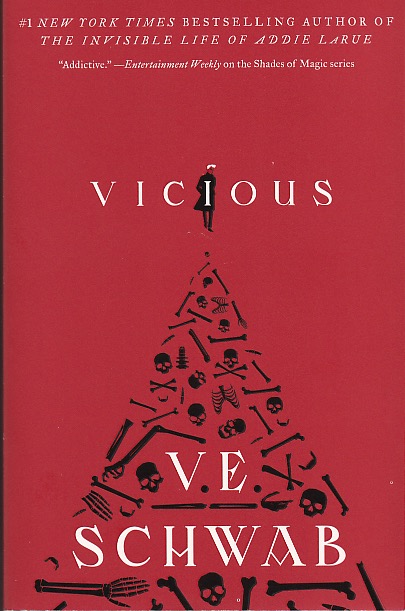
I discovered Vicious by V. E. Schwab on a list of dark academia novels.  I’m glad I did.  The dark academia comes in because the protagonist Victor and antagonist Eli meet in college.  Eli has already stolen Victor’s girlfriend, and he has a thesis idea that postulates EOs (Extra Ordinaries) gain their ability from near death experiences (NDEs).  Determined to prove this, he and Victor try to kill each other, with consent, so that they can be revived to see if they have special abilities.  They do.  Victor’s parents, self-help book writers, have no time for him while Eli is very religious.  They soon become enemies.  Victor’s ability is controlling pain, both his own and that of others.  Eli can heal nearly instantaneously from any injury.  Ten years later Victor is in jail and Eli has become religiously convinced that he has to kill EOs.  He finds a college woman who controls minds and together they get away with murder.

The book is quite well written.   I’ve read plenty of novels that were a plod to get through, but this one never lost my interest.  The tension builds to a pretty high level at some points.  And yes, there is blood.  I think dark academia is an appropriate classification here, and perhaps low fantasy.  There are horror elements, but the abilities of the EOs make it feel like a superhero movie.  Thoughts of The X-Men kept coming back.  In any case, Victor escapes from prison with his cellmate and goes on the hunt for Eli, who’s been systematically murdering EOs because they go against God’s laws.  They discover Sydney who has an ability on which the entire story turns.  With the page-turning power of a thriller, Vicious was a book I always looked forward to picking up again.

I’m not going to give any spoilers here—the novel is well worth reading.  I was intrigued by the way Schwab used the religion angle to motivate the killer.  Those who come back from death, the plot suggests, have something missing that was there before.  This, combined with his religion, gives Eli the motive for killing.  Of course, his morals were problematic to begin with.  Selfish and narcissistic, he ignores Victor’s needs from the beginning.  Even when being saved by the woman who controls minds, he’s never grateful.  Religious but completely oblivious to his own moral failings, he develops a God complex.  This adds a depth to what might otherwise be simply a speculative action story.  With, of course, dark academia stylings.


Everything Theory

Many years ago I read Stephen Hawking’s A Brief History of Time.  More recently in time, I’ve become a fan of dark academia in several of its forms.  One of those forms is the biopic of famous, often challenged, academics.  The Theory of Everything is offered as such a biopic.  The darkness is, of course, Hawking’s Motor Neuron Disease.  The movie was critically acclaimed, and watching it made me think it was from before a time when academia fell under sustained fire from various governments.  So much of what we know of the world, indeed, the universe, derives from those rare individuals paid to pursue the life of the mind and take the rest of us the places they discovered.  In the case of Hawking, it seems that without his tragic disease his fame may well have never taken off.  Few people, in my experience, are really interested in physics or cosmology.

The movie, of course, dramatizes the life of Stephen and Jane Hawking.  It deftly focuses on the dynamics and strains of their relationship.  The academic part also plays a role, of course, but this is more of a personal story.   As usual, such films make me miss the academic life I’ve been denied.  I was never good enough at math to manage a career in the sciences.  Some of us have brains that focus much more clearly on the humanities (which, of course, sustain the heaviest fire from critics, despite being the grounds upon which higher education itself was founded).  Many, if not most, dark academia biopics focus on scientists or mathematicians.  Perhaps their lives are naturally more dramatic.  Their discoveries are more often newsworthy.  (Newsworthiness is, however, not the sole measure of importance.)  I’m wandering off topic (how human of me!); this is a very good movie.  It does play off of the fact that Hawking’s atheism was a bit of a difficulty for Jane’s Anglicanism.  Interestingly enough, she was a humanities student and did, in real life, earn her doctorate in literature.  Hers, while not as famous, would also be a life worthy of dark academic exploration.  

The acting in The Theory of Everything is pretty incredible.  And the film does make you interested in learning more about these very human people caught in a tragic, but somewhat heroic, situation.  Ironically, the religion and science fields perhaps come closest in cosmology.  This shows up in the final lines of A Brief History of Time, and continues to be a point of discussion in academia, both dark and light.


Dark Academy Series

With Prufrock Preparatory Academy, A Series of Unfortunate Events enters directly into dark academia.  Not only that, but The Austere Academy also introduces the V.F.D. that kept me guessing for quite some time the first read through.  But let’s start with dark academia.  Any gathering of young people with the intent of equipping them to get along in the world is a school.  And schools all have their dark corners.  That’s because adults trade in secrets and other shadowy things.  Of course, Lemony Snicket makes Prufrock Prep into a pretty dismal academy with harsh rules, boring classes, and unsatisfactory accommodations.  The Baudelaire orphans are found by Count Olaf, of course.  They do, however, make friends with the Quagmire Triplets and the larger scheme of what happened to their parents begins to unfold.  It does seem that the tales grow darker and not quite as funny as they reach this point.

The school motto is Memento Mori, “remember you will die.”  Although this is a good life lesson, it might be a bit harsh for children.  Some of us grew up with a religion that made sure we understood this from an early stage in our lives.  I can’t say that was a fun way to grow up, but I can see the wisdom in it.  Our culture is about the denial of death and then when it does come it can be devastating.  Of course, these are children’s books and they don’t linger on such thoughts too much.  And although Count Olaf is dangerous, his disguises are always a bit silly.  In The Austere Academy, as in The Miserable Mill, he stays somewhat in the background, orchestrating schemes that make the orphans fail, and offering to take care of them.  In this case his disguise involves a turban that he cannot remove for “religious” reasons.  A fascinating misuse of pluralism, it made me think how some people hide behind it.

Not having written books in a series, and not having had a publisher’s input into what I’ve written, I don’t know how far ahead Daniel Handler planned the series.  I do recall that from this point on the mystery of what V.F.D. is becomes important.  I’d completely forgotten about the Quagmire Triplets.  Reading books for young readers as an adult can reveal quite a lot.  Sometimes it’s easy to forget that they’re written by adults and they may have had to go through the same rejection trials that other creative adults face daily.  Trying to break into publishing can indeed be a series of unfortunate events. Dark academia indeed.  I’m glad Lemony Snicket broke through.


Lemony Reptiles

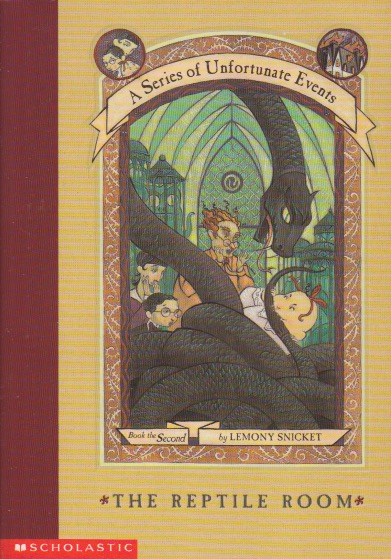
Having embarked on A Series of Unfortunate Events again, and having just finished The Reptile Room again, I might reflect on Lemony Snicket’s contribution to dark academia.  I mentioned to a friend recently that some dark academia aficionados consider the series to fall into that genre.  Having had the books read to her at a young age, she asked “Why?”  That got me thinking again about this wide, wonderful, amorphous category of books.  In my personal calculus, dark academia involves education—and this may be book learning undertaken independently—something going seriously wrong, and, in the best of it, a gothic atmosphere.  While A Series of Unfortunate Events is generally quite funny and fun to read, it clearly has the main elements I seek in classifying dark academia.  The Baudelaire orphans are pursued relentlessly by Count Olaf in a setting which, although difficult to place time wise, has Victorian aesthetics.

Of course, The Reptile Room is the second book utilized by the movie A Series of Unfortunate Events to get it up to feature length.  Reading it again revealed just how distorted my memory of the story had become by the movie.  The resolution of the scam by Stephano in the film is merely a distraction by the children to come to the real reveal in the book.  I’m not one to diss the movie.  It is quite gothic and it has many quotable moments, but it isn’t the same as the books.  I still remember when we first learned about these books from a niece, very young at the time, who enthused about them.  We were just a little cautious about reading scary stories to our daughter because one Roald Dahl book we read really was too gruesome for a child of tender years.  We immediately loved this series, however.

A quarter century or so is plenty of time to forget details.  Rereading these books also reminds me how influential they were on some of my own writing, although I read them as what passes for an adult at the time.  (I was old enough to be, and indeed was, a father.)  It occurs to me, as it likely did back then, just how clueless adults are.  Some of the descriptions of Count Olaf in this book could easily be substituted for a particular denizen of the Oval Office these days.  And, I suspect, children are able to see through those who constantly make up excuses to cover their own incompetence.  I’m looking forward to The Wide Window.


Dark Academese

I thought I was having a stroke.  The words on the page just didn’t make sense.  Nouns were being used as verbs.  Gerunds were mugging nouns.  A subject for the sentence was impossible to be found.  Was this a brain seizure?  No, it was a piece of academic writing.  In a field in which I hold a terminal degree.  This made me feel plain terminal.  I wonder what has happened to academia.  My wife and I were going to be an academic couple.  We started out when there were defined academic disciplines and with a little bit of discipline-specific training you could read just about any journal article in said discipline.  Now hires are being made in what seem like completely made up fields.  People can’t explain their appointments, so they opt for addressing their current research project.  And I confirm with Toto that this isn’t Kansas anymore.

Fearing for my sanity, I asked my wife for a reality check.  She opined (probably correctly) that in the 1980s universities were issuing lots and lots of business degrees.  More and more people were thinking college was the same as job training, not teaching young people to think for themselves.  That could explain how the rules of grammar have been abandoned so that a humanities professor can make him/herself sound like a nuclear physicist.  And those of us with degrees from the early nineties are unemployable because the standard disciplines just aren’t on offer any more.  I scratched my head when the University of Wisconsin Oshkosh couldn’t get a position in religious studies approved but was launching a marina management major.  (No joke.)

I’m a fan of dark academia.  I think maybe it makes sense given the weirdness into which I’ve stumbled.  I like to think I have a reasonable education, but I often come across documents in my own field that I can’t hope to understand.  Perhaps I’m just a slave to S-V-O (subject-verb-object, to eschew obfuscation).  All I want is to be able to understand what I’m reading from my peers.  They’ve come to believe, however, that if you write so that people understand what you’re trying to express, they’ve somehow failed in erudition.  I love higher education.  I’d go back to the professorate in a wink.  I’d be considered somewhat more ancient than protoplasm, I expect.  I went to school to learn how to communicate effectively and to express my findings so that they could be understood.  Today I’m wiping my brow, glad to learn that this isn’t a stroke after all.


Life Underground

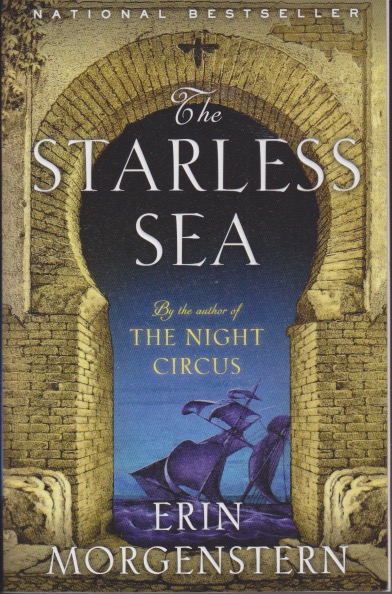
Having really enjoyed Erin Morgenstern’s The Night Circus, I was looking forward to The Starless Sea, despite its nearly 600 pages.  I don’t mind getting lost in a book; in fact it’s one of life’s true and simple joys.  The Starless Sea came to my attention as a dark academia book.  The story is a good one, but in my uninformed opinion, a bit too long.  The fault is my own, I’m sure.  My sensitivity to high fantasy has reached a point where swords tend to put me off.  And some bits, particularly in book V were a bit confusing.  Still, Morgenstern’s writing is beautiful, and at some points sublime.  If it’d been a bit shorter I’d probably be gushing.  Instead I’m reflectively admiring.  As a sometime writer myself, I know that you write what you write and others may not get it.  That’s life.

The story generally follows grad student Zachary Ezra Rawlins as he finds a book from a library of a world that’s beneath the ground.  A world that includes a harbor on the Starless Sea.  That world is inhabited by the surviving members of a decaying society made up of stories.  Most members of this world (and it’s difficult not to see this as an allegory) have left for the world above (this world).  Access between the two worlds is through doors.  Sometimes real doors, other times doors painted on a wall.  Zachary finally goes through one, having not tried one outside his house when he was just a boy.  He’s not sure if he wants to stay in the Starless Sea world or not, but he gets roped into the story.

Many other characters, at varying levels of the story within a story get involved, of course.  He meets his true love, and one of the undergrads he taught gets interested in his fate, and the denizens of the world below are intriguing characters in their own right.  Despite the length of the book, there are still plenty of gaps left for the readers to fill in for themselves.  Again, my own limitations prefer to have not too many gaps because I get confused.  The story tips a hat to several of its influences explicitly, and in many ways reminded me of Susanna Clarke’s Piranesi.  With its grad school protagonist, lots of libraries, and even a secret society, this fantasy is a card-carrying dark academia novel.  The genre encompasses may differing books and styles.  And I’m glad to have read this one as part of my own quest in that genre.  It was a sustained escape from life in the upper world.


Access Denied

We like to pride ourselves on our levels of knowledge obtained.  But access to it is limited to the club.  I’ve run into this several times since being booted from academia.  I still research and write books.  They sell like academic books (not well), but I am blocked from academic resources.  I was attempting to access an article in a book from an academic press, named here nevermore, only to find every path blocked.  I had to verify that I was human a time or two, but being human isn’t enough.  You need to be a wealthy human.  I went to Academia.edu.  The author hadn’t posted the chapter.  It was posted on Research Gate, but to request a PDF I had to have an institutional email, which I do not.  I tried Internet Archive, which has saved me many times.  They didn’t have a full view and the link to the book told me I could purchase for a mere $150.

I know other academic presses that do this.  Limit the knowledge to those in institutions that can pay such high fees.  Academia is becoming more and more privileged all the time.  I get it.  You can’t just give the stuff away.  Whenever possible I post my articles for free on Academia.  I wrote them to be read, not to be tucked away and inaccessible as the world made love to the electronic revolution.  Not all scholars think that way.  And academic presses charge prices that can only be described as exploitative.  It’s as if they think we’re all paid like professors are.  Privileged.  And this pains me.  As a former professor I know that not all academics are paid well.  We’re in it for the knowledge.  But once you lose that academic email, it’s access denied for you.

Sadly, I’m not the only one in this category.  There’s an entire generation of us who’ve been thrown from the ivory tower.  Here’s the thing: your curiosity doesn’t die just because you’re not called “Professor” any more.  Maybe this is why I enjoy dark academia so much.  The truth is that there is something very wrong with our higher educational system.  University presses, stressed to make money when everyone just asks some AI that was never human and has no knowledge for an answer to a difficult question.  There used to be a way to find that answer through the hard work of research.  And when you were done you had the pride of accomplishment.  Now all that we have is access denied.


Intensity

It was the biggest excuse for breaking up with me.  “You’re too intense.”  I lost track of the number of times college coeds told me that.  At the same time, the same adjective was whispered in awe when applied to professors in class.  You wanted intense professors, but not intense boyfriends.  Was “intense” bad or good?  I don’t deny being intense.  Some of us are just that way.  In personal relationships I’ve often managed to keep it under control.  It was one of the reasons, however, that I was such a good professor.  Students seem to have responded well, even if academia had no permanent home for me.  Thus, dark academia.  Which tends to be intense.  When I throw all my energy at something, it can become intense.  But it’s also true that I’m on the receiving end of it.  My mental mapping, especially in the fallow times, means that I must try to make sense of it all.

Some periods in life are intense.  I’m sure that’s true for everybody.  Or most people.  A concentration of events when time itself seems to have collapsed on top of you and you still have a 9-2-5 for five long days before you can start to deal with the residue.   So far, since the end of November many months ago, I’ve been in an intense zone.  So much is happening that I have trouble keeping up.  Unlike a dating relationship, I can’t beg off with intensity as an excuse.  A big part of it has been the calendar.  Thanksgiving fell late and January with its cold felt like it would last forever.  Both Trump and AI simmered in the background.  And, of course, 9-2-5.

Two major snowstorms were separated by only a few weeks.  As the second was tuning up, a death in the family.  The third in three years.  A novel was finished.  As was a nonfiction draft.  Two orders from Amazon went awry.  Who has time for returns?  Because of the storms, things became double-booked.  Preparations for the 2026 Lehigh Valley Book Festival.  With my expensive books.  I really didn’t think they’d select me as a participant, but was committed.  Or should be.  My wife’s 9-2-5 also hit an intense period.  We had to deal with two major household repairs simultaneously.  An unexpected auto repair.  I checked another website (No Kill Switch) to help define intensity.  What he has to say makes a lot of sense, but the question remains.  Is intensity good or bad?  It does seem to be the opposite of boredom, when you get time to deal with things, after work.  


Confidential Hazing

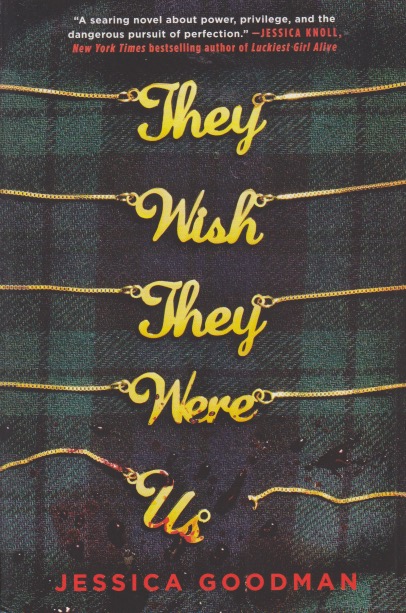
Set in a Long Island prep school, among a somewhat secret society called the Players, this is a dark academia tale of murder and discovery.  The Players, usually numbering eight in the senior class at Gold Coast Prep, are down to six.  One of their number was murdered and the one who confessed to that murder has been jailed.  Most of the students are extremely wealthy, but Jill Newman isn’t really rich.  This is what lies behind They Wish They Were Us by Jessica Goodman.  Although technically a young adult novel there are several disturbing elements here, some worthy of Lord of the Flies.  For that we need to dig a bit deeper.  To become a member of the Players, hazing is involved.  Since this isn’t an official program of the school, the hazing is entirely controlled by the seniors who are Players, to initiate their underclassmen into the club.

Some of the hazing is pretty intense, even for an adult reading the novel.  Kids aren’t always good about thinking through the consequences of traumatic activities on other kids.  People tend to be resilient, but at the same time scars heal in different ways.  In the course of one of the hazing tasks, something goes wrong and one of Jill’s friends, her best friend, ends up dead.  Since there’s a lot of drinking and drugs involved, it isn’t always easy to piece together what might’ve happened.  The crisis occurs for Jill when her younger brother joins the Players.  She has to watch him face the hazing, and at the same time comes to have suspicions about what really happened to her best friend.  Things get pretty tense.

As adults we can easily place ourselves, in our minds, back to our teenage years.  This is something that we didn’t appreciate as teens, and even now most teens don’t realize this about adults.  Wisdom, hopefully, comes with age.  In this fictional setting, rich adults are seldom around.  Their kids, with access to nearly unlimited money, can set their own rules.  Even the police treat them differently.  I’m deliberately not saying too much about the story since it would be too easy to give away the ending.  The school officials in the book care more about preserving the reputation of Gold Coast Prep than they do about the welfare of their students, even if this leads to blackmail to maintain its good name.  And this is something that teens will come to understand only once they start to work for a company with its own secrets.


Vengeance Is Hers

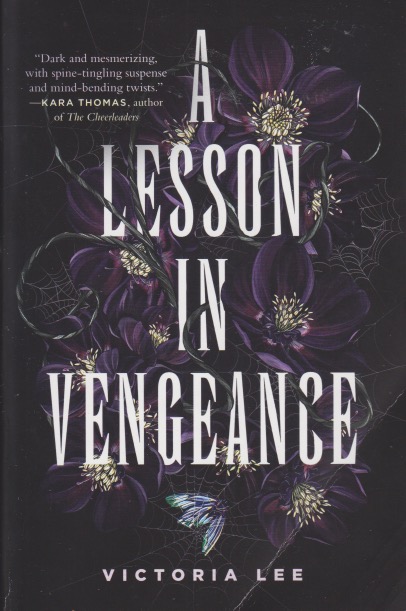
A Lesson in Vengeance, by Victoria Lee,  is a novel with some twists that I’ll try to conceal.  It is a kind of young adult horror-themed dark academia novel.  I really enjoyed it although there are a few improbable events.  That’s the way of fiction with an unreliable narrator.  Felicity Morrow, a girl from a wealthy Boston family, is enrolled at Dalloway School.  Dalloway is a girl’s prep school in upstate New York.  Felicity had to take some time off, during which she was institutionalized, after the death of her best friend, and lover, Alex.  Now that she’s back at school she feels the ghost of her friend coming back for vengeance.  She lives in Godwin House, which only has space for five.  It’s also part of the story of the Dalloway five, girls accused as witches when the school was founded, who all died there.

A new girl is starting at Dalloway this year.  Ellis Haley has already written a published novel and is working on a second.  She lives in Alex’s old room.  In spite of their rocky start, Ellis and Felicity become friends.  Then more than friends.  Meanwhile, they’re both working on their senior projects but Ellis wants to form a fictional coven and replay the way the Dalloway five died, for her novel.  Things grow tense as Felicity begins to remember more and more about what happened to Alex.  Then a murder takes place.  I won’t say more about the plot.  The last several chapters are ones where putting down the book is a real struggle.  You want to know who did it.  And since Felicity is the narrator, you gather that she must survive.  But this isn’t without danger.

The horror elements involve ghosts and witches.  Since Felicity is revealed to be an unreliable narrator it’s unclear whether the ghosts are real or not.  Most of the events are revealed to have had naturalistic answers, but one remains as either a real ghostly visitation or a delusion on the part of Felicity.  I read this book as part of my ongoing fascination with dark academia, and I’m glad I did.  It’s quite a well-told story.  Enough information is held back and revealed in moments of insight as the story unfolds that I was kept guessing until very near the end.  And the final realization only hits at the very end.  This is a good entry into dark academia for anyone wondering where to start, at least in my opinion.


Talking Tolkien

I read The Hobbit and The Lord of the Rings back in college.  Although I enjoyed them a great deal, they weren’t enough to swing me into high fantasy.  I do sometimes think I should go back and re-read them, but with so many books on my to read list, it’s a matter of time.  In any case, I’d read that the movie Tolkien was a good example of dark academia, cinema-style, so I finally got around to seeing it.  Although I learned quite a bit about Tolkien’s life from it, as a movie it really never soars.  The academia part is pretty straightforward as King Edward’s School and Oxford University play a large role in Tolkien’s life, and in the movie.  As does World War I, which is where the darkness comes from.  That, and being an orphan.  And also a guardian priest who prevents you from being with the girl you love.  The movie stays with Tolkien until he begins writing The Hobbit.

The difficulty with biopics of writers is that trying to portray where they get their ideas is a fraught business.  Those of us who write fiction know that inspiration comes in many forms, from dreams, to real life events, to the visit of an unusual shop.  Travel, intriguing people, and ideas out of the blue can all trigger a story or novel.  How do you capture inspiration on film?  A love story is, believe it or not, somewhat easier.  The film portrays Tolkien’s early fascination with Edith Bratt, whom he would eventually marry.  One thing that I’ve learned from psychology and those who teach storytelling is that certain narratives more or less play automatically in people’s minds.  Now, this cannot be asserted universally, but if you introduce a young woman and a young man in a story, many people’s minds naturally begin to bring them together romantically.  Showing how a writer goes about their craft is different.

Many biopics of writers are considered examples of dark academia.  Probably one of the reasons is that no lives are lived without loss and trauma.  People handled traumatic events differently.  Many writers use their art as a coping mechanism.  I can’t know, but I suspect that such things often lead people to become writers.  Poe, for example, keenly felt the loss of his mother at a young age, a trauma that would lead to a lifetime of writing.  I hadn’t known, until watching this movie, that Tolkien had become an orphan.  I knew little of his life; I’d read his books, and even walked by his house in Oxford, but this movie did provide a bit of context.  I’m glad, for that reason, to have seen it.


Dark Dreams

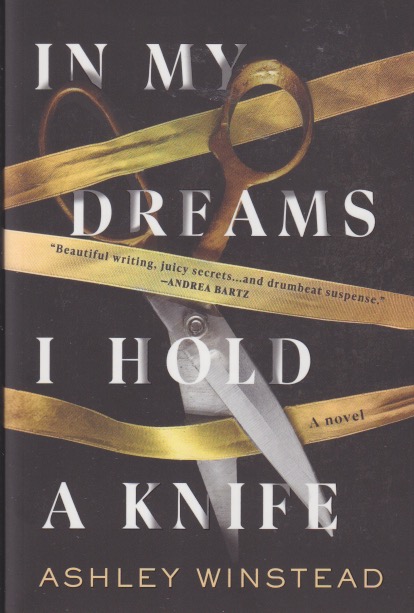
I’ve been pondering the role of religion in dark academia.  While not a major element, it’s certainly present in Ashley Winstead’s In My Dreams I Hold a Knife.  There are plenty of plot twists, and I’ll try to avoid giving away whodunit, at least ultimately.  The basic idea is that a group of seven students, the “East House Seven,” band together at Duquette University, a near-Ivy League school in North Carolina.  They get into some college hijinks, but things turn dark when one of them (Heather) is murdered their senior year.  Jessica Miller, one of the seven, has become a corporate climber, despite her family background, and ten years later she goes to Homecoming to show off her accomplishments.  But things don’t work out as planned.  Heather’s younger brother, who works at Duquette, has been doing some detective work and uses Homecoming to confront those who remain about the murder.

The seven (which actually involves an eighth student) pretty much date among themselves.  Some of them, including Heather, are quite wealthy, but not all.  Jessica isn’t among the affluent, and another of the seven, Coop, ends up dealing drugs to make money on the side.  Heather’s boyfriend was suspected in the murder, but had to be released for lack of evidence, and he decides not to attend Homecoming.  Those present for the event are confronted by Heather’s brother and the story is told as flashbacks from the Homecoming to events that took place during the college years of the seven.  As I say, I won’t reveal who did it, but each of the remaining seven is suspected until the reveal comes near the end.

For me, these kinds of stories are a little difficult to follow because of the number of active players.  Jessica reveals herself to be an unreliable narrator, and although the story felt long to me, it takes quite a bit of space to get to know all the characters well enough to understand their motivations.  Two of them were raised religious, which is what ties this theme into the novel.  The wealthy students aren’t exactly the kinds of people to emulate, and those raised religious end up being the good ones at the end, although they do participate in Greek life with its parties and other activities that college encourages.  (Sorry about the long sentence.)  Overall, this is a good story, but it’s hard to give too much sympathy to the group as they do have shifting alliances and are mostly power-hungry.  Yet, isn’t that like life itself?  It is dark academia. 


Murder in Oxford

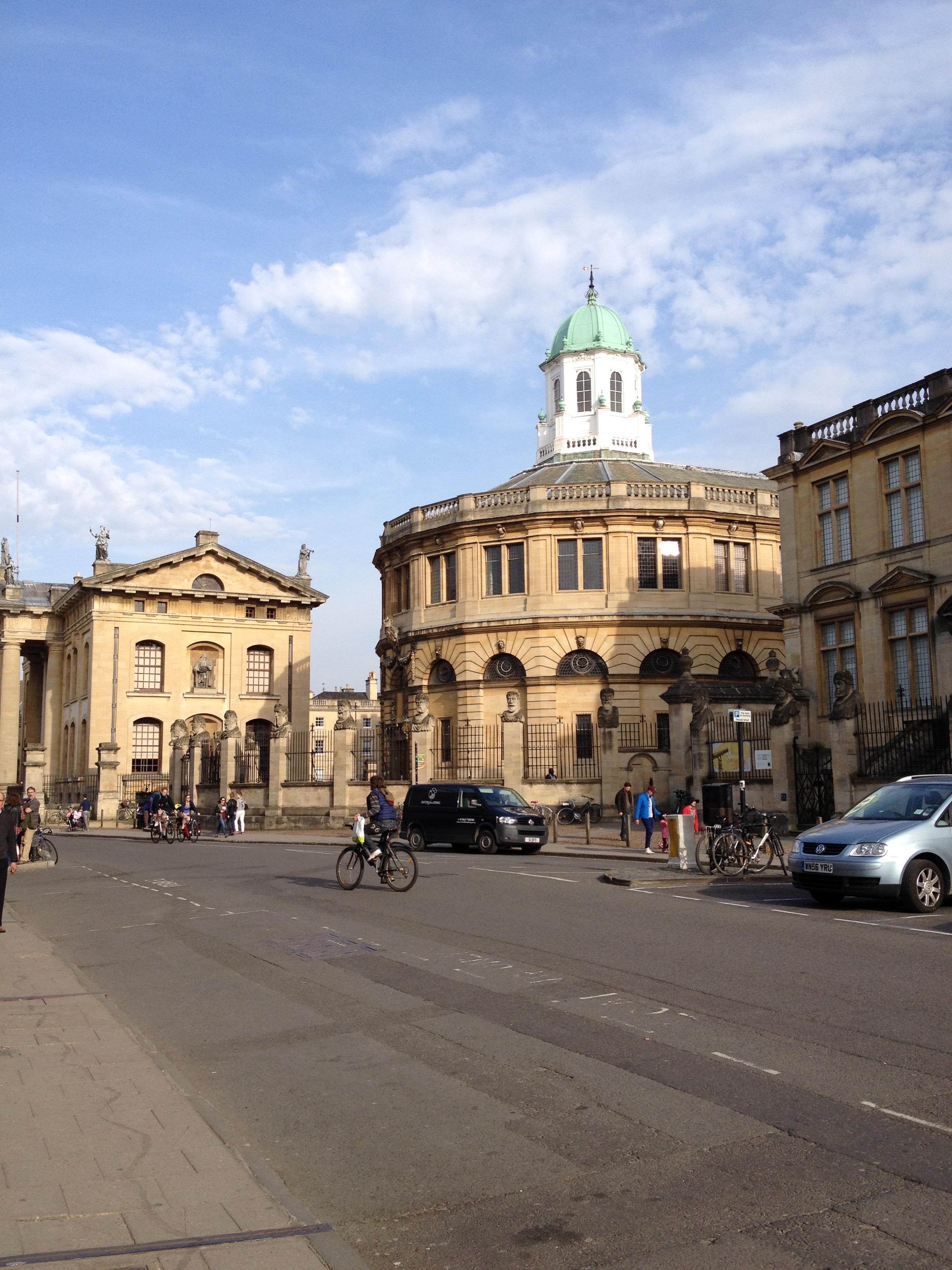
The Oxford Murders isn’t a bad effort as a thriller, but where it works is as dark academia.  This 2008 movie didn’t have significant box office take, so it may be one rather unknown.  Nevertheless, it is erudite, involving considerable debate about logic (including Wittgenstein) and higher math.  So much so that some might get lost.  Set in Oxford (and filmed there), it has the dark academia atmosphere down.  Since it’s so complex there will be spoilers here, so if you intend to watch it, best do that now.

Here’s a spoiler: the elderly widow of a famed mathematician is murdered by her daughter.  The reason for this is that the young woman has fallen in love with an American boarder at their house, but her mother, who has outlived her expectation with cancer—for years—is interfering.  Meanwhile, the border (Martin) is obsessed with Arthur Seldom, a brilliant Oxford mathematician.  Seldom was in love with the girl’s mother and decides to protect her by making the murder look like the work of a serial killer leaving Pythagorean symbols on the murder notes.  Since Seldom isn’t a murderer, he chooses as his “victims” people who’ve already died, making their natural deaths look like murders.  This throws suspicion off of the daughter, but when the code and the motivation is published in the newspaper, a man struggling with sanity because his daughter requires an operation, finishes the Pythagorean sequence by killing ten special needs students in a bus crash.  Seldom didn’t technically kill anyone, but when Martin confronts him Seldom points out that if he hadn’t boarded with the old woman, her daughter wouldn’t have fallen in love with him and killed her.

The movie is a little clunky, but I think it’s been underrated.  There are lots of ideas here that beg to be discussed.  Like many murder-mysteries, it has subplots meant to throw you off, one involving a disgruntled mathematician, and another involving a nurse who hooks up with Martin, but who has previously had an affair with Seldom.  None of this detracts from the movie as dark academia—something has definitely gone wrong in Oxford.  The widow’s murder was a crime of passion, leading to the deaths of innocents, rather like the butterfly effect that the movie discusses.  The problem seems to be with the writing.  It was based on a novel by Guillermo Martínez, which, I suspect will be added to my reading list.  As a movie it’s not great, but it is good for a dark academia fix.


Beautiful Reality

Although it is central to understanding all human experience, we are far from comprehending consciousness.  It’s clear to me, based on the fact that our senses are limited, that rationality alone can’t provide us with all the answers.  And brilliance often comes at a cost.  These were my thoughts after watching A Beautiful Mind.  Having hung around Princeton quite a bit when living in New Jersey, it was nice to see it in a film.  The movie is, of course, a somewhat fictionalized account of the mathematician John Nash’s life.  Although extraordinary in his grasp of math, Nash suffered from mental illness as well.  A Beautiful Mind takes liberties, but then, most biopics do.  The film is well done from a cinematic point of view, and for those of us without any real knowledge of Nash (although we only lived about 15 miles away) it effectively fools you into mistaking reality.

I wanted to see the movie because it’s often cited as an example of dark academia.  Clearly the mental illness—called schizophrenia here—is the source of the darkness.  Academia is obvious.  This biopic genre of dark academia includes a number of films and many of them explore the disjunction between deep thinkers and social life.  It seems that we may be only in the early stages of mapping the intricacies of the human mind.  I was recently reading that psychology is still, after all these years, struggling to be considered a “real” science.  The human mind is a slippery place and emotion and intuition play into making someone really stand out from the rest of us.  And also, their stories have to be noticed by someone.  In Nash’s case, a book that was later made into a movie.

Academics in general aren’t given much notice.  Many operate in the rarified world of extended study.  Those who, like myself, are expelled, often have difficulty fitting in to other lines of work.  Thinkers often have trouble not thinking.  That can get you into trouble on the job.  Movies like A Beautiful Mind have some triggers for me because I often question what reality is.  I always have.  Please don’t take it personally, dear reader, when I say I’m not sure you’re real.  (You may think the same of me.) It’s just the way I look at the world.  I’m no mathematician, though, nor a scientist.  Not even a philosopher, according to the guild.  Academia, however, was my home and seems to have been what my mind was made to do.  At this point, I’ll settle for watching movies about dark academia.


Dark Library

Although it’s booming, I’m not a romance reader.  Not in the modern sense, anyway.  I’m a big fan of the Romantic Movement, which gave us the gothic novel, but the distant descendant of the latter is dark academia.  And dark academia is what brought me to Rachel Moore’s The Library of Shadows.  That, and ghosts.  I’d read somewhere that this novel (probably classified as young adult as well) brought dark academia and ghosts together and indeed it does.  I’m finding dark academia to be quite liberating.  I may no longer be a card-carrying member of Club Academe, but that setting is never far from my mind.  Enough about me.  Here’s the story: Este is a student at Radcliffe Prep, reputed to be the third most haunted school in the country.  She doesn’t come from money, however, since her father, a former Radcliffe Prep student, died prematurely and her mother has gone in search of anything that might remind her of him.

Este, unlike her wealthy cohort, isn’t sure how she fits in.  She doesn’t believe in ghosts.  Until she falls in love with one.  (This isn’t really a spoiler since it’s on the back cover copy and you can infer as much from the cover art.)  The story revolves around how to resolve that tension.  I’m sorry to admit that I’m not sure if “fades” are a traditional kind of ghost or if they were invented for this story, but they are behind the somewhat-horror elements to the tale.  Moore lays out the rules for her ghosts: they can’t walk through walls (so they can be locked out of a room), they tend to be not seen in natural light, but artificial light brings them into view, if they want to be seen.  And those that inhabit the library at Radcliffe, have bodies that can affect the physical world, but they can’t connect with anything living.  The fades are much worse: they kill mortals.

Moore’s story is a romance and a fantasy, but it is fun to read.  As a first book it has the freshness that somehow fades when writers become too jaded with the system.  (As someone who has tried repeatedly to get fiction published, believe me, I know.)  I suspect those looking for serious adult fiction might find it on the light side, but romance does have its attractions.  Since this is for younger readers there’s nothing too explicit here.  Just a story that keeps you interested as the pages turn.  And if romance has ghosts, and fits dark academia, I wouldn’t rule out reading more.