Horror Shortly

Some short books have an outsized punch.  Especially when dealing with a large topic such as “horror.”  This isn’t just horror movies, which could easily fill such a book, but also literature and other media as well.  Darryl Jones has proven himself on this topic before and this Very Short Introduction is a showcase of what is a fascinating genre.  I’ve read a number of books in this series and this stands out as one that works admirably within extreme limits—they are very short—in making good decisions about representative aspects in what is really a sprawling field of inquiry.  The introduction lays the task out well and I came away from each chapter feeling inspired.  Of course, not all of horror can be covered in less than 150 pages.  Some may find their favorite fear unaddressed, but they’ll learn something nevertheless.

In his first content chapter, Monsters, Jones focuses on vampires and zombies.  These are both forms of cannibals as they’re currently conceived, zombies being relative newcomers to most favored monster status.  His next chapter, on the occult and supernatural, takes on the Devil himself before addressing satanists, demons, and ghosts.  These are, of course, religious monsters.  Although Jones doesn’t dwell on that aspect, the close relationship is nevertheless evident.  For those of us who explore religion and horror this framing proves helpful.  It’s worth pausing here to consider how all of these entities overlap a bit.  As anyone familiar with ghost hunters knows, ghosts and demons may both be found haunted places, and the Devil is the head demon.  Of course, horror is a fiction genre but many people believe in these entities.  That brings religion and horror within the same room.

Body horror occupies the next chapter, and here werewolves come into the picture.  Other aspects of body horror are also discussed, but the painful transformation of the shapeshifter is prime territory.  Horror and the mind brings us to psychological thrillers and the gothic fear of madness.  The topic segues nicely into science, which the next chapter covers.  Not only science itself but the mad scientist.  Finally, the lengthy afterword looks at where horror has gone, and may be going, in the new millennium.  Something that struck me, and which brings this back into religion, is how frequently Darwin and evolution are mentioned.  This concept challenged the human place in the divine hierarchy and led to much of what we think of as horror.  This book is a great resource in a small package.

Reading Lights

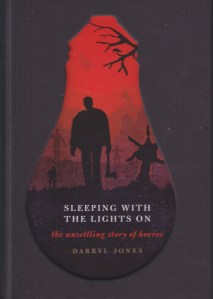
Late one night in Wisconsin—I had just come off the train from Champaign-Urbana—one of the students from Nashotah House was driving me to my spooky apartment on campus as part of his work-study job.  He mentioned what seemed an obscure topic to me, and I asked him why he liked it.  “Who can say,” he responded, “why they like anything?”  He had a point.  Work on Nightmares requires reading current studies of horror, and one that came out just before Halloween was Darryl Jones’ Sleeping with the Lights on: The Unsettling Story of Horror.  I don’t know why I like such things, but when the book was first announced I knew I’d need to read it, and soon.  It had to wait until the Warren books were finished, however.

This little gift book (with a novelty cover, even) contains quite a bit of insight.  In fact, while reading it I discerned that Jones had spotted something that I’d begun to write down independently.  Horror does that to people.  The book is divided up into chapters addressing different genres of monsters and analyzing why they have proven so popular with both horror authors and auteurs.  The discussion is lively and even witty at times, as befits a topic that most people really misunderstand.  I myself used to misunderstand it—I went through a terrible period of repudiating the things I liked when growing up (who could say why?).  I jettisoned my interest in the Gothic even as I visited ruined castles in the Scottish highlands, and thought that horror was something best left to the uneducated.

One of the realities of my own life—perhaps some of my readers will find it true as well—is that once you’ve been put through the mill once or twice your mind starts going back to childhood in what may be a vain effort to start all over again.  The likes of your youth come flooding back—this is why I began reacquiring Dark Shadows novels.  They aren’t fine literature, but they were one of the guilty pleasures with which I grew up.  As Jones notes, vampires are one of the most enduring of monsters.  He suggests that Bram Stoker’s Dracula was among the notably influential books of Victorian English literature.  As Jones points out, there are people who back away from him when he tells them he studies horror.  He also makes a clear case for its enduring connection with religion.  I might add as a coda here, that telling people you study religion often gets the same response as telling them you study horror.


Hopeful Horror

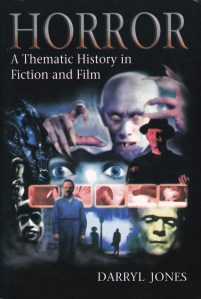
joneshorrorI don’t make New Year’s resolutions. To my way of thinking, if I’m aware I’m doing something wrong, I try to change it at that point, rather than waiting. Needless to say, then, I’m up to my old habits of reading about horror movies. Actually, Darryl Jones’ Horror: A Thematic History in Fiction and Film goes a bit broader than just the cinema. As the subtitle indicates, this charming book also addresses narrative fiction as well and the result is quite engaging. Divided thematically, Jones considers the various types of horror without delving into pretentious theorists to give him academic credibility. Here is a true fan who’s capable to sharing the excitement of the genre. Along the way, accompanying the usual observation that horror and religion share considerable conceptual space, he makes the point that in movies horror is one genre that makes use of academics as characters of authority. Sure, there are others, but in this realm to be educated is a benefit, whether the plan is to take over the world or to stop some evil force from doing the same.

I’ve been watching movies that can be broadly classified as horror since I was young. And I had admired—emulated to some extent—the professors and scientists I saw in those presentations. When a monster was on the loose, you went to find an expert to learn what to do. At the risk of contradicting myself, theorists have been suggesting that one of the problems with post-truth is the death of expertise. Anyone can be an expert these days. The question, “Why should I listen to you?” is on every self-appointed smarty’s lips. Earning a doctorate, the horror world tells us, gives you access to some kinds of knowledge that others don’t have. Problem is, zombies don’t respect such learning. They only want brains to consume.

It never seemed to me that watching horror was a means of learning. As a kid escapism is part of everyday life—taking things seriously is for adults. Growing up, however, I kept my love of scary movies in reserve. Little did I realize that it was a form of training. Now university-affiliated academics are finally able to begin admitting that they find monsters compelling. More than that, they actually learn something from them. Although not a resolution, I see myself reading further books about horror movies this year. It may be a naive hope, but it would be wonderful if they were all as insightful as this one has been.