Popular Eternity

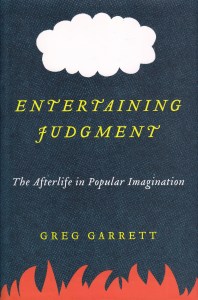
EntertainingJudgmentPopular culture, it seems to me, mediates reality. The media of various descriptions teach us what to think, and even if there is a religiously “orthodox” answer to questions, we will weigh it in the scales against what larger society says. This becomes clear in Greg Garrett’s Entertaining Judgment: The Afterlife in Popular Imagination. Garrett, a scholar of religion and popular culture, turns his attention to death in this book. More precisely, what happens after death. The usual suspects of ghosts, vampires, and zombies are here, but also the realms of Heaven, Hell, and for the Catholics in the house, Purgatory. All of these are seen through the various lenses of movies, television, song, comic books, regular books, and games. It’s fair to say that we’re a culture obsessed with death. But then again, what culture isn’t? It may be just that it comes across more charming when there’s a buck to be made at it.

What I found interesting is that although the Bible has little to say about Heaven or Hell (and nothing at all about Purgatory), each of these realms has developed a canonical script. Hell is hot and fiery, Heaven is cool and cloudy. Purgatory is gloomy, but beyond that comes in mild, medium, and hot varieties. We know these things from various teachings of our respective religions. In popular media, however, the script has been changing. We now have mild unpleasantness passing for Hell, if it lasts forever. Nobody needs to get burned. Heaven, meanwhile, can be just okay. It’s certainly better than the other place. Or the other two. We’ve overused our superlatives and have been left feeling like we’re on antidepressants.

Polls continue to tell us that many, if not most, Americans believe in literal Heavens and Hells. A point Garrett raises, however, is they may not mean by that what their clergy assert to be the case. Since near death experiences are controversial, nobody can say that they’ve actually been to either place, or the third. The exception to this rule is those who work in fiction—in whatever form. Since we can see their visions of the afterlife so clearly they have become the arbiters of eternity, with or without any religious training. In this day of marketplace religion and nones, Heaven and Hell seem to have become secular. The church may have introduced the ideas (actually, they seem to go back to the Zoroastrians, but I’m thinking of American culture) but the media have taken them over. We may be secular, but we still die. Entertaining Judgment might give you an idea of what to expect, depending on whose vision you buy.


Story of God

Synchronicities come at kinds of synchronaddresses. After I had written a recent post on human sacrifice, I watched the first episode of Morgan Freeman’s The Story of God. My wife actually figured out how to get it without the miracle of the triple play, and we watched the initial installment on death. I’ve stated repeatedly on this blog, as I used to in my lectures, that death is a universal concern of religion. I wasn’t really expecting to learn anything new from the show, but it is a good idea to keep up with what hoi polloi are being told about the field in which I’m supposed to be a specialist. In any case, The Story of God is very much like Through the Wormhole, only from the other side. Science and religion. Religion and science. Like chocolate and peanut butter, two great tastes that taste great together. Really, I mean that.

So after telling us that the Egyptians may have invented the afterlife (although it’s clear they didn’t), the show takes us through other religious expressions: Christian, Hindu, Aztec. The Aztec segment brought up human sacrifice again, in its particularly grisly expression, as a means of thinking about what happens after death. In the light of the article I’d read (see last Sunday’s post) I couldn’t help but think how this was an ideal form of social control. There’s no doubt who’s in power when you’re looking up at your still beating heart, strangely cooled. As I’m pondering that heart, I’m thinking it wasn’t the Egyptians who first had this idea at all.

DSCN6127

Neanderthals, it appears, may have buried their dead. Even if they didn’t other ancient, pre-historic people did. And with grave-goods which, if you think about it, are rather superfluous without any afterlife in which to use them. It stands to reason, even before reason, that as soon as people began to recognize death, they had to be wondering what happened next. It is a bit simplistic to suggest that religion began because of the fear of death. It is also equally simplistic to suggest that death had nothing to do with the beginnings of what we call religion. People have died as long as there have been people. And survivors have carried on after the passing of others. Maybe we are all grown up now, but it seems that we aren’t fully human unless we give some sort of thought to what comes next. Even if the answer is “nothing,” it’s some kind of religious statement, whether intentional or not.


Defying Labels

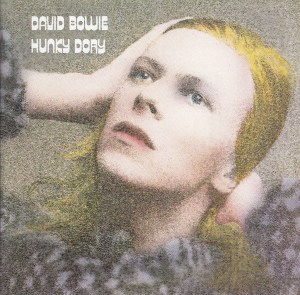
I don’t know much about the music industry, but I do know that as in publishing, labels make a difference. Who doesn’t conjure up a certain sound when they see Motown? Companies jealously sign artists to their label, with a close eye on the bottom line. Labels. Branding. Marking our territory. People like to give things labels to make them easier to understand. By now it’s no longer news that David Bowie has died. The tributes are coming thick and fast, and one recurring theme seems to be that nobody really knew how to label him. Bowie was an original, a creator. Like many truly creative people, he was seldom at the top of the charts, but his fan-base grew over decades and those who listened to him knew that he defied labels. Labels are for convenience, and life is, well, not convenient.

There’s been speculation about his final album, Blackstar, released an iconic two days before his death. The song “Lazarus” has flagged the attention of many, but here we are after the third day and he hasn’t come back. I think of my childhood and tween years in the 1970s, seeing Bowie’s album covers in my brother’s room and wondering if he was a man or woman. His transgressions frightened the young conservative that I was, accepting the label given to me by those who thought they knew me. I heard his songs coming through the open door. I couldn’t understand them, but somehow they remained with me until I was mature enough to learn to listen. Some sounds are too subtle to hear, except with experience. Here was a man telling the world “don’t label me.” And yet label we did.

“Lazarus” is a haunting song. I may be no music critic, but here is a piece by a man who knows he’s dying. The video shows him emerging from a tomb-like wardrobe (in itself significant) and simultaneously lying on his deathbed. He’s in Heaven, but in danger. Still, he knows he’s free. Like the biblical Lazarus from the Gospel of John, resurrection is only temporary. Lazarus has come back, but he must die again. As the frantic Bowie scribbles his final words on the final page, he backs up once again into the tomb from which he emerged. David Bowie may not have been a Bible scholar, but his song is prophetic. The three days have now gone past. He may not have come back, but it just may be that he never really left.

HunkyDory


Dead of Winter

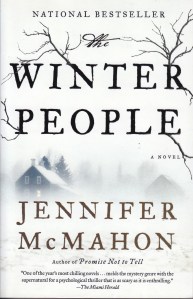
WinterPeopleOne of the commonalities of all religions, I used to tell my students, is the concern with death. Not that all religions react to it in nearly the same way, but the fact is no religion ignores it. For people, obviously, our awareness of our own mortality marks us as indelibly as our birth does. Once we become aware of death, we will never be able to forget it. This inevitability fuels many horror stories, whether literary or cinematic. When I saw Jennifer McMahon’s The Winter People, I knew that I would read it. Like most book consumers, I had to wait for the paperback edition, and once it was on offer I got a copy and waited for winter. Well, this year I’m still waiting for winter, but I began reading the story once the nights were long enough to qualify. It is an appropriate story for the season and it introduces what might be considered a kind of monster as well. Like most monsters, however, sleepers are not evil. The undead, however, have to find a way, ironically, to live.

The Winter People is a sad story, and tangled in the way that makes for successful novels. The main issue at play, however, is that with which all religions are concerned. Death is perhaps the most noble of literary subjects. Since we all have to face it, it is universal and yet somehow frightening. Fear of the unknown. The dead, unlike in the stories, don’t really come back to tell us what it’s like. Even those who do, in fiction, give us a distorted view. Theirs is a world inverted from our experience of it. It lacks finality. It is a place between. There is a macabre logic to it.

The living have never been comfortable with the dead. Memory reminds of who they were. McMahon is clear, in her vision, that memory is not who they are. We put them underground, but theologically we can’t let them go. Heaven, Nirvana, Purgatory, reincarnation, or even Hell—we feel that we need to give our dead a sense of place in a life after life. McMahon builds a sober mystery into her non-final afterlife. There are some, I’m sure, who will be kept up at night by her imagination. For me, I now have something to ponder. Many are the stories, like Stephen King’s Pet Sematary, that warn of resurrection. We can’t keep the departed with us, and winter, when it comes, is a season of harsh reality.


Clerk and Dagger

Photo credit: Luis García (Zaqarbal),, Wikimedia Commons

Photo credit: Luis García (Zaqarbal),, Wikimedia Commons

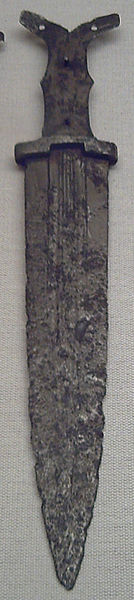
Recently I had the sad duty to list a contributor to a volume as deceased. The standard means of doing so in typography is with a symbol called a dagger (†). When I was young, I thought this was intended to be a cross, but it became clear, as I looked more closely, it wasn’t that at all. The origins of typographic marks go back to the classical Greeks. Used to mark dubious places in manuscripts, the asterisk was to show places where something had to be added to the text while the dagger was used to show deletion. Well, it wasn’t a dagger then. The earliest form was called an obelus and it could be a plain line, but was often shown with the symbol we now painfully associate with long division: ÷. This odd sign was said to represent a dart, a spit, or the sharp end of a javelin. Since things were to be cut out of the manuscript, a sharp instrument would be ideal. Early textual criticism, then, gave us symbols that have now been commandeered by math.

These signed evolved with time. By the Middle Ages the asterisk and the dagger could be used to indicate a pause when reciting Psalms. (Those of us at Nashotah House in the 1990s know all about pauses when reciting Psalms.) Medieval scribes marked up manuscripts religiously. Eventually the asterisk came to be associated with footnotes—a function that it still has, mostly in non-academic texts. The dagger was used for a footnote if an asterisk had already been used on that page. Beyond that, the double-dagger came into play. The function and the form of the obelus had now evolved solidly into the dagger form. The obelus continued on in math, at one time to mean subtraction, but finally settling down to represent division. Appropriate, given its graphic origins.

The dagger and asterisk were the earliest signs of textual criticism. Literalists today still don’t understand the concept, since all ancient documents of the Bible are copies of copies of copies. Nevertheless, how did a sign indicating a spit upon which an animal was roasted come to represent the dearly departed? Since asterisk and dagger often work as a pair, the most obvious way that this worked out was in representing the birth and death years of a person. An asterisk before the name meant “born in,” while a dagger in the same position meant “died in.” As a kind of typographical shorthand, then, a dagger after a name meant the person had died. Although it sounds dramatic and not a little violent, it is really only death by textual criticism. That, I suspect, is something most biblical scholars especially will be able to comprehend.


Death, Technically

Those of you who punish yourselves by reading my posts regularly may wonder at how different my last couple of posts have been. “Vacation” in and of itself is sufficient explanation for the out of the ordinary—different time zones, unreliable grammar, a certain dreaminess of topic (this is why we should all take plenty of time off work). In this case, however, there’s more to it. My wife injured herself the night before our early morning flight, and although she’s recovering well, another traveling companion is moribund. My faithful laptop that has traveled the country, indeed, crossed the ocean a hextad of times, died in its sleep on the flight over. I shut it down before climbing aboard the plane, and when I tried to boot up after that, nothing. Not friendly Apple starting tone, no wink from the camera, no sign of life from the screen.
I pulled out my phone as soon as I landed and asked Siri if there was a Genius Bar nearby. I was headed into remote parts, where shotguns are far more common than laptops. I had projects to accomplish in the rainy moments. I had a couple of readers to keep updated. Could the geniuses perform a miracle? Alas, the schedule was unforgiving. I hadn’t made an appointment and even though I’d been pouring money into Apple products while the genius before me was in still in diapers, I was up a proverbial (as well as literal) creek without an Apple. He halfheartedly gave my keyboard some kind of Vulcan finger combination pinch, but the look in his eye was definitely more Klingon.
I remember coming to this remote cabin before cell phones were invented. People were just beginning to whisper about this rumor called the Internet. People still wrote each other letters. And here I am in downtown Spokane, weeping over the dead device in my lap. It had its limits, in any case. I can’t take it into the lake with me. It needs, at its age, never to wander too far from a power outlet. And yet, it holds all my darkest secrets and most enlightened ideas. And my thumbs are too fat for typing on my phone. Looking out over the mist dancing wraith-like across the Saran-Wrap early morning surface of the lake, I see two bald eagles fly by. Surely I wouldn’t have seen them had I been behind the large screen of my departed friend. These are, after all, communications from the very edges of civilization, and technology may not, all things considered, save my soul.


Life Everlasting

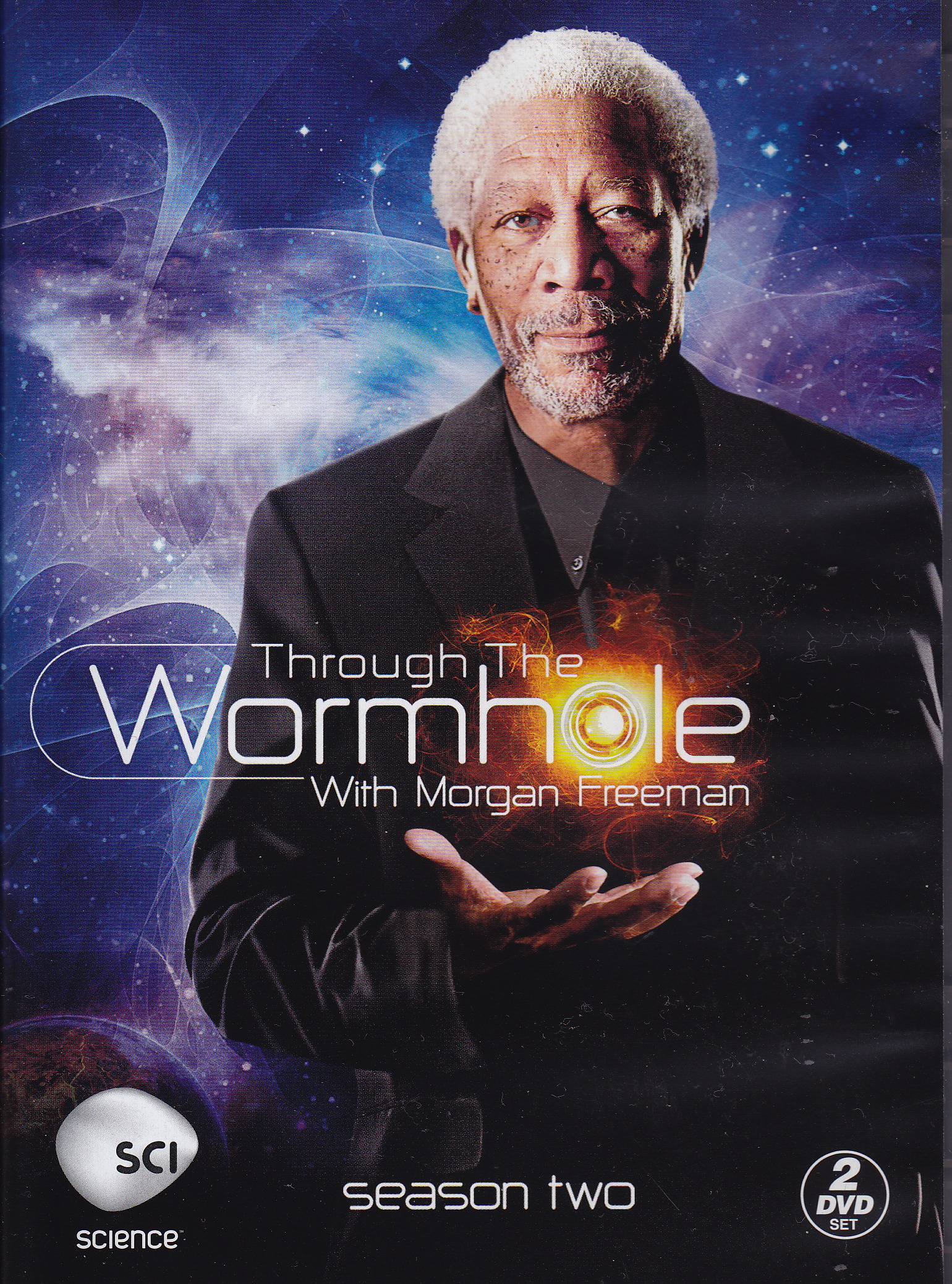
ThruTheWormholeThrough the Wormhole is one of those series that keeps me coming back. I’m currently working my way through the second season because it is a show that I take in small doses. The episodes require thought (and often, more importantly, time—something of which I have too little). Watching the installment “Can We Live Forever?” I was astonished by the optimism of the writers and interviewees. Among a cross-section of scientists, at least, there is the belief that we can, and will, dramatically expand human life. To biblical proportions. And that life won’t be a decrepit, declining feebleness. Instead, we can be, to quote one of the scientists, quoting Bob Dylan, “forever young.” Well, maybe not forever, but you get the picture. Of course, God came up quite a bit in this episode. Immortality is the stuff of divinity. The life-force, which much of science denies exists, is strong. No matter how weak or old, we don’t really want to give it up.

Of course, death is the price of life. We live on a finite planet with dwindling resources. If we don’t die, we run out of space for the next generation. Some have postulated that we need to colonize other worlds—just the thing that got Europeans in trouble in the first place—in order to make room. Room for us. The dominant species. No doubt, we are “programmed” to age and die. As far as we know, all animals are. Even plants. That is to say, life as we know it ends in death. If it doesn’t, can it truly be called life? I would be fascinated to live for a long while and see what we can make of this world. Not the greatest fan of technology, still, I’m impressed how far we’ve come in the brief time I’ve spent on this planet. And I do wonder where we’ll end up. In my mind, however, there always is an end. Even to this infinite universe, about the heat-death of which I’ve often read. What gives us the right to live longer than nature dictates?

It is, surely, a matter of degree. These glasses perched on my nose certainly have prolonged my life beyond what nature would dictate. The vitamin pills I swallow, the fabrics that keep me warm while wicking away perspiration, the things physicians can stop in their germy tracks. We already prolong life. Nevertheless, the century mark has always been symbolically our final goal and sign post that it’s time to hand things over. Thus it was in the beginning. The Bible makes clear that, although the antediluvians lived centuries rather than decades, this was never intended as the lot of the majority. No, we were born to die. We live through our children. The thought of eternity is scary. Especially when we think of how humans are. Those who can afford to live the longest are likely those who least deserve to do so. Do we want to live forever with the plutocrats in charge? Perhaps there’s a reason that we all take that final bow. Still, I can never listen to “Forever Young” without getting misty eyed and imagining the possibilities.


Trisagion

Irony is all around. When we hook words up into phrases or titles they often take on unexpected connotations. I often see the sign for Jesus’ Bookstore on a highway not far from here. I didn’t know the Lord sold books. In this economic climate, I hope he’s diversified his portfolio. One of the other ironies of life is that as soon as I started getting mailings from AARP (aarrpp, indeed! Retirement is a myth!) I also started to receive advertisements for funeral homes. While you’re planning for retirement (hah!) why not plan for the next step beyond? It is more certain. A nice, long sleep sounds good right about now. So I didn’t ignore the flier from the Mausoleum of the Holy Spirit. What’s not to like about that?

Mausoleum

That name, though. Mausoleum of the Holy Spirit. What sense of that troubling little preposition “of” is intended? Has the Holy Spirit been buried here? Or is it the of of ownership? One should probably be concerned with whom will be around the premises if one is to spend the rest of eternity there. Where your treasure is, there your heart will be also. The drawing of the mausoleum indicates that this is an effort at fund raising. We certainly prefer our graves to be whitewashed. That is the biblical way.

“We sincerely regret,” the reverse reads, “if this should reach any home where there is illness or sorrow, as this was certainly not intended.” In a world of ubiquitous illness and sorrow, such must be a risky proposition from the start. Also, one might note, if one is not Catholic. Are those not welcome at the eucharistic altar welcome at the Mausoleum of the Holy Spirit? What if one has a down-payment? Isn’t all of life a down-payment on eternity? In this day of facile information sharing, it isn’t unusual to have people you don’t even know wishing you happy birthday online (by the way, it’s not). It seems we’ve now gone to the other extreme to anticipate a happy death-day. That is, if I’m reading that preposition correctly.


Our Pigeons, Ourselves

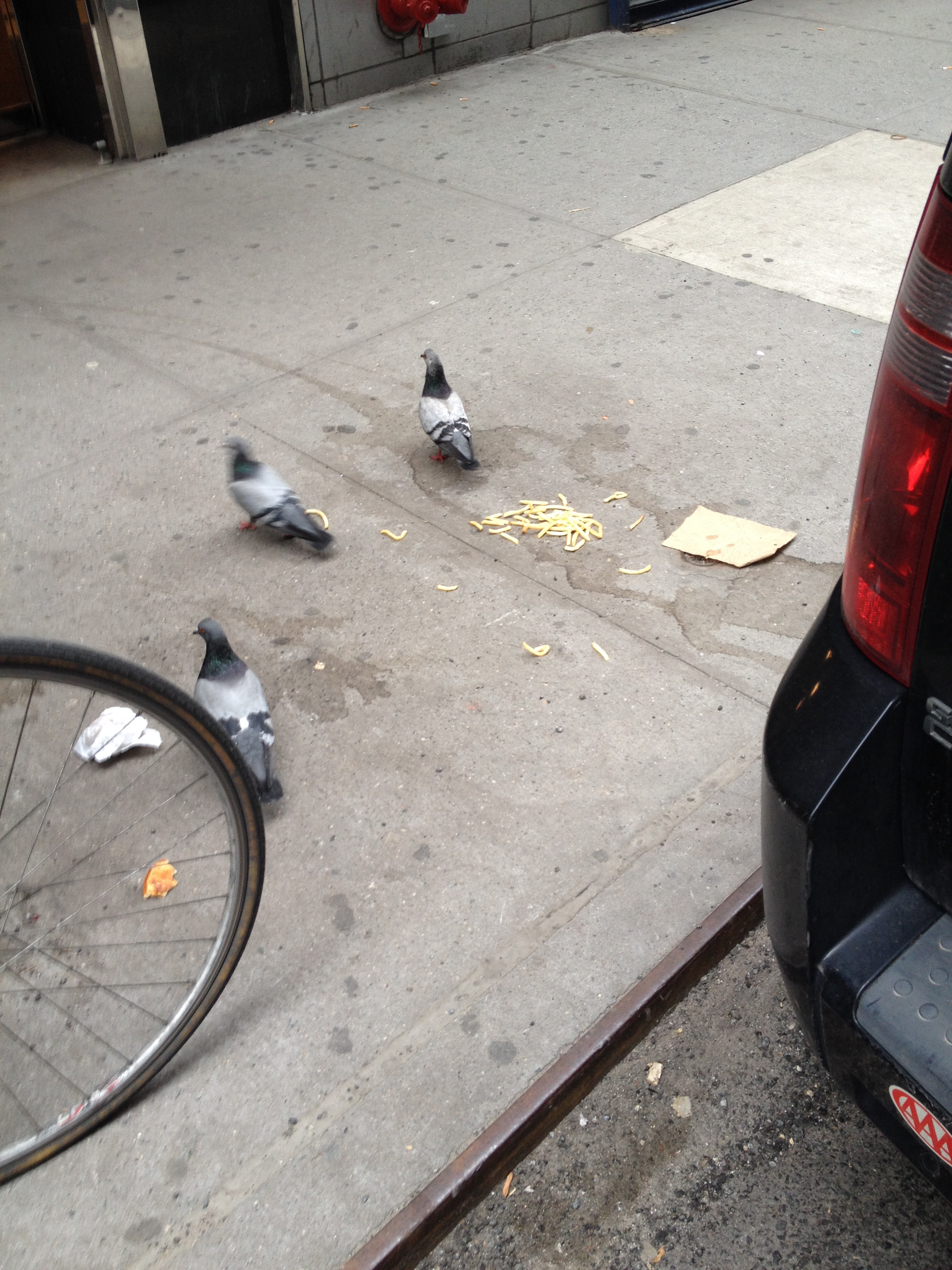
You don’t have to be in New York City long to begin to see yourself as an expert on pigeons. The ubiquitous avians are ruthlessly castigated as “flying rats” and “filthy birds,” primarily because they like people food and poop everywhere. I have it on the authority of Gomi and Stinchecum that everybody poops. From what I’ve seen walking through the city early on the morning after a holiday, not everyone is discriminate about where—and I’m not talking only about the pigeons. Still, I can’t help thinking that pigeons are unfairly maligned. They are pretty birds, when examined individually. They have iridescent throat feathers and a pleasing, portly gait—almost jaunty. They manage well, despite hardships. Often I see one hobbling about missing a foot or otherwise physically challenged, and yet ebullient in their pullastrine way.

IMG_1287

Yesterday as the NJ Transit behemoth in which I was riding rounded the helix into the Port Authority Bus Terminal, I saw two depressed pigeons. Unlike the jolly bobbing and pecking they usually seem to enjoy, this pair was simply standing. On the ground before them was a dead pigeon. Now I don’t know the backstory here, but the two standing around didn’t look like murderers to me. It seemed that they’d come upon a fallen comrade and were, in their own way, offering respects. In the ongoing debate separating ourselves from other animals, I often wonder if we have by-passed many of the basics. I do know that many animals find dead of their own species distressing. This is well documented. Why not pigeons?

Pigeons—related to doves, which, according to some religious traditions have sacred qualities, eh, Mary?—are seldom classed as the brightest of birds. I’ve written about the intelligence of corvids before, but pigeons have uniquely adapted themselves to our polluting ways. I grew up in a small town where pigeons weren’t especially abundant. They gather in large numbers where many people congregate and drop their litter. And, based on my recent experience, contemplate the mysteries of death. Peregrine falcons lurk overhead, doling out death at over 200 miles an hour. All the pigeons want to do, it seems to me, is to get a free lunch in an uncertain world where those whose presence has conjured them despise them. Unlike their sacred cousins, they are, like us, utterly pedestrian. Maybe they too appreciate the simple value of life.


A Run-By Fruiting

Photo credit: Eva Rinaldi, Wikimedia Common

Photo credit: Eva Rinaldi, Wikimedia Common

I’ve never been enticed by the cult of celebrity. Becoming famous is frequently a matter of being in the right place at the right time to get noticed. Interviews with stars inevitably come across as lacking in substance. Some of the funniest people I’ve known have worked in camera shops, administrative offices, and IT departments. Still, the suicide of Robin Williams a week ago has impacted a wide swath of the nation. We hate to see a funny man die. It is such a truism as to be trite that those who are clowns often host inner demons. Laughter, Reader’s Digest proclaims monthly, is the best medicine. Who better to heal than those who know what it’s like to have been wounded? Yet we want the funny to keep on making us laugh until we move on to the next diversion.

For this past week I’ve been pondering how one man’s tragic death has jolted a nation into a reflective moment of silence. I can’t say I was Robin Williams’ biggest fan, but I’d seen a number of his movies, and I was devoted to Mork and Mindy growing up (aliens have a way of getting prime-time exposure that has never really been explained). I thought he was good at what he did. He was famous and had money, but it wasn’t enough to buy off the demons. Suicides hit me hard since I’ve known a few and have struggled with depression myself. There are times, truth be told, when no direction is up. It is at those times, however, that others tend to ignore you, lest you bring them down. People like to laugh.

There is something profoundly religious about the idea of a wounded healer. Anthropologists as well as theologians have noticed it. They need have only looked as far as the Bible to find examples. Yet the Christian tradition treats suicide as a great sin against God and the plan is that we all live to die either at the hands of nature or of someone else, so the guilt doesn’t cling to us. Death always leads to a remorse that entails such guilt. And yet it is inevitable. As a nation we are used to seeing comedians overdose or live reckless lives that end tragically. Deliberate action, however, feels the most horrendous of all. We’ll ask “why?” for a while, and we’ll make tributes and tearful speeches. And meanwhile some of the funniest people we can claim will be sweeping our floors or asking “would you like fries with that?”


Shadowy Futures

A thoughtful, if prescient commentary by Andy Crouch in this week’s Time magazine takes us into the uncanny valley. Despite the boastful protestations of the materialists, most people are not very brave at facing death. With the passing of Ariel Sharon and the sad story of Jahi McMath, the question of keeping the practically dead practically alive takes on a particular poignancy. It’s not that the dying are the ones protesting, but it is the living. We rage against the dying of the light, and, as Crouch notes, it is often the most religious that protest the loudest. Religion, ironically, is the framework that many use to cope with the ultimate inevitability. Death is scary. That’s why so many pray and others watch so many horror movies. We have trouble finding uncannier valleys than that of Crouch’s shadow of death.

Religion, in addition to putatively renouncing the fear of death, has often introduced the denial of life’s goods along the way. What ascetic would not have truly welcomed death? A starving belly day after day and crushing loneliness in the most barren environments earth has to offer should change one’s perspective. Not all of us have such heroics, however, hardwired into us. We may see the illogic of a religion that states death is release into a better world while creating even greater terrors of the other side of that veil. We dance between the horns of a dilemma where neither side will really sustain our weight. As Crouch notes, what we truly want is the assurance that somebody loves us at the end.

425px-Mort_du_fossoyeur

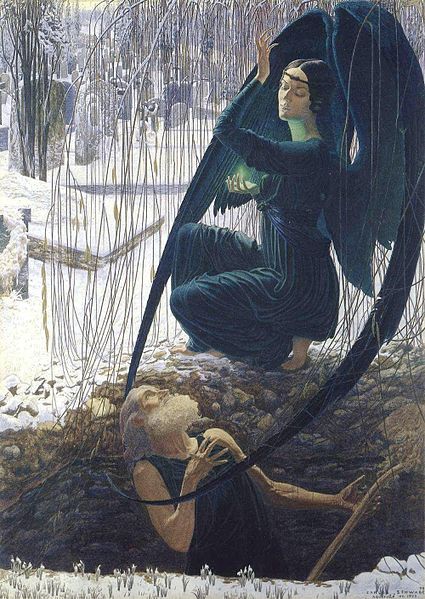
The materialist simply falls asleep for one last time. The faithful prepare to pass through a portal through which nobody has reliably come the other way. It is the ultimate test of faith. In the nineteenth century, when the death of a loved one at home was a common occurrence, an acceptance, perhaps morbid, pervaded the era. Who can think of Victorians without pondering the grave? Technology has cheated death both in small ways and in large. We are grateful for the salvation from small issues that once meant almost certain premature death, but we are scratching at the biggest door of all—immortality—begging to be let in. Will that head in a jar really be me? I have an uncanny feeling about that. Religion, for all its problems, should help us through this valley, if we really believe.


Revelations

BeringWhyIsThePenisSex. Religion. Death. One of these things is not like the others, if Sesame Street taught me anything. But in this case, the three actually are of a piece. In my teaching days I pointed out that every religion, without exception, tries to deal with sex and death—the two great, towering markers of human experience. Nevertheless, I cowered close to the window on the bus, choosing the left-hand side so the cover wouldn’t be visible, to read Jesse Bering’s Why Is the Penis Shaped Like That? From the first sentence you’ve got to like this guy. Although irreverent, Bering is never obnoxious as he asks questions about the basics of human existence that few would be willing to take on in the name of science. It’s a fascinating book, and, as I knew it would, it addressed religion and death as well as, well, you know.

Bering is an evolutionary psychologist, and he tends to lean toward a materialistic universe. His book raises a very important point, however; the belief in determinism statistically correlates with anti-social behavior. That is to say, those who believe they have no free will tend, to some extent, not to care about society. As Bering also points out, perspective is very important. I wonder if truth is subject to perspective. Actually, I’m rather certain that it is. I have fought determinism from my youngest days, although I generally feel out of control of my own life. I first encountered determinism in that insidious theological position known as predestination. The deity of a universe that predestines most people to Hell is a monster, no matter how saintly his/her portrait. One professor conceded after a vigorous debate in class: “on philosophical grounds free will wins, but on scriptural grounds, predestination does.” I disagreed. Still, he could go home happy—my challenge had, after all, been predestined.

Worse yet were the “double predestinarians.” They were those who believed that every little detail of life was predestined. I actually had a professor say, “if you fail an examine, it was predestined.” Already the illogic of it all struck the same timbre of distaste that materialistic determinism does. By its fruits you shall know it. As much as I enjoyed Bering’s book, I wondered how anyone obviously so intelligent could believe that this magnificent mental world we inhabit is nothing more than sparks tickling chemicals in our brains. Or even the biological wonders he explores. As I huddled up in a ball on the bus, my book close to my face, I knew that this behavior wasn’t natural at all. Not even science could have predicted it.


Honorable Theft

The_Book_ThiefYoung adult literature can be amazingly profound. My curiosity about Markus Zusak’s The Book Thief bubbled to the surface after the movie was released last weekend. I didn’t see it, along with thousands of others, because of its very limited theatrical release. I’m sure you know that distressing feeling when you type your zip code into Fandango and come up with zero results. Short of going all the way into New York City just to see a movie, I was pretty much out of luck. The silver lining is that it made me read the book. I’m not sure what I was expecting (I can also be the victim of hype), but what I found was deeply engrossing while also being deeply disturbing. Spoiler alert!

The Book Thief is set in Nazi Germany. It is narrated by Death. The protagonist, Liesel Meminger, represents the plight of all people; we have no control over when, where, or to whom we’re born. With parents considered enemies of the state, the Book Thief is raised by foster parents who are German, but who are also poor. They are good people, and much of the tension in the book revolves around their hiding a Jewish friend in their small house. The convention of Death as a narrator predates George Pendle’s Death: A Life, by three years. Although in the end Death is the only survivor, he is remarkably sympathetic to the human condition. Death also supplies the main religious observations in a book otherwise devoid of God. When Death attempts to pray during the horrors of war, a devastating conclusion is drawn: “God never says anything.” Is that why Veteran’s Day celebrations tend to be so silent? There may not be any atheists in foxholes, but there’s no God there either.

As Death stalks all those who are dear to her, Liesel finds her comfort in books. Although she begins the story illiterate, and although books are difficult to find in a poor family in a nation at war, Liesel discovers that words have a power that even dictators can’t steal. Her love of reading saves her life as her street is obliterated in an air raid. Even Death has to question the futility of war. In my most idealistic of moments, I hold the conviction that many of the world’s evils would be eliminated if people just read more. We would discover, for example, that even the devastation of war can be overcome by words. The only book Death is portrayed as reading is the Book Thief’s life story. And this gives Death pause, because even young adult literature can be amazingly profound.


Resurrinception

Inception_ver3Like most profound movies, Inception keeps me coming back repeatedly. I’ve already written a post on how the Theseus and minotaur myth lurk deep within the labyrinths of this film, but upon my most recent viewing a new angle caught my attention. In the first level down into Fischer’s dream, when Saito is unexpectedly shot, Eames asks Cobb, “What happens when we die?” It could be the question of a child faced with a dead pet for the first time. Of course, Eames refers to death in a dream under sedation, and limbo is the closest thing to spiritual death that a person can experience. The timing of that question, however, triggered in my head the number of resurrections that take place in the movie. I have frequently noted here that resurrection is a standard part of the tool kit for western movies, particularly American ones. We expect resurrection. So, finally, three layers down, a dream within a dream within a dream (even Poe would be proud), Saito dies. He is lost in limbo.

Limbo is a fuzzy theological construct thought up by the church for those who don’t deserve Heaven, or Hell, or even Purgatory. Some, it seems, end up in limbo. In Inception limbo is unconstructed sub-conscious, an area even Freud would fear to tread. Saito dies and goes to limbo. Fischer, meanwhile, also ends up in limbo because Mal shoots him dead in the third-level dream. Mal is already in limbo because she killed herself in real life—or was it a dream? Cobb, of course, must die to return to limbo to retrieve Saito so that he won’t be arrested when the plane lands. In limbo, three of the four escape, riding the kick back up to consciousness. Only after baptism in the first level dream, when the van plunges into the river, do the lost souls emerge. What happens after we die? Resurrection.

I’m not suggesting that Christopher Nolan planted a Christian idea in the viewers’ subconscious mind. Resurrection is part and parcel of our culture. Perhaps, however, this helps to explain the durability of some religious concepts. We long for resurrection on such a deep—maybe subconscious—level that we want to see it on the big screen. Even ghosts, we’re told, haunt because of unfinished business. It is Saito, the Japanese business mogul, however, who undergoes the most resurrections. He dies in the van underwater, in the fortified mountain hospital, and in limbo (perhaps in the elevator as well, but this is uncertain). His is a regular reincarnation of resurrections. Inception, I’m sure, will keep me coming back for more. One of the questions that none of us escapes while alive, is that uttered at the level of the dream.


It’s All Gonna

When I first got married, I was distressed to learn that my wife was an organ donor. Still fresh from seminary, I had yet to outgrown the theological willies concerning earthly remains. Then she told me that she would prefer cremation to burial. My existential angst spiked. Scripture indicates a bodily resurrection, so what about those who are cremated? Obviously I hadn’t thought through the implications seriously. Even for those who are biblical literalists, all kinds of things have happened to Judeo-Christian bodies over the millennia. People have been eaten by wild beasts, fallen off boats, and been cremated without the benefit of being dead first. If the movies I’d watched growing up were to be believed, some might have even fallen into huge vats of acid like they have sitting around laboratories all over the mad scientist world. This week’s Time magazine has demonstrated, however, that my early angst was not a singular one.

In a story about the rise in popularity of cremation Josh Sanburn (with an ironically appropriate surname) addresses the religious objections head on. The reason America has been slow to adopt cremation has been largely religious. Apparently the factor that has turned up the heat on this motivation is financial. Let’s face it: money talks. Cremation costs much less than standard burial, and as much as I like a moody, whimsical cemetery, it just makes better sense. If you can get over the religious objections.

Resurrection has a powerful draw. Movies just wouldn’t be the same without it, whether it is a horror villain whose body disappears to come back in a sequel, or ET rising from his tomb to tell us all to be good. We want to keep it going forever. Life, that is. Funnily enough, resurrection is a miracle. A God who can raise the dead can surely reconstitute the parts, no matter how scattered or charred. Anyone who’s actually looked at a decayed body knows that bringing that thing to life would take a miracle, especially if other newly resurrected bodies want to hang out in the same room with it. As my critical faculties began to grow, I lost my fear of cremation. Maybe even having your ashes mixed with those of your spouse would be a very fitting symbol. Chances are, you won’t have much to say about it in any case. When I went back to the DMV to renew my license, after my wife talked some sense into me, I came out with an orange organ donor sticker affixed to the back. Perhaps life will go on, after all.

DSCN3300