Belief Matters

What you believe matters. This is shown clearly in the case of exorcism. Brian P. Levack admits to personal reasons for interest in this dark subject. His The Devil Within: Possession and Exorcism in the Christian West is a masterful treatment of a topic that it considers from many angles. As a form of Christian practice it goes all the way back to the beginning—Jesus’ initial fame was as an exorcist of sorts. He didn’t require any ritual or authority to expel demons, but he became a public figure largely because of his ability to do so. Levack’s study focuses mainly on the Middle Ages and the Early Modern period. The latter was the high-water mark of possessions until the resurgent interest of the post-Exorcist twentieth century.

An aspect of exorcism that had raised my curiosity more than once was its Catholic disposition. Many Protestants believe in demons, but only the Roman Church has the grand ritual to drive them out. There are Protestant exorcisms, but they have a different goal—they’re intended to eliminate sin. This leads Levack to a strong contrast between Catholicism and that most extreme of Protestant traditions, Calvinism. Few Calvinists suffered from possession. Those who did were not held blameless, as in Catholicism (if you were being controlled by a demon you could hardly be held responsible for your actions). Calvinists believed only the sinful could be possessed and since their God is Republican you can hardly count on any mercy. In fact, if you were possessed, chances were you would become a witch. And everyone in early modernity knew what the cure for that would be.

We tend to think that the Enlightenment drove such beliefs extinct. In fact, the height of both witch hunts and demonic possession came after the scientific paradigm took hold. Levack makes the point that this is a kind of theater—performance undeniably plays a part in exorcisms. Both science and Calvinism, taken neat, can leave a body feeling cold and in need of some emotion. As the book notes, you could generally find a Catholic priest who’d be glad to drive out your demons. It seems that the great forces of good and evil play themselves out not only in the spiritual realm, but in the varieties of religious experiences in the all-too-political world of the church. The Devil Within is a fascinating book with a plausible thesis written by an author who understands that ideas have consequences that aren’t always easy to expel.


Exercising Exorcism

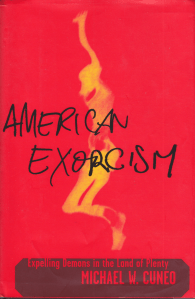
About the last people, ironically, that you’ll find researching demons are religion scholars. That’s perhaps a slight exaggeration, but there’s an embarrassment to the topic that serious academics just can’t shake. Nobody wants to be thought truly believing in that stuff. Michael W. Cuneo, who teaches sociology and anthropology at Fordham University, isn’t afraid to look. His American Exorcism: Expelling Demons in the Land of Plenty is a user-friendly, often witty look at what is an amazing phenomenon. Exorcism had pretty much gone extinct by the middle of the twentieth century. Then The Exorcist happened. Cuneo makes no bones about it—Hollywood wrote the script on what was to become a somewhat bustling business through the end of the millennium and beyond. And it wasn’t limited to Catholics. Protestants, mainly of Evangelical stripe, cottoned onto Deliverance ministry and joined the fray against the demonic.

American Exorcism reflects Cuneo’s personal account of attending exorcisms. As he puts it at the end, no fireworks occurred. In fact, he’s skeptical that demons exist and he strongly suspects exorcisms work in the same way that a placebo does. He’s well aware that the majority of people he met and talked with in the making of this book disagree on that point. Cuneo himself attended at least fifty exorcisms, both Catholic and Protestant, and shysters among the exorcists were rare. Most were sincere, devoted people who are helping others in distress for no fees, no glory, and no promotion. They see a need, believe they know the diabolical cause, and take the devil by the horns (metaphorically speaking).

There is a solid mistrust between academics with their studied skepticism and exorcists with their eyewitness accounts that defy belief. Cuneo suggests that even what they think they see may not really be happening in the real world. My question, coming down to the end of the fascinating book, revolves around what exactly this real world is. There can be no doubt that present day concepts of exorcism are largely based on “the movie.” Cuneo seems just a bit reluctant to say what I also declared in my forthcoming book—pop culture, the movies, dictate reality for many people. At least in the realm of religion. Sacred institutions have lost their authority to make ex cathedra pronouncements about what is real and what is not. Few bother to, or can, delve into the tedious work of reading academic studies on the subject. It’s far easier to let the unseen presences behind the camera take over. Isn’t that what possession is about, after all?


Exiting Amityville

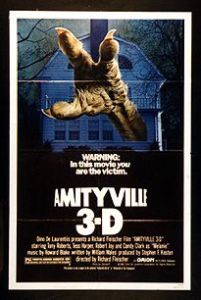
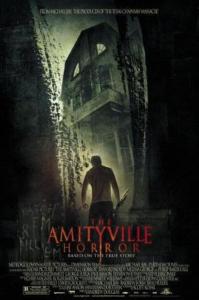
Okay, I confess. I watched Amityville 3-D. One of the standard features of horror, you see, is the sequel. As a rule the members of the franchise degenerate until they don’t earn enough money to keep Hollywood’s attention. In the case of The Amityville Horror, the story only made it three deep. I’m no film critic, but with missteps at almost every turn, Amityville 3-D almost made a farce of itself and horror fans take that as an insult. (Good horror comedy is an exception, of course.) The original story is well known: the Lutz family moved into the DeFeo murder house and moved out again just over a month and a half later. The tale has been considered both a hoax and a legitimate haunting, but subsequent families haven’t reported supernatural happenings on the property.

I had some hopes for this installment, as it was also known as Amityville III: The Demon. The second feature film was part of my viewing late last year, and it was okay. I never thought the original was that good, in any case. As I watched III I realized something was missing. Religion. Any sign of it. No priests were involved—this was the fear vector for the first two films of the series. Although John Baxter moves into the house knowing the history, he’s a skeptic and seems not even to believe as the house blows up in a silly finale before his very eyes. When the flies start buzzing around everywhere he thinks they’re just pests, not making the connection with the original account. The entire series is, of course, an extension of the Beelzebub—“Lord of the flies”—myth. That’s what gives it its demonic thrust.

When it finally comes time to wrap things up, and no priest has been called, and no religious imagery has been shown, there’s nothing here to scare but cheap startles. Eliot West, the leader of the cadre of paranormal investigators, attempts to free Baxter’s drowned daughter from the turquoise, boiling well that was dubbed “the gate to Hell,” a demon pops up and grabs him. There’s no explanation of who or what the demon is. Like everything else here it’s secular to a fault. And though it may startle, it can’t scare.

Not all horror uses religion, of course. Even some movies about demons avoid it and manage to be scary. If the premise, however, rests on religion gone awry—as in the first two films of the franchise—exorcising it completely is asking for trouble. Even if the telephone number for the realtor at the start of the film does begin with a secular 666.


Middle Age Demons

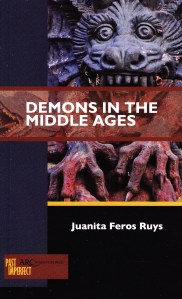
One of the consequences of watching horror movies is the interest in the origins of various monsters. Since many such films feature demons, their backgrounds and origin stories have always been a point of curiosity. Time is always an issue and Juanita Feros Ruys obliges that hurried sense by packing a lot of information into her short book Demons in the Middle Ages. Covering the basics in the introduction, she moves on to discuss demons in the desert—the bane of the early monastic, and demons in the monasteries of populous Europe. A chapter on the Scholastics describes how early science was applied to incorporeal beings, and a final chapter on learned magic, i.e., raising demons via magic books, finishes off this brief study.

What is particularly striking here is that the Bible says surprisingly little on the topic. It says, however, just enough to kickstart the Late Antique and Medieval interest in the subject. Vast amounts of speculation were raised in the Middle Ages concerning what exactly demons were and what they were made of and what they could or couldn’t do. Ruys points out the trajectory of the male necromancer giving way to the female witch just as early modernity was getting started. The results, we all know, were horrific. Throughout it is remarkably clear that belief in demons was strong. People took them very seriously—the Bible says they’re there, so there. Belief, as always, has consequences. Beginning with the Scholastics, however, a reasoned understanding of the spiritual world was deeply desired.

Reason and faith aren’t really the strangers they’re often portrayed to be. Medieval monks could be quite clever and scientific in their outlook. Human mental faculties, created, as they believed, by God, were necessarily good. Something I’d never considered, but which Ruys explores, is the belief that God cannot experience emotions. Being an “unmoved mover” meant not experiencing emotion (which, she points out, includes a noun of movement). This also meant that demons, according to some, had no feelings. This is a very cold spiritual world, particularly when it’s put into conflict with the human one. Spiritual, rational beings subjected to emotions, we’re the ones at the mercy of supernatural beings more powerful than us, yet incapable of the warmth we crave. About a millennium and a half of shifting beliefs in demons crowd this tiny book. Although not intended to be especially profound, it gives the reader plenty to ponder. Including why some of us watch horror movies at all when religion can do the trick all by itself.


Anneliese or Emily?

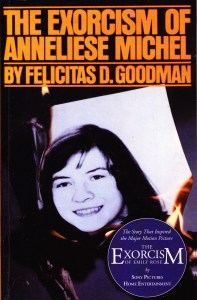
If it weren’t for the movie The Exorcism of Emily Rose, the name of Anneliese Michel would undoubtedly be less recognized than it is. Probably the first exorcism movie since The Exorcist to move the genre in a new direction, Emily Rose was based on the real life case of Anneliese Michel. There were significant differences between film and reality, however. Michel was from Bavaria, and she died at the age of 23 rather than being an American teenager like Emily. The story caught media attention because it was discovered that Michel had died after an extensive, months-long exorcism. Charges were made and the priests and Anneliese’s parents were found guilty of negligent homicide. The movie plays the whole thing out in the courtroom with flashbacks of the possession.

The book which led to the film was The Exorcism of Anneliese Michel, by Felicitas D. Goodman. Goodman, who died in 2005, was a rare academic who wasn’t afraid to address the supernatural. Trained as a linguist, she had years of anthropological fieldwork experience and a medical background. She was also not dismissive of religious experiences. Naturally, this makes her suspect among academics, but her treatment of Michel’s case is both sympathetic and masterful. After narrating events pieced together from court records, diaries, tapes of the exorcism, and information supplied by some of those involved, she offers her own hypothesis of what actually happened. Anneliese Michel was a religious girl caught up in a religious altered state of consciousness that was treated scientifically by drugs. The result was fatal.

Throughout history, and even today, shamanistic persons exist. Whereas in tribal cultures they tend to become prominent, in the “developed world” they are often quite hidden. They experience what Goodman calls religious states of altered consciousness, and are sometimes misdiagnosed as requiring chemical healing. There have been many thoroughly documented cases where such individuals do “impossible” things. The rationalistic world has no place for them, however, for like capitalism, materialism takes no prisoners. Religion is part of who we are. Human beings do have spiritual needs. Such needs can be placated by other means at times, and we can continue to believe that everything in this universe is made of atoms, or super-strings, or quarks. Or we can perhaps admit that theres’s much we do not know. Goodman admits that her solution is an educated guess, but it does put all the pieces together rather nicely. And she doesn’t declare unilaterally whether demons are physical or not. In the case of Anneliese Michel, however, they were undeniably real.


After Dark

So many spooky things happen at night. If you’ve read much on this blog you’ll know I blushingly confess to a horror movie addiction. So much so that I wrote a book about it. Friends occasionally feed this fear by sending me stories of strange, nocturnal happenings that are frequently posted on the internet. All kinds of odd creatures roam the night: dog-men, goat-men, lizard-men (and they mostly seem to be male, for whatever reason). It’s enough to keep you inside once the sun sets. Of course, if you read this blog you know that I’m an extreme morning person. Sleeping in, for me, means getting out of bed at 4 a.m. instead of 3:00. Yes, it’s often dark at that time of day, and horror movies teach us that demons are particularly active around 3 o’clock. But then the sun comes up, and everything’s okay. Until the next twilight.

Now that December’s here, I find myself out in the dark more than usually occurs for a guy who gets up so early. After the time change—for which there exists no logical reason—it’s dark by the time I climb off the bus from my day job in New York City. The other day I was compelled to drive after dark. It was only just after 6 p.m., but that’s getting late for me. I scan the road looking for deer. A thought occurred to me—what if I see something weird cross the road? What would I do? A few moments later I was startled to see a woman and child beside the street. I was prepared to stop since—and this is apparently an unknown fact—it is the law in New Jersey to stop for pedestrians in a crosswalk. The young boy then made a dash in front of my car. The woman grabbed him and yelled. They weren’t crossing as they struggled at the roadside, so I slowed down but drove on. “That was weird,” my wife said, “that boy was in his bare feet.”

It was 40 degrees (Fahrenheit) outside. This wasn’t one of New Jersey’s famed haunted roads, even. It was a comfortably affluent suburban street. The image stayed in my mind. There’s only so much you can do when driving in traffic. Yes, it was night, but this is New Jersey—there’s always traffic. Did anybody else see what we saw? What was happening here? Why was I so afraid? Fear is the most honest of our emotions. Without it no organism could long survive in this hostile world. After nightfall even governments are at their worst.


Creating Annabelle

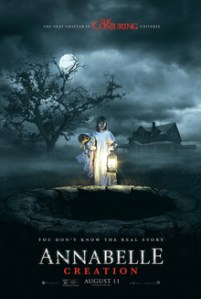
You might go crazy trying to piece it all together. The buzz for The Conjuring had a spinoff prequel, Annabelle, in the making even as the movie hit theaters. Love it or hate it, horror makes money. A more traditional sequel, The Conjuring 2, is leading to two further spinoffs, The Nun and The Crooked Man. And this summer a prequel to the prequel, Annabelle: Creation, came out. Only Annabelle isn’t really so much a prequel since it doesn’t have to do with Ed and Lorraine Warren. In any case, I finally had a chance to watch Annabelle: Creation and found it one of the more stunning examples of the genre in a long while. Intelligent, intricate, and slotted into the series in ways that required serious thought, it works as a stand-alone film or as part of a series. And, like much horror, it is deeply invested in religion.

First of all, the orphans moving into the Mullins’ large home are from a Catholic orphanage that has been closed. They are overseen by Sister Charlotte, so we expect religion to interdigitate with the horror here. Confession of sins, prayer, and crucifixes appear amid the unfolding lives of the girls in an isolated house inhabited by a demon. Some of the tricks we’ve seen before, but there’s enough new here to reinforce the thesis that religion and fear are close kin. Despite all this, and having a priest on call, no exorcism takes place. The doll, Father Massey declares, is just a doll. After the house has been blessed, there’s no need to fear. Of course we’ve already seen what comes next so we know the priest is wrong.

Some people watch horror to be scared. Others of us watch it looking for something a bit deeper. Not for everyone is religion a source of fear. We do, however, tend to cling to our beliefs because the world is such an uncertain place. We’re aware that we won’t last forever. Horror exploits that openly and without shame. Threats are constant and unrelenting, even if contrived. Religion is often a place to find consolation in the face of fear, so it becomes even more frightening when the place to which you’ve fled is the very place that’s out to get you. Annabelle: Creation is aware of this dynamic. The crucifixes, the Bibles, the prayers—none of this helps. What’s more, the girls manage to pull themselves together for safety when there are no men around. The real danger, after all, is inhuman.


Amityville Revisited

Remakes, standard wisdom holds, are seldom as good as the originals. When the original wasn’t great to begin with, the bar should be lower. Should be. I’ve been curious about the Lutz haunting in Amityville, having just read the book that started the phenomenon back in the late 1970s. I saw the movie first. That was several years ago now, but I do recall that even as horror movies go it had its failings. Some of that goes back to the book (presuming that anything happened)—nobody had a solid grip on whether this was a ghostly haunting or a demonic infestation. What the movie did do well is show how fragile family relationships can be, especially when under the pressures of supernatural supervision, not of the positive kind. Although, as is to be expected, the book was scarier.

Overcome by curiosity I finally watched the remake from 2005. Clearly I’m not the only one still curious about this alleged haunting, alleged hoax. I also have the alleged burden of looking for religion in horror. Only on this final count was it not disappointing. Well, that and in featuring burgeoning scream queen Chloë Grace Moretz. Although Father Callaway’s role is late in the film and brief, early on religious ideas are implicated. If the movie hadn’t tried so hard to be The Shining these themes might’ve been developed to good advantage. Instead it introduces Rev. Jeremiah Ketcham (also late in the film) as the first owner of the house in 1692 (did the real-estate agent’s mention of that date make you shiver?). Ketcham was a sadist to the Indians under his care, torturing them to death in the house. No time is left to explore the sinister minister’s motivation as the family implodes in its attempt to escape the house by boat.

As is frequently the case with the supernatural, we’ll likely never know what happened at the Amityville house. The story Jay Anson told is now generally classified as a novel. The preternatural can be judged neither in the courtroom nor the laboratory. The best that we can do is make celluloid adaptations to make some money on the deal. The DeFeo murders happened in living memory. The Lutzes left the house in a hurry shortly after purchasing it. Anson’s Indian “asylum” was never really there—and there were no such Native American practices in any case. What the remake left out was demons. Although the movie attempted other religious scares, the house just isn’t the same without them.


Spirits and Souls

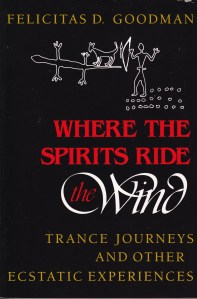
I first became aware of the work of Felicitas D. Goodman because of her classic text on spirit possession. Published by the reputable Indiana University Press, that book has become a standard for anthropological understanding of a strange phenomenon, which includes demonic possession. I found Where the Spirits Ride the Wind: Trance Journeys and Other Ecstatic Experiences in a used bookstore. Recognizing Goodman’s name, and always eager to learn about spirituality, I picked it up, It’s one of those books that makes you wonder. In an effort to experience trance states, Goodman began to experiment with various posture represented in the archaeological record. When she taught classes where students had no foreknowledge on the postures, she found they they reported similar visions during their trances while using the same posture. Matter, it seems, can effect mind.

I couldn’t help but wonder, as I read her account, what Indiana University Press must have thought about what they were publishing. This could be some serious woo, depending on how far you’re willing to go with Goodman. She was a doctorate-holding professor, so academic convention suggests she should be taken seriously. The BISAC classifications (those categories that often appear on the back cover of a book) tell the reader that this is Anthropology and Psychology of Religion. Neither field tends to give a whole lot of credence to the supernatural. At least not necessarily. And yet, there it is. Neither field really captures what Goodman describes in this book. Nobody really doubts that trances can happen; alternate states of consciousness are acknowledged phenomena. What we don’t have, however, is an explanation of what’s really going on.

A good deal of the this book consists of her students’ accounts of their visions. Although a native of Hungary, Goodman, through fieldwork and experience, became quite adept at Native American and other indigenous religious practices. The images that suggested the postures to her come from archaeological contexts around the world. This suggests that, according to Goodman’s worldview, these are some universal experiences. Attaining trance states, like meditation, takes practice. They can shift perceptions of reality. We tend not to hear too much about religion faculty who explore such things too openly. It’s a dangerous move in academia. Ironically, the institutions we build to understand our world tend to restrict themselves to the physical world or those fields that make ample lucre. I’m impressed that, even if by labeling it anthropology or psychology of religion, at least one university press took a chance at offering an exploration that might have some real world consequences.


Amityville

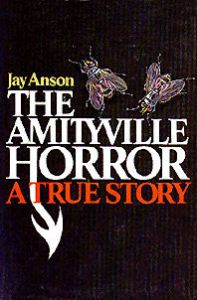
Surely one of the most controversial haunting stories of my own lifetime was that which came to be known as The Amityville Horror. After the tragic deaths of the DeFeo family in 1974, the next occupants of the fatal house, the Lutz family, claimed to have experienced 28 days of terror before moving out in the middle of winter and taking no belongings with them. Their story, written by Jay Anson, became a sensational bestseller. Published just four years after the unexpected cinematic success of The Exorcist, a movie was quickly signed and it was all the talk of my high school before I was quite at the stage of watching real horror films. By the time I got around to seeing the DVD, the tropes were so well known that it wasn’t really that scary. I realized that I had never read the book.

Whether you find Anson’s account scary or not probably depends on your level of belief in demons. Although he concludes his book with the suggestion that a combination of ghosts and a demon plagued the Lutzes and their priest, the focus of the narrative is clearly on the demonic. Fr. Mancuso suffers because the demon wants to keep him out of the house. The multiplication of flies, the constant waking up just after 3:00 a.m., and the smell of excrement all point to demonic activity. The book does have its share of historical inaccuracies and embellishments. It has been declared a complete hoax by some while others claim that at least some of what was described in the book happened to the blended family that called it home for less than a month. If you don’t accept demons, there’s little here to frighten you beyond a couple of benign ghosts.

As with any story claiming supernatural activity, we’ll never really know what happened. The Amityville Horror is often classified as a novel now. Our minds are conditioned to reject anything so terribly out of the ordinary that it is difficult to accept what you’re reading. The DeFeo family was undoubtedly murdered in the house by one of their own. The Lutz family did buy and then abandon the house in fairly short order for such an expensive purchase. There was a priest involved. The question marks hover about the supernatural elements, as they generally do. These are the ghosts and demons of the rational world which we inhabit. We safely confine them to fiction. Then we sleep at night with the lights left on.


Haunting Toyland

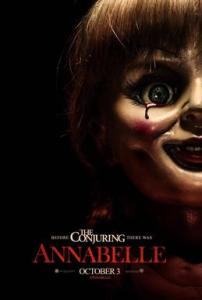
Although it hasn’t always been this way, one of the most characteristic aspects of the modern horror film is the sequel. Some franchises spin into countless sequels and remakes, until their iconic anti-heroes become household names. The Conjuring diegesis participates in this somewhat, but instead of having a repeat fiend, it’s a theme that comes up time and again, tied together by the work of Ed and Lorraine Warren. I’ve written about The Conjuring before, as well as The Conjuring 2. Prior to the sequel there was a prequel of sorts—more properly a spinoff—Annabelle. Not attaining the critical regard as its originator, Annabelle nonetheless did quite well at the box office, as horror movies often do. The idea behind the movie was to give some backstory to the doll that appeared in The Conjuring.

According to the Warrens, there really is such a haunted doll. Technically it’s not haunted. They call it a conduit through which a demon seeks to entrap a human soul. This past summer a prequel to the prequel, Annabelle: Creation, received higher critical marks than its initial installment. All of this is to say that I had to see the original Annabelle in order to try to make sense of this whole series. Despite its failings, the movie once again shows the interlaced nature of horror and religion. It opens in a church and the priest, Fr. Perez, makes several appearances in the story as the Form couple struggles with the demon inside the doll. Pregnant and vulnerable, Mia Form is traumatized when two cult members invade and then die in her home. Annabelle Higgins, one the intruders, dies holding the doll, bleeding into it. She and her accomplice are satanists, trying to raise a demon for nefarious purposes. (I suppose those are the only kinds of purposes to raise a demon, actually.)

The plot takes various twists and turns, never veering far from the main conceit that the demon wants Mia’s soul. I won’t give any spoilers in case any readers are even further behind in their movie viewing than me. Suffice it to say, this is one of the most thoroughly religious horror films I’ve seen. The Conjuring 2 will pick up the story again with the Warrens and a demon disguised as a nun (and a sequel to both The Conjuring universe and the nun are in the works). Critics are certain religion is dying. If popular culture is any measure, that conclusion is far from certain. Sometimes it’s a bit preachy, but it’s there in horror. Even a possessed doll knows that.


Getting Exorcize

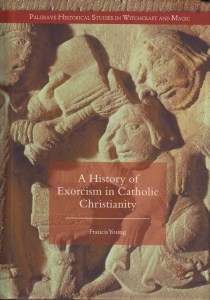
Supply and demand may seem to be an odd framework to apply to religion, but it obviously exists within the polity of churches, synagogues, and mosques. What the people want does influence what’s on offer. Watching movies about demonic possession isn’t something that comes naturally to me. Demons are scary, and it doesn’t help that, historically speaking, they’ve never really been properly defined. Francis Young has provided a service to the curious with his book A History of Exorcism in Catholic Christianity. The book is just what it says, an examination of how Catholics have formally dealt with demons, or more properly, demoniacs, over the centuries. Young notes the protean nature of demons at the beginning—they meet cultural expectations of their time rather than obeying theological niceties. What to do about them?

Long relegated to the realm of epilepsy and mental illness, possession has gone through several periods of ascendency and decline. Indeed, in the nineteenth century it looked as though exorcism, in Catholicism, might have been on the endangered species list. Science was calling the reality of the spiritual world into question and nobody likes to be thought naive. With few exceptions, the move toward eliminating the role of the exorcist was gaining steam. Then in the twentieth century the demand for exorcism revived. As Young notes, a large part of the increasing interest arose from the novel and subsequent movie, The Exorcist. Possession was something so little talked about for so many years that it proved a rich ground for a new kind of monster that was eminently believable. The church, after all, never said there weren’t demons. Since that time, interest has been waxing once again.

Part of the reason would seem to be that humans are meaning-seeking creatures. When our main sources of authority in that realm are eroded, we start looking elsewhere to find succor. Ironically, outside Catholicism the mainstay of exorcism has been among various evangelical Protestant groups. They may not have an ancient ritual to use, but what they lack in experience they make up for in enthusiasm. Their demons are culled from a literal reading of the Bible. And interest among Catholics, in this strange supply and demand rubric, has meant that more exorcists are being trained and made available. The world that Young leads his readers through is one in which strange things reside. He makes no judgment about demons or their reality. He does, however, provide a very thorough history of what the Catholic Church has done about them, when the demand exceeds supply.


Night of the Museum

I admit to being a relative stranger to contemporary commercial television. We don’t have “triple play” at home, and since the internet provides more information and entertainment than one person can possibly handle in a lifetime, why pay extra? On a visit home, however, where internet does not yet exist, I fell to the default of watching TV. Scrolling through the cable channels available in this small town, I start to understand why we don’t pay extra for this at home. Much on offer appeals to the lowest common denominator, and although some educational programs exist, they have to put somebody in danger in some remote location in order to draw the viewers in. Then I stumbled on Mysteries at the Museum.

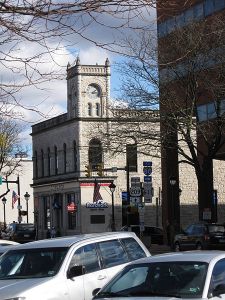
For those of us hopelessly enamored of the past, museums are an irresistible draw. I joined the program already in progress. It was talking about Stroudsburg, Pennsylvania, through which we’d driven to get here. A resort town in the Poconos, I always think of Stroudsburg as a traffic bottleneck, particularly on a holiday weekend. Instead the story was telling of a haunted jail in which a prisoner had to be exorcised after it was found that he could make it rain inside his cell. Then the name of the Warrens was mentioned. The Bible used in the exorcism is from their occult museum (thus the tie to the title of the program). Ed and Lorraine Warren, as my regular readers know, get mentioned here every once in a while. Real life ghost hunters, they kept a museum of the occult in their Connecticut home. I’d missed the part of the program where they revealed the provenance of the artifact. Now things started to make sense. After the commercial break, however, the story shifted to a historic pair of hiking boots.

Image credit: Creative Commons Share Alike 2.0 Generic license. Photo by Doug Kerr, Wikimedia Commons.

What was so striking about this brief segment of the show was not the implied credulousness of the investigation, but rather the certainty with which those interviewed declared this was a water demon case. Okay, so I’d just finished a seven-hour drive and I may not have been at my sharpest, but where did such certainty come from? Who were these experts telling us what had happened? I’ve read enough of the Warrens’ accounts to get a sense of how they worked, but not even the name of the priest was presented, let alone that of the demon. What we had, then, in this 15-minute segment, was a Bible and an anecdote of rain falling in a Stroudsburg jail. As I switched off the program to go to bed, I knew that I’d find the missing information on the internet. Even without triple play.


The Price of Worship

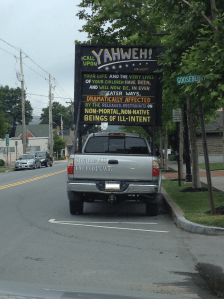
The wind resistance alone must drive the cost of gas up considerably. Of course, with Yahweh on your side you don’t need to worry about pocket change. We were driving through a sleepy town in the Poconos. A light rain was falling. We came upon a truck advocating not for the usual and expected Christ, but instead for Yahweh. Promising “dramatically affected” lives for those who do so, the implied message on this portable billboard is somewhat ominous. We are apparently being restrained by “non-mortal, non-native beings of ill-intent.” The grammar of the placard confuses things a bit since it seems to suggest that calling on Yahweh will “release restraints on” said non-mortals, and that’s hardly a good thing. I suppose they can’t reveal the nature of these entities without giving away spoilers for drawing the curious in.

This vague, supernatural world presided over by the personal name of the deity seems just a little out of place in Bible country. There’s a kind of literalism about Pennsylvania that I find strangely comforting. It is where and how I grew up. I never encountered God’s personal name—at least not with first-person familiarity—until I attended college. Even then we were encouraged to be careful with its use. The commandment about taking the divine name in vain is just a bit disconcertingly unspecific, considering that it isn’t spelled out in more detail. And who exactly are these beings of ill-intent? They’re all the more frightening for not being named. Demons, I must suppose, but I don’t recall the Good Book saying anything about their restraints being released. This is a new kind of apocalypse maybe.

The thing about the Bible is that it’s everybody’s book. Some modern translations use Yahweh rather freely, opting for the admission that translating it leads only to more questions and “Lord” is obfuscation. Still, it seems awfully familiar. The need to air one’s personal beliefs, in some quarters, is very intense. There’s a passion behind this proclamation that I can’t help but admire. People stop and stare. Some, like yours truly, will want photographs of your vehicle. I suppose that’s the point, nevertheless, not too many people like being stared at. Evangelical culture demands it, as I recall from my youth. Putting your personal beliefs out there comes with a price. Part of that may be reduced gas milage and, consequently, pocket change.


Night and Day

Jim was aghast. The joke had been entirely inappropriate. I had asked him about the Pentecostal service we’d just left. Jim was my college roommate and had invited me to see what his tradition was all about. I’d witnessed speaking in tongues before, but never on such a scale. That wasn’t what was bothering Jim, though. The minister had told a joke about a demon. It had something to do with a man possessed by a coffee demon. The exorcist declared to the demon “You have no grounds to be in him!” Inappropriate. It might make people think there weren’t real demons. We used to disagree on many points, but remained friends. I lost track of Jim. He dropped out of college to go follow a spirit-filled man in Waco who’d learned Hebrew and Greek without ever having studied them. His concern about that joke, however, raises an interesting question.

I’ve just finished reading Ralph Sarchie and Lisa Collier Cool’s book, Deliver Us from Evil: A New York Cop Investigates the Supernatural. It’s hard not to like Sarchie. A rough and tumble associate of Ed and Lorraine Warren, he is most sincere law enforcement officer (now, at my age, retired). Openly believing in the supernatural, claiming his traditionalist Catholic faith, he hates demons for the misery they cause both humans and God. I admire such unquestioning faith. At the same time he’s clearly aware of his own foibles and weaknesses—something we might like to see more often in the police force. He doesn’t doubt, however, that demons are real. The concern, however, is that he might sometimes be a bit harsh on non-Christian religions. He admits that he’s not the most studious of demonologists.

No doubt, belief is important. Belief with knowledge is even better, it stands to reason. Problem is, academic or scientific studies on demons are sorely lacking. Sarchie was an associate of the controversial Malachi Martin (whose book Hostage to the Devil I blogged about some time ago). I feel for someone who wants to know more but runs into the limits imposed by academia. Where do you find information if the recognized specialists in a discipline don’t write about it so regular people can read it? It is a real dilemma. A scientific approach would declare the events in Deliver Us from Evil (also published as Beware the Night, before being released as a movie) are anecdotal. This is technically correct. No laboratory procedure exists to confirm something science denies exists in the first place. The only weapon against such a foe is faith. Thinking back to college, I don’t know what happened to Jim, but on this point I’m sure he would have agreed.