Why, Cathy?

Learning to appreciate bad movies is a skill like any other.  It takes practice.  “Why?” I hear you ask?  Why climb a mountain?  Actually, there is a motive for seeing bad movies, apart from the good feeling they can leave you with.  (I might’ve actually done it better!)  That’s because they’re often free streaming.  If I had an endless budget I might well be able to avoid bad movies, but what’s the fun in that?  I found out about Cathy’s Curse because I was looking for a movie about a cursed doll.  (Don’t ask.)  I’ve seen many, of course.  Child’s Play and the whole Annabelle series.  But I felt I was missing something.  Wikipedia actually has a page on haunted doll movies, and Cathy’s Curse stood out to me.  Yes, I was forewarned, but I was also curious.

A Canadian horror film from 1977, Cathy’s Curse has become a cult classic.  The story line decidedly makes no sense.  Cathy, a young girl, moves into her grandparents’ house with her father and mother.  Her father’s father had died in a car crash with his daughter Laura, about Cathy’s age, some 30 years earlier.  Cathy’s parents are troubled, her mother having recently had a nervous breakdown.  Laura’s vengeful spirit possesses Cathy through a doll the latter finds in the attic.  For some reason, Cathy kills the housekeepers and attacks other children.  She tries to drown herself.  She kills the handyman’s dog.  The dog, which is clearly male, is explicitly said to be female in the movie, perhaps because one of the favorite words of the writer is “bitch.”  After about an hour and a half of running around screaming, the opening of the cursed doll’s eyes suddenly brings normalcy to the house.

There are some genuinely good things about the movie.  The late fall-early winter mood is nicely framed.  Why people hang out outdoors without coats in freezing weather is never really explained, though.  Neither the writing nor the acting are stellar.  And have I pointed out that the story makes no sense?  But still, there’s something there.  The idea of possession, a young girl under threat, the scary old mansion—these are classic tropes.  It’s unclear why, when Cathy’s father is fixing breakfast, he immediately sends her to bed and it’s suddenly night.  Or why the detective calls him by the wrong name.  Or why nobody can take a doll away from a little girl.  Ah, but that’s it, you see.  The haunted doll.  You have to learn how to appreciate these things, you know.
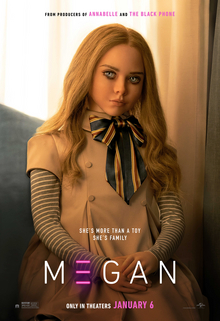

Creepy AI Doll

We’ve all seen the killing doll horror movie before, of course.  Who hasn’t?  What makes M3GAN different is the whole artificial intelligence angle.  Okay, so you understand it’s about a killing doll, but unlike Chucky or Annabelle, M3GAN has a titanium frame and a super-advanced, wifi-connected brain.  Like generative AI, she’s able to learn on her own and even able to use her own reasoning to get around her basic programming.  Now, you’re likely smarter than me and I didn’t catch what the critics call the “campiness” to the film.  Yes, there are places that made me snicker a little, but although the killing doll premise made the results somewhat predictable, I watched it seriously.  Some websites list it as horror comedy, while others prefer sci-fi thriller.  Nevertheless, it isn’t really that funny.  And there’s a cautionary element to it.

Funki, a Seattle-based toy company, is always trying to stay ahead of the competition.  Animatronic toys are the rage, and Gemma (brilliant choice to have a female mad scientist here) is a visionary programmer.  She wasn’t expecting, however, to become her niece’s guardian after Gemma’s sister was killed in an accident.  The M3GAN prototype was already underway, but Gemma kicks it into high gear to help make up for her own lack of parenting skills.  M3GAN becomes her niece’s companion—soulmate, even—and since the two are bonded with biometrics, her protector.  Bullies, lend me your ear; you don’t want to mess with a girl who has an android as a bestie.  And nosey neighbors, fix that hole in your fence.  Or at least curb your dog.

Instead of I, Robot this is more like You, Robot.  There is a wisdom to the othering that goes on here because none of us know in what kind of reasoning generative IA might engage.  In real life computers have been discovered communicating with one another in a language that their programmers couldn’t read.  We’re all biological, however, and thinking, as we know it, involves many biological factors.  Logic is part of it, but it’s not the whole story.  So techies who idolize Spock and his lack of emotion feel that they can emulate thinking by making it a set of algorithms.  My algorithms lead me to watch horror films out of a combination of curiosity and a need for therapy.  Where does a computer go for therapy?  The internet?  Well, you might find some good advice there, but don’t be surprised if it comes at you with a paper-cutter sword in the end.  You’ve been warned.


Conscientious Ghosts

It’s finally Halloween. In keeping with the spirit of the season, NPR recently ran a story on ghosts. I’ve posted on the topic of ghosts several times since they are inherently a religious phenomenon, whether they actually exist or not. Empirical method only takes us as far as that terminal border, but not beyond. Since we all face death, the question of ghosts is intriguing to many people. In some parts of the world, according to the NPR story, up to about 90 percent of the population believes in ghosts. They have been part of the religious thought of humanity since writing began. Ghosts have haunted us from earliest memory.

What makes the NPR story so interesting is that there is a kind of moral consciousness that runs through the story. An interview with Tok Thompson, an anthropologist at the University of Southern California, makes up part of the story. Thompson notes that ghost stories often concern unresolved justice issues. He cites the overused “Indian burial ground” motif as an example—where there is a collective guilt, ghosts tend to gather. Slavery is another such social injustice, and again, ghosts and slaves are no strangers. Christianity tended to push justice off into the afterlife. The fact is many people do not receive fair treatment in their lives. Some of them are very good folk who just never get a fair chance. That troubled early Christian thinkers into making Heaven into a place where the reward came. It also, unsuccessfully, tried to suppress the idea of ghosts. Ghosts problematize such easy theology. What are they still doing here when Heaven, Hell, or Purgatory should suffice?

Hammersmith_Ghost

The NPR story even addresses the idea of possessed dolls. Tok Thompson notes that the word “doll” derives from the word “idol.” This sheds a whole new light on Barbie, I suppose. An idol is an image representing a deity. In the Judeo-Christian tradition religious statuary was problematic at first. Again, Christianity bucked the trend by allowing images because people naturally want to see what it is they believe. Stories of haunted dolls and statues and other inanimate devices are difficult to accept. They are, however, deeply religious. That’s because ghosts represent what we really believe. Death is the most parsimonious of thresholds. We can’t look over at the other side, but, if ghosts exist, they may give us a glimpse beyond human sight. And that seems like an awful decent thing to do.